

Your product works well in isolation. Clinics use it, patients rely on it, and your team has spent years refining the core application. Then a hospital asks for FHIR connectivity, a payer requests structured claims data, and a provincial programme requires a specific conformance profile. Suddenly, the patient record that exists in your platform can't move cleanly into the systems where care, payment, or reporting happens.
That situation is common across healthcare. Canada has widespread digital records, yet only 13% of Canadians reported online access to all core components of their health records in 2025, while 69% could access at least one type of electronic health information. Canada's national digital health measurement describes the gap clearly: data can be digital without being connected.
HealthTech interoperability doesn't require replacing your entire technology stack. With a FHIR facade, an integration engine, terminology services, and provincial conformance modules, you can add controlled exchange around the product you already operate. This guide explains how to approach healthcare interoperability as a layered product capability, not a rip-and-replace project. For broader software and digital delivery context, visit Cleffex and explore this practical perspective on connected healthcare systems.
Introduction: Why Interoperability Matters Now
A referral arrives at a clinic. The receiving team can see that a patient was referred, but the medication history is missing. Laboratory results sit in a hospital system, imaging reports are stored elsewhere, and the clinic's application uses local codes that don't match the payer's vocabulary. Staff members start copying information manually, asking patients to repeat their history, or waiting for a document that may arrive after the appointment.
The data isn't necessarily absent. It's trapped behind incompatible interfaces, inconsistent meanings, and organisational rules.
That affects more than clinical convenience. Healthcare buyers increasingly assess whether a product can fit existing workflows and exchange information with the systems already used by providers, insurers, laboratories, pharmacies, and public bodies. A product that requires every customer to change its systems before integration becomes possible creates friction during procurement and onboarding.
Canada's provider-side data illustrates the problem. Although 92% of Canadian healthcare providers had access to a digital health system in 2025, 50% of those users identified insufficient integration between digital systems as the most common barrier to electronic sharing. Statistics Canada's survey release also reports that 46% said their systems couldn't send or share clinical information electronically with providers outside their practice setting.
The product question: Can your platform exchange the right information, in the right meaning, at the right time, without forcing customers to abandon the workflows that already function?
That question changes the architecture discussion. Rather than rebuilding your database, user interface, and business logic around every external requirement, you can place an interoperability layer around the core. The layer translates, validates, routes, secures, and monitors data while your primary application continues to manage its own domain.
The result is interoperable HealthTech that can grow incrementally. You can begin with one high-value use case, such as clinic-to-hospital referrals or remote monitoring data sharing, then extend the same approach to additional partners and jurisdictions.
What Healthtech Interoperability Really Means
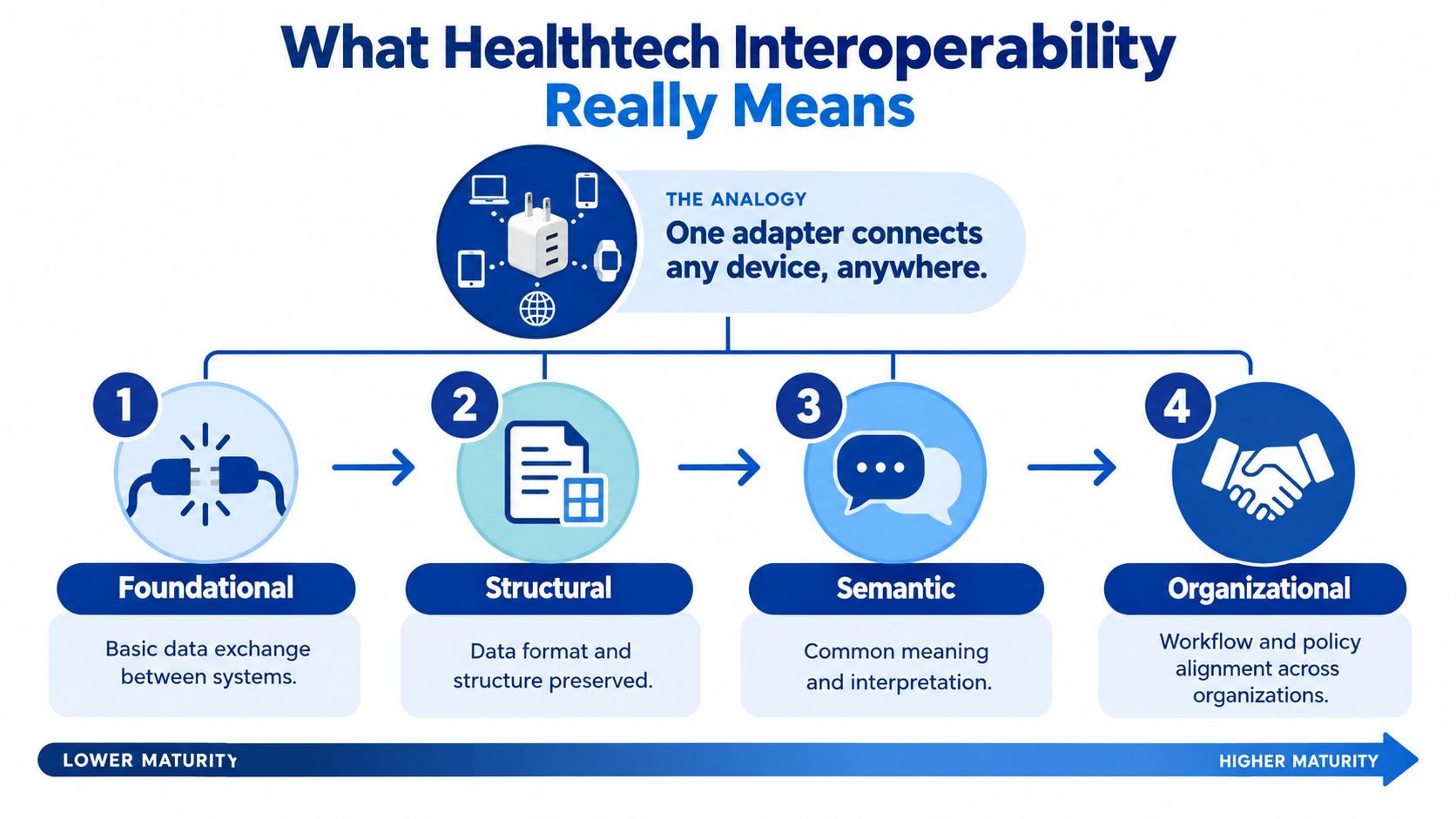
A universal power adapter is a useful analogy. Your device can keep its internal design, but the adapter gives it a safe way to connect to different sockets. Healthcare interoperability works similarly. An external system needs a reliable interface, a recognised structure, and a shared understanding of what each data element means.
HealthTech interoperability means that separate systems can exchange health information and use it correctly within their own workflows.
A connection alone isn't enough. A file may transfer successfully while still producing an unsafe or unusable result. Product leaders should distinguish four levels.
Foundational exchange
At the first level, systems can send and receive data. An API request reaches its destination, a message is delivered, or a document becomes available. This solves physical connectivity, but it doesn't guarantee that the receiving application can interpret the content.
Structural consistency
The next level preserves the organisation of the data. A clinical document has predictable sections, a FHIR resource follows its required structure, and fields retain their expected types. Structure allows software to process information without treating every incoming payload as a one-off document.
Semantic agreement
Semantic interoperability gives data a shared meaning. A medication, allergy, diagnosis, or laboratory result must represent the same clinical concept across systems. Terminology services and value-set mapping matter here. A local code for a test can't safely substitute for a recognised code unless the mapping has been reviewed and maintained.
Organisational alignment
The highest level connects technical exchange with policies and workflows. Organisations need agreement on consent, access, responsibility, data retention, exception handling, and the actions triggered by incoming information. A hospital may receive a referral technically, but interoperability is incomplete if no team owns triage or if the receiving workflow can't acknowledge it.
Simple integration often stops at the first or second level. Healthcare data exchange becomes dependable only when structure, meaning, and organisational behaviour align. That distinction helps non-technical stakeholders understand why a single connector rarely solves the whole problem.
Core Standards and Architectures Behind Healthcare Data Exchange
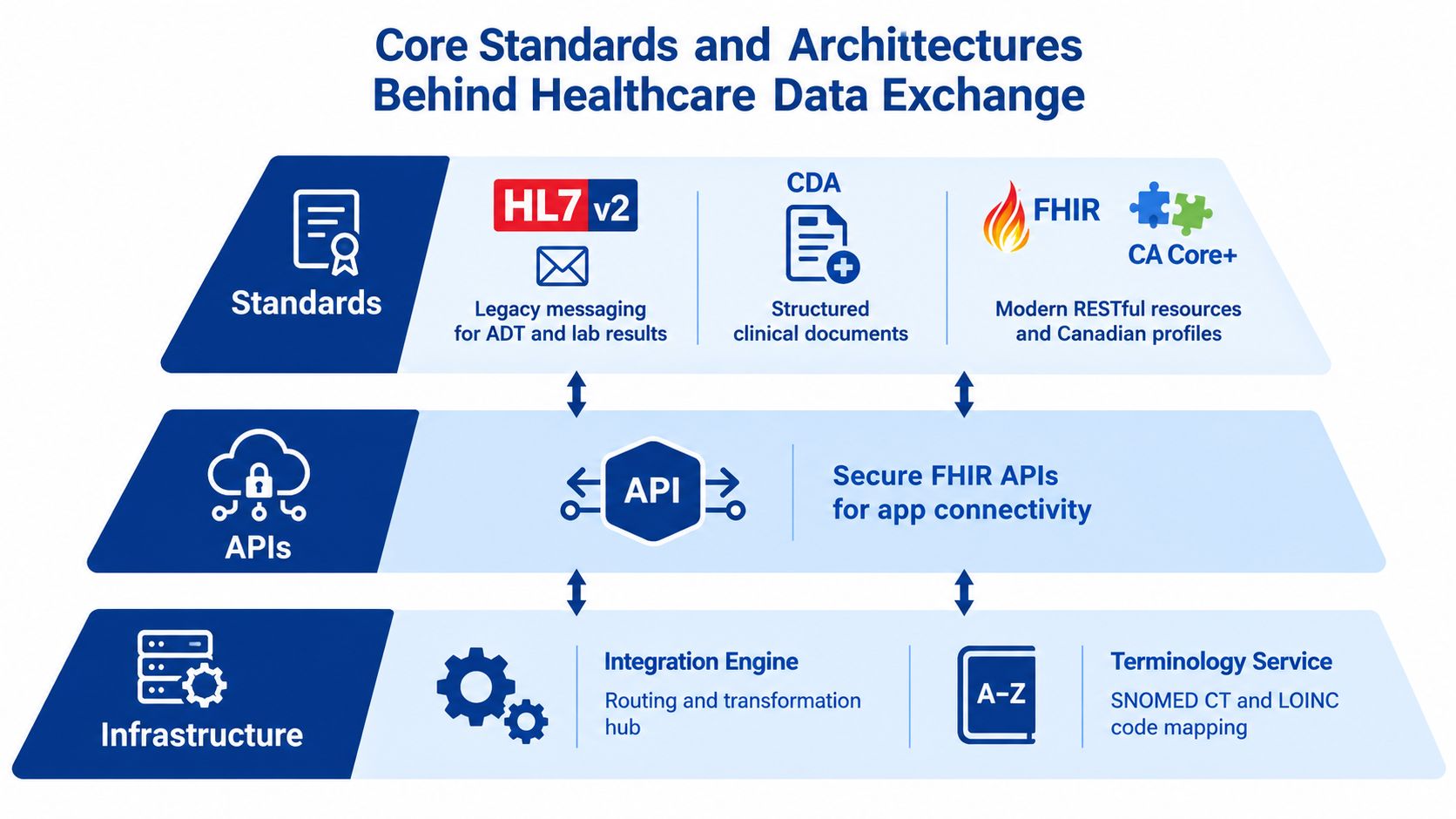
Interoperability standards solve different problems, so treating them as interchangeable creates unnecessary confusion. A mature architecture usually combines established messaging, structured documents, modern APIs, integration middleware, and terminology services.
Use each standard for its proper job
HL7 v2 remains useful for event-based messages such as admissions, discharges, transfers, and laboratory results. It often appears in hospital environments and legacy integrations. A healthtech company doesn't need to redesign its product around HL7 v2. An integration engine can receive the message, validate it, transform it, and pass a suitable representation to the product.
CDA supports structured clinical documents. It can preserve the context of a report or summary while giving receiving systems a predictable document model. CDA is particularly useful when the exchange needs to retain a human-readable clinical record alongside structured sections.
FHIR provides modular resources and RESTful APIs. A product can expose or consume resources such as Patient, Observation, Medication, and DiagnosticReport without treating an entire record as one indivisible file. FHIR supports a facade pattern, where an external API presents standard resources while the existing application continues using its internal models.
CA Core+ adds Canadian FHIR profiles and implementation guidance. It helps teams align their FHIR interfaces with Canadian expectations rather than relying on generic resource definitions alone.
Build a layered exchange architecture
The application remains responsible for its core business rules. Around it, the interoperability layer can include:
FHIR API facade: Presents standard resources and endpoints without forcing a database rewrite.
Integration engine: Routes messages, transforms formats, handles retries, and connects legacy interfaces.
Terminology service: Maps local concepts to standards such as SNOMED CT and LOINC where appropriate.
Validation service: Checks profiles, required fields, identifiers, and value sets before data leaves or enters the platform.
Audit and identity controls: Records access and supports authenticated, authorised exchange.
Canada's semantic model also needs more than transport. CIHI's description of CACDI and the Pan-Canadian Health Data Content Framework explains that Canadian Core Data for Interoperability, or CACDI, is a standardised set of data elements and value sets designed for exchange between systems and jurisdictions. CACDI works alongside CA Core+ FHIR profiles, so semantic interoperability depends on both common content and aligned transport specifications.
CIHI describes a common data architecture as a way to improve consistency across care settings, using established coding systems and pan-Canadian governance to reduce ambiguity. For teams working across borders, MedQAIR EHDS insights offer useful additional context on how broader health data exchange policy can influence product planning.
A practical guide to integrating FHIR with EHR systems can help engineering teams turn these layers into an implementation design. The key is to keep the core product stable while giving external partners a standards-based boundary.
How to Add Interoperability Without Rebuilding Your Technology Stack
A rebuild treats every external requirement as a reason to redesign the product. A layer-on approach treats interoperability as a set of bounded capabilities around the product's domain model.
Suppose your application stores a patient's observations in a custom schema. You can retain that schema, create a mapping service, and expose a FHIR Observation resource through an API facade. The facade translates inbound and outbound representations, while the product's existing screens and business rules continue to operate.
Compare the practical patterns
| Pattern | Best For | Effort Level | Trade Off |
|---|---|---|---|
| FHIR facade or API gateway | Products with a stable core and a need for modern partner access | Moderate | Requires careful mapping and version management |
| Integration engine middleware | Legacy interfaces, HL7 v2 messages, multiple partner formats, and complex routing | Moderate to high | Adds operational infrastructure and transformation rules |
| SMART on FHIR app layer | Applications launched inside compatible clinical environments | Moderate | Depends on host capabilities, scopes, identity, and workflow support |
| Provincial conformance module | Deployments that must meet jurisdiction-specific profiles and validation rules | Moderate | Creates a maintenance obligation as provincial requirements evolve |
A FHIR facade suits a product whose internal model works well but doesn't match external expectations. It should handle authentication, pagination, search, profile validation, error responses, and versioning without leaking internal database details.
An integration engine is valuable when the environment contains HL7 v2, CDA, flat files, vendor-specific APIs, and event queues. It becomes the controlled translation hub rather than scattering partner-specific mappings throughout the application code.
A SMART on FHIR layer can provide launch context and delegated access inside a clinical system. It works best when the host environment supports the necessary launch and authorisation patterns.
Provincial modules prevent regional rules from contaminating the entire codebase. British Columbia's Health Information Standards catalogue lists endorsed standards for clinical information systems, EMRs, pharmacy management systems, terminology servers, CDA exchanges, and B.C. FHIR profiles. Ontario provides another model through DHIEX, where conformance and verification form part of the exchange approach.
The right pattern depends on your current constraints. Reuse the core domain model where it is sound, isolate external variation at the boundary, and avoid promising that one universal adapter will remove every local requirement. For operational considerations, consult this healthcare API integration operations guide.
Implementation Roadmap and Best Practices for Interoperable HealthTech
A working integration starts with a narrow exchange objective. “Make the platform interoperable” is too broad to design, test, or govern. “Send a referral summary from the clinic application to a hospital endpoint and receive an acknowledgement” gives the team a bounded workflow and a measurable outcome.
Start with discovery
Inventory the data that moves through the product. Document sources, destinations, identifiers, event triggers, local codes, consent states, manual steps, and failure paths. Include the people who perform the workflow, because an interface that technically works can still disrupt care delivery.
Ask which data must be exchanged now and which data can remain internal. This prevents premature mapping of every database table.
Map meaning before building endpoints
Map the selected use case to CACDI and CA Core+ where applicable. Identify which fields are required, which are optional, which need terminology translation, and which need provenance.
A terminology service should own mappings rather than burying them in application code. That makes review, versioning, and correction safer when a partner uses a different local vocabulary.
Add the boundary layer
Choose the smallest architecture that meets the use case. A FHIR facade may be enough for a modern API exchange. An integration engine becomes more appropriate when the product must process legacy messages, route by organisation, transform formats, and manage retries.
Keep mappings observable. Every transformation should produce logs that help the team answer what arrived, what changed, what was rejected, and why.
Validate the whole workflow
Conformance testing should cover both technical payloads and clinical operations. Test valid messages, incomplete data, duplicate records, unknown identifiers, expired consent, unavailable endpoints, and delayed responses.
A successful test is not just a valid payload. It's a safe workflow with a clear owner when something fails.
Pilot with one exchange partner before expanding. Monitor validation errors, processing delays, rejected messages, duplicate creation, user intervention, and acknowledgement handling. Use those results to refine mappings and operational playbooks.
Plan for change
Canadian standards work is still evolving. CIHI says draft CACDI v3 is expected in September 2026, with finalisation planned for March 2027. Treat those dates as planning inputs, not a reason to pause current delivery. Version your profiles, maintain a change log, and keep provincial modules separate from shared product services.
A practical checklist includes:
Define ownership: Assign responsibility for data quality, mappings, security, and incident response.
Protect workflows: Test with clinicians and administrative staff before broad deployment.
Version deliberately: Record profile, terminology, and partner-specific changes.
Monitor exceptions: Give support teams actionable error details instead of generic failures.
Review governance: Confirm consent, retention, access, and cross-jurisdiction responsibilities.
Security Regulation and Business Benefits You Must Balance
Interoperability can shorten partner onboarding, reduce repeated data entry, support coordinated decisions, and open routes into new provider or payer environments. Those benefits appear only when the exchange is trustworthy. A fast API that exposes the wrong record, ignores consent, or lacks an audit trail creates a clinical and commercial liability.
Ontario offers a concrete governance example. The province's interoperability regulation under the Personal Health Information Protection Act, 2004 came into force on 1 January 2021, and Ontario Health says the framework gives it authority to define health information standards and interoperability specifications. The Ontario Health Data Council report also describes model-driven exchange, including FHIR and compliance verification through DHIEX.
At the federal level, the Government of Canada announced the Connected Care for Canadians Act in June 2024. The announcement says the proposed framework would require common standards and secure information exchange for digital health service providers, applying where provinces and territories don't have substantially similar legislation.
Design security into the exchange boundary
The interoperability layer should enforce controls rather than rely on every downstream feature to behave correctly.
Identity and access: Authenticate systems and users, apply least-privilege scopes, and separate service access from patient-facing access.
Consent and purpose: Record why information is being accessed and enforce the permitted purpose.
Encryption and audit: Protect data in transit and at rest, while logging access, transformations, failures, and administrative actions.
Data minimisation: Exchange the fields needed for the workflow instead of copying entire records by default.
Sovereignty and governance: Include Indigenous data sovereignty in decisions about stewardship, access, consent, and community control.
The Canadian Medical Association's task force report calls for stronger federal, provincial, and territorial coordination, a national governance council, and stewardship policies that respect Indigenous data sovereignty. Those principles affect product design. API permissions, consent models, retention policies, and cross-jurisdiction routing can't be treated as purely technical choices.
A product architecture that anticipates secure, standards-based exchange can support commercial growth without weakening trust. Governance isn't a later compliance layer. It shapes the interface contracts from the start.
Conclusion and Next Steps for Building Interoperable Products
HealthTech interoperability is achievable without replacing a functioning platform. Keep the core focused on its business domain, then add a standards-based boundary with a FHIR facade, integration engine, terminology service, validation, and jurisdiction-specific modules.
Start with one valuable exchange. A clinic-to-hospital referral, payer claims automation, or remote monitoring feed can reveal the mapping, consent, workflow, and monitoring requirements that broader programmes will need. Validate that exchange against the relevant provincial standards before extending it to more partners.
The strongest products won't promise that every system connects through one effortless connector. They'll make variation manageable, keep external rules at the boundary, and give customers confidence that data will arrive with the right structure and meaning.
If your team needs help assessing its current stack, Cleffex Digital Ltd offers healthcare software integration for connecting medical devices, SaMD applications, digital platforms, and hospital EHRs through technologies including HL7, FHIR, DICOM, SNOMED CT, and LOINC. Explore Cleffex Digital Ltd to discuss a practical, incremental path to interoperable HealthTech.