

You can feel it in the middle of a normal shift. A nurse is retyping demographics from one screen into another, a coordinator is chasing a missing lab result, and someone in finance is reconciling a referral that never cleanly made it from one system to the next. None of those tasks looks dramatic on its own, but together they drain the day, slow discharge, and turn good clinical work into avoidable admin work.
That's where connected healthcare systems change the operating picture. They don't just move data around; they reduce the friction that keeps clinicians, operations teams, and patients waiting for the next hand-off. In market terms, the scale is already large and still growing, with one 2026 estimate placing North America's connected healthcare market at US$46.78 billion, alongside a global forecast of US$105.48 billion in 2026 rising, to US$268.54 billion by 2031 at a 20.55% CAGR. The reason matters to anyone running a service line, because advanced connectivity is not only about modernisation; it's about workload, error reduction, and throughput.
A Day in Two Hospitals Connected and Disconnected
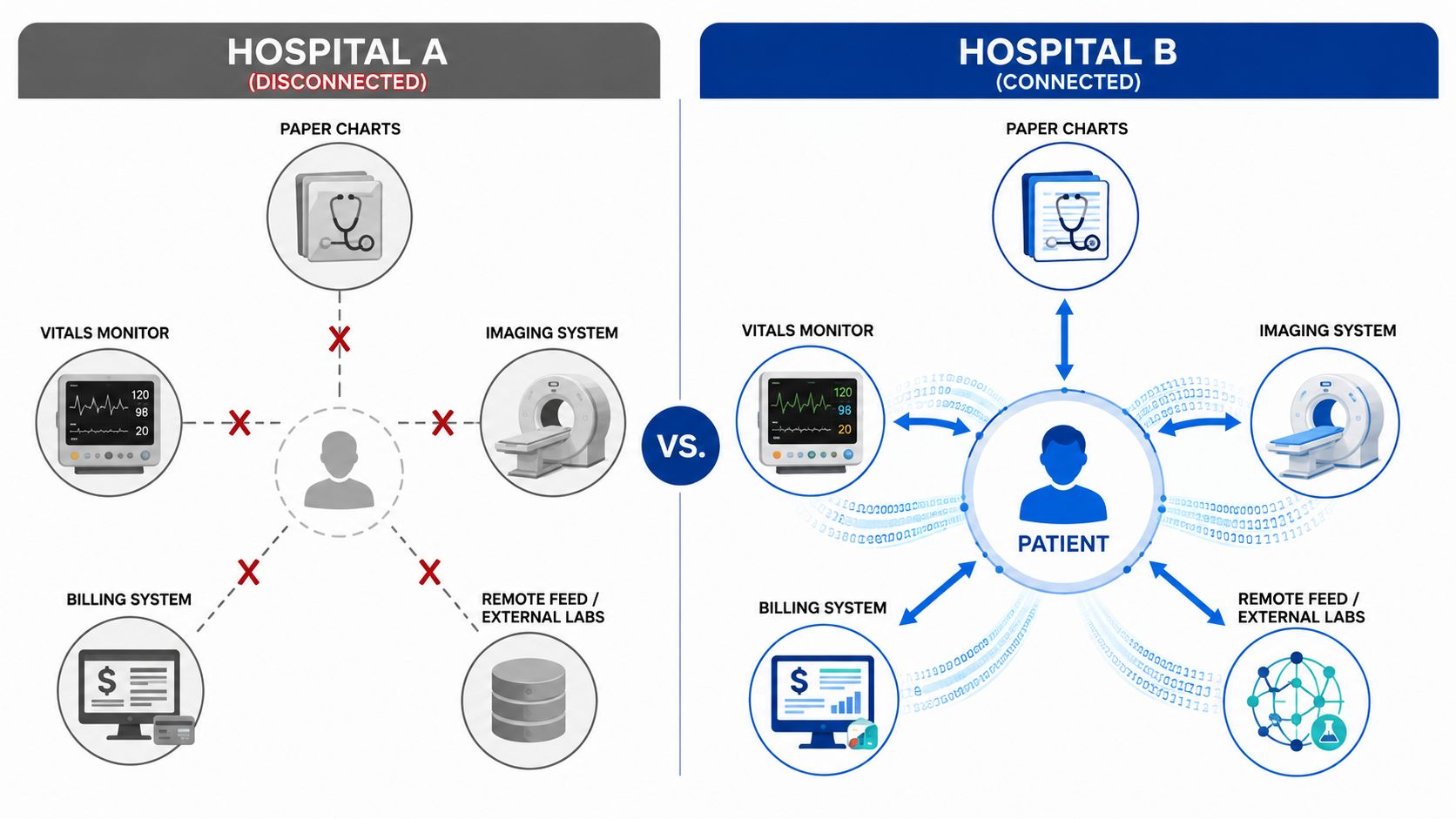
By 8:15 a.m. in the disconnected hospital, the day is already behind. A patient arrives for a follow-up appointment, but the receptionist still has to confirm a medication list that was updated yesterday in a different system. The nurse opens the chart, then opens another portal for vitals, then calls radiology because the imaging summary hasn't synced. By the time the physician walks in, three people have touched the same information, and none of them has fully trusted what they saw.
The hidden cost of small delays
That hospital doesn't fail because staff are careless. It fails because the workflow is fragmented. Duplicate entry, missing alerts, and after-hours reconciliation are the kind of operational leaks that don't show up in a glossy demo, but they consume clinical capacity and administrative time. The shift from fragmented systems to healthcare system integration is less about technology fashion and more about removing all the tiny pauses that add up across a full day.
In the connected hospital, the flow is different. The bedside monitor, the remote feed, the chart, and the discharge plan sit inside a shared data path, so the nurse isn't rekeying the same facts three times. The operations manager sees exceptions sooner, not after the fact, and the care team spends more time acting on the patient's status than reconstructing it.
Practical rule: if a workflow depends on staff copying the same clinical fact into multiple systems, it's not a workflow, it's a reconciliation problem.
That difference shows up in value, not just convenience. McKinsey estimates that advanced connectivity in healthcare could deliver $70 billion to $120 billion in annual value globally, with $40 billion to $70 billion of that coming from efficiencies such as reducing medical errors and improving workflow performance. For operations leaders, that's the story. The gain isn't abstract digital maturity; it's fewer duplicate tasks, faster hand-offs, and less time lost to correction.
A useful visual of that contrast is below, because the operational gap is easier to see than to describe.
The same pressure shows up outside the hospital too. A materials management workflow that can't see demand signals, inventory usage, and care activity in one place ends up creating waste in a different department. Connected care changes that pattern by making operations legible across the whole pathway, not just within one team.
What Connected Healthcare Systems Mean
The clearest way to define connected healthcare systems is through the work they do between people and systems. Dell's connected-health model describes them as systems that link doctors to data, patients to healthcare providers, and practices to networks so care is more integrated, and information moves faster. That definition matters because it keeps the focus on operational flow, not on any single product or vendor promise.
From plumbing to usable information
Under the surface, the work is a pipeline. Clinical and device data has to move through ingestion, preprocessing, storage, analytics, and visualisation before anyone can use it operationally. In Canadian deployments, that matters because integration is not just about connecting a device or an app; it is about making the data safe, structured, and available in the right form for the next step. Healthcare interoperability is the plumbing that lets one system understand what another system sent.
A parcel sorting hub is a useful comparison. A parcel can arrive in good condition, but if nobody sorts it, labels it correctly, and routes it to the right destination, it stays clutter in a warehouse. Clinical data behaves the same way. A lab result, a note, or a remote-monitoring alert does not create operational value until the system can route it to the right person at the right moment.
CMS makes the same point from a different angle. Its framing of interoperability is operational because it says health information should be exchanged and used across different systems, which helps reduce duplicate data entry, support coordinated care, and give clinicians the right information at decision time. In practice, standards such as HL7 and FHIR are the rules that keep the parcel hub moving, especially when data has to pass between systems that were never built together.
The same logic applies to integrated healthcare platforms, which only work when they reduce the number of places staff have to look, update, and verify. A platform that appears connected but still forces manual re-entry is still a silo, just with a cleaner interface.
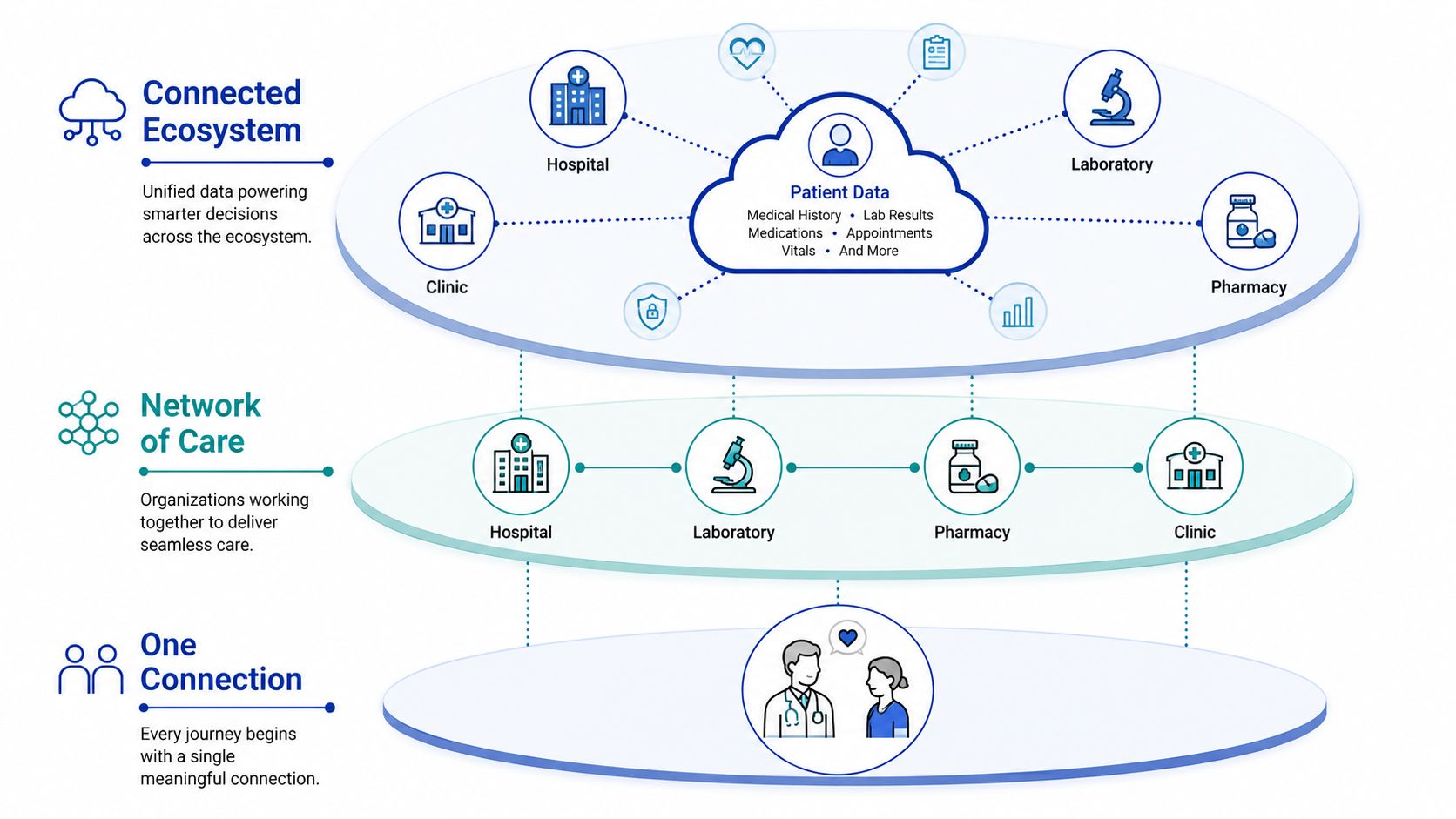
A diagram shows the hierarchy from one connection to a full ecosystem.
The Core Components That Drive Efficiency Gains
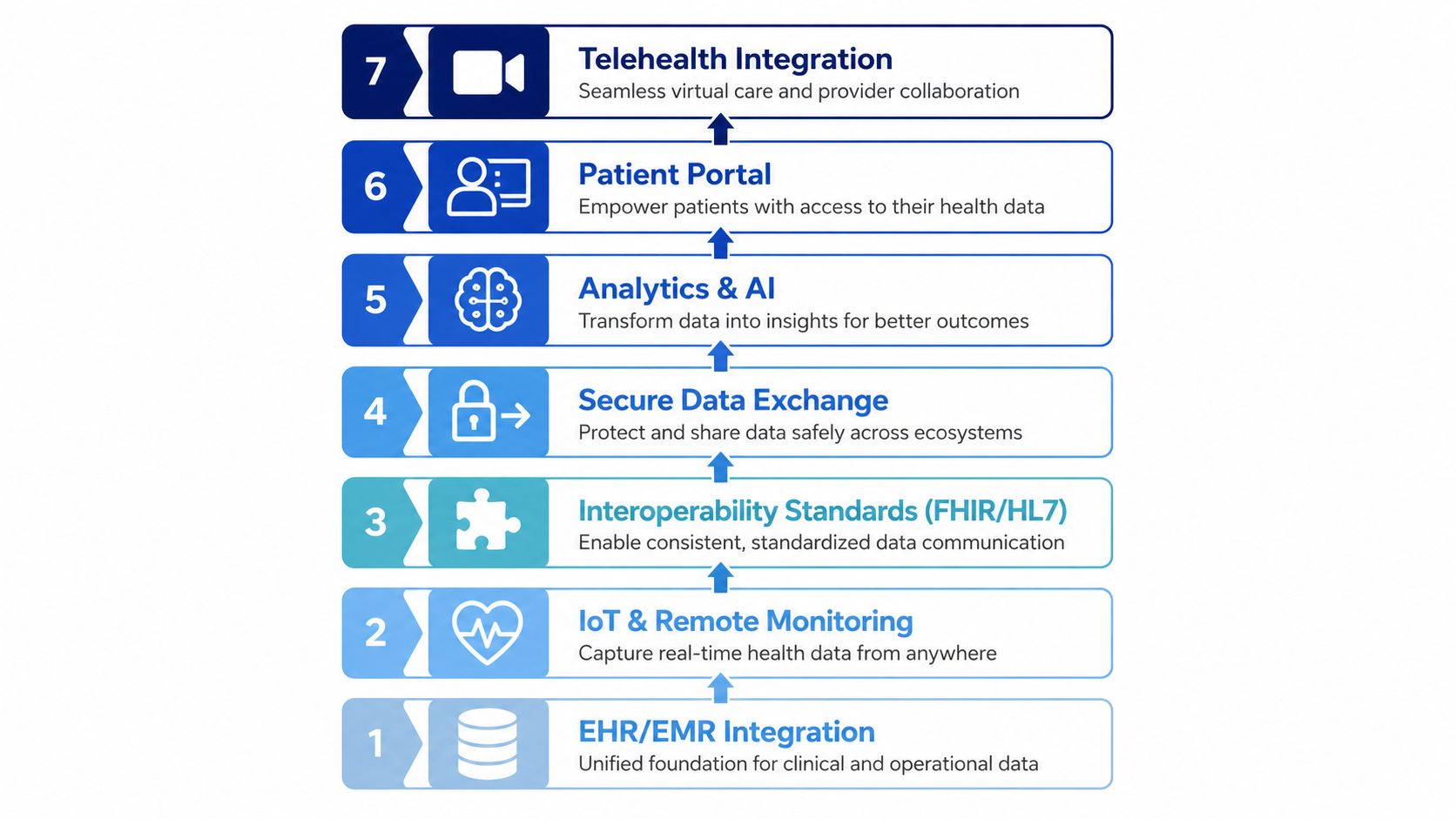
A working connected stack doesn't start with AI; it starts with the boring layers that make AI and automation trustworthy. The seven components below are the ones that usually decide whether a rollout saves time or just adds another dashboard to maintain.
The building blocks that actually move work
EHR and EMR integration: This keeps charting, orders, and updates in sync, which reduces duplicate documentation and prevents staff from chasing conflicting versions of the same record.
IoT and remote-monitoring devices: These bring bedside and at-home signals into the care pathway, which can support earlier intervention and, in some settings, earlier discharge planning.
Interoperability standards such as FHIR and HL7: These define how systems exchange data, which lowers the cost of custom point-to-point fixes and makes integrations easier to maintain over time.
Open APIs: These let systems talk without brittle workarounds, which matters when a provider needs to connect a portal, a referral system, or a scheduling layer quickly.
Cloud and edge infrastructure: Cloud supports scale and central governance, while edge processing helps filter and batch device data before it hits the core stack.
Analytics and AI: These turn raw activity into prioritised action, such as flagging high-risk cohorts or surfacing workflow bottlenecks for operations teams.
Identity, security, and patient engagement tooling: These make sure the right person sees the right data, while portals and messaging tools reduce avoidable inbound calls and confusion.
The scale of that data flow is easy to underestimate. Baxter reports that the average patient generates at least 80 MB of clinical data per year, including sensor readings, notes, labs, imaging, and medication lists. In parallel, a healthcare IoT survey notes sensor rates from 48 bps for pulse rate and 240 bps for respiratory rate to 6–48 kbps for ECG, which is why connected architectures need batching, edge filtering, and store-and-forward transport instead of assuming every signal must travel continuously.
Operational insight: the fastest way to fail a connected rollout is to create data faster than the team can normalise, secure, and route it.
That's why architecture matters in layers. One group of tools creates data, another group moves it, and a third group turns it into decisions. A clinician-friendly example is patient engagement. If the portal can't reflect the same appointment, medication, or follow-up status as the EHR, staff end up playing traffic controller instead of supporting care. A useful reference point for teams evaluating workflow layers is exploring medical AI innovations, especially when AI is being considered as part of a larger operational stack rather than as a standalone feature.
For deeper implementation work, healthcare data integration guidance is only useful when it stays tied to operational reality, which means fewer hand-offs, fewer exceptions, and cleaner data ownership.
A seven-step view of the stack is shown here.
Implementation Roadmap From Pilot to Scale
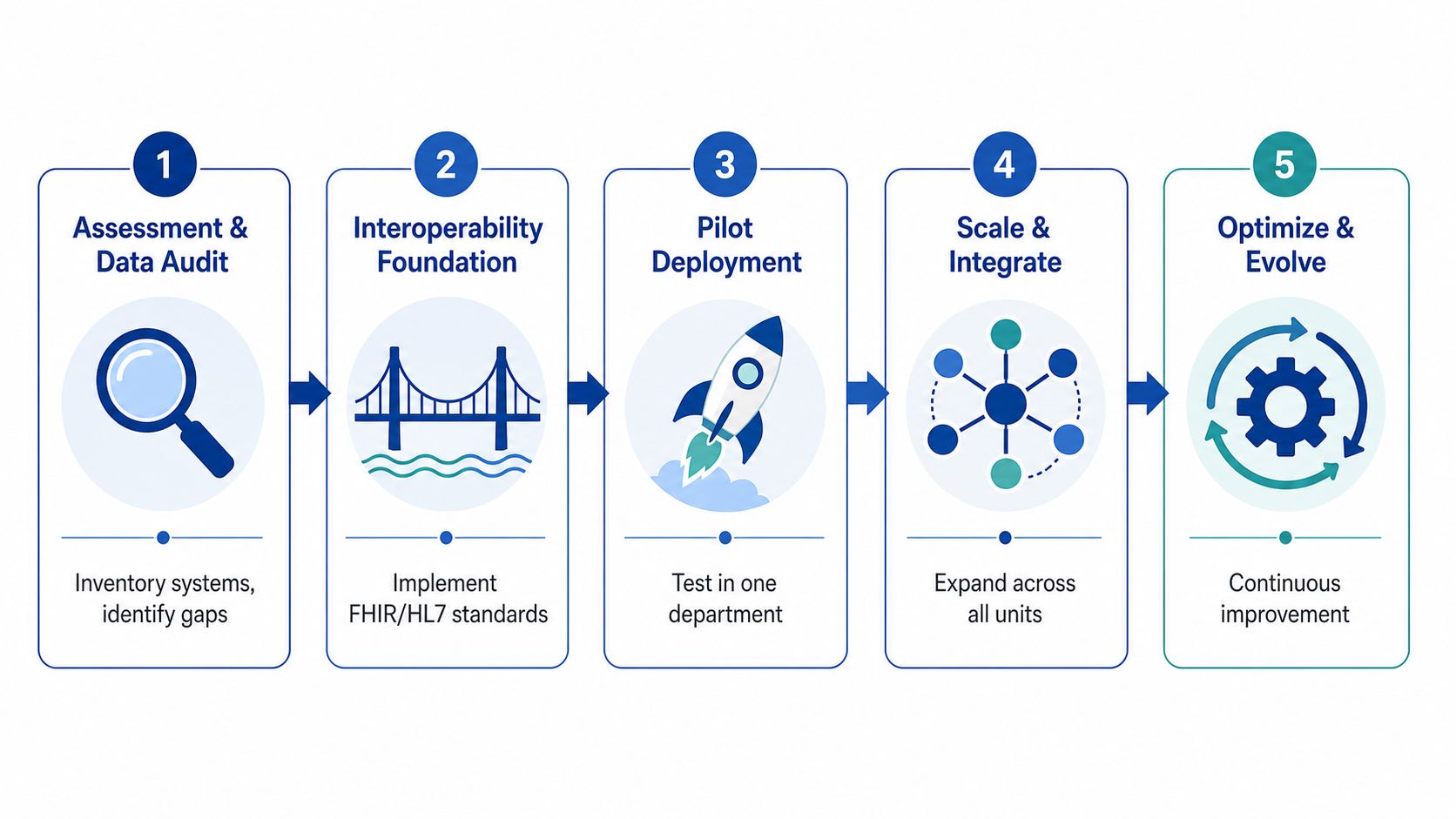
Most connected healthcare projects fail for the same reason; they start with a platform decision before they finish a workflow decision. The right order is simpler: know the data, stabilise the exchange, then redesign how people work around it. That sequencing matters because the operational win depends on adoption, not just installation.
Five phases that keep the rollout grounded
Assessment and data audit: This answers what systems exist, what data is duplicated, and where the current bottlenecks sit. It's usually the shortest phase on paper, but it exposes the largest amount of hidden mess. The common pitfall is skipping workflow mapping and jumping straight to vendor demos. The success signal is a cleaner inventory of source systems and a shared view of which data objects matter most.
Interoperability foundation: FHIR, HL7, API layers, and identity rules get stabilised. The question is whether data can move safely and predictably between systems. The common pitfall is building point fixes for one use case, then discovering they don't scale. Success shows up in fewer manual transfers and fewer broken interfaces.
Integration and device onboarding: This phase brings in the first real feeds, such as remote monitoring or scheduling data. The operational question is whether incoming signals arrive in a form the team can use. The pitfall is onboarding too many devices before the data model is ready. Success is a working pilot with reliable ingestion and low exception volume.
Analytics and workflow redesign: Teams decide what changes on the floor, in the call centre, or in the care manager's queue. The question is not whether dashboards exist, but whether they change decisions. The common failure is treating analytics as the end product instead of a tool for redesigning work. Success is visible in metrics such as time-to-discharge, duplicate-lab rate, or clinician-hours saved.
Governance and continuous optimisation: This answers who owns the rules, who reviews access, and how exceptions get handled over time. The pitfall is assuming governance can be bolted on after launch. It can't. It has to sit beside operations from day one so the system doesn't drift back into fragmentation.
A short ordering rule helps teams avoid the usual trap.
Start with data lifecycle engineering before visual design. If the information is not normalised, deduplicated, and role-controlled, the dashboard is only showing you a cleaner version of the same mess.
That prioritisation matters because a patient's data volume grows quickly across chronic-care cohorts. Secure normalisation, deduplication, and role-based access controls have to come before flashy analytics, or the stack becomes harder to govern than the legacy process it replaced. A practical way to move from planning to execution is to treat healthcare system integration as a delivery track, not a one-off project.
Benefits, Business Outcomes, and Adoption Risks
The business case is strong enough to get serious procurement attention, but the operational payoff only shows up when the data flows are designed for daily use. In connected care, the core question is whether the system removes handoff friction, reduces duplicate work, and gives staff cleaner information without creating a new layer of manual review.
What the upside looks like in practice
The upside is usually operational before it is financial. Connected healthcare systems reduce duplicate entries, speed up hand-offs, tighten referrals, and cut the reconciliation work that drains clinical and admin time. That is the point executives need to hear, because it maps the technology back to workload, not to marketing language.
That said, the return depends on what gets connected first. If the ingestion pipeline is built around clean feeds from EHRs, devices, and scheduling systems, teams spend less time chasing missing context and more time acting on it. If the feeds are fragmented, every downstream dashboard inherits the same gaps, just in a different format.
A provider evaluating vendor options through cleffex.com is usually asking practical questions: which workflows will get faster, where will human review still be required, and which data sources are too inconsistent to automate yet? Those are the right questions, because the first rollout always exposes trade-offs between speed, data quality, and governance.
Adoption risk rises fast in settings with weak connectivity and uneven digital access. A U.S. county-level study on digital health access found that the lowest-broadband cluster had only 64% broadband access, with underserved counties concentrated in digital-desert regions, especially in the South. Connected care has to work with that reality. It cannot assume stable broadband, reliable device ownership, or high digital literacy at the point of use.
Health IT guidance for underserved communities makes the continuity issue clear. Information exchange can improve care for transient patients by creating an electronic record that follows them across settings HealthIT.gov. In practice, that means identity matching, cross-site hand-offs, and workflow alignment matter just as much as the portal or the dashboard.
The teams that get durable results treat these constraints as design inputs, not exceptions. They plan for low-bandwidth access, inconsistent device performance, and fragmented care pathways before the first pilot goes live. That is where integration services earn their keep, because the work is not just linking systems; it is making sure the links survive real clinical operations.
Compliance Security and the Recommended Tech Stack
Security is not a separate workstream in connected care. It's part of the efficiency model, because every consent failure, access-policy mistake, or audit exception creates rework that drags people back into manual checks. A system that moves faster but can't prove who saw what, or why, isn't operationally efficient for long.
What to prioritise in the stack
The foundation should be cloud-native integration platforms with FHIR-native API gateways, because that gives the team a cleaner path for exchange and governance than a patchwork of custom scripts. Add edge gateways where device normalisation matters, especially for remote monitoring feeds, and layer in identity brokers so access can be role-based and auditable. Analytics should sit on top with explainable models, not black boxes, so operations teams can see why a cohort was flagged.
A strong partner profile looks like this, especially for healthcare and life sciences teams:
Interoperability credentials, with direct experience in FHIR, HL7, EMR, and EHR integration.
Healthcare compliance experience, including data residency, consent handling, and audit trail design.
Agile delivery, because integration work always changes once real data hits real workflows.
DevSecOps capability, so security checks are part of deployment, not an afterthought.
Workflow redesign support, because integration without process change leaves the old bottlenecks intact.
For teams evaluating platform reliability and automation risk, the discipline behind autonomous agent reliability is a useful comparator, especially where AI or agentic workflow tools will sit on top of clinical systems. The lesson is straightforward: the more autonomy a system gets, the more evidence, controls, and escalation logic it needs.
Cleffex Digital Ltd fits into this discussion as one option in the delivery layer, because it builds healthcare software integration work around connected workflows, not just interfaces. Its healthcare and life sciences capability is relevant when a team needs systems joined up without losing control over compliance, data flow, or operational ownership. The right stack is the one that makes the next integration easier, not the one that looks finished on day one.
FAQs and Your 90 Day Operational Efficiency Plan
A typical connected healthcare rollout is usually phased, not all at once. The quickest wins usually come from one pilot department, one data domain, and one workflow that staff already hate handling manually. Cost depends on scope, legacy complexity, and compliance requirements, so the better question is which integration removes the most manual work per month.
Which integrations usually pay back first?
EHR-to-portal synchronisation, referral flow, appointment management, and remote-monitoring ingestion tend to surface value early because they cut duplication and reduce back-and-forth.
How should a mid-sized provider start?
Pick one service line, audit the data objects, and stabilise the exchange before adding analytics or AI.
A practical 90-day plan looks like this:
Weeks 1 to 2: Complete the data and workflow audit, map duplicate entry points, and identify ownership.
Weeks 3 to 6: Build the interoperability foundation and run one pilot integration.
Weeks 7 to 10: Layer in analytics and redesign the clinician workflow around the new data flow.
Weeks 11 to 12: Review governance, access controls, and scale decisions.
The next frontier is identity matching, equity-aware design, and AI-assisted workflows that help staff without burying them in another system. Teams ready to move from planning to delivery can start the conversation at Cleffex Digital Ltd, especially if the goal is to turn fragmented care pathways into a more connected operating model.
Cleffex Digital Ltd helps healthcare teams connect systems, data, and workflows so operations feel less fragmented and more usable for staff and patients. If you're planning a connected care rollout, visit Cleffex Digital Ltd to discuss healthcare software integration, interoperability, and practical implementation support.