

A customer calls after a stressful car accident. They've been insured with you for years, yet the service representative can't see the relevant policy history, payment record, earlier quotes and claim notes in one place. The customer repeats information the insurer already holds, while the representative moves between screens and rekeys details.
That experience is a symptom of disconnected policyholder data. Insurance data integration gives teams a more complete, current view by linking policy administration, claims, billing, broker, customer and external data. The challenge in Canada is that the useful design isn't the one that connects the most systems. It must also respect consent, privacy, data residency and long-standing regulatory limits.
This guide explains the standards, architecture patterns, governance controls, implementation steps and selection criteria that can help a mid-size insurer create a practical 360-degree policyholder view.
Why Your Policyholder Data Lives in Silos
Insurance systems store policyholder information in separate silos. The claims platform records incidents, billing records payments, policy administration stores coverage, and the CRM holds conversations. A broker may keep another copy in its management system, with different field names and update times.
When these records do not connect, the same person can appear new in one workflow and long-standing in another. An underwriter may wait for information already held elsewhere. A claims handler may miss context from an earlier interaction, while a service representative asks again for an address, vehicle detail or contact number.
The operational cost of disconnected records
The visible issue is inconvenience. The business cost is broader:
Rekeying: Staff copy information between systems, creating opportunities for transcription errors.
Fragmented underwriting: Risk teams assess partial records instead of a coherent history.
Slow quotations: Brokers and customers wait while employees gather details from separate applications.
Claims friction: Adjusters reconcile policy, payment and incident information manually.
Cross-sell blind spots: Teams cannot identify relevant cover reliably when customer details are scattered.
Weak reporting: Leaders struggle to produce consistent operational views because systems use different definitions.
These effects reinforce one another. An address corrected in one application may remain outdated in another, so the next workflow starts with a mismatch. Legacy platforms often make the problem harder because they may expose limited interfaces, use proprietary formats or depend on scheduled batch updates.
A modern insurance data platform provides a controlled meeting point for approved records. It can connect legacy platforms, standardise fields, apply identity rules and supply current information to authorised people and workflows. The core applications can continue to issue policies, process claims or collect payments while selected data moves between them.
That distinction shapes InsurTech integration. A quoting tool, fraud service or customer portal may perform well alone, yet deliver less value when it cannot exchange dependable information with the systems running the insurer.
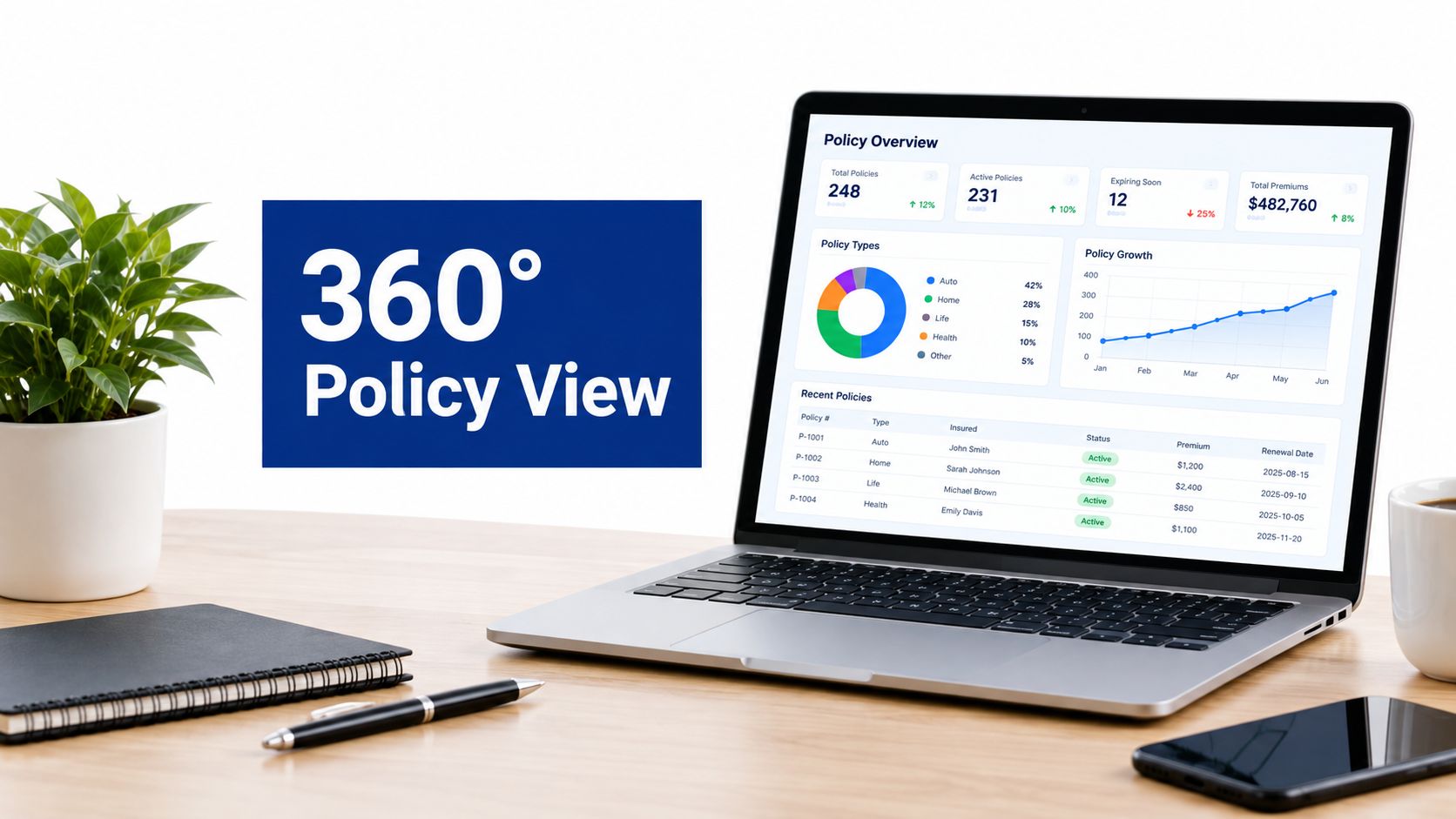
A 360-degree view is not a screen with more fields. It is a governed, connected record that gives the right person the right context at the right time.
Canada adds a further test. CSIO and CITS standards can reduce ambiguity between systems, but they do not decide whether information may be shared. Consent, purpose, access controls and privacy obligations must shape the integration design, particularly under PIPEDA, Quebec Law 25 and Bank Act restrictions. The practical goal is a single guest ledger for the policyholder, with clear ownership and auditability, rather than uncontrolled copies spread across the company.
What Insurance Data Integration Really Means
Think of a hotel. The front desk records a guest's arrival, the restaurant records meals, and the spa records appointments. Each department needs its own operational system, but the hotel serves the guest better when approved interactions also appear in a consistent guest ledger.
Insurance works in much the same way. Policy administration, claims, billing, CRM, broker management and third-party services each have a legitimate role. Insurance data integration connects those systems so information can move reliably, be matched to the right person or organisation and remain traceable.
An integrated view doesn't mean every system must use identical technology. A legacy policy engine can continue issuing policies while an API, event stream or scheduled data pipeline shares selected information with a modern insurance data platform.
Build the view by data domain
A useful 360-degree view usually brings together several domains, each with a clear owner and purpose:
Identity: Names, addresses, contact details, business relationships and identifiers used to match records safely.
Policy: Coverages, limits, endorsements, effective dates, cancellations and renewal status.
Claims: Reported incidents, adjustment activity, reserves, settlements and supporting documents.
Financial activity: Invoices, payments, balances and approved billing events.
Engagement: Calls, emails, portal activity, broker interactions, preferences and consent records.
Risk signals: Information from approved external services, telematics or other relevant sources.
The point isn't to flatten all of this into one giant database without context. A strong platform preserves source ownership, records when data changed and distinguishes a verified value from an inferred or incomplete one.
Why the view changes daily work
At onboarding, connected data can reduce repeated questions and support validation. At renewal, it can bring policy changes, claims activity and communications into the same workflow. During a claim, it can help the handler understand cover and prior interactions without searching across unrelated applications.
Cross-sell also becomes more responsible. Rather than sending a generic offer, a team can use the information it is permitted to use, check the customer's preferences and present a relevant option.
Core idea: Connect the systems, standardise the meaning, govern the access and preserve the evidence behind every important field.
The Data Sources and Standards That Power Connectivity
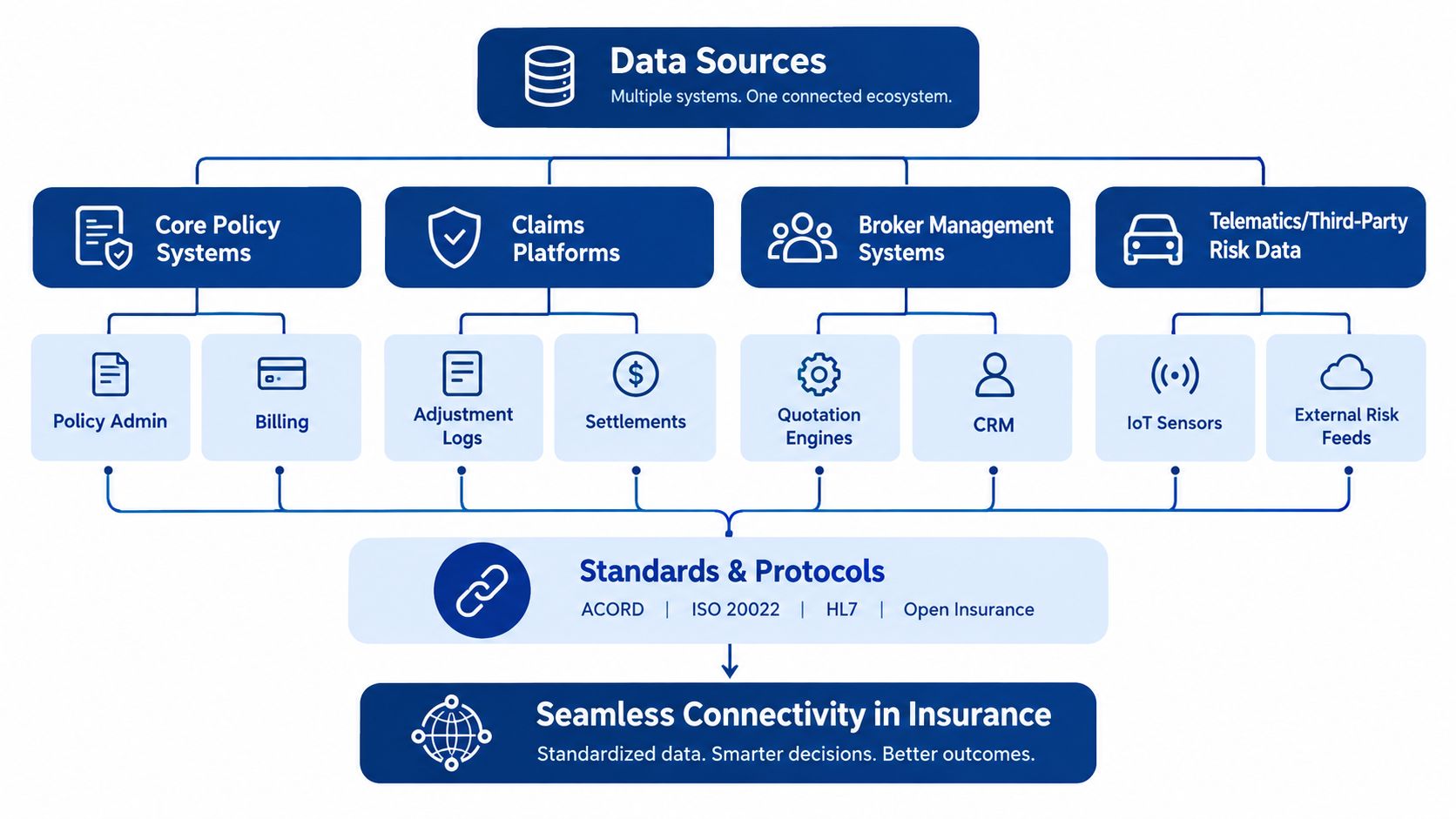
The first design question is simple: where does the policyholder story originate? Most insurers draw from four broad source groups.
Core policy systems hold policy status, coverages, endorsements and premium-related information. Claims platforms add incident notifications, adjustment logs, settlements and documents. Broker management systems contribute quotations, customer records and communications. Telematics and third-party risk data may provide approved external signals, subject to the relevant consent and legal basis.
Standards reduce the translation work between these sources. ACORD-based formats are important in many insurance exchanges, while Canadian property and casualty workflows also rely heavily on CSIO standards. CSIO supports XML, EDI and JSON exchanges for insurer and broker processes, including policy download and eDocs. CSIO says its standards are used daily by more than 43,000 brokers in Canada according to its insurer and vendor benefits page.
For life insurance, CLIEDIS describes CITS feeds based on ACORD implementation guides. Predefined structures help remove ambiguous mapping between sender and receiver systems, allowing a canonical format to be shared with multiple downstream applications. CLIEDIS identifies application notification, pending notification and book of business feeds as three correlated feeds that provide a fuller view of distributor business in its CITS guidance.
Auto insurers and brokers can also use IBC's DASH service to retrieve policy and claims history for risk assessment. DASH is available through a web portal or API to eligible private auto insurers and brokers in the listed Canadian jurisdictions as described by the Insurance Bureau of Canada.
Match the standard to the job
| Standard or Service | Insurance Line | Format | Typical Use |
|---|---|---|---|
| CSIO standards | Property and casualty | XML, EDI and JSON | Policy download, eDocs and insurer-broker exchange |
| CITS | Life and health | ACORD XML-based feeds | Application, pending and book of business data |
| DASH | Private auto | Portal or API service | Policy and claims history for risk assessment |
| ACORD implementation guides | Multiple insurance workflows | Structured exchange formats | Consistent mapping between systems |
A claims team may also benefit from guidance on analysing commercial claims data when deciding which fields, events and measures belong in an operational or analytical view. The integration layer should support that work without turning every reporting requirement into a new custom mapping exercise.
For teams documenting their broader technology estate, this guide to policy management system integration offers a useful companion perspective. The key principle is practical: use a recognised standard where one exists, and document exceptions instead of hiding them in fragile transformations.
Choosing Between Integration Architectures and Patterns
No single architecture suits every insurance workflow. A nightly finance reconciliation has different timing needs from a fraud signal generated during claims intake, and neither is identical to a broker portal requesting a live policy status.
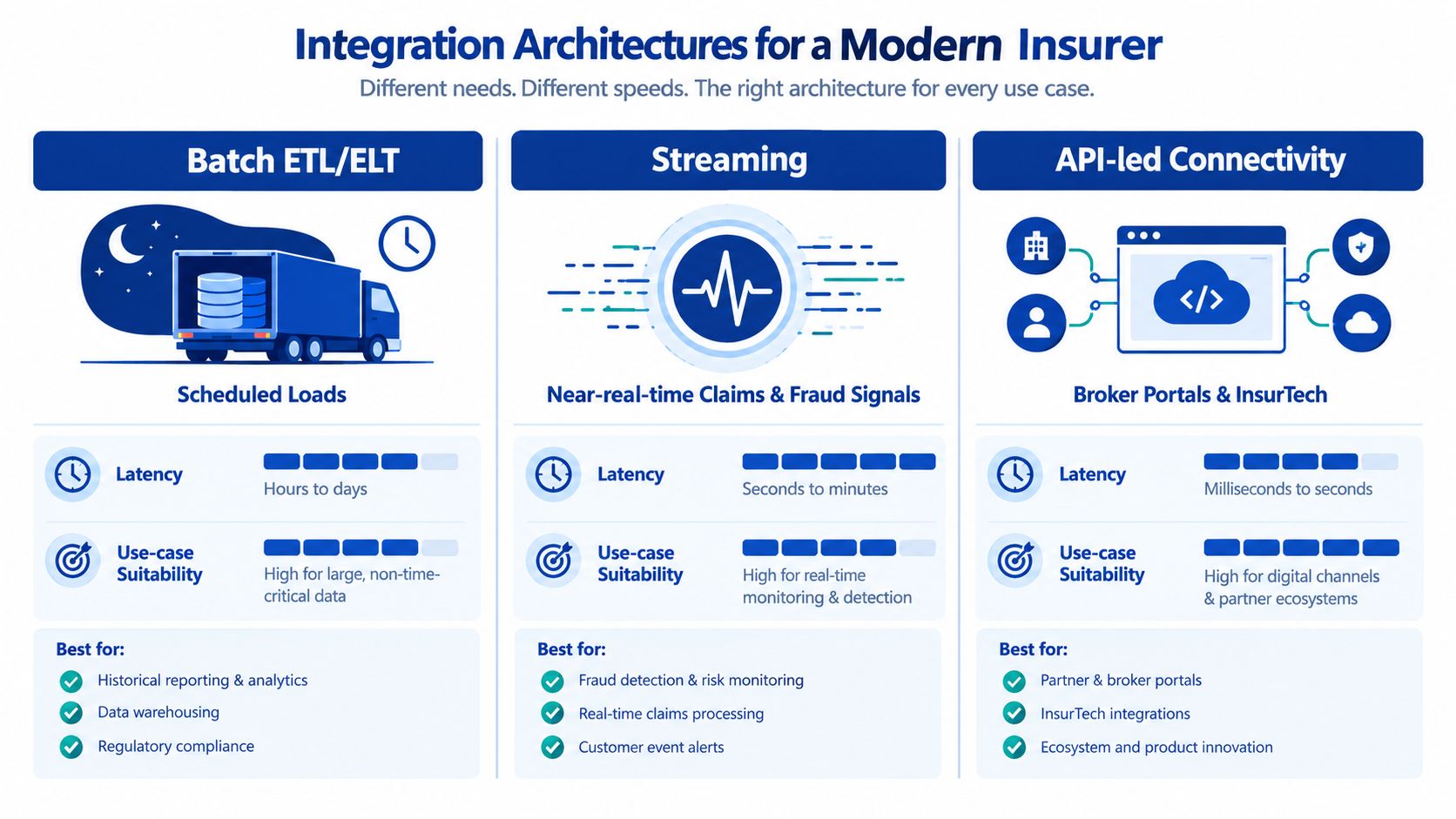
Batch ETL or ELT remains useful for scheduled loads, historical reporting and systems that can't support modern interfaces. It is often easier to control and budget, but information can be stale between runs and mappings may require manual maintenance.
Streaming suits event-driven work such as claims updates, payment events and near-real-time fraud signals. It offers speed, but teams need stronger observability, event design and failure recovery. A message arriving twice, or arriving out of order, must not create a duplicate claim action.
API-led connectivity creates reusable, permissioned interfaces for portals, partners and InsurTech integration. It can expose policy inquiry or quote services without opening the underlying core system, although API ownership, authentication and version management add operational responsibilities.
Patterns that sit across the architecture
An iPaaS can help a smaller team assemble connectors and workflows with less bespoke code. It may accelerate delivery, but the insurer still owns data definitions, access decisions and exception handling.
Master data management, or MDM, addresses a different problem. It establishes trusted identity and reference rules so the business can decide whether two records describe the same policyholder. MDM doesn't replace an API or a data pipeline. It helps those connections produce a reliable golden record.
The AI question needs careful treatment. Underwriting enrichment and claims triage require clean, current inputs, but they also require lineage, versioning and human review. A model should be able to show which approved fields influenced a recommendation and which source supplied them. That is more difficult when data is copied from legacy systems without clear ownership.
| Insurer profile | Practical starting pattern | Why |
|---|---|---|
| Large insurer | Hybrid batch, API, streaming and MDM | Supports varied core systems and different latency needs |
| Small brokerage | Standards-based API or iPaaS flows | Limits custom development while improving exchange |
| InsurTech startup | API-led connectivity with focused event handling | Makes partner integration easier without recreating a carrier estate |
Most Canadian insurers will need a hybrid design. A useful practical guide to InsurTech integration can help teams think through interfaces, ownership and sequencing before selecting a platform.
Designing for Security, Privacy and Compliance
Canadian insurance integration can't be designed as unrestricted data exchange. The Consumer-Driven Banking Act, passed in 2024, states that nothing in the Act overrides Bank Act restrictions on banks sharing consumer information with an insurance company, agent or broker for insurance business purposes. The Competition Bureau also notes that banks aren't allowed to share customer data with affiliated insurance companies.
That means a bank and an insurer can't assume that a technical connection creates a legal right to exchange information. Consent, purpose, role and jurisdiction must shape the integration pattern from the start.
PIPEDA adds obligations around appropriate use, transparency and purpose limitation. Quebec's Law 25 brings additional privacy governance expectations, including privacy impact assessments for higher-risk processing. AI workflows deserve particular scrutiny because automated decisions can magnify errors in identity matching or outdated records.
Convert rules into controls
A practical compliance design should include:
Consent capture: Record what the person agreed to, when they agreed, and the purpose covered.
Purpose controls: Restrict each interface to the fields and uses it needs.
Access logging: Keep an auditable record of who accessed or changed sensitive information.
Encryption: Protect policyholder data in transit and at rest.
Residency assessment: Evaluate where sensitive data is stored and processed, including cloud-provider arrangements.
Recovery testing: Test restoration procedures rather than relying on a written backup policy.
Vendor evidence: Review security documentation, incident processes and relevant compliance-ready pentest reports before onboarding a service.
One Canadian insurance data platform guide recommends keeping sensitive policyholder data in Canada and assessing cloud-provider risk, access-control logging and recovery testing in its platform guidance. Treat that as a design question to validate with legal, privacy and security teams, not as a blanket substitute for your organisation's obligations.
Good governance doesn't require a multinational budget. A smaller insurer can start with a data inventory, a short approved-field list, named owners, strong authentication and central logs. This overview of cybersecurity in the insurance industry can support the conversation between operations, technology and risk leaders.
A Practical Implementation Roadmap for Insurers
A successful programme starts with a narrow operational problem and expands only after the first connection works. The following sequence suits a mid-market insurer that needs progress without destabilising core operations.
Start with evidence, not architecture
Phase one is discovery: Inventory policy, claims, billing, CRM, broker and external sources. Sample records, document mismatched identifiers and check which team owns each field. The common pitfall is scope creep. A useful success signal is a map that shows where the same policyholder appears, what each system says and which data may be shared.
Phase two defines the golden record: Agree the minimum policyholder profile, matching rules, source precedence and retention requirements. Select applicable standards such as ACORD, CITS or CSIO rather than inventing a private format. If teams skip data quality here, the platform will distribute inconsistent information faster.
Phase three delivers one integration: Choose a focused workflow, such as policy download into a broker management system or a claims-to-CRM connection. Test normal records, duplicates, cancellations, amendments and failed messages. The goal is a visible operational improvement, not a perfect enterprise model.
Add controls before adding volume
Phase four adds MDM, consent management and monitoring: Introduce identity resolution, field-level permissions, lineage, alerts and reconciliation. Legacy quirks often surface at this stage, especially around dates, status codes and records created before current processes existed. A stable exception queue is a better sign than a dashboard showing only successful transactions.
Phase five extends the platform: Add approved partner connections and AI-assisted workflows only after the underlying data can be explained. For claims triage or underwriting enrichment, retain the source, timestamp, transformation history and human decision path.
Each phase can be sequenced over quarters rather than treated as a single replacement programme. Keep the existing policy engine where it remains dependable, put a governed integration layer around it and retire manual work only when the new flow has passed operational and compliance testing.
Measuring ROI and Selecting the Right Technology
Technology selection should begin with the result the operations team needs to see. If the problem is repeated data entry during claims intake, measure rekeying volume and claims cycle time. If the problem is slow broker service, measure quote turnaround and document handling. A 360-degree view earns support when leaders can connect the investment to a change in daily work.
Score capability against the operating model
A shortlist should be tested against more than a product demonstration:
Standards support: Can it handle the relevant ACORD, CITS and CSIO exchanges without hidden custom mapping?
Residency options: Can the insurer control where sensitive records are stored and processed?
API maturity: Does it offer versioning, authentication, rate controls, documentation and monitoring?
MDM capability: Can it resolve identities, manage duplicates and preserve source lineage?
Security evidence: Can the supplier provide appropriate audit material, testing records and incident processes?
Total cost: What will implementation, support, change requests, storage, monitoring and future connections cost?
Use a weighted score agreed by operations, IT, privacy, security and procurement. A platform that wins technically but fails residency or audit requirements isn't a viable option.
Link measures to a business case
Track a baseline before implementation, then compare the same workflow after release. Useful measures include:
Quote turnaround time
Manual rekeying volume
Claims cycle time
Cross-sell conversion
Data-quality scores
Exception and reconciliation rates
The Competition Bureau found that an insurance data portability framework could save Canadians between $1.1 billion and $3.8 billion annually, while stressing that meaningful portability depends on interoperability, privacy protection, clear consent and user-friendly transfer tools, as reported by the Insurance Institute of Canada. For an insurer, the lesson is broader than the headline value. Raw access isn't enough. A useful transfer must arrive in a format systems can interpret and people can trust.
A mid-size P&C insurer might begin by joining claims and policy records to create governed fraud signals for review. A small brokerage might start with CSIO-compliant policy and document flows to reduce handling across broker and insurer systems.
For custom integration, data workflows and operational software support, review Cleffex's homepage and its retail and ecommerce development services, where connected customer journeys and transaction systems are relevant to organisations serving policyholders across digital channels.
Key Takeaways and Frequently Asked Questions
A dependable 360-degree view follows five principles:
Connect deliberately: Link the systems that support a defined workflow.
Standardise meaning: Use CSIO, CITS or other applicable formats rather than relying on one-off mappings.
Design for consent: Treat privacy, purpose and regulatory restrictions as architecture requirements.
Sequence the work: Prove one integration before expanding across the estate.
Measure relentlessly: Track service speed, data quality, manual effort and customer outcomes.
How long does a typical project take for a small brokerage?
The answer depends on the number of systems, the quality of existing identifiers and the broker's access to insurer interfaces. A focused standards-based connection can be scoped separately from a wider customer-data programme, which helps a small team avoid waiting for an enterprise transformation.
Can a legacy policy administration system join a modern insurance data platform?
Yes. A legacy system can usually participate through an existing API, a scheduled export, a message adapter or a carefully controlled database interface. Replacement isn't the only route, but the integration must document old status codes, missing values and update timing so the modern platform doesn't present false certainty.
How do insurers handle residency with cloud iPaaS tools?
They assess the provider's storage and processing locations, subcontractors, support access, encryption, logging and recovery arrangements before approving the service. The insurer may keep sensitive records in a Canadian environment while allowing carefully minimised metadata or workflow messages to move through another service, subject to its privacy and security review.
What's the first quick-win integration for a limited budget?
Choose the workflow that creates visible manual effort and has a clear source and destination. Policy download into a broker system or claims updates into a service workspace can be practical starting points, provided the exchange uses an applicable standard and includes reconciliation for failures.
Connected data isn't a distant ideal. With a narrow first use case, a consent-first design and honest treatment of legacy constraints, insurers can build a policyholder view that supports faster, clearer decisions.
Cleffex Digital Ltd offers custom software development and integration services that can connect policy administration, claims, billing, compliance and third-party workflows into a governed data layer. Visit Cleffex Digital Ltd to discuss an insurance data integration roadmap built around your systems, standards and operational priorities.