

Most FinTech advice treats real-time financial data as a race to the lowest possible latency. That's usually the wrong race. A Canadian insurer deciding whether to adjust a policy, an SME lender reviewing working capital, or a healthcare administrator checking a suspicious claim often gains more from combining fast events with slower, more predictive signals than from buying every tick from every exchange.
The useful question isn't “How quickly can we move data?” It's “Which decision is waiting for it?” Canada already illustrates why the distinction matters. Statistics Canada releases real-time tables approximately one week after official source tables, while the Bank of Canada publishes selected market indicators on daily schedules, including exchange rates at 16:30 ET and interest rates between 12:15 and 12:30 ET. These are valuable feeds, but they aren't the same as a direct exchange feed.
This article takes a practical view of FinTech data analytics, financial data integration, and real-time financial analytics. It focuses on what real-time buys, where it adds needless cost, and how to build a hybrid system that serves decisions rather than impressing a procurement team.
Why Real-Time Financial Data Is Not What Most FinTechs Think
The popular assumption is simple: faster data produces better decisions. In practice, speed only helps when it arrives before the decision window closes. A courier's commercial auto policy may need a fresh risk signal on a Tuesday morning. A microloan pricing engine may need to react after a payroll drop. A claims team may need to flag an unusual pattern before a payment clears. None of those decisions automatically requires tick-by-tick market data.
Canadian market infrastructure makes the trade-off visible. The Ontario Securities Commission distinguishes between direct marketplace data, often used by smart order routers and direct electronic access where latency matters, and consolidated feeds that introduce transmission delay. Its consultation paper lists monthly Canada-wide costs of C$118.85 for top-of-book data and C$268.35 for depth-of-book data. Richer and faster data brings infrastructure and licensing consequences, not just technical prestige.
Match freshness to the decision
For many Canadian FinTechs, insurers, and SMEs, the better design combines:
Fast market events, where exposure, pricing, or liquidity can change quickly.
Daily or weekly credit information, which can reveal financial stress more reliably than an isolated transaction.
Macroeconomic releases, which place local activity and affordability in context.
Permissioned account data, where cash flow, income, and affordability decisions depend on a customer's current position.
An insurer might use a live weather alert to trigger a review, then combine it with policy history and claims data before changing treatment. An SME lender might ingest current account activity while waiting for a bureau refresh before changing a credit limit. This is hybrid decisioning, not a compromise.
Practical rule: Buy the fastest feed only when a slower feed would arrive after the action you need to take.
The same discipline applies to financial communications. A fast earnings summary can still mislead if it strips away context, as the discussion of Artul.ai earnings analysis makes clear. Freshness helps, but interpretation and evidence determine whether a decision is sound.
Real-time should therefore be treated as a decision-latency choice, not a marketing badge. The architecture, vendor contract, and operating model should all follow that choice.
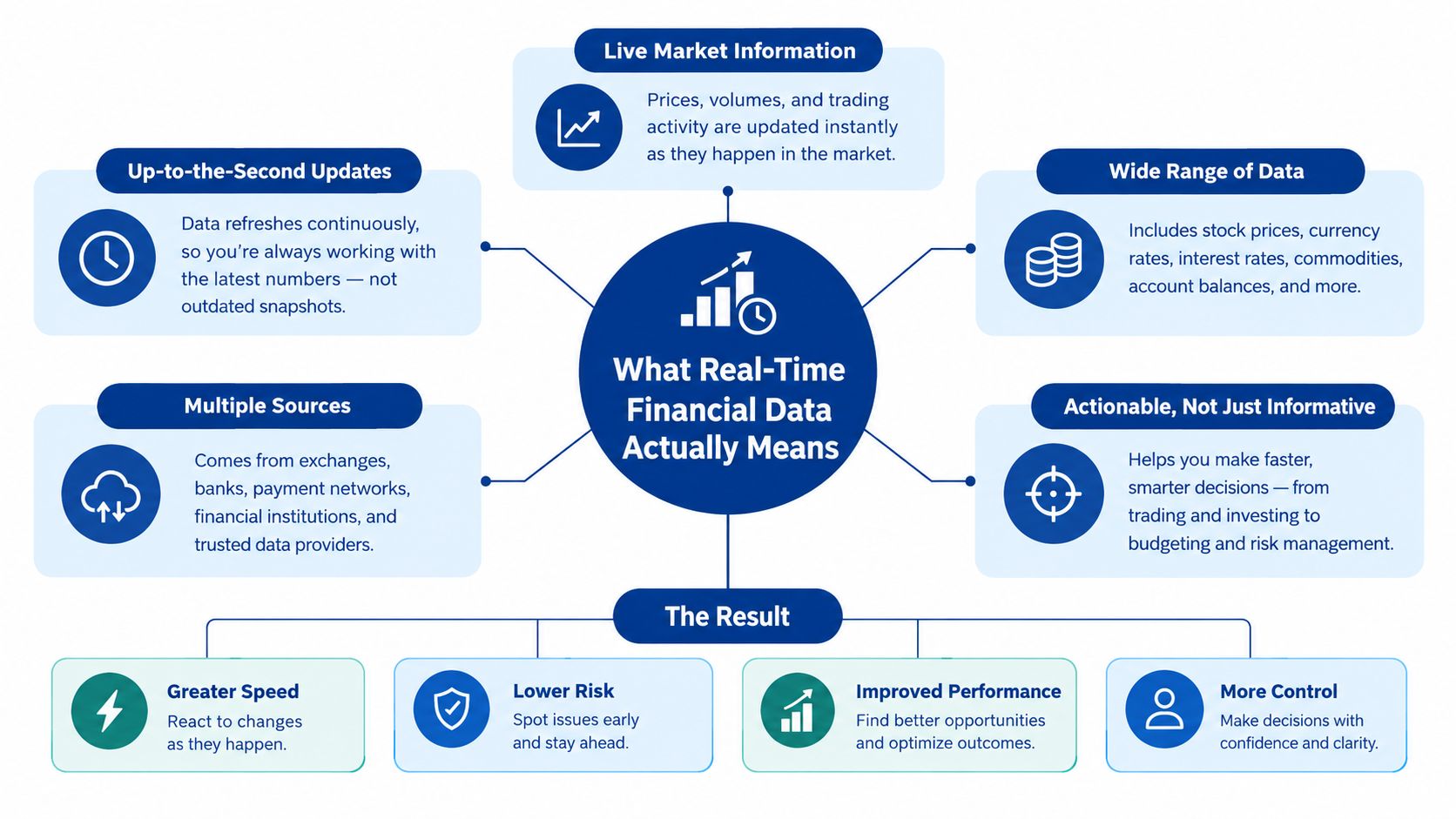
What Real-Time Financial Data Actually Means
Start with a coffee shop. One espresso pour is an event, a recorded occurrence such as a card transaction, a new claim, or a bank-account balance change. A sensor reporting each pour creates a stream, a continuing sequence of events that can be processed as they arrive.
The line of customers gives that stream business meaning. If orders are arriving faster than the barista can serve them, the system needs to identify the pattern, not merely store individual orders. The barista adjusting the next shot is the decision. In FinTech, that response might be a fraud challenge, a pricing change, an underwriting referral, or a liquidity alert.
Five terms that prevent expensive confusion
Event: One business occurrence, such as a payment authorisation or policy update.
Stream: Events delivered continuously, usually with timestamps, identifiers, and ordering rules.
Freshness: How recently the underlying data was generated or released.
Latency: The time between generation, ingestion, processing, and availability.
End-to-end decision latency: The time from trigger event to completed business action.
A feed can be technically fast but operationally slow. If a transaction arrives quickly yet waits for a congested rules service, the customer still experiences delay. Similarly, a dashboard may display fresh data while an underwriting workflow continues to rely on a stale feature store.
Choose the freshness tier that earns its cost
Hard real-time supports decisions where sub-second response is part of the operating model, such as market-making or automated exposure management. Soft real-time usually means seconds to minutes, which fits fraud detection, claims triage, and payment controls. Near-real-time may mean minutes to an hour, which can suit onboarding, account review, and operational reporting.
A live market price is not automatically a trading decision. Teams evaluating that distinction can use this explanation of live market price to separate the displayed quote from the wider data and execution context around it.
The right design starts with the action. Ask how long the business can wait, what happens when the signal is late, and whether the source itself is published continuously or on a release schedule. That last point matters in Canada, where official macroeconomic data and exchange data sit in different availability models.
Real-Time Versus Batch in Plain Language
Payroll is a good batch workload. A company can collect approved hours, calculate totals, validate deductions, and run the payment file as a scheduled process. A total that is several hours old doesn't usually prevent an accurate payroll run.
Card-not-present fraud is different. At 02:14, the transaction, device context, merchant history, and customer behaviour may need to reach a decision service before authorisation completes. Waiting for a nightly file would turn prevention into investigation.
The choice isn't binary. Month-end reconciliation benefits from repeatable batch processing because finance teams need a complete, auditable period. An intraday liquidity dashboard may combine streaming account events with scheduled bank statements. A KYC refresh can run as a micro-batch while high-risk changes trigger an on-demand check.
Compare the operating model
| Dimension | Batch | Streaming |
|---|---|---|
| Freshness | Scheduled, from hours to longer reporting cycles | Continuous or event-triggered |
| Cost per event | Efficient for large grouped workloads | Higher operational overhead for individual events |
| Reprocessing | Straightforward reruns over a defined period | Requires offsets, replay, idempotency, and event retention |
| Complexity | Easier to test and operate | More demanding observability and failure recovery |
| Best fit | Payroll, reconciliation, periodic KYC, regulatory reporting | Fraud controls, exposure alerts, live pricing, payment decisions |
A hybrid pattern often works best. Use streaming for the trigger and immediate action, then use batch for enrichment, reconciliation, and model training. For example, a lender can stream account transactions into a temporary risk signal, apply a daily bureau refresh, and reconcile the final position in a scheduled finance process.
Streaming should accelerate a decision, not force every workload to pretend it has a sub-second deadline.
The practical rule is to define a freshness window for each output. If a dashboard only changes materially during business hours, continuous ingestion may add cost without improving judgement. If a fraud rule must act before settlement, a scheduled pipeline is structurally unsuitable.
Where FinTech Teams Put Real-Time Data to Work
The strongest use cases begin with a trigger and end with a decision. They don't start with a dashboard.
A Canadian property and casualty carrier might receive telematics events and a weather alert after a hailstorm. The underwriting team can review affected policy segments, combine the event with claims history and geographic exposure, and adjust pricing or outreach. The stream identifies when attention is needed. It doesn't replace actuarial review.
A benefits administrator faces a different pattern. Repeated submissions across providers can indicate coordinated billing activity. A stream of claims, provider identifiers, treatment codes, and historical relationships can surface a suspicious cluster within minutes, allowing the administrator to hold or refer the claim before payment.
Five decisions, five latency profiles
| Vertical | Decision unlocked | Key real-time feeds | Latency needed |
|---|---|---|---|
| Insurance | Review pricing, exposure, or claims treatment after a risk event | Telematics, weather, policy, and claims events | Seconds to minutes |
| Healthcare | Refer suspicious duplicate-submission patterns | Claims, provider, and submission events | Minutes |
| Automotive | Investigate covenant risk after asset depreciation changes | Dealer floorplan, vehicle, auction, and financing data | Minutes to hours |
| SME banking | Adjust working-capital offers using current activity and credit context | Account transactions, categorisation, and bureau refreshes | Minutes to daily |
| FinTech start-up | Manage FX exposure on cross-border payouts | Sub-second price feeds, payout instructions, and hedge positions | Sub-second to seconds |
An automotive fleet-financing arm could blend dealer floorplan feeds with resale auction prices. When a vehicle crosses a depreciation threshold, the system can flag the account for covenant review rather than waiting for a periodic portfolio report.
For SME banking, the useful combination is usually less glamorous. Live transaction categorisation can reveal a sudden sales or payroll change, while a daily bureau refresh provides a broader credit signal. The lender can tighten or redesign a working-capital offer without treating one anomalous payment as a complete risk assessment.
A payments newcomer has a narrower latency requirement. If payouts cross currencies, sub-second market prices can help calculate exposure and support hedging controls. That system still needs slower settlement, reconciliation, and treasury data to establish whether the position is correct.
The same principles apply to payment-product design. Teams building payment experiences can use this guide to real-time payment software key features as a reference point, then map each feature to an actual customer or risk decision.
The Streaming Architecture Behind Better Decisions
A useful architecture has five layers. Each one should answer a business question, not merely satisfy a technology diagram.
Source and ingestion
Sources may include market-data APIs, core-banking events, IoT telematics, claims systems, and bureau refreshes. TMX provides access to real-time Canadian equities and derivatives feeds from the Toronto Stock Exchange, TSX Venture Exchange, TSX Alpha Exchange, and Montréal Exchange. Cboe Canada also states that real-time data is available for its listed securities, including full-depth order-book information.
Ingestion should place events on a durable bus such as Kafka, Pulsar, or Kinesis. Use a schema registry and partition by a meaningful key, such as instrument, policy, customer, or account. Out-of-order trades and duplicate events are normal engineering problems, not edge cases.
Processing and serving
A stream processor such as Flink, Kafka Streams, or Materialize can run windowed aggregations, complex-event-processing rules, and feature engineering. Claims may arrive late. Account events may be corrected. Every calculation needs an explicit policy for event time, processing time, and late data.
Serve operational outputs from a low-latency store such as Redis, ScyllaDB, or ClickHouse, with a feature store for model inputs. Keep raw events in a lakehouse so teams can replay decisions, investigate disputes, and support regulator or auditor requests. Replay must be deterministic. A re-run that produces a different risk decision without an explainable model or data change creates serious governance problems.
Consumption and failure control
Consumers include dashboards, REST or WebSocket APIs, partner applications, and event subscriptions that trigger underwriting, claims, or pricing workflows. Avoid writing the same event independently to a ledger and an analytics store without a reliable coordination pattern. Dual-write hazards can create a customer-facing balance that disagrees with the system of record.
The pipeline must accept a tick stream and a nightly credit file without forcing both into one latency tier. That means separate service objectives, retention policies, and fallback paths, even when the feeds share a common event platform.
Teams planning the wider platform can use this guide to build AI-ready FinTech infrastructure to connect streaming requirements with model governance, security, and production operations.
Integrating Real-Time Data Without Breaking the Bank
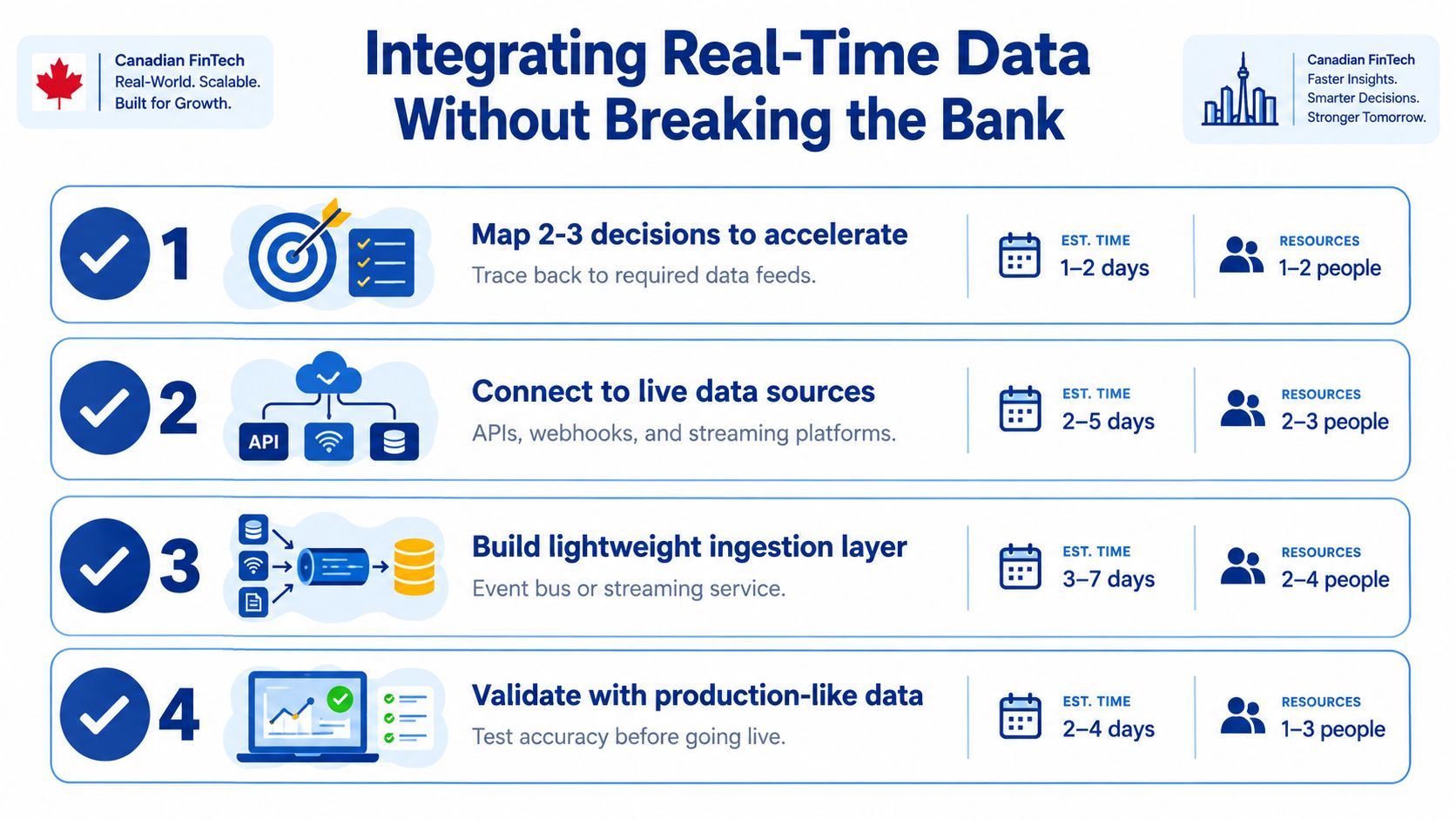
Start with decisions, not vendors. Select two or three decisions to accelerate, then trace each one back to the feeds, transformations, and controls it needs. A fraud referral, a pricing review, and a liquidity alert may share infrastructure, but they won't share the same freshness requirement.
Build the smallest useful path
Map the decision: Define the trigger, owner, action, fallback, and acceptable delay. If no person or system will act on the output, don't stream it yet.
Connect the sources: Use managed Kafka or a serverless equivalent, plus change data capture from the core banking or ledger database where appropriate. Prefer documented REST and WebSocket interfaces with sandbox access, rate limits, and service-level commitments.
Prototype the logic: Test the stream in a notebook with production-like events, including duplicates, missing fields, late arrivals, and schema changes. Promote proven logic to Flink or Kafka Streams with idempotent sinks.
Expose both views: Provide a cached REST endpoint or WebSocket for low-latency consumers, alongside a batch view for finance, risk, and reconciliation teams.
Managed services such as Confluent Cloud, AWS Kinesis, and Materialize Cloud can reduce operational work. Self-hosting can provide more control. Compare total cost of ownership, including on-call coverage, upgrades, observability, security reviews, and recovery testing, rather than comparing headline infrastructure prices.
Set service objectives by use case
A market-data feed may require a sub-second objective. Fraud decisions may tolerate seconds. A credit refresh may be useful within minutes. Budget for the tail, not just the median, because a system that is fast most of the time can still fail when customer demand or market activity rises.
Security belongs in the first design, not the hardening backlog. Encrypt data in transit and at rest, isolate personally identifiable information in a governed zone, and align controls with PIPEDA and OSFI B-13 expectations. Retain raw events for audit and model retraining according to documented retention rules.
For teams that need implementation support, Cleffex Digital Ltd provides software development and FinTech API integration services connecting financial products with banks, payment rails, identity tools, and data providers. Its work can sit alongside managed infrastructure or support a custom financial data integration programme. Cloud spend should remain visible throughout the build, which is why a practical guide to cloud cost optimisation strategies is useful during architecture review.
Metrics, Monitoring, and a 90-Day Adoption Plan
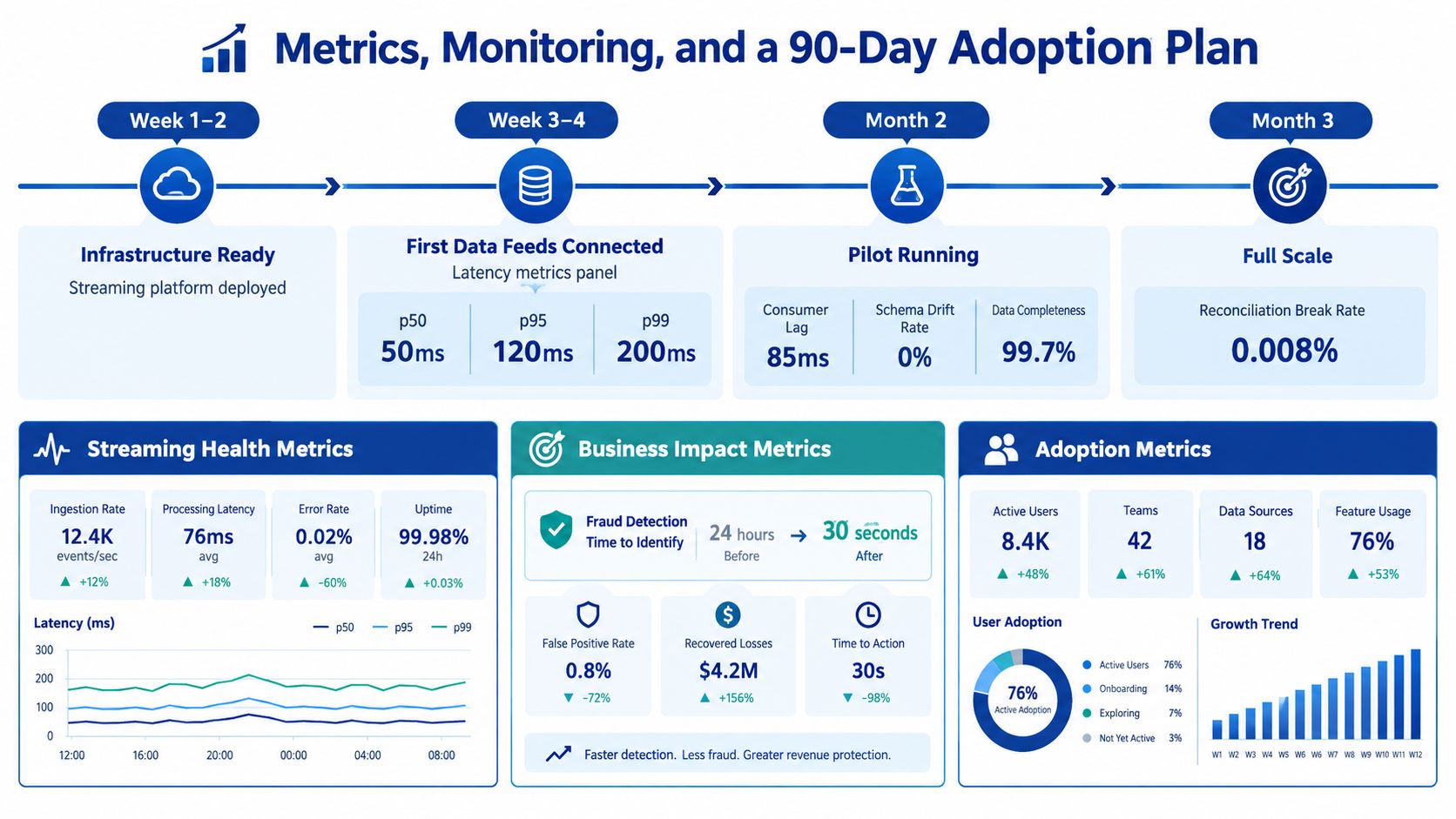
A streaming pipeline is only valuable when its technical health connects to decision quality. Track end-to-end latency at p50, p95, and p99, then pair those measures with consumer lag, schema drift rate, data completeness, and reconciliation break rate.
Those numbers need business counterparts. A fraud team may care about straight-through-processing percentage and referral quality. An underwriting team may track cycle time and credit-decision hit rate. A finance team may focus on reconciliation exceptions and the time needed to close a period.
Days 1 to 30
Baseline one critical decision path. Instrument every handoff from source event to final action, establish alerts for missing data and stalled consumers, and record the current batch process as the comparison point.
Don't retire the old process yet. It provides a control path while the team learns whether the new stream is both fresh and accurate.
Days 31 to 60
Publish one source through a controlled event subscription and add replay capability. Validate the service objective against business targets, not only infrastructure dashboards. Add PII tokenisation, access controls, and audit logs before expanding the number of consumers.
The team should also test vendor and source failure. A fallback that exists only in a design document isn't a fallback.
Days 61 to 90
Add two more sources, codify vendor failover, and compare the new path with the legacy batch baseline. Retire the batch job only after freshness and accuracy both outperform the old process for the decision it supports.
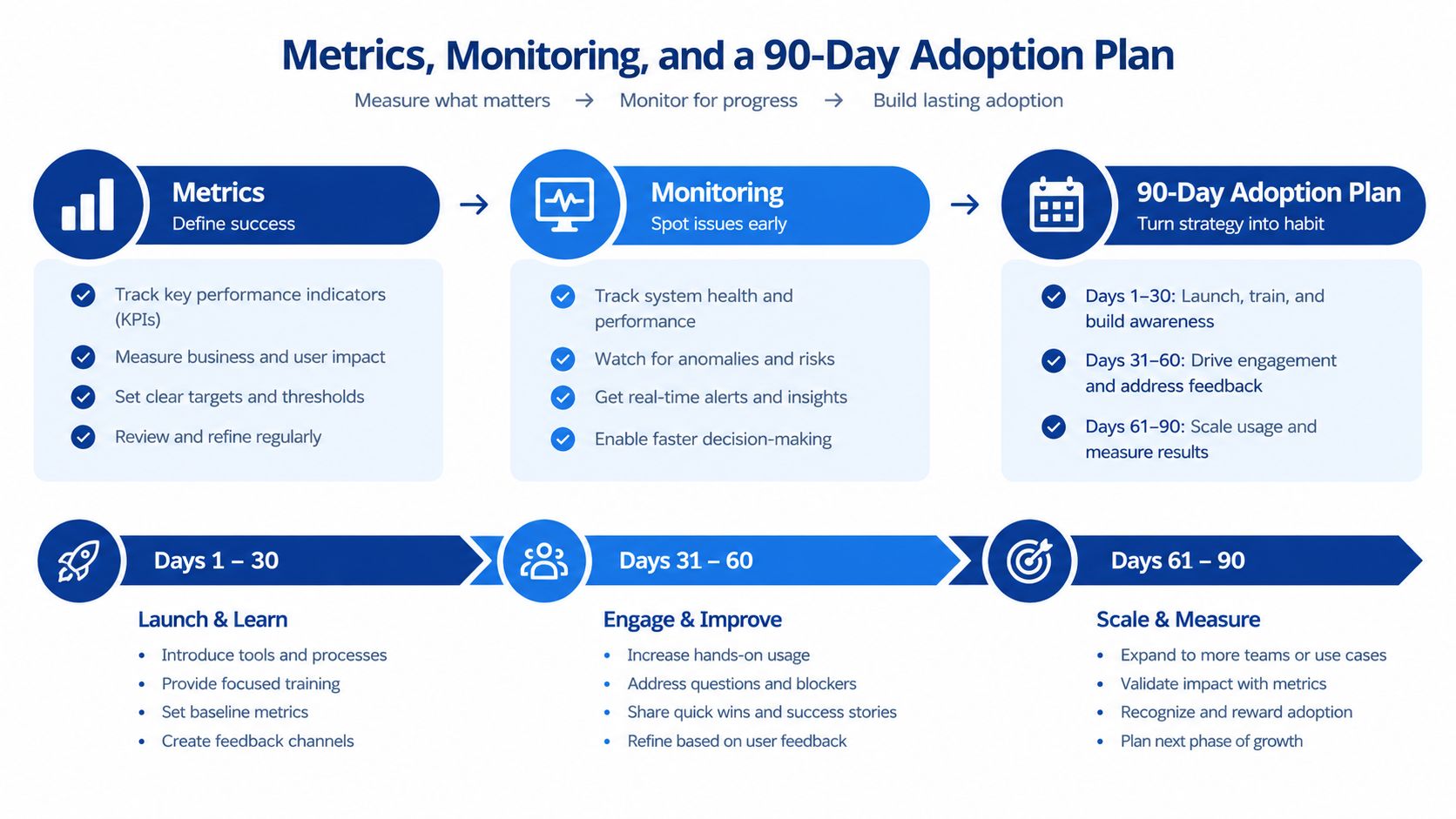
Hold a weekly decision-quality review with product, risk, finance, and engineering. Discuss whether metric drift changed revenue, loss, customer treatment, or operational workload. That meeting turns monitoring from an SRE exercise into a business control.
The central lesson is straightforward: real-time financial analytics works best as a layered system. Fast events handle immediate triggers. Slower macro, credit, income, and balance-sheet signals add predictive context. Canadian official data already combines daily indicators with long-run historical series, while market-data infrastructure offers both direct and consolidated access. The winning architecture respects those differences instead of pretending every signal belongs in the same stream.
Cleffex Digital Ltd helps FinTech, insurance, healthcare, automotive, and SME teams design financial data integrations, streaming pipelines, APIs, and AI-ready infrastructure for faster, more controlled decisions. Visit Cleffex Digital Ltd to discuss a real-time data architecture built around your highest-value decision paths.