

A referral arrives while Dr Patel is moving between appointments. The sending clinic has an electronic record, but its medication list doesn't appear in her system. She calls the clinic, waits for a fax, and retypes the patient's history into her EMR. The record is digital in both places, yet the care pathway still depends on manual work.
That gap is the practical challenge of healthcare interoperability. Connected healthcare ecosystems must let systems exchange information, preserve its meaning, and help authorised people act on it safely. HL7 integration, FHIR integration, and healthcare API integration aren't competing projects. They are complementary parts of the same architecture, supported by middleware, Health Information Exchanges, identity controls, consent, and shared governance.
This matters in Canada, where electronic records are widely used but connections between care settings remain uneven. Health Canada reported in 2023 that only one third of Canadians could access some of their health information online, while providers still couldn't easily access or share information because systems don't always connect. A 2026 peer-reviewed analysis found high EHR adoption but low and inconsistent interoperability maturity across Canadian jurisdictions, with exchange between primary care, specialists, hospitals, and community settings still heavily dependent on fax or mailed letters. The sections below explain the layers, standards, plumbing, privacy controls, and delivery roadmap behind a more connected model.
What Healthcare Interoperability Really Means
Healthcare interoperability is the ability of systems, data, and people to exchange, interpret, and use health information without forcing every participant to repeat the same manual work. A message can travel successfully and still fail to interoperate if the receiving EMR can't understand the codes, identify the patient, or place the information in the right clinical workflow.
That distinction is important:
Data exchange moves information from one system to another.
Interoperability makes that information meaningful and usable at the destination.
Connected care adds the people, consent, workflow, and accountability needed to act on it.
A laboratory result illustrates the difference. An HL7 v2 message may deliver a result to a hospital interface engine. But the receiving application still needs a reliable patient identifier, a recognised test code, a usable result value, reference information, and a workflow that alerts the right clinician. If any of those pieces fail, the bytes arrived, but the clinical handoff didn't.
Four questions define a connected exchange
When I assess an integration, I ask four practical questions:
Can the systems connect?
This is the transport layer.
Do they agree on the message structure?
This is the structural layer.
Do the fields mean the same thing?
This is semantic interoperability.
Do the organisations agree on consent, responsibility, and workflow?
This is organisational interoperability.
Canada's policy direction reflects that broader definition. The Connected Care approach focuses on common standards for secure transfer of health information across systems and to patients, and Health Canada announced the priority to advance that roadmap on 29 May 2023. The proposed Connected Care for Canadians Act would also require digital health vendors to adopt common standards for secure information exchange.
The result is a shift in mindset. A successful project isn't merely an API that returns HTTP responses. It's a trusted clinical connection in which the right information reaches the right user, with enough context to support safe action.
The Four Layers Behind Connected Health Systems
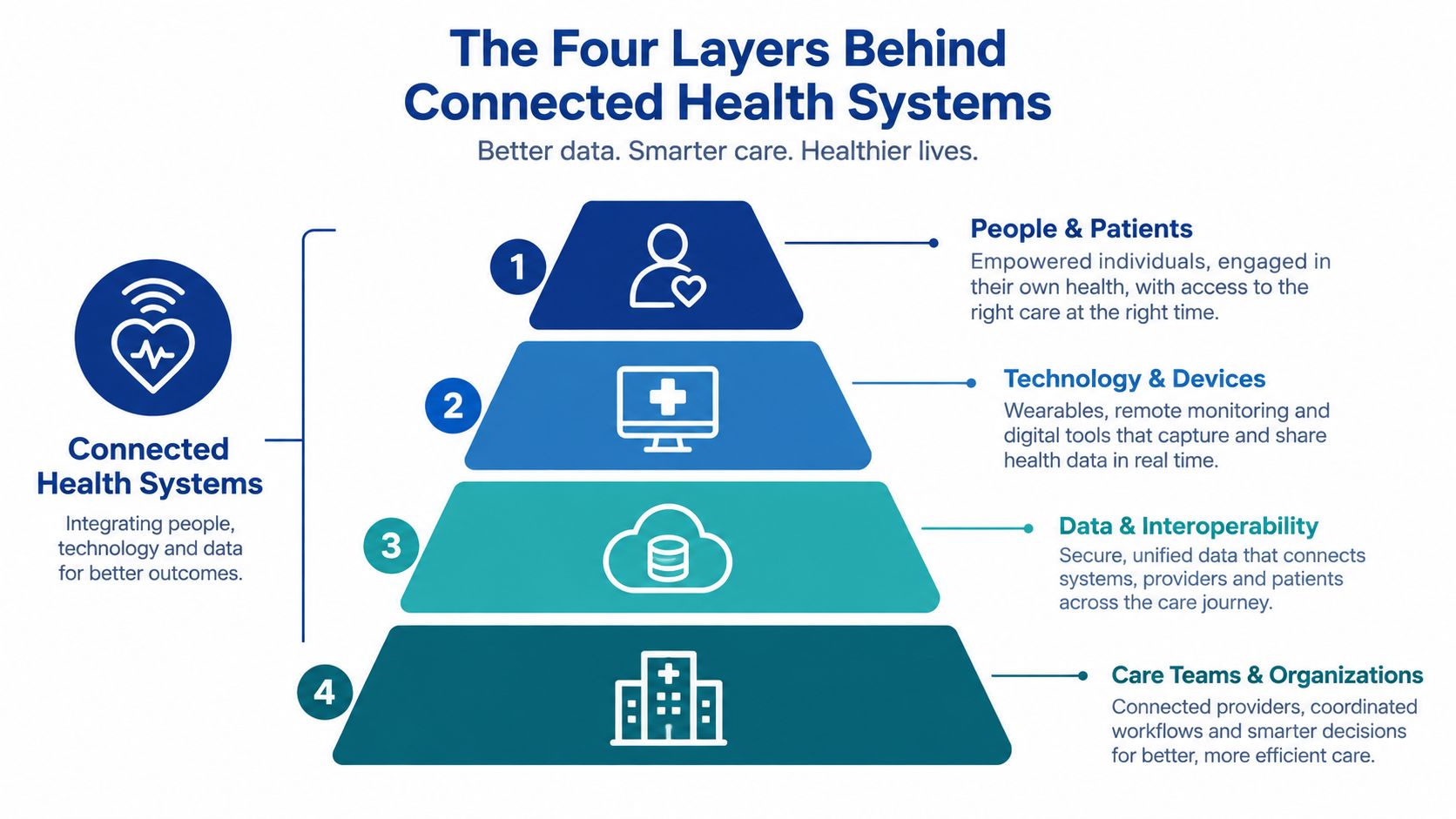
Think of a healthcare message as a shipment moving through a distribution network. Foundational interoperability provides the roads and loading equipment. Structural interoperability ensures the package has a recognised shape. Semantic interoperability makes the label readable to every warehouse. Organisational interoperability determines whether the recipient is authorised and ready to use the contents.
The lower layers carry the message
The foundational layer includes transport technologies such as TCP/IP, MLLP, HTTPS, certificates, queues, and network routing. It answers a narrow question: can system A reach system B?
The structural layer defines the shape of the exchange. In HL7 v2, that shape is expressed through segments, fields, and delimiters. In FHIR, it may be a JSON resource constrained by an implementation guide and profile. XML schemas play a similar role for CDA documents. Projects often stall here when a hospital's custom Z-segments don't have an agreed equivalent in the receiving system.
The semantic layer is where clinical meaning becomes portable. A laboratory test represented with LOINC, a condition represented with SNOMED CT, or a medication represented with an accepted medication terminology can be interpreted more consistently than a free-text label. Canadian interoperability work also stresses that exchanged data must be meaningful, comparable, and usable across systems, not merely transmitted.
The top layer is organisational
Governance determines who may share data, under which consent, and for what purpose. It also determines who resolves duplicates, corrects a mapping, monitors failed messages, and answers a clinician's question when an exchange looks wrong.
A system may technically support a referral but still fail if staff don't trust the destination, the consent process is confusing, or the receiving queue isn't monitored. Practical patient handoff strategies help teams connect technical exchange with the human workflow that protects continuity of care.
Practical rule: Don't declare interoperability complete until a clinician can find, understand, trust, and use the exchanged information in the workflow where care happens.
Comparing HL7 v2, CDA, and FHIR Standards
HL7 standards resemble different postal services. HL7 v2 is a fast courier that delivers focused messages. CDA is a structured envelope containing a complete clinical document. FHIR is a modern service counter where applications request and exchange individual resources through APIs.
HL7 v2 remains common for admission, discharge, transfer, laboratory, pharmacy, and scheduling feeds. Messages commonly use pipe-delimited fields and travel through MLLP. They're efficient for event notification, but local variations and custom Z-segments can make long-term maintenance difficult.
CDA packages information as an XML clinical document with a header and body. It works well when the recipient needs a human-readable summary with structured sections, such as a discharge summary or transition-of-care document. Its document orientation is useful for clinical context, although extracting one small data element can require more processing than a focused API request.
FHIR represents resources such as Patient, Observation, and ServiceRequest in JSON or XML. RESTful operations, profiles, extensions, search parameters, and implementation guides make FHIR suitable for application integration, patient-facing access, referrals, and modular exchange. FHIR doesn't remove design work. Teams must still agree on profiles, cardinalities, terminology, identifiers, and workflow actors.
| Standard | Format | Transport | Primary Use Case | Strengths | Limitations |
|---|---|---|---|---|---|
| HL7 v2 | Delimited messages | Commonly MLLP | ADT, laboratory, pharmacy, and event feeds | Fast, mature, widely deployed | Local variants, rigid structures, mapping burden |
| CDA | XML clinical documents | Document exchange and web transport | Discharge and transition-of-care documents | Complete clinical context, human-readable structure | Less granular for individual data requests |
| FHIR | JSON or XML resources | RESTful APIs and messaging | Apps, referrals, patient access, and modular exchange | Granular resources, modern tooling, profiles | Requires careful conformance and terminology design |
FHIR profiles make jurisdictional requirements explicit. In Canada, national interoperability direction is converging on CA Core+ and pan-Canadian FHIR profile work, while Ontario's referral and consult specification uses HL7 FHIR R4 with Direct Messaging, SMART integration, and RESTful API modes.
Teams may also encounter C-CDA-on-FHIR and other transitional patterns. The practical choice isn't “old standard or new standard”. A realistic ecosystem often runs HL7 v2 feeds, CDA documents, and FHIR APIs together while gradually moving selected workflows to more reusable profiles. For implementation details, see this guide to HL7 interface development.
APIs, Middleware, and HIEs as the Plumbing Layer
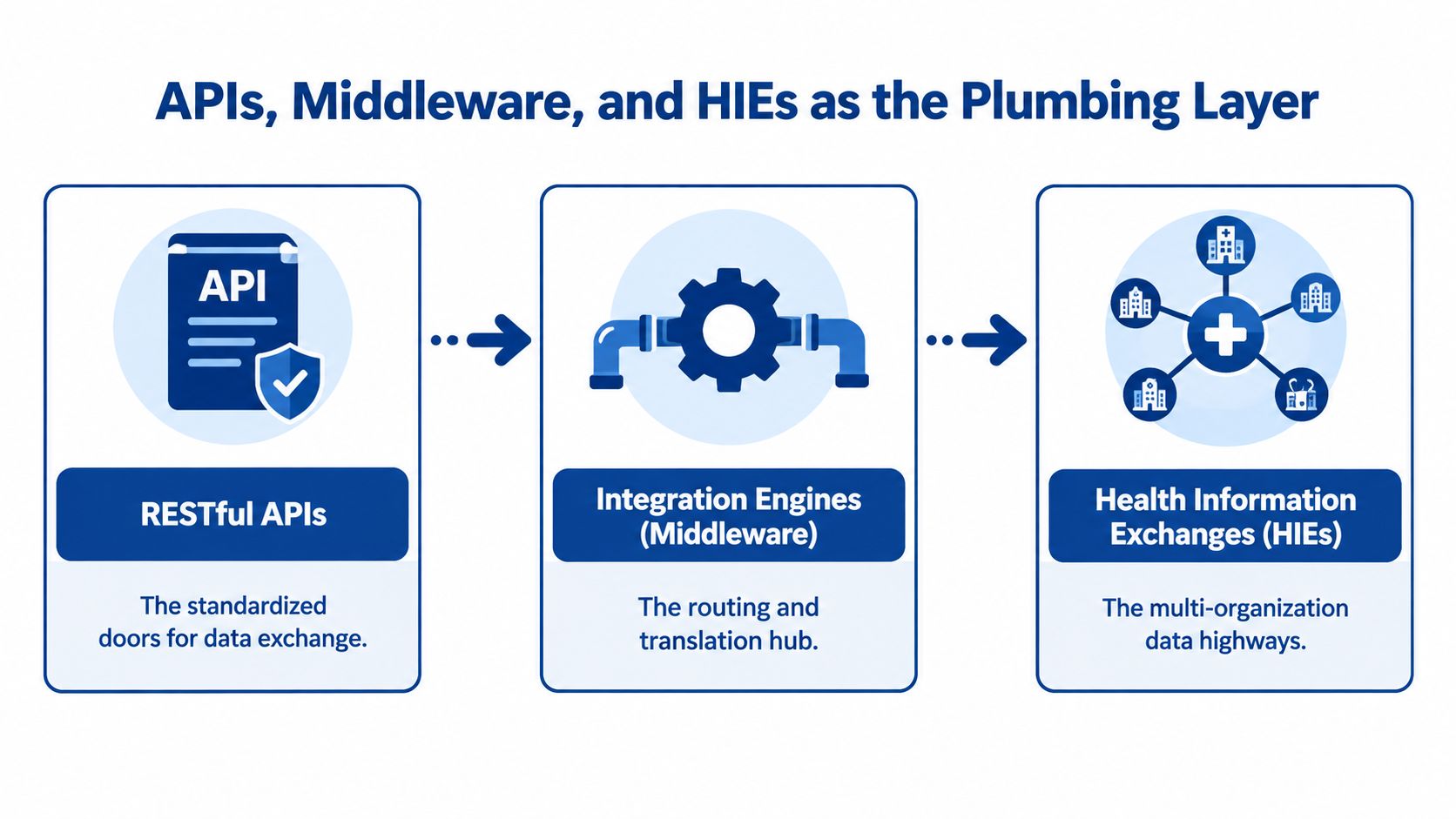
An API is a contract. It defines which endpoint a client can call, what authentication it must present, which resources it may request, and how errors are returned. In healthcare API integration, that contract also needs clinical rules, patient identity requirements, consent handling, versioning, and audit expectations.
Middleware sits between systems that don't speak the same dialect. Products such as Mirth, Rhapsody, Iguana, and InterSystems IRIS can route messages, transform HL7 v2 into FHIR, validate profiles, enrich identifiers, queue failures, and record audit events. Middleware shouldn't become an invisible dumping ground for business logic. Clear mappings and version-controlled transformations are easier to test and govern.
An HIE provides a shared exchange environment across organisations. Depending on the design, it may support record location, identity services, document discovery, consent enforcement, or broader clinical data exchange. It reduces the need for every provider to build a separate connection to every other provider, but it also introduces shared governance and participation requirements.
A referral's journey
Consider an Ontario referral workflow. A source EMR creates a ServiceRequest and supporting FHIR resources. A SMART-on-FHIR integration authenticates the application, while middleware performs validation, patient matching, routing, and consent checks. The destination CIS receives a FHIR R4 POST, places the referral in its intake workflow, and returns an acknowledgement or error.
That layered path differs from a point-to-point HL7 v2 feed over MLLP. A direct feed can be appropriate for a stable hospital event, but every new destination may require another mapping, connection, monitoring arrangement, and support process. A layered design creates clearer control points for retries, observability, access decisions, and audit logging. Ontario's specification deliberately supports multiple integration modes, allowing organisations to phase in interoperability instead of forcing a single migration pattern.
Teams planning operational ownership should also consider healthcare API integration operations. An interface isn't finished when it passes a test message. Someone must watch queues, investigate rejected resources, manage certificates, review access logs, and communicate changes to clinical users.
Privacy, Consent, and Cross-Border Compliance
Privacy requirements shape interoperability architecture from the first design workshop. PIPEDA, provincial health privacy laws, and HIPAA address different legal contexts, but they all affect identity, purpose, access, disclosure, retention, vendors, and auditability. A cross-border service adds questions about where data is stored, where support staff can access it, and which agreements govern the transfer.
Minimum-necessary use is a useful engineering principle. A referral application may need patient identity, clinical reason, urgency, attachments, and destination details. It may not need an entire longitudinal record. Narrow scopes reduce exposure and make consent easier for patients and staff to understand.
Turn obligations into technical artefacts
Consent must be represented as data, not left in a policy document. A FHIR Consent resource can record the patient, purpose, permitted actors, provisions, and period of validity. AuditEvent can capture access, disclosure, break-glass use, and administrative action. Identity matching, role-based access, OAuth 2.0, SMART on FHIR, TLS, and field-level protection for sensitive identifiers provide additional controls.
The legal interpretation also matters. Direct-care exchange may rely on implied consent under some PIPEDA circumstances, while health-specific provincial regimes and HIE arrangements may require more explicit patient choices. Teams must validate the actual rule for each jurisdiction and workflow rather than copying a consent pattern from another country.
| Regulation | Core Obligation | Technical Control in the Stack |
|---|---|---|
| HIPAA | Protect regulated health information and control disclosures | Role-based access, audit trails, business associate agreements, minimum-necessary scopes |
| PIPEDA | Govern personal information collection, use, disclosure, and safeguards | Purpose limitation, consent records, access controls, retention policies |
| PHIPA | Protect personal health information in Ontario | Health information custodian and provider governance, access logging, consent enforcement |
| HIA | Govern health information handling in Alberta | Defined roles, safeguards, disclosure controls, documented access decisions |
Ransomware and artificial intelligence make patient-controlled sharing more important, not less. A Canadian health data governance report highlights the need for clearer consent mechanisms, stronger privacy and security standards, and tools that let patients manage consent more transparently. It also points to the importance of ethical, secure data sharing with First Nations, Inuit, and Métis communities. Compliance should therefore be a property of identity, consent, data minimisation, and logging from day one. A practical overview of these engineering concerns is available in healthcare compliance software development.
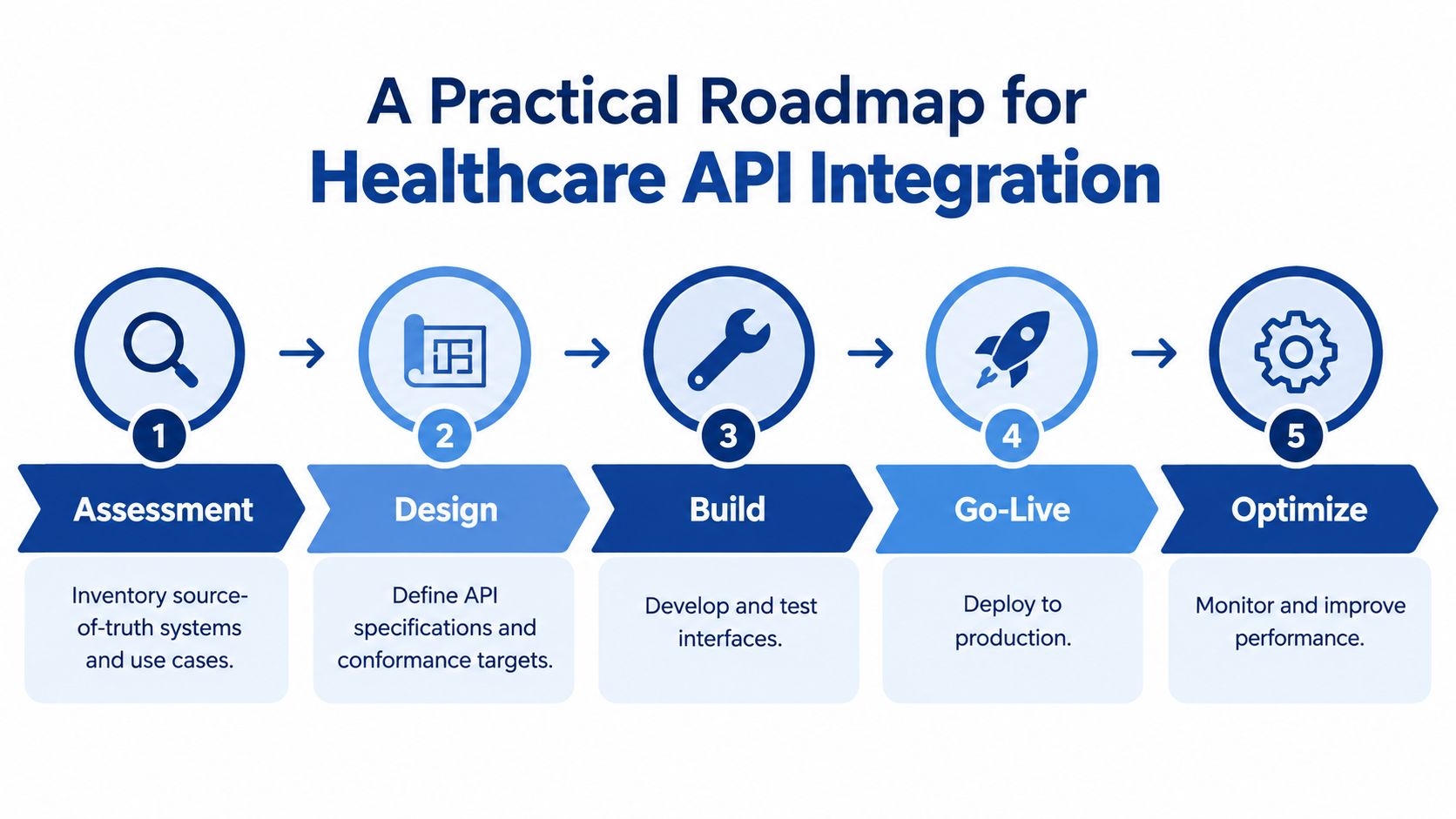
A Practical Roadmap for Healthcare API Integration
A dependable healthcare API integration programme starts with scope, not technology. Choose one clinical workflow with a clear owner, measurable operational pain, and a defined receiving system. Then build the architecture around the information and decisions that workflow requires.
Phases one and two establish the boundary
Assessment begins with an inventory. Identify systems of record, interface engines, EMRs, CIS platforms, patient identity services, current HL7 v2 feeds, documents, APIs, and manual handoffs. Map the patient journey, not only the application ecosystem. Record where data originates, who changes it, who consumes it, and where consent is captured.
Set conformance targets early. For a Canadian exchange, that may include CA Core+, the Pan-Canadian Interoperability Roadmap, provincial implementation guides, and Ontario's FHIR R4 referral specification where relevant. The pan-Canadian roadmap also describes CA:FeX, a FHIR exchange specification intended to create consistency across RESTful exchange patterns pan-Canadian interoperability roadmap update.
Design turns the workflow into a model. Select FHIR resources, profiles, ValueSets, identifiers, search parameters, error responses, and workflow states. Decide whether the connection should use direct FHIR, middleware-mediated exchange, an HIE, or a combination. Draft consent, authentication, audit, downtime, and reconciliation behaviour before development starts.
Build, operate, improve
Build the smallest useful vertical slice. Provide a developer sandbox, implement SMART-on-FHIR authorisation where appropriate, create safe test data with Synthea, and validate resources with Touchstone or Inferno suites. Test negative cases deliberately, including missing identifiers, invalid terminology, duplicate submissions, revoked consent, and unavailable destinations.
Go-live needs a cutover plan, parallel operation where risk justifies it, support ownership, and a feedback loop with clinicians. A technically valid payload can still fail if users don't know where to find it or what an acknowledgement means.
Optimise with instrumentation. Track uptime, latency, rejected messages, duplicate records, patient-matching accuracy, clinician effort, and referral completion signals. Review mappings and profiles as workflows change, and maintain a governed roadmap for capabilities such as IPS and FHIR subscriptions.
Real-World Use Cases and Case Studies
A multi-site clinic network
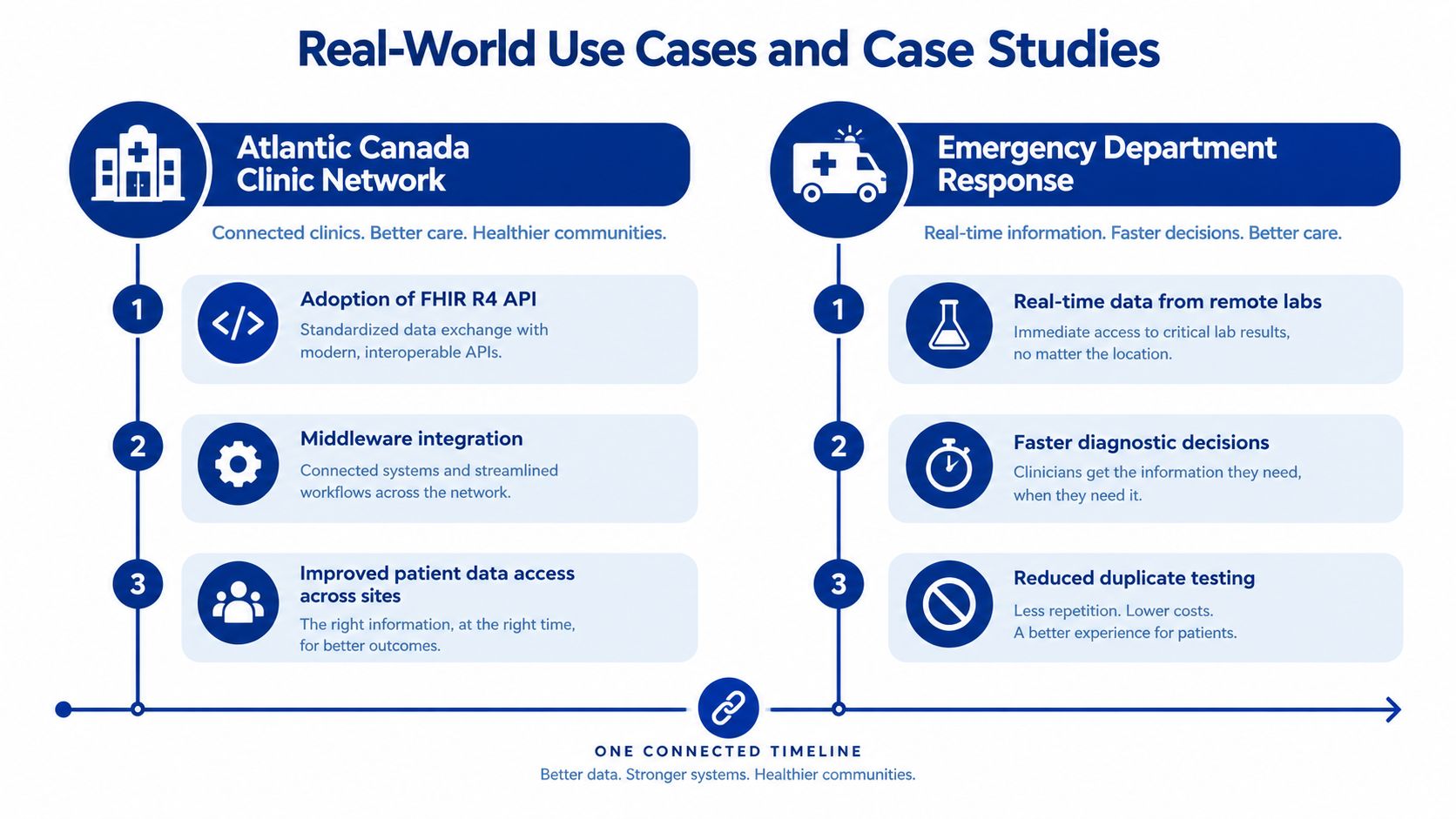
A small clinic network in Atlantic Canada receives laboratory results from several external providers. Its architects place a FHIR R4 API at the boundary, then use middleware to transform incoming messages, reconcile identifiers, validate Observation resources, and route results to the correct EMR locations. The design connects modern FHIR exchange with the HL7 v2 feeds that laboratories may already operate, rather than treating either standard as a complete replacement for the other.
The clinical value depends on what happens after delivery. A structured result is attached to the correct patient, exceptions enter a failure queue, and access is recorded in an audit trail. The project team profiles laboratory data, agrees on terminology mappings, documents local variations, and tests duplicate and correction scenarios. Those decisions are the local equivalent of the profile work seen in Canadian initiatives such as CA Core+, where shared constraints make data more reusable across organisations.
A result is complete only when its lifecycle is defined. The team must decide how corrections are represented, how acknowledgements are handled, where clinicians see the result, when an exception is escalated, and how it is reconciled with a report received manually. This pattern also applies to an Ontario referral exchange built around a FHIR R4 specification: the resource matters, but so do workflow state and operational ownership.
A coordinated-care programme
A provincial coordinated-care programme uses an HIE to make medication history available within community EMRs. A SMART-on-FHIR launch establishes the user's application context, while the HIE supports discovery and exchange across participating organisations. Consent rules determine whether a request proceeds, what information is returned, and which action is recorded.
This arrangement can expose information distributed across sites, while also bringing governance problems into daily clinical work. Patient matching may be uncertain, medication entries may be stale, and source systems may differ in reliability. A correction process is therefore part of the exchange design. Clinicians should treat the returned history as governed clinical information, not as an unquestionable list.
Across both scenarios, three practices keep implementation grounded:
Profile before mapping: Define required data, terminology, and workflow states before writing transformations.
Capture consent in context: Show the patient's choice and access purpose to the application, then retain them in the audit trail.
Manage adoption with the code: Train users, collect exceptions, and revise workflows when exchange creates new work.
Key Takeaways and How Cleffex Can Help
Healthcare interoperability is a layered capability. Transport lets systems connect, structure gives messages a predictable shape, terminology preserves meaning, and organisational governance makes exchange trustworthy. HL7 v2, CDA, and FHIR each have a role, while APIs, middleware, and HIEs provide the plumbing that connects them.
Canadian organisations also need to design for the direction of national and provincial standards. CA Core+, CA:FeX, the Pan-Canadian Interoperability Roadmap, and Ontario's FHIR R4 referral work all point towards shared profiles, reusable data models, and exchange patterns that support more than one local interface. The practical work moves beyond connectivity into terminology alignment, profile conformance, patient identity, consent, and operational ownership.
Leaders should evaluate the result in terms people can recognise:
Clinician time: Less manual calling, faxing, and rekeying.
Care coordination: Faster access to referral, laboratory, and medication information.
Data quality: Fewer duplicate records and more consistent clinical meaning.
Risk management: Consent decisions and access activity that teams can review.
Operational resilience: Queues, retries, monitoring, and clear support responsibilities.
An integration partner can help inventory systems, select standards, create CA Core+ mappings, configure middleware, implement FHIR APIs, test conformance, and monitor go-live behaviour. Cleffex Digital Ltd describes healthcare integration services that connect medical devices, SaMD applications, digital platforms, and hospital EHRs, including HL7 FHIR integration with DICOM, SNOMED CT, and LOINC healthcare software integration services.
If your organisation is evaluating an HL7 feed, FHIR API, referral connection, or HIE initiative, begin with a scoped workflow and a documented roadmap. The strongest architecture is the one clinicians can use, patients can understand, and operations teams can support.
Cleffex Digital Ltd offers healthcare software integration for connecting clinical platforms, medical devices, SaMD applications, and hospital EHRs through standards-based HL7 and FHIR patterns. Visit Cleffex Digital Ltd to discuss your interoperability workflow and arrange a practical scoping conversation.
Frequently Asked Questions
What is healthcare interoperability?
Healthcare interoperability is the ability of healthcare systems and authorised users to exchange, interpret, and use health information consistently. It goes beyond sending a file or message because the receiving system must preserve the data's clinical meaning and place it into a usable workflow.
Is HL7 v2 still relevant when an organisation adopts FHIR?
Yes. HL7 v2 remains useful for established hospital feeds such as ADT and laboratory messaging. Many organisations use middleware to connect HL7 v2 sources with FHIR APIs, allowing modern applications to develop without replacing every legacy interface at once.
What does FHIR integration add?
FHIR integration provides reusable resources, profiles, search operations, and API patterns for exchanging focused clinical information. A successful implementation still requires decisions about terminology, identifiers, consent, authorisation, versioning, and jurisdiction-specific profiles such as CA Core+.
What role does an HIE play?
A Health Information Exchange provides shared services and governance for exchanging information between participating organisations. Depending on its design, an HIE may support patient matching, record location, document discovery, consent enforcement, or clinical data exchange.
How should a Canadian organisation approach interoperability?
Start with one defined workflow, inventory the systems and manual handoffs involved, and identify the relevant provincial and pan-Canadian conformance targets. Design consent, identity, terminology, error handling, audit, and operational support alongside the API or message format, rather than adding them after development.