


Healthcare organisations are trying to deploy AI, telehealth and connected devices while 97% still rely on legacy technology, and 51% say those systems make networks more vulnerable to attack, according to a Canadian healthcare technology report. That combination reframes healthcare technical debt. It isn't old code waiting for replacement. It's the operational, security, data and governance burden created when critical systems must keep running while newer services depend on them.
For hospital IT directors, the consequences are familiar. Clinicians work across records that don't share context. Engineers maintain interfaces nobody wants to touch. Security teams monitor unsupported components. Procurement decisions made in separate departments leave the organisation with duplicated capabilities and incompatible data models. Meanwhile, every proposed AI or digital-health initiative inherits the weaknesses of the platform underneath it.
Platform modernisation provides a practical way forward, but only when leaders treat the work as a managed reduction of risk rather than a wholesale technology refresh. The right approach combines healthcare application modernisation, standards-led integration, targeted refactoring and governance that prevents new debt from accumulating.
The Hidden Cost of Ageing HealthTech Infrastructure
Technical debt becomes expensive when staff must work around it every day. A clinician may have an electronic record in one application, referral information in another and diagnostic context in a separate system. Even if each product performs its narrow function, the care team carries the integration burden manually.
That burden affects more than convenience. The Public Health Agency of Canada's Expert Advisory Group report on the Pan-Canadian Health Data Strategy describes significant data debt as a structural barrier that impedes outcomes, worsens patient and provider experience and drives higher costs. It also describes the resulting integration environment as an “expensive patchwork of ad hoc solutions” across fragmented legacy IT systems.
Technical debt is an operational tax
A useful working definition is this: healthcare technical debt is the accumulated cost of decisions, interfaces, platforms and governance arrangements that make safe change slower and more difficult.
It includes:
Application debt: Unsupported software, obsolete frameworks and modules that can't be changed without unintended consequences.
Integration debt: Custom interfaces, duplicated transformations and point-to-point connections that fail when a vendor changes a data field.
Data debt: Inconsistent definitions, incomplete records and unclear ownership across programmes and jurisdictions.
Security debt: Systems that can't receive updates easily, lack modern authentication or depend on insecure communication practices.
Governance debt: Unclear accountability for standards, architecture, procurement and retirement decisions.
Health Canada's 2026 Deputy Ministerial Briefing Book identifies dated IT systems and applications as risks to cybersecurity, reliability and service delivery. It records an environment containing 26 database technologies and versions, 28 operating systems and versions, 26 web server technologies and 64 development languages. Those figures describe portfolio complexity, not a single overdue upgrade.
Practical rule: If a platform makes routine clinical change depend on specialist memory, undocumented workarounds or manual reconciliation, count that dependency as technical debt.
The immediate cost is often hidden in maintenance work. Teams spend their time keeping legacy servers, interfaces and applications available instead of improving patient-facing workflows. That reduces the capacity available for new capability, increases dependency on scarce specialists and makes every migration harder.
Modernisation therefore shouldn't begin with the question, “Which old system should we replace?” It should begin with, “Which dependencies are creating the greatest operational and clinical risk, and what can we safely change first?”
Root Causes of Accumulated System Debt
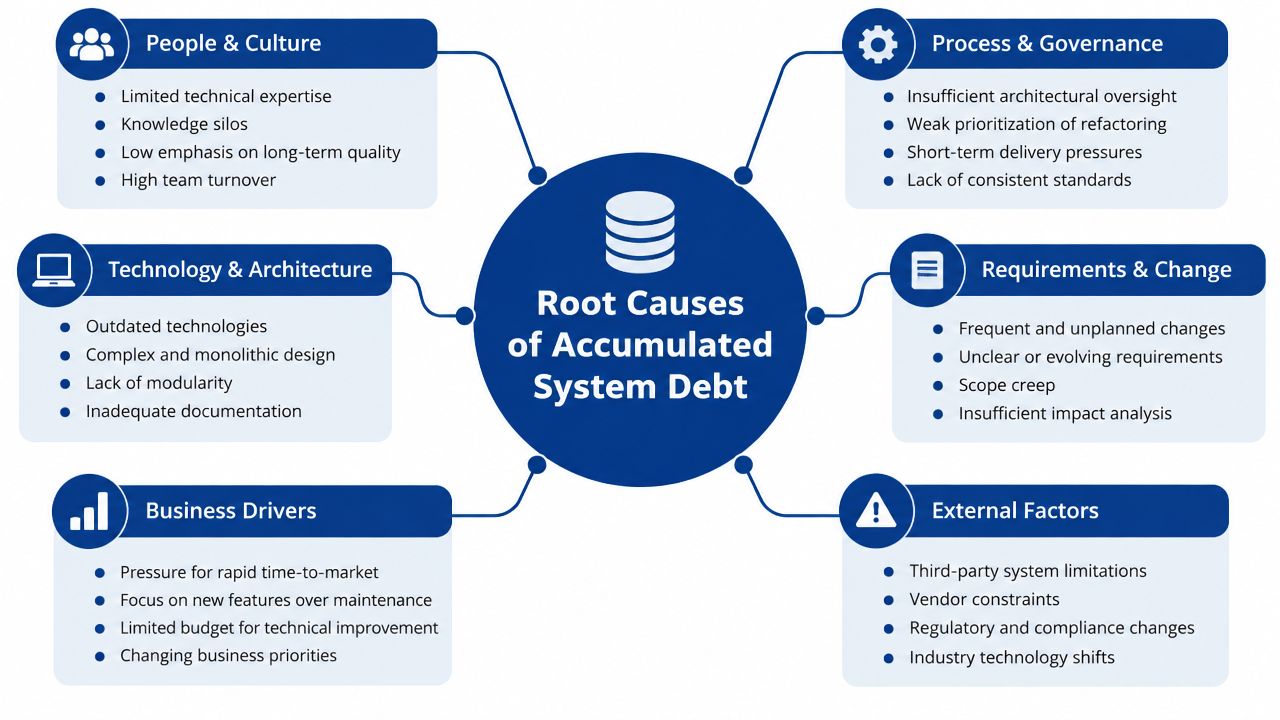
Healthcare organisations rarely choose complexity as a deliberate outcome. It accumulates through reasonable local decisions made without a durable enterprise architecture. A department buys a specialised tool because it solves an immediate workflow problem. A health authority adds an interface to meet a reporting requirement. An emergency programme introduces a temporary data exchange that becomes permanent.
Over time, temporary solutions become infrastructure. The organisation then maintains not one coherent platform, but a collection of products with different owners, contracts, release cycles and technical assumptions.
Local optimisation creates enterprise sprawl
Siloed procurement is a common starting point. Clinical, administrative and public-health teams may select systems according to immediate needs, while interoperability is treated as an implementation detail. The result is a set of products that each work acceptably in isolation but require custom mapping to exchange information.
Vendor lock-in deepens the problem. A hospital may depend on proprietary data models, specialised interfaces or contractual restrictions that make migration difficult. Replacing the product then appears riskier than continuing to operate it, even as support costs and security exposure grow.
Emergency delivery creates another layer. During a public-health response, speed matters, and teams may use short-lived connectors, manual exports or narrowly scoped databases. Those choices can be defensible at the time. They become debt when nobody assigns ownership, documents the design or schedules retirement.
Complexity compounds at the platform level
Health Canada's portfolio description shows why this is more than a collection of old applications. Maintaining 26 database technologies and versions, 28 operating systems and versions, 26 web server technologies and 64 development languages means engineers must preserve knowledge across a broad technical estate. Each additional variation increases testing combinations, patching requirements and dependency management.
The deeper issue is governance. If an organisation approves another point-to-point integration without a shared data model, it may solve one business request while making the next request more expensive. If procurement doesn't require standards conformance, the IT team inherits a long-term architecture decision through a short-term purchasing process.
A practical debt register should therefore record more than age. For every system, capture:
Ownership: Who can approve changes, fund remediation, and accept residual risk?
Dependencies: Which clinical, operational and reporting services rely on it?
Data behaviour: What does it store, expose and transform?
Exit constraints: What prevents replacement, migration or retirement?
Failure impact: What happens to care delivery if it becomes unavailable?
This shifts the conversation from blaming teams for old software to managing the decisions that allowed complexity to persist.
How Legacy Software Blocks AI and Interoperability
AI doesn't remove the need for reliable health data. It increases that need. A predictive model, remote-monitoring service or clinical decision-support tool requires consistent data definitions, dependable exchange and clear permission to use information. Legacy platforms often provide none of those conditions without additional engineering.
A Canadian review found that EHR adoption is high, but interoperability remains low and uneven. Nearly all jurisdictions lack data exchange between hospitals, community specialists and primary care, while disconnected records are estimated to cost taxpayers more than $9.4 billion annually, as documented in the Canadian review of EHR interoperability.
Connectivity isn't the same as interoperability
Two systems can be connected and still fail to exchange useful information. One may send a code that another system interprets differently. A field may exist in both applications but use different value sets. A referral may move electronically while attachments, consent context or clinical provenance remain unavailable.
Canada's national standards work addresses this distinction. The Canadian Core Data for Interoperability defines standardised data elements and value sets. Canada Health Infoway's CA Core+ provides pan-Canadian FHIR profiles for exchange. Together, they separate what the data means from how it moves.
Without that separation, every new integration creates another custom mapping. Engineers then maintain brittle interfaces instead of reusable platform capabilities. The organisation pays repeatedly for work that common semantic and transport standards could have reduced.
AI inherits the weakness of its source systems
An AI project may have a sound model and a capable data-science team, but still fail operationally if source systems are incomplete, delayed or inconsistent. Staff may need to extract data manually, reconcile patient identities or build a new connector for every facility. That work consumes the time that should have gone into validation, clinical safety and adoption.
The same constraint affects telehealth and connected devices. The 2025 Canadian report found that 71% of Canadian organisations use unintegrated, outdated systems for IoT and telehealth devices, while 73% report downtime or technical issues. The report also says legacy systems prevent staff from deploying and managing new devices efficiently, diverting effort into maintenance.
The practical response is to make interoperability a platform capability, not a project-specific add-on. IT leaders assessing an AI-ready healthcare infrastructure roadmap should start with identity, data quality, event exchange, consent, auditability and standards conformance before selecting another AI tool.
Frameworks for Measuring and Prioritising Remediation
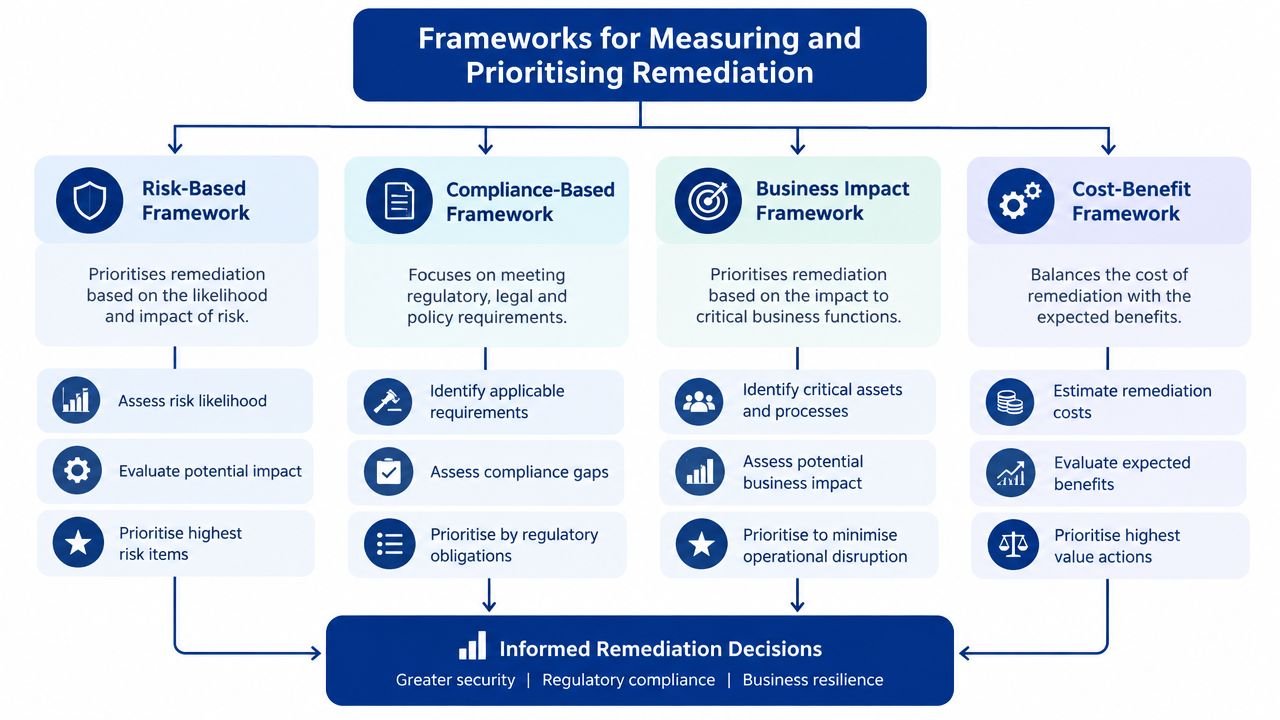
A remediation programme needs evidence that clinical, financial, security and engineering leaders can understand together. A list of old applications isn't enough. It should show which systems create the most harm, which dependencies make change difficult and which intervention can reduce risk without disrupting care.
Start with an application portfolio map. Record each system's purpose, owner, users, data classifications, interfaces, hosting model, vendor constraints, recovery requirements and current support status. Then trace the workflows that cross system boundaries, especially referrals, results, medication information, scheduling and patient communications.
Use four lenses to rank the estate
Clinical and operational criticality comes first. A system supporting a high-volume care workflow deserves a different migration plan from an internal reporting tool. Assess the consequences of delay, degraded performance and unavailability.
Security exposure should be explicit. Flag unsupported operating systems, obsolete components, weak authentication, unencrypted exchanges and systems that can't be monitored consistently. Health Canada's briefing material links dated systems to cyber and reliability risks, so security remediation belongs in the same portfolio conversation as functional modernisation.
Interoperability debt requires a standards comparison. Map existing data elements and exchange patterns against CACDI and relevant CA Core+ profiles. This exposes whether the problem is missing connectivity, incompatible semantics or both.
Change friction reveals the cost of future work. Measure how many teams are needed for a release, how much specialist knowledge is required, how often interfaces break and whether automated testing exists. Qualitative scoring is still useful when the evidence is consistent and reviewed by accountable owners.
Prioritise a safe path to change
The strangler pattern helps teams reduce risk by placing a modern capability around a legacy system, then moving selected functions behind the new interface. Choose a bounded workflow, establish a stable contract and route new activity through the modern service. Retire the corresponding legacy path only after usage, data integrity and operational support are proven.
Use a roadmap that ties each technical action to a visible outcome. A technology roadmap template can help teams align dependencies, ownership and sequencing rather than funding disconnected upgrades.
A useful prioritisation question is, “If we fix this dependency, which clinical workflow becomes safer, faster or easier to change?” That keeps modernisation budgets focused on outcomes instead of platform fashion.
Modernisation Strategies and the Strangler Pattern
The most tempting approach is a full rewrite. It promises a clean architecture, a single migration programme and an end to legacy constraints. In a hospital environment, it also concentrates clinical, data and operational risk into one release. Requirements change during long programmes, integrations behave differently in production, and staff must adapt while the old system remains essential.
Incremental modernisation is slower to describe but safer to operate. Teams expose selected functions through APIs, introduce a standards-based data layer and move capabilities one workflow at a time. The legacy platform continues to serve functions that haven't been replaced, while the modern layer takes ownership of new journeys.
Compare the available paths
| Strategy | Risk Level | Timeline | Best Use Case |
|---|---|---|---|
| Full replacement | High | Long | A system with a clear boundary, stable requirements and a viable parallel operating plan |
| Re-platforming | Medium | Moderate | Moving a supported application to a more maintainable hosting and infrastructure model |
| API-led integration | Medium | Incremental | Preserving core functions while improving exchange, orchestration and access |
| Strangler pattern | Controlled, provided boundaries are clear | Incremental | Replacing high-value modules without switching off the full legacy estate |
| Cloud migration | Variable | Incremental to long | Reducing infrastructure constraints when security, residency and operating controls are ready |
The strangler pattern works best when leaders choose a narrow starting point. A referral workflow, for example, may be separated from a monolithic record system through an API gateway, a FHIR-compatible data layer and a modern service for routing and status. The team can then observe usage, validate data and improve the workflow without rewriting every clinical module.
Sequence engineering around patient care
Cloud migration can support this approach, but cloud hosting doesn't fix poor architecture by itself. Moving a tightly coupled application to a new environment may improve infrastructure operations while preserving integration debt, unclear ownership and difficult releases.
For each migration increment, define rollback conditions, data reconciliation procedures, downtime communications and clinical acceptance criteria. Teams planning cutovers should also review practical guidance on how to minimise downtime during migration, particularly where data must remain available across old and new services.
The trade-off is deliberate. Incremental work may maintain two operating models temporarily, but it limits the blast radius of failure and creates evidence after each release. That is usually preferable to betting patient-facing operations on a single transformation event.
Governance Checklists for Secure Connected Care
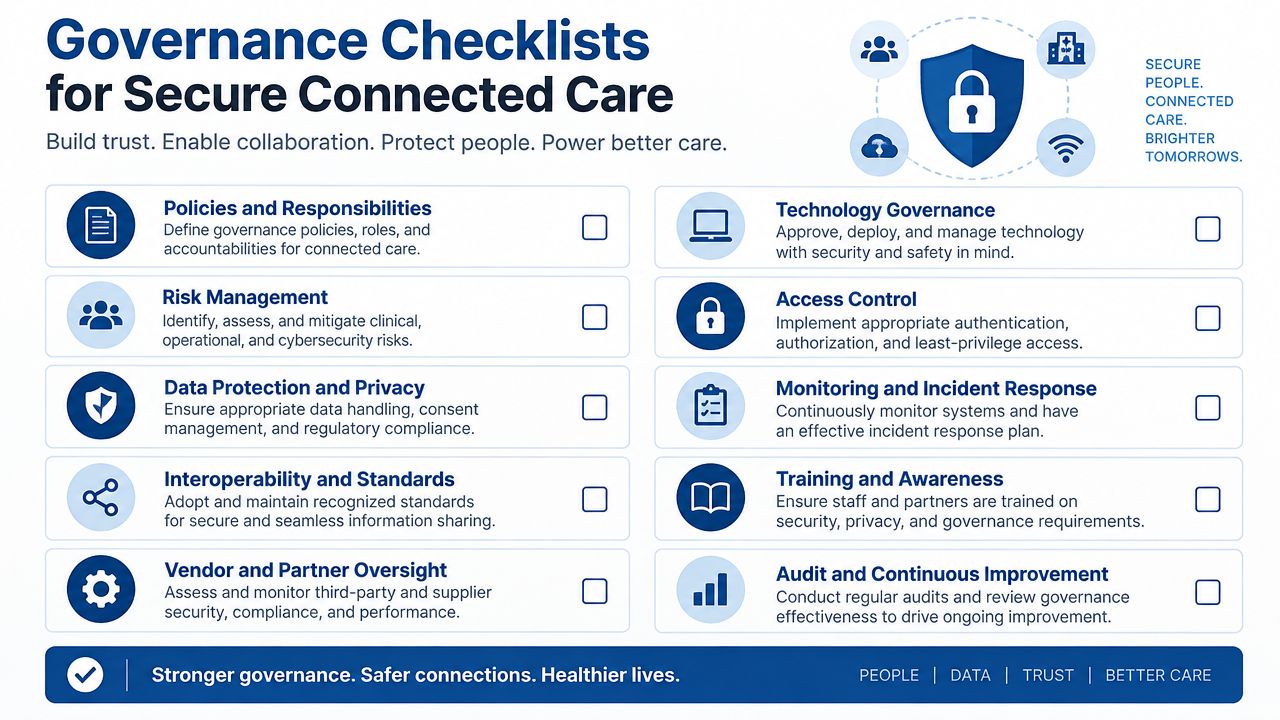
A modern platform can still accumulate debt if governance remains attached to the old environment. Security, privacy, architecture and procurement teams need shared rules for how systems exchange information, how vendors support access and how teams retire unsafe processes.
Canada's privacy commissioners and provincial and territorial partners have called for a coordinated phase-out of traditional fax and unencrypted email for personal health information. Their joint resolution on secure digital health communication identifies encrypted email, secure patient portals, electronic referrals and electronic prescribing as interoperable alternatives.
Replace unsafe communication by workflow
A fax replacement programme fails when it treats fax as a device rather than a clinical process. Identify where staff send, receive, verify and archive information. Then provide an approved alternative that preserves the workflow, including identity checks, delivery status, audit records and exception handling.
Use a staged checklist:
Find the dependency: Inventory fax machines, unencrypted email routes, shared inboxes and manual scanning points.
Define the replacement: Select secure portals, encrypted email, electronic referrals or prescribing based on the workflow and recipient capability.
Control access: Apply role-based access, strong authentication and clear permissions for clinical information.
Record activity: Retain audit trails for access, transmission, amendment and exception handling.
Test with users: Confirm that clinicians and administrative staff can complete the same task without unsafe workarounds.
Retire the old route: Remove obsolete channels only after monitoring confirms that approved alternatives work.
The same resolution recommends standards such as ISO, NIST or CIS, alongside continuous monitoring, periodic audits and incident response plans. Those controls should enter the product lifecycle, not sit in a policy folder reviewed only after an incident.
Prepare for connected-care obligations
On 4 February 2026, the federal government introduced Bill S-5, the Connected Care for Canadians Act, requiring information technology companies providing digital health services in Canada to adopt common standards and support protected, secure information exchange, as described in Health Canada's announcement of the legislation.
The proposed framework defines interoperability through access, use and exchange of electronic health information, and it prohibits data blocking. IT leaders should therefore ask vendors whether their products expose usable data, support prescribed standards and permit a controlled exit. Procurement contracts should include these expectations before a new system becomes another closed dependency.
A practical healthcare data governance guide can help teams formalise ownership, quality controls, retention, consent and accountability.
Building a Future-Proof HealthTech Engineering Culture
Reducing healthcare technical debt becomes sustainable when platform health is treated as part of clinical service delivery. Engineers, clinicians, privacy specialists, procurement leaders and operations teams need shared ownership of the roadmap. A modern interface that can't be supported by the service desk, or a standards project that clinicians can't use, hasn't solved the underlying problem.
Federal policy creates a stronger environment for that shift. Health Canada said Budget 2023 committed close to C$200 billion over 10 years to improve healthcare services, including commitments to improve how health information is collected, shared and used through common standards and policies, as set out in its connected modern healthcare announcement.
Make modernisation continuous
A durable HealthTech engineering culture includes:
Architecture ownership: Someone remains accountable for boundaries, standards and retirement decisions.
Delivery discipline: Every new feature includes testing, observability, documentation and a support plan.
Clinical partnership: Users validate workflow changes before teams retire familiar legacy paths.
Portfolio review: Leaders revisit risk, cost and interoperability as services evolve.
External capability: Specialist partners can augment internal teams for API design, cloud-ready cores, FHIR and HL7 data layers, microservices and secure healthcare software integration.
The goal isn't to eliminate every old component. It's to ensure each component has a clear purpose, owner, risk treatment and exit strategy. That discipline gives AI initiatives dependable data, gives clinicians safer workflows and gives IT teams room to improve the platform instead of merely preserving it.
Cleffex Digital Ltd helps healthcare organisations modernise legacy estates through secure integration, cloud-ready platforms, API gateways, microservices and FHIR and HL7 data layers designed for phased change. Visit Cleffex Digital Ltd to discuss a practical modernisation roadmap that reduces operational risk without forcing an unsafe big-bang replacement.