

You already know the pain point even if you don't call it by name. A broker is waiting, a quote is due, and someone on your team is hopping between a policy admin screen, a claims system, a spreadsheet, and a PDF full of notes that may or may not be current. In that moment, insurance data integration stops being an abstract technology term and becomes the difference between a defensible risk call and a rushed guess.
The strongest insurance teams treat connected data as part of underwriting, pricing, claims, and fraud work, not as a separate IT project. That matters because Canada's regulators and industry bodies are already moving in that direction, and the decisions at stake are concrete, from renewal terms to fraud referrals to reserve accuracy. The result is simple to say and harder to build: one governed view of risk that helps people decide faster and with more confidence.
Why Insurance Data Integration Matters Now
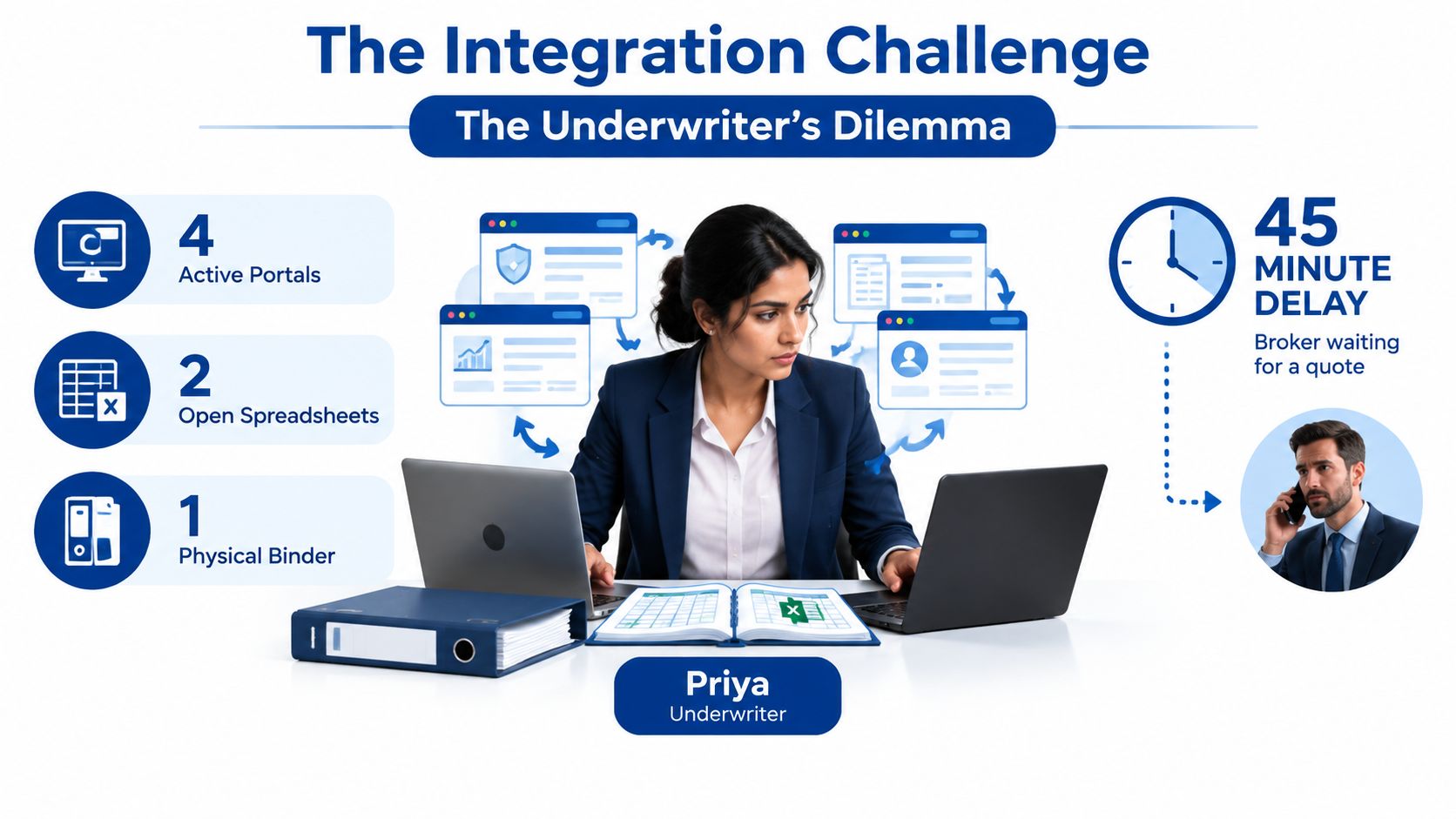
Priya, an underwriter, is staring at four portals, two spreadsheets, and a PDF binder while a broker waits on a quote for a $4M commercial property. She checks bureau data, pulls a motor vehicle record, opens a legacy policy screen, and still has to reconcile what belongs to the applicant, what belongs to the location, and what belongs to an earlier submission. None of the systems is useless on its own, but together they force her to assemble the risk by hand.
Thirty seconds later, the same case looks different when the data is already connected. Priya sees a single risk dashboard with policy, claims, broker notes, external property signals, and prior loss activity tied to one record. The underwriting conversation changes from, “Where is the missing piece?” to, “Is this a quote, a referral, or a decline?”
Three pressures are pushing the change
First, customers expect speed. If a broker can get a fast answer elsewhere, waiting on manual rekeying feels outdated. Second, regulators want decisions that can be explained and audited. Ontario's FSRA is explicitly pushing better reporting and more effective integration of auto-insurance data, while the industry's own dashboard and fraud tools show that shared data has already become operational infrastructure, not a side project. Third, the data itself has multiplied, with telematics, IoT feeds, and third-party signals adding more useful context, but only if teams can connect them to policy and claims systems.
Practical rule: if a piece of data can change a quote, a reserve, or a fraud referral, it should live in the same governed flow as the decision that uses it.
That is why integration matters now. It is the connective layer that turns scattered signals into an underwriting call you can defend, a claim you can triage faster, or a pricing decision that reflects the actual risk rather than the fragments you happened to find.
What Insurance Data Integration Really Means
The cleanest way to think about insurance data integration is an air traffic control tower. Radar, weather, and transponder signals all arrive from different places, but the controller needs one clear picture before a plane lands. In insurance, the same idea applies to policy, claim, customer, and external data, except the goal is not a safe landing; it is a better decision about accept, price, investigate, reserve, or pay.

The three moving parts
The first part is sources. These include policy administration systems, claims platforms, CRM tools, third-party bureaus, telematics feeds, and open data. Each source has its own format and its own timing, which is why a quote file from one system may not line up with a claim extract from another.
The second part is pipelines. Some insurers use batch ETL or ELT jobs. Others use streaming APIs, event buses, or change data capture so updates move when the business event happens. The right method depends on the decision. A nightly warehouse load may suit portfolio analysis, while an instant quote flow needs near-real-time exchange.
The third part is governance. That means lineage, master data, role-based access, consent handling, and audit logs. Without governance, integration just moves confusion faster. With governance, the same record can support underwriting, claims, compliance, and analytics without each team creating its own version of the truth.
What it is not
It is not a one-time migration. A merger, a new product, or a new regulatory feed can change the whole picture. That is why mature teams treat integration as a continuous operating capability, not a project that ends when the last file lands.
Here's the simplest test. If a system only stores data, it is a repository. If it helps people make decisions from multiple sources at once, it is an integration layer.
The Business Case and ROI of Connected Insurance Data
Canada's Competition Bureau estimated in January 2026 that a data portability framework in insurance could save Canadians between $1.1 billion and $3.8 billion in annual costs, which is a strong signal that connected data can create real economic value, not just cleaner workflows. The same policy logic also points to stronger consent, privacy protection, and interoperability, which are exactly the conditions insurers need if they want decisions to be faster and defensible at the same time. You can see the same pattern in pooled fraud work, where shared data surfaces risk that one carrier would never see on its own.
The business case is easiest to understand when you tie it to four CFO-friendly buckets.
| Value Driver | Primary KPI | Typical Baseline | Illustrative Uplift |
|---|---|---|---|
| Faster underwriting | Quote-to-bind cycle time | Manual hand-offs and rekeying | Shorter cycle time through fewer system hops |
| Better risk selection | Loss ratio | Mixed-quality risk signals | Improved pricing and acceptance decisions |
| Less claims leakage | Leakage rate, recoveries | Delayed fraud and subrogation flags | Earlier intervention and cleaner reserves |
| Lower compliance effort | Reporting turnaround | Rebuilt extracts for each request | Reusable regulatory datasets and audit trails |
A simple margin example
Suppose a carrier improves loss ratio by 2 points on a $500M book; that equals $10M of annual margin. That is not a theory exercise; it is the kind of outcome that shows why leadership funds integration work when the data directly affects underwriting and claims performance.
The hard part is connecting the dots between the data and the result. When brokers, policy systems, claims systems, and external sources are linked, underwriters can spot favourable risks more accurately, claims teams can flag fraud earlier, and finance teams can rely on one set of numbers instead of rebuilding them for each report. The value is not just speed. It is fewer bad decisions made with incomplete evidence.
Bottom line: connected insurance data pays off when it changes decisions, not when it merely moves records.
For teams mapping those decisions to broader insurance analytics, this insurance analytics solutions guide is a useful companion when you want to connect data flow to portfolio insight.
Core Architectures and Technical Approaches
The architecture you choose should follow the decision you need to make. A telematics pricing model, an instant quote workflow, and a merger clean-up exercise all need different levels of latency, governance, and flexibility. That is why the “best” pattern depends less on trend and more on what risk decision the data has to support.
Matching architecture to the job
Batch ETL still works well when the business can tolerate delay. It is common for summary reporting, reserve reviews, and historical analysis. ELT into a cloud warehouse suits insurers that want raw source data landing quickly in platforms such as Snowflake or Databricks before transformation. That works well for telematics-driven pricing or wider analytics, where the value comes from combining many signals after ingestion.
Real-time APIs are the right fit when the decision has to happen immediately, such as quote-to-bind, claims intake, or a broker portal response. Enterprise Application Integration buses help when many systems must coordinate event flow, especially in older environments with policy, billing, and claims platforms that were never designed as one stack. Master Data Management hubs become vital when policy, party, vehicle, and claim records need reconciliation across multiple acquired books or business units.
If you are comparing vendors, one useful way to pressure-test the architecture is to ask how they handle lineage, consent, and reuse across underwriting and claims. That is also where a practical resource such as reach for UK trade inquiries from AutoProv can be helpful, especially when your team is assessing integration fit across operational systems.
A simple technical picture
A common analytics layer might look like this:
policy_fact, one row per policy event or transaction
party_dim, one row per insured, broker, or claimant
vehicle_dim, one row per vehicle or asset
claim_dim, one row per claim or loss event
That star schema gives actuaries, underwriters, and fraud teams a common structure for analysis. It also makes it easier to feed models, reports, and supervisory extracts from the same governed dataset.
For teams exploring how policy platforms and data layers fit together, this guide to policy management system integration offers a practical complement. Cleffex Digital Ltd also builds insurance integration layers that connect policy administration, claims, billing, compliance, and third-party systems into a single source of truth.
| Integration Pattern | Latency | Best Insurance Use Case | Governance Fit | Typical Cost Profile |
|---|---|---|---|---|
| Batch ETL | Low speed, scheduled | Reporting, reserves, history loads | Strong for controlled extracts | Lower upfront, slower to adapt |
| ELT in warehouse | Medium | Analytics, telematics, pricing | Good if modelling is disciplined | Moderate, scalable over time |
| Real-time APIs | High | Quote, bind, claim intake | Strong with contracts and audit logs | Higher design effort, high value |
| EAI bus | Medium to high | Cross-system orchestration | Good in complex estates | Moderate to high |
| MDM hub | Medium | Party and policy reconciliation | Very strong for master records | Higher setup, lower duplication |
Industry Standards, Data Models, and Compliance Foundations
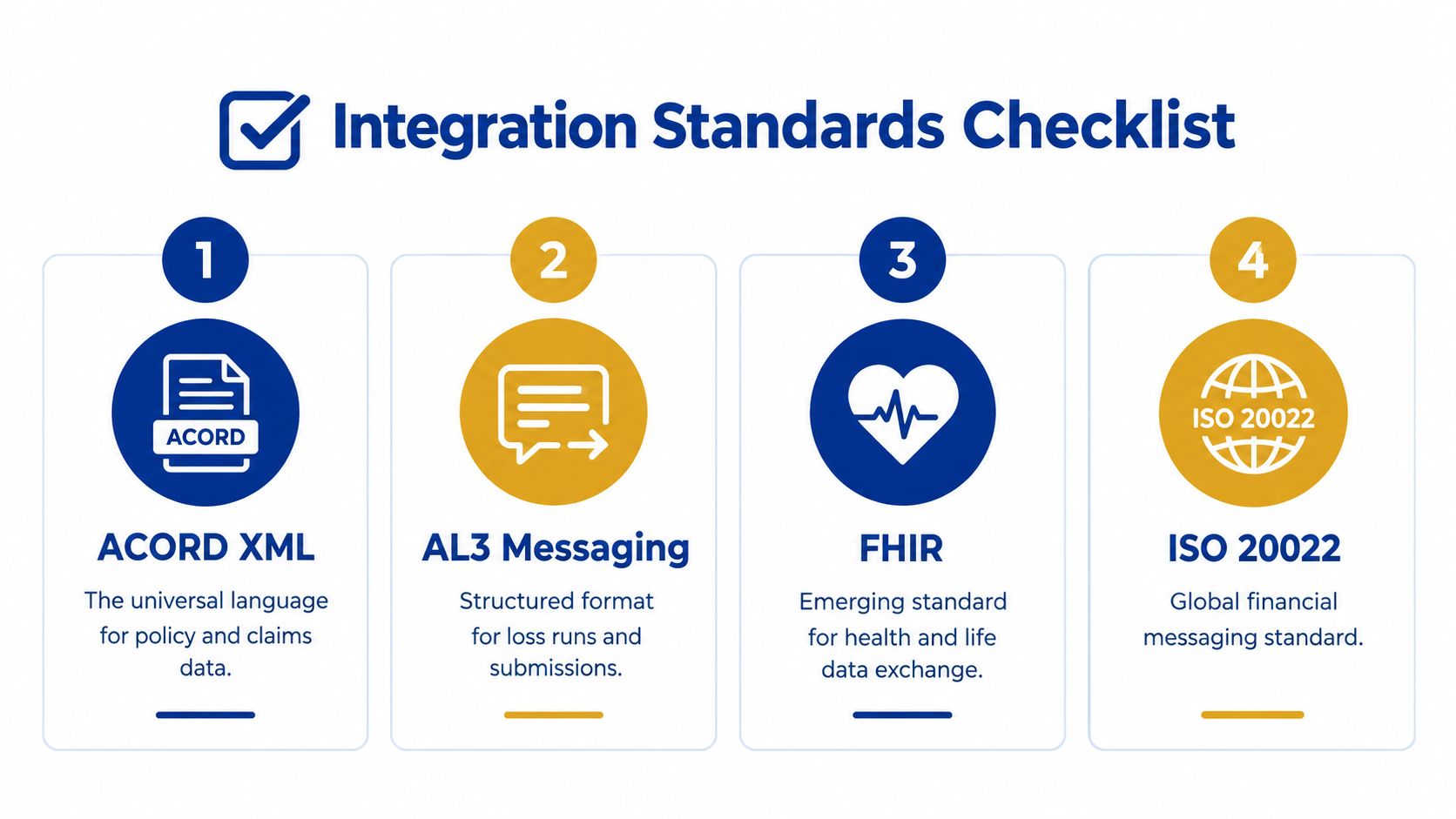
Integration breaks down fast when everyone uses different language for the same thing. That is why standards matter. ACORD XML and AL3 give carriers, brokers, and reinsurers a structured way to exchange policy, claim, and submission data. In the US, IID supports insurance intercompany distribution, while CSIO plays a similar broker-carrier role in Canada.
The standards stack that keeps data usable
A working integration programme usually needs four layers of structure. First, a canonical data model for party, policy, and claim entities. Second, an Insurance Data Dictionary so terms mean the same thing across systems. Third, transport formats such as ACORD XML or AL3. Fourth, controls that define who can see and change what.
That control layer matters just as much as the format layer. In Canada, PIPEDA sets privacy expectations, and if personal health data is involved, HIPAA becomes relevant in the broader ecosystem. On the operational side, the NAIC Model Law and OSFI B-13 shape expectations around cloud use and third-party risk, so integration teams need to think about vendors, hosting, and auditability from day one.
What a good team produces
A mature insurance integration team should be able to show:
A data dictionary, so business and IT agree on definitions
A lineage map, so the path from source to report is visible
A consent record, so privacy choices are traceable
An audit log, so access and changes can be reviewed
If a regulator asked where a field came from, who changed it, and whether the customer consented, your team should be able to answer without pulling three people into a meeting.
For health-related exchange, standards like FHIR are becoming more important, and global finance teams may also encounter ISO 20022. The point is not to collect acronyms. It is to make sure every data movement has a common format, a known owner, and a clear compliance trail.
Real-World Use Cases That Improve Risk Decisions
A Toronto homeowner with a renovated kitchen and a new security system should not be priced the same way as someone with stale property records and no recent activity. When underwriting teams can combine property data, prior loss history, and external signals, the decision becomes more precise. The data does not make the decision for the underwriter; it gives the underwriter a better basis for the call.
Four ways connected data changes the decision
| Use Case | Integrated Data Sources | Decision Changed | Measurable Outcome |
|---|---|---|---|
| Property underwriting | Property data, policy history, external risk signals | Accept, price, or refer | Better risk selection and cleaner pricing |
| First notice of loss | Claims data, pooled fraud patterns, telematics | Investigate or pay | Faster fraud triage |
| Cat exposure monitoring | Shared policy and claims data across carriers | Reserve and exposure decisions | Better portfolio visibility |
| Cross-carrier fraud review | Anonymised claims data across insurers | Flag or escalate | Stronger fraud detection workflow |
Ontario's auto market offers one of the clearest examples of this in practice. CANATICS-style pooled analytics help insurers analyse claims patterns across the market, which means suspicious behaviour can be surfaced sooner than any single carrier could manage alone. The same logic applies to the 20-insurer life and health fraud pool, where anonymised service-provider claims data supports investigation without sharing personal facts about insured people.
For teams that want to connect property signals to underwriting, this assess risk using API resource is a useful example of how external data can support a more structured review process. The implementation question is always the same: which data changes the decision, and at what point in the workflow?
What changes operationally
In claims, connected data can move a file from passive intake to active investigation. In underwriting, it can turn a vague referral into a specific pricing action. In portfolio management, it can give leadership a more current view of concentration and exposure, which is especially relevant when reports need to line up across carriers and regulators.
The claims system integration for insurers discussion is useful here because claims is where integration often proves its worth fastest. Faster cycle times matter, but so does confidence that the reserve, the fraud flag, and the policy history all refer to the same event.
Implementation Roadmap, KPIs, and Vendor Selection
The fastest way to fail is to start with tools before you know which risk decision they support. A better sequence is discovery, pilot, production, and optimisation. Each stage should be tied to one underwriting or claims milestone; otherwise the programme becomes a data project with no business owner.
A phased rollout that stays grounded
Discovery and data inventory come first. Map policy, claims, billing, CRM, document, and external sources, then identify where data quality or duplication affects decisions. The KPI here is not glamour; it is visibility. If the team cannot tell where a key field originates, the rest of the roadmap is shaky.
Pilot on one line of business should focus on one decision, such as quote triage or first notice of loss. Measure straight-through processing rate, underwriting cycle time, or fraud referral quality before widening the scope.
Scaled production rollout should connect the pilot to compliance and reporting. Ontario's FSRA and Canada's broader shared-data environment make reusable extracts, lineage, and auditability essential, not optional.
Continuous optimisation is where teams tune matching rules, refine master data, and improve exception handling. That is where data quality score, claims leakage reduction, and fraud detection hit rate matter most.
What to look for in a vendor
A vendor checklist should ask whether the platform supports ACORD formats, pre-built insurance models, Canadian compliance experience, cloud security controls, and the integration pattern your estate needs. It should also ask for reference customers in similar lines, because a platform that works for a life insurer may not fit a P&C claims workflow.
A mid-size P&C carrier can usually shortlist vendors quickly if it scores them on those criteria and keeps the pilot narrow. One practical pattern is to compare two vendors over 60 days, using the same use case, the same data sample, and the same success metrics, then choose the one that creates less manual reconciliation.
| Criterion | What to Verify | Why It Matters |
|---|---|---|
| ACORD support | Policy, claim, and submission compatibility | Reduces custom mapping |
| Canadian compliance track record | FSRA, OSFI, PIPEDA experience | Lowers regulatory risk |
| Security posture | Access control, logging, encryption | Protects sensitive data |
| Integration coverage | APIs, batch, events, MDM | Matches your operating model |
| Insurance data model | Canonical entities and lineage | Improves consistency |
| Reference customers | Similar line, similar scale | Reduces implementation risk |
If your team is comparing build and buy options, remember that maintenance usually decides the question. Custom builds can work, but they need more ongoing ownership than most business teams expect.
Frequently Asked Questions and the Road Ahead
How much does a project like this cost?
Mid-size carriers often face meaningful platform and implementation effort, but the right answer depends on scope, legacy complexity, and how many decisions the integration must support. A pilot can stay narrow, but a full operating layer needs governance, mapping, testing, and support.
How long does it take to go from pilot to production?
A focused pilot can move quickly if the team limits the use case and the source systems are well understood. Full production usually takes longer because security, consent, lineage, and workflow design all have to be proven in practice.
Should we build or buy?
Buy when speed, maintenance burden, and compliance readiness matter most. Build only if the integration logic is highly specialised and you are ready to own it for the long term.
What goes wrong most often?
Teams underestimate data quality work, skip governance, or over-customise APIs. Any one of those can turn a sensible integration into a support burden.
By 2027, real-time integration, AI-assisted underwriting, and pooled fraud analytics are likely to sit much closer to the centre of risk decisioning. The winning insurers won't be the ones with the most data; they'll be the ones that can turn connected data into cleaner underwriting, faster claims handling, and better fraud control without losing governance on the way.
Cleffex Digital Ltd helps insurers connect policy administration, claims, billing, compliance, and third-party systems into a governed data layer that supports underwriting, claims, and analytics. If you're planning an insurance data integration programme and want a practical engineering partner, visit Cleffex Digital Ltd to see how its insurance and fintech services can support your roadmap.