

Your remote-monitoring product works beautifully in one clinic. The workflow is familiar, the data stays within a controlled environment, and your team can solve problems through a shared chat channel. Then a second site goes live. Patient identifiers collide, site permissions blur, an EHR export arrives in an unexpected format, and the engineer on call can't reproduce the error from production.
That moment exposes the challenge in healthtech product development. Scaling isn't a neat sequence of features added to a working MVP. It's the process of extending a foundation without rewriting identity, data, integration, security, and operational controls under pressure. In Canada, the market has already moved beyond basic digitisation. Statistics Canada reports that 92% of health care providers had access to a digital health system in 2024, so buyers increasingly expect products to fit secure, interoperable clinical workflows.
This guide focuses on the decisions that keep a HealthTech MVP extensible. At every stage, the question is simple: what must exist in the foundation now, and what can safely wait?
The Day Your Pilot Stops Working
The founder usually sees the failure as a bad deployment. The team sees something else. A remote-monitoring MVP that handled one speciality clinic has encountered assumptions hidden in almost every layer of the product.
At the first clinic, a patient identifier may look unique. At the second site, the same identifier can refer to another person. If the database has no tenant boundary, the application can't reliably separate records. If audit logs record only a user ID and timestamp, an investigation can't show which organisation accessed or changed the record.
The identity system often fails next. A pilot may rely on local accounts or shared passwords because the clinic needs to start quickly. Enterprise customers expect SSO, role-based access, lifecycle management, and clear separation between administrators, clinicians, support staff, and patients. A shared credential isn't merely inconvenient. It destroys accountability.
The integration exposes hidden assumptions
The first EHR may provide a clean export. The next sends a different representation of allergies, missing fields, duplicate records, or unfamiliar clinical codes. A direct mapping written for one site becomes a chain of exceptions. Without a canonical clinical model and an auditable ingestion process, developers patch symptoms instead of controlling data quality.
FHIR guidance in Canada treats secure transit, authorised access, and audit measures as baseline requirements for FHIR transactions, not optional enterprise enhancements. The Canadian FHIR security guidance is a useful reference when deciding which controls belong in the original architecture.
Practical rule: If a capability affects who can access health information, which tenant owns it, what changed, or whether the product crosses a regulated boundary, design for it before the first pilot.
The operational failure is just as serious. The on-call engineer can't reproduce an error because production data, configuration, integration responses, and permissions differ from the development environment. The team has no correlation IDs, replayable events, structured logs, or safe support tooling.
This is why a practical healthtech platform engineering approach treats the MVP as a small deployment of a larger platform, not a disposable prototype. The product can remain narrow, but its boundaries must be deliberate.
MVP Mindset Versus Enterprise Mindset
An MVP optimises for learning. An enterprise platform optimises for repeatable operation across organisations that don't share your assumptions. Both mindsets are useful, but confusing them creates expensive rework.
The MVP can support one workflow, one customer, one clinical champion, and manual operational handholds. It shouldn't, however, hard-code those constraints into identity, storage, or regulated behaviour. The enterprise product adds stronger controls, formal evidence, contractual commitments, and broader integration coverage around that foundation.
A decision table for the foundation
| Dimension | MVP Mindset | Enterprise Mindset |
|---|---|---|
| Identity | A small set of roles and controlled account provisioning | SSO, automated lifecycle management, granular roles, and organisation boundaries |
| Data model | A focused workflow with a canonical internal model | Multi-tenant clinical, operational, consent, and audit data with governed exchange |
| Deployment | One controlled environment and manual release support | Repeatable environments, controlled changes, monitoring, rollback, and customer isolation |
| Support | Founder-led responses and direct clinical feedback | Ticketing, escalation paths, service commitments, and documented ownership |
| Security | Threat model, encryption, access controls, and audit events | Continuous assurance, evidence collection, supplier controls, and formal security reviews |
| Compliance | Defined intended use and documented risk assumptions | Controlled lifecycle, validation evidence, post-market processes, and procurement documentation |
Some enterprise capabilities can wait. Multi-region failover, advanced analytics, polished self-service administration, and broad connector libraries usually don't belong in the first release if the product has no evidence of demand for them.
The dangerous deferrals are different. A team can postpone a complex consent console, but it can't postpone recording consent decisions in a way that can later support policy-driven workflows. It can start with one identity provider, but it shouldn't build an identity model that assumes every user belongs to one organisation. It can manually review releases, but it needs versioned changes and traceability from the beginning.
Canada's market signals this shift in buyer expectations. Pender Ventures reported approximately C$700 million in Canadian health tech venture funding across 287 deals in 2024, after funding fell 18% from 2023. The same report describes roughly C$1.3 billion in disclosed capital in 2025, with fewer deals and larger overall funding. That pattern points towards selective investment in products with stronger validation, regulatory readiness, and commercial evidence.
The foundation test
Use this rule during backlog grooming:
Identity: Build organisation, user, role, and service-account boundaries into the MVP.
Data partitioning: Make tenant ownership explicit in storage and application services.
Audit: Capture security-relevant and clinical-relevant events in a durable, queryable log.
Regulated boundary: Define intended use, claims, risk controls, and change ownership before adding clinical decision functionality.
Experience: Defer visual polish and complex configuration until users prove the workflow.
Scale mechanics: Add capacity automation and failover when usage and contractual obligations justify them, but keep deployment repeatable from the start.
The MVP saves time when it narrows the workflow. It doesn't save time when it disguises structural shortcuts as speed.
Compliance and Privacy Built In From Day One
Privacy compliance isn't a release checklist. It shapes the data model, user journeys, vendor contracts, support processes, and engineering evidence. Retrofitting it after adoption creates difficult migrations because the product has already collected information under assumptions that may not be defensible.
Start by classifying the data. Separate direct identifiers, clinical information, operational metadata, device telemetry, support records, and derived analytics. Document the lawful basis or permitted purpose for each use under the applicable framework, including HIPAA, PIPEDA, and GDPR where the product operates across jurisdictions. Consent isn't interchangeable across those regimes, so the system should record the policy and context behind a decision rather than storing a generic yes or no.
Controls that belong in the first release
Role-based access should exist before the first external user. Keep clinical access, organisation administration, support access, and system operations distinct. Add a controlled break-glass path for exceptional access, with a reason, approval or review workflow, strong authentication, and prominent audit events.
The audit trail must be durable and resistant to casual alteration. Record who performed an action, what resource it affected, when it occurred, which organisation context applied, and whether the action succeeded. Encrypt data at rest and in transit, manage keys separately from application secrets, and define retention and deletion behaviour before the database grows.
Training and analytics introduce another boundary. De-identify or appropriately minimise data used for model development, testing, and reporting. A copy of production data in a developer environment isn't a harmless convenience, especially when the team hasn't defined access, retention, or re-identification controls.
Know when software becomes regulated
Intended use and product claims determine whether a feature sits inside a medical-device boundary in a relevant jurisdiction. A dashboard that displays information may face a different pathway from software that recommends diagnosis or treatment. Once the product crosses that boundary, documentation, verification, validation, risk management, and change control become part of product delivery.
For practical background on designing privacy controls, privacy compliance by SigOS can help teams connect principles to implementation decisions. A more engineering-focused treatment is available in this guide to compliance-driven software development.
Your day-one baseline should include:
Threat model: Map actors, trust boundaries, sensitive assets, abuse cases, and mitigations.
Privacy assessment: Complete a DPIA or equivalent assessment for the intended processing.
Supplier agreements: Put BAAs and equivalent data-processing terms in place with relevant sub-processors.
Security baseline: Document authentication, encryption, logging, vulnerability management, and access review requirements.
Ownership: Name a privacy owner and a security owner, even if one person initially holds both responsibilities.
Change discipline: Version requirements, risk decisions, architecture changes, and releases.
Compliance adds work early. That work is cheaper than explaining to a hospital why the product can't prove who accessed a record.
Architecture, EHR Integration, and FHIR Exchange
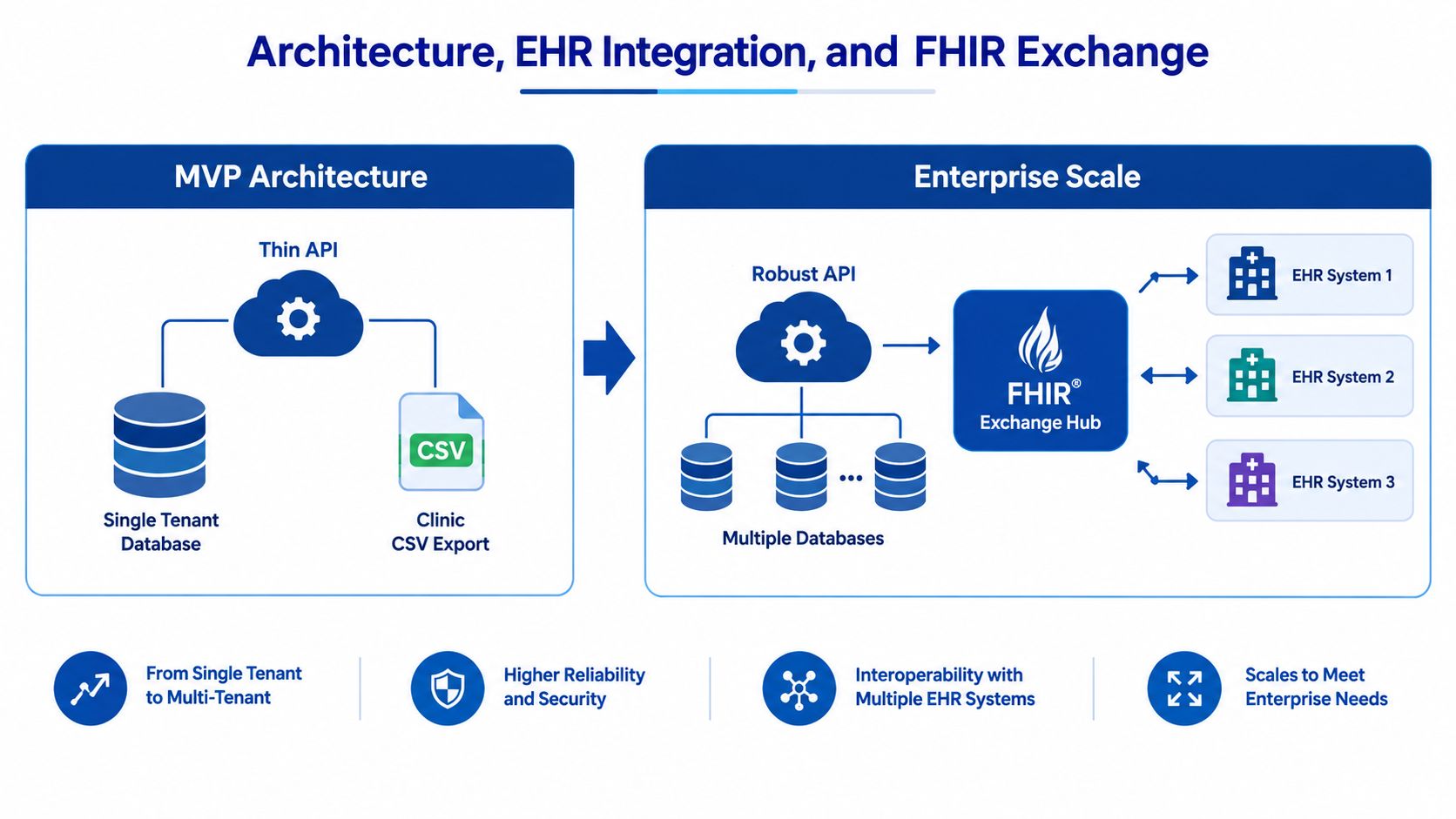
A narrow MVP can start with a thin API, a single tenant database, and one integration target. In practice, that target is often a clinic's CSV export from an EHR. This is acceptable as a learning mechanism, provided the internal model doesn't become a copy of the first file format.
Enterprise HealthTech platform development needs stronger boundaries. Each customer may require a separate identity context, different data residency expectations, bidirectional exchange, and connectivity with systems such as Epic, Cerner, or Meditech. The architecture must accommodate those requirements without making every new integration a bespoke rewrite.
Lock the right layers early
Keep clinical data separate from operational data and audit data. Clinical resources should represent structured concepts, operational records should handle workflow state, and audit events should preserve evidence of what the system did. Mixing all three into one flexible table makes early development quick and later governance painful.
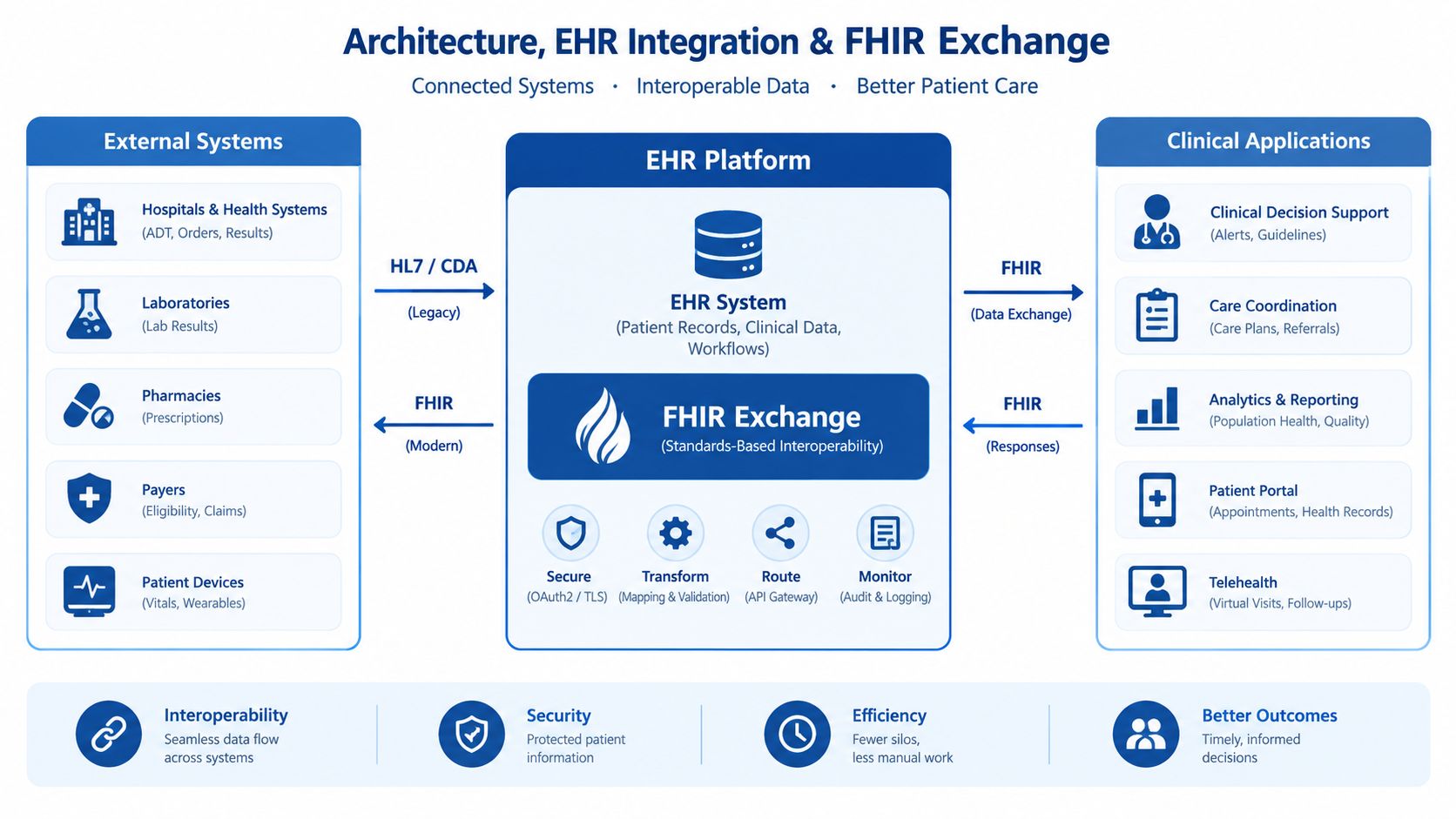
Choose a FHIR-first internal model even if the first customer uses REST or file exchange. Canadian interoperability work describes FHIR resources for medications, conditions, allergies, lab results, and immunisations, exposed through RESTful APIs. A Senate brief on the federal interoperability framework explains the value of structured resources and secure exchange across health information technologies.
An identity and consent service should be able to map users, organisations, scopes, and authorisation decisions to SMART-on-FHIR patterns. The MVP doesn't need every SMART capability, but it should avoid embedding permissions inside individual screens or integration scripts.
Replace batch assumptions with traceable exchange
An event-driven backbone lets ingestion, reconciliation, notifications, audit, and downstream processing react to durable events. The first deployment can still use a scheduled export, but the event record should show when data arrived, how it was transformed, which version performed the transformation, and whether a human resolved an exception.
Use HL7v2 where a legacy bridge requires it, and FHIR for newer endpoints. Put those protocol decisions in an integration tier rather than spreading them through clinical services. The same principle applies to connected devices. Teams working with connected medical equipment should treat securing IoMT devices as part of the trust boundary, not as a separate hardware concern.
A practical guide to integrating FHIR with EHR systems can support discovery, but the product team still needs its own conformance tests, mapping catalogue, error policy, and reconciliation workflow. A successful MVP proves one clinical use case. A scalable foundation proves that the next source can be added without changing the meaning of existing data.
Validation, Testing, and Post-Market Monitoring
A regulated product changes the meaning of “tested”. In an ordinary application, a passing test may show that a feature behaves as coded. In medical software, the team must also show that the intended use is supported, hazards are controlled, users can operate the system safely, and changes don't invalidate previous evidence.
The MVP can use focused usability sessions, risk-based exploratory testing, and a carefully bounded pilot. That doesn't justify an undocumented process. Define requirements, intended users, foreseeable misuse, and acceptance criteria before the pilot produces evidence you later need to interpret.
Testing maturity changes with the product
| Activity | MVP / Pilot | Enterprise / Regulated |
|---|---|---|
| Requirements | Focused workflow requirements and known assumptions | Traceable requirements linked to risks, tests, releases, and intended use |
| Verification | Automated unit and integration tests around critical paths | Design-verification protocols, controlled execution, review, and retained evidence |
| Validation | Limited usability work with the target clinical workflow | Formal design validation, clinical evaluation, and representative use environments |
| Risk management | Initial hazard analysis and mitigation backlog | Maintained FMEA or equivalent, risk-based regression, and documented residual risk |
| Usability | Task observation and feedback from pilot users | IEC 62366 usability engineering artefacts and use-related risk controls |
| Software lifecycle | Lightweight release notes and code review | IEC 62304-aligned lifecycle evidence, configuration control, and change assessment |
| Cybersecurity | Threat modelling and security testing of exposed surfaces | Penetration testing, vulnerability response, SBOM management, and release evidence |
| Post-market | Direct issue reporting and manual review | Complaint handling, safety reporting, anomaly detection, and real-world evidence review |
The precise regulatory route depends on the product's intended use and jurisdiction. For software as a medical device, teams may need to work with frameworks such as MDR Annex XIV or FDA quality-system expectations. The important engineering consequence is consistent: validation becomes a maintained pipeline, not a document created before launch.
Models need their own operating discipline
Machine-learning tools add change risk because performance can shift as data, environments, and model versions change. Health Canada's guidance for machine-learning-enabled medical devices highlights expectations around algorithm change protocols, transparency, and cybersecurity. The Canadian regulatory discussion of healthcare AI is useful for framing the operational burden beyond initial authorisation.
For every model, record training data provenance, evaluation cohorts, intended operating conditions, version history, approval status, and rollback criteria. Monitor input quality and output anomalies without exposing unnecessary patient information. A model update should trigger a documented impact assessment, targeted regression tests, and a decision about whether new clinical evidence is required.
Post-market operations should include:
Complaint handling: Capture, triage, investigate, and close issues through a controlled workflow.
Safety escalation: Separate clinical safety review from ordinary technical support.
Vulnerability response: Track advisories, affected components, remediation, and customer communication.
Performance monitoring: Watch for drift, abnormal outputs, integration failures, and unexpected use.
Evidence feedback: Feed verified findings into requirements, risk files, training, and release planning.
A pilot proves that software can work. Enterprise validation proves that the organisation can know when it stops working.
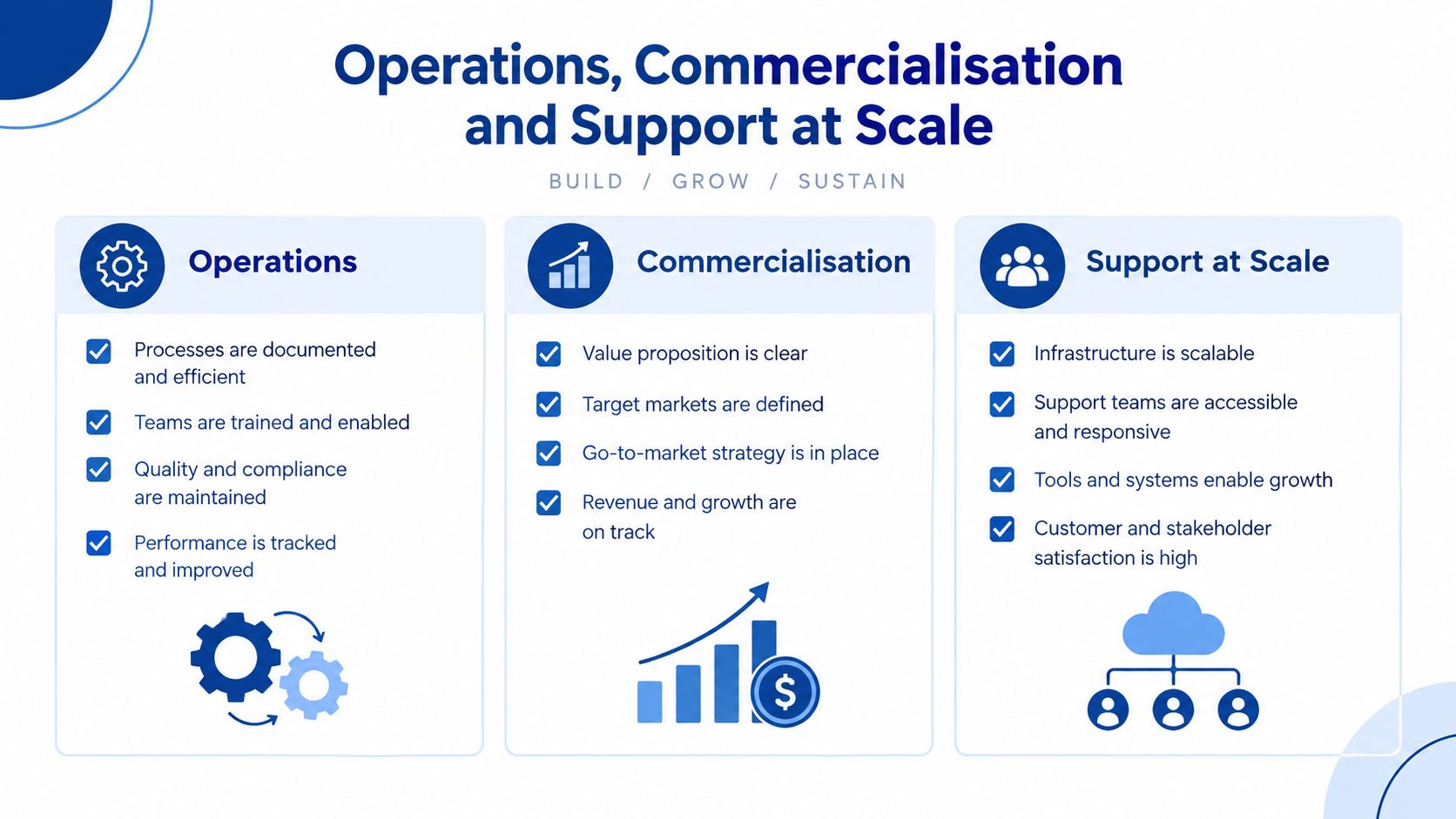
Operations, Commercialisation, and Support at Scale
A founder on call can keep a pilot alive. That isn't an operating model for hospitals, insurers, or multi-site clinical networks. Enterprise customers need predictable service, clear accountability, evidence of control, and a safe route to escalate clinical concerns.
Start planning the operating backbone before the full platform arrives. Define service tiers by customer need, with measurable availability objectives, incident response commitments, maintenance rules, and escalation ownership. A clinical safety escalation path should sit alongside engineering on call, because a data delay, incorrect alert, or failed integration can have a different consequence from an ordinary application defect.
Make trust visible to buyers
Procurement teams often ask for evidence before they approve a deployment. A status page, customer trust portal, security policies, sub-processor register, incident process, and audit evidence reduce repeated conversations. SOC 2 Type II and ISO 27001 preparation should begin before the first enterprise deal if those frameworks are relevant to the target market. Waiting until procurement asks for them turns commercial momentum into a compliance emergency.
The 2026 Canadian policy direction makes this operational maturity more important. Health Canada describes legislation introduced in February 2026 that would require common standards for secure information exchange while respecting existing privacy law. A product that works only through a private, undocumented connector may survive a pilot, but it will struggle when customers expect standards-based exchange and evidence of policy alignment.
Pricing must reflect the work you support
Per-seat pricing can work for a narrow clinical workflow, but it may not represent the value or cost of population monitoring, connected devices, integrations, and support. Consider whether a value-based, organisation-based, or population-based structure better matches usage and clinical responsibility. Avoid promising service levels that the operating team can't measure.
Contracts should define data use, sub-processors, security responsibilities, retention, breach communication, service commitments, and exit assistance. Support tooling must also protect the data. Use a ticketing system with PHI redaction, controlled attachments, access logging, and a clear rule that production records aren't copied into informal channels.
Create a customer success function around clinical champions, not just contract renewals. Frontline tickets reveal confusing workflows, unsafe defaults, missing integrations, and training gaps. Route those signals into a prioritised product backlog with ownership and evidence. Broader lessons from biotech scale-up pitfalls also apply here, particularly the risk of expanding commercial activity faster than quality and operational controls can support.
The foundation still matters most. Build tenant-aware identity, structured data, auditability, secure exchange, controlled releases, and observable operations into the MVP. Add advanced reporting, wider connectors, self-service administration, and resilience improvements as demand and contractual obligations justify them. That balance is the practical core of healthcare software scalability.
Cleffex Digital Ltd helps healthtech teams turn validated workflows into secure, integration-ready products, from discovery and MVP architecture through healthcare software integration and enterprise delivery. Visit Cleffex Digital Ltd to discuss the identity, interoperability, compliance, and operational foundations your product needs before its next customer exposes the cracks.