

You’re probably in one of two situations right now. Either your team is close to launching software, and someone has finally asked, “Have we checked the compliance side?” Or you already launched, a customer or partner sent over a security questionnaire, and now the whole project has slowed to a crawl.
That’s where compliance-driven software development stops being a theory and starts becoming a practical operating model. For small and mid-sized businesses, the problem usually isn’t a lack of intent. It’s that the business doesn’t have a large internal compliance team, yet still has to build software that handles customer data, survives vendor reviews, and passes audits without turning every release into a committee exercise.
The good news is that compliance doesn’t have to sit at the end of the project like a final exam. The better approach is to build software the same way a good builder works, to code from the first drawing, not after the walls are already up.
The High Stakes of Software in a Regulated World
A lot of teams still treat compliance as paperwork. It isn’t. It shapes product decisions, architecture, hosting choices, analytics setup, third-party integrations, and even how support staff access records.
That pressure is easy to see in the market. In the Canadian region, North America holds 38% of the global Regulatory Compliance Management Software Market, which was valued at USD 27,800 million in 2024 and is projected to reach USD 68,832 million by 2032. Healthcare is also the fastest-growing vertical at 14.12% CAGR, according to Credence Research’s regulatory compliance management software market analysis. That tells you something important. Businesses aren’t spending on compliance because it’s fashionable. They’re doing it because software now sits directly inside regulated operations.
For an SME, this usually shows up in ordinary business decisions. A clinic wants online intake forms. An insurer wants a customer portal. A dealership wants lead capture tied into a CRM. A startup wants AI features in a Shopify experience. Each looks like a normal software request until questions arrive about consent, retention, auditability, vendor access, and cross-border data handling.
Practical rule: If your software touches regulated data, compliance is already part of the product. Pretending otherwise only delays the work.
This is also why buyers are increasingly looking beyond code delivery alone. They want tooling, process, and legal awareness to move together. If your internal team is sorting through contracts, privacy language, and workflow controls at the same time, a practical overview of legal tech tools can help frame the wider ecosystem around compliance operations.
The stake isn’t just avoiding trouble. It’s keeping delivery moving while still building something customers, auditors, and partners can trust.
What Is Compliance-Driven Software Development
Compliance-driven software development means building software with regulatory requirements embedded from the start, not checked after the build is “done”.
Consider the analogy of construction. If you design a building with fire exits, structural load rules, and electrical code built into the blueprint, construction stays orderly. If you ignore the code until inspection day, you start tearing into finished walls. Software works the same way.
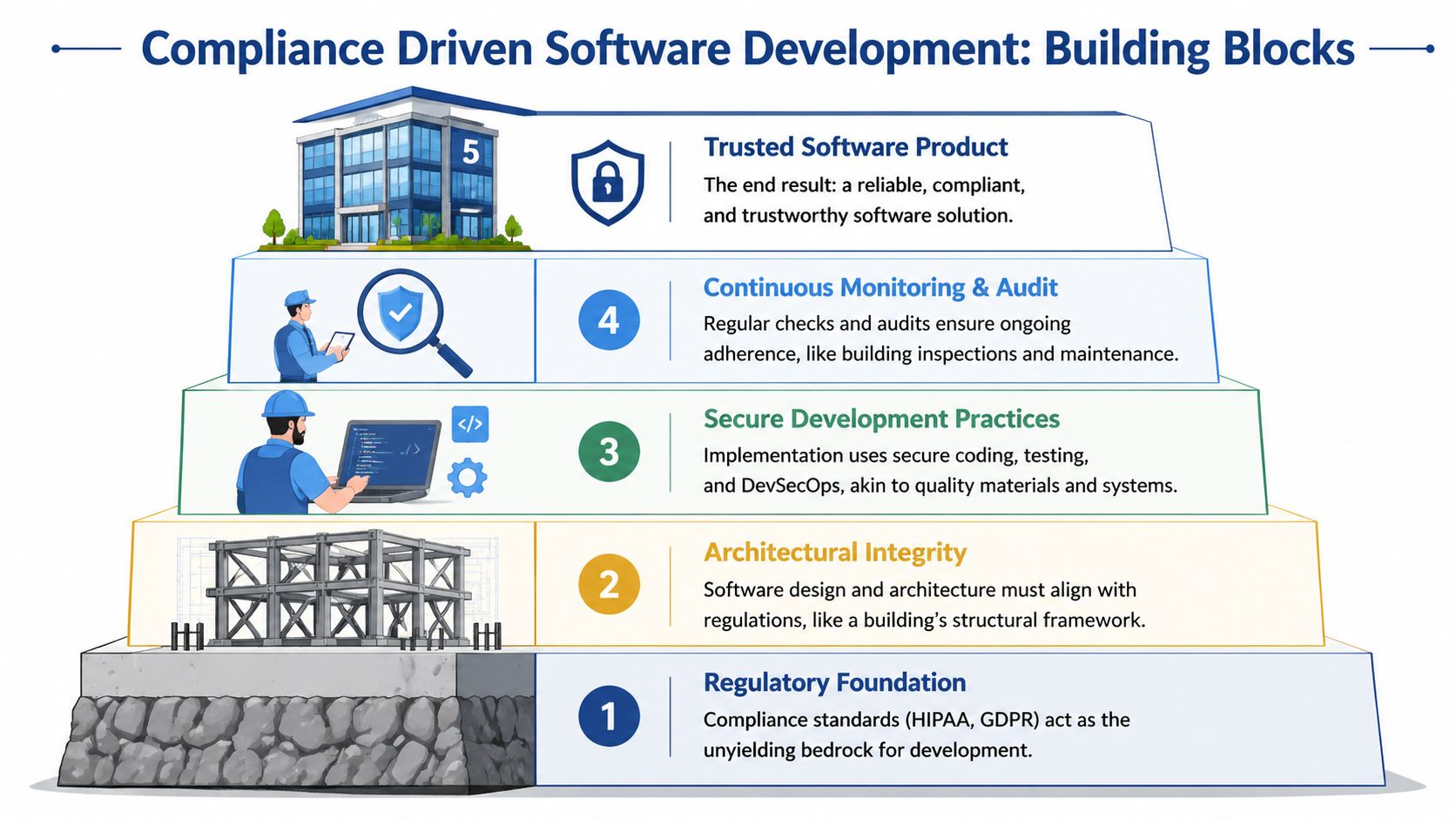
Built In, Not Bolted On
In a reactive model, teams usually build for speed first. Compliance comes later as a patching exercise. Someone adds extra access controls near release. A policy document gets written after the architecture has already been chosen. QA is asked to “test compliance”, even though many compliance failures come from design choices that testing alone can’t fix.
A compliance-driven model changes the order of operations.
Requirements include controls: The team captures consent, data handling, audit logging, and retention rules as product requirements, not legal footnotes.
Architecture reflects obligations: Storage, encryption, identity, and vendor choices are made with regulatory constraints in mind.
Delivery pipelines enforce policy: CI/CD isn’t just for deployment speed. It becomes a place to run security and compliance checks automatically.
Evidence is created continuously: Logs, approvals, and test results are gathered as the work happens, which makes audits far less painful.
What This Looks Like on a Real Team
A product owner writes a user story. In a traditional flow, it might say: “Users can upload patient files.”
In a compliance-driven flow, the story changes. Who can upload? Who can view? What consent supports the upload? How long is the file retained? What happens when a user requests deletion? Is access logged? Can the file be downloaded to unmanaged devices?
Those questions don’t slow down delivery. They stop the wrong thing from being built.
Build compliance controls the same way you build authentication; as product behaviour, not as admin paperwork.
The Mindset SMEs Need
Large enterprises can afford separate departments for legal, security, architecture, and audit. SMEs usually can’t. That’s why they need a simpler frame. Don’t try to “do all compliance” at once. Build the product around the specific obligations that apply to your business, your data, and your customers.
That makes outsourcing far more effective, too. A good development partner can only deliver compliant software if the engagement includes risk assumptions, documentation expectations, and evidence requirements from the beginning. Otherwise, the partner is just coding features and leaving the hardest questions for later.
Navigating the Alphabet Soup of Regulations
Most businesses don’t struggle because regulations are impossible. They struggle because the names blur together. HIPAA, GDPR, SOC 2, ISO 27001. The terms sound similar, but they solve different business problems.
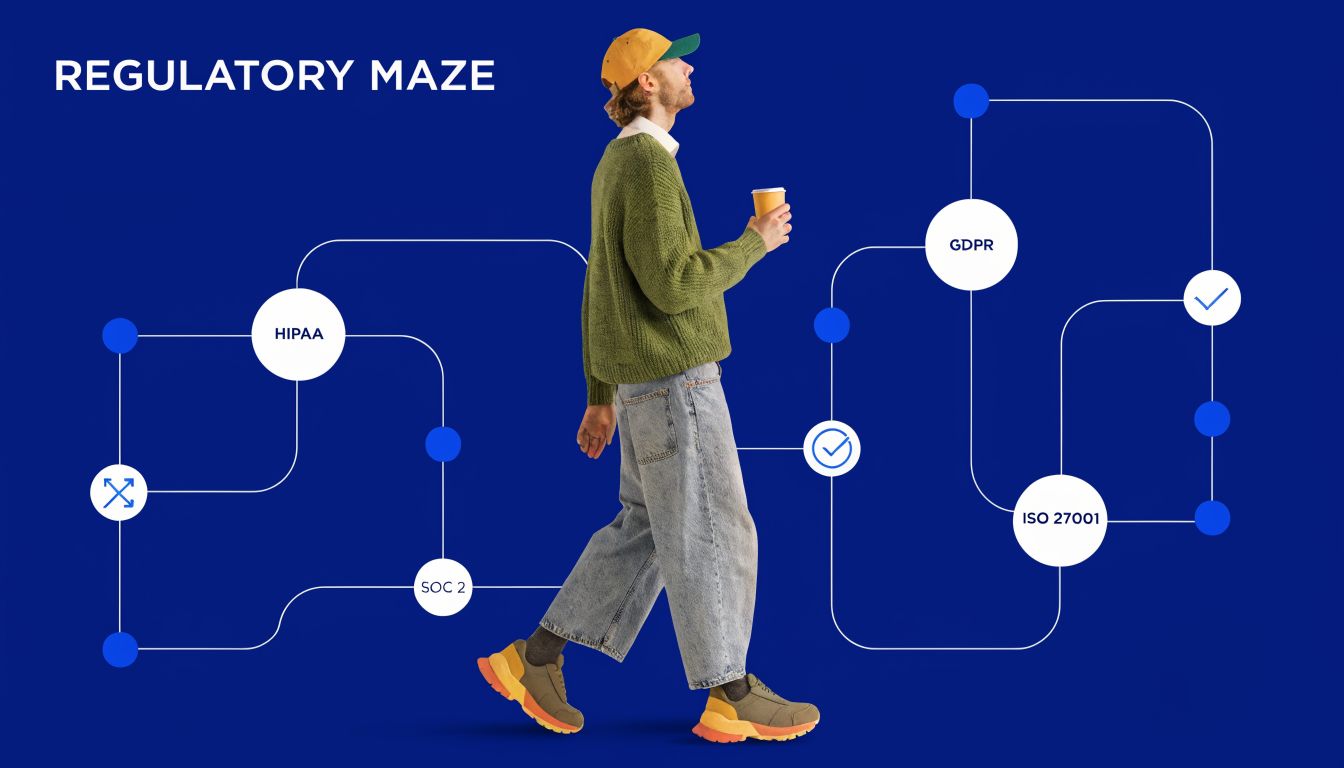
In Canada, this matters commercially, not just legally. The BFSI and insurance sector accounts for 23.89% of compliance market revenue as of 2025, while healthcare is growing at 14.12% CAGR. The same market analysis says 82% of firms are investing more in technology for compliance activities such as risk assessment and monitoring, based on Mordor Intelligence’s compliance software market report. That investment is happening because each framework answers a buyer's concern.
Match the Framework to the Business Problem
Here’s the practical translation.
| Framework | Business problem it solves | What teams usually have to prove |
|---|---|---|
| HIPAA | Patient trust and protected health information handling | Access controls, safeguards, auditability, privacy-aware workflows |
| GDPR | Respecting privacy rights for people in Europe | Consent handling, lawful processing, deletion and data rights support |
| SOC 2 | Earning trust from customers and partners | Security controls operate consistently over time |
| ISO 27001 | Building an organised information security system | Policies, risk management, control governance, continuous improvement |
If you run a healthcare product, HIPAA isn’t just a legal acronym. It affects forms, analytics, staff access, and vendor selection. If you sell into European markets, GDPR reaches into cookie design, account deletion, and data exports. If you’re trying to win B2B deals, SOC 2 often becomes part of procurement. ISO 27001 is less about one app feature and more about how the business manages security as a system.
Where SMEs Get Confused
A smaller business often asks, “Which one do we need?” The more useful question is, “What are our customers, data flows, and contracts forcing us to prove?”
That’s why sector-specific reading helps. For healthcare teams trying to sort out analytics and privacy controls, this breakdown of the impact of the Healthcare HIPAA Privacy Rule in digital analytics is useful because analytics is one of the first places compliance gets messy.
For Canadian healthcare builders, it also helps to ground decisions in implementation detail, not labels alone. This guide to healthcare compliance software development is relevant because it brings the conversation back to software choices rather than abstract regulation summaries.
Regulations matter most when they become product constraints. If the team can’t point to the feature, workflow, or control a rule affects, they probably haven’t translated it into engineering terms yet.
Embedding Compliance Into Your Development Lifecycle
The fastest way to make compliance expensive is to leave it to QA or audit week. The cheaper way is to spread the work across the lifecycle so each stage carries its share.
That approach has concrete value in the Canadian context. Integrating PIPEDA requirements into the SDLC through DevSecOps can reduce data breach vulnerabilities by up to 40%. Shifting compliance left can prevent 70% of rework costs, and ISO/IEC 27001-aligned scans have shown 92% of vulnerabilities detected pre-deployment, as described in PureDome’s discussion of compliance challenges for software development agencies.
Compliance Activities Across the SDLC
| SDLC Phase | Compliance Activity | Example |
|---|---|---|
| Requirements | Translate regulations into user stories and non-functional requirements | “User consent must be recorded and retrievable” |
| Design | Choose architecture that supports privacy, security, and audit needs | Role-based access, data segregation, retention-aware storage |
| Development | Enforce coding and dependency rules in daily work | SAST, secrets scanning, policy checks in pull requests |
| QA | Test regulated behaviour, not just features | Verify consent flows, access boundaries, audit logs, and deletion requests |
| Deployment | Gate releases with evidence and approval controls | CI/CD checks, change approvals, and infrastructure policy validation |
| Maintenance | Monitor, document, and update controls continuously | Vendor reviews, log review, patching, and access recertification |
What Good Looks Like in Each Phase
Requirements
SMEs often underinvest. They gather business features but skip compliance acceptance criteria. That causes trouble later because developers can only build what the backlog makes visible.
A stronger approach is to capture obligations in plain language. If PIPEDA applies, the backlog should include consent, purpose limitation, and data access expectations in ways developers and testers can work with.
Design
Architecture is where many audit findings are born. A team chooses the wrong analytics setup, lets admin roles sprawl, or stores sensitive documents in a way that makes retention hard to enforce.
A short design review goes a long way here. Before the build starts, ask:
What data are we collecting: Only what the product needs.
Who can access it: By role, not by convenience.
Where does it live: Including backups, analytics, and third-party systems.
How do we prove control operation: Through logs, tickets, approvals, and system evidence.
Development and QA
Developers shouldn’t be asked to memorise regulations. They should work within guardrails. That means pull request templates, branch checks, secure coding standards, approved libraries, and test cases tied to compliance requirements.
QA needs to test more than happy paths. In regulated software, the edge cases matter. Failed consent capture, incorrect permissions, audit trail gaps, and retention failures often matter more than cosmetic defects.
A passing feature test does not mean a compliant feature. If a user can perform the right action through the wrong control path, you still have a problem.
Deployment and Maintenance
The release process should answer simple questions before production. Did scans pass? Were policy exceptions approved? Are infrastructure changes documented? Can the team show evidence later without rebuilding history from Slack messages and memory?
For teams building or buying systems to support this process, this guide to compliance management software helps frame what to automate and what still needs human review.
For SMEs working with an outsourcing partner, the key is shared responsibility. The vendor can build controls into code and pipelines. The client still needs to define obligations, approve risk decisions, and own the final policy posture.
Essential Practices and Tools for Sustainable Compliance
Most compliance programmes fail for a simple reason. They depend on memory and heroics. Someone remembers to run a scan. Someone saves an approval email. Someone updates a spreadsheet before the audit. That might work once. It doesn’t scale.
The sustainable model is to turn compliance into a repeatable engineering practice. Within this model, DevSecOps, automated evidence collection, and control traceability stop being buzzwords and become operational necessities.

One strong example is SOC 2. Achieving SOC 2 Type II attestation can yield a 35% reduction in third-party risk exposure, and firms adopting compliance-by-design have been shown to cut non-compliance incidents by 50%, based on benchmarks cited in this analysis of innovation and compliance in software development. For any business relying on vendors, cloud platforms, or outsourced development, that matters because third-party risk is often where trust breaks first.
The Practices That Actually Hold Up
Automate Policy Checks In CI/CD
Manual review alone won’t catch enough. Put checks where code already flows. Common examples include SAST for source analysis, software composition analysis for dependency review, secret scanning, and infrastructure policy validation.
This doesn’t replace human judgment. It reserves human attention for exceptions and higher-risk decisions.
Keep an Audit Trail That Nobody Has To Reconstruct
Auditors usually don’t want a speech. They want evidence. Who approved the change? Which control was tested? When was access granted and removed? Where is the log that proves it?
Teams should store this evidence in the normal delivery toolchain. Tickets, pull requests, build logs, approval records, change histories, and test artefacts should be linked, retained, and easy to retrieve.
Make Requirements Traceable
A compliance requirement should point to design decisions, code changes, tests, and release records. If that chain doesn’t exist, the organisation ends up proving compliance with screenshots and last-minute narratives.
This is one reason regulated teams often standardise templates for user stories, test cases, and release notes. The discipline feels heavy at first, but it removes confusion later.
Tools That Fit the Work
Different teams need different stacks, but the useful categories are consistent:
Code and dependency scanning: SonarQube, Snyk, or similar tools help catch coding and library risks early.
Policy enforcement: Open Policy Agent is commonly used when teams want codified rules around infrastructure and deployment.
Ticketing and evidence flow: Jira, Azure DevOps, or comparable systems can support traceability if the workflow is designed properly.
Cloud and control monitoring: Teams often add cloud-native logging and alerting to prove the ongoing operation of controls.
Compliance platforms: Businesses comparing structured options may want a broad overview of Regulatory Compliance Software, especially if they’re deciding what to centralise versus what to keep inside existing engineering tools.
One practical option for organisations that need both implementation help and governance support is cybersecurity and compliance consulting. That type of service is useful when the business needs architecture, process, and delivery guidance together rather than a standalone audit checklist.
Good compliance tooling doesn’t create more forms. It removes repeated manual proofreading work.
What Doesn’t Work
A few patterns fail over and over.
Late-stage compliance reviews: These catch issues when fixes are most disruptive.
Policy documents with no engineering link: If developers can’t see how a policy affects code or infrastructure, the policy won’t change behaviour.
Over-control for low-risk features: Not every form field needs the same treatment as a claims database.
Blind reuse of enterprise templates: SME teams often inherit processes built for far larger organisations and end up drowning in admin rather than managing risk.
The right system is disciplined, but it’s also proportionate.
Compliance-Driven Development in Action
Abstract advice helps less than seeing the choices play out.

A Telehealth Startup
A Canadian startup wanted to launch a telehealth platform quickly. Their first instinct was typical. Build booking, video sessions, and patient messaging first, then “tighten up privacy” before launch.
That would have been a mistake.
Instead, they started with three compliance-shaped design decisions. Consent had to be explicit and recorded. Patient records needed role-based access. Every meaningful staff action needs to leave an audit trail. Those decisions affected backlog items, database structure, admin screens, and support workflows from week one.
The result wasn’t slower delivery. It was a cleaner delivery. Developers didn’t have to retrofit access boundaries into an already messy product. QA tested consent withdrawal and record visibility as normal scenarios, not edge cases. When a partner asked how patient actions were logged, the answer already existed in the product.
A Smaller Insurance Operation
An insurance business wanted to automate parts of claims intake and review. The initial brief focused on efficiency. Upload documents, route claims, notify staff, and reduce manual handling.
The turning point came when they looked at compliance not as a separate track, but as workflow design. They defined which claim events had to be logged, who could override status changes, and what supporting evidence had to travel with each decision. They also reviewed each third-party integration before wiring it into the process.
That changed the software in useful ways. Managers got clearer approval paths. Staff could see why a claim moved stages. The business had a record of who touched what and when. Instead of choosing between auditability and usability, they built one system that served both.
The strongest compliant products usually feel calmer to operate. Roles are clearer, decisions are recorded, and fewer tasks rely on memory.
Both examples point to the same lesson. Compliance-driven software development works best when the team treats regulation as part of product design, not as a final inspection hurdle.
Your Adoption Path: A Practical Checklist
Most SMEs don’t need a giant compliance transformation. They need a workable starting point, a clear sequence, and a delivery model that won’t crush budgets.
That matters because Canadian SMEs already feel the cost pressure. In sectors such as insurance, 62% report struggling with PIPEDA compliance costs exceeding $50K annually, and over-reliance on US HIPAA models can create problems by missing Canada’s consent-based nuances, according to Bridge Global’s piece on compliance-driven software development.
A Practical Checklist for SMEs
Identify the Actual Obligations
List the regulations, customer commitments, and contractual requirements that apply to your software. Don’t start with a generic framework library. Start with your data, your market, and your buyers.Map Those Obligations to Product Behaviour
Turn each compliance need into something buildable. Consent capture, access rules, retention handling, audit logging, and vendor restrictions should appear in stories, acceptance criteria, and architecture notes.Run a Gap Review Before the Next Major Release
Compare what the software does now against what the business must prove. Look at workflows, not just policies. The gaps usually show up in admin access, analytics, exports, third-party scripts, and undocumented manual processes.Decide What To Automate First
Start with controls that repeat often and fail unobserved. Code scanning, dependency review, release approvals, and evidence capture are usually good first candidates.Choose an Outsourcing Model With Shared Responsibility Defined
If you use a development partner, define who owns legal interpretation, control implementation, evidence retention, and release approval. Vague responsibility creates expensive surprises.Avoid Copying US Healthcare Assumptions Into Canadian Software
If your software operates under Canadian privacy obligations, design around consent and local handling requirements rather than importing a US-centric model and hoping it fits.Train Product, Engineering, and Operations Together
Compliance breaks when one team treats it as somebody else’s problem. Product defines intent, engineering builds controls, and operations keeps those controls running.
What To Ask an Outsourcing Partner
Use direct questions.
How do you convert regulations into backlog items and acceptance criteria?
What evidence will exist after each release?
Which checks run automatically in the pipeline?
How do you handle third-party libraries and vendor risk?
Who signs off on policy exceptions?
If the answers stay abstract, the engagement probably isn’t mature enough for regulated work.
A practical partner should help you narrow the scope, define controls early, automate what repeats, and keep the process lean enough that the business can still ship.
If your team needs to build compliant software without creating a heavy internal compliance department, Cleffex Digital Ltd is one option to consider for outsourced development and compliance-aware delivery support. The useful starting point is a focused conversation around your product, your regulated data, and the controls you need to prove, then shaping a build process that keeps audits manageable without losing agility.