

A hospital's emergency department can have a patient record in one system, medication information in another, laboratory results in a third, and a partner analytics platform waiting for a scheduled export. Clinicians still need a complete view, but the integration team is left maintaining custom feeds, repeated transformations, and fragile point-to-point connections. That's the practical problem healthcare API development must solve.
An API-first platform creates a governed exchange layer between clinical systems, patient applications, registries, analytics tools, and external partners. It doesn't require every legacy application to be replaced immediately. It gives each integration a clear contract, controlled access, validation rules, and an upgrade path.
Canada's healthcare API market was estimated at US$132.6 million in 2024 and is projected to reach US$174.5 million by 2030, implying a 4.7% CAGR from 2025 to 2030, according to Canada healthcare API market data. The market's largest segment in 2024 was EHR access, at 30.69% of revenue, while remote patient monitoring was identified as the fastest-growing segment, reinforcing the importance of interoperability and clinical data access.
This guide focuses on the delivery details that policy documents often leave unanswered, including FHIR contracts, Canadian profiles, identity, consent, versioning, testing, and integration architecture. For teams also assessing patient-facing automation, a practical overview of conversational AI in healthcare can help clarify where secure APIs fit into digital patient experiences. Organisations planning broader HealthTech integration can also review Cleffex's healthcare software integration services and its digital technology solutions.
Introduction to Healthcare API Development
The strongest healthcare APIs begin with a workflow, not an endpoint list. A hospital may want to expose appointments to a patient app, retrieve provider details for referral routing, and deliver laboratory results to an analytics service. Those requests sound separate, but they often depend on the same foundations: patient identity, consent, reliable source data, and a stable contract.
An API-first approach treats those contracts as products. Teams define what a consumer can request, which fields are returned, how errors are represented, how access is authorised, and how changes are communicated. The API then becomes a controlled boundary around older EHRs, laboratory systems, registries, and data warehouses.
Why point-to-point integration fails
Direct connections can appear fast at the start. A developer maps one source system to one application, adds a transformation, and moves on. Over time, every new consumer needs another connector, another set of credentials, another exception list, and another operational dashboard.
That structure creates familiar problems:
Duplicated business logic: Different integrations interpret medication, appointment, or provider data differently.
Hidden coupling: A source-system change can break several consumers without a clear owner.
Poor observability: Teams see that a workflow failed, but not which transformation or dependency caused it.
Clinician disruption: Data arrives in a separate screen or requires manual reconciliation.
An API gateway, canonical model, and event layer provide more control. They let teams modernise gradually while keeping clinical workflows in familiar systems.
Practical rule: Build the smallest useful clinical workflow end to end, then expand the platform. A large catalogue of unvalidated endpoints won't compensate for a broken patient identity or consent process.
What this guide prioritises
Effective healthcare platform development balances four concerns:
Interoperability: Use FHIR and HL7 where they fit, while accommodating local variations.
Safety: Enforce least privilege, audit access, validate payloads, and protect sensitive data.
Operational reliability: Design for retries, duplicate messages, partial outages, and replay.
Developer usability: Publish discoverable contracts, examples, error models, and lifecycle rules.
The result should be more than a technically valid API. It should be an exchange layer that supports patient care, administrative work, analytics, and future applications without multiplying integration debt.
Embracing Interoperability Standards
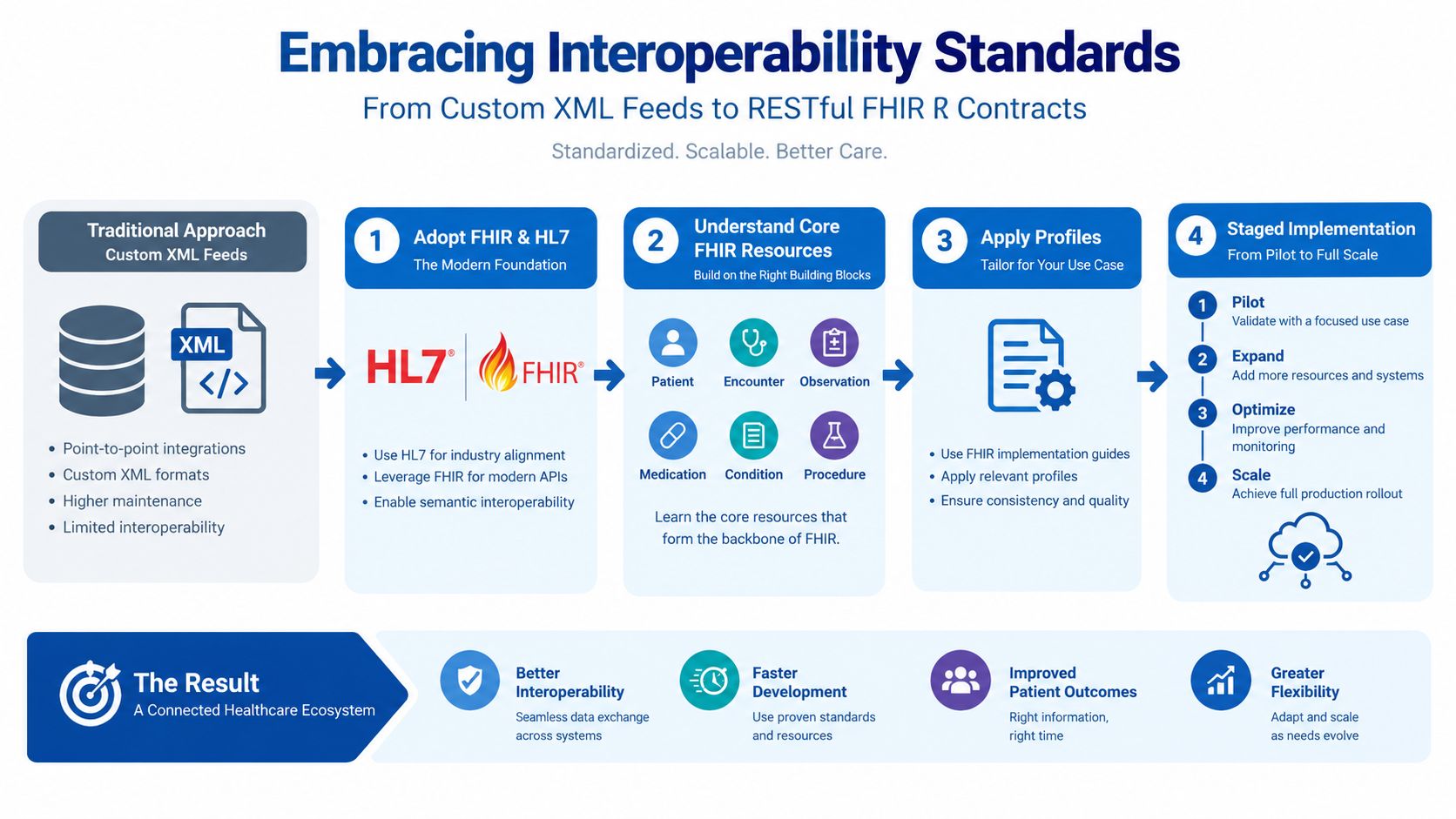
FHIR is useful because it gives teams a shared language for healthcare resources and a familiar RESTful exchange pattern. HL7 v2 remains important in many operational environments, particularly where admissions, orders, results, and scheduling messages already move through interface engines. The practical choice is rarely “FHIR or HL7”. It's usually how to expose a modern contract while safely translating existing messages.
Use profiles, not base resources alone
FHIR resources such as Patient, Observation, Condition, MedicationRequest, Practitioner, and Organization provide a foundation. They don't automatically guarantee that two systems will interpret every field, code, cardinality, or search parameter in the same way.
Profiles make the contract specific. They can require fields, constrain value sets, define supported searches, and express jurisdictional expectations. In Canada, teams should evaluate the Canadian Baseline and CA Core+ specifications before creating local definitions. Canada Health Infoway describes CA Core+ as a national core set of essential HL7 FHIR profiles, data elements, value sets, and constraints for common exchange needs through its Pan-Canadian core specifications.
A profile should answer practical questions:
Which elements must a sender include?
Which identifiers are accepted?
Which terminology systems are valid?
Which searches must the server support?
What does a consumer do when a field is absent?
Follow a staged adoption path
Canadian interoperability maturity makes sequencing important. A 2024 Canadian survey found that 70% of organisations described their state as foundational interoperability, 50% as structural, and 30% as semantic, while 31% reported using FHIR compared with 46% using HL7 v2 in the same survey results from Orion Health's Canadian interoperability survey.
A workable implementation path is:
Exchange fields reliably: Establish source ownership, identifiers, required fields, and transport behaviour.
Map to FHIR resources: Translate local structures into resources such as
Patient,Encounter, orObservation.Apply Canadian profiles: Constrain resources and validate them against the relevant implementation guides.
Normalise meaning: Align terminology, units, identifiers, and code systems.
Embed the workflow: Deliver the result where staff already work, rather than creating another reconciliation screen.
Starting with semantic normalisation can slow delivery if upstream data ownership and field mappings aren't stable. FHIR adoption alone also doesn't solve interpretation. A structurally valid resource may still contain local codes, incomplete medication information, or inconsistent patient identifiers.
Use national tooling and exchange specifications
Canada Health Infoway's Accelero developer tools include a Canadian FHIR Registry, a Canadian URI Registry, and Terminology Service RESTful APIs. Microsoft also announced that Azure API for FHIR became generally available in Canada in July 2021 through Canadian data centres, as documented in the Accelero developer tools.
CA:FeX is especially relevant to gradual modernisation because its FHIR RESTful exchange patterns can sit above existing non-FHIR infrastructure. Its specification describes an implementable and testable approach for creating, consuming, and sharing clinical data, which supports a migration path instead of a full system replacement.
Teams comparing Canadian exchange practices with other markets may find how Australian clinics use secure messaging useful for understanding the operational role of secure, workflow-oriented exchange. For a deeper Canadian compliance perspective, review this FHIR integration services guide.
Designing Stable Data Models and Versioning
A healthcare API data model should make invalid or ambiguous clinical data difficult to publish. Start from a recognised profile, separate source-specific mapping from the public contract, and treat extensions as deliberate design decisions rather than storage for whatever does not fit.
The Canadian Baseline FHIR implementation guide provides a concrete reference for jurisdiction-specific constraints and conformance testing, including profiles for human-patient systems. Use the applicable profile as an implementation boundary, then verify which requirements your API can enforce at ingestion and publication.
Establish a canonical contract
The source system and public API should not share an internal shape by accident. A provincial EHR, clinic application, and laboratory platform may represent the same concept differently. Put a mapping layer between them and make ownership explicit.
A useful model separates:
Canonical fields: Data the platform promises to consumers.
Source mappings: Rules that translate local fields into canonical fields.
Terminology mappings: Crosswalks between local codes and approved value sets.
Provenance: Information about where the data came from and when it was transformed.
Validation rules: Constraints applied before a resource is accepted or published.
For example, a local medication status may use a short internal code. The transformation service should map it to the agreed FHIR value set, preserve the original where governance permits, and record the mapping decision. Individual consuming applications should not interpret that local code independently, because each interpretation becomes another source of clinical inconsistency.
Add extensions with restraint
FHIR extensions are appropriate when a jurisdiction or workflow needs information that the base resource and selected profile do not represent. Give each extension a stable URL, clear definition, data type, cardinality rules, and named owner.
An illustrative extension structure might look like this:
{
  "resourceType": "Patient",
  "meta": {
    "profile": [
      "https://example.ca/fhir/StructureDefinition/ca-patient"
    ]
  },
  "extension": [
    {
      "url": "https://example.ca/fhir/StructureDefinition/preferred-contact-channel",
      "valueCode": "secure-message"
    }
  ]
}
The URLs in this example are illustrative, not Canadian standards. In production, use the canonical URL defined by the governing implementation guide. If a field matters across several integrations, assess whether it belongs in a shared profile rather than a private extension.
Modeling advice: An extension should add a named, governable concept. It should not become a miscellaneous property bag.
Version contracts, not just URLs
A breaking change can remove a required field, alter its meaning, change an identifier rule, or replace a code system without a migration path. Treat these changes as a new contract and publish a compatibility policy.
A versioned endpoint can use a pattern such as:
The exact URL is a design example. Define whether versioning lives in the path, media type, or server capability statement, then apply that choice consistently across resources.
Keep resource history separate from API contract history. A FHIR resource can change over time while the API contract remains compatible. For concurrent updates, use conditional requests and validate the current version before writing.
For contract evolution:
Additive changes: New optional fields are usually easier to introduce safely.
Constrained changes: Tightening a value set can invalidate existing clients.
Breaking changes: Removing or reinterpreting data requires a new contract and migration plan.
Deprecation: Publish a retirement date, replacement route, and monitoring for remaining consumers.
Author profiles around a defined workflow, then validate them in continuous integration. Forge, SUSHI, and the FHIR Validator can support authoring and conformance checks. Their output still requires review by clinical, privacy, and integration stakeholders, because a technically valid resource may remain unsuitable for the workflow that consumes it.
Implementing Authentication and Access Control
Healthcare APIs need more than a login check. They must establish who or what is calling, which patient or organisation context applies, what the caller may do, and how the access decision can be audited.
OAuth 2.0 provides the authorisation framework. OpenID Connect adds identity information for user-facing applications. For a patient portal, the authorisation code flow with PKCE is generally more appropriate than embedding a secret in a mobile application. For a scheduled backend exchange, client credentials or a healthcare-specific backend service pattern can be more suitable.
Separate user and machine access
A clinician launching an application from an EHR has a different security context from an analytics worker processing an approved data feed. Don't force both through one broad service account.
A typical user flow looks like this:
The application sends the user to the identity provider.
The user authenticates and grants the requested access.
The application receives an authorisation code.
The backend exchanges the code for tokens.
The API validates the access token before serving the request.
A machine flow should use a dedicated client identity, narrowly defined scopes, private connectivity where appropriate, and an auditable owner. It shouldn't inherit a human user's permissions.
Make scopes meaningful
Scopes should correspond to actual capabilities, not vague labels such as full_access. Examples might include:
patient/Patient.readpatient/Observation.readuser/Appointment.readsystem/DiagnosticReport.write
The exact scope vocabulary depends on the implementation guide and identity provider. Pair scopes with roles, organisation context, purpose-of-use rules, and resource-level checks where necessary. A token that permits Patient.read still shouldn't expose every patient record to every user.
Token validation must check the issuer, audience, signature, expiry, and relevant claims. The API should reject an invalid token before executing business logic, and it should return structured errors without revealing sensitive internal details.
Protect tokens and sensitive logs
Keep access tokens out of URLs, browser storage where safer alternatives exist, and application logs. Store refresh tokens securely, rotate credentials, revoke compromised clients, and define what happens when a user leaves an organisation.
Logging needs equal care. Redact clinical payloads and identifiers unless an approved audit requirement demands them. Record enough metadata to investigate access, such as the client, subject, route, decision, correlation identifier, and outcome.
Security boundary: Authentication answers “who are you?” Authorisation answers “what may you access in this context?” Your API needs both.
Run security tests against authentication, authorisation, input validation, rate controls, token handling, and audit behaviour. Cleffex's API security testing guidance provides a useful reference for turning those controls into repeatable checks.
Testing Monitoring and Deployment Best Practices
A healthcare API isn't production-ready because a happy-path request returned a valid JSON response. It must handle malformed resources, duplicate messages, expired credentials, unavailable dependencies, unexpected terminology, pagination, retries, and partial failure without corrupting clinical workflows.
Test the contract at several levels
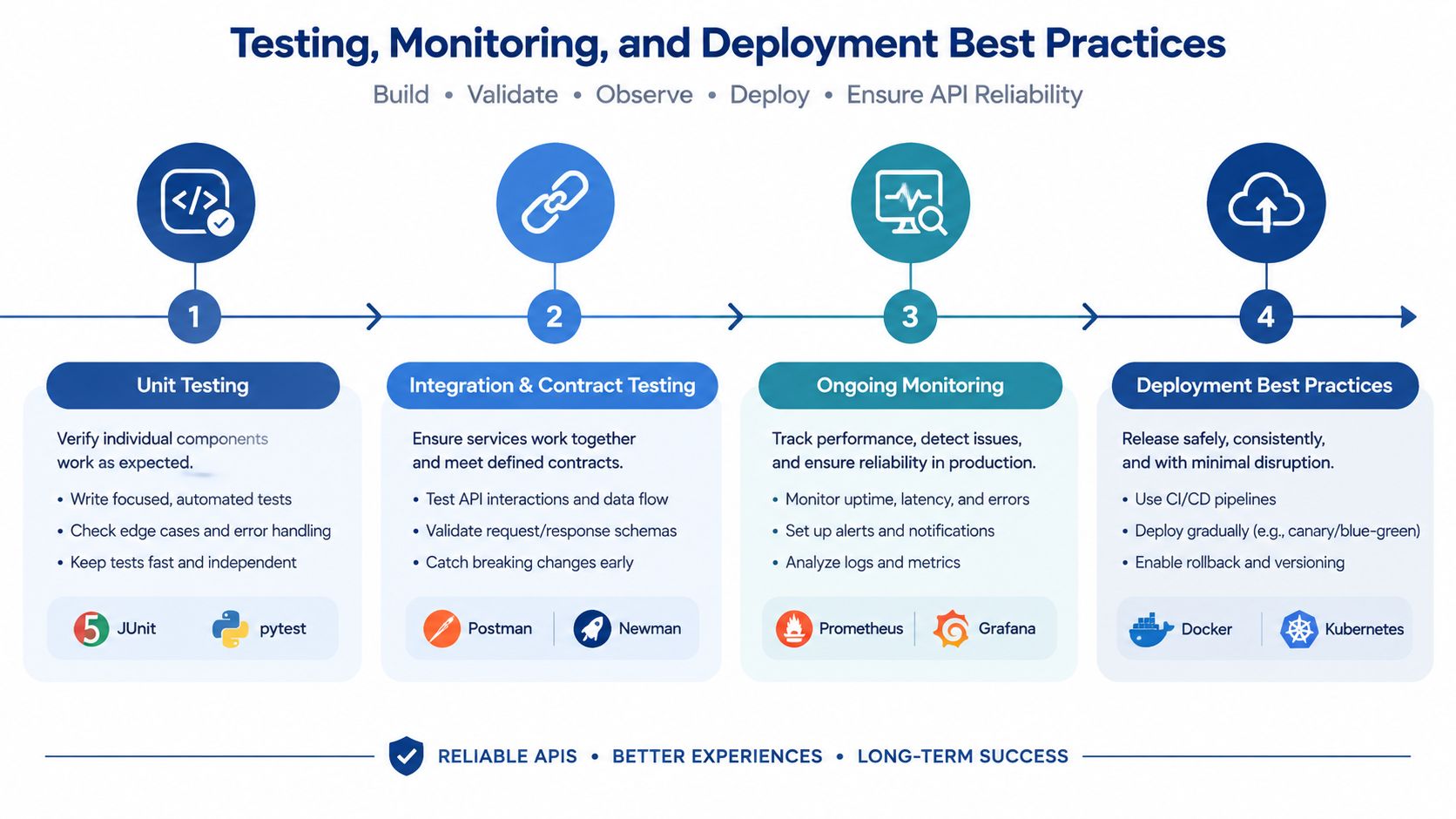
Unit tests should cover mapping rules, validation, permission decisions, and error translation. Use pytest, JUnit, or the equivalent framework already supported by your team. Keep these tests fast so developers run them on every change.
Integration tests should exercise real or representative dependencies. Test the interface engine, FHIR server, terminology service, identity provider, queue, and persistence layer in combinations that reflect the workflow. Synthetic data helps teams test without exposing unnecessary patient information.
Contract tests protect consumers from accidental changes. Generate or review an OpenAPI document, validate request and response schemas, and use Postman collections with Newman in the build pipeline. For FHIR, validate resources against the declared profiles and inspect OperationOutcome responses rather than treating every non-success response as an opaque failure.
Observe behaviour, not just uptime
A green health check doesn't prove that patient lookup or result delivery works. Monitor the workflow signals that operators can act on:
Latency: Track response time by route, dependency, and outcome.
Error taxonomy: Distinguish validation, authorisation, timeout, mapping, and downstream errors.
Queue health: Watch backlog, retry activity, dead-letter messages, and replay status.
Data quality: Flag missing identifiers, rejected terminology, and profile validation failures.
Audit coverage: Confirm that access and transformation events contain the required metadata.
Structured logs should include a correlation identifier and should redact sensitive fields. ELK, Splunk, Prometheus, and Grafana can support the operational stack, but configuration matters more than brand selection. Alert on actionable thresholds and workflow failures, not every transient event.
Deploy with controlled change
A practical CI/CD pipeline should:
Validate code, dependencies, schemas, and profile definitions.
Run unit, integration, contract, security, and migration tests.
Publish versioned API documentation and deployment evidence.
Promote the same artefact through controlled environments.
Release gradually with a rollback path.
Confirm health, error rates, queue behaviour, and consumer compatibility.
Feature flags help separate deployment from activation. Rolling releases and canary exposure reduce blast radius, but they don't remove the need for backward compatibility. A deployment can be technically successful while a partner application fails because it relied on undocumented behaviour.
Operational standard: Every integration needs a runbook. Document replay, credential rotation, dependency outage handling, support ownership, and rollback before go-live.
Integration Patterns and Reference Architectures
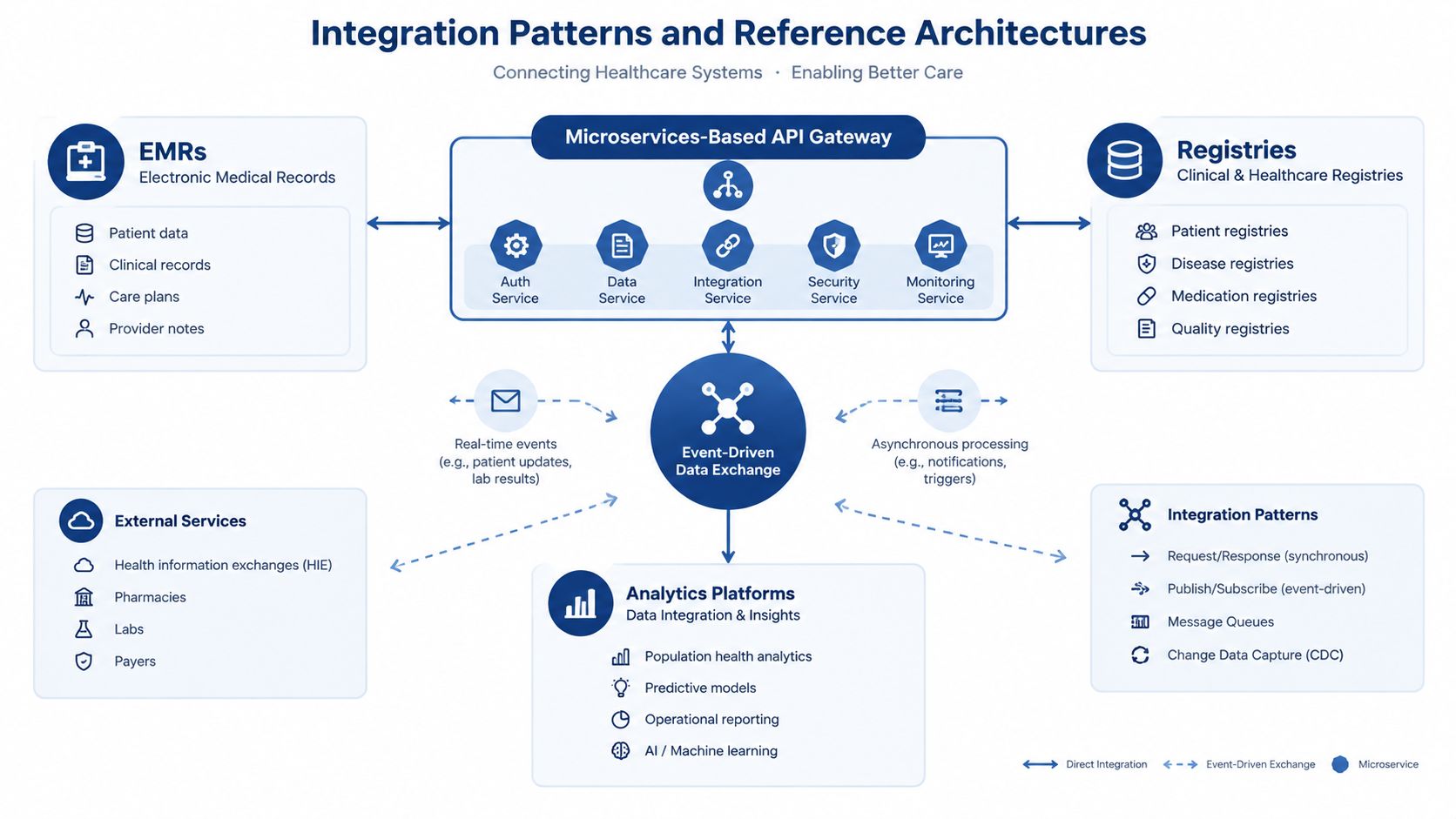
A hospital application needs a patient lookup now, while several downstream systems may need the same update later. That split should shape the architecture from the beginning. A connected digital health ecosystem needs separate responsibilities for synchronous queries, asynchronous events, translation logic, identity services, and consumer-specific views.
A practical reference architecture
A useful pattern has four layers:
Experience layer: Mobile applications, clinician portals, partner applications, and patient services.
API gateway: Authentication, routing, throttling, request validation, and consumer policies.
Domain services: Patient identity, provider directory, scheduling, results, consent, and terminology.
Integration and event layer: HL7 v2 adapters, FHIR servers, queues, event streams, registries, and analytics destinations.
Synchronous FHIR queries fit interactive tasks such as provider lookup or retrieving current appointments. Event-driven exchange fits workflows where multiple consumers need the same change, such as a result becoming available or an encounter changing state.
Kafka can provide the event backbone, but it does not define clinical meaning. Publish canonical events with clear ownership, event identifiers, timestamps, provenance, retry handling, and schema evolution rules. Consumers should process messages idempotently because retries can produce duplicates.
Keep legacy translation at the edge
An HL7 v2 message should not expose its local structure to every new application. An adapter receives the source message, validates it, maps it to a canonical representation, and publishes a FHIR resource or domain event. The public API remains stable while source-specific mapping changes behind that boundary.
The same rule applies to older enterprise systems. The practical guide to API integration for legacy enterprises can inform the choice between replacing, wrapping, and gradually modernising existing applications. Keep transformation logic at the boundary, where teams can test it without coupling each domain service to a local message format.
Registry lookup example
Ontario provides a concrete regional example. Its Provincial Client Registry FHIR implementation guide defines patient-data query patterns, while provider registry specifications support matching organisations and clinicians across mobile, cloud, EHR, and institutional contexts.
A client should inspect the server's documented capability and use approved search parameters. Do not assume that every FHIR server supports the same query. An illustrative request pattern is:
GET {registry-base}/Patient?identifier={system}|{value}
Accept: application/fhir+json
Authorization: Bearer {access-token}
A provider search may use the registry's documented Practitioner, Organization, or related parameters:
GET {registry-base}/Practitioner?identifier={system}|{value}
Accept: application/fhir+json
Authorization: Bearer {access-token}
These are templates, not live endpoints. The implementation guide, server capability statement, consent model, and regional access requirements determine the permitted route, identifier system, and response handling.
Design for provincial variation
Canada has 10 separate provincial health information technology systems, and provincial access conditions differ. A single universal connector is therefore unrealistic. Keep jurisdictional differences in governed configuration rather than scattered conditionals.
Store provincial profiles, identifier systems, consent rules, endpoint capabilities, and terminology mappings as explicit configuration. Test each jurisdictional variant against the same core workflow and contract suite, then record which behaviours are shared and which require local handling.
For wider architecture decisions, this overview of enterprise application architecture patterns helps teams compare gateway, service, event, and integration-layer responsibilities. The result is an API design that reflects regional policy while keeping implementation boundaries clear.
Conclusion and Next Steps
API-first healthcare platform development works when teams treat interoperability as an engineering discipline rather than a standards checkbox. FHIR gives developers reusable resources and exchange patterns. Canadian profiles and specifications make those resources more precise. HL7 v2 adapters preserve access to existing workflows while a modern API layer grows around them.
The implementation priorities are clear:
Start with one valuable clinical workflow and map its real dependencies.
Establish patient, provider, consent, terminology, and provenance rules early.
Build against Canadian profiles instead of relying on unconstrained base FHIR.
Separate user authentication from machine access and enforce least privilege.
Test mappings, contracts, profiles, permissions, retries, and failure recovery.
Monitor workflow outcomes, not just server availability.
Use synchronous APIs for interactive lookups and durable events for fan-out.
Treat provincial variation as configuration and governance work, not an afterthought.
The teams that make progress fastest aren't the ones that publish the most endpoints. They're the ones that define ownership, validate every boundary, document capability accurately, and give consumers a safe path to change.
If you're planning healthcare API development, begin with a system inventory, one end-to-end workflow, a Canadian profile target, and an operational runbook. Then validate the design with clinicians, privacy stakeholders, integration engineers, and the teams that will support it after launch.
Cleffex Digital Ltd provides healthcare software integration services covering EHR and HL7 FHIR connections, legacy clinical systems, secure gateways, and patient-facing applications. Visit Cleffex Digital Ltd to discuss an API-first integration plan for your connected digital health ecosystem.