

Your team is probably dealing with this already. A hospital wants lab results from one system, discharge summaries from another, and medication data from a pharmacy platform. A clinic asks for a patient-facing app. Leadership wants cleaner reporting, faster onboarding for partners, and fewer manual workarounds. Meanwhile, IT has to keep the lights on while privacy, data residency, and interoperability requirements keep getting tighter.
That's where FHIR integration becomes less of a technical nice-to-have and more of an operating requirement. In Canada, that pressure is sharper because interoperability now sits at the intersection of care delivery, vendor accountability, and compliance. For small and mid-sized organisations, the challenge isn't just exposing an API. It's deciding what to integrate first, how to map legacy data safely, and how to avoid building something that breaks the moment you cross a provincial boundary.
What Exactly Are FHIR Integration Services
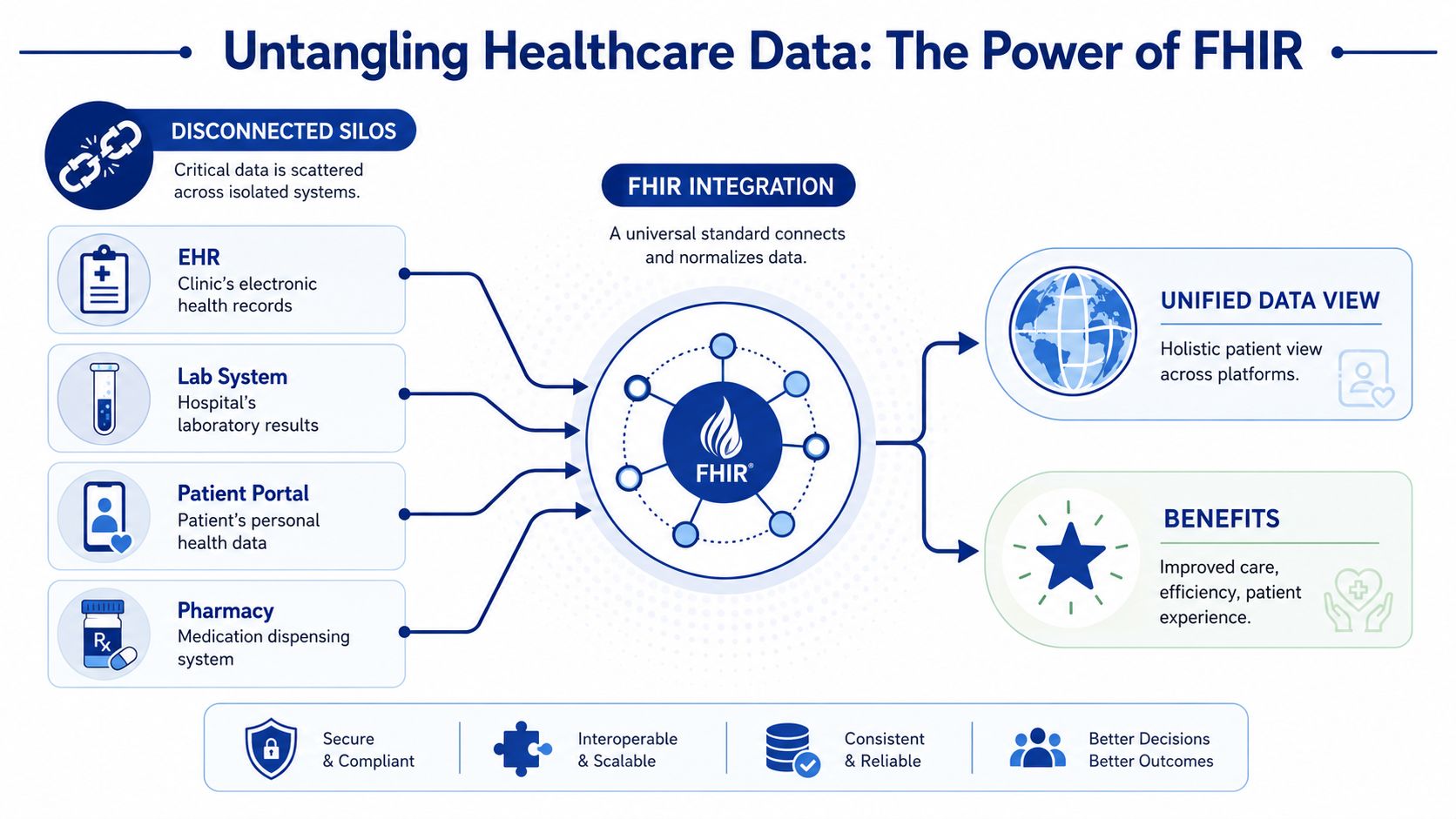
Healthcare data often lives in separate systems that were never designed to work together cleanly. The EHR stores encounters and diagnoses. The lab system holds observations. A patient portal exposes a small subset of information. Pharmacy and billing platforms add more fragments. Everyone can access some data, but very few teams can assemble a reliable, complete patient view without custom work.
FHIR integration services are the practical services that turn those fragments into usable, connected workflows. FHIR itself is a standard for structuring and exchanging healthcare data. The integration service is everything wrapped around that standard: architecture, mapping, API design, security, testing, profile validation, deployment, and ongoing support.
What the service actually does
A useful way to think about it is this. FHIR is the language. Integration services are the interpreters, routers, and quality controls that make sure each system speaks that language correctly and securely.
A FHIR integration service connects source systems, translates local data into FHIR resources, enforces profile rules, secures access, and delivers data in a form that downstream applications can trust.
That last part matters. Moving data isn't enough. If one system records allergies as free text, another uses local codes, and a third expects a specific FHIR profile, a simple interface won't solve the problem. Someone has to define the mapping rules, terminology handling, and validation logic.
In the Canadian context
Canada adds another layer. The pan-Canadian Patient Summary FHIR Implementation Guide requires a specific HL7 FHIR composition payload derived from the International Patient Summary so that patient summary data can move across provincial health information networks without losing structure or meaning, as detailed in the PS-CA v1.1.0 implementation guide.
That means FHIR integration services in Canada aren't just about exposing generic endpoints. They need to support the specific exchange formats and interaction patterns expected in pan-Canadian interoperability work.
What buyers should expect
When hospital administrators or IT directors evaluate FHIR integration services, they should expect work in four areas:
Data normalisation: Converting local records into recognised FHIR resources such as Patient, Observation, Medication, or Composition.
Security controls: Implementing access rules, authentication, consent-aware access patterns, and audit-friendly operations.
Profile compliance: Validating payloads against the FHIR guides and profiles required by the target exchange.
Operational reliability: Monitoring failures, retrying transactions, handling version changes, and supporting production workflows.
If a vendor only talks about APIs, they're describing a thin slice of the job. Real FHIR integration work sits where clinical meaning, software engineering, and Canadian compliance all meet.
The Business Case for FHIR Adoption
FHIR adoption usually gets framed as a standards decision. In practice, it's a business decision with technical consequences. The organisations that treat it only as a compliance exercise tend to underinvest in design and overpay in rework.
Business outcomes leadership cares about
The strongest case for FHIR is operational. Teams can reduce the custom interface burden that comes with older exchange methods and support more consistent digital experiences across portals, apps, analytics tools, and partner integrations. In Canada, that matters even more because the regulatory direction is no longer neutral.
As of 2026, over 75% of EHR systems in North America already incorporate FHIR APIs to some extent, and the same source notes that FHIR R4 is the most widely adopted version in Canada. The same market analysis projects the global FHIR integration services market to grow from $1.53 billion in 2025 to $1.85 billion in 2026 at a 20.4% CAGR, according to this overview of global FHIR adoption statistics. That doesn't tell you which project to fund, but it does confirm that FHIR has become the common integration baseline rather than a niche architecture choice.
For leadership teams building digital front doors, care coordination workflows, or insurer-provider data exchanges, FHIR creates a cleaner path to patient-facing products. If you're shaping service delivery around engagement and access, these strategies for patient-centric care help connect integration choices to the patient experience rather than treating interoperability as a back-office issue.
Technical gains that affect budgets
The engineering case is just as important because architecture choices become cost choices very quickly.
Canadian technical benchmarks show that FHIR reduces implementation complexity by approximately 40 to 60% compared to HL7 v2, v3, and CDA while maintaining 99.8% information integrity, according to this Canadian analysis of FHIR implementation and interoperability. That combination matters. Lower complexity shortens design and build cycles. High information integrity reduces the risk that teams “save time” by introducing clinical ambiguity.
Practical rule: If an integration approach lowers build effort but weakens semantic accuracy, it usually creates downstream cost in testing, support, and clinical workflow exceptions.
FHIR also aligns with modern development patterns. RESTful APIs, resource-based models, and easier browser and mobile integration make it simpler for internal teams and external partners to consume health data without depending on brittle, custom connectors. For a plain-language view of where that transformation shows up in real delivery models, this overview of how FHIR integration transforms healthcare is a useful companion read.
Common FHIR Integration Architectures Explained
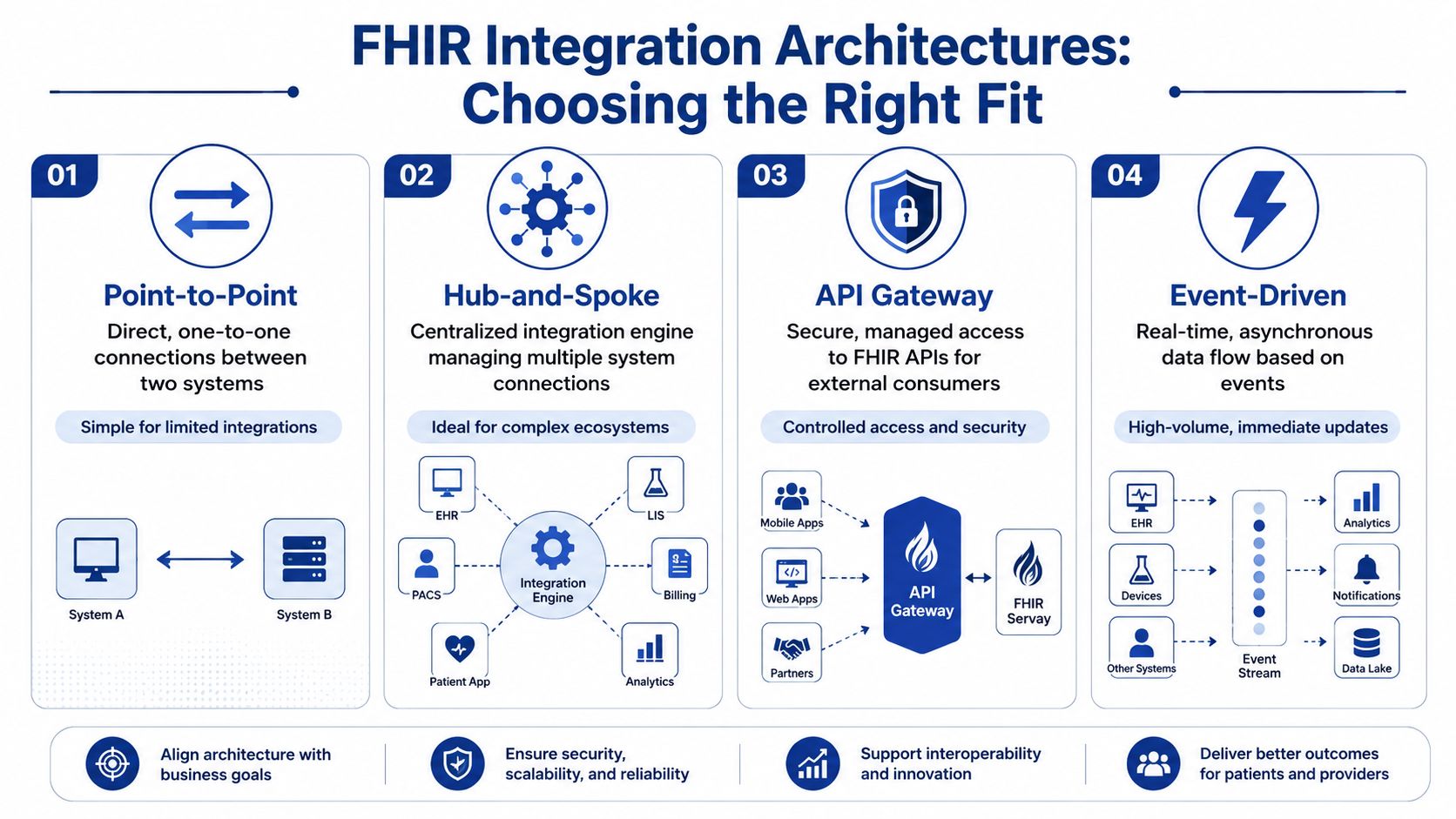
There isn't one correct architecture for FHIR integration services. The right model depends on what you're trying to solve. A hospital exposing controlled access to external apps needs a different setup than a regional network consolidating feeds from multiple clinical systems.
API gateway pattern
An API gateway sits in front of FHIR services and manages access. It handles authentication, rate controls, auditing, request policies, and often version management. This is the pattern I recommend when external consumers need controlled access, especially if you're supporting mobile apps, partner organisations, or third-party clinical tools.
Use this when your biggest concern is secure, governed access rather than deep transformation logic.
Middleware or integration engine
This is the workhorse pattern for complex environments. An integration engine receives messages from legacy systems, transforms them, routes them, and passes them into a FHIR server or downstream service. It's often the best fit when hospitals still depend on HL7 v2 feeds, flat files, vendor APIs, and bespoke departmental systems.
Use this when your biggest challenge is translation between inconsistent systems.
A practical comparison of legacy EHR connectivity and standards-based exchange appears in this guide to integrating FHIR with EHR systems, especially for organisations running mixed environments.
ETL pipeline for analytics
ETL pipelines are less about transactional exchange and more about preparing data for analytics, population health, reporting, or AI workloads. Data gets extracted from source systems, transformed into a FHIR-aligned or analysis-ready structure, and loaded into a warehouse, lake, or reporting environment.
Use this when your primary goal is secondary use of data, not real-time clinical workflow.
Event-driven architecture
In an event-driven model, systems publish changes as events and subscribers react to them. That supports near real-time updates, notifications, and loosely coupled workflows. It's useful when admissions, lab results, referral updates, or consent changes need to trigger downstream actions quickly.
Use this when your environment depends on timely reactions rather than scheduled polling.
Point-to-point interfaces can work for a small number of connections. They become hard to govern once multiple teams, vendors, and workflows depend on them.
A simple selection view
| Architecture | Best fit | Main trade-off |
|---|---|---|
| API gateway | External access to FHIR APIs | Doesn't solve deep source-system mapping by itself |
| Middleware | Legacy modernisation and routing | Can become complex if governance is weak |
| ETL | Analytics and data platforms | Not ideal for live transactional use |
| Event-driven | Real-time workflow orchestration | Operational monitoring becomes more important |
Most Canadian providers end up with a combination, not a single pattern. The mistake is choosing based on what a platform sells rather than what the workflow requires.
A Phased Roadmap to FHIR Implementation
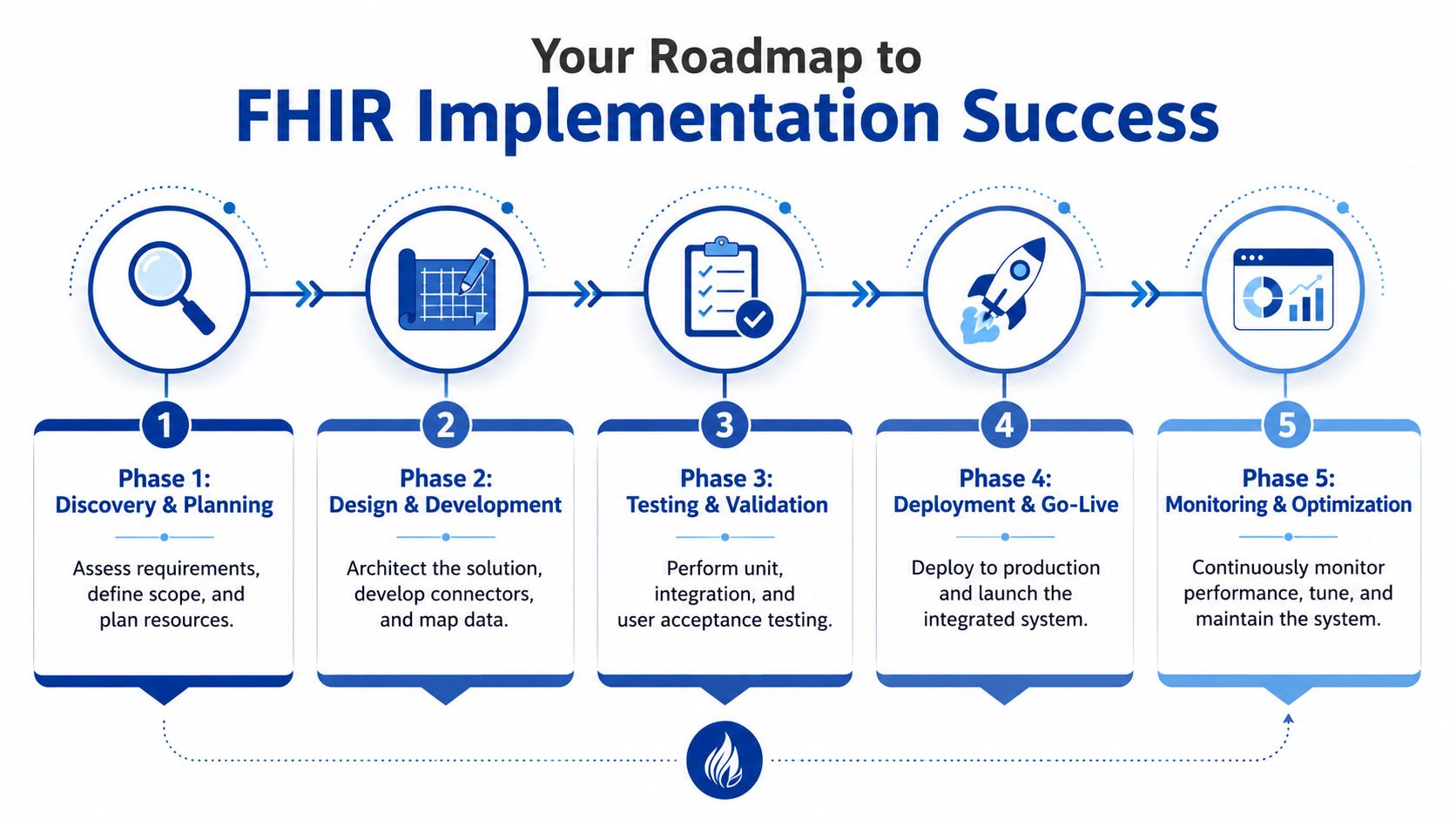
Most FHIR programmes fail in the early stages for predictable reasons. Teams start with endpoint design before deciding which workflows matter. Or they buy a FHIR server and assume the hard part is done. A better path is phased, with each stage producing something operationally useful.
Phase 1: Discovery and planning
Start with the business workflow, not the resource list. Pick a use case that matters operationally, such as patient summary exchange, lab result sharing, referral coordination, or insurer-provider document flow.
Then assess your source systems. Identify where the data lives, who owns it, how clean it is, and which fields are authoritative. This is also where governance begins. If no one can decide what the correct source of medication history is, technical design won't save the project.
Phase 2: Design and development
Once scope is stable, choose the architecture that matches the workflow. Some teams need a gateway in front of an existing FHIR-capable EHR. Others need middleware because their data still arrives in older formats.
Core work in this phase usually includes:
Resource selection: Decide which FHIR resources and profiles are in scope for the first release.
Mapping design: Define how local fields translate into FHIR elements, codes, identifiers, and references.
Security model: Set authentication, authorisation, and audit expectations early so they aren't bolted on later.
Environment setup: Establish development, test, and validation environments before partner testing starts.
Phase 3: Testing and validation
Testing has to go beyond “the API returned data.” Clinical and operational teams need to confirm that the data is correct, complete enough for the use case, and understandable at the receiving end.
Build validation into the delivery process. Don't leave profile checking and semantic review until the week before go-live.
That means unit testing for transformations, integration testing across systems, payload validation against target profiles, and user acceptance with the people who rely on the workflow.
Phase 4: Deployment and go-live
Production rollouts work better when they're staged. Start with a narrow use case, a limited set of users, or a small number of connected systems. Watch logs closely, track failed transactions, and give support teams clear escalation paths.
For organisations that want implementation support from a development partner, Cleffex Digital Ltd offers FHIR integration services that cover goal definition, data-source review, data-quality assessment, and deployment planning. That kind of service is most useful when internal teams understand the workflow but need execution capacity.
Phase 5: Monitoring and optimisation
Go-live isn't the finish line. Source systems change, profile rules evolve, and data quality issues surface under production load. Mature teams treat integration as a product with release management, observability, version control, and a backlog of improvements.
A phased roadmap reduces risk because it gives decision-makers checkpoints. It also prevents the common mistake of funding “FHIR” as a platform purchase instead of a governed interoperability programme.
Security and Data Mapping Best Practices
A common Canadian go-live problem looks like this. The API calls work in test, the payloads pass basic validation, and then privacy review or semantic mismatches stall production because one province expects a different profile constraint, one hospital uses local codes no one documented, and no one settled how access logs will be retained. That is the point where FHIR integration stops being an interface project and becomes an operating risk.

Start with access control and auditability
Security design needs to be settled early, especially in Canada where legal and operational requirements do not line up neatly across jurisdictions. Federal direction is tightening under Bill C-72, but implementation still happens through a mix of pan-Canadian guidance, provincial rules, hospital policies, and vendor-specific constraints. Teams that treat security as a final hardening step usually end up revisiting architecture, identity flows, and support procedures late in the project.
For FHIR deployments, the practical baseline is clear. Use standards-based authorisation for API access, define which users and systems can read or write each resource type, and make audit trails usable for privacy review and incident response. Health Level Seven International's FHIR security guidance outlines how SMART on FHIR and OAuth 2.0 are commonly used to control app and user access in production healthcare environments, not just in development labs, as described in the FHIR security implementation guidance from HL7.
Hospital administrators should ask direct questions here. Where are tokens issued and rotated? How are service accounts separated from human users? What gets logged when a record is queried, updated, or exported? Those answers affect privacy exposure, accreditation readiness, and support costs.
For organisations reviewing their broader defensive posture alongside interoperability work, guidance on how to secure your IT infrastructure can help frame FHIR security inside the larger cybersecurity programme instead of treating it as a separate stream.
Data mapping is where budgets and timelines slip
The harder problem is usually not transport. It is meaning.
FHIR gives teams a shared structure, but it does not automatically resolve local naming, workflow differences, old code sets, or inconsistent source data. That gap shows up quickly in Canadian environments because provincial profiles can differ, legacy hospital systems often carry years of local customisation, and smaller providers or startups may not have dedicated terminology or data-governance staff.
A field called "status" can still fail in production because the sending system means billing status while the receiving workflow expects clinical status. A medication code may be valid locally but unusable for downstream reconciliation if the target profile expects a different terminology binding. Free-text allergies, partial demographics, and department-specific abbreviations create the same problem.
Semantic errors are harder to spot than failed API calls. They often pass through interface monitoring and surface later in reporting, decision support, patient matching, or quality audits.
Practices that reduce real project risk
Validate against the exact target profile early: Base resource validation is not enough if a province, network, or partner has tighter constraints.
Separate field transformation from semantic mapping: Converting formats is one task. Deciding what a source value means is another.
Keep a terminology and mapping decision log: Record local code mappings, default values, null handling, and unresolved ambiguities so teams are not reinterpreting data at every release.
Test with messy real-world samples: Old departmental systems, incomplete registrations, duplicate identifiers, and mixed-language entries expose defects that clean sample data will miss.
Review audit and operations workflows before launch: Operations teams need procedures for credential rotation, alert review, failed transaction handling, and privacy investigations.
Assign ownership for profile changes: Someone needs to track updates to provincial implementation guides and partner requirements, then assess what each change means for mapping and regression testing.
A useful technical companion for governance and operational controls is this guide to data security in healthcare information systems.
Vendor Selection and Compliance in Canada
A hospital signs a vendor that demos clean FHIR APIs, connects well in a pilot, and passes procurement. Six months later, problems emerge. Quebec requires one set of profile decisions, Ontario partners expect another, privacy review asks where transient logs are stored, and the support team discovers the vendor has never handled a regulated Canadian production environment at scale.
That pattern is common enough that buyers should treat Canadian fit as a separate evaluation track, not a footnote under technical capability. FHIR support matters. It does not answer whether a vendor can operate across provincial rules, data handling obligations, and the day-to-day realities of healthcare support.
Bill C-72 changes the procurement standard
Federal interoperability policy is tightening, and procurement teams should reflect that now. Bill C-72 has been introduced as part of Canada's push to reduce information blocking and set clearer expectations for interoperable health IT. For buyers, the practical point is simple: vendor selection is no longer just about adding API capacity. It is about reducing future compliance exposure and avoiding rework when interoperability expectations become more explicit in contracts, audits, and partner onboarding.
If a vendor cannot explain how they track Canadian regulatory changes, update conformance targets, and document their obligations by province, that gap should affect the scorecard.
What strong vendor due diligence looks like
Product demos rarely expose the actual delivery risk. The better questions are operational.
Provincial profile readiness: Ask which Canadian implementation guides and provincial profiles they support in production today, not which ones are on the roadmap.
Compliance ownership: Confirm who is responsible for profile updates, validation rule changes, privacy impact support, and audit evidence after go-live.
Legacy coexistence: Check how they handle HL7 v2 feeds, CSV imports, older departmental systems, and partner-specific formats without forcing a full replacement.
Hosting and data handling: Verify where data is processed, cached, logged, monitored, and backed up, including vendor subprocessors.
Support model: Ask for named response times, escalation paths, and examples of incident handling in regulated healthcare environments.
Mapping governance: Require a clear process for terminology decisions, exception handling, and change control when one province or network interprets a field differently.
I usually advise buyers to ask vendors for a sample change request from a live healthcare client. It shows far more than a polished sales deck. You can see how they document impact, who approves mapping changes, how they test revisions, and whether support and engineering work from the same operating model.
Provincial fragmentation is where good projects slip
Canada does not have one FHIR implementation reality. It has a shared direction with local variation layered on top. That affects consent handling, profile constraints, terminology choices, onboarding timelines, and sometimes the data elements that partners consider mandatory.
Smaller providers, digital health startups, and SMEs often get caught. They buy for the first deployment and underestimate the cost of the second province. A vendor may perform well in one jurisdiction and still require substantial remapping, retesting, and documentation work elsewhere. The problem is rarely the API alone. The problem is semantic interpretation, local conformance, and who carries the work when those requirements diverge.
Commercial terms deserve the same scrutiny as technical fit
FHIR integration pricing usually falls into three models:
| Model | Works well when | Watch for |
|---|---|---|
| Project-based pricing | Scope is well defined | Profile changes and partner-specific mapping can turn into expensive change orders |
| Subscription pricing | The platform will be used across multiple workflows over time | Included support, conformance updates, and usage limits may be unclear |
| Transaction-based pricing | Message volumes are stable and easy to forecast | Costs can rise quickly as more partners, provinces, or event types are added |
The best model depends on your rollout plan. An early-stage startup launching in one province may accept project pricing to control initial spend. A hospital group expecting ongoing partner onboarding usually needs clearer provisions for support, profile maintenance, and change requests, even if the annual price is higher.
Cheap implementation pricing often pushes cost into the wrong place later: remapping, exception handling, delayed onboarding, and audit preparation.
A practical Canadian selection standard
Choose vendors that can show three things. They can deliver against the profile requirements you face today, they have a method for handling provincial variation tomorrow, and they can support the compliance record your organisation will need to keep.
In Canada, that is the difference between a working pilot and a service that survives procurement review, privacy review, and expansion into the next jurisdiction.
Migration Tips and Your Next Steps
Most organisations don't replace legacy exchange overnight. They run hybrid environments for a while, and that's normal. The safest migration approach is usually incremental.
Start with one high-value workflow and leave the rest of the legacy estate in place. Use a translation layer where needed so HL7 v2, older vendor interfaces, and FHIR can coexist without forcing a full platform rewrite. Keep the source of truth clear. If two systems can update the same clinical concept, define ownership before you expose that data through FHIR.
A few migration habits help immediately:
Prioritise stable data domains: Demographics, encounters, and common observations are often easier starting points than highly variable clinical narratives.
Preserve traceability: Keep links back to source identifiers so support teams can investigate discrepancies.
Run parallel validation: Compare legacy outputs and FHIR outputs during rollout instead of cutting over blindly.
Treat mappings as governed assets: They need version control, review, and maintenance.
For Canadian providers, startups, and SMEs, this is no longer just an innovation project. It's part compliance, part operational modernisation, and part foundation for future products. The teams that do it well start narrow, validate thoroughly, and plan for provincial complexity early.
If your organisation needs a practical path through FHIR adoption, Cleffex Digital Ltd can help assess your current systems, define realistic integration scope, and build a roadmap that fits Canadian interoperability and security requirements.