


A customer sees a jacket online, taps “pick up today”, and walks into the store expecting one conversation, one stock count and one loyalty record. Instead, the associate is checking a separate till screen, the website says the item is available, and the back room says otherwise. That gap is where unified commerce architecture earns its keep, because it turns a stitched-together retail experience into one operating model that customers can trust and staff can run.
In Canada, this is no longer a niche technology debate. Statistics Canada reported that total Canadian retail spending reached CAD 865.2 billion in 2024, with e-commerce representing roughly 8.5% of annual revenue and growing about three times faster than overall retail. That scale means a retailer can't treat digital commerce as a side channel. It has to connect storefronts, inventory, orders, payments and customer data through one operational spine.
When Online and Offline Stop Feeling Like One Store
The customer usually notices the problem before the leadership team does. She orders online, expects the branch to know her size, and wants the pickup desk to see the same order status her phone showed five minutes ago. If the store team has to cross-check three systems, the experience feels broken even when every system is technically “working”.
That's why this topic matters for Canadian retailers, dealerships, insurers and healthcare businesses that sell through both digital and physical touchpoints. In practice, the pain shows up in small ways: a missing pickup alert, a stale stock count, a loyalty balance that doesn't follow the customer from app to store. Those are not cosmetic issues. They're signs that each channel is running its own version of the truth.
For a useful companion on how this friction looks from a delivery and fulfilment angle, the Routelink guide for dispatch teams is a helpful read because it highlights the operational side of coordinated last-mile work.
Practical rule: if a customer can place an order online that store staff can't see quickly, your channels are connected at the front end but not unified underneath.
The best internal comparison point is a retailer's own customer journey work, and the omnichannel retail solutions for Canadian SME perspective shows why the customer-facing experience only holds up when the back office is aligned too. That is the shift. Unified commerce isn't about adding more touchpoints. It's about making each touchpoint read from the same operational record.
What a Unified Commerce Architecture Actually Is
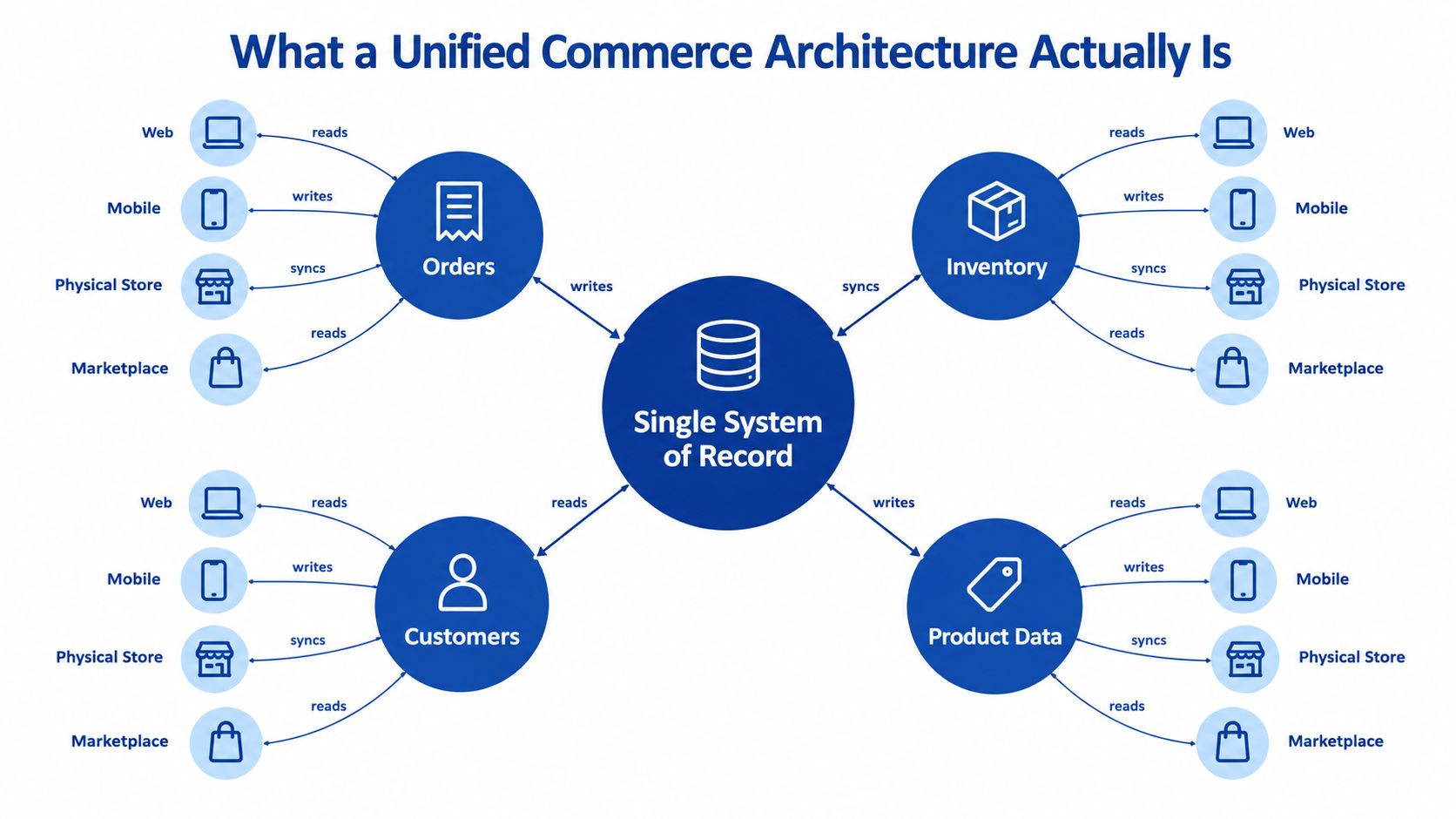
A unified commerce architecture is a system design where orders, inventory, customers and product data have one authoritative home, and every channel consumes that data instead of maintaining its own private version. It works like a hospital record. A patient can move between reception, triage and specialist care, but the record stays consistent because one file drives the whole process.
That differs from classic multichannel commerce, where the website, store system and service desk each keep their own records and only exchange partial updates. It also differs from loose omnichannel commerce, which usually focuses on the customer experience across touchpoints without fully solving the back-end coordination problem. Omnichannel says the customer should feel continuity. Unified commerce makes sure the operations behind that continuity are shared.
A good test is simple. If the store can't trust the same inventory number the website is showing, you don't yet have unified commerce; you have parallel systems with a sync layer.
The architecture matters because the channel count is not the core problem. A business can have web, mobile, marketplace and store presence and still be fragmented if every channel owns its own logic. The better model is one commerce core with channels acting as readers and writers through controlled interfaces.
This also explains why the 2020 retail shock mattered so much. Statistics Canada data shows online share of retail rose from 2.4% in 2016 to 4.0% in 2019 and surged to a record 11.4% in April 2020, forcing retailers to coordinate digital and store operations in real time. Once customers expected fluid movement between online and offline, the architecture underneath had to stop behaving like separate stores.
For teams evaluating platform choices, an all-in-one digital experience platform can be useful when the aim is to align publishing, experience and commerce content in one place, but it still needs the underlying data model to be disciplined.
Core Components of a Connected Commerce Stack
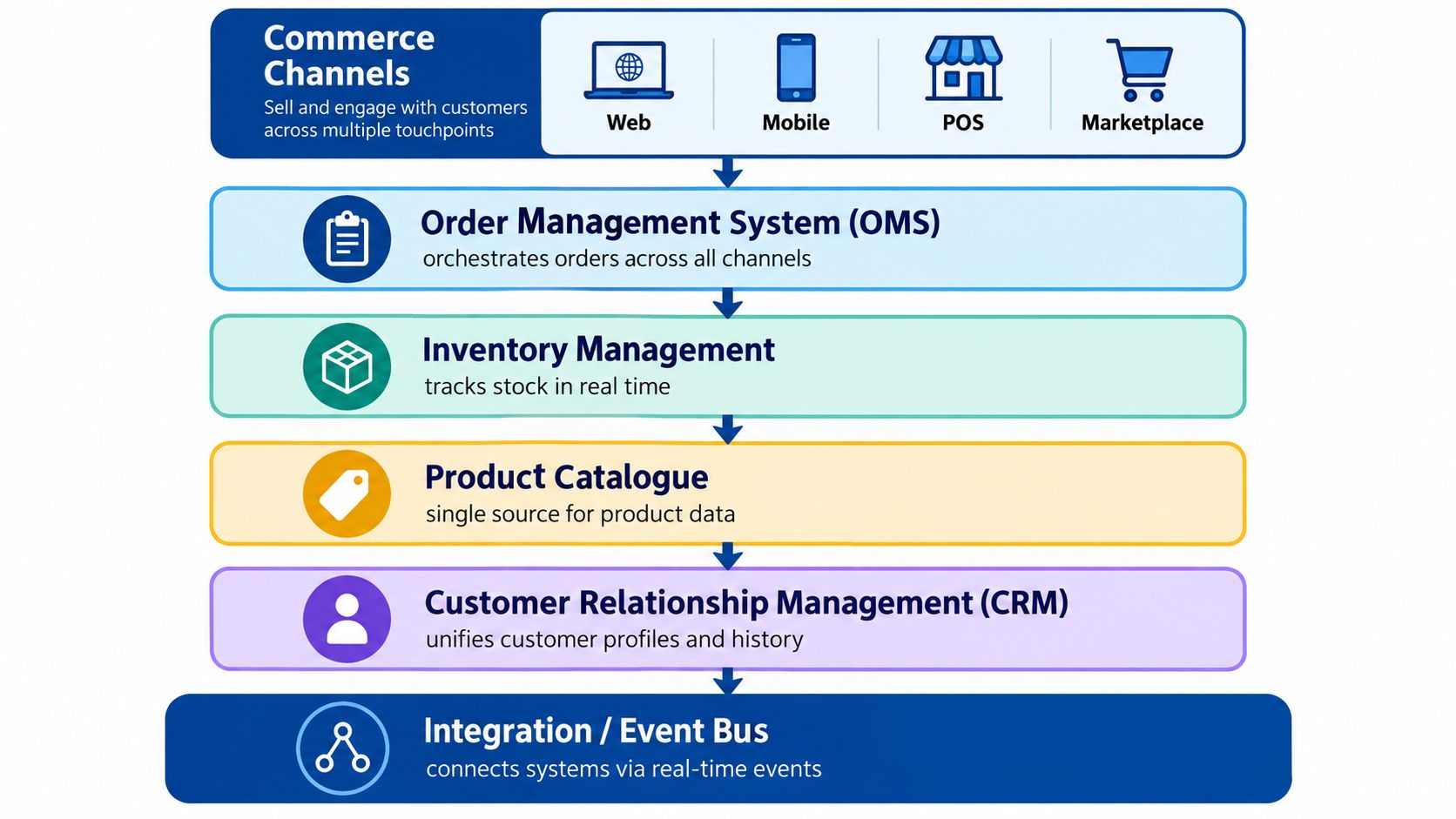
The easiest way to understand the stack is to ask what each layer owns and what breaks if it disappears. The order management system, or OMS, sits near the centre because it orchestrates the order lifecycle across channels. If you remove it, every channel starts making its own decisions about fulfilment, cancellation and return handling.
The layers and their jobs
Commerce channels are the customer entry points: web, mobile, store POS, marketplace and service desk. They should collect intent, not invent business rules.
Inventory management tracks what's available, what's reserved and what's moving between locations.
Product catalogues hold the product content, attributes and merchandising rules that need to stay consistent.
CRM keeps customer identity, preferences and service history together.
Integration or event bus carries changes between systems, so updates move fast without every application needing a custom point-to-point connection.
That structure is easier to operate than a pile of one-off links, because each layer has a clean responsibility. If your CRM is also acting like a stock service, or your storefront is making reservation decisions on its own, the stack will drift. Cleffex's ecommerce development service fits naturally into this kind of build when a client needs storefronts, ordering and connected back-office systems assembled as one working setup.
For teams that prefer a more technical integration view, the NanoPIM integration overview is a useful reference point because it reinforces the idea that product and data flows need a shared discipline, not just more connectors.
Useful checkpoint: if a system can't state clearly whether it owns a record, reads it, or merely passes it along, it will eventually create data ambiguity.
Architecture Patterns Worth Choosing On Purpose
Not every SME needs the same pattern, and that's where a lot of vendor advice gets sloppy. The right choice depends on how fast the business changes, how much in-house support it has, and how much complexity the team can realistically operate.
| Pattern | Best fit for | Main trade-off |
|---|---|---|
| Headless commerce | Teams that need to change the customer experience quickly across web, mobile and other front ends | More flexibility at the front, more integration work behind it |
| Microservices | Organisations with strong engineering discipline and clear domain boundaries | Operational overhead can grow fast for smaller teams |
| Event-driven architecture | Businesses where inventory, order status and fulfilment need near real-time coordination | Requires good observability and careful event design |
| Modular monolith | SMEs that want simpler deployment and governance while they mature | Less independent scaling, but far easier to manage |
For many Canadian SMEs, the modular monolith is the sane starting point. It reduces moving parts while still allowing the commerce core to be separated by responsibility. A headless front end can still sit on top of that if the user experience needs faster iteration. Microservices only pay off when the team has the discipline to run them without turning every change into a support burden.
The useful rule is to choose the pattern that matches the organisation's maturity, not the one with the most fashionable language. That's especially important when the business is still sorting out ownership of stock, customer identity and payment flows. The enterprise application architecture patterns discussion is a helpful companion if you want to compare these options through a broader systems lens.
Following One Customer Order Through the Stack
A click-and-collect order is the best way to make the architecture real because every layer has to do something useful. The customer checks out online, pays, gets a pickup message, and the store fulfils the order without guessing which number is current. If the stack is sound, the journey is boring in the best possible way.
What happens at each step
Checkout sends the order event from the storefront to the OMS.
Payment authorisation confirms the transaction through the payment service, then returns a status the OMS can store.
Inventory reservation locks the stock against that order so another channel can't sell the same item twice.
Store fulfilment updates the order when staff pick the item and mark it ready.
Pickup notification goes to the customer once the order is staged.
Collection and return handling update the same order record later if the customer brings the item back or swaps it at a counter.
That sequence matters because a click-and-collect order isn't just a sale. It's a chain of state changes that must stay synchronised across payment, stock and service channels. Statistics Canada reported seasonally adjusted e-commerce sales of $4.3 billion in December 2024, showing that digital orders remain a material share of retail activity alongside physical store operations.
A well-built OMS also gives the store a common view when the customer walks in. That's the point where a system like the one described in the guide to order management system software becomes practical rather than abstract, because the OMS has to carry the order from purchase to fulfilment without losing the state history.
The best sign of a healthy order flow is not speed alone; it's that every team sees the same status at the same time.
A Realistic Migration Roadmap for SMEs
The mistake many smaller firms make is trying to replatform everything at once. That's risky, expensive and usually unnecessary. A better route is to connect the highest-value data first, then layer in orchestration once the core records are stable.
A phased path that a CFO can defend
Phase 1, Shared inventory. Centralise stock data across channels so web and store stop arguing over availability. This is the quickest way to reduce obvious friction.
Phase 2, Order consolidation. Route orders through one OMS so the team can see every sale, cancellation and fulfilment step in one place.
Phase 3, Customer unification. Merge customer profiles and purchase history, so support, marketing and store staff work from the same identity.
Phase 4, Full integration. Add event-driven synchronisation across systems, so updates move in near real time.
That sequence lines up with what Canadian SMEs are living with. A 2025 CFIB survey of 1,683 Canadian business owners found 92% used at least one digital tool but only 10% were classified as fully digitised, with 45% using tools in only some business areas and reporting limited operational integration. In other words, most firms already have tools. They don't have enough integration.
When Cleffex works with insurers, dealerships or regional retailers, the useful question isn't “should we replace everything”. It's “which record needs to become reliable first”. That usually leads to a narrower build, not a bigger one. The goal is to make the existing stack behave as one business, not to erase every tool on day one.
Security, Compliance and Payment Realities in Canada
Payments and privacy are where unified commerce stops being a design exercise and becomes a governance issue. Canadian customers still use a mix of rails, so a checkout design that assumes one preferred method is too brittle for the market. Payments Canada reported that digital payments represented 86% of total payment volume and 77% of total payment value in 2024, while cash still accounted for 11% of payment volume and credit plus debit cards together represented 63% of volume.
What the architecture needs to protect
Payment data should be tokenised once and then passed between channels as tokens, not raw card details. That keeps the payment layer cleaner and reduces the chance that one channel ends up with special logic the others don't share. It also means refunds, partial captures and reversals can be tracked as immutable events instead of ad hoc edits.
Privacy needs the same discipline. PIPEDA requires meaningful consent for collecting, using or disclosing personal information, and that consent must be understandable in plain terms. A retailer that links loyalty, browsing, app activity and store purchases needs to record purpose, consent status and withdrawal across all connected systems, not just in the website footer. The Office of the Privacy Commissioner of Canada's consent guidance is worth reading closely before identity and personalisation work starts.
Architecture rule: one customer record does not mean unlimited access. It means controlled access with clear purpose, retention and audit trails.
Fraud controls should also be shared across web, mobile and POS, because risk doesn't respect channels. Device signals, session patterns, manual review and wallet authentication should feed one risk service rather than three separate ones. That way, a safe decision in one channel can inform the others without exposing more sensitive data than necessary.
Measuring Success and Applying This to Your Sector
The simplest scorecard is the one staff can see in day-to-day work. Authorisation rate, inventory sync latency, click-and-collect pickup success, return exceptions and cross-channel customer history completeness tell you whether the architecture is behaving as one system or just pretending to. If one metric improves while the others get messier, the stack is still fragmented.
The sector fit is different, but the logic stays the same. Retailers need reliable stock and fulfilment. Dealerships need clean lead-to-appointment handoffs. Insurers need one customer view from quote to policy service. Healthcare and life sciences teams need the same integration discipline with stricter privacy and consent controls. The common thread is that the channels are only as strong as the records beneath them.
If you want a practical starting point, begin with the record that causes the most visible friction, usually inventory, order status or customer identity. Then make sure every channel reads from it, and every exception is auditable. That is the work of retail technology in a unified commerce model, and it's where a connected storefront starts paying for itself.
Cleffex Digital Ltd helps businesses connect storefronts, order flows, inventory and back-office systems into one practical commerce setup. If your team is working through unified commerce architecture, omnichannel commerce or a connected retail stack, visit Cleffex Digital Ltd and review the service options that fit your current systems and next steps.