

Approximately 9 million Canadians already share confidential banking credentials with service providers, and FinTech APIs offer a safer alternative by enabling consent-based access without handing over usernames and passwords. The shift is changing how financial products are designed, tested and governed across banking, insurance, healthcare and small-business finance.
You may have encountered the problem without seeing it. A customer connects a budgeting app to a bank account, an insurer needs to verify a payment, or a lender wants transaction history for an application. Behind the simple “connect your account” button sits a difficult decision: should a product collect credentials, depend on an intermediary, or build around controlled API access?
For Canadian businesses, the answer is more complicated than a generic API tutorial suggests. Consumer-driven banking isn't yet available nationally, the technical standard is still developing, and insurance providers don't offer consistent machine-readable access. A sound strategy therefore needs more than endpoints and authentication. It needs consent management, adaptable architecture, security controls, fallback workflows and clear accountability.
The Growing Problem With Financial Data Access
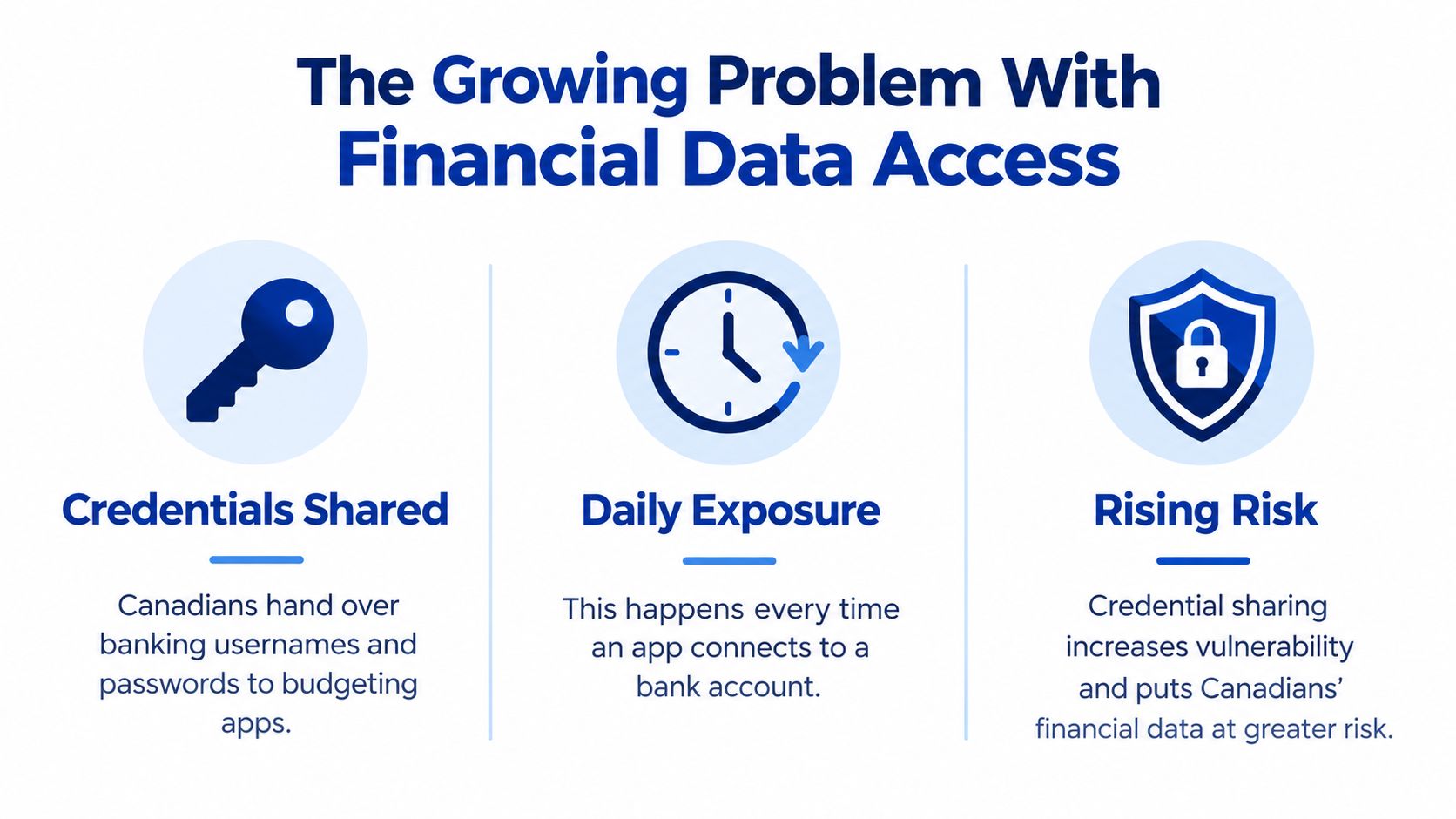
When a customer links a financial app today, they may be authorising more than they realise. Under screen scraping, the application receives banking credentials and uses them to imitate the customer's login. That approach helped aggregation services grow, but it creates a direct security problem because a third party holds information that should remain private.
The Canadian federal government reported that approximately 9 million Canadians were sharing financial data by providing confidential banking credentials to service providers. The figure signals demand for connected financial services, but it also shows why credential sharing can't remain the foundation for financial API development.
What changes with consent-based access
A properly designed API lets a customer authorise defined access without revealing their online-banking password. The permission might cover account balances and transaction history, while excluding unrelated products or actions. The customer can then manage the permission, and the provider can record which service accessed which data.
That distinction matters for a small-business cash-flow tool. The product may need transaction history to categorise income and expenses, but it shouldn't automatically receive permission to initiate payments. A lending workflow may need account information for assessment, while an insurance process may need confirmation of a payment rather than a complete financial profile.
Canada's earlier policy work described APIs as the principal technical mechanism for giving fintech companies access to consumer financial information. The same 2019 parliamentary research publication estimated that nearly 4 million Canadians were already using smartphone applications relying on screen scraping, demonstrating that connected-finance demand existed before a national open-banking framework was fully implemented.
Practical rule: Treat every permission as a product decision, not just an authentication event.
Why this affects product design
FinTech APIs replace a fragile imitation of a customer login with a more controlled relationship between the financial institution, the authorised provider and the customer. That can improve transparency, but it doesn't remove responsibility. The product still needs to define what it collects, why it collects it, how long it retains it and what happens when access is withdrawn.
Teams exploring the wider technical domain can also review this #1 web scraping api resource to understand the difference between extracting public web information and connecting to protected financial systems. For a deeper architectural perspective, see Cleffex's guide to building a financial data platform for fintech.
The result is a change in the design brief. A financial product is no longer just an interface on top of a bank connection. It's a governed data service that must make customer choice visible and operational.
Understanding Different FinTech API Categories
“FinTech API” describes a broad family of interfaces, not one standard product. Each category supports a different business capability, with its own data sensitivity, authorisation model and operational risks.
Banking and open-banking APIs
Banking APIs typically expose account information, balances, transaction history and product details. A personal-finance application can use them to create a consolidated view of a customer's accounts. A cash-flow platform can use transaction data to help a small business understand incoming and outgoing funds.
Open-banking APIs add a governance layer around that access. Canada's proposed framework covers consumers and small businesses, with information such as account balances, transactions, product information and fees within the proposed scope. It also contemplates machine-readable access through approved providers, rather than informal credential sharing.
Payment APIs
Payment APIs let a product request or initiate a payment, depending on the provider and the customer's authorisation. An invoicing platform might create a payment request, while an embedded-finance product could connect payment initiation to a customer workflow.
Payment access is more sensitive than read-only account access because the API can cause money to move. Product teams need stronger transaction controls, clear confirmation screens, fraud monitoring and an audit trail that records the customer's decision.
Identity, KYC and lending APIs
Identity and KYC APIs help a business verify a customer before it opens an account, issues a policy or processes a financial request. The integration may combine identity evidence, verification results and risk signals, but the product must avoid treating an external response as an unquestionable decision.
Lending APIs can connect applications with data collection, assessment and repayment workflows. A lender may use authorised transaction information to understand cash flow, but it still needs an explainable decision process and appropriate controls for sensitive data.
Accounting and data-provider APIs
Accounting APIs connect banking or payment activity with bookkeeping systems. They can support reconciliation, invoice matching and financial reporting without requiring staff to re-enter every transaction.
Data-provider APIs can sit across these categories, offering normalised information from several institutions. Normalisation reduces application complexity, but it can hide meaningful differences in data quality, freshness and consent status. A transaction category supplied by one provider may not carry the same confidence or context as one supplied by another.
The category tells you what an API can do. The consent model tells you what your product should do with it.
Choosing the Right Integration Architecture
The central architecture decision is whether to connect directly with financial institutions or use an aggregator platform. Neither option is automatically correct for every Canadian product. The right choice depends on the required coverage, regulatory posture, customisation needs and ability to operate integrations over time.
A direct connection offers control over authentication, payload mapping, error handling and release timing. It may suit an established organisation with a narrow set of strategic partners and enough engineering capacity to maintain those relationships. The cost is operational complexity, because every institution can expose different specifications and behaviours.
An aggregator provides a common interface across multiple institutions. That can help a startup validate a product sooner and reduce the number of provider-specific components in its first release. The trade-off is dependency. The aggregator controls part of the connection, may limit access to specialised capabilities and can introduce pricing or availability risk.
| Factor | Direct Connection | Aggregator Platform |
|---|---|---|
| Coverage | You select and maintain each institution | One provider may offer access to multiple institutions |
| Control | Greater control over data mapping and workflows | Less control over provider-specific behaviour |
| Time to launch | Usually requires more preparation | Often provides a faster starting point |
| Customisation | Better for specialised capabilities | Common features may be easier than edge cases |
| Operations | Your team handles monitoring and changes | The platform handles part of the integration burden |
| Dependency | More dependencies on individual institutions | Concentrated dependency on the aggregator |
| Canadian readiness | You can design for local requirements directly | You must assess how the platform supports Canadian requirements |
A third option is a transitional architecture. Build a provider adapter layer inside your product, then connect an aggregator, a direct institution or a future domestic standard behind that layer. The core application consumes your own stable data model instead of embedding provider-specific assumptions throughout the codebase.
That approach is particularly relevant while Canada's consumer-driven banking framework remains under development. The government says consumer-driven banking isn't yet available nationally and has updated its implementation plan in Budget 2025. Teams can prepare by separating consent, identity, provider adapters and data mapping rather than waiting for every technical detail to settle.
For a broader view of adaptable systems, consult this guide to AI-ready fintech infrastructure. The same principle applies here: keep the business logic stable while external data sources change.
Navigating Security and Compliance Requirements
Security isn't an add-on to FinTech API integration. It shapes which data a product can access, how it stores permissions and what evidence it must retain when something goes wrong.
Canada's Consumer-Driven Banking Act, adopted in June 2024, gave the Financial Consumer Agency of Canada responsibility for overseeing, administering and enforcing the consumer-driven banking framework. That formal oversight makes accreditation, privacy, security and consumer control part of the product design rather than optional policy documentation.

Build the consent layer first
Start by defining the permission journey in plain language. The customer should understand:
What data is requested: Name the categories, such as balances, transactions or product information.
Why it's needed: Connect each category to a visible product function.
Who receives it: Identify the service provider and any relevant sub-processors.
How long access lasts: Record the permission period and renewal process.
How to withdraw it: Make revocation practical, not hidden in support documentation.
What happens next: Explain how the product behaves when access expires or is denied.
Data minimisation should guide the API contract. If a workflow only needs confirmation of a payment, don't request a complete transaction history. If a product needs read access, don't ask for write access.
Account for outsourced risk
OSFI Guideline B-10 applies to federally regulated financial institutions, including foreign bank branches and foreign insurance company branches operating in Canada. It states that an institution remains accountable for outsourced activities, functions and services, and identifies technology and cyber risk in third-party arrangements as an area requiring additional controls.
That means an API provider doesn't become the sole owner of the risk. A regulated institution or product owner still needs vendor due diligence, access controls, encryption, resilience planning, incident procedures and evidence that the arrangement can be governed.
Make auditability operational
A secure implementation should record consent events, token use, data access, administrative actions, errors and revocations. It should also separate production secrets from application code, restrict staff access and monitor unusual request patterns.
For insurance or healthcare use cases, teams must consider applicable privacy obligations alongside financial requirements. Cleffex's overview of fintech compliance solutions provides further context for designing compliance into software delivery.
Security principle: If your team can't explain who accessed which data and why, the product isn't ready for production.
Building Resilient Financial Product Architectures
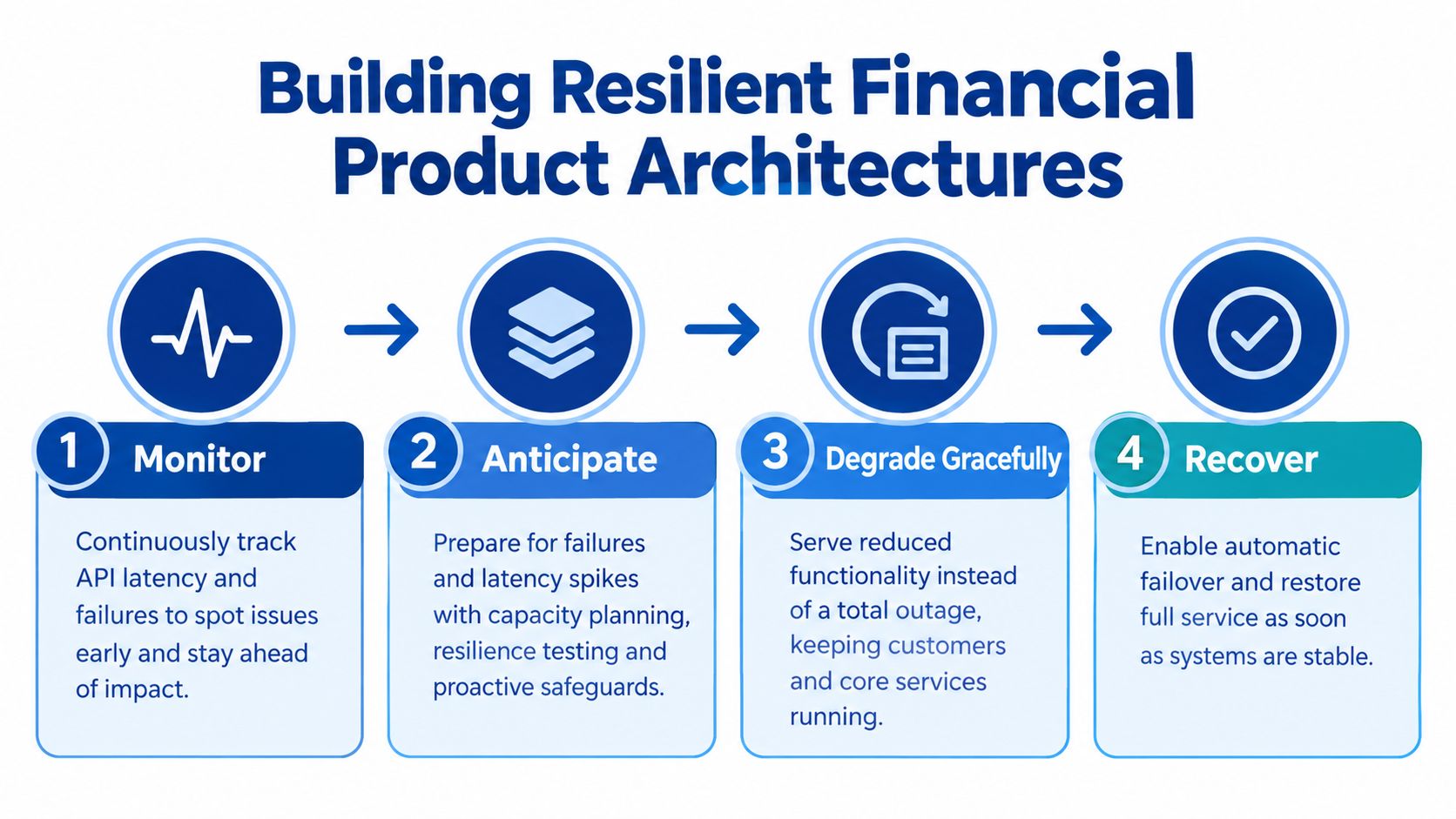
A financial product shouldn't fail completely because one institution has a slow response, an undocumented change or no machine-readable endpoint. Resilience comes from treating every external connection as a component that can fail, recover or produce incomplete information.
Canadian insurance illustrates the challenge. An API directory tracking Canadian insurance providers lists 20 providers and 37 indexed APIs, while only 8 providers publish at least one machine-readable API and 12 publish none indexed. The practical implication is clear: an API-only strategy may leave important carriers or workflows outside the product.
Combine access methods deliberately
A resilient architecture can use different channels for different jobs:
API connections: Support interactive reads, updates and authorised transactions.
Secure file exchange: Handle controlled batch processes where an API isn't available.
Broker or partner portals: Support providers that still depend on human-facing systems.
Manual review queues: Resolve exceptions without hiding them inside failed automation.
Audit records: Preserve the reason, source and time behind every material decision.
The key is to make these channels visible within one workflow. If an insurer's policy data is unavailable through an API, the system should show a controlled fallback state, assign an owner and record what information was used.
Use events and reconciliation together
Push APIs can deliver real-time, event-based updates and may reduce unnecessary transfer compared with repeated polling. They're useful for cash-flow alerts, payment verification and reconciliation, but event delivery can fail or arrive out of order.
A practical design uses push notifications to identify a change, then retrieves the authoritative resource through a scoped API call. Add webhook authentication, replay protection, idempotency keys, sequence numbers, retry policies and dead-letter handling. Periodic reconciliation pulls provide a second check when an event is delayed or missed.
Keep providers replaceable
An abstraction layer should translate external payloads into an internal model without pretending that every source is identical. Store provider identifiers, freshness information, consent status and transformation decisions so downstream teams can assess reliability.
This produces a business benefit as well as a technical one. Product managers can add a new data source or fallback process without rewriting underwriting, reconciliation or customer-service logic.
Getting Started With API Development Projects
The safest first step isn't choosing a vendor. It's mapping the product's actual data requirements against the capabilities that providers can reliably supply.
A small-business cash-flow product might need balances and transaction history, while an insurance workflow might need payment verification, policy identifiers and claims information. These requirements shouldn't be combined under a vague request for “financial data”. Each one should have a purpose, a consent scope, a source, a freshness expectation and a fallback.
Build a decision record
Before development begins, document:
Business outcomes: Define the customer or operational decision the data supports.
Required fields: Separate essential data from convenient extras.
Access mode: Decide whether the product needs read, write or event-driven access.
Provider coverage: Identify which institutions, carriers or platforms are supported.
Failure behaviour: Specify what happens when data is stale, missing or contradictory.
Compliance ownership: Assign responsibility for consent, retention, review and incidents.
Then create an API contract that describes payloads, error semantics, rate limits, consent status, data freshness and recovery behaviour. “The provider returns an error” isn't enough. Your team needs to know whether to retry, wait for a user action, use a cached value or send the case to review.
Challenge the API-first assumption
API-first is useful, but it can become a blind spot when teams assume every partner has a stable, documented interface. Canadian insurance coverage shows why a production design may need APIs, secure files, portals and human review at the same time.
Test the complete workflow, not just the successful request. Include expired consent, partial records, duplicate events, network failures, provider downtime, malformed data and a customer who withdraws access halfway through a process.
For a practical introduction to retrieving data through APIs, this real-world API usage guide can help non-specialists understand the interaction between a request, a response and application logic.
Choose delivery support carefully
A development partner should be able to discuss architecture, compliance, testing and operational ownership in the same conversation. Cleffex Digital Ltd provides FinTech API integration, banking API implementation, financial-platform architecture, testing and rollout support for products connecting banks, payment rails, identity tools and data providers.
Start with a contained workflow, define measurable acceptance criteria and keep the provider boundary replaceable. That approach lets a team learn from real usage without locking the entire product to assumptions that Canadian standards may later change.
Frequently Asked Questions
What are FinTech APIs?
FinTech APIs are software interfaces that let financial products exchange data or initiate actions with banks, payment providers, identity services, accounting platforms and other systems. Their value depends on the permission model, security controls, data quality and operating agreement behind the interface.
How do FinTech APIs improve on screen scraping?
Screen scraping requires a third-party application to use a customer's banking credentials. API-based access can let the customer authorise defined data categories without sharing those credentials, while giving the provider clearer permission and audit controls.
What are banking APIs used for?
Banking APIs can support account information, balances, transaction history and product details. Businesses use them for budgeting, cash-flow analysis, reconciliation, lending workflows and other services that depend on authorised financial information.
Is open banking available nationally in Canada?
Canada's consumer-driven banking framework is still being developed, and consumer-driven banking isn't yet available nationally. Businesses should therefore avoid hard-coding assumptions about accreditation, consent duration, read access, payment initiation, liability and technical standards.
Should a company connect directly to banks or use an aggregator?
A direct connection offers greater control but requires your team to maintain institution-specific integrations. An aggregator can simplify multi-provider access and speed up an initial launch, but it creates dependency and may limit specialised functionality. A provider-adapter layer can help preserve flexibility.
Why do insurance workflows need fallback processes?
Insurance API availability is fragmented. Some providers publish machine-readable interfaces, while others may require secure files, portals or manual processes. A resilient product should record the source and status of information rather than treating missing data as if it were a successful result.
What security controls should a FinTech API include?
Controls should include scoped consent, strong authentication, encryption, least-privilege access, audit trails, webhook verification, replay protection, idempotency, monitoring and clear revocation handling. Regulated organisations should also assess vendors and retain accountability for outsourced services.
What's the difference between push and pull APIs?
A push API sends an event when a change occurs. A pull API requires the product to request the current resource. A hybrid model often works best, with push events providing timely notification and scoped pulls retrieving authoritative information before a consequential decision.
How should a team start financial API development?
Begin with a data-needs map and a consent model. Define the API contract, provider coverage, failure states, testing scope, retention rules and audit requirements before selecting an integration pattern or beginning implementation.
With the Canadian framework still evolving, the strongest financial products won't depend on a single connection method or a hard-coded interpretation of future standards. They'll combine consent-based access, replaceable provider adapters, resilient fallbacks and evidence-based governance.
Cleffex Digital Ltd helps businesses design and deliver FinTech API integration, banking API connections and secure financial workflows across banking, payments, identity and data providers. Visit Cleffex Digital Ltd to discuss an architecture that supports today's requirements while remaining adaptable as Canada's consumer-driven banking ecosystem develops.