

You're probably living with the same contradiction many Canadian healthcare teams face right now. The core systems are “digital”, but the patient experience still feels slow, fragmented, and overly manual. A clinician can be using a modern screen while the information behind that screen still arrives late, incomplete, or in a format nobody else can easily reuse.
That gap is what HealthTech Modernisation is really about. It's not a shiny software refresh, and it's not a risky wipe-the-board rewrite. It's the disciplined work of layering FHIR, CA:FeX, identity, governance, and security over legacy healthcare systems so care teams can move from disconnected handling of data to safer, faster, more connected workflows.
The pressure to modernise is already visible in Canada's numbers. By 2024, 92% of Canadian health care providers reported access to a digital health system, yet only 52% said they used one to send or share patient clinical information with providers outside their main practice setting, and 78% still reported at least one barrier to sharing information electronically with external providers, according to Statistics Canada's national data on provider access and use of digital health systems. On the patient side, access still lags behind infrastructure. In 2025, 69% of Canadians could access at least one type of electronic health information, but only 13% reported online access to all core components of their health records, according to CIHI's digital health information overview.
That's why leaders can't treat modernisation as an IT side project. It's a care delivery issue, a compliance issue, and a trust issue all at once. If you're also looking at broader operational patterns across the sector, a useful starting point is industries in healthcare, which helps frame how healthcare organisations differ from standard enterprise software buyers.
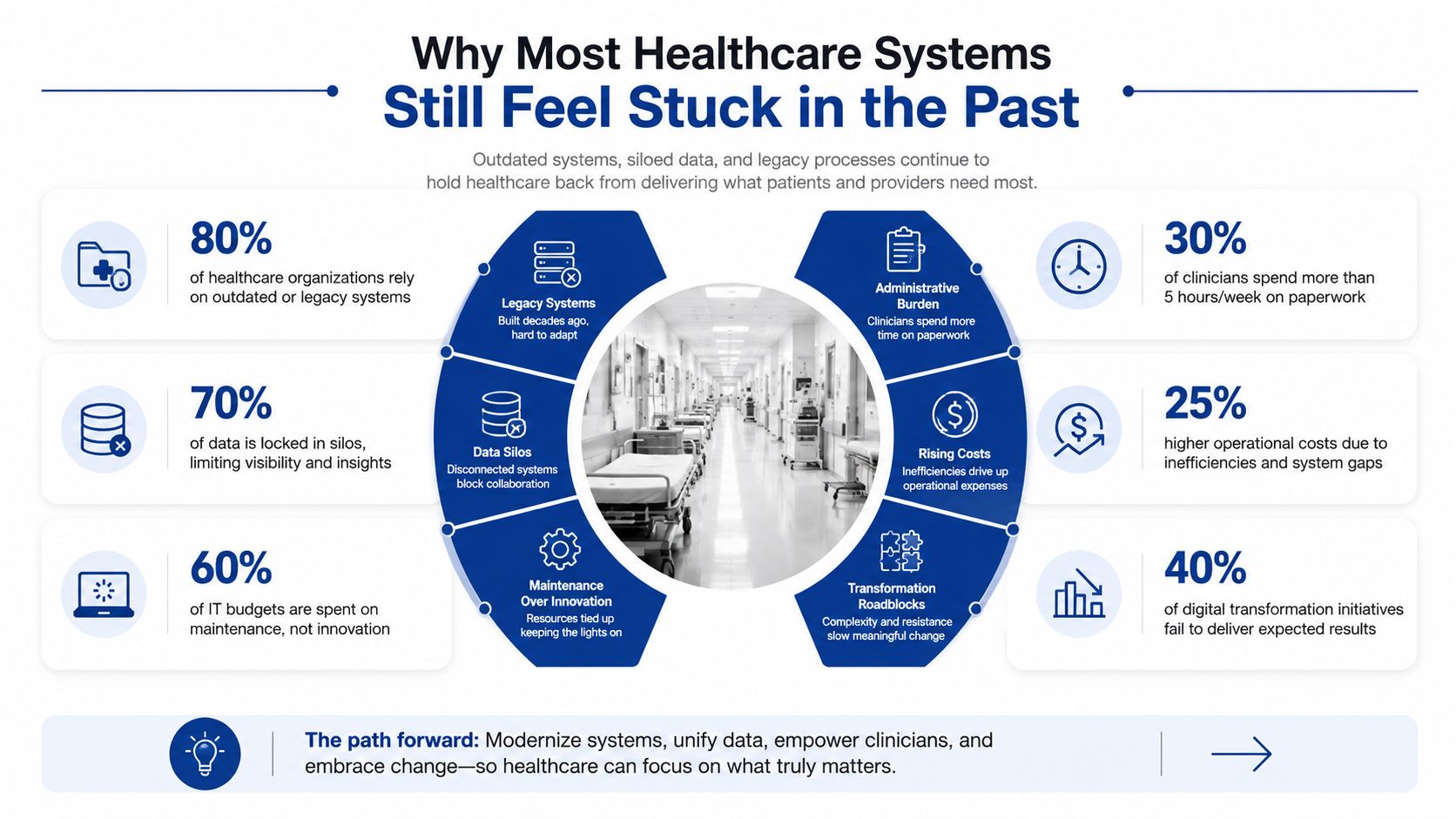
Why Most Healthcare Systems Still Feel Stuck in the Past
A mid-sized Ontario hospital can have a modern patient portal, a polished EHR login, and still leave a family physician waiting two days for a faxed referral reply. The patient checks the portal and sees almost nothing useful. The hospital has technology, but the workflow still behaves like it's several systems behind.
That's the pain point in healthcare digital transformation. The problem usually isn't the absence of software; it's the way information is trapped in provincial repositories, vendor-specific formats, and under-resourced integration layers. Canadian providers often end up with digital tools that work inside one department, then stall the moment a patient moves across settings.
Practical rule: if a clinician has to copy, paste, fax, or retype the same fact more than once, the system is still acting like a set of islands, not a connected network.
Decades of compliance fixes have added more layers, not less complexity. Each new privacy rule, vendor contract, or local workaround may have solved a narrow problem, but it also created more interfaces to maintain and more places where data can drift. That's why legacy healthcare systems feel stable on the surface while frontline care still encounters delays, duplicate entry, and missing context.
A good way to think about it is this: the modern stack may exist, but the patient journey still travels through old roads. The operational reality is often a patchwork of fax, portal, email, and manual transcription. For a broader market view of how healthcare organisations are being segmented and modernised, the healthcare software and systems landscape is a useful reference point.
The most important takeaway is simple. HealthTech Modernisation is not happening because hospitals suddenly got access to more tools. It's happening because connected care now depends on making those tools behave like one system, not ten disconnected ones.
What HealthTech Modernisation Really Means
A hospital can keep caring for patients while its systems are upgraded in layers. Some parts stay in place, some are replaced, and some are connected through new controls and services. That approach avoids a risky rebuild and lets the organisation improve what staff experience day to day.
That is what healthcare software modernisation means in practice. It is the careful layering of cloud services, APIs, identity controls, and data governance over existing assets. The goal is to make current systems easier to connect and safer to use, while preserving the parts that still support care.
The four pillars that have to hold
A modern programme usually needs four things working together. First, a cloud foundation that can scale workloads without turning every change into a hardware project. Second, well-governed APIs so systems exchange data in predictable ways instead of relying on one-off interfaces. Third, data governance so records, codes, and consent rules stay trustworthy. Fourth, security and privacy controls that meet provincial obligations and the hardening expectations in CAN/DGSI 118.
The Canadian context matters because the rules are concrete, not theoretical. CAN/DGSI 118 calls for data-flow diagrams, patch discipline, encrypted channels, and the phasing out of fax and unencrypted email in healthcare workflows, as set out in CAN/DGSI 118 Cyber Resiliency in Healthcare. Modernisation is also a control design exercise, because each new connection has to be traceable, protected, and supportable.
Modernisation reduces risk when it makes the secure path the easy path for clinicians, not when it adds another login or another portal.
For teams evaluating how automation fits into governed workflows, a practical overview is available in the browse AI in healthcare resources. The useful question is not whether AI belongs in healthcare, but whether it sits on top of an information layer that already has clear access rules, data quality checks, and auditability.
The simplest definition is this. HealthTech Modernisation means making legacy systems easier to connect, safer to operate, and more useful for patients and staff without stopping care to rebuild everything from scratch.
The Core Technical Components Behind Modernisation
The technical stack doesn't need to sound mysterious. Each layer has a job, and each job supports the next one. If one layer is weak, the whole effort becomes fragile.
Cloud APIs and interoperability
Cloud is not just “someone else's server”. In a healthcare setting, it's the part that lets teams use managed services instead of spending their time patching ageing databases and babysitting infrastructure. Canadian hosting options, hyperscalers, and managed database services all matter because they change how quickly a team can scale and recover without making every upgrade a major event.
APIs are the next layer. They let a clinician-facing app ask for data in a clean, structured way, rather than pulling it from a custom interface built years ago. In Canadian interoperability work, HL7 FHIR R4 is the common language, and the national baseline guide helps define shared expectations across jurisdictions, while CA:FeX is designed to work even on top of non-FHIR systems, which is important for legacy estates. For a deeper compliance-oriented view, see FHIR integration services and compliance guidance.
Data Governance, Security and AI
Data governance is the discipline that makes the answers trustworthy. That means master patient indexes, consent handling, de-identification, and quality rules that stop one patient from being treated like two different people. If the data foundation is messy, analytics become decoration.
Security sits alongside governance, not after it. Encryption, identity checks, audit logging, and controlled access zones are what make cloud, mobile, and AI systems viable in healthcare. A strong Canadian implementation needs that same discipline, because the security standard and privacy obligations in healthcare are not optional add-ons.
AI belongs on top of those foundations, not underneath them. Ambient documentation, decision support, and imaging models can help only when the inputs are clean, and the controls are already in place. Otherwise, you're automating confusion.
| Component | Primary Function | Canadian Healthcare Example | Key Risk Mitigated |
|---|---|---|---|
| Cloud | Scales systems and reduces infrastructure burden | Managed hosting for clinical workloads and databases | Patching delay and capacity bottlenecks |
| APIs | Moves data between systems in a controlled way | FHIR-based chart exchange across settings | Manual re-entry and interface sprawl |
| Data governance | Keeps patient data accurate and reusable | Master patient matching and consent rules | Duplicate records and unreliable analytics |
| Security | Protects PHI across the full lifecycle | Encrypted portals, logging, and identity controls | Breach exposure and audit failure |
| AI | Adds support for documentation and decision-making | Clinical summarisation and imaging support | Unsafe automation on weak data |
For teams planning a realistic sequence, the key is to make the stack support workflow first, then layer intelligence on top. That order keeps the project grounded in care delivery, not just architecture.
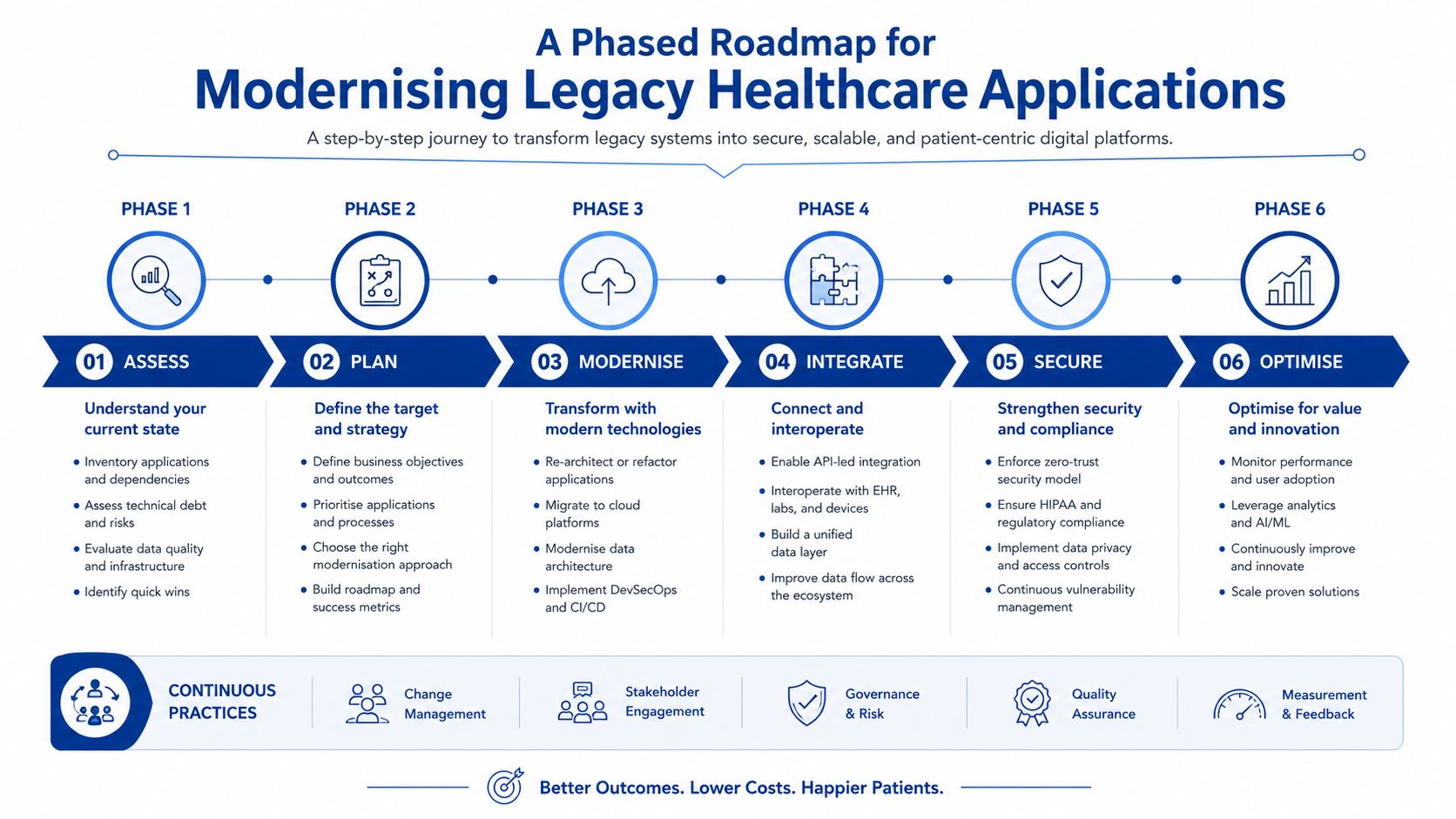
A Phased Roadmap for Modernising Legacy Healthcare Applications
A big-bang rewrite sounds decisive, but in healthcare it usually creates more risk than it removes. The safer model is to build in layers, keep the core running, and expose value as each layer becomes trustworthy.
Start with the current state
The first job is discovery. Map clinical workflows, catalogue systems, and trace where patient data moves. That includes interviewing staff who live with the work, because the documented workflow and the actual workflow are often not the same thing.
This is also where control expectations matter. A modernisation team should identify where PHI is created, stored, transformed, and shared so it can line up the evidence trail with CAN/DGSI 118 expectations. If you can't explain where data goes, you can't secure it well.
Build the exchange layer before the new experience
Stage two is the interoperability backbone. That usually means FHIR APIs and a clinical data repository that can expose existing records safely, without forcing every legacy system to be replaced at once. The CA:FeX approach is especially useful because it can sit on top of existing infrastructure and still promote RESTful exchange patterns, which is exactly what a mixed legacy environment needs.
Stage three is the patient and clinician experience layer. That's where portals, virtual care, and dashboards draw through the new APIs without breaking core systems. This is also where teams usually decide whether duplicate records can be retired, whether shadow IT should be shut down, and whether the privacy review is ready for patient-facing features.
Practical rule: don't let the front end outrun the data layer. A nicer screen can hide a weaker system for a while, but it can't fix it.
Stage four is optimisation. AI-driven triage, predictive analytics, and continuous compliance monitoring can all add value once the exchange layer, governance, and security controls are stable. For a practical cautionary comparison, the pitfalls described in why mainframe modernisation fails for architects are a useful reminder that replacing the core too early can create more dependency risk than it removes.
The pattern is progressive, not theatrical. You keep clinical operations moving while each layer of the modern stack earns its place.
Choosing the Right Migration Strategy for Your Legacy Stack
Different systems need different moves, and not every legacy application deserves the same level of surgery. The right strategy depends on urgency, risk tolerance, vendor constraints, and how tightly the application sits inside clinical workflow.
Compare before you commit
Rehost, or lift and shift, is the fastest way to move a workload into managed cloud infrastructure with minimal code change. It fits regulated workloads that need a stable hosting move first, then deeper modernisation later. Replatform goes a little further by swapping out specific pieces, such as the database or identity layer, while keeping the rest intact.
Refactor is the stronger long-term option when a system needs to be broken into cleaner services that align with FHIR and other integration standards. Rebuild is the most disruptive choice and should stay reserved for cases where technical debt makes interoperability or security goals unattainable any other way. The right answer is rarely ideological; it's usually operational.
| Strategy | Cost | Risk | Timeline | Best Fit |
|---|---|---|---|---|
| Rehost | Lower upfront change | Lower application risk, but technical debt remains | Shorter | Workloads needing quick cloud relocation |
| Replatform | Moderate | Moderate | Moderate | Systems that need targeted improvements |
| Refactor | Higher | Moderate to higher during transition | Longer | Clinical applications that need durable interoperability |
| Rebuild | Highest | Highest | Longest | Legacy systems that block security or exchange goals |
For Canadian teams, procurement and privacy reviews often shape the path as much as architecture does. If a vendor can't support the migration pattern cleanly, the programme stalls before the clinical value appears. A practical planning reference for that decision process is healthcare cloud migration guidance.
The useful question is not “Which strategy is best?” It's “Which strategy reduces clinical disruption while still moving the organisation toward interoperable care?”
Practical Checklists for Assessment, Testing, and Compliance
Modernisation efforts usually fail in the handover between architecture and operations. A checklist keeps the work visible, especially when clinical, technical, and compliance teams all think they own a different part of the same problem.
Assessment and testing that prove the system is ready
Start with an application inventory, workflow dependency map, and data classification review. You need to know which systems touch PHI, which ones support clinical decisions, and which ones are holding things together in the background. A proper FHIR readiness gap analysis belongs here too, because you don't want to discover mapping issues after the first live interface goes live.
Testing has to go beyond “the API returned a result”. It should include unit, integration, performance, and clinical safety testing, plus regression suites that prove old interfaces still behave correctly when exposed through new APIs. The point is not only whether the new layer works, but whether the old layer still does what staff expect.
Compliance evidence that can survive review
The compliance pack should map evidence to CAN/DGSI 118 control families and provincial health information laws. If your deployment is in Ontario, PHIPA evidence matters. If it's in Alberta, the Health Information Act does. The control story should also show audit trails, logging, and privacy review artefacts in a format a reviewer can follow without chasing side emails.
Keep the evidence chain boring. Boring is what survives a privacy review, a security audit, and a live incident.
A well-run programme should end this phase with concrete outputs, not vague confidence. That means a signed risk register, a FHIR conformance report, and a privacy impact assessment ready for submission. If you want a practical security lens for those artefacts, data security in healthcare information systems is a useful companion read.
The goal is simple. When a board, auditor, or privacy office asks what changed, the answer should be documented, testable, and traceable back to patient safety.
Measuring ROI and Leading People Through the Change
Financial return matters, but in healthcare it rarely tells the full story on its own. A spreadsheet can miss the value of fewer duplicate charting tasks, cleaner handoffs, and safer patient movement across settings.
Track the right kind of proof
Leaders should watch four buckets:
Operational efficiency shows whether clinicians are spending less time on repetitive work.
Clinical outcomes show whether better information access supports earlier intervention and cleaner follow-up.
Financial returns include infrastructure savings, deferred capital spend, and faster revenue cycle movement where relevant.
Risk reduction covers audit findings, breach likelihood, and compliance posture.
Adoption signals often move before the finance dashboard does. Daily active users, time-in-system changes, and feedback from nurses and physicians usually tell you whether the new workflow is sticking. If staff are using the tool because it makes the work easier, ROI usually follows.
| Measurement Bucket | Example Indicators | Adoption Signal That Predicts ROI | Typical Reporting Horizon |
|---|---|---|---|
| Operational efficiency | Less duplicate charting, fewer manual handoffs | Rising use by frontline staff | Early months |
| Clinical outcomes | Better escalation and follow-up patterns | Consistent use in clinical teams | Mid-term |
| Financial returns | Lower infrastructure burden, deferred upgrades | Stable utilisation and reduced workarounds | Multi-year |
| Risk reduction | Fewer audit issues, stronger control evidence | Improved compliance behaviour | Ongoing |
Lead the people side early
Change management works best when clinical informatics teams are involved before go-live, not after complaints start. Map workflow impacts in advance, train super-users on each unit, and build feedback loops into the first ninety days so problems surface while they're still easy to fix. Provincial boards and funders also need reporting that treats modernisation as a multi-year capability shift, not a one-quarter software purchase.
In a Canadian context, one option for teams seeking delivery support is Cleffex Digital Ltd, which works on healthcare software integration and AI HealthTech projects that support legacy platform modernisation and clinical workflow deployment.
Selecting Vendors Partners and Frequently Asked Questions
A vendor review has to start with proof, not promises. Ask for demonstrated FHIR and CA:FeX implementation experience, alignment with CAN/DGSI 118 and provincial privacy law, production healthcare deployments, Canadian data residency options, managed security services with incident response, integration depth with major EHR ecosystems, and references from peer hospitals or health authorities.
Cultural fit matters too. Score the partner on how well they transfer knowledge, document decisions, and support your exit strategy if the contract ends or the product is sunset mid-term. A good partner doesn't trap your data; it helps you keep control of it.
Frequently Asked Questions
How long does a typical modernisation engagement take?
It depends on scope, regulatory review, and how much legacy integration is involved. Smaller phases can move faster than full-platform change, especially when the first step is a controlled interoperability layer.
Can a small hospital modernise in stages with a limited budget?
Yes. A phased approach is often the safest path, because it lets you prioritise workflow bottlenecks, security, and patient-facing access without replacing every system at once.
What should happen to legacy data that won't move into the new stack?
Archive it with a clear retention and retrieval plan. You still need auditability, legal defensibility, and a path for clinical access if records must be reviewed later.
What if a vendor product is sunset while we're under contract?
That's where exit clauses, data export rights, and transition support matter. If those terms aren't in the contract, the migration risk shifts back onto your clinical team.
Cleffex Digital Ltd helps healthcare organisations connect legacy applications, modern APIs, cloud environments, and AI-enabled workflows without forcing a disruptive big-bang rewrite. If you're planning a safer path for HealthTech Modernisation, visit Cleffex Digital Ltd to explore integration and modernisation support that fits Canadian healthcare realities.