

Your underwriting team probably has the same problem right now: a stack of submissions is growing, brokers want faster answers, and someone is promising that AI underwriting will fix the backlog if you just let the model decide more. That pitch is seductive and usually wrong. The challenge is not whether the model can score risk; it's whether you can automate the routine work without handing away accountability for the cases that move capital, complaints, and regulator attention.
The right way to think about AI underwriting is as a human-machine allocation problem. Machines should handle intake, extraction, sorting, and standard decisions where the data is clean, and the rules are stable. Humans should stay in the loop where exceptions, judgement, legal exposure, and reputation risk are highest. In Canada, that split is no longer optional, because OSFI's Guideline E-23 is bringing underwriting models, including AI and machine learning, into a formal governance regime with a compliance date already set for May 1, 2027.
That changes the conversation. The question is no longer, “Can the model be accurate enough?” It's, “Where is the human accountable, how is the model controlled, and how do we prove it under exam?” If you get that wrong, you don't have automation. You have a fast way to create a governance problem.
Why AI Underwriting Is a Human Allocation Problem, Not a Model Problem
A COO who inherits a glossy model with a strong test score is usually told the same thing: retire a couple of senior underwriters and let the machine do the work. That is the wrong instinct. A model's score on a hold-out set says nothing about whether your organisation has placed decision rights in the right hands, at the right point in the workflow, with the right override rules.
The decision is where the machine stops
In practice, the useful question is not whether the model is “good”. It is where you are willing to let the machine commit capital, and where a human must remain accountable for the call. That line should move depending on the product, the complexity of the risk, and the quality of the incoming data.
A clean personal-lines submission with complete structured data can be automated aggressively. A complex commercial risk with messy broker notes, unusual geography, or a medical history that falls outside the standard corridor should not be handed over blindly. The point of automated underwriting is not to erase judgement; it is to reserve it for the files where it matters most.
Practical rule: automate the repeatable, escalate the ambiguous, and make the escalation path visible in the process design.
The insurers that win treat AI insurance solutions as a workflow design problem first and a modelling problem second. The ones that lose do the opposite, then spend a year trying to explain why the model is technically strong but operationally unusable.
Use a five-question test before anything goes live
Before you buy or build, force every underwriting automation proposal through five questions:
What gets automated first?
Intake, triage, pricing support, or binding paperwork.
Who stays in the loop?
Name the role, not the department.
How do you satisfy OSFI E-23?
Inventory, validation, monitoring, and override.
How will ROI be measured?
Cycle time, straight-through handling, and labour redeployment, not vanity model scores.
How do you avoid pilot purgatory?
Start narrow, prove value, then scale with governance.
That is the standard a COO should demand. Anything looser turns into a science project dressed up as transformation. Anything tighter, and you'll kill the automation before it ever reaches production.
For teams mapping this kind of operating model, the most useful companion isn't another model library. It's a practical integration plan, like the one described in this insurtech integration guide, because underwriting automation fails more often at workflow handoff than at algorithm design. For a broader example of task allocation in a digital operation, AI employees for founders is also a useful way to think about where software should take over repetitive work and where people should still own the outcome.
What AI Underwriting Actually Means in an Insurance Workflow
AI underwriting is not one thing. In Canadian insurance workflows, it usually shows up in three different forms, and each one belongs in a different part of the process. If you can't distinguish them, you'll buy the wrong tool and ask it to do the wrong job.
Three model families do different work
A rule-based engine is the simplest form. It scores straightforward cases against deterministic logic, for example, “if the file meets these conditions, route it straight through”. This is the checklist layer, and it works best where the appetite is already clear, and the decision tree is stable.
A machine learning model does something different. It predicts risk and pricing segments from structured history, telematics, claims data, and external feeds. This is the experienced underwriter's gut, only formalised, and it is best used where patterns matter more than a single hard rule.
An LLM-augmented intake layer does document work. It reads broker emails, normalises submission packs, extracts the useful bits from supporting documents, and pushes clean inputs into the workflow. This is the fast document reader, not the decision-maker.
The smartest teams do not ask one model to do all three jobs. They separate intake, scoring, and decisioning, then govern each one differently.
That distinction matters because each model needs different data. Rule engines need structured policy history and clean business rules. ML models need richer historical data, often including telematics or claims experience. LLM-based tools need broker emails, application forms, and other unstructured submissions. The data also lives in different places, which means the implementation burden is really a workflow burden.
A useful analogy is a lending operation. A rule engine is the pre-screen checklist, an ML model is the credit analyst's pattern recognition, and an LLM is the assistant who reads the file and pulls the key facts out fast. None of them should own the whole decision.
That's the main point. Insurance workflow automation works when the machine handles extraction and triage, then passes clean, traceable cases into the right human hands. It fails when the organisation pretends a document reader can replace an underwriter or a risk engine can explain a denial on its own.
A practical resource on governance-heavy AI implementation is the browse AI accuracy articles collection from DocuCraft. It is worth scanning if your team keeps confusing model scoring with operational readiness.
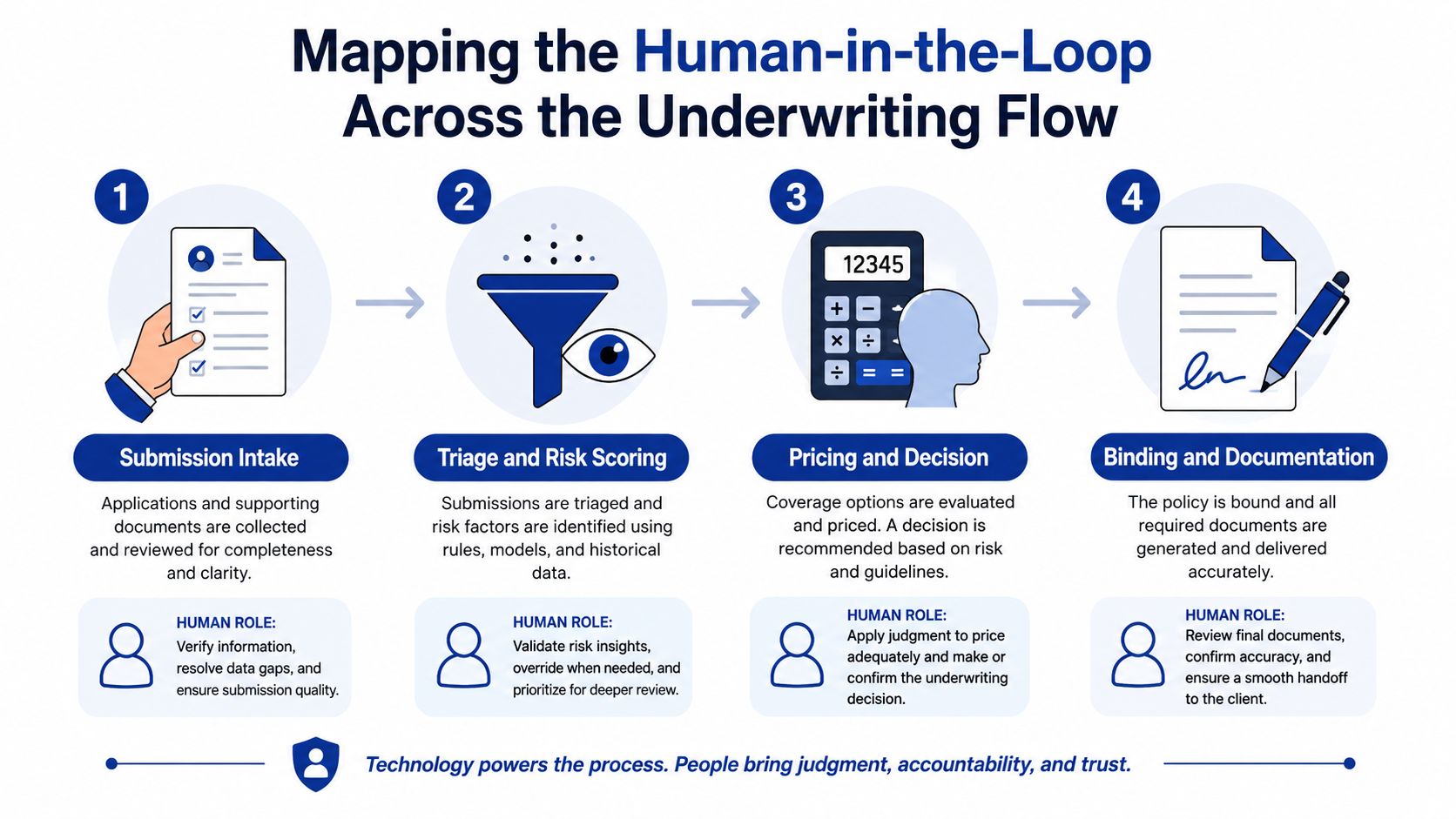
Mapping the Human-in-the-Loop Across the Underwriting Flow
The right operating model is simple on paper and disciplined in practice. You tighten the loop where data quality is strong, and the regulatory exposure is low. You leave it open where the file is messy, the jurisdiction is sensitive, or the decision is likely to trigger a complaint.
Submission intake and triage
At submission intake, the machine should do the grunt work. It can read the file, standardise the data, and flag missing pieces before a human ever touches it. The broker relationship manager should own the awkward files, because incomplete data is usually a relationship issue before it becomes a modelling issue.
At triage and risk scoring, straight-through handling should happen only for clean cases. Anything flagged by the model, whether because of missing information, low confidence, or an odd combination of attributes, should go to an underwriter for review. The human should not be fixing the model's blind spots after the fact; they should be handling the cases the model already identified as uncertain.
Pricing, decision, binding
Pricing and decisioning is where the human-machine split becomes strict. Standard quotes can flow through rules-based engines or model-supported pricing. Complex commercial cases and medically impaired life cases should stay with the underwriter, because these are the files where nuance matters and error is expensive.
Binding and documentation can be heavily automated, but not blindly so. The system can release the policy pack, populate the forms, and stamp the standard wording. A human underwriter should sign off on any deviation, override, or non-standard acceptance.
A useful governance principle is this: tighten the loop when capital commitment is low, open it up when the file is unusual, disputed, or likely to need explanation later. That is how you keep both speed and control.
The insurance industry is already moving this way. In Canada, commercial underwriters are using AI to transcribe risk exposure from emails, read inventory lists, and process broker statements, while industry coverage notes that these systems are used for routine work and are not authorised to issue rated offers or declines. That is the correct pattern. Automation for intake and extraction. Humans for material judgement.
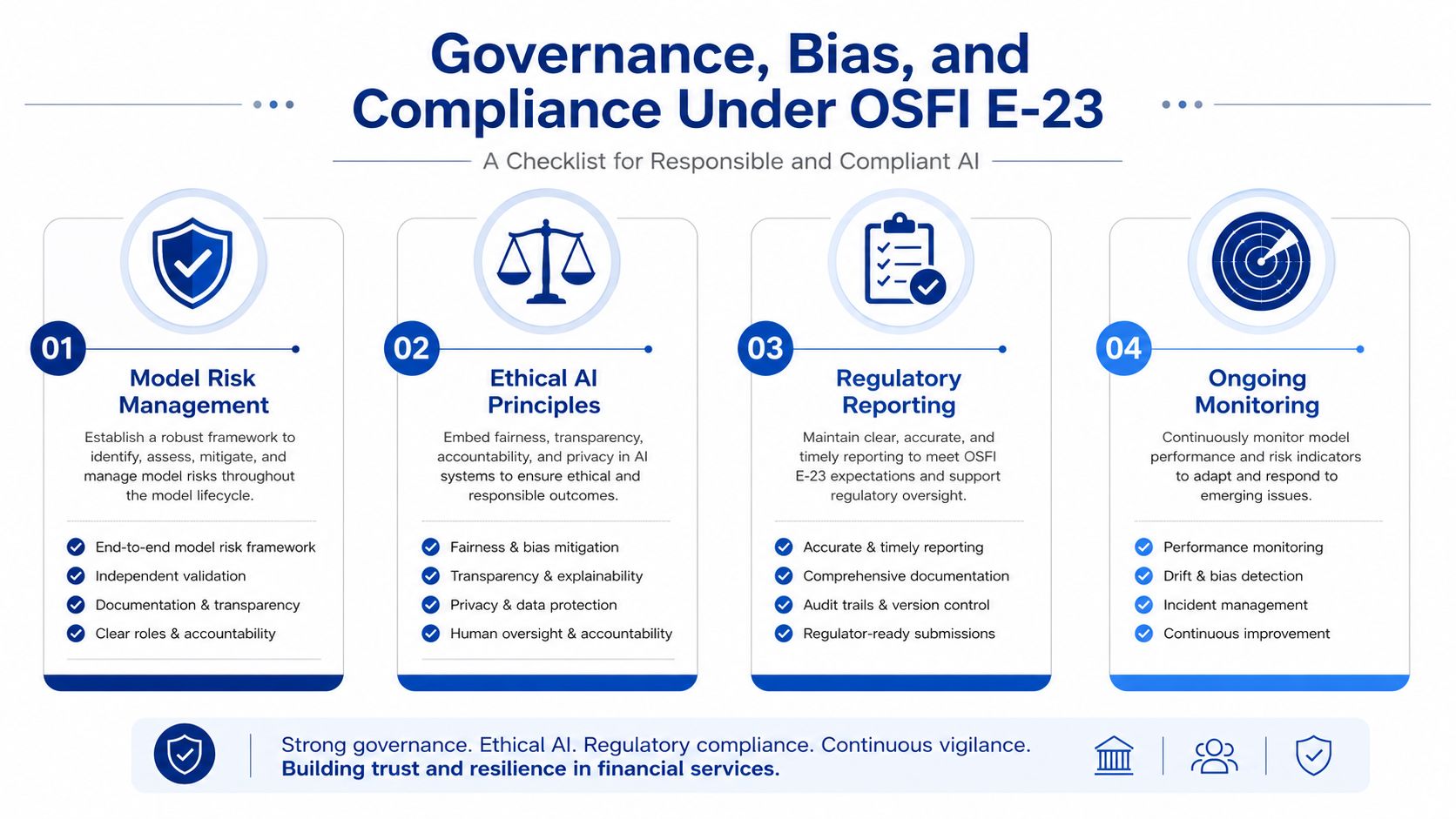
Governance, Bias, and Compliance Under OSFI E-23
A Canadian insurer cannot put an AI underwriting decision into production without assigning ownership for the model, the data, and the human decision around it. OSFI's Guideline E-23 applies to models, including AI and machine learning used in underwriting and pricing. It calls for a model inventory and evidence that data is accurate, relevant, representative, privacy-compliant, and updated often enough to reflect current conditions, as outlined in Deloitte's overview of OSFI's expanded model governance. Treat E-23 as the control frame for deciding where automation stops and human judgement begins.
The checklist every legal and risk team needs
Build the governance pack before the first live decision. It should cover four controls:
Model inventory and classification: Log every underwriting model, its owner, purpose, inputs, outputs, and risk rating.
Independent validation: Separate model development from validation so the owner cannot approve their own work.
Ongoing monitoring: Track drift, input quality, error patterns, and human overrides after deployment.
Human override duty: Assign an adjudicator who can reverse the model and must record the reason.
Required: the record must show who overrode the recommendation, why, and when. Without that trail, the system cannot be examined properly.
Bias testing must examine proxy variables and unequal effects across relevant cohorts. A model can appear balanced on one headline metric while producing worse outcomes for a particular group. If training data expands beyond its original collection purpose, review consent and privacy impacts under PIPEDA and Quebec's Law 25 where applicable. The compliance decision belongs with accountable legal and risk owners, not with the model team alone.
The audit trail should let an examiner reconstruct the file from submission to final decision. Capture who accessed it, which inputs the model used, what it recommended, what the human changed, and the reason for the final outcome. Store the evidence at the same level as the decision. A summary dashboard cannot replace the underlying record.
Many insurers buy the model and underfund the control layer. That approach fails because OSFI's question is whether the insurer can direct, test, monitor, and explain the system. Use this AI for insurance compliance guide to align legal, risk, and operations on the working controls.
Real Canadian Case Studies and Where They Break
Canadian insurers are already showing the shape of hybrid underwriting in production. The important lesson is not that the systems are clever. It is that they speed up the easy cases and still rely on human judgement when the file falls outside the corridor.
Manulife and BMO show the same pattern
Manulife Canada's MAUDE system approved 58% of eligible individual life applications automatically by December 2025, which was a 56% increase from the pre-launch baseline, and eligible applicants could get decisions in as little as two minutes. The redesigned digital application also cut medical questions by up to 40% for Manulife Canada MAUDE coverage. That is what good automation looks like: faster evidence gathering, cleaner routing, and fewer repetitive questions.
BMO Insurance's SmartDecision pushed eligible applications to decisions in as little as 14 seconds for cases up to C$5 million, with no tele-interview or medical evidence required for qualifying applicants. Again, the point is not speed for its own sake. The point is to reserve human time for the files that need it.
Where the model breaks
Both examples have the same failure point. Rare disease histories, borderline build charts, unusual medical context, and messy broker narratives still need an underwriter who can read beyond the standard decision path. The machine can compress the routine. It cannot explain away uncertainty.
That is why exception queues matter. If you automate the front end and forget to staff the back end, you create a bottleneck with a nicer user interface. You also damage broker trust, because agents will tolerate speed only if the hard cases are handled properly, and the reasons are understandable.
The practical lesson is blunt. Straight-through processing works inside a tight corridor. Outside that corridor, the insurer must be able to explain the decision in plain language, route the case to a human quickly, and keep the file moving without losing control.
An Implementation Roadmap That Survives Pilot Stage
Most AI underwriting programmes fail because they start with the model instead of the operating foundation. If you want production value, build the rollout in sequence and refuse to skip the unglamorous work.
Start with data, not demos
Phase 1 is data readiness: Consolidate application data, clean third-party feeds, and document lineage before you choose the model. If the source data is messy, the best model in the world will just automate confusion.
Phase 2 is a narrow use case: Pick a corridor where straight-through processing is safe, usually a low-complexity personal line or another contained book. Run the new logic in shadow mode against human decisions before you let it influence live outcomes.
Integrate, govern, scale
Phase 3 is workflow integration: Put the model into the policy admin and agent portal with routing rules, not as a rip-and-replace project. Underwriters should see exactly why a case was handled automatically or escalated.
Phase 4 is governance: Stand up the model registry, the bias-testing cadence, the override workflow, and OSFI-aligned reporting before the rollout broadens.
Phase 5 is scale: Only after the first use case is stable should you expand into adjacent products or more complex risk segments.
The cheapest mistake is not the model you bought; it's the data lineage you didn't document.
The three things that usually kill pilots are predictable. Teams skip lineage. They obsess over model accuracy instead of cycle-time and hit-rate gains. They underfund change management, especially with underwriters who think automation means replacement. That last one matters more than people admit. If the team that must use the system doesn't trust it, the workflow will route around it.
KPIs and ROI That Justify the Spend
A CFO will defend an underwriting system when its operational and financial outcomes reach the P&L directly. A tidy AUC curve will not clear a business case if the underwriting queue remains clogged. Measure the allocation of work between software and underwriters, then tie that allocation to capacity, portfolio performance, and control.
The four metrics that matter
Cycle time reduction per risk: Measure submission-to-decision time against a real baseline, not a selected sample.
Straight-through processing rate by product: Track each line separately. One blended average hides where automation is safe and where human review remains necessary.
Loss and expense ratio change on the automated book: Automated decisions must demonstrate their financial effect on the business they handle.
Underwriter hours redeployed: Count hours moved from data entry to higher-value review, exception handling, and broker work.
A defensible baseline uses pre-automation queue times, like-for-like business segments, and separate results for automated cases and manual exceptions. Document who handled each decision and where an underwriter entered the loop. Without that separation, the dashboard measures activity while the business case remains unproven.
A useful industry signal is visible in Canada and North America. In a 2026 WTW survey of 59 insurers in Canada and the U.S., close to 80% said they rely on advanced rating and pricing models, while 11% planned to implement them soon. Only 16% currently use AI to augment human underwriting, but 60% plan to prioritise that use by 2028. The direction is clear. Your ROI case still depends on internal results, with a defined owner for each metric and escalation path.
| Metric Category | Vanity Metric to Avoid | CFO-Grade KPI to Use |
|---|---|---|
| Model performance | Aggregate accuracy | Cycle time reduction per risk |
| Classification quality | AUC in isolation | Straight-through processing rate by product |
| Predictive strength | Precision on a test set | Loss and expense ratio change on the automated book |
| Technology adoption | Number of models deployed | Underwriter hours redeployed |
The AI solutions in insurance guide provides context on how automation platforms fit into a broader insurance stack. Use that context to scrutinise vendors, not to accept their ROI claims. The worthwhile system reduces manual handling while preserving review authority and avoiding new reconciliation work.
Common Questions Before You Sign the Vendor Contract
The last check before you sign should be plain and uncomfortable. If the vendor can't answer these questions cleanly, don't buy. Too many underwriting pilots die because the commercial questions were never as strong as the technical demo.
The four questions operators should ask
How do we prove fairness under OSFI E-23?
If protected-class data is restricted, the vendor should explain its proxy-variable controls, cohort testing, and override logic without hiding behind jargon. If they can't show how they test for disparate impact at the cohort level, they are not ready.
How long until first live decision?
The honest answer is that the timeline usually slips around data labelling and workflow mapping, not the model build itself. If the vendor promises speed without asking about source quality, they're selling a deck, not a deployment.
How do we stop broker workarounds?
If agents can route around the system when they disagree with a decision, the automation becomes optional. That means the workflow needs clear escalation paths, visible reasons, and a human review channel that resolves disputes.
Who owns the model when the regulator asks?
This one gets dodged constantly. You need to know who holds accountability, what happens if the vendor is acquired or sunsets the product, and how the exit clause protects your data, logic, and audit trail.
If the contract doesn't spell out ownership, transparency, and exit rights, you don't own the underwriting capability. You rent it.
A one-page vendor evaluation checklist should cover model transparency, data residency, audit trail detail, override mechanics, and contractual IP ownership. That's the minimum bar, not the gold standard.
For teams comparing platform options and feature depth, this underwriting software pricing features 2026 resource is a useful starting point, especially if you want to see how vendors package automation versus governance. One final point: Cleffex Digital Ltd also builds AI-powered insurance workflows, including document processing and compliant integration for underwriting and compliance use cases, so it belongs on the shortlist if you're looking for a delivery partner rather than just a software licence.
If you want to automate underwriting without losing control, Cleffex Digital Ltd can help you design the workflow, integrate the models, and put the governance around them so the system survives both production pressure and regulator scrutiny. Visit Cleffex Digital Ltd to discuss a practical AI underwriting rollout that keeps humans accountable where they should be and automation in the places that can safely carry it.