


In Canada, 97% of health care providers had access to patient clinical information in 2024, yet only 52% electronically shared information with providers outside their own practice. That gap reveals the challenge behind a scalable healthtech platform. The hard part isn't serving more logins, storing more records, or adding more cloud capacity. It's making fragmented systems exchange useful, secure information across provinces, vendors, and care settings.
A platform can scale technically and still fail operationally. It may handle traffic smoothly while clinicians receive incomplete patient histories, pharmacies miss medication updates, or a new provincial integration requires another custom connector. Effective HealthTech platform development starts by treating interoperability, governance, and workflow reliability as core product capabilities.
This article sets out the architecture decisions that matter in 2026, from Canadian FHIR standards and data residency to event-driven integration, cloud trade-offs, AI governance, and production readiness.
Why Most HealthTech Platforms Fail to Scale
Canada has a strong digital foundation, but care systems remain poorly connected. In 2024, 97% of Canadian health care providers reported access to some form of patient clinical information, and 92% said they had access to a digital health system. Yet only 52% electronically shared patient information outside their own practice, while 17% reported barriers to routine access from other care settings.
These figures define the scalability problem. A clinic application may perform reliably with one database and a few stable interfaces. A platform serving clinics, hospitals, laboratories, pharmacies, insurers, and patients must align different data models, consent rules, identity systems, workflow assumptions, and vendor interfaces.
The scalability gap in Canadian HealthTech
| Metric | Percentage | Implication |
|---|---|---|
| Providers with access to patient clinical information | 97% | Digital information exists across most provider environments |
| Providers with access to a digital health system | 92% | The market has a substantial technical foundation |
| Providers electronically sharing information outside their practice | 52% | Cross-organisation exchange remains incomplete |
| Providers reporting barriers to routine access across care settings | 17% | Integration and workflow friction still block practical use |
Expansion exposes weaknesses that a single province or EHR vendor can conceal. Teams add point-to-point interfaces, exception handling, manual reconciliation, and separate deployment rules. Each connection increases testing effort and introduces another failure path.
Servers do not resolve terminology mismatches. Indexing does not make a medication record intelligible to a receiving system using different codes. Caching cannot correct a consent decision that was represented inconsistently.
Practical rule: Treat interoperability as a product boundary, not as integration work that starts after the core application is complete.
Successful architecture separates clinical data exchange from business workflows, applies standards at system boundaries, and allows individual adapters to be replaced. That design also supports the Shared Pan-Canadian Interoperability Roadmap, advanced by Health Canada and Canada Health Infoway in 2023, which sets a national direction for secure information transfer across systems and to patients. The 2026 legislative push makes those choices more urgent, while pan-Canadian FHIR standards provide a practical foundation for exchange.
A platform can scale in compute capacity and still fail in production. Clinicians may receive incomplete histories, pharmacies may miss medication updates, and a new provincial connection may require another custom connector. Interoperability, governance, and workflow reliability therefore belong in the product architecture from the first release.
Architecture Patterns That Support Real Growth
A scalable healthcare design requires architects to isolate failure, ownership, security policy, and scaling behaviour at boundaries that reflect real clinical operations. Those boundaries should also match the way Canadian providers, vendors, and provincial systems exchange information.
Start with bounded clinical services
A patient record service should control access to protected health information and enforce organisation, role, consent, and purpose-of-use rules. Appointment scheduling has a different workload and change pattern. It should manage provider availability, locations, booking rules, cancellations, and time-zone behaviour without making the patient record service responsible for every calendar operation.
Clinical decision support should evolve independently. Its rules, terminology dependencies, and validation cycle differ from registration and billing. Separating these domains limits the impact of a release and lets a team improve one workflow without redeploying the entire platform.
Microservices help when boundaries are meaningful. They create unnecessary operational cost when a simple workflow becomes a chain of network calls requiring separate deployment, tracing, security configuration, and incident response. Service ownership, data contracts, and failure handling should be clear before a team extracts another service.
For a practical overview of service boundaries and deployment choices, see this guide to enterprise application architecture patterns.
Use events for change, not for everything
Event-driven architecture works when one clinical action must notify several independent consumers. A lab result can publish an event that triggers a care-team alert, updates a patient-facing portal, and feeds an analytics pipeline. A medication change can notify a pharmacy integration without forcing the prescribing workflow to wait for every downstream system.
Each event needs a stable contract, event identifier, provenance, timestamp, subject reference, and enough information for safe processing. Consumers require idempotency, retry policies, dead-letter handling, and audit visibility. Without those controls, asynchronous delivery can hide an error until a clinician notices missing information.
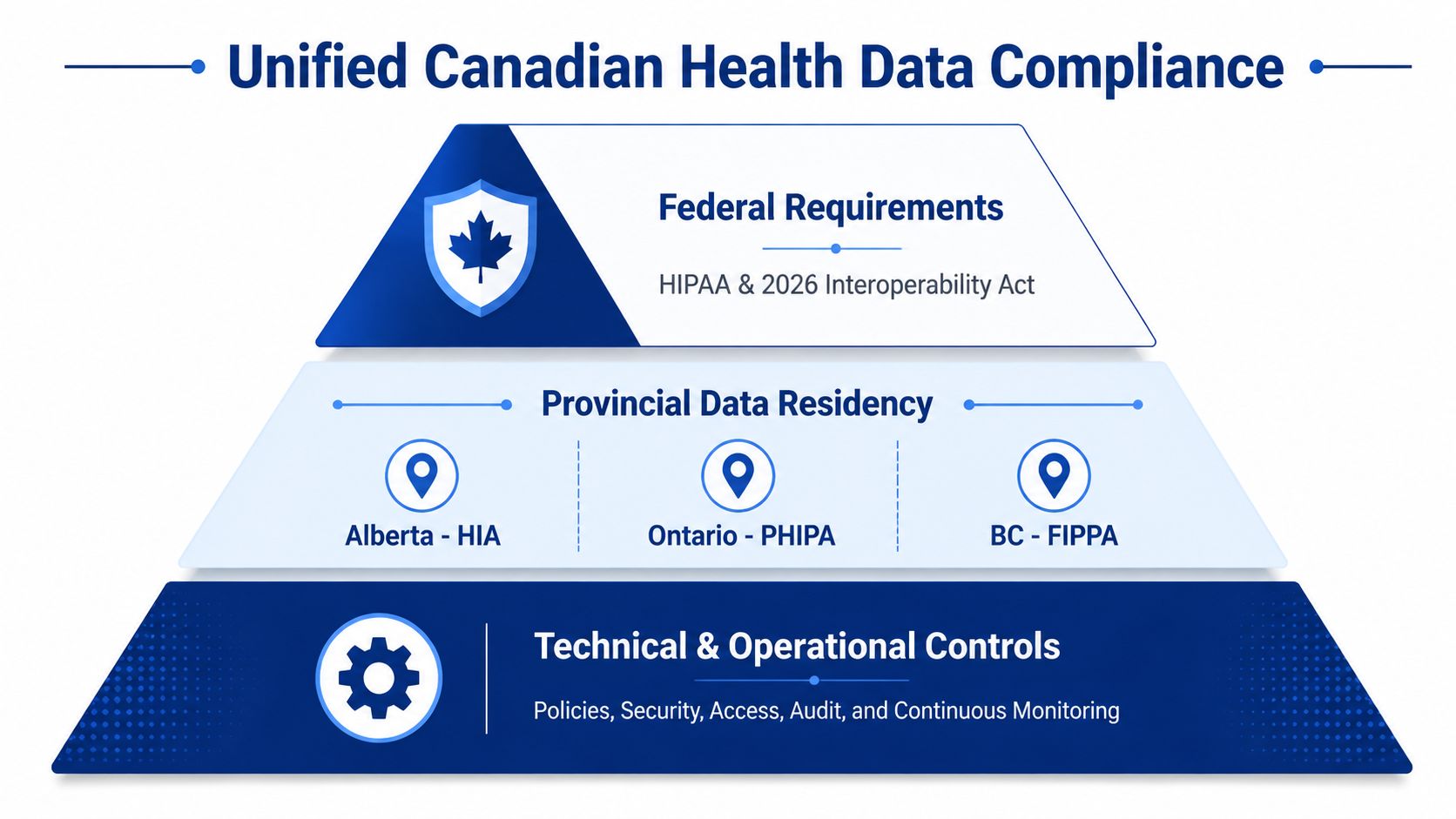
This infographic illustrates how technical controls should sit beneath federal and provincial requirements.
Partition data without blocking care coordination
Multi-tenant platforms need logical separation between organisations and, in some deployments, jurisdiction-aware storage boundaries. A tenant-aware data model should prevent accidental cross-organisation reads. A policy layer should decide whether a legitimate cross-boundary care interaction is permitted.
That does not require copying every record everywhere. The platform can keep authoritative data in the appropriate regional store, expose a controlled patient summary, and retain provenance for each element. Cross-boundary coordination then becomes an explicit exchange workflow rather than uncontrolled replication.
Autoscaling should follow workload characteristics. Appointment booking may produce predictable demand at the start of a working week, while a public-health campaign can create a sudden surge. Queue-based workers, rate limits, circuit breakers, and independent scaling for read-heavy and write-heavy services are more useful than repeatedly increasing one application server.
Compliance and Data Residency Requirements
Healthcare compliance determines where information lives, how services authenticate, which systems may exchange data, and how investigators reconstruct access after an incident.
Canadian teams may need to account for Alberta's HIA, Ontario's PHIPA, and BC's FIPPA, alongside contractual obligations and, where relevant, HIPAA requirements. These regimes do not create one universal deployment recipe. They require a data classification model covering clinical records, identifiers, operational data, audit events, analytics data, and de-identified material.
Design residency into the deployment model
Data residency affects cloud regions, backups, disaster recovery, support access, and observability. A platform may keep primary clinical data in an approved Canadian region while ensuring logs, traces, snapshots, and support exports remain within the intended boundary.
Disaster recovery becomes harder when a secondary region must meet the same residency and access requirements. Recovery procedures should document which datasets are replicated, which keys remain available during failover, how consent state is restored, and how a recovered service avoids serving stale permissions.
A unified compliance architecture typically includes:
Consent management: Store patient permissions as structured, versioned records that downstream services can evaluate.
Audit pipelines: Record access, disclosure, modification, administrative action, and integration activity in tamper-resistant storage.
Key management: Separate encryption keys by environment, tenant, or jurisdiction where the risk model requires it.
Data classification: Attach sensitivity and residency attributes to data products, messages, exports, and backups.
Policy enforcement: Apply access rules at API, service, query, and export boundaries rather than relying on user-interface controls alone.
The federal direction is also changing interoperability work. Legislation introduced in 2026 would require IT companies providing digital health services in Canada to adopt common standards for protected, secure information exchange.
Platforms therefore need standardised exchange formats alongside jurisdictional controls. Consent, identity, auditability, and exception handling still determine whether an integration works safely in production. Cloud capacity does not resolve those gaps.
Development teams can use healthcare compliance software development as a reference for embedding these controls into product architecture rather than adding them during final review.
The FHIR Standards Stack You Cannot Ignore
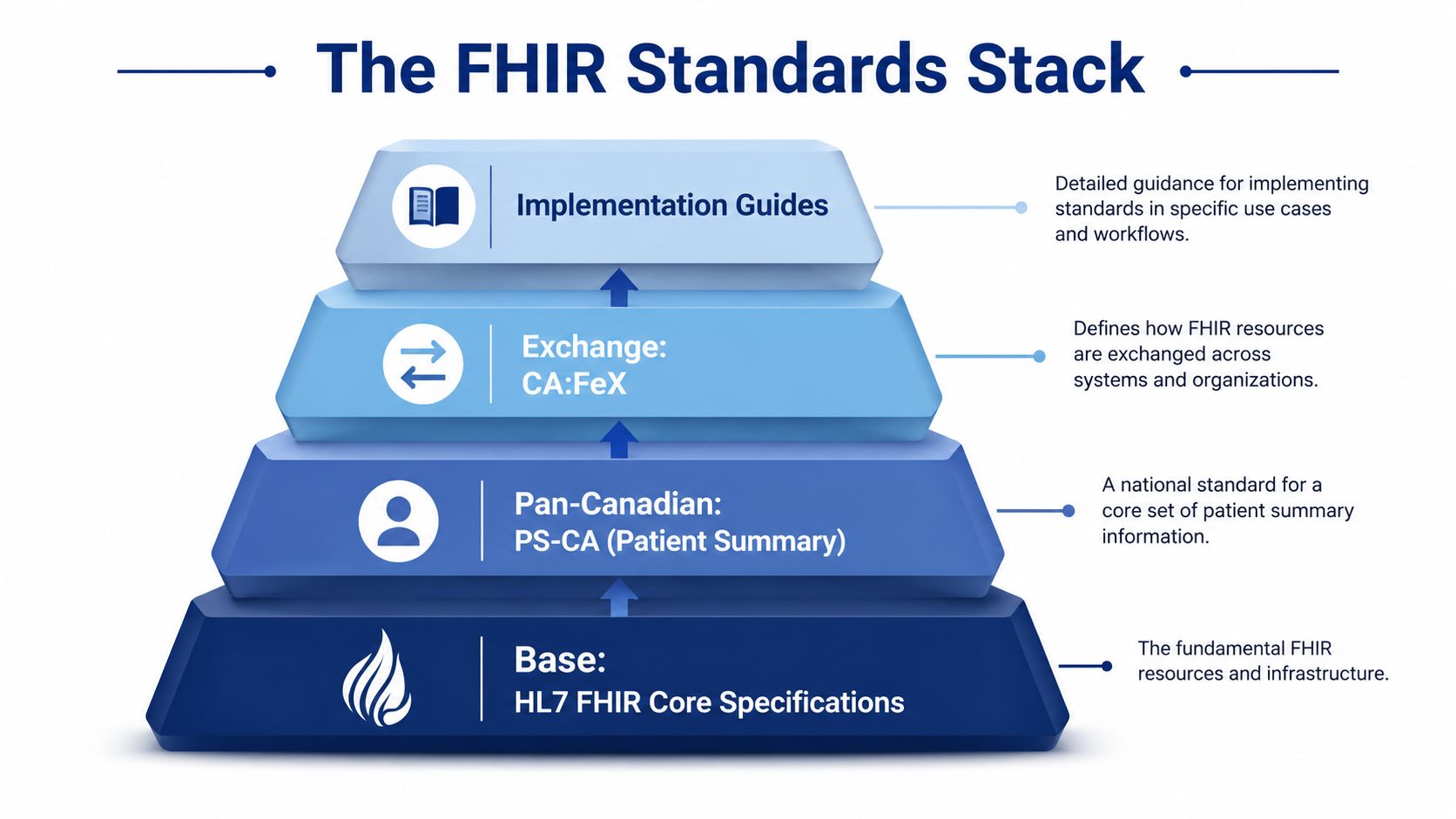
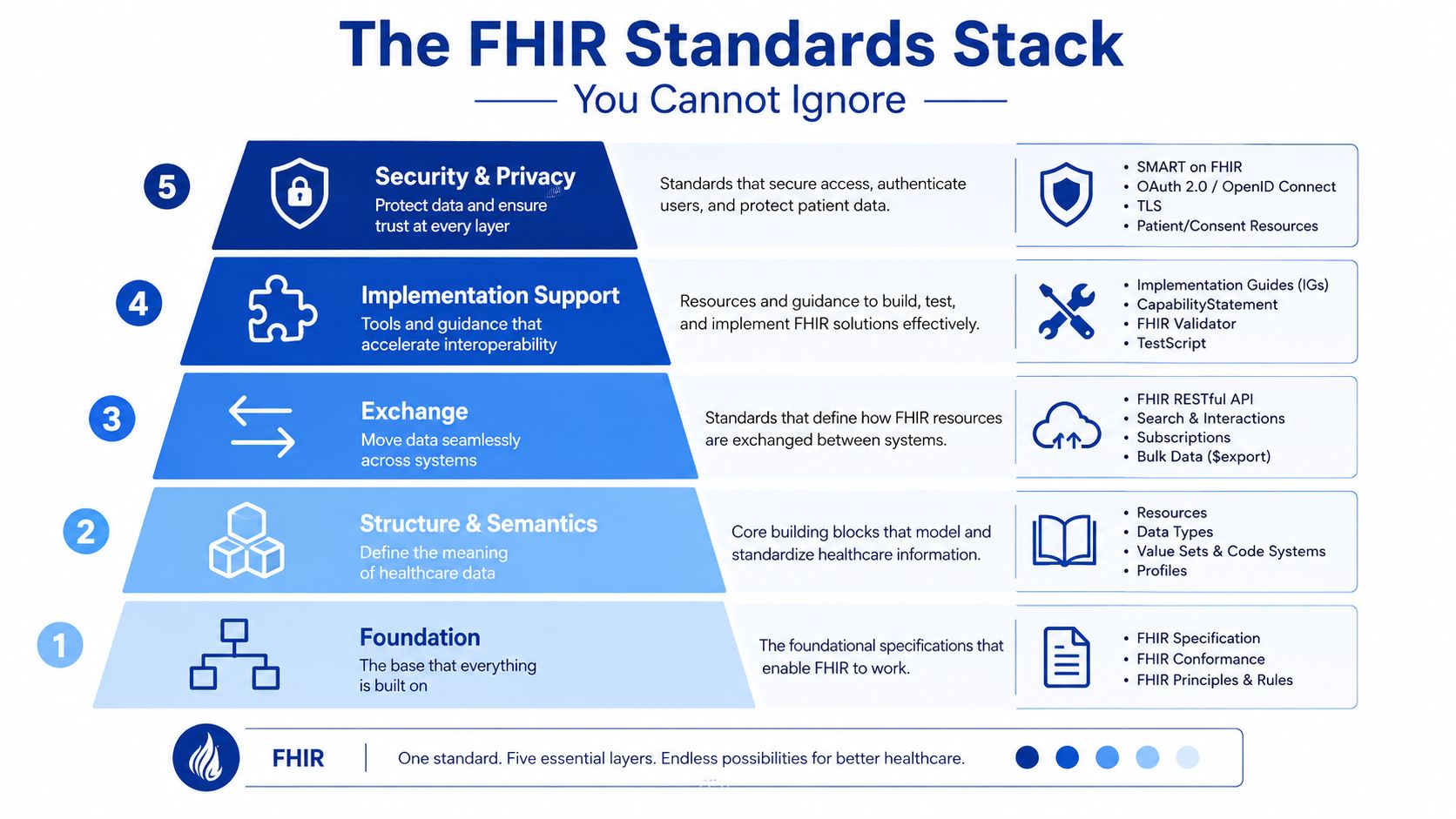
For a platform targeting several Canadian jurisdictions, FHIR should be more than an API format. It should define how the system represents resources, validates content, manages exchange, and handles legacy documents.
Canada Health Infoway's standards stack provides practical building blocks. The Shared Pan-Canadian Interoperability Roadmap market guidance identifies PS-CA, CA:FeX, and CA Core+, while CIHI's Canadian Core Data for Interoperability establishes minimum data elements and value sets for interoperable care.
Use PS-CA for a consistent patient summary
PS-CA, the Pan-Canadian Patient Summary, addresses a common platform failure: every integration team creates a slightly different patient summary. A shared structure gives demographic, clinical, medication, allergy, and other relevant information a consistent shape, subject to the applicable implementation guide and exchange context.
That doesn't eliminate local variation. It gives local variation a controlled boundary. Your internal model can support richer workflows, while the exchange layer produces a predictable summary for another provider or care setting.
Use CA:FeX for exchange patterns and trust
CA:FeX defines Canadian FHIR exchange patterns and supports RESTful interaction. Production implementations still need identity, authorisation, consent, throttling, certificate management where applicable, and operational monitoring.
OAuth 2.0 and OpenID Connect are relevant for authorisation and identity, while SMART on FHIR patterns can support delegated access for applications operating within clinical contexts. The important point is to separate authentication from the decision about what a user or service may access.
Apply CA Core+ and CACDI deliberately
CA Core+ constrains base FHIR resources for Canadian consistency. Those constraints reduce ambiguity during validation and make downstream mapping more predictable. Teams should validate profiles in CI, not discover incompatibilities during a partner's acceptance testing.
CACDI, the Canadian Core Data for Interoperability, standardises minimum data elements and value sets. It helps teams define what must be present for meaningful exchange, rather than confusing a technically valid payload with a clinically useful one.
Legacy provincial repositories may still expose CDA documents or HL7 v2 messages. A scalable platform shouldn't pretend those systems will disappear. Use an anti-corruption layer to translate legacy content into governed FHIR resources, retain the original document when required, and record provenance so clinicians can distinguish source content from transformed data.
Choosing Cloud Services and Integration Approaches
Cloud selection should follow the clinical and regulatory operating model, not a generic preference for one hyperscaler. AWS HealthLake, Azure Health Data Services, and Google Cloud Healthcare API can all support healthcare data workloads, but the relevant questions are implementation-specific.
Ask whether the service supports the FHIR release and profiles you need, which Canadian regions are available, how identity integrates with your enterprise model, how audit records are exposed, and whether you can export data without rebuilding the platform.
Compare the services against your actual constraints
| Capability | AWS HealthLake | Azure Health Data Services | Google Cloud Healthcare API |
|---|---|---|---|
| FHIR data store | Managed AWS health data service | Managed Azure health data service | Managed Google Cloud healthcare service |
| Integration focus | Fits AWS-native ingestion, analytics, and event patterns | Fits Microsoft identity, security, and enterprise integration patterns | Fits Google data, analytics, and machine-learning workflows |
| Canadian residency | Validate supported regions and service-specific terms | Validate supported regions and service-specific terms | Validate supported regions and service-specific terms |
| SMART on FHIR | Confirm current service and implementation requirements | Confirm current service and implementation requirements | Confirm current service and implementation requirements |
| Cost at scale | Model storage, reads, writes, exports, and downstream services | Model storage, reads, writes, exports, and downstream services | Model storage, reads, writes, exports, and downstream services |
Managed services reduce undifferentiated operations, but they can expose teams to proprietary resource behaviour, service quotas, and migration friction. A portability layer around FHIR repositories, terminology services, event contracts, and export pipelines can preserve options without rejecting managed infrastructure altogether.
Choose integration tools by failure behaviour
Amazon EventBridge and Azure Event Grid are useful for managed event routing when teams need low operational overhead and clear integration with the surrounding cloud. Custom Kafka deployments offer more control over retention, replay, throughput, and topology, but they also create a larger operational and security responsibility.
A message broker doesn't replace a clinical audit trail. Store business-significant exchange events in an auditable record, and make replay safe through idempotent consumers. For FHIR APIs, place an API gateway in front of resources to enforce authentication, consent-aware authorisation, rate limits, schema validation, and partner-specific policies.
Identity presents a similar choice. Azure AD B2C and Auth0 can accelerate managed identity capabilities. Self-hosted Keycloak can offer greater control, but your team then owns patching, availability, configuration, federation, and incident response.
Architecture test: If replacing a cloud service requires rewriting clinical data contracts, identity decisions, and audit records, the platform has coupled itself too tightly to that service.
Where AI Actually Fits in Scalable Healthcare Systems
AI adoption is rising in Canada, but that doesn't mean AI is the main scalability barrier. In 2025, 87% of Canadian IT decision-makers reported that AI was used in patient care, up from 72% the previous year; 68% used it to update patient records and 52% for administrative tasks, according to SOTI coverage reported by ITBrief.
Those figures indicate interest and active use, but they don't prove that every model is clinically validated, safely governed, or embedded in a reliable workflow. AI fails at scale when teams attach a model to poor data, unclear accountability, or a process clinicians can't realistically use.
Make AI a governed consumer
A scalable platform should treat AI as a downstream consumer of well-governed, normalised data. Event-driven pipelines can provide de-identified or appropriately authorised data to an inference service without coupling the clinical core to a particular model version.
That separation supports model replacement, controlled evaluation, and rollback. It also makes data lineage visible. Teams should know which source records fed an inference, which terminology version was applied, which model generated the output, and whether a clinician accepted, modified, or rejected it.
Canadian adoption also shows where workflow embedding matters. Ontario primary care AI scribe adoption was above 10%, with a province-wide bulk purchase expected to raise adoption to 50% by spring, as reported in the same ITBrief article. The operational lesson is more important than the adoption figure. Tools gain traction when they fit an existing clinical task, reduce documentation effort, and provide a clear review step.
Useful platform-aligned applications include:
Documentation assistance: Draft notes for clinician review, with source visibility and explicit sign-off.
Triage support: Prioritise work queues while keeping clinical responsibility with authorised staff.
Predictive analysis: Surface risk indicators only when the input data is complete enough and the output has a defined response.
Administrative automation: Classify, route, or summarise documents with human escalation for uncertainty.
The regulatory context remains unsettled. Sector-specific regulation is still developing, AIDA died on the Order Paper in January 2025, and Health Canada issued pre-market guidance for machine-learning-enabled medical devices in February 2025.
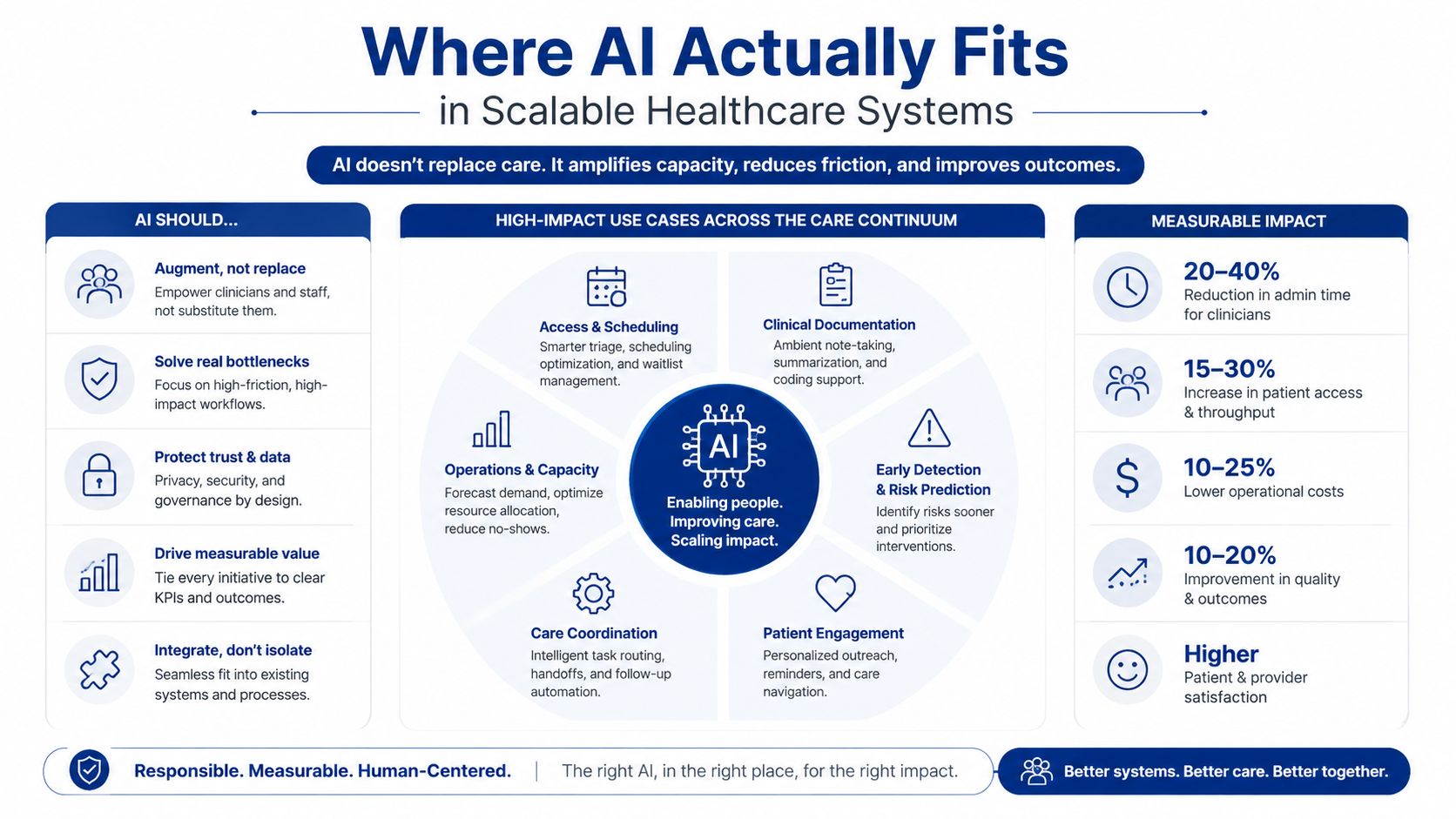
Before adding another model, build consent-aware de-identification, monitoring, evaluation, incident management, and lineage. The AI integration guide for HealthTech platforms provides a useful starting point for that operational layer.
Implementation Checklist and Operational Readiness
A scalable platform results from controlled decisions, not one migration event. The implementation plan should produce evidence at every stage, allowing teams to isolate failures in infrastructure, data quality, external dependencies, or clinical workflows.
Establish the architectural boundaries
Start with a system inventory and data-flow map. Record each source, consumer, identifier, terminology dependency, data classification, residency requirement, and operational owner. Set service boundaries around workflows that require independent change or scaling, rather than arbitrary technical layers.
Before production exchange, require:
Profile conformance: Validate PS-CA, CA:FeX, CA Core+, and applicable implementation guides automatically.
Terminology checks: Test SNOMED CT and LOINC mappings wherever clinical concepts or laboratory results cross system boundaries.
Identity validation: Test OAuth 2.0 and OpenID Connect flows, token expiry, delegated access, and least-privilege scopes.
Consent scenarios: Verify permitted, denied, expired, withdrawn, emergency, and organisation-specific access.
Provenance checks: Confirm that transformed resources retain their source, author, timestamp, and processing context.
Test the clinical path, not just the API
Load tests should model appointment, result-delivery, portal, and integration behaviour. Include predictable demand and sudden spikes, but assess more than response time. A clinically meaningful test verifies that a laboratory result reaches the correct queue, duplicate events remain safe, and a delayed dependency produces a visible operational state.
Chaos testing should include message-broker failure, identity-provider unavailability, regional service loss, delayed partner responses, and corrupted downstream mappings. Recovery drills must verify data integrity and access-policy integrity.
Test the handoffs between vendors and care settings, where many Canadian implementations fail despite passing isolated API checks.
Operate with evidence
Distributed tracing should follow a clinical transaction through the gateway, service, queue, external adapter, and notification layer. Alerting should reflect service impact. Medication dispensing, urgent result delivery, and patient access require different thresholds and escalation paths from a background analytics job.
Maintain immutable or tamper-evident audit records, monitor FHIR validation failures, track terminology drift, and review rejected messages by partner. Define recovery objectives for each workflow and test them. A backup that has never been restored is not a recovery plan.
Operational readiness should control release approval. Security, privacy, clinical safety, integration, support, and product owners should sign off against documented evidence before enabling a new province, vendor, or care setting. That evidence should include failed-test handling, support ownership, rollback steps, and confirmation that provincial interoperability requirements work in the target workflow, not only in a conformance report.
Frequently Asked Questions
How do you handle data residency across provinces?
Start by classifying data and mapping every copy, including backups, logs, traces, analytics extracts, and support files. Use region-aware storage and policy enforcement, then confirm the arrangement with privacy counsel and the customer's contractual requirements. A single national deployment may be simpler operationally, but it isn't automatically appropriate for every dataset or jurisdiction.
What is the real cost difference between microservices and a monolith?
Microservices usually cost more to operate at the beginning because teams need deployment automation, observability, service security, contract testing, and incident processes. They can reduce change contention when domains need independent releases or scaling. A modular monolith may be the better first stage if the team can preserve clear boundaries and stable APIs.
How long does FHIR certification take?
There isn't one universal timeline. The work depends on the profiles, implementation guides, partner environments, terminology, security flows, test evidence, and clinical acceptance required. Teams that leave conformance until the end often discover that technically valid resources still fail real workflow tests.
Can a platform scale without full cloud migration?
Yes. Containerised services, queue-based integration, database partitioning, caching, and stronger observability can improve an on-premises or hybrid environment. Cloud services may simplify operations, but they don't remove the need for standards, consent, audit, and reliable partner contracts.
What happens when an EHR vendor changes its API?
Keep vendor-specific logic in an adapter layer. Contract tests should detect schema, authentication, and behaviour changes before release, while versioned event contracts protect internal services from external churn. The platform should also support replay, reconciliation, and a clear process for handling records that arrive during an integration outage.
Which skills does the team need?
A credible team combines healthcare integration engineering, FHIR and terminology expertise, privacy and security knowledge, cloud operations, quality engineering, product ownership, and clinical workflow input. True interoperability is a multi-organisation programme, so partner coordination and operational support matter as much as application development.
What does scalable healthcare software mean in practice?
It means the platform can add organisations, workflows, and jurisdictions without multiplying custom infrastructure and uncontrolled exceptions. Canada's current interoperability work is still developing, so the practical target isn't a promise of instant nationwide connectivity. It's an architecture that can adopt common standards as the ecosystem matures, including the roadmap's movement towards 2027.
Cleffex Digital Ltd helps healthcare organisations design and build secure software, modernise legacy platforms, and connect medical devices, digital products, and hospital EHRs through healthcare software integration. Visit Cleffex Digital Ltd to discuss an interoperability-first architecture for your next scalable HealthTech platform.