

Canadian primary care clinicians lose 19.8 million hours each year to administrative work, capacity that could otherwise support patient care, according to data cited in Accenture’s report on transforming Canadian healthcare. That figure changes the question. Healthcare workflow optimization isn’t just about adding another digital form or replacing a fax with an email. It’s about removing the hidden work that keeps clinicians waiting, forces staff to re-enter information, and leaves patients moving between disconnected services.
The most expensive bottlenecks rarely sit inside one task. They form between registration and triage, between a referral and an appointment, between discharge planning and community capacity, or between an EHR and a system that can’t exchange information with it. Technology can help, but only when leaders redesign the process around the patient journey rather than automating isolated steps.
The Hidden Cost of Healthcare Workflow Bottlenecks
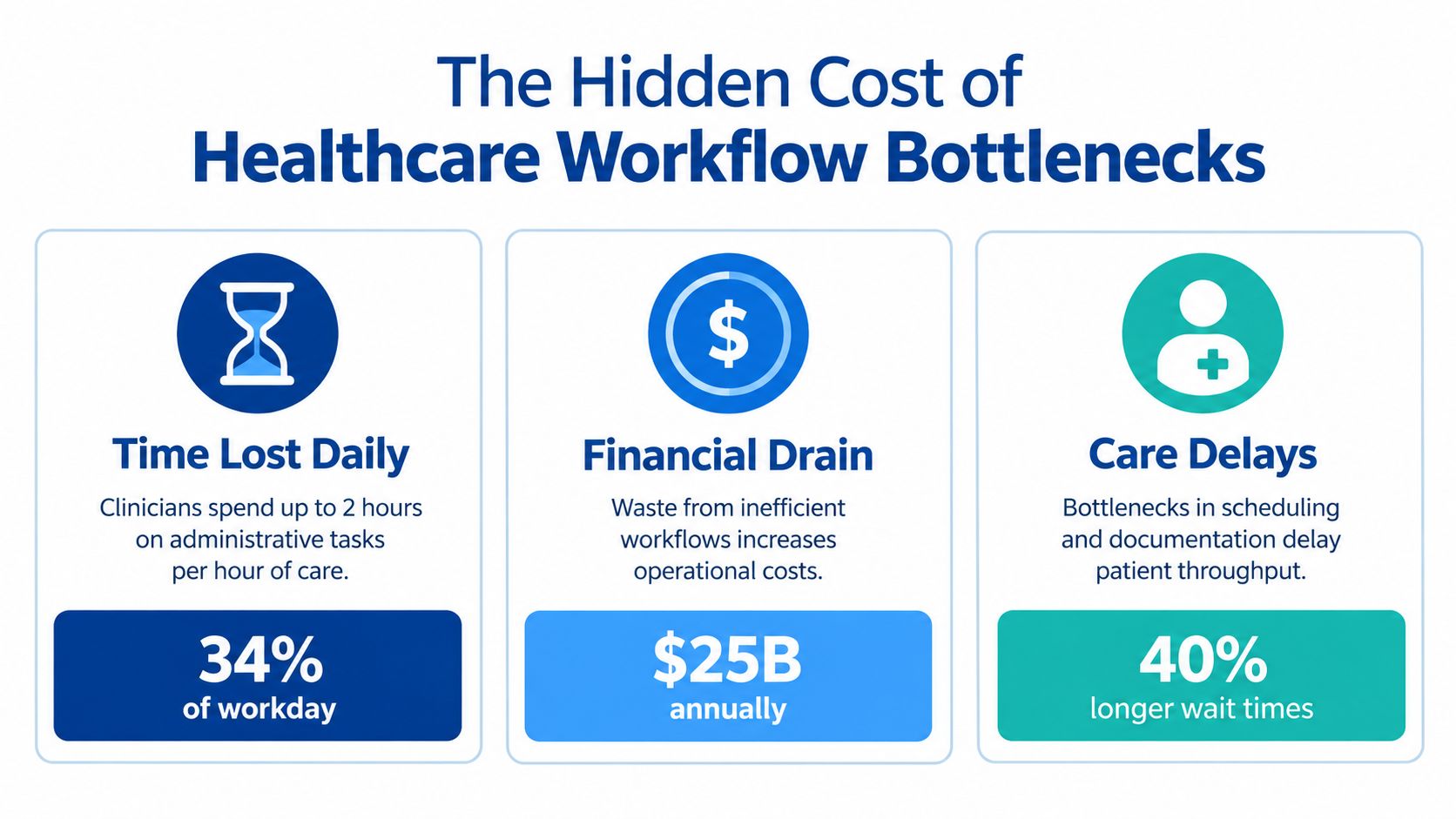
Administrative work is often treated as an unavoidable part of healthcare. Some documentation supports safe care, but much of the burden comes from duplicated entry, manual reconciliation, missing information, and follow-up that no single department owns. The 19.8 million hours annually cited earlier are not evenly distributed. They accumulate at handoffs, exceptions, and points where systems fail to exchange usable information.
The cost is measured in staff capacity, patient delays, and operational risk. A clinician searching for a missing report has less time for assessment. A nurse manually transcribing an order has less time for patient observation. A clinic coordinator who phones several departments to confirm an appointment becomes a dependency in a process that should be visible to everyone involved.
Where the hidden work accumulates
A visible queue is often only the final symptom. The underlying failure may occur earlier, then create work for another team or site.
Siloed records: Staff search across systems or request information that another department already holds.
Redundant handoffs: The same patient details are copied into multiple forms, messages, or spreadsheets.
Unclear ownership: A referral, result, or discharge task remains unresolved because no team owns the next action.
Exception handling: A digital workflow supports the standard case but sends unusual cases back to manual phone and fax processes.
Poorly timed capacity: A procedure room is available, but the patient, transport, preparation, or recovery space is not ready.
These problems are particularly costly in fragmented Canadian care settings, where patients move between primary care, hospitals, diagnostic services, community providers, and different regional systems. A local scheduling tool may fill available appointments while a referral from another site remains incomplete. An automated notification may increase alerts without identifying the person responsible for acting on them. A new form may reduce paper handling while forcing staff to enter the same information into an EHR and an external application.
Digitisation therefore needs an ownership model and an integration plan. Before selecting a tool, leaders should identify the system of record, the data each team must receive, the exceptions that require review, and the service responsible when an exchange fails. Knowledge management also matters. Resources such as Documind knowledge management tools can help teams find policies, procedures, and guidance when routine cases fall outside the standard path.
The operational and human consequences
Healthcare workflow optimisation is a capacity and safety issue as well as a technology decision. Ontario hospitals have been described as having the lowest hospitalisation rate, the shortest average length of stay in acute care hospitals, and the lowest per-capita expenditure in Canada since 2018. That experience shows the value of disciplined operational design, while also reinforcing the need to test how each process works locally.
Practical rule: If a task exists only because two systems cannot exchange information, the task is an interoperability problem before it is a staffing problem.
Leaders should separate handoffs that add clinical value from those that merely transfer information. They should also identify whether a workaround will remove administrative effort or move it from physicians to nurses, clerical teams, or another site. That distinction is the starting point for process improvement that reduces workload without hiding the same failure elsewhere.
Mapping Processes and Identifying True Bottlenecks
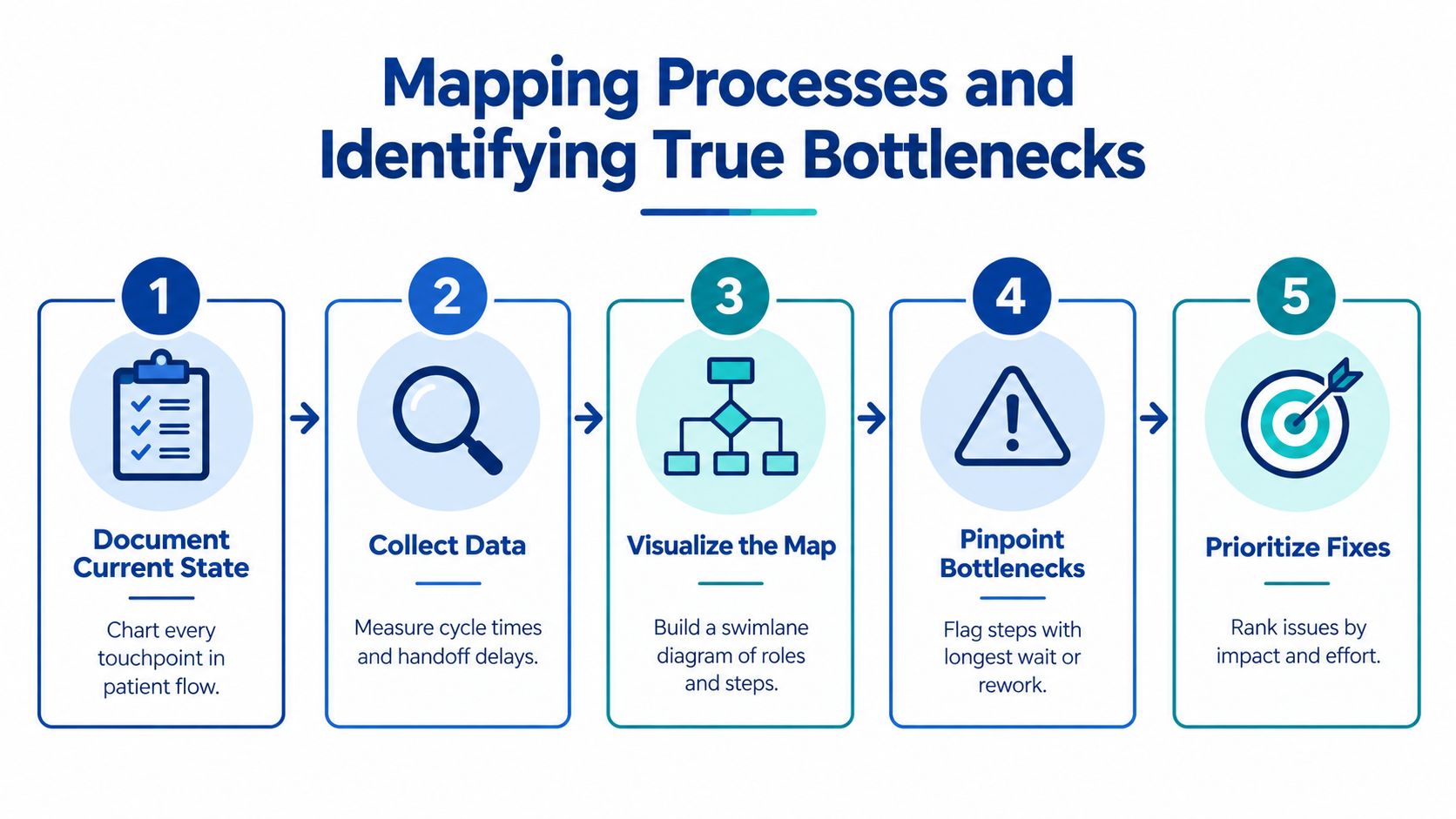
Technology selection should come after direct observation. Start with one patient journey, such as an emergency admission, outpatient referral, diagnostic test, or discharge, and follow it from the first request to the final completed action. Include the patient, clinicians, administrative staff, transport teams, diagnostic services, and external providers involved in the journey.
A process map should show what happens in practice, not what the policy manual says should happen. Record every queue, repeated data entry, phone call, approval, missing document, and handoff. Ask staff to demonstrate the work using real, appropriately de-identified cases, because workarounds often remain invisible in formal diagrams.
A practical observation method
Use a small, focused time-and-motion exercise rather than attempting to map the entire hospital at once.
Define the start and finish: For example, begin when a referral arrives and finish when the patient receives a booked appointment and confirmation.
List every role: Include people who touch the process indirectly, such as records staff, schedulers, porters, and external providers.
Capture timestamps: Record when work starts, when it ends, and how long the item waits between steps.
Classify the work: Separate clinical activity, required compliance work, value-adding coordination, rework, and waiting.
Check the exceptions: Review cases that required escalation, manual correction, or a second request for information.
A study at Kingston’s Hotel-Dieu Hospital measured 137 endoscopy procedures and found that room durations exceeded allocated slots because of pre-procedure and recovery logistics, even when procedure times themselves were reasonable, as reported in the hospital patient-flow time-and-motion study. The lesson is operationally important. Optimising the clinical act while ignoring preparation, room turnover, transport, and recovery will not resolve the constraint.
Turn observations into decisions
Once the map is complete, rank problems by their effect on patients and staff. A delay that affects every referral may deserve priority over a longer delay that occurs rarely. Conversely, a short step with serious safety implications may require attention before a larger but low-risk queue.
Use a simple decision grid:
| Question | What to examine |
|---|---|
| Does the step delay care? | Whether patients, beds, rooms, or clinicians wait for its completion |
| Does it create rework? | Whether staff correct, repeat, or reconcile information |
| Is ownership clear? | Whether one role is accountable for the next action |
| Can the process be standardised? | Whether common cases follow a reliable path |
| Does the issue cross systems? | Whether an EHR, referral platform, inbox, or external provider is involved |
Teams should also document the current failure mode before choosing an intervention. A guide to breaking down healthcare data silos can help leaders frame information exchange as a process requirement rather than an abstract IT objective.
Observation beats assumption. Average procedure time, average wait time, and average staffing levels can hide the handoff that actually controls throughput.
The output of this exercise should be a short list of bottlenecks with owners, evidence, and a defined patient impact. Without that baseline, automation risks preserving the same queue in a new interface.
Designing Interventions with Automation and AI
The best intervention is usually narrower than the original technology proposal. If the problem is that referrals arrive incomplete, start with structured intake, validation, routing, and exception ownership. If the problem is that discharge tasks are invisible across teams, create a shared task record with status, due dates, and escalation rules. If the problem is repeated data entry, connect the systems that already hold the information instead of asking staff to maintain another database.
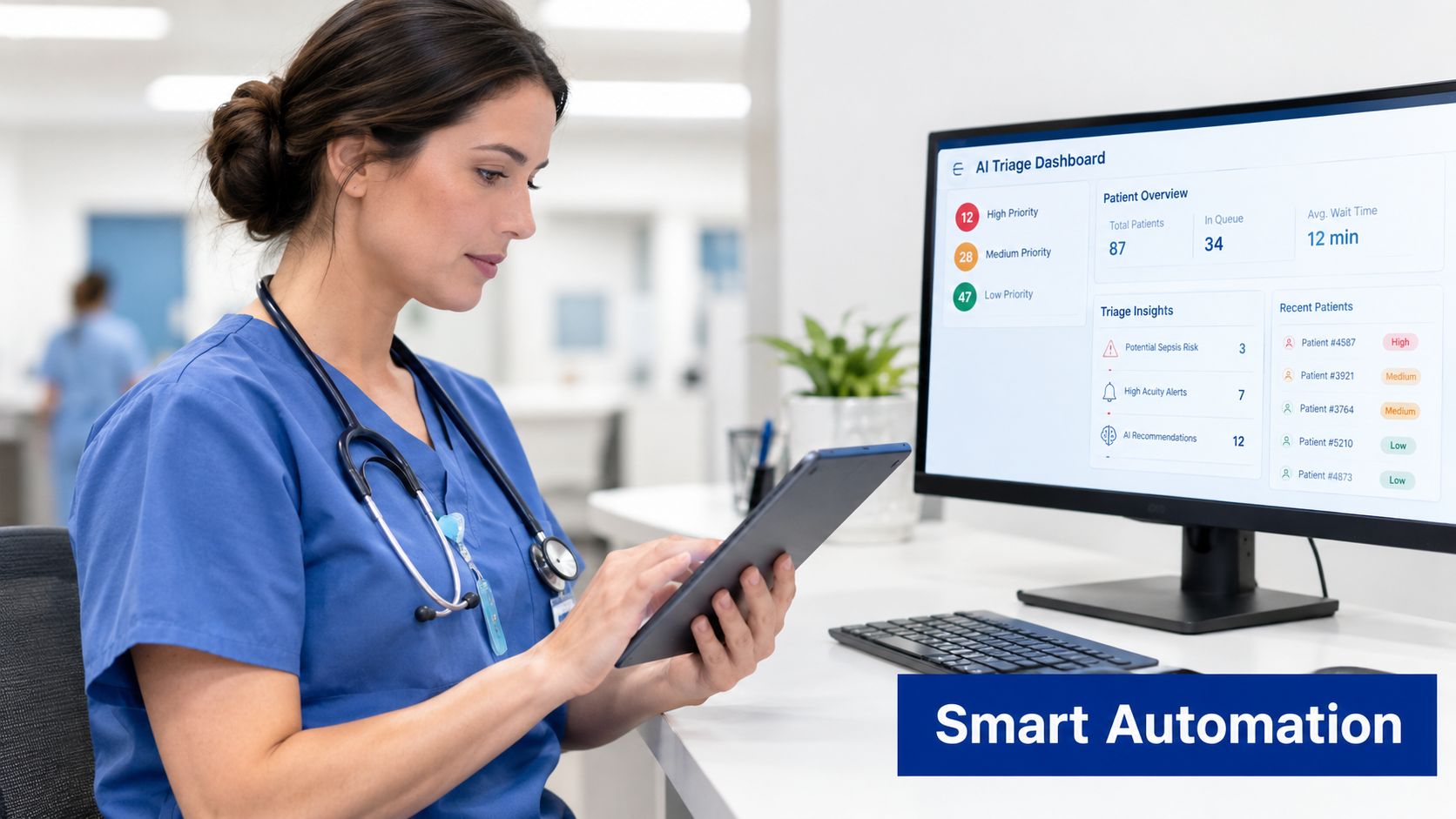
Healthcare workflow automation is useful for predictable, repeatable work. It can route a referral, notify a responsible team, check whether required information is present, create a task, or trigger a patient message. It should not make clinical decisions that require professional judgement.
Match the tool to the failure
Rules-based automation works well where the path is stable. Examples include routing a complete referral to the correct queue, sending a reminder when an order remains incomplete, or escalating a task that has passed its service target. The trade-off is that rigid rules can create false exceptions when patient circumstances don't match the standard pathway.
AI-assisted triage can help prioritise information, identify patterns, or support scheduling decisions. It may be useful when demand is variable, and staff need help reviewing a large volume of cases. The trade-off is governance. Clinical leaders must define how recommendations are reviewed, what information the system uses, and what happens when the output is uncertain or wrong.
EHR integration addresses a different problem. It allows patient information and task status to move between systems so staff don't have to re-enter it. Integration is often less visible than a new AI feature, but it can produce greater system value because it reduces the number of disconnected workarounds.
Canadian evidence reviewed by CADTH on artificial intelligence in healthcare describes AI use or investigation for emergency admission prediction, alternate-level-of-care transfers, discharge timing, oncology capacity planning, and scheduling. The operational caution is clear: AI can improve local efficiency while system-wide delays remain if interoperability and digital communication are weak.
Design for the full care continuum
A hospital may optimise its own appointment queue while a patient still waits for a cross-site referral. An emergency department may predict admissions while discharge remains dependent on community services or long-term-care availability. A scheduling algorithm can't create capacity that the wider system doesn't have.
Technology selection should therefore test:
Cross-site referrals: Can the receiving organisation access the referral, attachments, urgency, and status without manual reconstruction?
Waitlist triage: Can authorised staff update priority and communicate the reason for a change?
Discharge dependencies: Can the care team see outstanding transport, equipment, medication, or community-care actions?
Integration failure: Is there a safe fallback when an interface stops working?
Human review: Can staff override an automated recommendation and record why?
The contrarian view: The most valuable AI programme may be the one built on reliable information exchange, not the one with the most advanced model.
When evaluating vendors, ask them to demonstrate a failure scenario, not just a successful patient path. A team exploring service-desk orchestration may also review how to automate Freshservice with DataLunix, particularly when operational requests need structured routing, ownership, and escalation across support teams. The same principle applies in healthcare: automation must make responsibility clearer, not hide it behind a status label.
Running Pilots and Measuring Operational KPIs
A pilot should test a defined operational hypothesis. For example, a team might ask whether structured referral intake reduces incomplete submissions, or whether a shared discharge worklist reduces time spent searching for task status. The pilot needs a named owner, a limited workflow boundary, a baseline, and a decision rule for what happens after the test.
Don't begin with a facility-wide rollout. Start with a service where leaders can observe the work closely, staff can provide rapid feedback, and the process has a measurable outcome. Include the people who perform the work in configuration sessions. They'll identify exceptions that a project team may miss.
Measure workload as well as speed
A shorter queue isn't a successful outcome if staff now complete more manual reconciliation behind the scenes. Track the full effect across roles.
Patient flow: Measure wait time, turnaround time, completed appointments, and unresolved tasks.
Workforce pressure: Track overtime, sick time, agency reliance, and time spent on rework.
Administrative effort: Record touches per case, duplicate entries, manual calls, and escalations.
Quality and safety: Monitor missing information, correction rates, declined referrals, and incidents connected to the workflow.
Experience: Gather feedback from patients and staff about clarity, delays, and confidence in the process.
Across Canadian hospitals in 2023–24, healthcare providers worked almost 32 million overtime hours, a 100% increase since 2019–20, according to the Canadian healthcare workforce report. Overtime is not only a workforce metric. It can reveal a process that regularly pushes essential work beyond scheduled capacity.
Ontario's Performance Monitoring Dashboard from the Ontario Hospital Association tracks emergency department admission rates, ED wait times, sick-time rates, administrative costs, overtime, and a GEM-based efficiency measure comparing expected and actual hospital expenses for the latest fiscal year. These measures provide a useful model for balancing patient flow, workforce, and financial indicators rather than celebrating one isolated improvement.
Manage adoption deliberately
Clinician resistance often reflects a legitimate workflow concern. A new tool may add clicks, interrupt consultation, create duplicate documentation, or produce alerts without useful action. Treat resistance as operational data.
Run short feedback cycles and publish what changed as a result. Train staff using realistic cases, including incomplete referrals and failed integrations. Define downtime procedures before launch, and make sure managers know when to pause the pilot rather than asking staff to improvise.
Healthcare operational analytics guidance can help teams connect daily workflow measures to broader management decisions. ROI should be calculated by role and process, including time reclaimed, overtime avoided, rework reduced, and patient capacity recovered. Don't count physician time as a saving if the same work has moved to nursing or administration.
Ensuring Privacy and Scaling System-Wide Changes
A successful pilot can fail during scale-up because the surrounding systems, permissions, contracts, and behaviours aren't ready. One clinic may have a clean process, while a hospital network has several EHR configurations, different referral rules, separate identity management, and external partners that use other communication channels.
Privacy must be built into the workflow design. Leaders should define what information each role needs, where it is stored, how access is logged, and what happens when a user changes team or leaves the organisation. Vendors should explain their hosting, security controls, breach processes, subcontractors, retention practices, and integration responsibilities in terms that clinical and privacy teams can evaluate.
A secure workflow also needs operational resilience. If an interface fails during a busy period, staff must know how to continue safely, how to record actions taken offline, and how to reconcile records once the connection returns. A fallback that depends on an undocumented spreadsheet is not a resilience plan.
Interoperability is a service requirement
Interoperability isn't an optional technical enhancement when patient care crosses organisational boundaries. A referral that cannot carry its attachments, urgency, clinical context, and current status creates work for both the sending and receiving teams. A discharge process that cannot communicate with community providers leaves hospital staff managing a chain of phone calls.
Ontario's move towards centralised waitlist management and expanded eReferral reflects this coordination challenge. The practical objective isn't to make one department faster. It's to ensure that information and responsibility follow the patient across sites.
Use an integration review before expanding a pilot:
Data meaning: Do connected systems interpret patient, referral, appointment, and status fields consistently?
Identity matching: Can the workflow reliably connect information to the correct patient?
Ownership: Is each task assigned to a person or team at every stage?
Exceptions: Can staff handle missing, conflicting, or late information?
Auditability: Can the organisation reconstruct who accessed, changed, or approved a record?
Vendor accountability: Do contracts define support, uptime expectations, incident response, and change control?
The healthcare data security and information systems guide provides useful context for this work. Scaling should happen only when the organisation can protect privacy, explain decisions, support users, and maintain safe operations when the ideal digital path breaks.
Scale the operating model, not just the software. A shared tool without shared definitions, ownership, and escalation rules creates a larger version of the original bottleneck.
Frequently Asked Questions About Workflow Optimisation
How should leaders handle resistance to an AI scribe or triage tool?
Start by identifying the specific objection. Clinicians may be concerned about accuracy, documentation responsibility, patient consent, alert fatigue, or extra review work. Run a supervised pilot, define when human review is mandatory, and measure documentation effort and correction work alongside any time saved.
What should staff do when an integration fails during peak hours?
Use a documented downtime workflow with a designated owner. Staff should record essential actions in an approved temporary location, avoid duplicate submissions, notify the support team, and reconcile records after restoration. The fallback must protect continuity and privacy, not rely on informal messages.
How can a hospital calculate the ROI of shorter patient waits?
Measure the baseline process, then track waiting time, completed activity, staff effort, overtime, cancellations, and rework after the change. Separate capacity recovered from activity merely shifted to another role. Financial value should be considered alongside safety, patient experience, and workforce sustainability.
What is the first step in healthcare workflow optimisation?
Map one complete patient journey before buying software. Observe actual timestamps, handoffs, queues, exceptions, and system boundaries. Then choose the smallest intervention that addresses the verified constraint.
What does successful healthcare process improvement look like?
It gives staff clearer ownership, reduces unnecessary handling, improves information continuity, and produces better patient flow without creating hidden work elsewhere. Technology supports that result, but governance, training, interoperability, and measurement make it sustainable.
Cleffex Digital Ltd designs and builds secure healthcare software for administrative handoffs, workflow automation, and integration between EHRs, digital platforms, devices, and operational tools. Visit Cleffex Digital Ltd to discuss a workflow assessment or integration project focused on reducing bottlenecks across your care processes.