

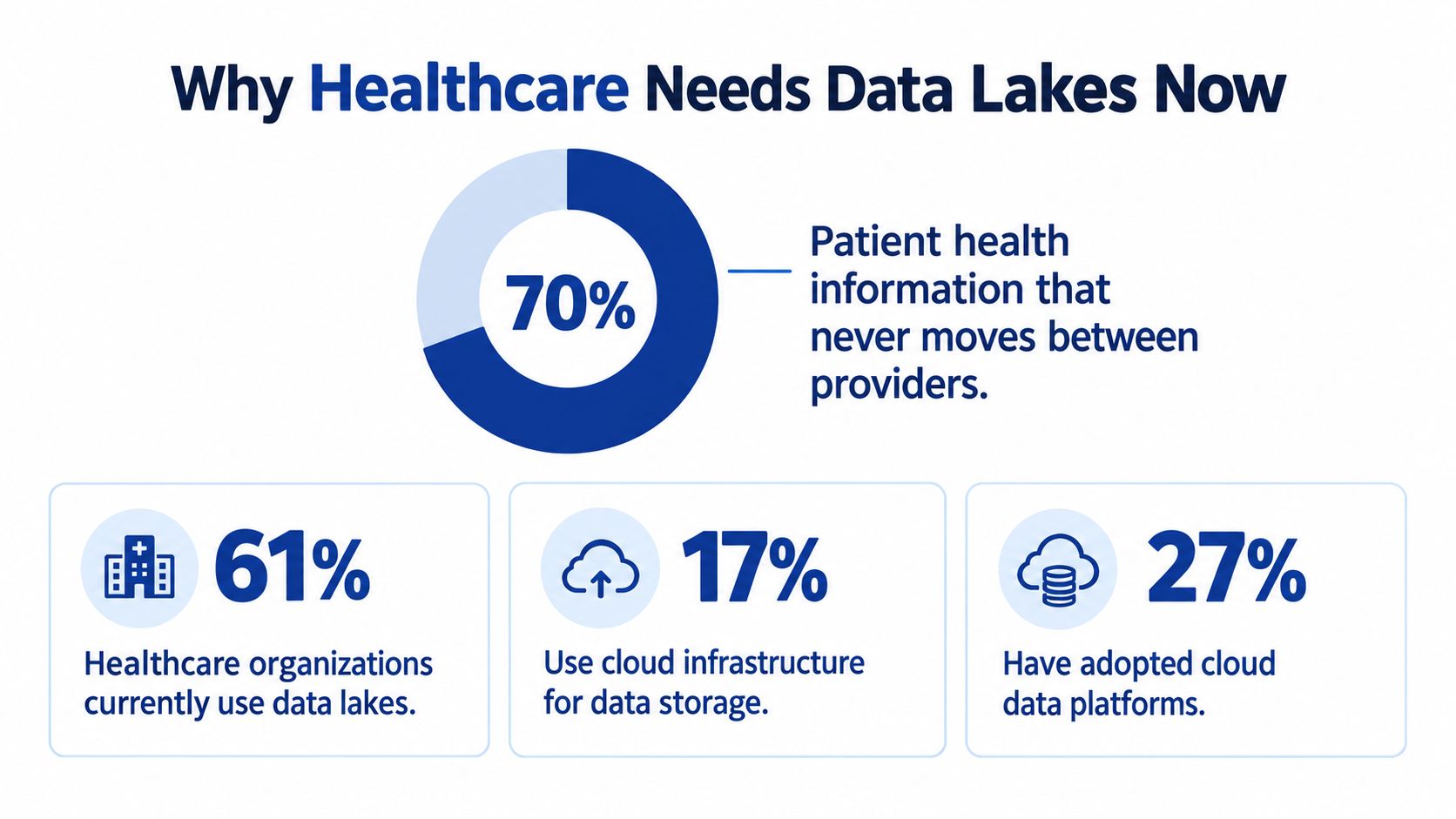
Despite widespread use of electronic medical records, more than 70% of electronic health information isn't shared among providers, according to a 2026 analysis of healthcare record fragmentation in Canada. For a patient moving between a family doctor, specialist, emergency department, and hospital, that gap can mean missing context at the moment a clinician needs it most.
A healthcare data lake offers a practical way to address that problem. It brings clinical records, laboratory results, diagnostic images, claims, devices, documents, and other health information into a governed environment where teams can preserve the original data, standardise it, and make it available to authorised applications.
The lake isn't only a cheaper place to store files. Properly designed, it becomes the foundation of a healthcare data platform that supports cross-jurisdiction interoperability, patient-level timelines, clinical analytics, artificial intelligence, and carefully controlled data sharing. For Canadian hospitals and HealthTech companies, the central question is how to connect existing systems without creating another isolated repository.
Why Healthcare Needs Data Lakes Now
A healthcare data lake is best understood as a secure reservoir with well-managed pipes. Each pipe brings in a different type of information. One may carry structured EHR tables, another free-text clinical notes, another HL7 messages, another DICOM images, and another streams from wearable or remote-monitoring devices.
The reservoir keeps data in its native form when it first arrives. Engineers and analysts can then filter, transform, link, and serve that information for a specific purpose. This approach suits healthcare because clinical data rarely arrives in one neat format or with one predictable structure.
The gap between records and care
A hospital may hold an admission record while an affiliated clinic has the latest medication list. A laboratory system may contain results that haven't reached a specialist's workflow. A regional health authority may have population-level information that isn't connected to an operational dashboard.
A lake doesn't automatically solve identity matching or consent. It gives the organisation a controlled place to perform those jobs, with the lineage and auditability needed to show where information came from and how it was changed.
Lake versus warehouse
A traditional data warehouse usually expects teams to define a model before loading information. That works well for stable, structured reporting such as activity measures, finance, or quality dashboards. It becomes restrictive when teams need to retain an unstructured note, an image, an evolving device feed, or a new clinical source that wasn't anticipated during the original design.
A data lake uses a more flexible pattern. Raw data remains available for replay and future processing, while curated datasets can support structured reporting. The warehouse still has an important role, but it doesn't need to carry every format or every experimental workload.
For a hospital CIO, the practical benefits include:
Unified patient timelines: Authorised users can assemble encounters, observations, medications, procedures, and documents across settings.
FHIR-ready exchange: Normalised resources can support applications that need a consistent interoperability interface.
Faster model preparation: Data scientists can work from governed structured and unstructured datasets rather than repeatedly extracting from operational systems.
Value-based reporting foundations: Linked clinical, utilisation, and outcomes data can support more complete analysis.
Teams that want to connect analytics with day-to-day operational improvement can also optimise workflows with PlotStudio AI, particularly when dashboards and workflow signals need to sit alongside clinical data.
Inside the Healthcare Data Architecture
A strong healthcare data architecture separates collection, preservation, transformation, meaning, and delivery. Consider a hospital network with several affiliated clinics. Each organisation can keep its source systems while contributing selected data to a shared, governed architecture.
Source and ingestion layers
The ingestion layer captures HL7v2 events, FHIR R4 resources, DICOM studies, X12 claims, CSV laboratory files, and IoT device streams. Streaming ingestion suits events such as admissions, transfers, and new results. Batch ingestion remains useful for scheduled extracts, historical files, and systems that can't publish events continuously.
The first design priority is replayability. If a mapping rule changes, the team should be able to process the original record again rather than ask the source system for a new copy.
Raw storage and normalisation
The raw lake storage layer uses object storage to preserve information in its original fidelity. Formats such as Parquet or Delta can support efficient downstream processing, but the original message or file should remain available for audit and reprocessing.
The normalisation layer then maps records into a common clinical vocabulary. Canada's Canadian Core Data for Interoperability and connected-care framework provides a national direction for consistent data content and exchange. CIHI states that CACDI has expanded the baseline to 10 data categories and 55 core data elements, giving architects a concrete target for comparing and exchanging essential information.
Meaning and delivery
The semantic layer resolves the identities that make cross-system analysis useful. A master patient index links records to the right person. Provider and facility indexes do the same for clinicians, locations, departments, and organisations.
The serving layer exposes information through BI dashboards, FHIR APIs, research datasets, clinical applications, and machine-learning feature stores. Governance and observability cross every layer, covering data quality, access, lineage, pipeline health, and policy enforcement.
Hospital teams planning an integration programme may find a practical 2026 EHR checklist useful when reviewing interfaces, ownership, and implementation dependencies. Cleffex also provides a healthcare data integration practical guide for teams mapping EHRs, laboratories, portals, and downstream applications.
Architecture rule: Keep the raw record available, but never make clinicians or analysts work directly from an unmanaged raw zone.
Healthcare Data Lake vs Data Warehouse vs Platform
These three terms describe different roles, not interchangeable products. A data lake preserves breadth and flexibility. A data warehouse provides controlled, structured reporting. A medical data platform orchestrates storage, standards, identity, APIs, governance, and user access around those components.
Ontario shows why scale changes the design conversation. eHealth Ontario reports that provincial repositories store more than 6 billion records, including medication dispenses, laboratory orders and results, diagnostic imaging reports and images, and hospital discharge summaries. At that scale, ingestion, harmonisation, linkage, and governance matter as much as storage capacity.
| Criterion | Data Lake | Data Warehouse | Medical Data Platform |
|---|---|---|---|
| Data types | Structured, semi-structured, unstructured, imaging, device data, and potentially genomics | Primarily structured and modelled data | Coordinates structured, unstructured, imaging, and operational data through managed services |
| Ingest-to-query latency | Batch or streaming, depending on pipeline design | Usually scheduled or near-real-time for selected datasets | Can combine event-driven, batch, API, and analytical access |
| Cost model | Object storage and processing costs vary by volume, retention, and query pattern | Compute, storage, modelling, and licensing costs vary by workload | Service, integration, governance, and consumption costs vary by scope |
| Governance maturity | Must be deliberately designed across raw and curated zones | Often mature for defined reporting datasets | Intended to make governance, identity, standards, and access operational |
| FHIR and HL7 support | Usually requires ingestion and transformation services | Requires mapped structured models and interfaces | Commonly provides connectors, APIs, terminology services, or FHIR-oriented components |
| AI and machine learning | Strong fit for exploratory analysis and mixed-format training data | Strong fit for stable features and governed reporting datasets | Connects data preparation, model workflows, APIs, monitoring, and applications |
| Best-fit workload | Raw retention, discovery, historical analysis, and large-scale preparation | Regulated reporting, KPI cubes, finance, and repeatable dashboards | Coordinated clinical, analytical, integration, and governance workflows |
The practical rule is simple. Put raw and exploratory workloads in the lake, regulated reporting and KPI cubes in the warehouse, and use the platform as the orchestrated layer that lets clinicians, engineers, analysts, and compliance officers work from consistent policies.
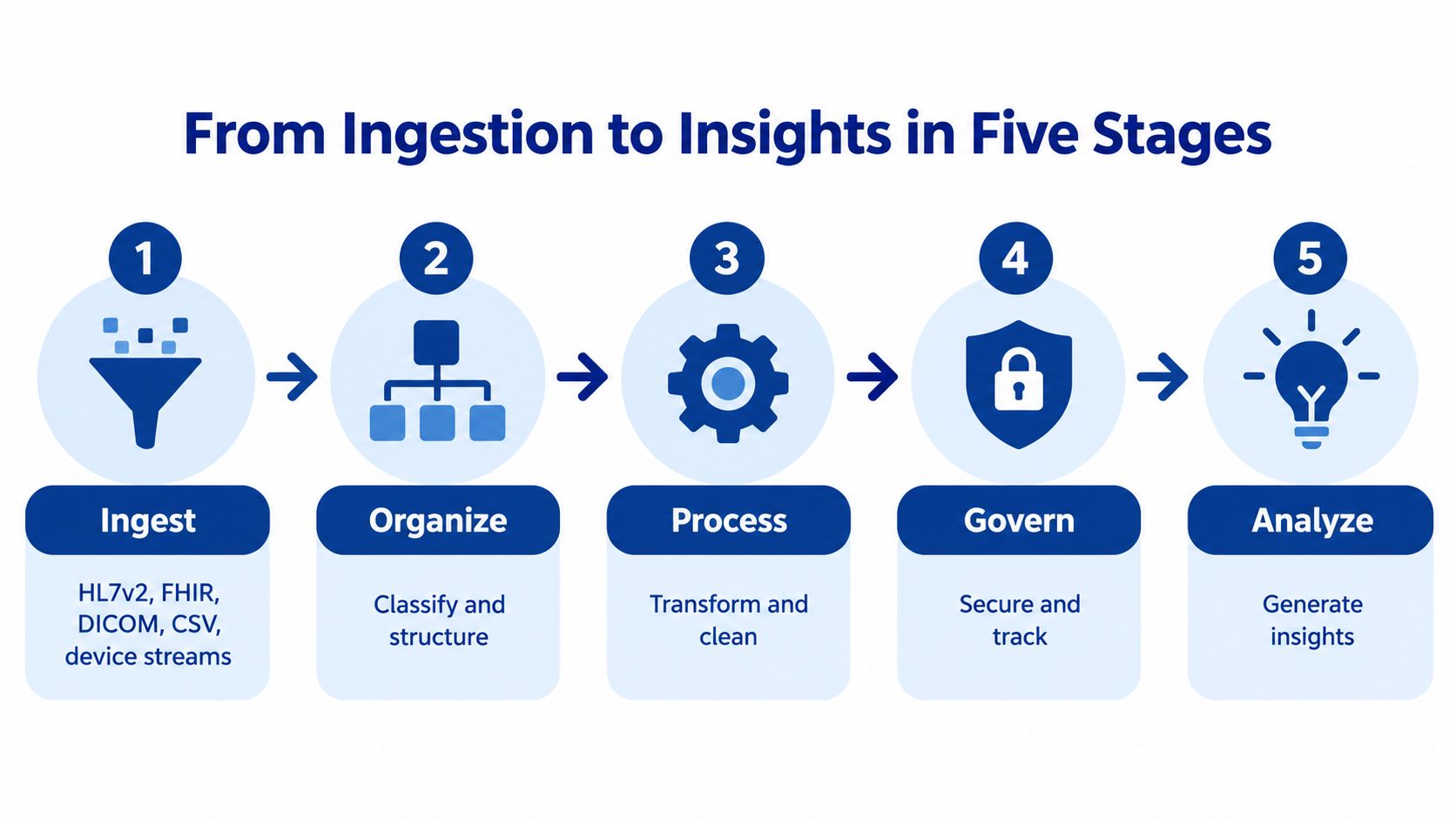
From Ingestion to Insights in Five Stages
A healthcare data lake pipeline should be understandable to the people who depend on it. Each stage has one main job, and each hand-off should be observable.
Stage one captures every relevant source
Ingest HL7v2, FHIR R4, DICOM, CSV laboratory files, claims, and device streams through a combination of event-driven and batch processes. A new result may arrive immediately, while a historical clinic extract may arrive on a scheduled cycle.
The pipeline should record the source, arrival time, message type, processing status, and any validation failure. That information helps engineers investigate missing events without interrupting the clinical system.
Stage two preserves the original record
The bronze zone stores the raw message or file with immutable controls. It acts as an audit reference and a recovery point when a transformation rule changes. Partitioning by source and arrival period can improve retrieval without altering the clinical content.
Stage three establishes common meaning
Normalisation maps incoming information to FHIR R4 resources, an OMOP common data model, or another approved analytical model. Terminology mapping, patient identity resolution, deduplication, and temporal validation belong here.
AWS HealthLake's Canadian offering provides a concrete example of this approach. It supports storage and transformation using HL7 FHIR R4, keeps data residency in Canada, and is positioned to process health data at petabyte scale, with natural-language processing for clinical context in unstructured text, according to the AWS HealthLake Canada announcement.
Stages four and five make data usable
The silver zone contains cleaned, linked, and policy-controlled data. The gold zone contains purpose-specific views for dashboards, clinical decision support, quality reporting, or model features. Role-based access control can assign permissions by job function, while attribute-based access control can consider data sensitivity, location, purpose, or patient relationship.
The final stage serves insights. That may mean a FHIR API for an application, a dashboard for bed management, a research dataset with identifiers removed, or a feature store for a validated model. The pipeline succeeds when the right user receives the right data for an approved purpose, not when the lake merely contains more data.
Governance, Security and Compliance That Earn Trust
A healthcare data lake starts with trust boundaries. Once one lake connects hospitals, clinics, laboratories, and devices, a weak point in identity, access, consent, or data quality can affect both care decisions and reporting.
Canadian organisations need to account for PIPEDA, Ontario's PHIPA, other provincial health-information laws, contractual duties, and, where relevant, HIPAA for US-connected operations. These frameworks do not line up neatly. A control that works in one jurisdiction may fail in another.
Four governance foundations
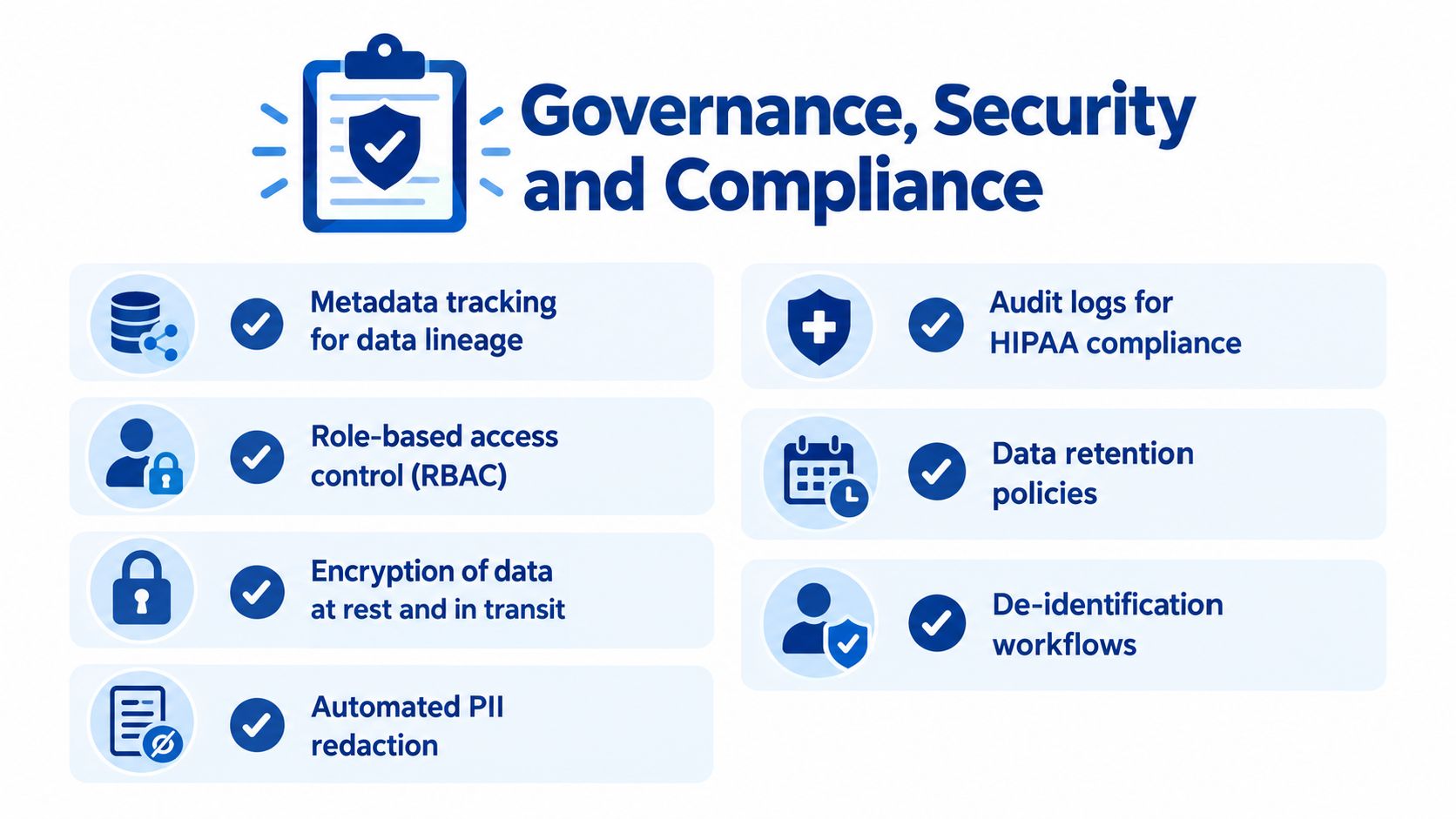
Cataloguing and lineage show what each dataset contains, who owns it, where it came from, and which transformations changed it. A catalogue should let an analyst trace a dashboard number back to its source records.
Consent and purpose tracking connect access to an approved use. A research analyst may use a de-identified dataset, while a clinical application may need identifiable information for direct care.
Identity and access management combines RBAC with ABAC. RBAC defines what a role can do. ABAC adds context such as department, purpose, geography, data classification, and the relationship between a user and a patient.
Protection and evidence include encryption at rest and in transit, customer-managed key controls where appropriate, carefully designed BYOK arrangements, de-identification, retention policies, and immutable audit logs. Safe-harbour-style methods and expert determination may apply to de-identification, but organisations should document the chosen method and test residual risk for each use.
Canadian healthcare organisations faced the highest average number of cyberattacks among Canadian sectors in 2025. That pressure makes privacy engineering part of the architecture, not an afterthought.
Before selecting a supplier, ask whether it can provide:
Canadian residency options: Confirm where primary data, backups, logs, and support copies are stored.
Contractual clarity: Check for a Canadian health-data agreement or BAA-equivalent terms that set responsibilities, subprocessors, breach handling, and permitted uses.
Operational evidence: Request audit reports, key-management details, access-log retention, incident procedures, and deletion controls.
De-identification controls: Verify that the workflow separates identifiable, limited, and de-identified environments.
Policy tooling: Look for lineage, consent, purpose-of-use, retention, and data-quality monitoring.
A practical reference on controls, ownership, and operating processes is Vision's guide to 2026 data governance best practices, alongside Cleffex's healthcare data governance practical guide adapted to PHIPA and provincial requirements. Canadian teams should still shape any generic framework around local policies and the rules that govern their own information use.
AI and Analytics Use Cases in Action
A lake earns its place when it helps a real team make a better decision. The following examples show how the same governed foundation can serve different users without forcing every application into one data model.
Population health
A regional health authority combines encounters, medication information, laboratory observations, and community context to identify a rising cohort that may benefit from proactive outreach. Care managers see an approved patient list with the supporting signals, while analysts work from de-identified or limited datasets for programme evaluation.
The important design choice is traceability. A clinician should be able to see which records contributed to a flag and whether the information is current enough for outreach.
Clinical decision support
An emergency department uses a language model to review permitted clinical notes and structured observations during triage. The model surfaces possible sepsis risk for clinician review, but it doesn't replace assessment, diagnosis, or escalation protocols.
A safe implementation keeps the model close to the governed data layer. It limits inputs, records the model version, logs the output, and gives clinicians a clear path to challenge or disregard the suggestion.
Genomics
A precision-medicine programme stores genomic files alongside relevant clinical context. Researchers can run variant-calling workflows against the genomic data while linking results to approved phenotypes, medications, and outcomes through controlled identifiers.
The lake is useful here because large files, structured clinical records, and derived features don't need to be forced into one operational database.
Operations
A hospital network combines procedure schedules, staffing availability, room status, and supply signals to identify factors associated with operating-room turnover. Operations leaders can test scheduling changes and monitor whether the result affects throughput, delays, or patient flow.
Teams assessing the broader role of healthcare data analytics solutions should define the clinical or operational decision first, then collect only the data needed to support it. A lake that receives everything without a consumer, owner, or quality rule quickly becomes difficult to govern.
Implementation Roadmap and Cloud Vendor Choices
Canadian hospitals should treat implementation as a clinical and operating-model programme, not only a cloud migration. Start with a narrow outcome, involve privacy and clinical informatics early, and expand only when the first data products have accountable owners.
Phase one maps the estate
Inventory EHRs, laboratory systems, imaging repositories, claims feeds, portals, devices, identity services, and existing warehouses. Record the owner, format, refresh pattern, data sensitivity, retention requirement, and likely consumers for each source.
Bring clinicians, privacy officers, security teams, integration engineers, analysts, and procurement into the same discovery process. Their priorities will differ, and the architecture must make those differences explicit.
Phase two establishes the landing zone
Create segregated environments for raw, development, testing, curated, and approved analytical data. Set up Canadian residency controls, identity federation, key management, network boundaries, logging, and disaster-recovery procedures before onboarding sensitive records.
Select an initial interoperability target, such as FHIR R4 resources for patient, encounter, observation, medication, and diagnostic information. Use CACDI as a reference for the minimum national data content where it fits the programme.
Phase three operationalises governance
Add the catalogue, lineage, consent and purpose controls, terminology services, patient identity management, de-identification workflows, quality checks, and audit reporting. Test access with realistic roles, including a clinician, researcher, analyst, support engineer, and external partner.
A supplier should explain how it handles provincial obligations, PHIPA where Ontario data is involved, cross-border support access, and interoperability mandates. Teams looking for implementation support can review Cleffex's healthcare software integration service alongside their internal delivery model.
Phase five expands the products
The final rollout introduces dashboards, FHIR APIs, analytical workspaces, model pipelines, and clinician-facing applications. The numbering can reflect an organisation's existing programme gates, but the principle is consistent: production use follows evidence that ingestion, governance, identity, and quality controls work together.
| Vendor | PHIPA readiness | FHIR support | Data residency | Typical cost model |
|---|---|---|---|---|
| AWS HealthLake | Requires configuration, contracts, and organisational controls for the intended PHIPA use | FHIR R4 storage and transformation | Canadian option available | Consumption-based storage, processing, API, and related services |
| Google Cloud Healthcare | Requires configuration, contracts, and organisational controls for the intended PHIPA use | Healthcare API and FHIR-oriented services | Depends on selected Canadian services and deployment design | Consumption-based storage, processing, API, and analytics services |
| Azure Health Data Services | Requires configuration, contracts, and organisational controls for the intended PHIPA use | FHIR and related health-data services | Depends on selected Canadian region and services | Consumption-based storage, transactions, compute, and platform services |
| On-premises lake stack | Direct organisational control, with compliance depending on local operations and suppliers | Requires selected interfaces, tooling, and integration work | Within the organisation's facilities or chosen hosting arrangement | Capital, infrastructure, software, staffing, maintenance, and energy costs |
No vendor makes a deployment compliant by default. The buyer remains responsible for the data flows, configuration, contracts, access model, retention rules, and clinical use.
Key Takeaways and Frequently Asked Questions
A healthcare data lake is most valuable when it becomes a controlled interoperability layer, not a large undifferentiated store. Canada's fragmented health-record environment needs common content, patient identity resolution, exchange standards, and governance that can work across jurisdictions.
The pan-Canadian strategy describes an interoperable platform that doesn't require one physical system. It proposes connecting existing and new datasets through interoperable connections and a standardised layer that can link personal, clinical, and analytical systems, as outlined in the Pan-Canadian Health Data Strategy reports and summaries.
How long does it take to reach the first useful insight?
The answer depends on the number of source systems, data quality, identity matching, approval processes, and the first use case. A focused pilot can move faster than a province-wide programme, but teams shouldn't skip governance to meet a launch date.
Choose one measurable decision, such as a quality report or patient-flow dashboard. Deliver the source connection, lineage, access policy, and validation for that product before expanding to more domains.
Is HIPAA the same as PHIPA for Canadian teams?
No. HIPAA is a US framework, while PHIPA governs personal health information in Ontario. Other provinces have their own rules and public-sector requirements. A Canadian architecture may need to satisfy both when systems, patients, partners, or support operations cross borders.
Treat jurisdiction, residency, access, disclosure, retention, breach response, and contractual responsibilities as separate design questions. Ask legal and privacy specialists to review the actual data flows rather than relying on a product label.
What budget range should a hospital expect?
A responsible estimate requires a data inventory, target use case, security design, retention policy, query profile, integration scope, and operating model. Storage alone doesn't represent the full cost. Teams also need to account for ingestion, transformation, terminology mapping, identity resolution, governance, monitoring, support, and clinical validation.
A vendor should provide a scenario-based estimate with assumptions that can be tested. Avoid accepting a single headline figure without understanding what happens when data volume, users, retention, or analytical workloads change.
How can an organisation migrate from a legacy warehouse without downtime?
Keep the warehouse serving its existing reports while the lake ingests selected sources in parallel. Reconcile key measures between the old and new paths, publish new products from the lake first, and move individual workloads only after owners approve the results.
Use change-data capture or scheduled extracts where appropriate, preserve the original records, and define a rollback path. Migration should be workload by workload, not a one-time replacement of every system.
The strategic case is clear. A governed healthcare data lake can preserve diverse records, support FHIR-centred exchange, make Canadian analytics more reusable, and provide a controlled foundation for AI. It won't fix fragmented care on its own, but it gives hospitals and HealthTech teams the architecture needed to connect systems without surrendering privacy or operational control.
Cleffex Digital Ltd can help hospital IT teams assess their current architecture, map EHR and clinical interfaces to FHIR, and design compliance-ready data-lake implementations for analytics and HealthTech applications. Visit Cleffex Digital Ltd to discuss an architecture assessment and a practical integration roadmap.