

You're running a ward with too many moving parts. A nurse is waiting on a bed decision, an ICU patient is trending the wrong way, and theatre is already behind. In that moment, digital twins in healthcare sound less like a buzzword and more like a way to test a decision before it lands in actual practice.
What Digital Twins in Healthcare Actually Mean
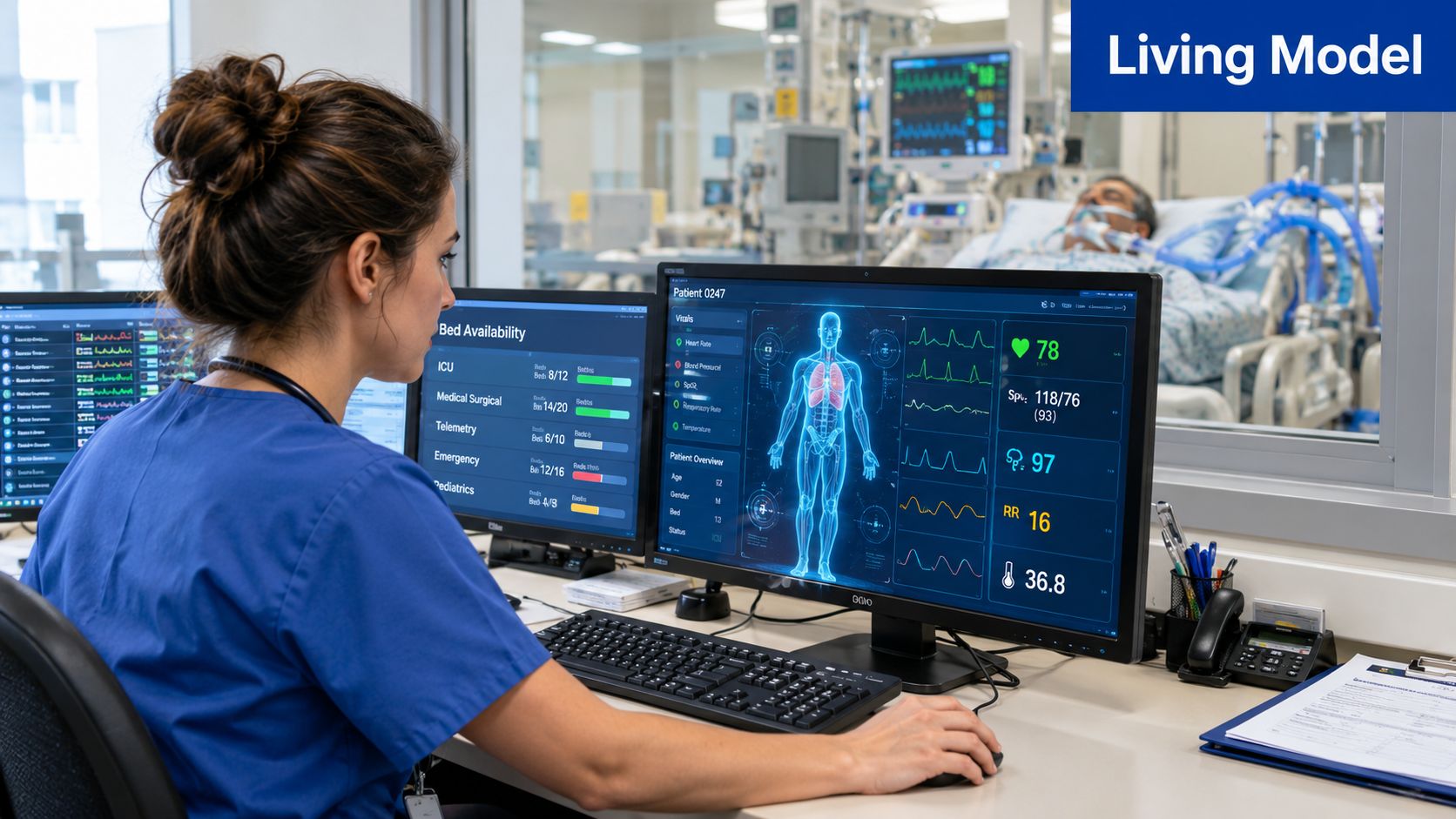
A digital twin is a live, continuously updated virtual replica of a real thing. In healthcare, that thing might be a patient, a pacemaker, or an entire hospital floor. The model keeps absorbing new data, then runs what-if tests before anyone changes care in the real world.
That's the key difference from a dashboard or a one-off simulation. A dashboard shows status. A simulation tests a scenario. A true digital twin does both, but with a live connection back to the thing it represents.
A simple working definition
A useful one-sentence definition is this: digital twins in healthcare are dynamic models that mirror a patient, device, or care system in real time so clinicians and operators can test decisions before acting.
A flight simulator is a good analogy. A simulator teaches a pilot in a controlled environment, but a digital twin is wired to the aircraft's actual condition as it changes. That live feedback loop is what gives the model practical value.
Practical rule: If the model never updates from real-world data, it's probably analytics or simulation, not a true twin.
That is where vendor language gets slippery. Some products call themselves digital twins when they're really advanced dashboards, forecasting tools, or static planning models. For readers evaluating healthcare digital twins, the question is simple: does the model stay connected to reality and change as reality changes?
Patient, Device, and Hospital Twins Explained
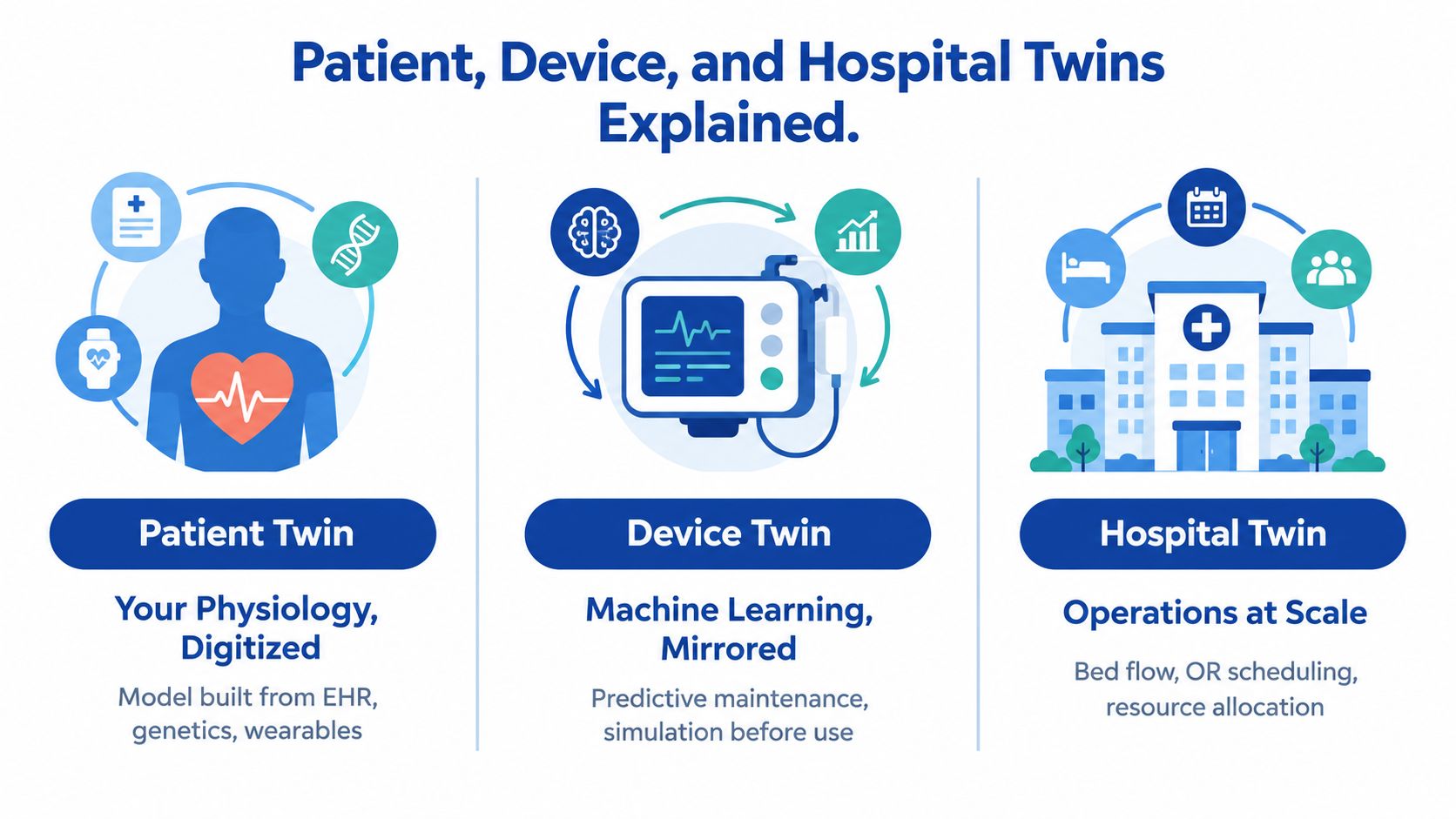
The easiest way to understand digital twin technology in healthcare is to split it into three categories. They solve different problems, mature at different speeds, and depend on different data.
Patient twins
A patient twin models one person's physiology using sources such as EHR data, imaging, genomics, and wearables. In practice, that can mean simulating tumour response before radiotherapy starts, or testing how a cardiac treatment might behave in a specific body.
This is the most exciting category and also the least mature. Patient twins are still heavily research-led because the biology is messy, the data is uneven, and the risks are significant. If a hospital leader asks for a quick rollout, that usually means the team hasn't separated the science from the sales pitch.
Device twins
A device twin mirrors a medical asset, such as an infusion pump, ventilator, implant, or scanner. It helps teams spot wear, predict failure, and test design changes before the hardware is put under pressure.
A good analogy is onboard diagnostics in a car, but more advanced. Instead of waiting for a warning light, the model learns from usage patterns and can flag trouble early. These twins are already practical in production settings because the object being mirrored is more predictable than human physiology.
Hospital twins
A hospital twin models flow, staffing, beds, equipment, and bottlenecks across a ward or an entire facility. Think of it as a city traffic-control model for a hospital; it helps leaders test what happens when demand spikes or a schedule changes.
Operations teams often see the clearest short-term value here. Bed flow, emergency department movement, operating theatre timing, and discharge planning are all easier to simulate than a full patient biology model. That's why hospital and device twins are generally ahead of patient twins in maturity.
How Digital Twin Technology in Healthcare Works
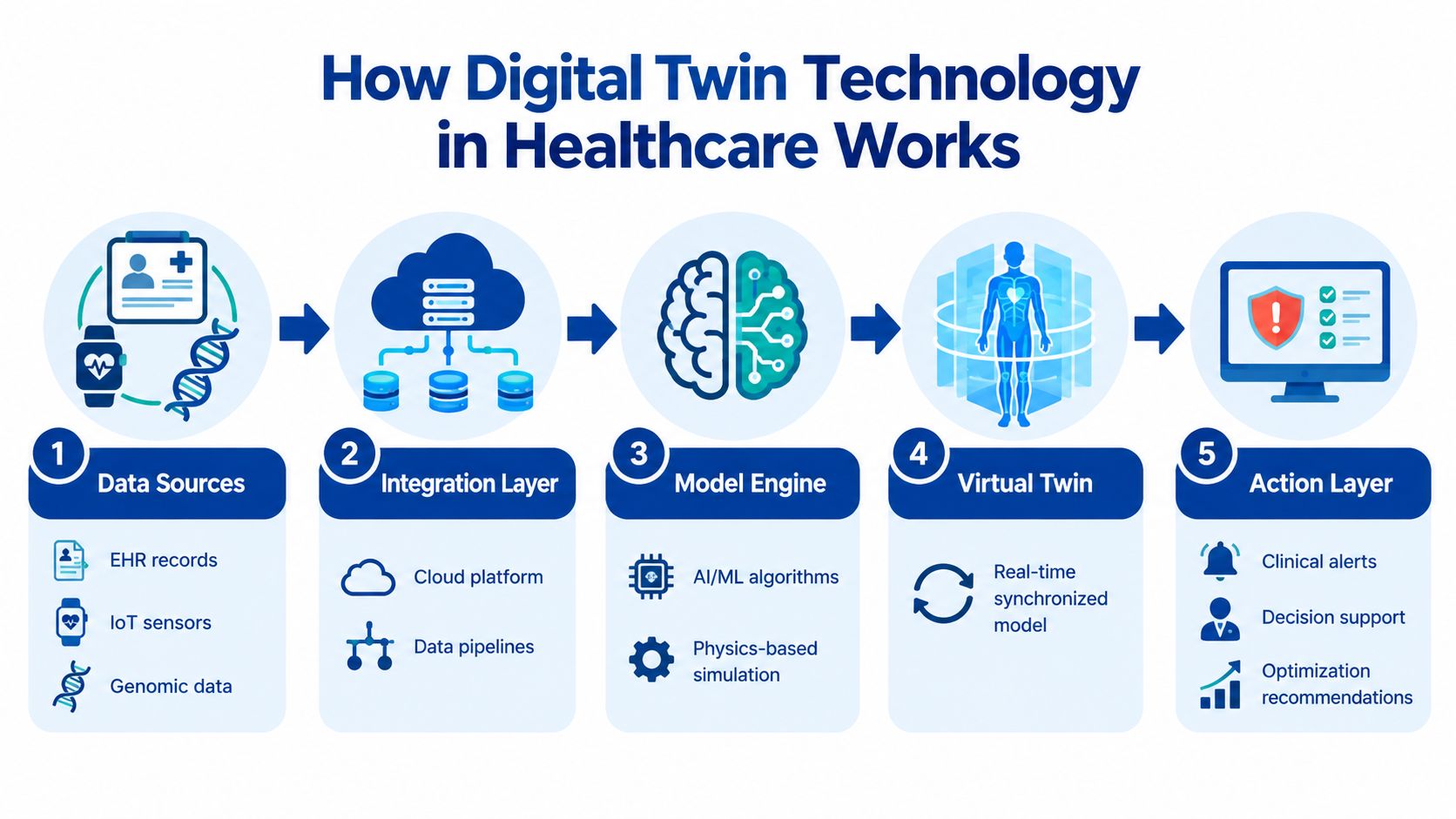
The architecture behind digital twins in healthcare is not mysterious, but it is layered. Most projects succeed or fail in the plumbing, not in the model demo.
From data to action
The first layer is input. That includes EHR records, bedside monitors, imaging such as CT and MRI, labs, genomics, and wearable feeds. If the hospital already has a strong IoT or device programme, the twin has a much better chance of staying current.
The second layer is integration. Data gets cleaned, harmonised, and synchronised through pipelines, data lakes, and streaming tools at this stage. Teams often underestimate it, then discover that disparate formats and inconsistent identifiers make the twin brittle.
The modelling layer sits in the middle. Here, physics-based methods, statistical models, machine learning, and simulation engines combine to estimate behaviour and run scenarios. The model recalibrates as new data arrives, which is why it can support planning instead of just reporting.
A twin is only as useful as its feedback loop. If the output never influences the workflow, it's an expensive model, not an operational tool.
The last layer is action. Dashboards, alerts, and planning interfaces feed insights back to clinicians, schedulers, and operations staff. For hospital teams, the practical question is whether the twin can talk to existing systems. That's why a foundation in healthcare IoT solutions for modern hospitals matters so much.
Real-World Examples of Digital Twins in Action
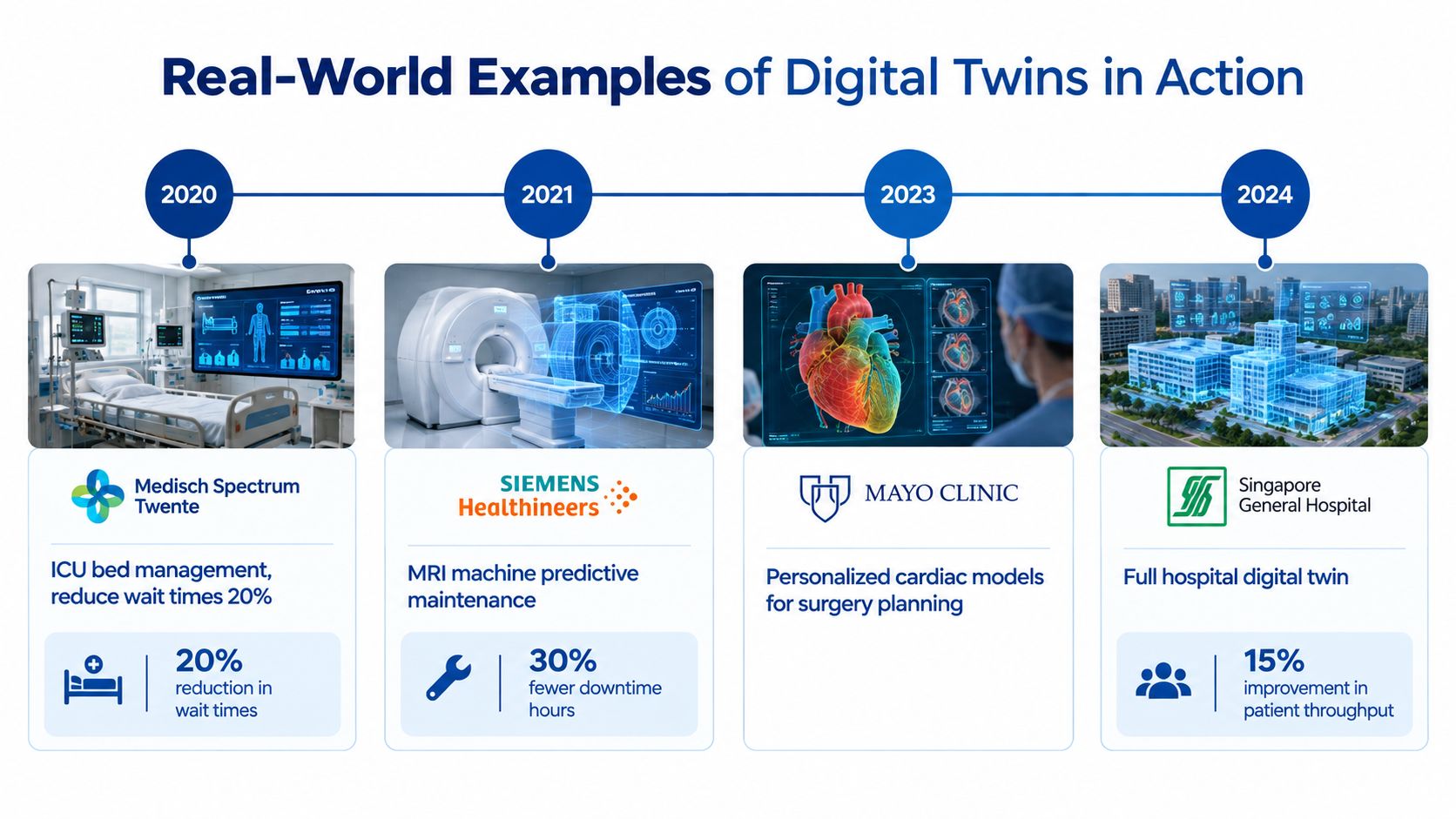
The best way to judge healthcare digital twins is to look at places where they've been used outside a slide deck. The pattern is consistent, the strongest deployments solve one painful operational or clinical problem first.
Hospital flow and capacity
Fraser Health Authority in British Columbia has been building a system-wide digital twin around a foundational digital twin that maps patient journeys and applies machine-learning models to data from multiple sources. Public material says the programme is designed to identify patients at risk of becoming more complex and costly, then support personalised interventions. The same system has also been described as modelling about two million patients across a 12-hospital network, which shows how serious the operational ambition is, even though the public details still focus more on vision than on a fully documented playbook. Fraser Health's digital twin programme overview is useful context here.
That's the hospital twin use case in plain language: less guesswork, better coordination.
Patient-level simulation
HeartFlow's FFR-CT workflow is a useful example of a patient twin in action. It builds a per-patient vascular simulation from CT angiography so clinicians can assess coronary lesions non-invasively before deciding on intervention. That's a strong example of how a twin can support clinical judgment without replacing it.
Device-level use
Device twins show up in the background of care too. Philips has been part of ICU-oriented digital twin work, where device behaviour and patient status are analysed together to support ventilator-related decision-making. The value here is less about glamour and more about preventing avoidable failure or delay.
For teams that want a broader implementation lens, healthcare AI adoption help is relevant because twin programmes often live or die on data governance, workflow design, and change management rather than model novelty.
A Practical Roadmap for Implementation
A mature programme usually unfolds in stages, and it rarely looks as neat as vendor brochures suggest. The teams that move fastest are the ones that treat digital twin rollout like an operating model change, not a software install.
Stage-by-stage adoption
Data strategy: Inventory EHR, imaging, device, and operational sources first. Sort out consent, provenance, and data ownership before anyone starts modelling.
Modelling: Start with a low-fidelity prototype if you're testing a workflow question. Move to higher-fidelity physics or machine-learning twins only when the use case is clear.
Validation: Test the model against historical data and then against live pilots. The point is to compare output with real clinical or operational ground truth, not just to prove the code runs.
Deployment: Build MLOps pipelines, clinician-facing views, and API contracts with the systems people already use. If the twin sits outside workflow, uptake will be weak.
Integration: Treat the twin as a service that talks to the EHR, scheduling, and asset systems. The programme becomes part of hospital operations instead of a separate application.
Monitoring: Watch drift, re-check performance, and recalibrate on a fixed governance cycle. Models lose value if the underlying care pattern shifts and nobody notices.
Practical rule: Pilot success is not the same as enterprise readiness. The moment a model leaves the lab, integration and support become the real product.
For teams building around the broader hospital stack, platform modernisation in healthcare is often the more honest starting point than “AI first” thinking. A digital twin is much easier to trust when the surrounding architecture is already stable.
Compliance, Privacy, and Integration Challenges
A hospital can build a convincing patient twin, then discover that its data cannot pass legal, security, or workflow review. The difficult work is making the twin useful without weakening privacy controls or disrupting care.
What usually trips teams up
Identifiable patient twins fall under strict health-data rules, including HIPAA in the United States and GDPR in the EU. Synthetic or population-level twins may face different direct clinical requirements, but they still carry privacy risk. Combining imaging, genomic, and auxiliary datasets can make re-identification possible, even when individual fields appear harmless.
Canada shows how quickly governance can change as data ambitions grow. Debate around proposed Bill C-27 reflects an evolving approach to health-data oversight. A dynamic twin adds another complication: wearables and bedside systems continuously produce new information, so consent must account for ongoing collection and changing uses.
Integration creates a separate barrier. Fewer than 40 per cent of acute-care organisations can exchange structured clinical data outside their walls, according to Canada Health Infoway and the Canadian Institute for Health Information. A hospital twin may therefore rely on incomplete HL7 FHIR feeds, leaving gaps in its view of the patient journey. A model can be technically accurate and still provide weak guidance when key events are missing.
| Risk Area | Likelihood | Recommended Mitigation |
|---|---|---|
| Re-identification | High | Data minimisation, strong access control, privacy-by-design |
| Wearable consent drift | Medium | Continuous consent review, clear patient notices |
| Legacy system mismatch | High | FHIR mapping, interface testing, staged rollout |
| Incomplete data feeds | High | Federated learning, proxy data review, governance checks |
| Model misuse | Medium | Defined clinical scope, validation and audit trails |
Complete a formal data protection impact assessment before scaling beyond a pilot. Federated learning and data minimisation can reduce exposure, but neither substitutes for clear ownership, access rules, and review processes. Governance must also define where the twin may support decisions and where human review remains required.
Integration and support become the product that actually matters. If the trust model is weak or the data connections remain unreliable, a promising twin will not survive review by a serious hospital IT team.
Measuring ROI and Choosing the Right Partner
A digital twin programme needs a business case, not just enthusiasm. Executives should judge it against operational KPIs they already trust, then decide who should build it.
What to measure
The strongest metrics are practical, not glamorous. Look at average length of stay, avoided readmissions, ICU capacity gains, device downtime prevented, and clinician hours saved per month. Those measures should be tracked across sensible windows, usually 90 days for early signals, six months for stabilisation, and 12 months for strategic review.
The build-versus-buy decision depends on how mature your data engineering is, whether the model needs proprietary logic, how the output will be regulated, and what the total cost of ownership looks like over three to five years. If your team lacks clean interoperability and monitoring patterns, an in-house build can become an expensive science project.
| Criterion | In-House Build | Specialist Vendor | Platform + Services Hybrid |
|---|---|---|---|
| Speed to pilot | Slower | Faster | Moderate |
| Data control | High | Medium | High |
| Custom logic | High | Medium to high | High |
| Internal skill demand | Very high | Lower | Moderate |
| Exit flexibility | Medium | Medium | High |
A vendor checklist should include clinical references, validation evidence, deployment history, and an exit path if the model underperforms. In practice, the best partner is the one that can prove it understands your data mess, not the one with the slickest demo. Cleffex Digital Ltd is one option in this space because it works on healthcare software integration and AI-driven healthcare solutions, which matters when a twin has to connect to real systems rather than live in a sandbox.
Key Takeaways and Common Questions
The main lesson is simple. Start with the clinical or operational problem, not the novelty of the technology. If the use case is unclear, the twin will drift into a pilot that nobody owns.
A few takeaways should stay front of mind:
Use case first: Choose a problem with visible operational pain.
Data quality is the bottleneck: The twin is only as reliable as its feeds.
Validation comes early: Don't wait until launch to test assumptions.
Integration costs real money: Budget for workflow fit, not just modelling.
Measure both sides: Clinical and operational KPIs should sit together.
Decide build or buy early: That choice shapes the whole programme.
Frequently Asked Questions
How long does a realistic pilot take?
Patient twins can take six to twelve months for a useful pilot, while hospital-level twins usually take longer because they depend on broader system integration and more operational testing.
Are digital twins medical devices?
Sometimes, but not always. It depends on intended use, the claims made, and whether the output influences diagnosis or treatment decisions.
What minimum data do you need to start?
A single well-defined use case with reliable baseline data is better than a giant but messy dataset. Clean historical records, a clear workflow, and a stable source of truth matter more than scale at the start.
Can smaller or rural hospitals participate?
Yes, if they focus on narrow use cases and avoid trying to model the entire hospital on day one. Shared services, vendor support, and phased integration can reduce the burden.
What happens next?
Over the next one to three years, adoption will likely stay uneven, with stronger uptake in operations, devices, and selected patient-specific use cases. Agentic AI and synthetic data generation may make modelling faster, but they won't fix weak governance or poor integration on their own.
If you're planning a healthcare digital twin initiative, Cleffex Digital Ltd can help with software integration, connected workflows, and AI-enabled healthcare systems that need to fit into real hospital environments. Visit Cleffex Digital Ltd to discuss a practical starting point for your programme.