

At 2 a.m., a physician is trying to confirm a medication allergy before an order goes in. The hospital EHR shows one version of the chart, the provincial lab repository shows another, and the clinic portal has a note that doesn't quite match either one. A few minutes later, the physician has opened three systems, copied and cross-checked the same detail twice, and still doesn't have the confidence that the record is complete.
That kind of moment is where healthcare data silos stop being an abstract architecture issue and become a practical risk. The problem isn't just that systems don't connect, it's that care teams, patients, and administrators are all working with different versions of the truth.
In Canada, that friction has a structural cause. Health administration is split across provinces and territories, so records, billing rules, and data standards evolved unevenly rather than through a single national platform, and national survey evidence showed that only 4 in 10 Canadian physicians could electronically access hospital discharge summaries in 2019, while fewer than 1 in 3 could exchange secure messages with colleagues outside their organisation, and only roughly 1 in 5 Canadians had access to their full medical record online at the time, according to the Canadian interoperability overview in the brief's verified data. Canada Health Infoway and related initiatives have treated interoperability as a long-term modernisation effort, but the practical challenge still starts with governance, identity, and workflow, not just interfaces.
The Clinician Who Lost an Hour to Three Login Screens
The night shift doesn't care how elegant your integration roadmap looks on paper. It cares whether the allergy is visible, whether the discharge summary is current, and whether the person on call can trust what they're seeing without phoning three departments.
A physician shouldn't need a scavenger hunt to answer a basic clinical question. Yet that's exactly what happens when the hospital EHR, provincial repository, and clinic portal each hold part of the story, with no single view that reconciles them.
The real cost of the hunt
The hidden cost is not just inconvenience. Every extra login adds friction, and every manual check adds the chance of a missed detail or a duplicated task. When clinicians are forced to move between systems, they spend time verifying what should already be trusted and visible.
Practical rule: if a care team needs to copy, paste, or retype the same patient detail into multiple systems, the organisation has already admitted that the workflow is fragmented.
That's why this topic deserves more than a generic “interoperability is important” summary. The executive question is not whether connectivity matters, it's which organisational controls, data models, and identity layers make connectivity reliable enough for daily clinical work.
What you'll get from a practical view
A useful conversation starts with the lived experience at the bedside, then moves into the structural causes behind the mess. From there, the focus shifts to the operational and patient harms, the technology stack that reduces the pain, and the phased steps that work for both large hospital networks and smaller clinic groups.
The best lens is not “how do we buy an interoperability suite.” It's “how do we build a dependable flow of clinical truth across provincial systems, vendor platforms, and care settings without breaking compliance or creating a new bottleneck.”
What a Healthcare Data Silo Actually Is
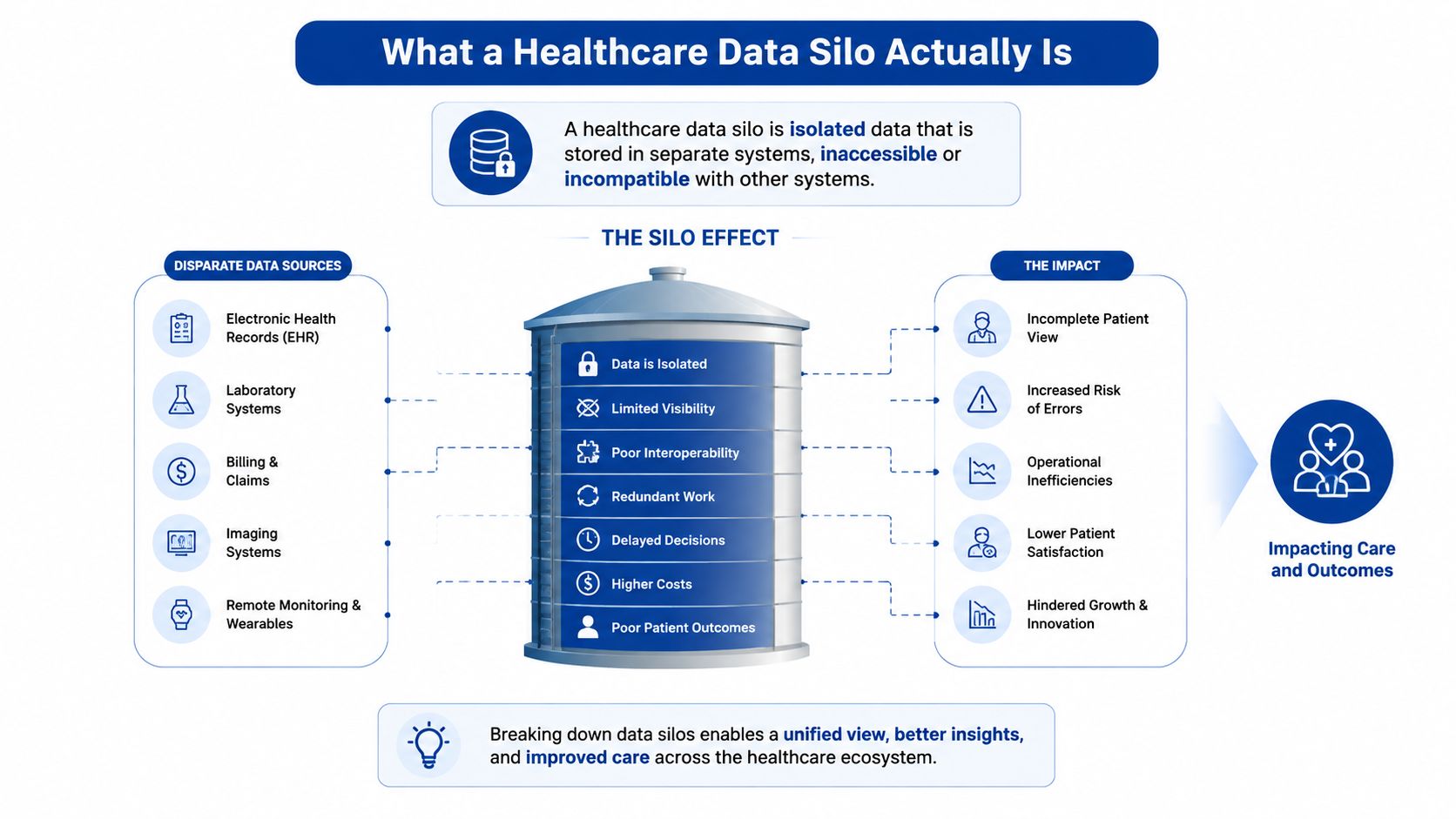
A healthcare data silo is what happens when one part of the system stores information in a way the rest of the system can't use cleanly. A simple analogy helps. Think of a hospital as a city where every building has its own mailbox, postal code, and language. The mail might arrive, but nobody can sort it, match it, or read it fast enough to act on it.
That's why silos persist even when vendors advertise APIs. An API can expose data, but it doesn't automatically solve mismatched identity, different vocabularies, or inconsistent governance. In Canada, the verified research points to heterogeneous EHRs, inconsistent interoperability standards, and legacy records as the practical drivers, which means every organisation still has to map, normalise, and reconcile data before it can be aggregated across sites. See the technical discussion of semantic heterogeneity in the verified Canadian source on interoperability and data modelling.
Why “different systems” is too shallow an explanation
The deeper problem is governance. One organisation may define a medication one way, another may code the same item differently, and a provincial service may expect a different exchange structure altogether. That's what the verified data calls semantic heterogeneity, meaning different terminologies, coding systems, and clinical taxonomies block straightforward analytics unless institutions adopt a common governance layer and standardise their data models.
This is why the phrase “we have APIs” often misleads executives. APIs are transport, not agreement. They can move messages around, but they don't decide whether a lab result, a patient identity, or a provider record means the same thing in every system.
How to recognise a silo in your own environment
If your teams have to re-enter the same patient details in multiple tools, reconcile conflicting chart versions, or manually map codes before reporting, you're already living with silos. If your analytics team keeps asking for exceptions because one site stores data differently from another, the problem isn't just technical debt, it's fragmented operating policy.
A common mistake is treating each interface as a one-off project. That creates a patchwork of connections, not a shared information layer.
Why Siloed Data Hurts Patients, Clinicians, and Budgets
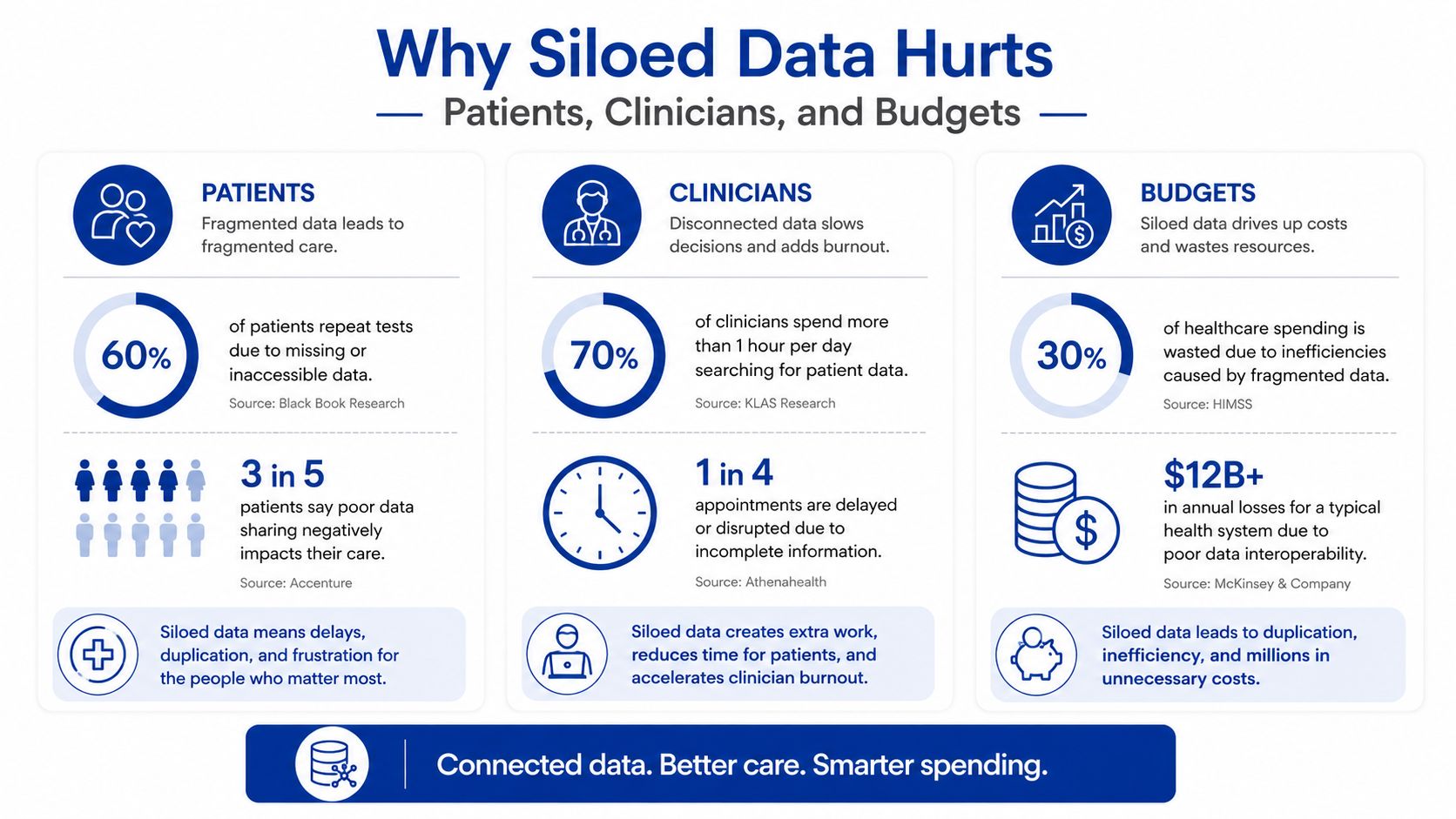
A patient arrives for care, yet the chart is scattered across separate systems, the medication history lives behind another login, and the note from the last visit may need to be retyped before anyone can use it. That is how fragmentation shows up in practice. The verified data highlights manual copy-paste reconciliation as a direct consequence of disconnected systems, and that matters because it makes real-time decision support harder and raises the chance of error. HealthTech Magazine's reporting in the brief notes that nearly 1 in 5 patients report mistakes in ambulatory visit notes, which is a sharp reminder that note quality is a patient-safety issue, not a back-office nuisance.
For clinicians, silos turn ordinary work into detective work. A prior imaging study sits in one system, a discharge summary sits in another, and the current medication list may be buried behind a different login. If the information is not visible where the decision is made, people repeat work, delay action, or order tests again because they cannot confidently see what has already been done.
The burden lands hardest on uncommon, dispersed cases
Rare-disease and longitudinal-care patients are hit especially hard. The verified Canadian research says siloed, proprietary datasets and weak natural-history data slow the generation of scalable solutions for underserved patient groups, and that matters even more when the patient population is already too small or too dispersed to be useful without cross-institution linkage. In plain terms, if the record stays scattered, the population stays invisible.
Beyond slower care for routine cases, siloed data also renders rare-disease populations invisible. Their outcomes depend on stitching together small fragments from many sites over time, and the system often loses that evidence before anyone can learn from it.
Why the problem compounds
Canada's fragmented provincial administration makes this worse over time. When every province, territory, and organisation evolves its own data rules, the system does not just stay disconnected, it accumulates more variation. That creates more reconciliation work, more audit pressure, and more inconsistency for every new programme that depends on timely, trustworthy data.
The Technology Stack That Actually Breaks Silos Down
The right stack doesn't start with a shiny platform. It starts with a specific failure mode. If the problem is inconsistent exchange, use standards. If the problem is identity mismatch, use master data management. If the problem is trapped history, use a landing zone that can normalise data over time.
Match the tool to the job
FHIR and HL7 handle structured exchange, which matters when you need data to move in a predictable format across organisations. RESTful APIs act as connective tissue, letting approved applications query or send data without custom point-to-point builds every time.
Data lakes help when the goal is longitudinal analysis, because they give you a place to land and organise data from multiple systems before you try to report on it. Master data management is what reconciles patient and provider identity across systems, which is critical when the same person appears under slightly different records. Integration middleware, the modern iPaaS layer, orchestrates the flows so data can move, transform, and validate without every interface becoming a one-off project.
Know the trade-offs before you buy
Every tool solves one problem and introduces another. A data lake can become a dumping ground if governance is weak. APIs can proliferate if identity matching is sloppy. Middleware can simplify orchestration, but only if the organisation agrees on which source is authoritative for each record type.
That's why the integration conversation should stay tied to workflow, not vendor slogans. If discharge summaries are the pain point, optimise that. If cross-site lab reconciliation is the pain point, fix that first. If patient matching is unreliable, no analytics layer will rescue the outcome.
For teams looking for a practical implementation map, Cleffex has a useful overview of healthcare integration patterns in its healthcare data integration guide, which is most relevant when you're deciding how interface, validation, and identity checks fit together.
Where rare-disease research benefits
Pooled, normalised data helps rare-disease work disproportionately because the evidence base is so thin to begin with. When systems can preserve links between patient, encounter, practitioner, organisation, and event records, researchers can ask better longitudinal questions without rebuilding the dataset every time.
Operational insight: if your architecture can't preserve provenance, it can't support trust. If it can't support trust, clinicians and researchers will keep falling back to manual verification.
A Phased Roadmap for Enterprise and SMB Healthcare Buyers
A twelve-hospital network and a five-clinic group do not need the same implementation plan. The principle stays the same, but the order of work changes. Large organisations need governance, identity, and sequencing discipline. Smaller clinics need speed, low overhead, and a path that does not lock them into a platform they cannot maintain.
A practical rollout starts by matching the size of the change to the size of the team. If the operating model is fragile, even a good interface can create more confusion than value.
Start with inventory, not ambition
The first phase is a full inventory of data sources, owning organisations, standards in use, and where the record of truth currently lives. If you do not know which system owns which clinical object, you will end up building integrations that work technically but fail in daily operations. That inventory should also show where identity is handled, because the same patient can appear under different labels across systems and across provinces.
Phase two is narrower. Pick two or three high-value workflows, such as discharge summaries or cross-organisation lab results, and unify those first. That gives leadership a visible win without asking the whole enterprise to absorb change everywhere at once. It also helps surface whether the pain is in the workflow, the matching rules, or the handoff between organisations.
Build the foundation before the analytics layer
Phase three brings the integration layer, master data management, and identity resolution together. That is when the organisation can start trusting identity and data lineage across systems, not just that a link exists. At that point, the team can trace where a record came from, how it was transformed, and which system should answer if two versions disagree.
Phase four is the broader analytics layer, including a full data lake and population-health reporting. If that layer arrives too early, teams spend more time arguing about data quality than using the information. Structured testing matters here, and resources like test automation success stories for hospitals can help teams treat reliability as part of the rollout, not as a post-launch fix.
A 90-day starting sequence for smaller groups
For SMB buyers, the first move should stay simple.
Choose one cloud EHR partner with strong FHIR support.
Turn on patient-facing access so the patient portal becomes part of the workflow.
Contract a middleware vendor that can connect the EHR to the next system without custom spaghetti.
That sequence keeps the work close to care delivery. It also gives smaller teams room to learn where the bottleneck sits before they add another integration point.
Enterprise teams need one more layer. They should add a data governance committee and a clinical informatics liaison early, so the work survives handoffs between IT, operations, and medical leadership. Without that bridge, the programme turns into an interface backlog instead of a care initiative. When the governance layer is in place, the hospital can compare rules for sharing, matching, and retention across sites, including the provincial fragmentation that often complicates Canadian deployments.
Governance, Identity, and Compliance as the Hidden Foundation
A patient arrives through emergency, the clinic record sits in one system, the provincial repository holds a different identifier, and the specialist's office has yet another chart. The interface may be working, but the organisation still cannot answer a simple question with confidence, who is this person, who may see their record, and which version of the truth should move first. Governance, identity, and compliance answer those questions before any exchange begins.
The four pillars that hold the system together
A unified patient and provider identity strategy sits at the base. That usually means an MPI, plus SSO, so users and records can be matched with confidence instead of guesswork. If the identity layer is weak, every downstream tool inherits the same ambiguity, like trying to route ambulances with three different street maps.
Role-based access control has to align with privacy obligations in Canada, including PHIPPA/PIPEDA, and with HIPAA in the US where applicable. Consent management needs to travel with the record so downstream systems know what can be shown, shared, or withheld. Audit trails then provide the evidence regulators expect when a record moves across systems.
Governance also sets the rules for provincial fragmentation. A hospital network in Ontario, Quebec, or British Columbia may all be dealing with different sharing boundaries, different stewardship expectations, and different operational habits across sites. Rare-disease research makes the same point from another angle, because a case that is scattered across separate records can disappear from view even when the underlying clinical picture is present.
Why identity is the silent multiplier
A patient-matching error is not just another operational defect. It contaminates analytics, weakens consent enforcement, and creates work for every team downstream. A nurse can waste time reconciling a chart, a data analyst can inherit a false trend, and a privacy officer can be left explaining why a record reached the wrong place.
That is why compliance officers and CISOs need a seat at the same table as architects from the start, before interfaces are already built and hard to unwind. The practical questions come first, who owns the data, which role can see it, what consent applies, and how should the system match records before it shares anything. A healthcare data governance practical guide is a useful reference point for turning those questions into controls.
Governance rule: if people can't explain who owns the data, who can see it, and how consent follows it, the architecture isn't ready yet.
Two Example Architectures That Bring Silos Down
A multi-site hospital network often starts with a FHIR-based integration engine, an enterprise master person index, and a clinical data lake. That mix gives the organisation a common way to move records, match patients, and analyse care across locations without forcing every source system into the same product. The practical shift goes beyond technical flow. The network ends up with one operational view across sites instead of three competing versions of the same chart, and that matters because governance can then set one rulebook for identity, consent, and access across the whole system.
The cost structure changes too. A hospital network model usually carries more central platform overhead, because the integration engine, master person index, and analytics layer need shared ownership, monitoring, and stewardship. That expense is easier to justify when the organisation already manages multiple facilities, shared service lines, and provincial reporting obligations, because the same core platform can support many teams at once. In a fragmented Canadian setting, that shared layer also helps a network avoid building separate workarounds in each province or site.
A smaller clinic group usually follows a leaner pattern. It adopts a single cloud EHR with built-in FHIR APIs, enables patient-facing portals, and uses a lightweight iPaaS connector to send structured data to a regional health information exchange. That arrangement keeps the clinic from overbuilding while still giving patients and downstream partners a more reliable record. The governance model is narrower as well. The clinic group can define a tighter set of access rules, a simpler consent workflow, and a smaller support model, which lowers the burden on local staff and reduces the number of moving parts that need to be maintained.
The trade-off is control versus coverage. A clinic model is usually faster to standardise inside a small organisation, but it depends more heavily on the quality of the EHR vendor's APIs and the discipline of the exchange it connects to. A hospital network model is harder to coordinate at the start, yet it gives executives more room to manage identity, stewardship, and audit requirements centrally. For rare-disease research, that difference matters because a clinic architecture may improve local sharing without creating a wide enough view of the patient's story, while a network architecture can bring more of the dispersed evidence into one governed record.
What changes when the architecture is right
In both cases, data that used to sit in isolated islands starts moving through controlled paths with clear ownership. Clinicians see fewer gaps. Administrators spend less time chasing mismatched records. Researchers and care coordinators can work from a more complete timeline instead of a patchwork of exports.
The same pattern appears in the controls. A data fabric blueprint can help teams decide which data stays close to the source, which data is normalised centrally, and which access rules need to follow the record as it moves. That is the useful comparison for executives. One architecture concentrates more of the operating burden in a shared network layer, while the other pushes more responsibility into the clinic's own cloud stack and its exchange connections. The right choice depends on who is prepared to own stewardship, support, and audit work after the first integration goes live, not just who can buy the software.
For a broader systems blueprint, Cleffex's healthcare data fabric blueprint is a useful companion reference when you're comparing centralised and federated design choices.
Measuring Success and Avoiding the Common Risks
The right metrics tell you whether the silo is coming down. Track cross-organisation record access for clinicians, the time to retrieve an outside record, the reduction in duplicate diagnostics, and patient-reported continuity-of-care feedback. If those don't move, the technology has been installed, but the workflow hasn't changed.
The common failure modes are predictable. Teams expand scope into a multi-year platform rebuild, underestimate clinical change management, or treat integration as a one-time project instead of an ongoing discipline. Those are programme risks, not software bugs.
A clean 90-day checklist
Map your highest-friction workflows.
Choose one identity strategy.
Pick one or two cross-site data flows.
Assign business and clinical owners.
Review access, consent, and audit controls before launch.
If you want to explore how automation agents can help with integration monitoring, reconciliation, and workflow follow-through, an AI agent development company can be part of the conversation, but only after the governance model is clear.
| Metric or Risk | What to Measure or Watch | Owner | Early Warning Sign |
|---|---|---|---|
| Cross-organisation access | Clinicians who can see outside records | Clinical informatics | Staff still ask for faxed copies |
| Record retrieval time | Time to find an external result | IT operations | Calls to the help desk rise |
| Duplicate diagnostics | Repeat imaging or labs due to missing history | Quality and safety | Clinicians say “I couldn't see it” |
| Continuity feedback | Patient-reported care continuity | Patient experience | Complaints about repeating the same story |
| Scope creep | Programme expanding into a rebuild | Executive sponsor | Roadmap keeps resetting |
| Change management gaps | Training and adoption in live workflow | Department leaders | Workarounds appear after go-live |
Cleffex Digital Ltd helps healthcare organisations connect fragmented systems, design safer data flows, and align integration work with governance, identity, and compliance. If your team is trying to reduce silos without creating a new layer of operational risk, visit Cleffex Digital Ltd to explore how their software and integration capabilities can support the next step.