

The core problem in healthcare data integration isn't whether systems can connect. It's whether clinicians can act on outside data inside a live workflow. In one detailed analysis, healthcare organisations managed an average of 8.2 different data systems; only 31% had successful integration between the primary EHR and other clinical systems, and clinicians spent about 5.9 hours per week searching for and reconciling information. That is not a back-office inconvenience. It is time taken away from care, revenue operations, and patient safety.
HealthcareOps platforms live or die on that gap between connectivity and usability. A platform can technically move messages, yet still leave nurses, coders, and care coordinators toggling between screens, rechecking histories, and fixing mismatches by hand. Real progress comes when healthcare interoperability is embedded into the workflow, not bolted on as a transport layer.
The Fragmentation Problem in Healthcare Systems
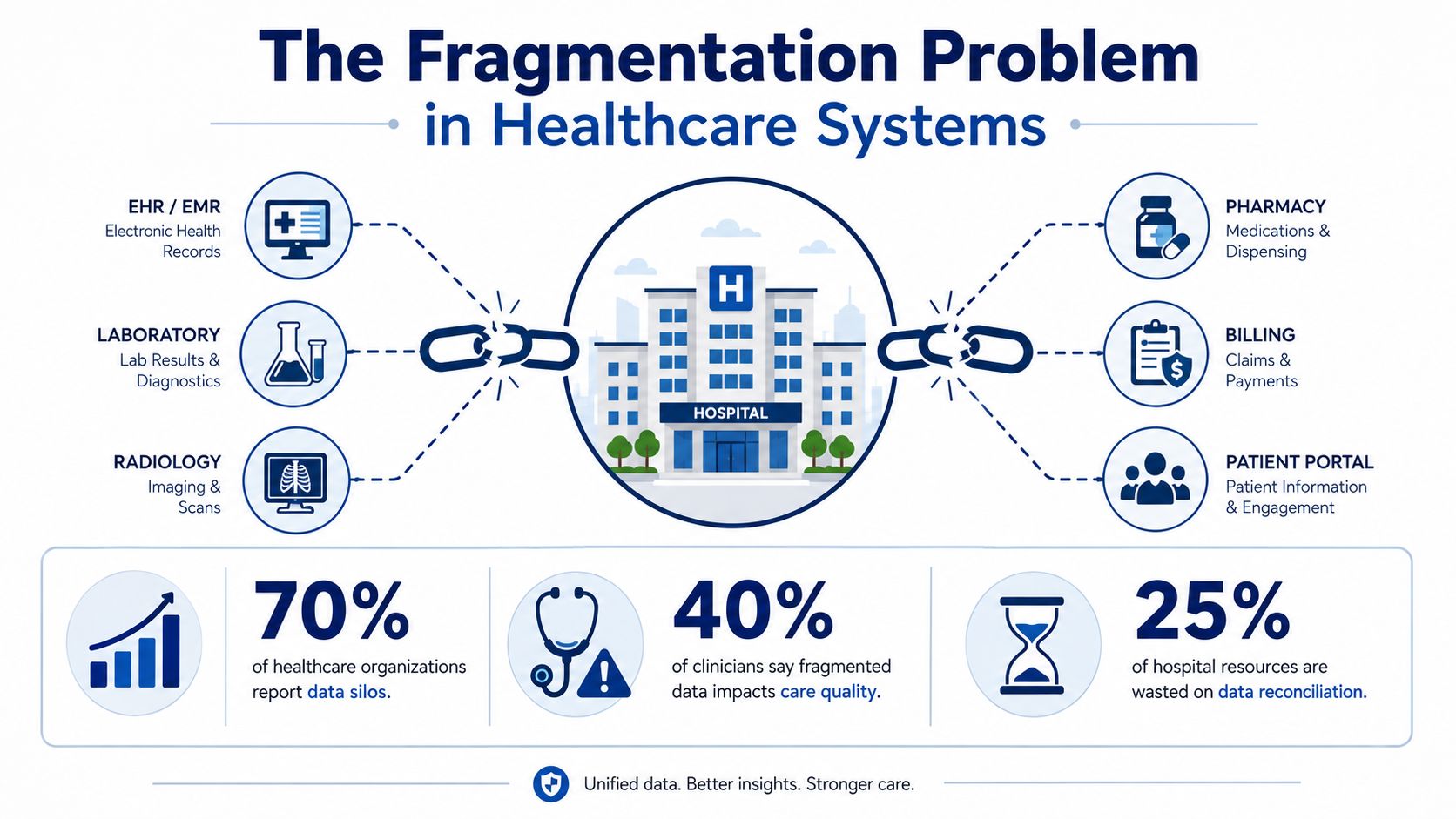
A fragmented care environment creates a familiar operational pattern. Registration updates one system, the lab writes to another, pharmacy keeps its own records, and the EHR becomes the place where everyone hopes the truth has landed. In practice, the issue is that each department keeps producing a partial version of the patient record, so staff spend time checking which version is current and which one is wrong. That is why healthcare data integration is a workflow problem before it is an IT problem.
A patient can arrive through the ED, have orders placed in the EHR, move to imaging, then have medication verification happen somewhere else entirely. If those handoffs are not aligned, the chart may look complete while the operational work underneath it is still split across disconnected queues. The result is not just inconvenience. It is duplicate entry, delayed review, and a growing chance that a small mismatch turns into a clinical decision made with incomplete context.
What fragmentation costs in daily work
Clinicians spending about 5.9 hours per week searching for and reconciling information is a brutal signal of hidden operational cost. That time includes checking whether a medication list is current, whether a lab value has been duplicated, or whether a discharge summary is buried in an inbox somewhere outside the chart. Each extra step increases the chance that a team member makes a decision with incomplete context.
The patient-safety impact is just as concrete. Organisations with stronger integration strategies saw fewer laboratory test duplications and fewer medication errors. Those are not abstract efficiency gains. They are signs that the right information reached the right person in time, without forcing staff to clean up the record first.
Practical rule: if integration does not shorten the path from data arrival to clinical action, it is mostly a transport project.
The infographic above should feel uncomfortably familiar to any hospital team still stitching together separate departmental views. A platform strategy matters because it reduces manual handoffs, duplicate entries, and the opportunities for small inconsistencies to become clinical risk. A good example of that operational mindset is the healthtech integration approach for healthcare systems.
Integration Architectures and Data Flow Patterns
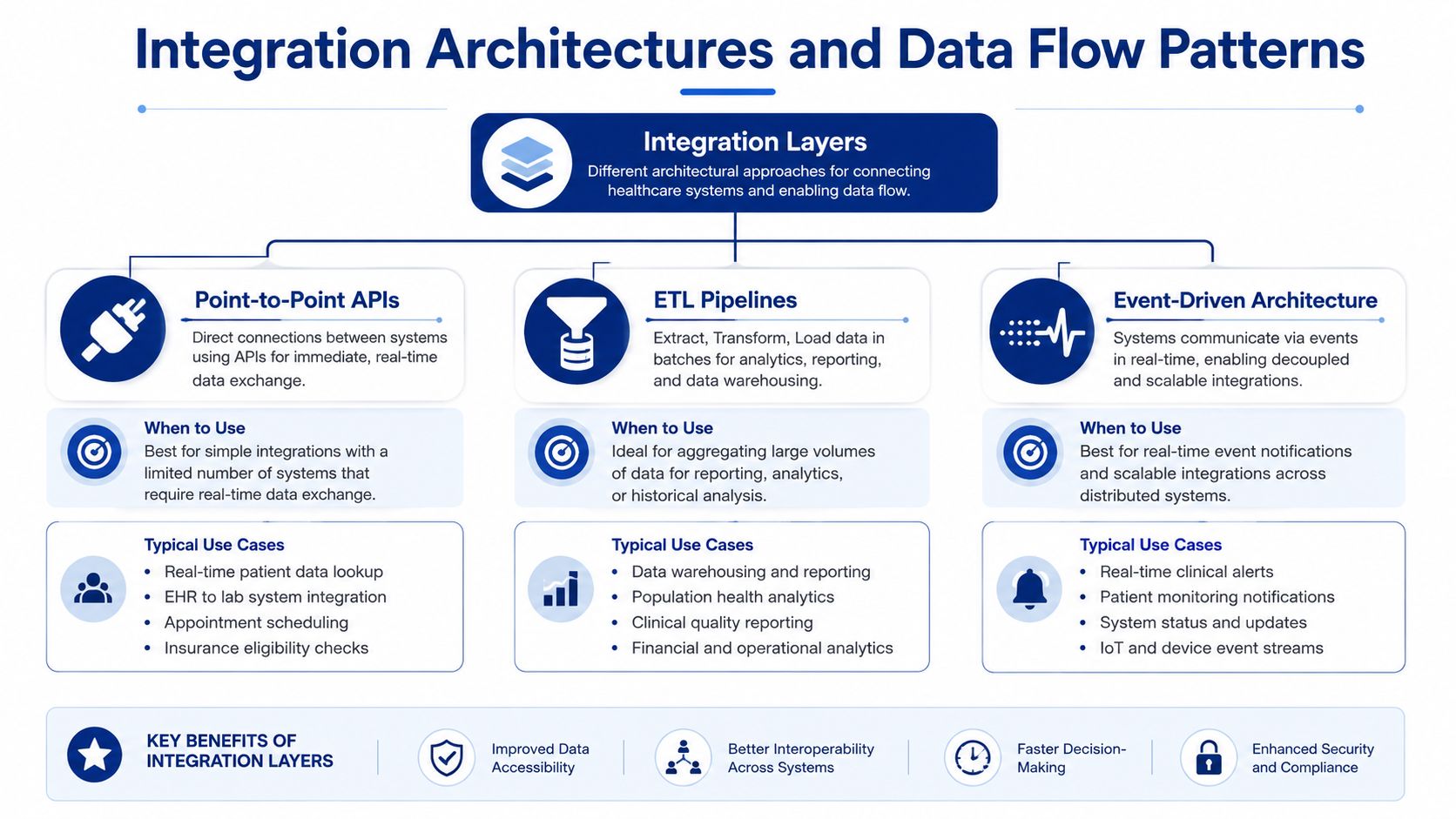
Healthcare platforms usually evolve through three broad patterns. First comes point-to-point connectivity, then scheduled data movement, then event-driven designs that can support real-time healthcare analytics without forcing every system into a brittle chain. The right choice depends on how fast the data must move, how many systems touch it, and how damaging stale information would be in a live workflow.
Start with the simplest pattern that still fits the clinical task
Point-to-point APIs work well when one application needs a direct, narrow exchange with another. A patient intake app that posts demographics into an EHR is a sensible example. The weakness appears quickly when each new interface creates another one-off relationship to maintain.
ETL pipelines suit batch work, historical reporting, and scheduled consolidation. If a finance team needs overnight reconciliation or a population health team needs a refreshed dataset each morning, ETL can be a solid fit. The trade-off is latency, because the data is only as fresh as the last load.
Event-driven architecture is the stronger pattern when downstream workflows need immediate awareness. Lab results, medication changes, bed status updates, and discharge events are all good candidates for message-driven flow. That design lets multiple consumers react without hard-wiring each pair of systems together.
The architecture question is less about elegance and more about failure mode. If a delayed update creates a clinical delay, batch is the wrong default.
A helpful external framework for thinking through these choices is software architecture design trade-offs. In healthcare, those trade-offs get harsher because data timeliness and auditability matter as much as technical cleanliness.
Decide by latency, volume, and operational blast radius
A small clinic with two systems and modest volume does not need the same integration stack as a hospital network running several clinical domains. As system count rises, orchestration becomes harder, and middleware has to do more than shuttle records. It has to route, validate, transform, and observe traffic without introducing silent failures.
Many teams overbuild or underbuild. They either create an event platform for a simple monthly exchange, or they keep patching point-to-point links until every change turns into an outage risk. Good healthcare platform integration means matching the design to the operational reality, not to vendor slideware.
Healthcare Interoperability Standards Explained
Standards talk gets messy because vendors often claim compliance without showing how the system will work in a clinical setting. FHIR, HL7 v2, and DICOM each solve different problems, and strong healthcare interoperability usually means combining more than one of them in the same environment.
| Standard | Best Use Case | Data Format | Implementation Complexity | Real-Time Capability |
|---|---|---|---|---|
| FHIR | Modern app integration, patient-facing workflows, APIs | Resource-based, REST-oriented | Moderate | High |
| HL7 v2 | Legacy system messaging, admissions, orders, results | Message-based | Moderate to high, depending on interface sprawl | High |
| DICOM | Imaging workflows and image metadata | Imaging standard with specialised objects | High for imaging environments | Moderate |
Use the standard that matches the workflow
FHIR fits modern applications because it exposes resources through web-style interactions. New platforms, portals, and orchestration layers can request the exact slice of data they need, which reduces unnecessary payloads and makes interface design cleaner. FHIR readiness alone does not guarantee clinical usability, because mapping rules and governance determine whether the data can be trusted at the point of care.
HL7 v2 still has a place in older environments and in message-based hospital workflows. In many organisations, it is the most practical choice because existing systems already depend on those message routes. The trade-off is interface sprawl, since each special-case route adds another place for mappings, acknowledgements, and exception handling to drift apart.
DICOM matters whenever imaging is part of the workflow. Radiology teams need more than a pointer to a picture; they need consistent handling of image metadata so the study can be tracked, queried, and matched to the right patient context. Without that, the exchange may look successful on paper while the imaging workflow still requires manual correction.
A useful implementation reference is the FHIR integration services guide to compliance. The point is straightforward. Compliance language around FHIR is only useful if the interface design also supports the actual clinical workflow.
Hybrid is normal in production
Most real environments mix standards. A hospital may keep HL7 v2 for core messaging, use FHIR for newer application access, and rely on DICOM for imaging. That is not a flaw. It reflects how departments modernise at different speeds and how existing operational dependencies limit how far any one standard can go on its own.
The test is whether the platform can translate without distorting meaning. If terminology mapping is weak, a technically successful message exchange can still produce an operationally useless result. Standards compliance should be judged by workflow outcome, not by a vendor checklist.
Patient Identity and Master Data Management
Identity resolution is where many integration projects succeed or fail. You can have clean interfaces and still end up with duplicates, overlays, and mismatched demographics if the master record strategy is weak. Healthcare organisations commonly run between 15 and 40 separate software systems in isolation, which makes identity matching a core engineering problem rather than a side task.
Matching patients is harder than matching messages
Simple deterministic rules work only when identifiers are stable and complete. In healthcare, that rarely holds for long. Names get entered differently, addresses change, and one department may capture a nickname while another uses a legal name.
Practical rule: the more systems you connect, the more you need a master patient index, canonical data definitions, and explicit observability around matching outcomes.
A stronger MDM approach creates a trusted version of key entities, often called a golden record. That matters because poor matches create duplicate records, manual reconciliation work, and downstream clinical ambiguity. It also increases the chance that staff spend time correcting records instead of using them.
Governance is part of the engine, not an afterthought
The technical layer only works when someone owns match rules, merge authority, and exception handling. Registration, lab, billing, and clinical teams all contribute data, but they don't all have equal authority over every field. If governance is vague, the matching engine becomes a dispute generator.
That's why patient identity needs a stewarded workflow, not just a probabilistic algorithm. When teams can see why two records were linked, they are more likely to trust the platform. When they can't, they route around it and create shadow processes.
A reliable identity layer reduces correction work only when staff trust the resolution logic enough to stop re-checking every record manually.
For organisations formalising this layer, a patient identity strategy should be designed alongside the broader master data model, not added after go-live. If the platform is already in production and duplicates are rising, remediation gets expensive quickly.
Implementation Roadmap and Testing Strategy
A realistic rollout starts with the data that causes the most operational pain, not the data that looks easiest in a demo. In one practical sequence, teams begin by mapping interfaces, then validating terminology, then testing identity logic, then checking load and failover behaviour before anything reaches clinical users. That order matters because most failures show up at the boundary between systems, not in isolated unit tests.
Phase the work so clinical users see stability early
Assessment comes first. Teams inventory source systems, identify authoritative data owners, and decide where transformation belongs. Design follows, and that is where the integration pattern is chosen, terminology maps are documented, and error handling gets defined.
Deployment should be phased, not theatrical. A hospital rollout that flips every feed at once is gambling with the support desk. Phased release lets teams watch for message delays, bad mappings, and correction spikes before the volume increases.
Testing cannot stop at technical validation. Clinical staff need to review whether the integrated record is usable in the workflow. That means looking at chart context, not just message success logs.
A useful operational reference for practice leaders is the guide for practice administrators. It's most useful when paired with an engineering review of rollback paths, monitoring, and ownership.
A good go-live checklist is boring in the best way
Interface specifications locked: Every source and destination has agreed field mappings, ownership, and error handling.
Terminology mapping checked: Code sets and clinical terms are validated before launch.
Identity resolution tested: Duplicate and near-duplicate records are exercised with realistic examples.
Load behaviour measured: The platform is tested under realistic message volume, not lab-perfect conditions.
Rollback plan ready: Teams know how to stop, isolate, and recover if a feed starts corrupting downstream data.
The worst mistake is assuming that integration failure will be obvious. Often it isn't. Data drifts, timing slips, and users compensate with manual work until the system feels unreliable. By then, the integration has already lost credibility.
A vendor or delivery partner should be judged on whether they build for observability from day one. If they can't show how they monitor throughput, transformation failures, and match quality, they're asking you to trust blind spots.
Real-World Use Cases and Measurable Outcomes
A small clinic usually wants relief from admin drag. If front-desk staff can stop retyping demographics and clinicians can see recent results without chasing another portal, the value shows up as fewer interruptions and cleaner handoffs. The gain is not flashy, but it changes the workday.
Hospitals care about throughput and patient safety. Real-time feeds make it possible to act on admissions, results, and medication changes inside the normal care flow instead of after the fact. Real-time healthcare analytics turns from a reporting layer into part of the operating model.
Different organisations win in different ways
A clinic might prioritise care coordination and reduced duplication at the front line. A hospital may focus on alerts, turnaround time, and support for bed management or pharmacy reconciliation. A health tech platform usually cares about exchange because integration is part of its product promise and customer retention story.
One study documented a 32.4% reduction in duplicate testing and annual savings of $12.3 million after integration improvements. Those results matter because they show what happens when connectivity reaches the workflow, not just the interface engine. Another healthcare integration study reported lower laboratory test duplication and fewer medication errors after integration strategies were implemented. The pattern is the same across settings: tighter flow cuts waste, and better context supports safer decisions.
What actually sells the outcome internally
Clinicians notice fewer missing facts: They don't need to hunt through multiple systems to see the latest context.
Operations sees less rework: Duplicate tests and manual reconciliation decrease when the platform is trustworthy.
Leadership gets cleaner reporting: Data quality improves when the source systems are aligned and monitored.
A sensible way to approach this is to tie each integration to one operational outcome. If the project can't name the workflow it improves, it will be hard to justify the maintenance burden later.
Cleffex Digital Ltd is one example of a delivery partner that provides healthcare software integration for connecting medical devices, SaMD apps, and digital platforms with hospital EHRs, which is the kind of work these outcomes depend on.
Security, Compliance, and Data Governance
More connectivity does not automatically improve care. In some environments, it just creates more places for bad data to spread. The difference is governance, because healthcare data integration has to support security, traceability, and clinical usability at the same time.
Compliance improves when the workflow is cleaner
Integrated systems should enforce encryption, access control, and audit logging by default. They also need clear ownership for authoritative sources, because a chart with competing truths is a compliance risk and an operational burden. When staff stop copying data into side channels, the audit trail stays cleaner and easier to defend.
ASPE notes that integrated data is central to value-based care, especially when organisations need to use outside data across settings for coordination and performance measurement. That is where governance earns its keep. If the wrong data moves faster, the organisation just becomes more efficient at making the wrong decision.
The useful question is who can trust what, and when
Some data should be available immediately to care teams. Some should be de-identified for analytics. Some should remain behind stricter consent rules or cross-border controls. Those distinctions belong in architecture, not in ad hoc policy notes.
For engineering teams shaping that layer, the build needs clear validation rules, consent handling, and dispute processes around authoritative sources.
A practical guide to the policy side is the healthcare data governance guide. Good governance maintains workflow integrity by keeping data accurate and compliant without adding unnecessary friction.
Cleffex Digital Ltd is one example of a delivery partner that provides healthcare software integration for connecting medical devices, SaMD apps, and digital platforms with hospital EHRs, which is the kind of work these controls depend on.