


Everyone keeps telling CTOs to wait for the “final” fintech rulebook before they build. That advice is dead wrong in Canada. The consumer-driven banking framework is still moving, open banking is not live at the national level yet, and the government's own timeline points to read-access APIs in 2026 and write-access capabilities in 2027. If you build as if the rules have already settled, you'll ship a product that needs a rewrite almost immediately.
FinTech API development now has to be treated as a compliance-resilient discipline, not a one-time integration project. The winning teams are designing for change, using contracts that can absorb shifting standards, security controls that stand up to audit, and partner layers that can be replaced without tearing out the core platform. That's the job in Canada right now, and it's the job most generic open-banking guides still miss.
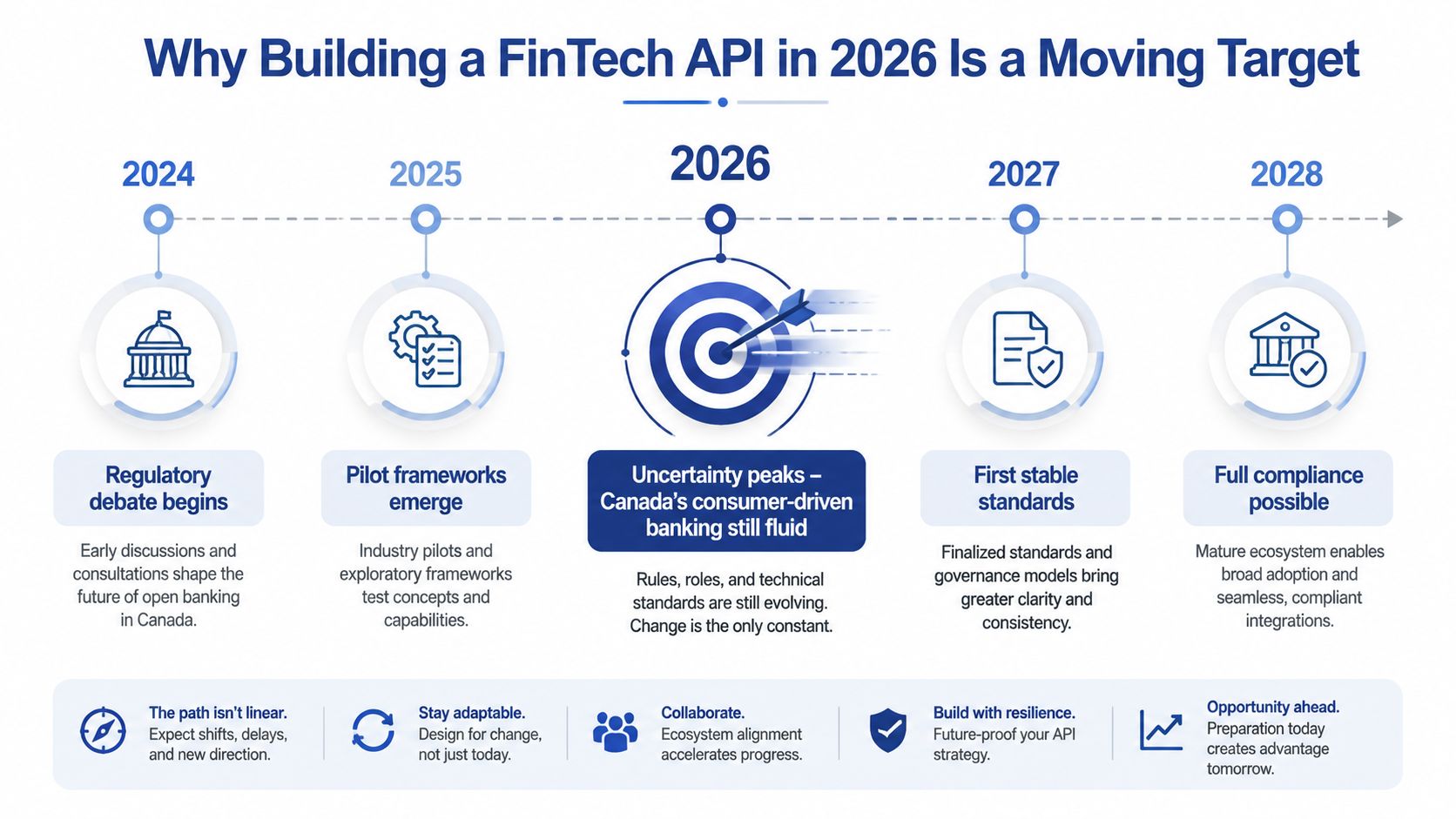
Why Building a FinTech API in 2026 Is a Moving Target
The wrong question is, “When will Canada finally finish the standards?” The useful question is, “How do we ship an API that still works when the standards shift again?” Canada's consumer-driven banking rollout is already underway, but Canada.ca still says open banking is not available yet. The framework is phased, with read access in 2026 and write access in 2027.
Treat the first release as a controlled bet, not a final design. The policy work points to accreditation, common rules, and technical standards, which means you are building inside a governance model that can move under your feet.
Build for replacement, not permanence
Put an abstraction layer between your core system and every external partner. Keep contracts versioned from day one. Log the product calls that could be affected by later regulation. If your domain model mirrors one partner's payload shape, you are baking in a rewrite.
Practical rule: if a dependency can be swapped without rewriting the business logic, you have the right layer.
That is where teams usually get sloppy. They treat the API as a delivery endpoint instead of a policy boundary. Canada's draft path still leaves implementation details in motion, and the June 2026 proposals show the operating model is not frozen yet.
For a wider planning view, read Cleffex's guide to mapping the future of fintech. The point is simple. Under uncertainty, architecture should be reversible, auditable, and boring.
Designing the API-First Architecture
API-first is not code generation first. It's contract-first design, where the OpenAPI or Protobuf file exists before the persistence layer, and the team agrees on the interface before arguing about tables. If you skip that discipline, you'll end up with a product-shaped database and an API that mirrors internal accidents instead of business intent.
Choose the right protocol for the job
For external partners, I'd default to REST with JSON. It's easier to consume, easier to document, and easier to expose through a gateway to multiple financial institutions, aggregators, and enterprise clients. For internal service-to-service traffic, gRPC usually wins on throughput and tight schemas, especially when your platform starts carrying more transaction flow and reconciliation logic.
| Criterion | REST/JSON | gRPC |
|---|---|---|
| Partner adoption | Easier for third parties | Harder for mixed ecosystems |
| Contract visibility | Very readable | Strong, but less human-friendly |
| External exposure | Better default | Usually not the first choice |
| Internal throughput | Adequate | Stronger fit |
| Browser compatibility | Straightforward | Not a natural fit |
| Tooling | Broad and mature | Strong, but narrower |
If your product is headed for bank partners, insurers, or embedded finance clients, REST keeps the surface area understandable. If you're wiring microservices behind the gateway, gRPC can reduce friction where humans shouldn't be hand-editing payloads anyway.
Set versioning and gateway rules early
Use URI versioning for public endpoints if you expect partner teams to discover changes visually, and keep a real deprecation window. Put idempotency keys on every write endpoint that can be retried, especially payments and beneficiary updates. Pagination should be explicit and stable, not inferred from whatever the database returns that day.
Your gateway should own rate limiting, request transformation, and request authentication checks. It should not become a dumping ground for business logic. That line matters because the gateway is where operational policy lives, while the application layer is where product behaviour belongs.
A useful resource for teams that are formalising these decisions is AI consultants for enterprise automation from Osher Digital, especially when you need integration planning to stay aligned with architecture rather than being bolted on later. For a related product-structure viewpoint, see Cleffex's API-first approach guide.
Contract testing in CI beats manual “it worked in staging” optimism. Break the build when schema drift appears.
Hardening Security Across People, Process and Code
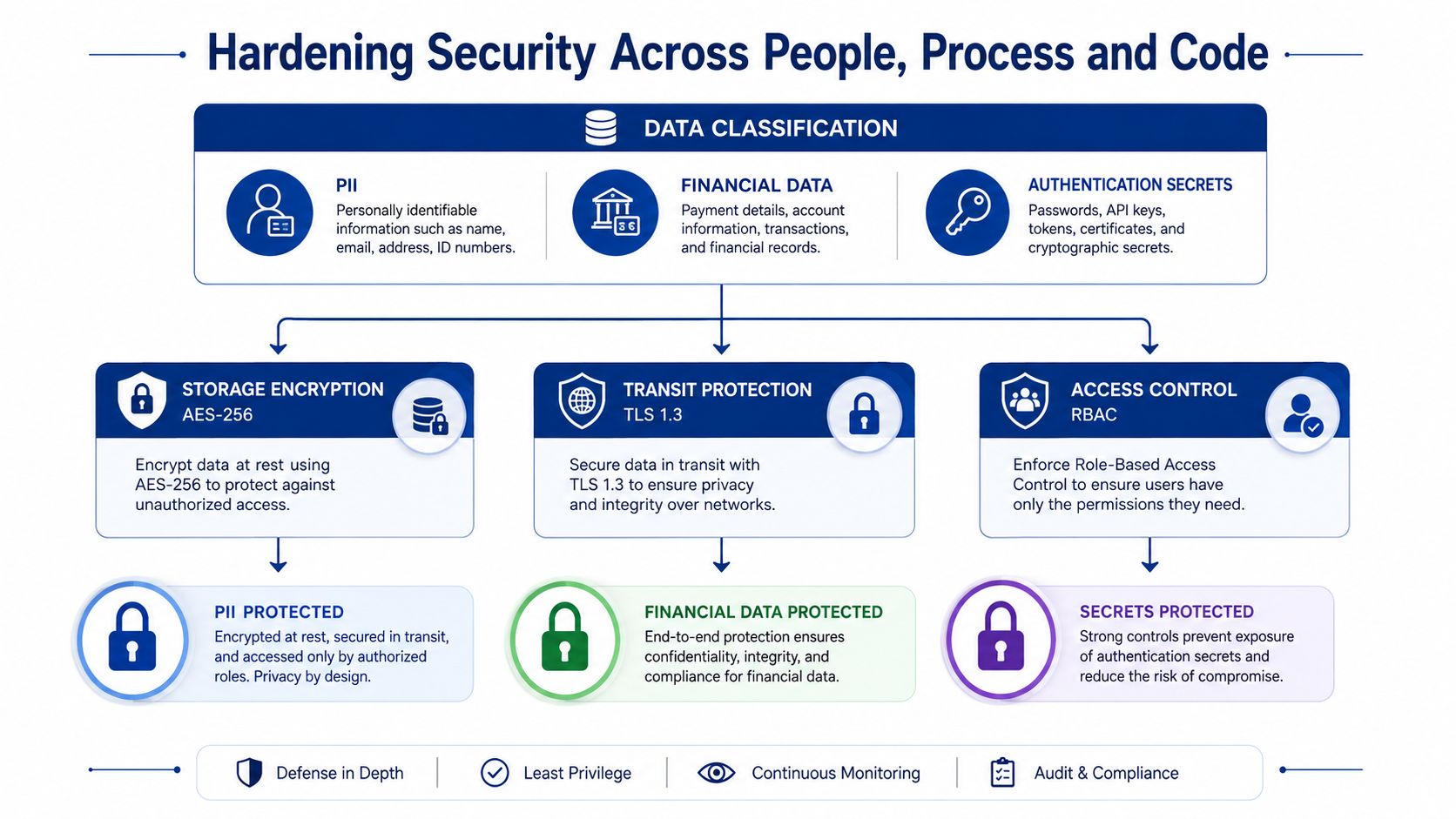
Treat security as a control system, not a checklist. Canada's framework explicitly expects teams to think across people, processes, technology, and infrastructure that touch in-scope data, with authentication, authorisation, encryption, audit trails, incident response, penetration testing, and recovery designed in from the outset Canadian consumer-driven banking advisory report. That's the right model, and it's the one that saves you from rebuilding controls after the first serious review.
Start with data classes and token discipline
Classify your data first. PII, financial data, and authentication secrets should never live in the same handling bucket, because the storage, transit, and access rules differ for each. Then define the token lifecycle properly: short-lived access tokens, refresh rotation, scoped claims, and service-to-service mTLS where internal hops need stronger assurance.
Key management needs the same discipline. Use HSM-backed KMS, rotate secrets on a fixed cadence, and decide early where encryption at rest is enough and where field-level encryption is required for sensitive identifiers. If you wait until production to settle that question, you'll end up doing a rushed security retrofit during a launch freeze.
Build the human controls into the delivery system
Security failures usually begin with permission sprawl. Limit CI/CD access to scoped roles, require mandatory security review for any change that touches authentication or data handling, and keep a runbook for token compromise that an on-call engineer can execute without improvising. The goal is to make the secure path the easiest path.
Structured logs matter far more than is typically admitted. Keep traceability strong enough for incident review, but strip out PII from operational logs so you're not creating a second breach while investigating the first.
For teams wanting a deeper implementation checklist, Cleffex's secure fintech software development guide is the right kind of companion reading.
If an engineer can ship a security-relevant change without review, the process is broken.
Mapping Compliance to Your API Design
Compliance should compile into the API, not sit beside it in a spreadsheet. If you treat regulatory duties as a later task, you will keep reworking the same surfaces every time a customer, auditor, or partner wants proof.
Make each regime change the schema, not the sprint plan
Under PCI DSS, tokenisation belongs at the edge, any service that touches PAN data needs scoped IAM, and logging must be auditable from the first release. For PSD2-style Strong Customer Authentication, put the SCA trigger into OAuth scope logic so retry handling cannot bypass it.
Canada adds a different constraint pattern. The policy rests on three pillars: accreditation, common rules, and technical standards, and the rollout is phased rather than a single hard launch. Build for that reality now. The practical API choices are a discoverability endpoint, a surface for long-horizon transaction history, and a consent artefact that stays consistent through the response flow.
| Regime | Design constraint | API move |
|---|---|---|
| PCI DSS | Protect card data and prove access control | Tokenise at the edge, log every access |
| PSD2-style SCA | Step-up auth must survive retries | Place the trigger in OAuth scope logic |
| Canada consumer-driven banking | Phased access, accreditation, consent, technical standards | Build discoverability, transaction history, consent artefacts |
| Audit expectations | Evidence must be retrievable later | Keep traceable records and immutable logs |
Design for the audit trail now
Canada's draft rules point to operational requirements that API teams should design around early, including 99.5% monthly API uptime, 24 months of transaction history, 12-month consent renewal, and five-year record retention. Your schema should already know how to preserve consent state, keep history available, and retain records without heroic recovery work later.
Auditability is a design choice, not a reporting task. Keep consent state explicit, make history retrieval predictable, and store records in a way that survives review without manual cleanup.
Regulator-friendly design is not about adding controls after launch. It is about making evidence cheap to produce from the first request.
Integrating Banking, Payments and KYC Partners
Sandbox-first wins because real partner behaviour is messier than vendor demos. I've shipped enough fintech integrations to say this bluntly: direct integration too early makes you hostage to one provider's quirks, one webhook format, and one retry model that nobody on your side fully tested.
Use adapters behind one internal interface
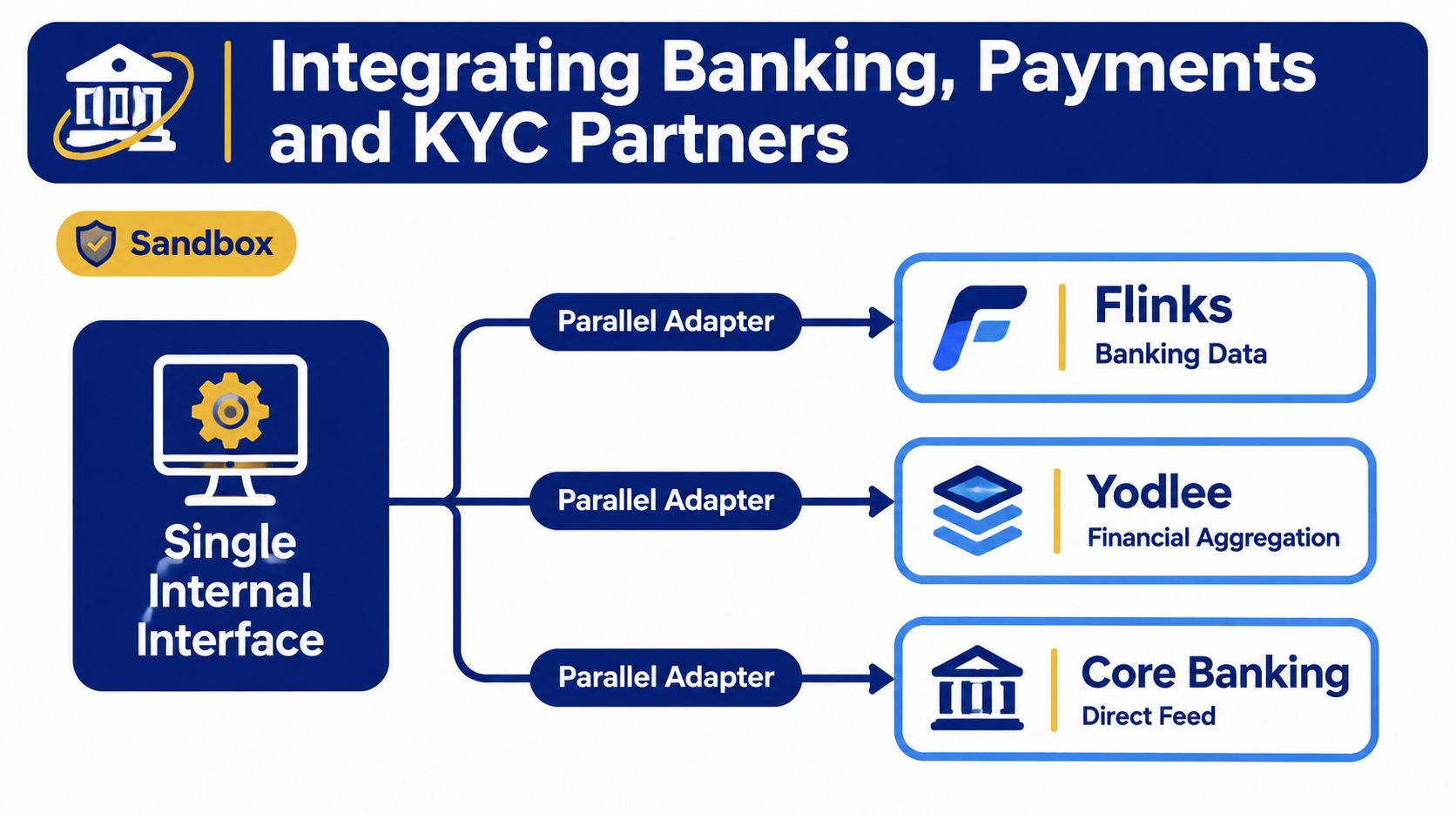
Build a single internal interface and put separate adapters behind it for banking, payments, and KYC. That gives you room to swap Flinks for Yodlee, or even a direct core-banking feed, without rewriting the call sites. The point is not elegance, it's containment.
Sequence integrations by what blocks revenue first. For many teams, that means payments rails and KYC before bank-data aggregation, because onboarding and money movement are what unblock customer activation. Once the consent flow is stable, you can add richer banking data without breaking your first impression.
Make each partner integration testable
Pick one primary payments gateway and keep a second behind a feature flag. For KYC, chain identity-document checks, liveness, and sanctions screening as a composite flow, then persist the raw score and your final risk decision so you can improve models later without forcing customers to start over.
Contract tests and recorded fixtures are essential. Webhook signing keys should be rotated on a fixed schedule, and idempotency must be checked before go-live. One missing idempotency key can cost far more than the evaluation process that should have caught it.
Recommendation: bring bank-data aggregation in after payments and KYC are stable, not before.
Testing, Deployment and Scalability Under Real Load
The fastest way to wreck a fintech launch is to confuse “it passed QA” with “it survives production traffic.” Financial APIs fail in ugly ways, through partner timeouts, partial writes, retry storms, and reconciliation gaps that only show up when real money is involved.
Ship in four stages
Start with contract tests per partner so schema drift gets caught before merge. Add property-based tests on money endpoints so edge cases around decimals, rounding, and state transitions don't sneak through. Then run shadow traffic against production and finish with chaos drills that drop a dependency mid-batch.
Deploy through a canary path and gate rollout on error budget burn, not vanity metrics. Green dashboards don't matter if the request path is degrading in a way the dashboard doesn't capture. I'd rather see a slower launch than a fast outage that poisons partner trust for months.
Scale on the right axes
For read-heavy banking products, use read replicas for history queries. For reconciliation, prefer event-sourced write paths so you can replay state when a partner or downstream service disagrees. In the gateway, set a per-tenant rate-limit tier so one client can't starve everyone else.
Observability has to exist before launch. Keep trace IDs alive across partner hops, strip PII from structured logs, and maintain a runbook for each alert that someone on call can follow at 2 a.m. If the team can't prove where a request went, the API isn't production-ready; it's merely public.
The draft Canadian thresholds matter here because they're operational, not theoretical. Teams should design against 99.5% uptime, keep the 24-month history surface fast, and store the audit trail in immutable WORM storage so retention isn't negotiable.
For security-focused validation, ThreatExploit AI's API security testing guide is worth using alongside your internal pipeline so you don't miss the boring attack paths that tend to become expensive later.
SLOs aren't an ops luxury. In fintech, they're a product requirement with a regulator attached.
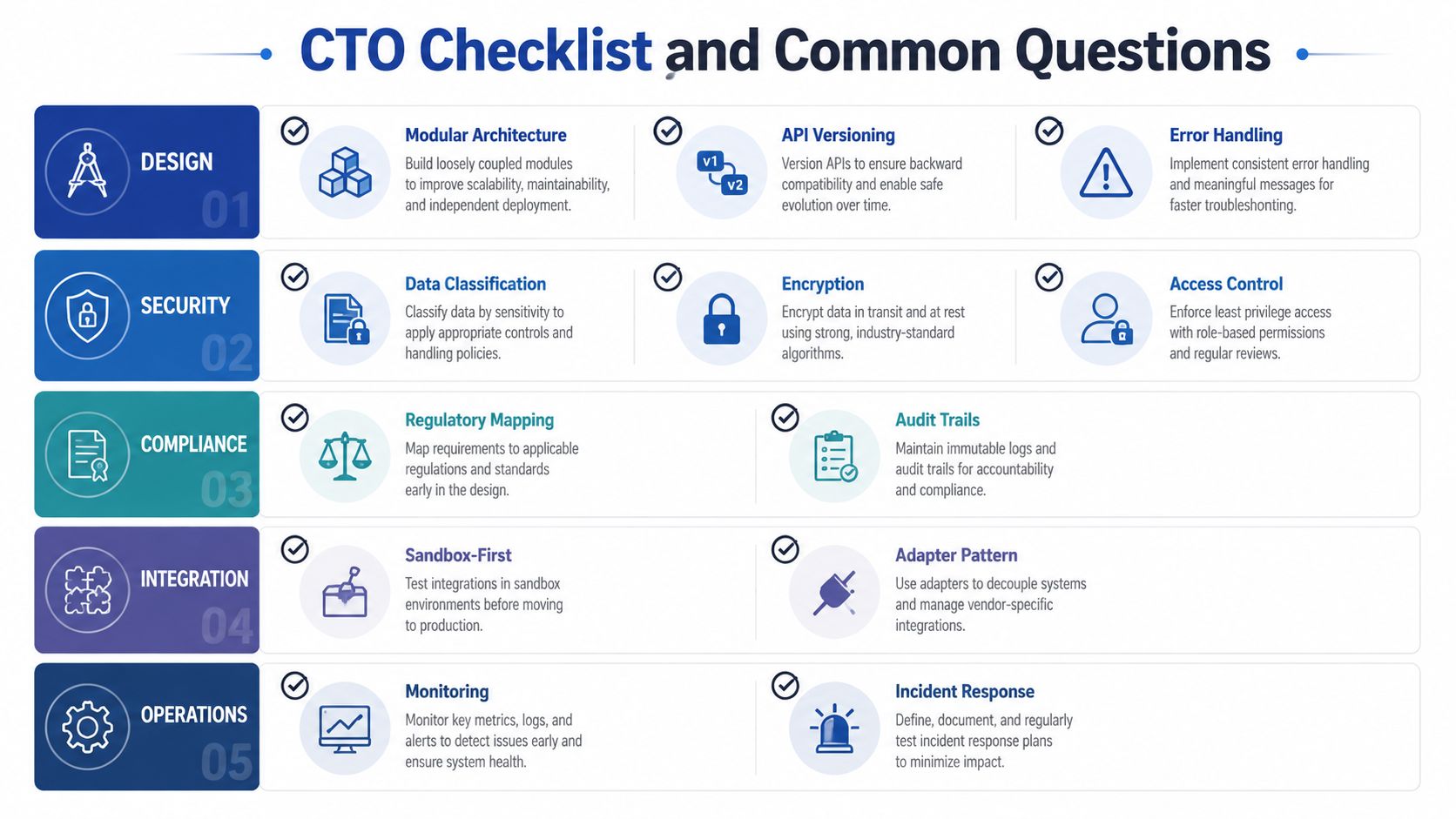
CTO Checklist and Common Questions
A CTO doesn't need another strategy deck. You need a build list you can assign on Monday and verify by Friday. The right FinTech API Development plan is a set of deliverables, not a slogan.
12-item CTO checklist
OpenAPI 3.1 contract published, versioned by URI, with explicit deprecation headers.
REST/JSON external surface defined, with gRPC reserved for internal service hops.
Idempotency keys enforced on every retriable write endpoint.
Data classification map completed, covering PII, financial data, and authentication secrets.
Token lifecycle documented, including access token expiry, refresh rotation, and scope rules.
mTLS enabled between internal services that carry sensitive financial data.
Security review gate added to CI/CD for auth and data-handling changes.
Consent flow mapped to compliance so retries can't bypass authentication steps.
Sandbox partner environment live, with recorded fixtures and contract tests.
Adapter layer implemented for banking, payments, and KYC providers.
Trace IDs and structured logs deployed, with PII excluded from operational logs.
WORM retention path verified, so audit evidence and history survive the retention window.
Frequently asked questions
Should I choose REST or gRPC for a fintech API?
Use REST/JSON for anything external, partner-facing, or likely to be consumed by mixed teams. Use gRPC behind the gateway when you control both sides of the call and care more about internal throughput than human readability.
Does PSD2 SCA apply to a Canadian-only product?
Not by default. If your product is Canadian-only, design to the Canadian framework first, then add PSD2-style controls only if your customer base, partner setup, or market expansion requires them.
What evidence satisfies 24-month history and five-year retention expectations?
Keep the original transaction record, the retrieval path, consent state, and immutable audit logs. If an auditor asks, you should be able to show both the data and the chain that proves it wasn't altered.
How do I scope an MVP against the 2026 read-access deadline?
Ship the smallest credible read path, consent, account discovery, history retrieval, logging, and partner isolation. Leave write flows for the next phase unless they're a hard revenue dependency.
Cleffex Digital Ltd builds API development and integration work that fits this kind of rollout pressure, including banking API implementation, architecture, testing, and rollout support. If you're planning a compliance-resilient financial platform in Canada, visit Cleffex Digital Ltd and speak with a team that can help you ship the first version without painting yourself into a corner.