


The popular advice on fintech modernisation is simple: replace the core, move everything to the cloud, and rebuild the customer experience around modern APIs. That advice is attractive, but it's unsafe for most Canadian financial institutions. A decades-old banking platform isn't a single application that can be switched off and replaced. It's a network of account rules, payment processes, data stores, operational controls, vendor dependencies, and regulatory evidence that customers rely on every day.
Legacy banking modernisation works better as controlled evolution. The aim is to introduce new capabilities around the existing core, isolate risk, and retire outdated components only when the replacement has earned operational trust. That approach supports service continuity while creating room for FinTech digital transformation, secure data sharing, embedded finance, and more automated financial workflows.
Canada's market makes this phased approach particularly important. Digital payment behaviour is growing, Consumer-Driven Banking is being introduced in stages, and regulatory obligations are expanding at the same time. The institutions that gain the most won't wait for perfect infrastructure. They'll identify useful, compliant opportunities now, then build an architecture that can absorb the next phase without forcing a disruptive migration.
Why Legacy Banking Modernisation Is Not a Big Bang Project
Modernisation doesn't require ripping out a functioning core banking system. It requires separating the parts that must remain stable from the capabilities that need to change quickly.
PwC notes that some Canadian banks still depend on legacy systems that are decades old, with data held in silos, analogue processes, or outdated formats. That architecture explains why a “big bang” replacement creates so much exposure. A core system often supports deposits, balances, interest calculations, payments, customer servicing, reporting, and controls at the same time. A failure in one dependency can affect several customer journeys.
A safer comparison is renovating a house while people are still living in it. You might replace the plumbing in one area, add electrical capacity in another, and build a new extension without removing the foundations on day one. The work needs temporary routes, testing, clear ownership, and a rollback plan. Financial software modernisation follows the same logic.
Start with seams, not systems
The first task is to map the boundaries around the core:
Customer experience: Introduce a new mobile journey or service portal while the core continues to process authoritative account data.
Integration: Put an API gateway or anti-corruption layer between new services and older interfaces.
Data: Create governed access to selected datasets instead of copying every historical record into a new platform immediately.
Operations: Run new components beside existing workflows, with reconciliation before any system becomes the system of record.
This pattern lets teams modernise a capability without pretending the entire institution can change at the same pace. A payments notification service, consent-management workflow, or fraud review queue may be a sensible first candidate because it can deliver value without changing ledger logic.
Practical rule: Migrate business capabilities in operationally meaningful slices, not technical components chosen only because they're convenient to deploy.
Protect continuity through controlled change
A responsible programme defines service-level expectations, data reconciliation rules, incident ownership, and rollback conditions before implementation begins. Teams should test normal processing, exception handling, batch dependencies, reporting, and customer support procedures. The migration isn't complete when the new service works in a demonstration. It's complete when staff can operate it during an incident, and auditors can trace what happened.
The strangler pattern is often useful here. New services gradually take responsibility for selected functions while the legacy platform continues to handle the remaining workload. Over time, the institution retires the old path when usage, controls, and support readiness justify doing so.
Patience is a strategic advantage. Canadian banks are modernising while payment infrastructure and consumer-authorised data sharing continue to mature. A phased architecture reduces disruption today and prevents the institution from overcommitting to assumptions that may change before the full programme is finished.
Business and Regulatory Drivers Accelerating FinTech Digital Transformation
Canadian institutions now face a combination of customer behaviour, regulation, infrastructure reform, and competitive pressure. These forces don't all demand the same response, but together they make postponing FinTech modernisation increasingly difficult.
The Bank of Canada reported that contactless credit and debit card payments account for about half of point-of-sale transactions, while smartphone payments represent about 5% of payment transactions. That smartphone share nearly doubled from 2023 to 2024, although it remains smaller than card usage. The same Bank of Canada context notes that most Canadians have smartphones capable of supporting digital payments, giving institutions an established technical base for wallets, app-based services, and mobile payment journeys. The Bank of Canada's account of payments innovation shows why modernisation is about changing behaviour around existing rails, not replacing every legacy habit.
Regulation is opening the payment stack
The Competition Bureau made 19 recommendations in 2018 covering retail payments, payment systems, investment dealing, advice, peer-to-peer lending, and equity crowdfunding. That scope matters because it frames modernisation as a financial-services competitiveness issue rather than a payments project alone. The Competition Bureau's financial-sector update provides useful context for that wider policy direction.
The Bank of Canada now supervises close to 1,500 payment service providers under the Retail Payment Activities Act. Its explanation of payment-system evolution describes a market in which non-bank providers can register directly with the central bank and participate under national oversight. That creates opportunity for fintechs, but it also means compliance, safeguarding, operational resilience, and risk ownership must become part of product design.
Consumer-Driven Banking creates a practical obligation
Bill C-15 received Royal Assent on 26 March 2026, and proposed Consumer-Driven Banking Regulations published on 27 June 2026 describe a federal framework for individuals and businesses to share financial data with accredited providers through APIs and consent controls. The federal announcement on Canada's financial-sector framework explains the legal foundation.
The business case should therefore connect modernisation spending to specific outcomes:
Better customer journeys: Reduce repeated data entry and make account information more useful across services.
New distribution models: Support embedded finance for insurance, healthcare, logistics, or small-business platforms.
Lower operational friction: Replace manual hand-offs with governed workflows and auditable integrations.
Competitive participation: Give smaller providers access to modern capabilities without requiring a complete core replacement.
The market is digitally enabled, but it isn't fully mature. That transition rewards organisations that build interoperability and trust before customers and partners treat a single operating model as the default.
Core Technologies Enabling Safe Financial Software Modernisation
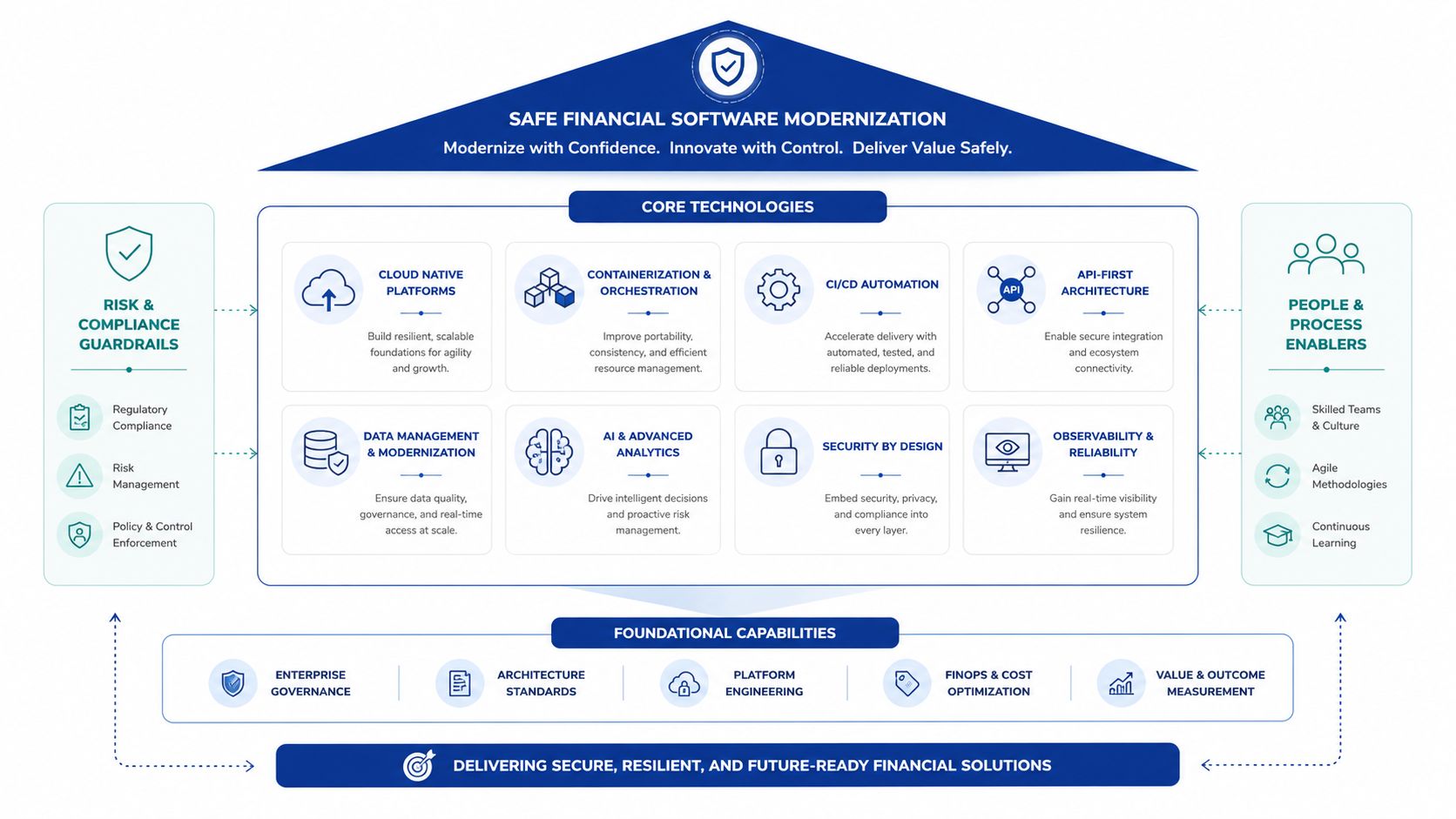
Technology should reduce migration risk, not create a new layer of complexity. The right sequence usually begins with visibility and control, then adds connectivity, modularity, and automation.
Build the foundation before moving workloads
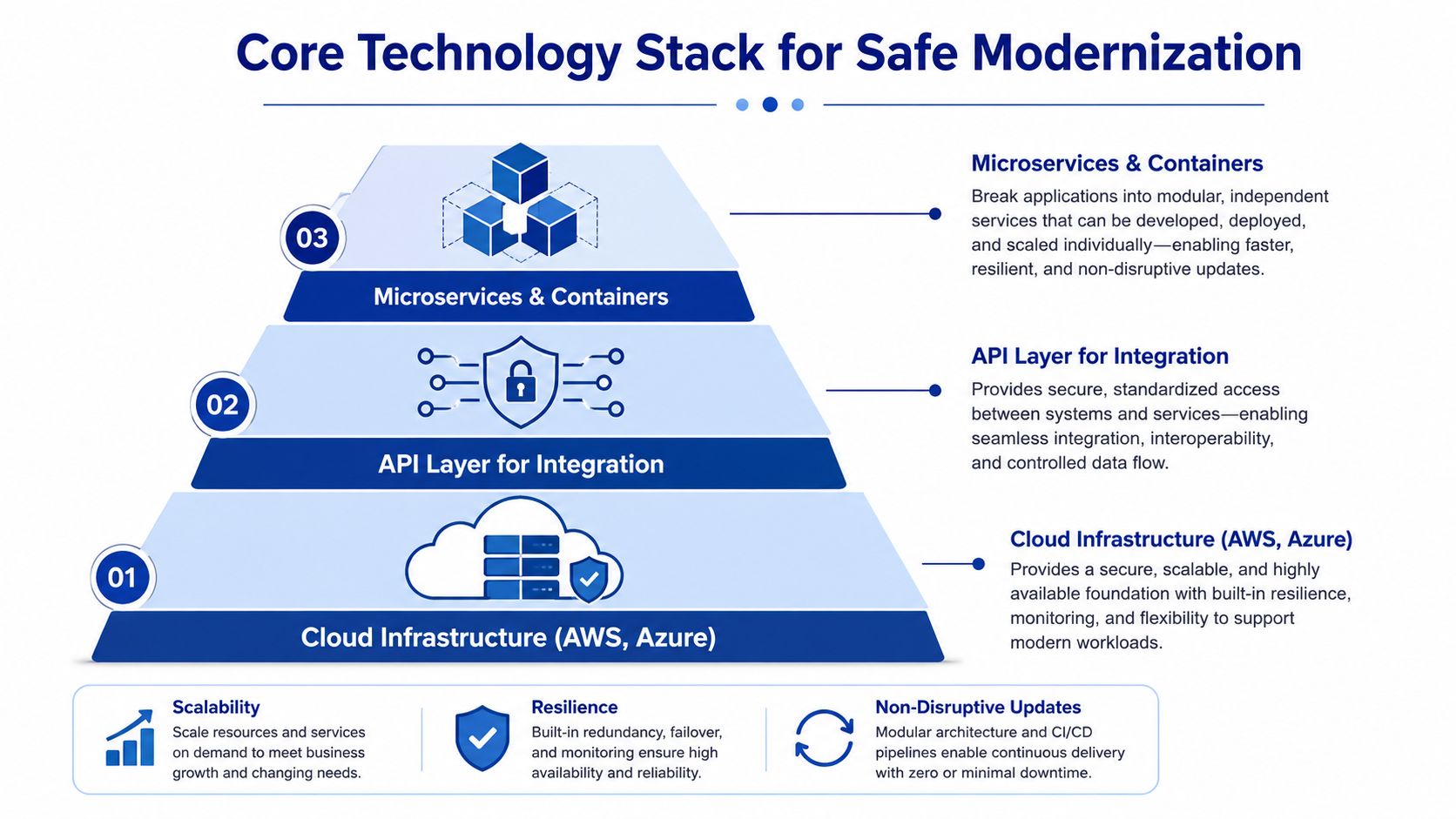
Cloud infrastructure can provide elastic capacity, managed resilience, centralised observability, and repeatable environments. It doesn't automatically make an application modern. Teams still need to decide which workloads belong in the cloud, how sensitive data is protected, how recovery is tested, and how costs are governed.
Containers and microservices can then separate changeable functions from the monolithic core. A customer notification service, document workflow, or transaction categorisation engine can evolve independently when its interfaces, data ownership, and failure behaviour are explicit. Decomposition should follow business boundaries. Splitting an application into technically small services without clear ownership distributes the old complexity.
Treat APIs as governed products
APIs are the connective tissue between new experiences, internal services, accredited providers, and legacy systems. They need authentication, authorisation, rate controls, versioning, monitoring, schema governance, and clear consent records. Under the proposed Canadian Consumer-Driven Banking framework, participating entities would need to support 99.5% monthly API uptime, provide at least 24 months of transaction history, renew consent at least every 12 months, and retain records for five years. The Canadian open-banking framework analysis from Flinks outlines these proposed operational controls.
Designing for those requirements early prevents an institution from bolting compliance onto an unreliable integration layer. It also makes it easier to test new use cases without exposing the core directly.
Make identity and data governance architectural concerns
Identity and access management should enforce least privilege across employees, services, partners, and customer-authorised applications. Strong authentication is only one part of the model. Teams also need lifecycle management, service credentials, consent states, privileged-access review, and evidence that access matched the approved purpose.
Modern data platforms help reconcile records across silos, but migration teams must preserve lineage and meaning. A customer address, account status, or transaction category may have different definitions in different systems. A data catalogue, quality rules, reconciliation process, and clear system-of-record policy matter more than selecting a fashionable storage technology.
AI and machine learning can support fraud detection, case prioritisation, and operational automation once the underlying data is reliable. They shouldn't be used to conceal poor data quality or bypass explainability requirements. For broader context on using governed information to support data-led banking growth, teams can review Visbanking's discussion of banking data and growth.
For implementation guidance on secure architecture, testing, and integration boundaries, see this secure fintech software development guide.
Navigating the Compliance Burden of Dual Supervision
The hidden cost of modernisation often sits outside the technology budget. A fintech may build a working payment product and still struggle to operate it because its controls, reporting, evidence, and ownership model weren't designed for overlapping regulatory expectations.
Supervision under the Retail Payment Activities Act became effective in September 2025, while FINTRAC introduced new obligations in 2025 covering factors, cheque-cashing businesses, financing or leasing entities, and beneficial-ownership discrepancy reporting. FINTRAC's explanation of recent business changes shows how the compliance perimeter is expanding.
Design one control model with mapped obligations
The wrong response is to create separate spreadsheets and review meetings for every regulator. That approach produces duplicate requests, inconsistent records, and uncertainty over which team owns a control.
A stronger model maps obligations to shared capabilities:
| Shared capability | Operational purpose |
|---|---|
| Identity and entity resolution | Connect customers, businesses, owners, accounts, and authorised users across systems. |
| Transaction monitoring | Detect unusual activity and preserve the context needed for investigation. |
| Consent and access records | Prove who authorised data access, what was shared, and when permission changed. |
| Evidence management | Retain policies, approvals, test results, incidents, and remediation history. |
| Regulatory reporting | Generate consistent submissions from governed, reconciled source data. |
The Bank of Canada framework and FINTRAC obligations won't be identical, so a shared platform doesn't mean a single generic rule set. It means the institution maintains reusable data, workflow, audit, and reporting services while keeping each obligation's logic explicit.
Staff governance before the launch window
Compliance, security, operations, legal, product, and engineering should agree on control ownership during design. Each new service needs a named owner, an escalation route, a recovery procedure, and a record of the evidence it must produce. Automated checks can validate data completeness, access events, consent expiry, reconciliation exceptions, and reporting readiness, but people still need to investigate ambiguous cases.
This is why a fintech compliance solutions resource should be treated as an operating-model input, not merely a checklist. The practical question isn't only what open banking permits. It's whether the organisation can maintain accurate controls while products, providers, and data flows change.
Governance principle: If a control can't be assigned to a person, tested through a repeatable process, and supported by retained evidence, it isn't ready for production.
A Phased Implementation Roadmap Aligned With Canadian Open Banking
Canada's rollout gives institutions useful sequencing signals. The framework is designed in phases, which allows teams to build capability without pretending that every open-banking use case is available immediately.
Phase 1 focuses on read access in 2026
The first priority is readiness, not a broad marketplace launch. Institutions should establish API governance, data classification, consent records, identity matching, security testing, service monitoring, and customer-support procedures. Read access creates practical use cases without requiring immediate payment initiation.
A financial institution could begin with:
Financial visibility: Give customers a consolidated view of permitted deposit, lending, payment, or investment information.
Consent operations: Test how customers grant, renew, withdraw, and review data permissions.
Service personalisation: Use authorised data to improve product recommendations or financial guidance, subject to suitability and privacy controls.
Internal reconciliation: Compare modern API responses with legacy records before expanding external access.
The return at this stage comes from better data readiness, lower manual handling, and evidence that the institution can operate secure sharing reliably.
Phase 2 adds write access in mid-2027
Write access and full payment initiation are targeted for mid-2027, contingent on the Real-Time Rail being live and in widespread use. This overview of Canada's phased open-banking and real-time-payments rollout explains why payment initiation shouldn't be treated as an immediate implementation assumption.
That dependency should shape investment decisions. Teams can prepare payment workflows, fraud controls, transaction limits, exception handling, and reconciliation in advance, but they shouldn't build a large production capability around infrastructure that isn't yet broadly available.
Use the transition to test commercial value
The funding environment is active, with close to C$1 billion invested in Canadian fintechs during the first three quarters of 2025, but access to capital doesn't remove implementation constraints. The Torys analysis of Canadian fintech highlights the staggered rollout and the gap between read-only access and later payment initiation.
A practical roadmap therefore asks which customers can benefit now. Insurance providers might improve quote or claims journeys through governed data access. SMB platforms might automate account verification and reconciliation. Healthcare organisations might pilot consent-driven financial workflows while keeping sensitive operational systems isolated. Startups can validate one narrow integration before investing in a broad banking platform.
For a fuller explanation of the regulatory sequence, use this guide to Canada's open-banking solutions.
Common Modernisation Pitfalls and How to Avoid Them
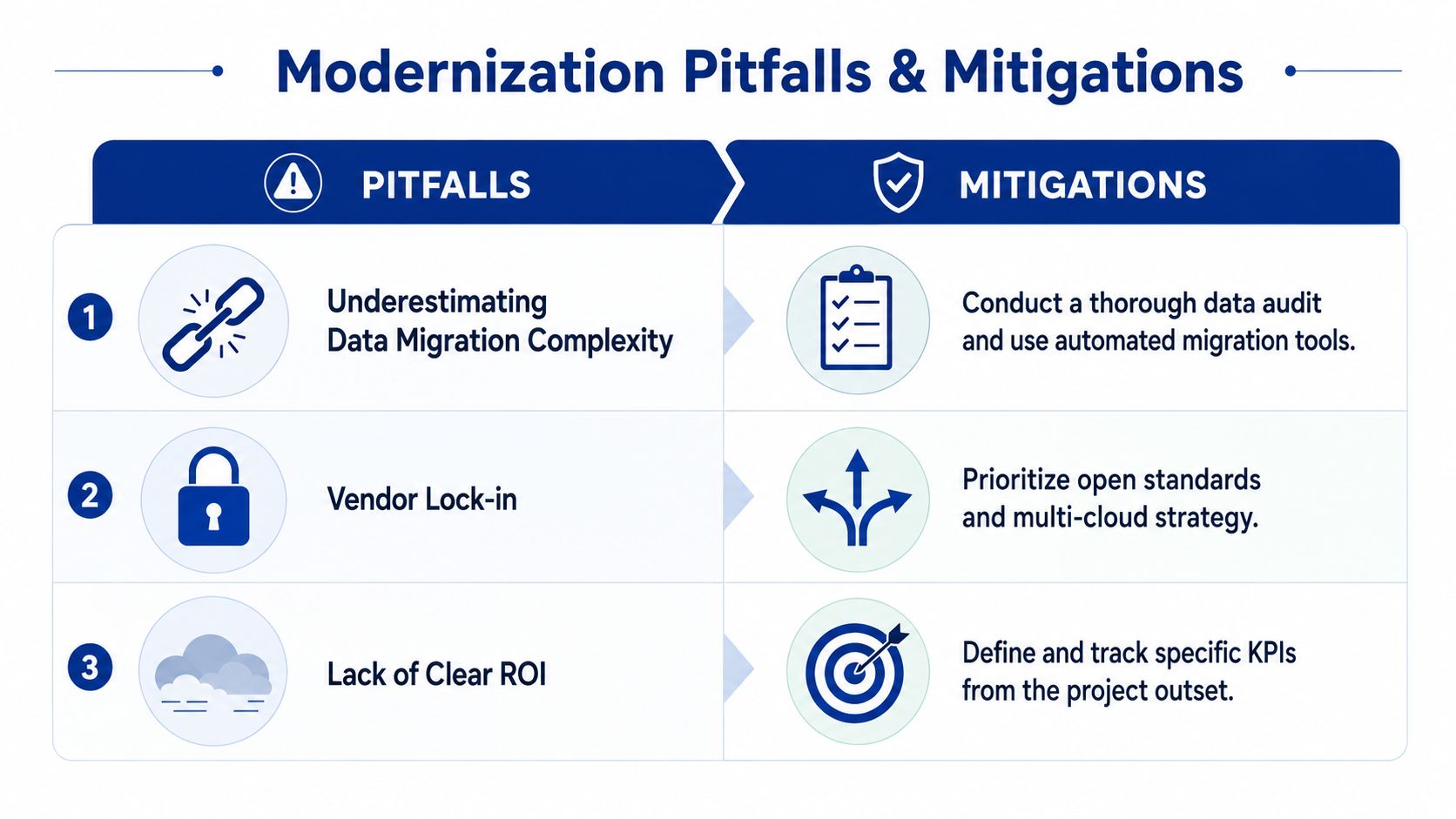
Most failed programmes don't fail because the institution chose the wrong cloud provider. They fail because leaders underestimate dependencies, treat compliance as paperwork, or measure technical delivery instead of operational value.
Data migration is a business problem
A database can be copied and still be wrong. Historical fields may use different formats, duplicate customers may exist under separate identifiers, and old transaction codes may have meanings that aren't documented outside operational teams.
Run a data audit before selecting migration tooling. Define ownership, quality thresholds, reconciliation rules, retention needs, and exception handling. Keep the original record available until the new path has demonstrated consistent results across realistic workloads.
API performance cannot be an afterthought
An API that works in a test environment may fail under partner traffic, consent changes, retries, or legacy back-end delays. Teams should test latency, throttling, timeouts, idempotency, monitoring, and degraded-mode behaviour before exposing services externally.
Open standards and clear contracts also reduce vendor dependency. A multi-cloud strategy may help some institutions, but it can add operational burden. Choose portability where it protects strategic options, not as a reflexive architecture slogan.
ROI needs a measurable owner
“Modernise the core” isn't a business outcome. A useful programme links each release to a defined customer, revenue, risk, service, or operating objective. If leadership can't explain what a component will improve and how teams will measure it, the release probably isn't ready for funding.
| Red flag | Safer response |
|---|---|
| The programme has no rollback criteria | Define technical and business stop conditions before cutover. |
| Compliance appears only before launch | Include control owners and evidence requirements in design reviews. |
| Every capability depends on the core | Introduce boundaries and prioritise low-risk, high-value services. |
| The roadmap assumes perfect infrastructure | Tie investment gates to actual regulatory and rail readiness. |
Smaller institutions should also assess whether they can operate every new platform themselves. A managed service or experienced delivery partner may reduce staffing pressure, provided contracts preserve data access, audit rights, portability, and clear accountability.
Actionable Next Steps for Your FinTech Modernisation Journey
Start with the business journey that has the clearest operational pain, not the most impressive technology label.
An insurance company exploring embedded finance can map policy, billing, claims, and identity data first. It can then select one consent-driven workflow, expose only the required information through governed APIs, and measure reconciliation effort, service handling, and customer completion qualitatively before expanding.
A small-business platform may begin with payment-status visibility or account verification rather than payment initiation. That gives the team a manageable integration boundary and helps it learn how customers respond to consent, exceptions, and support requests.
Healthcare organisations should separate secure financial data sharing from clinical systems. A pilot can use strict identity controls, limited data access, detailed audit records, and human review for exceptions. Startups should avoid building a broad financial stack before validating one regulated use case with an accredited provider and a clear responsibility matrix.
A practical first-month plan looks like this:
Inventory dependencies: Document core systems, interfaces, batch jobs, data owners, and service-critical processes.
Choose one bounded use case: Select a workflow that can deliver value without changing the ledger.
Define controls early: Map consent, access, monitoring, reporting, retention, and incident requirements.
Build a thin integration layer: Use versioned APIs, observable services, and reversible releases.
Set decision gates: Expand only after operations, compliance, customer support, and engineering agree that the service is ready.
Cleffex Digital Ltd supports regulated financial software development, incremental platform modernisation, core-system integrations, secure API architecture, automation, and longer-term product growth. If you're planning a controlled path through legacy banking modernisation, visit Cleffex Digital Ltd to discuss the architecture, delivery model, and first use case that fits your organisation.
Frequently Asked Questions
What does fintech modernisation mean for a traditional bank?
It means improving technology, data, workflows, and customer services without assuming the existing core must be replaced immediately. A bank might add API services, modern identity controls, cloud-based operations, or modular customer journeys while the legacy ledger continues to handle critical processing.
Why is a phased approach safer?
Phasing limits the number of dependencies that change at once. Teams can test data quality, resilience, controls, customer support, and rollback procedures with a bounded service before applying the same pattern to more sensitive capabilities.
What should Canadian institutions prioritise first?
They should prioritise visibility into legacy dependencies, API governance, consent management, identity resolution, data quality, monitoring, and compliance ownership. The first use case should have a clear business benefit and a manageable connection to the core.
How does Consumer-Driven Banking affect modernisation planning?
The framework creates a secure, consent-based model for sharing financial data through APIs. Read access is planned for 2026, while write access in mid-2027 depends on the Real-Time Rail being live and widely used, so institutions should prepare payment capabilities without assuming that full initiation is available immediately.
Why does FINTRAC matter to payment modernisation?
FINTRAC obligations affect customer, entity, ownership, monitoring, reporting, and record-management processes. Firms that handle payment services need a control model that can support both Bank of Canada supervision and FINTRAC requirements without duplicating data collection and operational work.