

You're probably dealing with the same problem many insurers and insurtech teams hit at the same time. A customer asks for a simple update, but the broker has one answer, the claims line has another, and the policy admin screen shows a third. That's not just a service issue; it's a platform issue, and InsurTech platform development is what turns those disconnected moments into one continuous customer journey.
The market pressure is real. Canada's insurtech sector is scaling quickly, with one market estimate placing it at USD 576.2 million in 2023 and projecting USD 11,395.4 million by 2030, a 53.2% CAGR from 2024 to 2030. At the same time, Canadian insurers are pushing harder into AI, digital experience, and integration, while regulators are tightening expectations around model governance, privacy, and operational control. The result is a simple truth: if quote, policy, billing, service, and claim still live in separate worlds, the customer feels every gap.
Where the Customer Journey Breaks Today
A policyholder calls after a car accident. The broker says the claim is in process, the claims line says it has been transferred, and the email thread says no one has confirmed receipt yet. The customer repeats the same facts to three different people and gets three different system statuses. That is the cost of fragmented insurance systems, and it shows why digital insurance platforms need to work as one connective layer across quote, policy, billing, service, and claim.
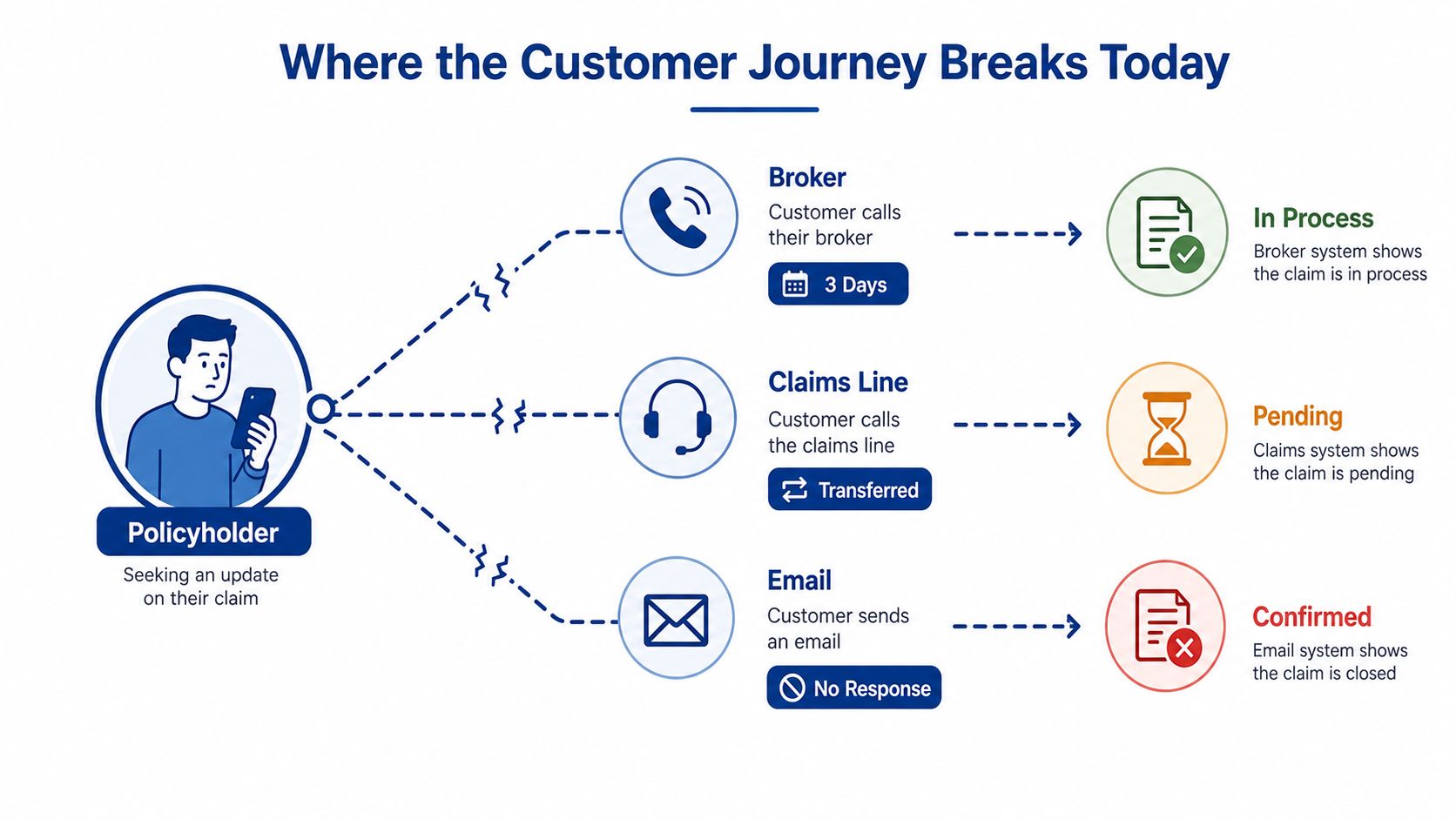
The friction shows up at every handoff
Quote flows often start in one channel and end in another. Underwriting may depend on data that never reaches policy servicing, and billing systems may miss changes made after bind. Claims teams then inherit an incomplete history, which is why customers are asked for documents they already sent.
A connected journey keeps the customer visible across quote, bind, endorsement, payment, and claim. It also keeps the policy record, consent status, and service history aligned so each team works from the same context.
Regulation makes the fragmentation more expensive
Canada's insurers are under pressure from market expectations and compliance obligations. Finance and insurance are among the sectors leading AI adoption, but adoption only matters if it can survive operational and regulatory scrutiny, including documented decision-making and privacy-aware data handling. Responsible AI expectations in Canada also push teams to treat consent, traceability, and human review as platform requirements, not afterthoughts.
The Canadian ecosystem also shows that this is a mature development arena, not a side niche. One industry report found more than 250 private insurtechs operating in or headquartered in Canada and $4.31 billion in disclosed funding since 2013, while another identified 151 active insurtech startups and 67 startups raising $1.158 billion in disclosed funding between 2011 and 2020. That density creates capability, but it also raises the bar for interoperability, auditability, and deployment discipline.
Practical rule: if a customer has to repeat the same information twice, the platform is already leaking value.
The business case is bigger than service speed
Insurers do not invest in connected platforms only to shorten call times. They do it because manual handoffs slow underwriting, delay settlement, and make every channel more expensive to run. Canadian life and health insurers are already signalling the direction of travel, with 80% planning to invest in digitally enabled customer experience in 1 to 3 years, 75% planning to use predictive analytics for product development, and 67% planning to invest in accelerated underwriting and digital marketing, while integration and legacy limits remain major blockers.
The takeaway is blunt. Customers expect one conversation. Regulators expect explainable systems. Operations need straight-through processing. A connected platform is the only realistic way to satisfy all three without building three different insurance companies inside the same organisation.
Designing the Connected Platform Architecture
A workable insurance platform starts with four core services: quoting, policy administration, billing, and claims. Each service needs a clear owner, a stable contract, and a data model that does not force every downstream system to copy the same truth in a different format. The platform layer sits above them and connects identity, consent, workflow, and event handling.
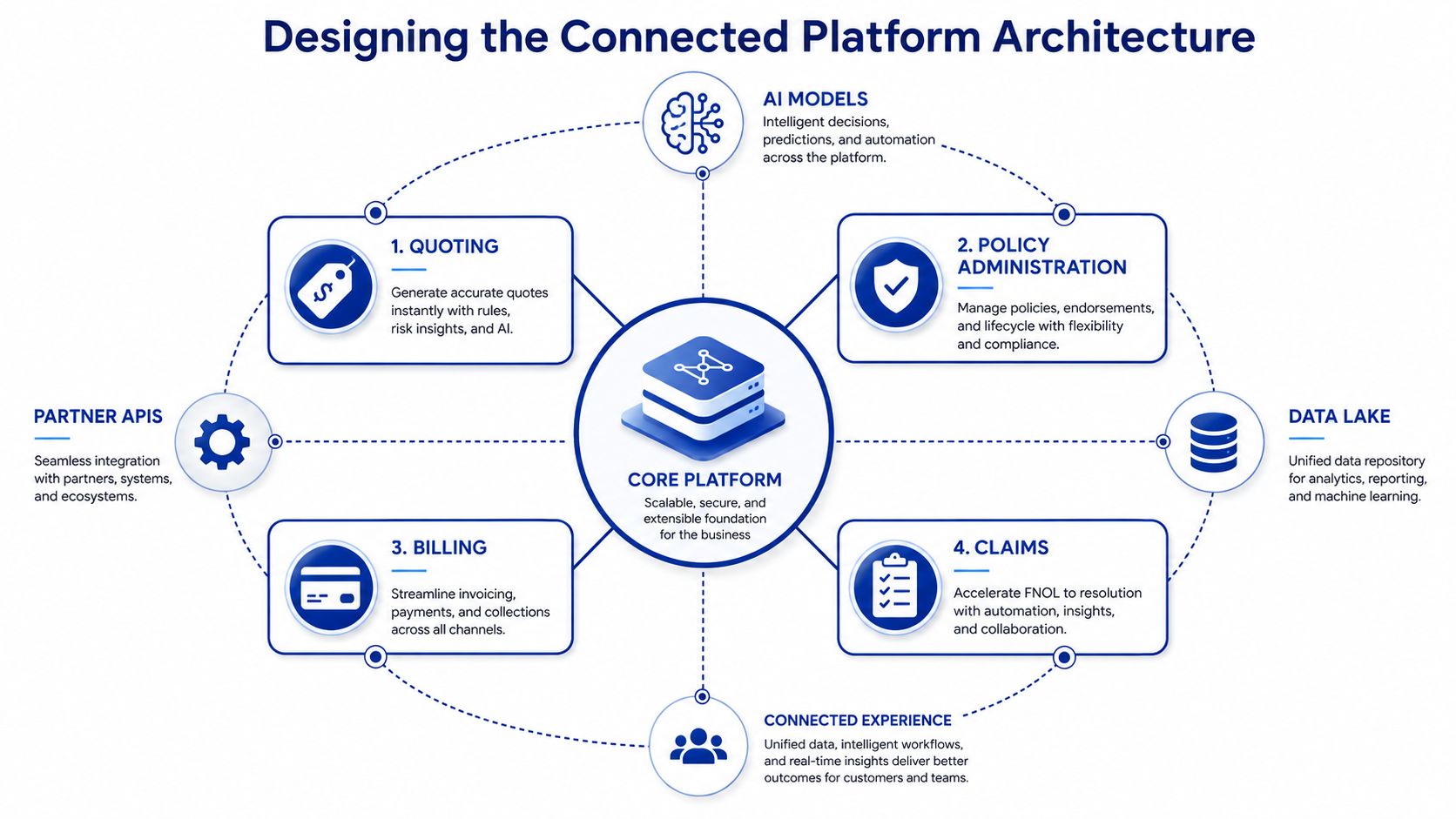
Start with domains, then choose the integration style
APIs work best where a user or partner needs a live response, such as quote generation, claim status, or payment confirmation. Event streams fit when one action should trigger many others, like a policy change updating service, analytics, and notification workflows. Batch still has a place for slower reconciliations, legacy migrations, and partner systems that cannot support real-time exchange.
The mistake is forcing one pattern everywhere. That usually leaves teams with brittle integrations, hidden delays, and expensive rework.
Treat identity and consent as shared services
A connected platform needs a customer record that spans products, channels, and policy numbers. If identity sits separately from policy data, service teams cannot easily resolve the same person across multiple lines, and compliance teams lose a clean trail for consent and disclosure.
A unified identity and consent store also reduces the number of places where privacy logic can drift. That matters in a Canadian environment where provincial rules, cross-border processing, and automated decision requirements can affect how the same workflow must behave in different contexts.
Choose a cloud foundation for control and scale
The right cloud base should support regional residency where needed, strong observability, and explainability hooks that compliance teams will eventually ask for. It should also make it easy to expose logs, lineage, and model metadata without stitching together a separate evidence system later.
Build the audit trail before the first model complaint arrives.
If you want a deeper view of integration patterns across insurance systems, this practical guide to insurtech integration is worth reading alongside your architecture workshop.
Choosing Build, Buy, or Partner for Core Components
The build, buy, or partner decision gets easier when you split the platform into four layers: policy administration, claims management, distribution and quoting, and data and analytics. Each layer has a different tolerance for customisation, regulatory complexity, and vendor dependency.
| Core Component | Recommended Path | Primary Driver | Key Trade-off |
|---|---|---|---|
| Policy Administration | Buy | Regulatory breadth and multi-line support | Less control over deep custom logic |
| Claims Management | Buy or partner | Proven workflows and faster implementation | Integration effort still remains |
| Distribution and Quoting | Build or partner | Channel fit and differentiation | Higher maintenance if built in-house |
| Data and Analytics | Partner or build | Control over reporting and model use | Data quality becomes your problem fast |
Build only when the capability is a genuine differentiator, such as a proprietary underwriting model or a niche product design that the business plans to own for years. Buy makes sense for core suites when you need broad regulatory support, proven integration patterns, and less implementation risk than a custom stack. A partner is often the fastest route for payments, telematics, fraud scoring, and similar components where speed matters more than ownership.
A useful way to score the decision is to weight time-to-market, engineering depth, compliance burden, and journey impact. If a component touches every customer interaction, it deserves heavier scrutiny than a back-office utility. Over a five-year horizon, total cost of ownership usually matters more than the initial licence or build estimate.
Before you lock in a vendor, it helps to compare operational controls as carefully as product features. The Vanta features and pricing breakdown is a practical read if your team needs to understand how security evidence and compliance tooling affect platform selection.
Embedding AI and Automation Without Losing Trust
A Canadian insurer can wire AI into a working platform and still lose customer trust if the controls are weak. The better pattern is to add automation where it speeds up a known workflow, while keeping human judgement accountable for every material decision.
Use AI for risk scoring, document extraction, claims triage, and next-best-action recommendations. Route adverse decisions, coverage declines, and large-loss claims through human review. In production, automation should remove repetitive work while human judgement stays accountable for every material decision.
OSFI's final Guideline E-23, published on September 11, 2025, applies to life, property and casualty, and fraternal insurers, and takes effect on May 1, 2027, requiring a complete inventory of models and documented processes for new or modified models. That makes model governance a platform requirement, not a policy memo.
The operating reality is clear. AI belongs inside the same connective layer that handles quote, policy, claims, and service, so every automated step can be traced, reviewed, and corrected without breaking the journey.
Wire AI into the journey
A claim should do more than score risk and stop. It should trigger the right status update, the right service message, and the right routing decision for the next human agent. That is how automation improves the customer experience instead of creating another hidden queue.
The technical discipline matters too. Prompt design, retrieval grounding, policy retrieval, and rollback paths should be versioned like application code. Evaluation sets and model metadata need the same treatment, because “AI-enabled” without traceability is just unreviewable output.
For teams working through the operating model side of this, AI solutions in insurance is a useful companion reference.
Governance checklist: document data residency, secure consent handling, set retraining cadence, and disclose AI involvement where customer-facing decisions are influenced.
Testing, DevOps, and Continuous Improvement
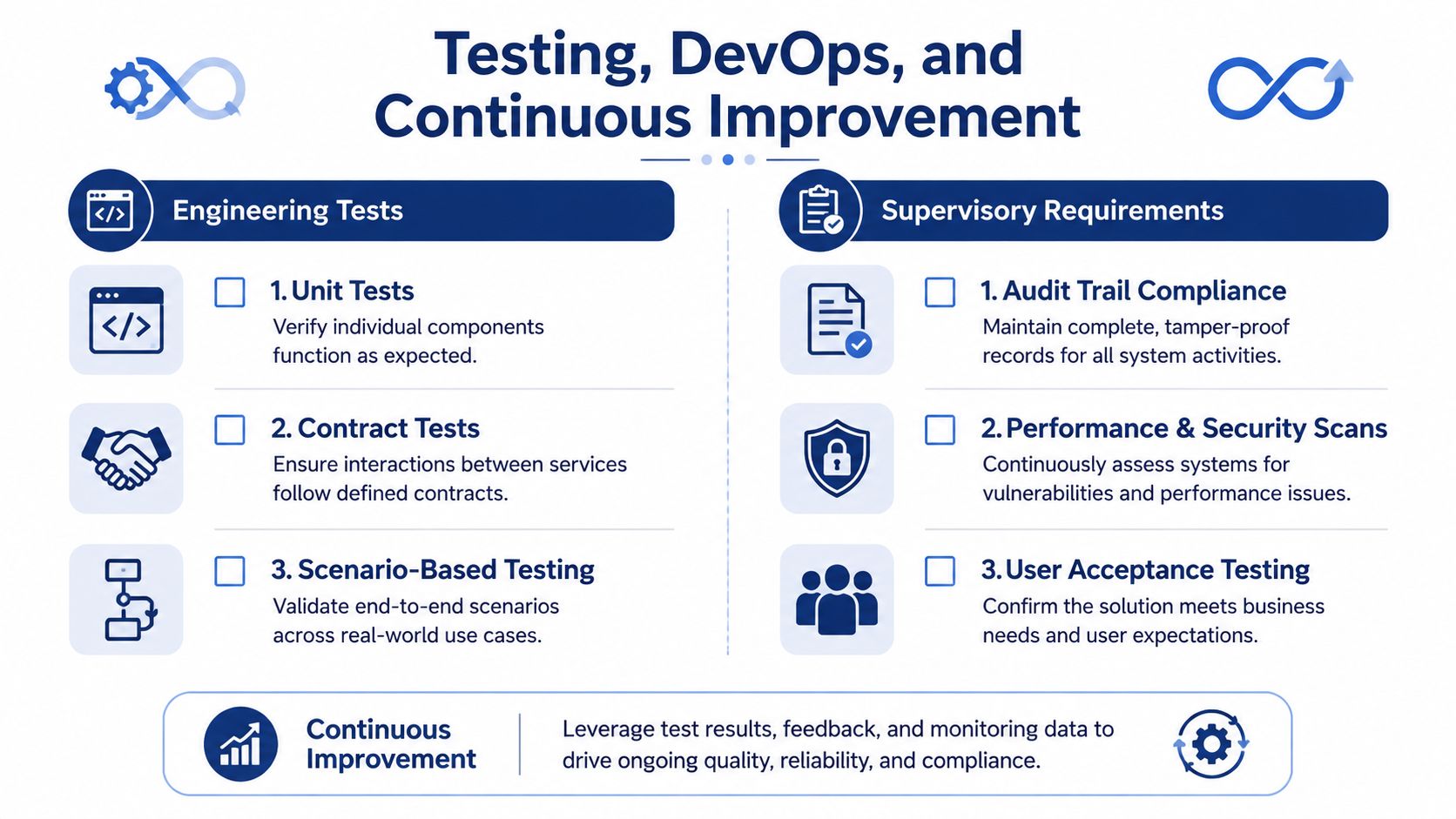
A regulated insurance platform should be tested like a product that will be audited, not like a website that can restart if it breaks. Unit tests catch code-level mistakes, but they won't tell you whether a policy endorsement still flows correctly into billing and claims after a rule update. That's why scenario-based testing matters, especially when it replays real quote, endorsement, cancellation, and claim events end to end.
Test for failure, not just success
Contract tests protect the interfaces between your own services and external partners. Chaos drills prove whether the platform can tolerate carrier downtime, payment outages, and model degradation without turning a small incident into a customer-wide problem. Progressive delivery then lets a team release a new underwriting rule or claims model to a small slice of traffic before widening the rollout.
Observability should sit on business signals as well as system health. Quote-to-claim latency, conversion, complaint volume, and rework rates tell you more about platform quality than CPU graphs alone. If those measures aren't visible in the same dashboard as infrastructure metrics, the team will miss the business impact until customers start calling.
Keep the feedback loop formal
Monthly review cycles work better than ad hoc fire drills. Post-launch metrics, regulatory bulletins, customer complaints, and call centre patterns should all feed the same backlog. That keeps the platform moving in step with changing product rules and evolving compliance expectations.
Before go-live, define the service levels you'll defend in production, not just the targets you hope to hit. A connected platform should name its key SLI and SLO measures for availability, end-to-end latency, failed transaction rates, and recovery time. Teams that can't agree on those numbers before launch usually argue about them after the first incident.
Common Pitfalls and a Pre-Launch Checklist
Most platform failures don't start with code. They start with assumptions, especially around legacy data, channel behaviour, and how much control the team has over upstream systems. A clean demo can hide broken ownership of policy data, a brittle broker portal, or an AI model whose output can't be reconstructed when compliance asks why a decision was made.
The mistakes that usually surface too late
Legacy policy records often lack a canonical owner, which makes downstream reconciliation messy. Broker portals also fail more often than teams expect when they meet real-world authentication behaviour, especially if they were only tested with friendly internal users. Claims integrations can look fine in sandbox and fall apart in production when external feeds, document formats, or timeout patterns change.
There's also a governance trap. If the team can't reproduce a model output, explain a flagged claim, or show the source of a recommendation, the feature may still work technically but fail the review it needs to survive.
Run the pre-launch check before cutover
Data lineage audit: Confirm who owns each core field, where it originated, and which systems can change it.
Policy mapping review: Verify one customer can be linked to multiple products without duplicate identities.
Broker UAT cycle: Test the actual portal with external users, not just internal demos.
Model card review: Document purpose, inputs, limits, and human escalation points for every model.
Synthetic load test: Replay partner claim feeds at realistic volume and failure patterns.
Fallback validation: Prove the platform can degrade gracefully if a third-party service fails.
Consent verification: Check that customer permissions are stored, retrievable, and usable in workflows.
Audit trail inspection: Confirm every material decision leaves an evidence path.
Privacy review: Test province-aware handling for data collection and disclosure.
Recovery drill: Simulate outage recovery and verify who owns the manual workaround.
Security scan: Check for exposed endpoints, weak permissions, and stale access roles.
Regulatory sign-off: Make sure operations and compliance have both reviewed the release.
Customer comms test: Verify status messages, decline notices, and service updates are clear.
Monitoring check: Ensure alerts map to business events, not just infrastructure errors.
Go-live rollback plan: Define exactly when to pause, revert, or switch traffic.
The claims system integration for insurers discussion becomes practical, because the hardest failures usually show up where claims, identity, and service systems meet.
Bringing the Quote-to-Claim Journey Together
A connected insurance platform works when the customer experiences one journey, even though many systems are working behind the scenes. The quote feels personalised because the data is already usable. The policy issues cleanly because the workflow is connected. The claim resolves faster because the same record, consent, and status history follow the customer through the process.
That's also where claims language needs care. If a model says one thing but the platform shows another, the customer will notice immediately. For teams using AI-generated text or automated summaries, understanding AI number claims is a useful reminder that machine output still needs human verification before it becomes customer truth.
A 30-day launch sequence that stays realistic
Week one should align stakeholders on a single journey map and a short list of success measures. Week two should pressure-test integrations, data contracts, and fallback paths. Week three should run a pilot cohort with live users and visible human support. Week four should lock in the feedback loop, with telemetry, service issues, and regulatory notes feeding the next backlog.
Keep the first release narrow. Don't try to redesign every line of business, every channel, and every policy type at once. Focus on one connected journey that proves the model, then expand from there.
If you're building for Canada, the winning platform is usually the one that stays modular, province-aware, and audit-ready while still moving fast enough for the business. That balance is hard, but it is the job of InsurTech platform development.
Cleffex Digital Ltd builds secure, compliant, and scalable insurance and fintech platforms that connect quote, policy, billing, and claims workflows into one system. If you're planning a connected customer journey or modernising an existing stack, visit Cleffex Digital Ltd to see how its custom development approach can support your roadmap.