

A lot of product teams hit the same wall.
They ship a clean MVP, win interest from a clinic or hospital group, and assume integration can wait until after the pilot starts. Then the first live customer asks basic questions that no one has pinned down. Which EHR is in scope? Who reconciles patient identity? Can the customer's network even accept your webhook traffic? Which records need to be real-time, and which can arrive later without breaking the workflow?
That's the point where HealthTech integration stops looking like a technical detail and starts looking like the product itself.
In regulated healthcare environments, integration debt shows up fast. It delays onboarding, blocks revenue, expands implementation scope, and pushes support teams into manual workarounds. In Canada, provider-side digitisation has advanced substantially, but patient and cross-setting access still reveal gaps. In 2024, 92% of Canadian healthcare providers had access to a digital health system, and 52% used one to send or share patient clinical information electronically with providers outside their main practice setting, according to Statistics Canada's digital health release. That's progress, but it also means your product has to operate in a mixed environment where some workflows are modern, and others are still fragmented.
Teams that handle this well don't treat connectivity as plumbing. They treat healthcare interoperability, healthcare API integration, and identity resolution as core product architecture decisions from the start.
Why Product Teams Treat Integration as an Afterthought
The pattern is familiar. A team builds a focused product for referrals, remote monitoring, scheduling, or patient intake. The demo works. The interface is polished. The pilot starts with a regional clinic. By day 30, the problems aren't about UI polish anymore.
No one knows whether the clinic's staff rely on a single EHR or several connected systems. The product stores a patient profile, but nobody has defined who owns the source of truth when the clinic record disagrees. Engineering added a webhook for status updates, but the customer's network policies make inbound traffic unreliable. Support starts forwarding CSVs because that gets the job done for now.
That “for now” usually becomes the operating model.
Where the first pilot usually goes wrong
Under-scope integration in three places:
Partner discovery is too shallow: Someone asks “Do they have an API?” instead of “Which workflows, identifiers, message formats, and approval paths are involved?”
Identity is left unresolved: Teams assume a patient name and date of birth will be enough until mismatches start surfacing in production.
Workflow ownership is vague: Product assumes the customer will map fields. The customer assumes the vendor will.
Practical rule: If onboarding depends on manual record matching, spreadsheet exports, or ad hoc firewall exceptions, the integration design isn't finished.
The expensive part is that none of this looks fatal during a sales cycle. It shows up after signature, when implementation hours grow and confidence drops.
A more durable approach is to make integration-first decisions early. That means deciding what data must move, when it must move, who authorises it, how identities are matched, and how failures surface. Those aren't back-end details. They define whether the product works in an actual care setting.
A useful starting point is to study how connected systems behave in production. Connected healthcare systems in practice are a good reference point because they frame integration as workflow design rather than just interface development.
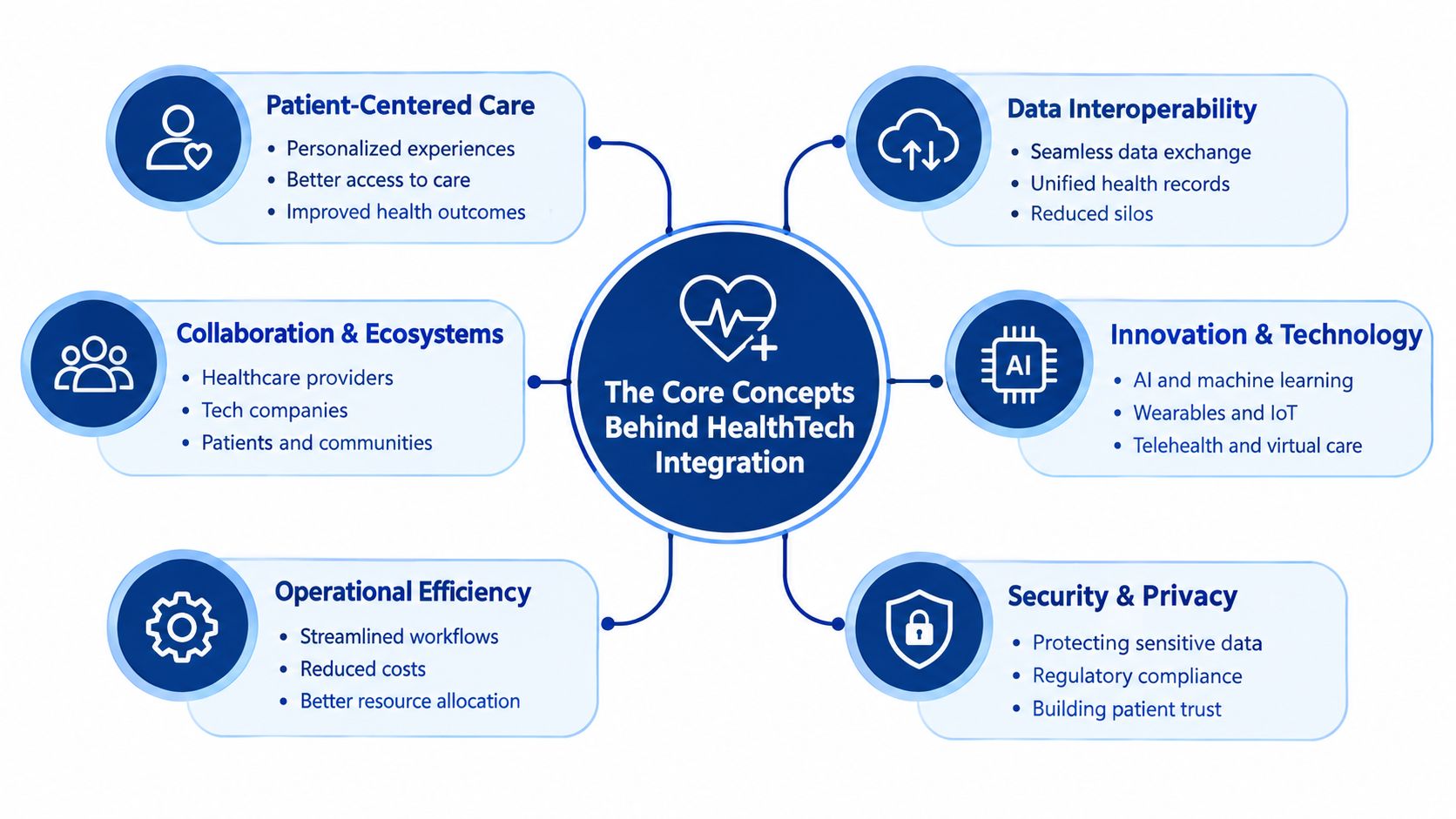
The Core Concepts Behind HealthTech Integration
Before choosing standards or middleware, product teams need a shared model of what they're building. Most failed integration projects don't fail because the team picked the wrong acronym. They fail because the team never agreed on the shape of the problem.
Interoperability is more than data exchange
Healthcare interoperability has at least three layers.
Structural interoperability means systems can technically pass data. Semantic interoperability means both systems interpret the data the same way. Organisational interoperability means the people, policies, and responsibilities around the data exchange are defined.
Structural interoperability is the parcel arriving. Semantic interoperability is the contents being labelled correctly. Organisational interoperability is knowing who signed for it and what they're supposed to do next.
Canada's history shows why this matters. The country spent more than $10 billion on EHR technology over roughly 15 years, yet interoperability remained uneven across settings.
Clinical and administrative data behave differently
Clinical data includes medications, allergies, observations, results, and encounter notes. Administrative data includes appointments, billing context, referrals, and eligibility details. Teams often lump them together, then wonder why workflows break.
A lab result and an appointment reminder don't have the same urgency, audience, or validation rules.
Use simple questions to separate them:
What affects clinical decision-making now: Medication lists, results, allergies, problem lists
What supports operations: Schedules, referral status, intake completion, demographic updates
What can tolerate delay: Batch reporting, analytics exports, finance reconciliation
HL7 v2 messages are often like inter-office memos. They move well through existing systems, but they aren't designed like modern developer-friendly APIs. FHIR resources are closer to modular API objects. They expose data in more reusable, queryable chunks. DICOM serves a different purpose again. It's the imaging file and workflow standard you reach for when scans and associated imaging metadata are involved.
Integration surface area is bigger than the EHR
Most products touch more systems than expected:
Clinician-facing interfaces: Launch context, chart embeds, referral screens
Patient-facing apps: Consent, login, records viewing, messaging
Back-office systems: Scheduling, reporting, reimbursement workflows
Devices and telemetry: Vitals streams, alerts, monitoring dashboards
An integration engine sits in the middle like a switchboard operator. It translates, routes, retries, and logs the traffic between systems that weren't designed together.
If your team needs a grounded walkthrough of this area, this practical guide to healthcare data integration is worth reviewing before making architecture commitments.
Standards and Architecture Patterns Worth Choosing Early
Early standards decisions have a long half-life. Once a customer depends on your data model and exchange pattern, changing course gets expensive. Product teams should choose standards based on customer environment, workflow timing, and support burden, not on what sounds modern in a pitch deck.
The Canadian direction is becoming clearer
Canada's interoperability stack is converging around HL7 FHIR R4 as a common exchange layer, but the practical implementation is constrained rather than generic. Canada Health Infoway and CIHI are aligning this work to the Pan-Canadian Health Data Content Framework, and Infoway's CA Core+ translates those requirements into national FHIR profiles and value sets, as described in this peer-reviewed overview of Canada's FHIR-based interoperability approach. That matters because product teams aren't just exposing base FHIR resources. They're mapping legacy interfaces into profiles with tighter expectations.
In plain terms, “we support FHIR” isn't enough. You need to know which profiles, fields, terminologies, and validation rules your target market expects.
Pattern choice affects build cost and support load
Here's a practical comparison.
| Standard or Pattern | Best Fit | Key Tradeoff |
|---|---|---|
| HL7 v2 messaging | Hospitals and older operational systems | Widely used, but harder to work with cleanly in modern product teams |
| FHIR REST APIs | Cloud products, apps, newer interoperability programmes | Cleaner resource model, but requires profile discipline and strong auth design |
| DICOM | Imaging workflows | Essential for imaging, but separate from most app-centric API patterns |
| SMART on FHIR | Apps launched inside EHR contexts | Strong user context, but depends on EHR-specific implementation detail |
| Point-to-point APIs | Few partners and narrow scope | Fast to start, painful to maintain at scale |
| Integration engine or iPaaS | Teams selling to many small or mixed environments | Faster partner onboarding, but adds platform dependency |
| ESB | Enterprise estates with governance needs | Better control and policy enforcement, but slower and heavier to change |
| Event-driven patterns | Alerts, telemetry, care coordination timing | Better responsiveness, but observability and ordering become critical |
What usually works in practice
If you're building for a handful of modern partners, FHIR APIs are often the right primary surface. If you're selling into fragmented environments, a thin middleware layer can absorb translation and retry logic without forcing your core application to speak every legacy format directly.
Ontario gives a concrete example of why architecture needs to stay flexible. The provincial eReferral and eConsult standard uses HL7 FHIR R4 and explicitly supports Direct Messaging, SMART Integration, and RESTful API exchange methods. One product may need to support more than one pattern for the same market.
Choose the smallest architecture that can survive your second and third integration, not just your first.
For teams comparing implementation options and compliance implications, this guide to FHIR integration services gives a useful decision lens.
Security, Compliance, and Identity From Day One
Security work goes wrong when teams treat it as procurement paperwork. In healthcare products, security and identity shape the user experience, the data model, and the support model from the first release.
Identity is an application concern
Patient matching isn't a side issue. It's one of the main ways products fail safely or fail dangerously.
Ontario's Provincial Client Registry FHIR implementation guide makes this concrete. It supports patient-record and identifier queries using Ontario health card numbers, medical record numbers from point-of-service systems, and other supported identifiers. The lesson for product teams is straightforward. Identity resolution belongs in the API and workflow design, not in a manual spreadsheet after launch.
If your product spans clinics, hospitals, devices, or patient apps, define:
Authoritative identifiers: Which identifiers you store and which system owns them
Match logic: Deterministic matching where possible, and explicit exception handling where not
Conflict flows: What happens when two systems disagree on identity or demographics
Security controls should map to engineering tasks
A useful security model is the boring one. Token scopes, access controls, audit logs, and encrypted storage aren't glamorous, but they prevent most avoidable incidents.
| Requirement | Engineering Action | Relevant Standard |
|---|---|---|
| Data in transit protection | Enforce HTTPS and secure API transport | OAuth 2.0 ecosystem practices |
| Data at rest protection | Encrypt databases, backups, and object storage | Organisational and regulatory security controls |
| Access control | Role-based access tied to clinical context | SMART on FHIR, OpenID Connect |
| Minimum necessary exposure | Scope tokens by resource and operation | OAuth 2.0 |
| Auditability | Store tamper-evident logs for access and change events | Healthcare compliance expectations |
| Emergency access | Define break-glass workflow and review process | Internal governance policy |
Common mistakes are painfully ordinary. PHI appears in logs because debugging was never cleaned up. Service accounts get broader access than clinicians. Consent revocation doesn't propagate cleanly. Vendors are added without clear data-boundary agreements.
A practical way to tighten your baseline is to review tested patterns for open source security controls, especially if your team wants transparent implementation references rather than abstract policy language.
Engineering check: if support staff can see more patient data than the clinician workflow requires, the access model is too broad.
For patient-facing apps, OAuth 2.0, SMART on FHIR, and OpenID Connect usually provide the cleanest path for delegated access, session identity, and user context. The important part isn't the acronym choice on its own. It's whether the scopes, audit events, and consent flows line up with how care is delivered.
A Phased Roadmap for Building Integration-Ready Products
A realistic roadmap beats a maturity model every time. Not every team needs a grand transformation plan. They need a sequence that reduces rework while getting a first integration live.
Phase 1: Discovery and scope control
Start with the workflow, not the standard.
Identify the partner systems involved, the minimum viable data set, the user roles, and the event timing. Separate “must-have for pilot” from “nice to have after adoption”. If a product only needs medication history and referral status to prove value, don't model the entire patient chart on day one.
A good phase-one output includes:
Integration inventory: EHRs, labs, registries, devices, portals
Data map: Minimum fields, source system, owning party, update frequency
Risk register: Identity ambiguity, approval dependencies, firewall assumptions
Phase 2: Architecture and standards choice
Once scope is real, choose the exchange pattern that fits it. In much of Canada, the path is increasingly specific. CIHI notes that the Pan-Canadian Health Data Content Framework and the Canadian Core Data for Interoperability work with Canada Health Infoway's CA Core+ FHIR profiles to support meaningful exchange across systems.
That gives teams something concrete to build against. FHIR plus constrained national profiles is a stronger starting point than a vague promise to “connect to healthcare”.
Phase 3: Scaffolding before features
Build the integration spine early:
Identity services: Patient, provider, and tenant-level identifiers
Logging and tracing: Enough detail to diagnose failures without leaking PHI
Retries and dead-letter handling: Because partners fail in non-obvious ways
Sandbox support: Separate test credentials, fixtures, and replayable events
If you need outside implementation help at this stage, one option in the market is Cleffex's healthcare software integration service, which focuses on connecting digital platforms, medical devices, and healthcare systems.
Phase 4: Pilot with real partners
A pilot should validate workflow fit, not just message delivery. Use one or two real partners. Watch who corrects mismatches, where approvals stall, and which screens staff ignore because the data arrives too late or in the wrong format.
Phase 5: Scale and operational hardening
After the first production proof point, shift focus to multi-tenant controls, queue visibility, alerting, partner-specific mappings, and recurring compliance review. This is also where AI ambitions need restraint. A 2025 report cited 87% of Canadian IT decision-makers saying AI is used in patient care, up from 72% in 2024, and 68% using it to update patient records, but the same discussion highlights unresolved governance, stewardship, and interoperability prerequisites in Canadian care settings, according to CanHealth's reporting on AI use and legacy system limits. Adding AI on top of weak integration only automates confusion.
Practical Scenarios for SMBs, Enterprises, and HealthTech Startups
Architecture choices look different once you put them in context. The principles stay consistent. The trade-offs around cost, speed, and control don't.
SMB clinic group
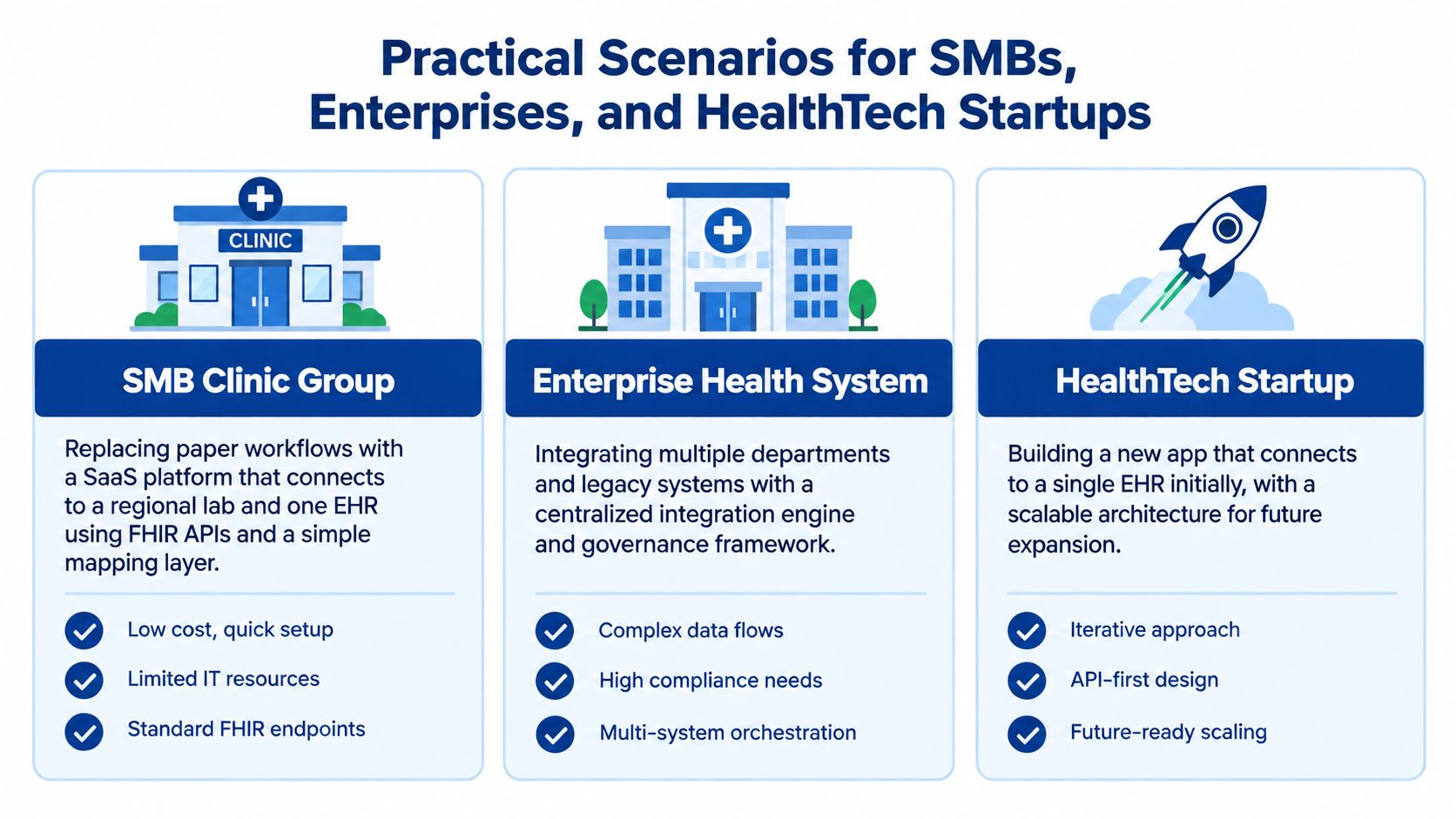
A clinic group replacing paper-heavy workflows usually doesn't need an enterprise bus on day one. It needs one EHR connection, one lab connection, simple identity rules, and stable support paths.
The sensible choice is often FHIR APIs where available, plus a managed mapping layer for anything older. Product teams win by narrowing the scope to the records and events staff use each day. The mistake is trying to model every future integration before the first one works.
Enterprise hospital system
Large health systems have a different problem. They already have many systems, many teams, and many governance boundaries.
Here, an event-driven middleware layer is often more useful than adding more point-to-point integrations. Device telemetry, departmental systems, and identity services need orchestration, auditability, and failure isolation. Canada's direction also matters. Federal and pan-Canadian guidance pushes provinces, territories, health system managers, and industry towards common standards for secure information transfer between systems and to patients, as outlined in Health Canada's update on connected modern healthcare priorities.
That policy direction means enterprise teams should design for interoperability as a durable requirement, not a temporary project.
HealthTech startup
Startups usually face a sequencing problem. They need to prove product value quickly without locking themselves into brittle one-off integrations.
A patient-facing app, for example, might begin with a single EHR partner and patient-consented data retrieval. The architecture should still preserve room for future sources, identity reconciliation, and consent revocation. If the product stores imported data, it also needs clear provenance so the team can explain what came from where and when.
Startups don't need a large integration estate early. They do need an API-first model that won't collapse when the second or third data source arrives.
The common lesson across all three cases is simple. Integration design scales when workflows, identifiers, and operational ownership are explicit.
Common Integration Mistakes Product Teams Should Avoid
Teams rarely fail because they picked one imperfect library. They fail because they repeated a few predictable planning errors.
The mistakes that keep resurfacing
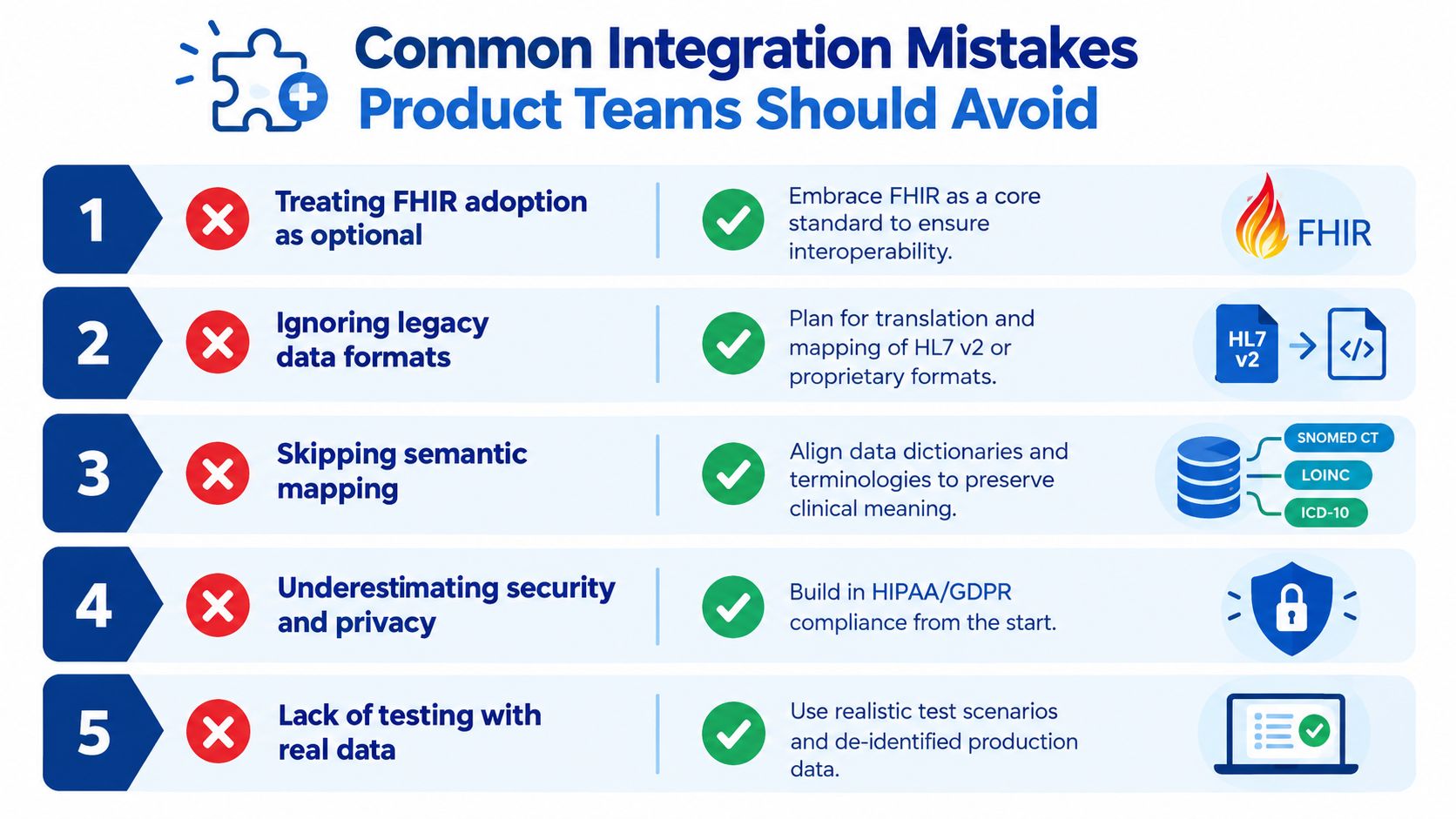
Treating FHIR as optional: In Canada, the national stack is increasingly oriented around FHIR and constrained profiles. Ignoring that means more rework later.
Ignoring legacy formats: Many customer environments still rely on HL7 v2, older exports, and proprietary workflows. Translation belongs in the plan.
Skipping identity reconciliation: If no one owns patient matching, production errors end up in support queues.
Building only point-to-point links: Direct integrations feel fast until the partner count grows and every change becomes custom work.
Deferring security review: If token scoping, audit trails, and consent handling arrive late, core flows often need redesign.
Underestimating mapping maintenance: Terminologies, value sets, and local field usage change over time.
A useful self-audit question is this: if your first customer asks for one more partner, one more site, or one more data source, does the architecture stretch or snap?
Frequently Asked Questions About HealthTech Integration
When should a team adopt FHIR instead of staying on HL7 v2?
Use FHIR when you're building a modern product surface, especially for apps, portals, and reusable APIs. Stay compatible with HL7 v2 when hospital operations or older partner systems still depend on it. In practice, many teams need both.
How should we evaluate healthcare API integration vendors?
Look at profile support, auth patterns, observability, error handling, sandbox quality, and how they manage mapping changes. Ask who owns retries, monitoring, and partner-specific quirks after go-live.
How long does a first EHR integration take?
It depends more on workflow clarity and partner readiness than coding alone. Teams move faster when scope is narrow, identity rules are explicit, and test access is available early.
Should we build an internal integration team or partner?
Build internally if integration is a core product differentiator, and you expect ongoing platform investment. Partner if speed, specialist experience, or customer-specific implementation capacity matters more right now.
What should we budget for after launch?
Budget for mapping updates, partner changes, credential rotation, audit support, monitoring, and operational troubleshooting. Integration maintenance is continuous work, not a one-off project.
What evidence do buyers expect in security review?
Expect questions about encryption, access control, logging, tenant separation, vendor boundaries, and incident handling. Buyers also want to see that identity, consent, and auditability are designed into the product, not patched in later.
Cleffex Digital Ltd builds software for teams that need healthcare systems, apps, devices, and workflows to connect cleanly in regulated environments. If you're planning a new integration or trying to stabilise one that already exists, visit Cleffex Digital Ltd to review their healthcare and product engineering capabilities.