

In 2024, 50% of Canadian health-care providers with access to a digital health system reported insufficient integration between different digital health systems as the main barrier to sending and sharing patient information. The referenced Canadian healthcare API analysis makes the operational issue clear: healthcare API integration isn't merely an engineering upgrade. It determines whether clinicians can access dependable information when they need it.
An API is the connective layer between electronic medical records, hospital systems, laboratory platforms, registries, patient portals, and digital-health applications. But a working endpoint alone doesn't create usable interoperability. Healthcare organisations also need shared data definitions, secure access controls, identity matching, clinical governance, and workflows that fit the way staff provide care.
Why a Family Doctor Still Cannot See Your Hospital Records
In 2024, 50% of Canadian health-care providers with access to a digital health system reported insufficient integration between different digital health systems as the main barrier to sending and sharing patient information. The Canadian interoperability overview connects that finding to a practical problem: healthcare API integration affects whether clinicians receive dependable information at the point of care.
A patient visits the hospital after an unexpected health issue. The hospital completes tests, prescribes treatment, and sends the patient home with discharge instructions. Days later, the family doctor needs the discharge summary, laboratory results, and imaging report, but those records have not reached the clinic's electronic medical record.
The doctor may receive a fax, search a separate portal, call the hospital, or ask the patient to describe what happened. A clinic team member may then re-enter the details manually. Every handoff takes time and creates opportunities for missing, duplicated, or incorrectly transcribed information.
The systems behind the frustration
The information may exist across several systems:
Electronic medical records, which store the clinic's notes and medication history.
Provincial client registries, which help identify patients across participating services.
Laboratory information systems, which produce results in their own technical formats.
Hospital information systems, which manage admissions, encounters, orders, and discharge documentation.
Patient portals, which expose selected information through a separate user experience.
These systems can each serve their own purpose while exchanging information poorly. A portal may let a clinician view a record, yet viewing is different from structured data arriving in the correct patient chart, at the right time, in a usable format.
Operational reality: A system can be digitally accessible and still be poorly integrated.
APIs as clinical connective tissue
Healthcare API integration gives systems a controlled method to request, validate, transform, and send information. Instead of asking a nurse to copy a laboratory value between screens, an API can make a structured result available to the receiving system, subject to authorisation and governance rules.
Canada's policy direction also points toward shared infrastructure. In 2023, Health Canada announced the Shared Pan-Canadian Interoperability Roadmap, endorsed by federal, provincial, and territorial governments except Quebec, to guide secure transfer of health information across systems and to patients.
For a clinic CIO, the decision reaches beyond funding an endpoint or interface. The organisation must decide whether manual reconciliation can keep pace as digital services expand, whether staff workflows support the exchange, and who governs data definitions, access, and patient identity. Healthcare APIs have become an operations concern, affecting clinical coordination, staff workload, patient experience, and the reliability of downstream reporting.
What Healthcare API Integration Actually Means
An application programming interface, or API, is a structured conversation between software systems. One system asks for something using an agreed method, and another system responds in an agreed format.
A clinic receptionist offers a useful analogy. A receptionist doesn't walk into every department and reorganise its records. They receive a request, check what the requester is allowed to access, translate the request into the language used by the relevant department, and return the right information.
Healthcare APIs perform a similar role between software systems. They don't replace the electronic medical record or decide what care a patient needs. They provide controlled ways for applications to exchange data and actions.
The conversation in practical terms
A modern healthcare API integration may include:
An endpoint, such as a route for retrieving a Patient or Observation resource.
A request, usually sent over HTTPS, asking for a specific record or action.
Authentication and authorisation, confirming who or what is making the request.
A structured response, often represented as JSON.
Validation and logging, showing whether the data meets the required rules and who accessed it.
HL7 FHIR gives these exchanges a shared structure. Instead of treating a whole patient chart as one large, opaque file, FHIR represents information through resources such as Patient, Observation, and Encounter. A receiving application can use the resource type, fields, identifiers, and terminology to interpret the data more consistently.
This guide to API integration in healthcare provides additional context on how these connections support broader healthcare system integration.
Why this is an ecosystem capability
Canada Health Infoway describes its Canadian FHIR Registry as the central repository for national FHIR profiles recommended for use in Canada. Its developer tools guidance also describes RESTful APIs as supporting real-time access, validation, and translation of standardised health data. Canada Health Infoway's Canadian interoperability resources illustrate why integration shouldn't be treated as a one-off connection between two vendors.
A durable HealthTech integration programme defines reusable standards, data contracts, access rules, error handling, and ownership. That foundation lets a clinic add future applications without rebuilding every connection from the beginning.
The Standards Stack From HL7 v2 to FHIR and SMART
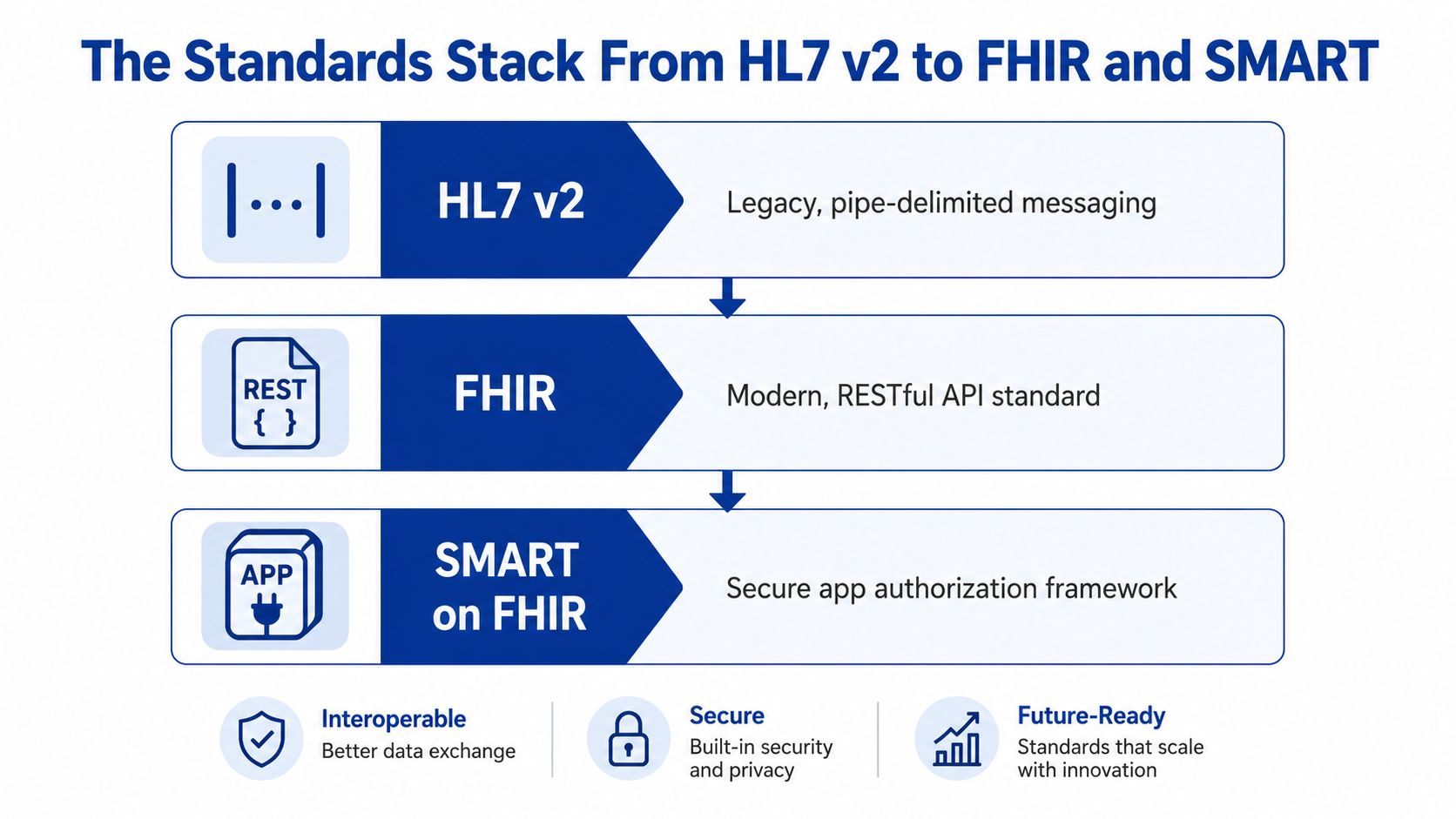
Standards answer different operational questions, so buyers should not treat them as interchangeable product labels. HL7 v2 carries established hospital messages. FHIR organises health information into resources that applications can request through APIs. SMART on FHIR adds a framework for launching applications and controlling their authorised access.
The distinction matters because Canadian providers still report integration as a leading barrier even when a standard is available. The engineering choice is only one part of the work. Governance teams must also agree on identifiers, terminology, ownership, workflow changes, and which system remains authoritative for each field.
HL7 v3 belongs mainly to the history of healthcare standards. It pursued a formal XML-based model, while Clinical Document Architecture remains relevant to selected document-exchange workflows. Procurement decisions usually focus on a more practical question: how will existing HL7 v2 systems connect with modern FHIR interfaces?
A buyer's comparison
| Standard | Format | Best fit | Adoption note |
|---|---|---|---|
| HL7 v2 | Pipe-delimited messages | Internal hospital events, orders, and results | Common in established hospital environments and often requires local mapping |
| HL7 v3 and CDA | XML-based structures and clinical documents | Document-oriented exchange and legacy implementations | More complex than modern REST approaches, with CDA still used in selected workflows |
| FHIR | RESTful resources, commonly represented in JSON or XML | Patient access, application integration, registries, and modern exchange | Central to Canadian interoperability work and reusable API design |
| SMART on FHIR | FHIR plus an application authorisation and launch framework | Secure third-party apps connected to an EHR | Helps standardise how applications receive permission and clinical context |
FHIR is not a universal replacement for older interfaces. A hospital can continue receiving an HL7 v2 laboratory message while an integration engine parses it, maps it to a FHIR Observation, and exposes that resource through a RESTful API. The arrangement resembles a clinical translator: the existing system keeps speaking its established language, while newer applications receive a consistent interface.
Ontario's direction is explicit. The Ontario Health Provincial Client Registry HL7 FHIR Implementation Guide Version 2, published in March 2021, specifies patient-data queries using FHIR and supports searches by Ontario health card numbers, medical record numbers, and other supported identifiers.
Canada-specific harmonisation
Canada Health Infoway's CA Core+ harmonised 27 jurisdictional specifications into unified data-element definitions and FHIR Core profiles, as described in the CA Core+ interoperability presentation. The Canadian Baseline v1.2.0 specification sets basic interoperability expectations for human-patient systems and identifies common data elements, code systems, and value sets for resources such as Patient and Medication.
Use the setting to guide the decision:
Greenfield patient-facing application: Start with FHIR and assess SMART on FHIR for secure application access.
Existing hospital environment: Retain required HL7 v2 feeds and add a FHIR façade through an integration layer.
Cross-jurisdiction programme: Align the API contract with Canadian profiles, terminology guidance, privacy obligations, and local vendor capabilities.
Procurement evaluation: Ask vendors which profiles, resources, versions, and workflows they support in production, rather than only in documentation.
For delivery planning, this guide to integrating FHIR with EHR systems connects standards decisions with implementation work.
Security and Compliance Controls Every Healthcare API Needs
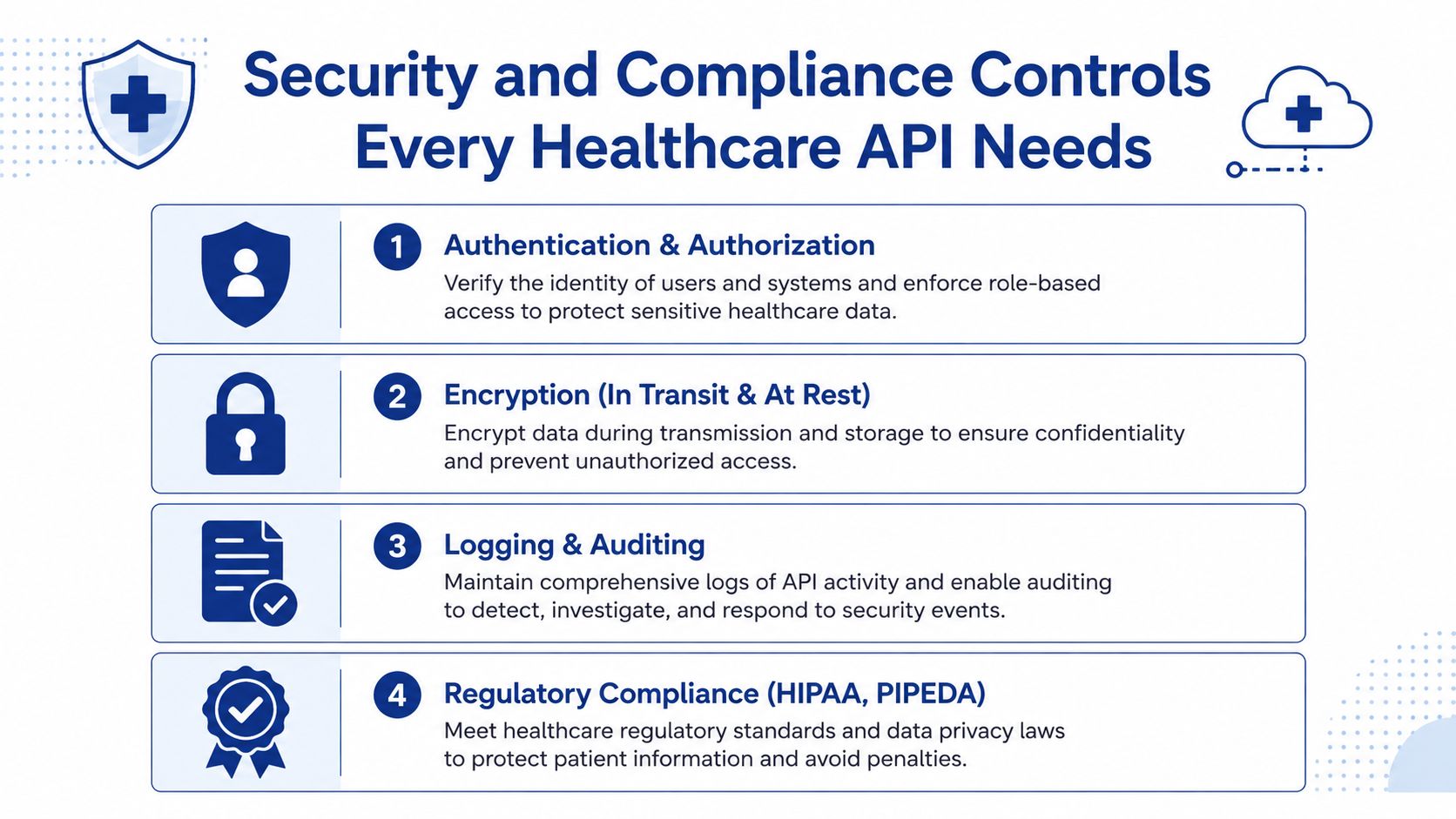
Security can't be added after the clinical workflow is already live. A healthcare API can expose protected health information through a small endpoint, so its controls need to cover transport, identity, authorisation, validation, monitoring, and incident response.
The Government of Canada provides a concrete baseline for API security. Its standards guidance for Government of Canada APIs requires secure communications using TLS 1.2 or higher for sensitive traffic, recommends OAuth 2.0 and OpenID Connect for REST APIs, requires JWT for RESTful API interactions, and advises gateway-based enforcement instead of simple IP allow-lists.
Four controls to design from the beginning
Transport encryption protects information while it moves between systems. TLS should be configured and maintained as part of the service's operational lifecycle, not treated as a certificate task that ends at launch.
Standards-based identity gives applications a controlled way to prove who they are and what they can access. OAuth 2.0 supports delegated access, OpenID Connect supports identity information, and signed JWTs help protect the integrity of tokens and claims.
Gateway enforcement centralises authentication, authorisation, routing, throttling, and policy controls. An allow-list may restrict network locations, but it doesn't provide the same level of identity-aware governance or audit context.
Validation and observability protect the data layer. Validate schemas, reject malformed payloads, record access events, and monitor unusual request patterns. Teams evaluating healthcare data breach prevention with SIEM can use security information and event management concepts to connect API activity with broader incident monitoring.
Ontario's Digital Health Playbook expects patient-facing digital-health solutions to use APIs aligned with HL7 FHIR for messaging and SMART on FHIR for open RESTful web applications. Ontario's interoperability specification also covers message structure, data content, terminology, migration and mapping, privacy, and security.
Security review question: Can your team show who accessed which data, under what authority, through which application, and what the system did when the request failed?
Before production, confirm scoped tokens, consent capture, audit retention, schema validation, secret management, alerting, and a tested incident process. For a broader view of data security in healthcare information systems, treat the API as one part of the full information-security environment.
Choosing the Right Integration Architecture for Your Setting
Architecture determines how much effort your team will spend maintaining connections after launch. A small clinic, a multi-site hospital, and a provincial authority may all use healthcare APIs, but they shouldn't assume the same operating model.
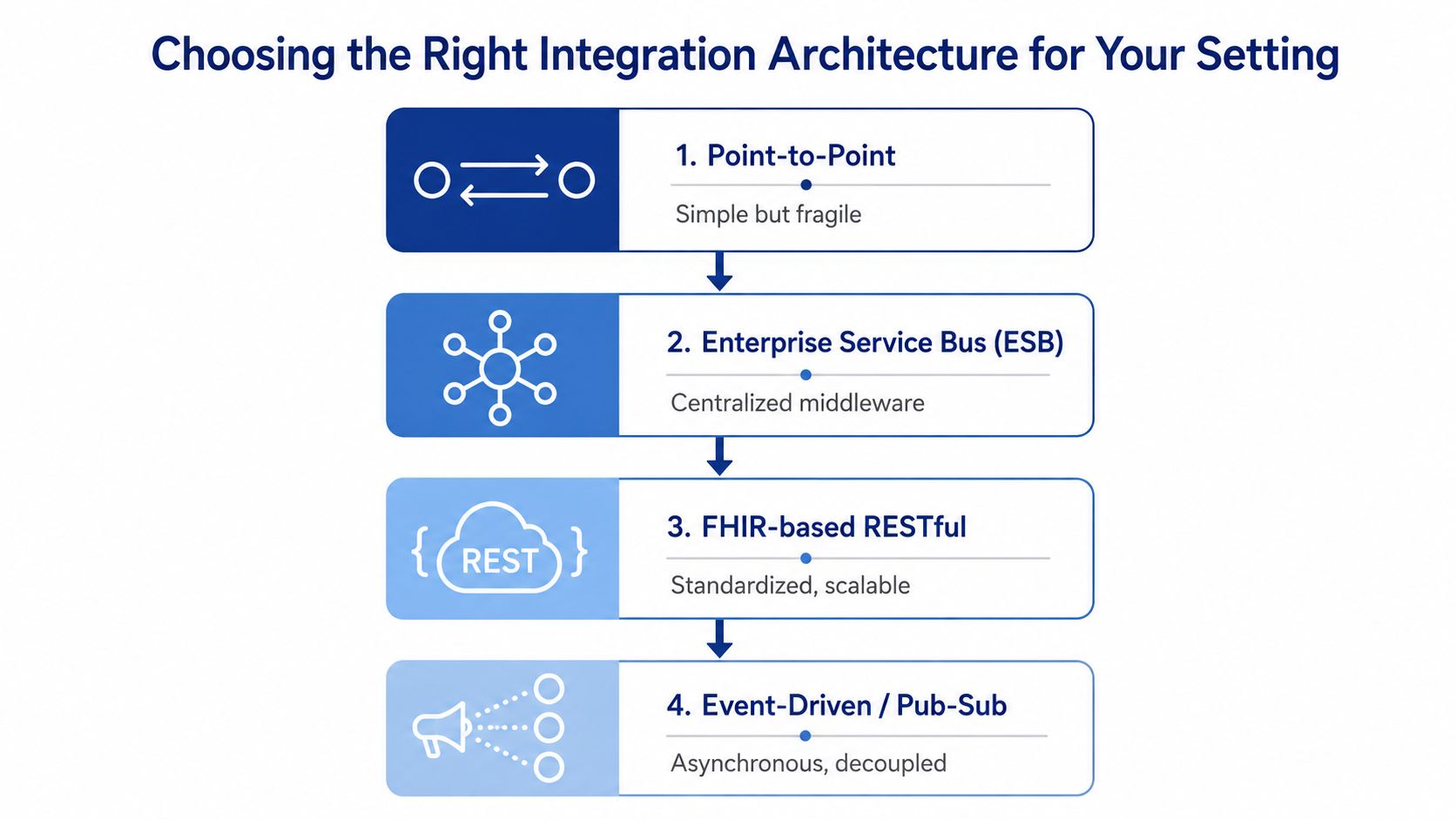
Four patterns and their trade-offs
Point-to-point interfaces connect one source directly to one destination. They can be appropriate for a tightly bounded need, such as sending a particular result feed to one application. The risk appears as more systems arrive. Each new connection adds another dependency, credential set, transformation rule, and failure path.
An API gateway provides a controlled front door for API traffic. It can apply authentication, routing, throttling, versioning, and monitoring policies consistently. A small clinic may use a managed gateway with a narrow scope, while a larger organisation may require separate environments, policy layers, and operational ownership.
An integration engine or middleware layer handles parsing, transformation, routing, and message orchestration. This is particularly useful when existing HL7 v2 feeds must be translated into FHIR resources. A hospital with multiple clinical and operational platforms usually benefits from keeping that transformation logic in a managed layer rather than embedding it separately in every application.
Event-driven architecture uses message brokers or webhooks to notify subscribers when something changes. It suits workflows where a receiving service shouldn't have to poll repeatedly, such as notifying a care-management application that a new result or encounter is available. The trade-off is greater operational complexity around retries, ordering, duplicate events, and eventual consistency.
Match the pattern to the organisation
A mid-sized provider often needs a gateway-plus-middleware hybrid. The gateway manages external access and policy enforcement, while middleware supports legacy feeds and data transformation. A provincial authority may also need event-driven distribution, strong tenant separation, identity governance, and clear rules for cross-jurisdiction stewardship.
Vendor neutrality matters at every scale. Require documented API contracts, exportable mappings, standard authentication, transparent ownership of transformed data, and a migration path if the vendor changes direction. This resource on SMB digital transformation by CloudCops offers broader context for evaluating transformation initiatives without treating one platform as the entire strategy.
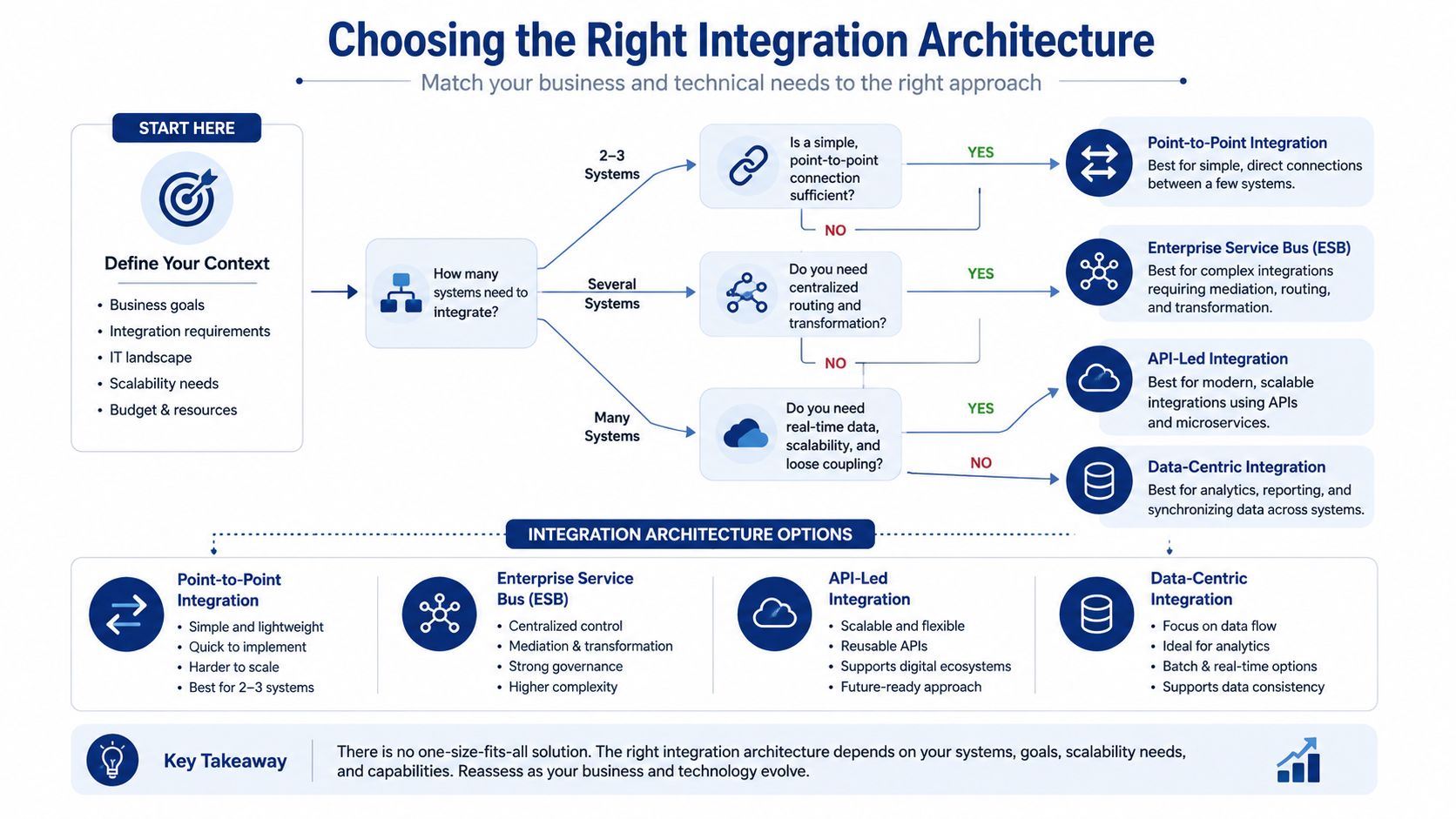
Architecture principle: Choose the simplest pattern that supports your next operational need, but design the contracts so the organisation can add systems without creating another maze of private connections.
Why Healthcare APIs Still Fail After the Standard Exists
In 2024, half of digital-health-system users reported insufficient integration between systems as the biggest barrier to sending and sharing patient information. The Royal College's Digital Health and Information Technology Task Force report helps explain why a published API standard has not removed that barrier. FHIR can describe the shape of a resource, but organisations still must agree on identifiers, terminology, required fields, consent, workflow ownership, and the meaning of local data.
A valid response does not guarantee a usable clinical exchange. The endpoint can work while the care pathway fails.
The failures below the endpoint
Common failure points include:
Identity matching is weak, so records remain separated or attach to the wrong person.
Terminology differs, leaving two systems with different codes or local descriptions for the same concept.
Required fields are inconsistent, preventing the receiving application from completing its workflow.
Mappings aren't governed, allowing a source-system change to break downstream processing without a clear owner.
Clinicians aren't involved, producing a technically correct exchange that does not fit how care is delivered.
Vendors implement profiles unevenly, forcing each buyer to discover differences during testing rather than through published contracts.
These are governance and workflow failures expressed through software. A clinic may receive a Patient resource, for example, but still need a local rule for which identifier is trusted, who corrects a demographic error, and what happens when the hospital sends incomplete information.
Canada Health Infoway's 2025 environmental scan calls for stronger common data architecture, standards, and certification pathways to support privacy and security in interoperable systems. Canadian interoperability work is still developing, with the content framework continuing to evolve towards a 2026 release. The direction matters because a standard can define a shared language, while certification and implementation rules determine whether organisations use that language consistently.
Governance is part of the interface
A provincial registry, hospital, clinic, and Indigenous health organisation may hold different responsibilities for stewardship and access. Cross-jurisdiction exchange therefore requires decisions about consent, privacy, Indigenous data sovereignty, vendor accountability, correction processes, and ownership of each data definition.
The Royal College report warns that widespread interoperability gains will likely take years to materialise and highlights the need for coordinated policy and implementation capacity. Canada's hardest integration problem is often policy alignment and adoption, not API syntax. Teams need named decision-makers, agreed clinical workflows, and operating rules for exceptions, not only a conformant endpoint.
An Implementation Roadmap and Vendor Selection Checklist
A healthcare API integration programme needs tangible outputs at every phase. Without them, teams can spend months discussing interoperability while missing the data owners, workflow decisions, and operational controls that determine whether the connection works.
Discover
Start with an integration inventory. Record each source and destination, the data exchanged, the current transport method, the accountable owner, the clinical workflow affected, and the known failure points.
Ask:
Which systems hold the authoritative version of each data element?
Which identifiers can match a patient across organisations?
Which feeds use HL7 v2, FHIR, documents, files, or proprietary APIs?
Which users and applications need access?
What consent, privacy, retention, and correction rules apply?
The deliverable should be a prioritised inventory, not a general architecture presentation.
Design
Create a target architecture diagram showing the API gateway, integration engine, FHIR server or source systems, identity provider, terminology services, audit store, monitoring tools, and downstream applications. Mark every boundary where data is transformed or where a different organisation becomes responsible for access.
Define the minimum viable resource set and write the initial API contracts. Include request and response examples, error behaviour, versioning, identifier rules, terminology bindings, and ownership for each field.
Build
Produce a contract catalogue alongside the code. Test against real vendor sandboxes or controlled environments, then test malformed payloads, expired tokens, duplicate messages, missing identifiers, delayed responses, and partial system outages.
For a Canadian deployment, assess the vendor's familiarity with Ontario requirements, federal API guidance, Canadian FHIR profiles, privacy obligations, gateway controls, and legacy HL7 workflows. A pilot that only demonstrates a successful happy-path request doesn't establish production readiness.
Operate
The final deliverable is an operations runbook. It should explain alert thresholds, retry behaviour, reconciliation procedures, access reviews, certificate or key rotation, release approvals, data-quality checks, incident escalation, and partner contacts.
Procurement test: Ask the vendor to show how a failed clinical message is detected, traced, corrected, replayed, and reported to the responsible team.
A suitable healthcare system integration partner should offer FHIR-native delivery experience, gateway and middleware capability, standards testing, documentation, and production support. Cleffex Digital Ltd can be considered alongside other providers when a clinic or health organisation needs custom software integration connecting healthcare platforms, FHIR-based architectures, and clinical applications.
Copy this checklist into your planning document:
Name every source, destination, owner, and workflow.
Define the patient identity and terminology approach.
Select the architecture and document its trade-offs.
Agree the FHIR profiles, resources, versions, and API contracts.
Design security, consent, audit, monitoring, and recovery before development.
Test with realistic data conditions and operational failure scenarios.
Launch with a runbook, ownership model, and change-control process.
Real-World Examples, Success Metrics and Your Next Steps
Good healthcare API integration makes a clinical or administrative task more dependable without asking staff to become integration specialists. The examples below represent practical patterns that Canadian organisations can evaluate without assuming that one architecture fits every setting.
Three useful operating scenarios
A provincial client registry can support patient lookup using an Ontario health card number, medical record number, or another supported identifier. Ontario Health documents this capability in its Provincial Client Registry HL7 FHIR Implementation Guide Version 2. The operational value lies in giving authorised systems a consistent way to locate the right patient record.
An EHR portal can expose FHIR resources to a patient-facing application. SMART on FHIR can then provide the application launch and authorisation framework, while the portal controls which resources the patient or clinician can access.
A hospital and external laboratory connection can transform incoming laboratory messages into structured clinical data and present the result inside the clinician's workflow. The success condition isn't only that the message arrived. The result must reach the correct patient, carry the right interpretation and provenance, and appear where staff can act on it.
Metrics that reveal operational value
Track measures that connect technical performance with care delivery:
Integration uptime: Whether the connection remains available during agreed operating periods.
Data latency: How long it takes for an approved source update to reach the receiving workflow.
Automatic record matching: The share of incoming records matched without manual reconciliation.
Clinician time saved: The reduction in searching, re-entry, and follow-up work during a shift.
Error recovery: How quickly the team detects, corrects, and reprocesses failed exchanges.
Data completeness: Whether receiving applications get the fields required for their intended workflow.
Frequently Asked Questions
Is FHIR mandatory for every healthcare integration?
Not every connection must use FHIR. The appropriate standard depends on the jurisdiction, system capability, workflow, and applicable policy. Ontario's Digital Health Playbook expects patient-facing digital-health solutions to use APIs aligned with HL7 FHIR and SMART on FHIR, so teams working in that context should treat those standards as a core design requirement.
How long does a typical integration take?
There isn't one reliable timeline for every project. Scope depends on the number of systems, data quality, vendor readiness, identity matching, required profiles, security review, testing, and production support. A discovery phase gives a more credible estimate than selecting a duration before the team understands those variables.
How should an organisation phase costs?
Start with discovery and a clearly bounded workflow, then expand through reusable contracts and shared security controls. This approach helps the organisation separate essential integration work from later applications, data-quality remediation, analytics, and operational enhancements.
For organisations planning their next step, Cleffex Digital's healthcare software integration services provide a route to discuss custom healthcare system integration, FHIR-based API layers, and connections between clinical platforms. You can also visit the Cleffex Digital homepage to review the wider software development offering.
Healthcare API integration succeeds when technical standards, governance, security, and clinical workflows reinforce one another. Start with one measurable information exchange, document the contract and ownership model, and build the operating discipline needed to scale beyond the first connection.
Cleffex Digital Ltd offers custom healthcare software integration for clinics, hospitals, and digital-health teams working with FHIR APIs, legacy clinical systems, secure gateways, and patient-facing applications. Visit Cleffex Digital Ltd to start a conversation about designing and delivering an integration that works in production.