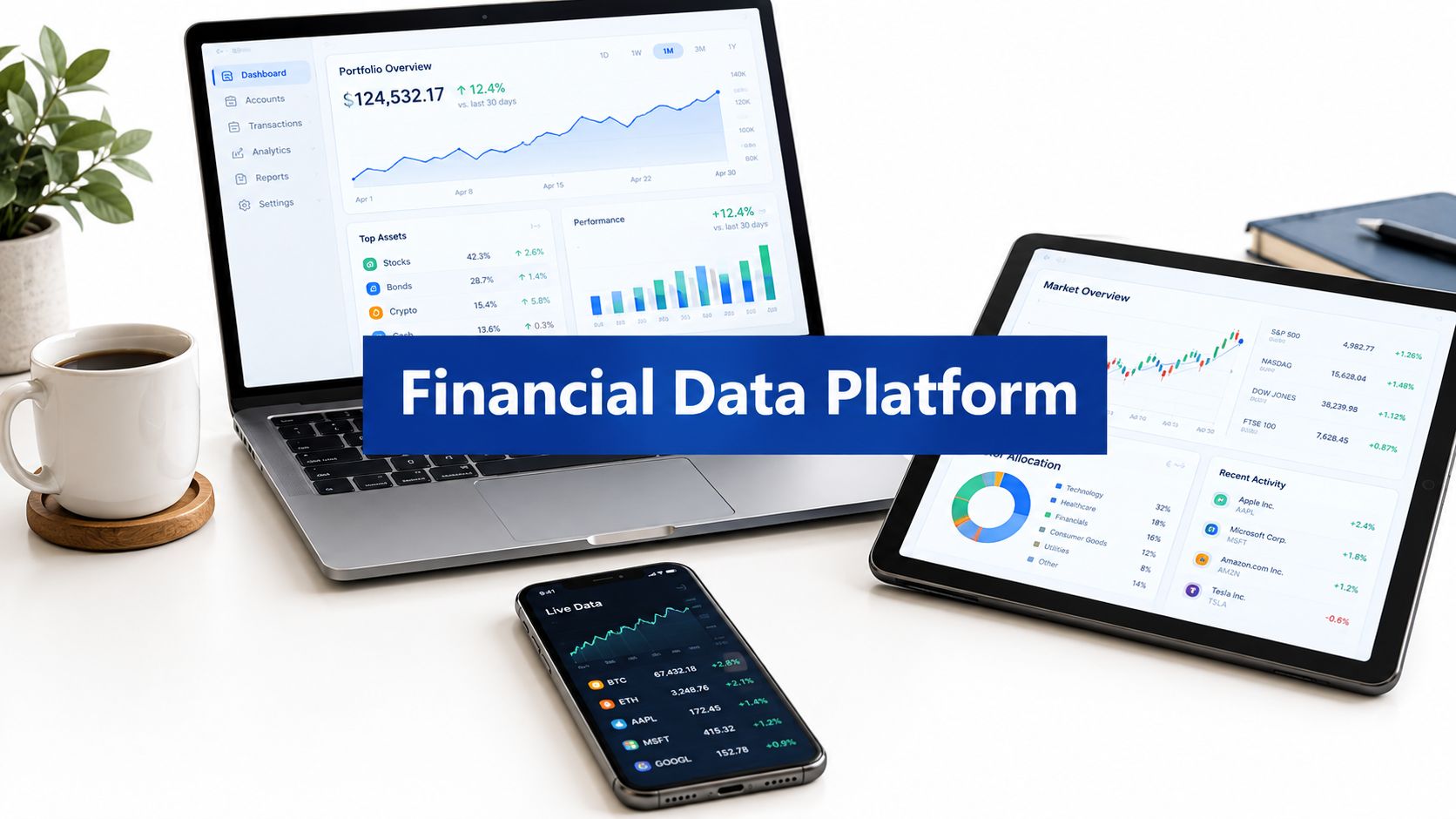


You're probably staring at a product plan, a risk register, and a pile of bank feeds that don't quite agree with each other. One team wants faster onboarding, another wants cleaner reporting, and compliance keeps asking where the audit trail lives. That is usually the moment a financial data platform stops sounding abstract and starts looking like the missing piece in your financial software architecture.
For modern FinTech teams, the challenge isn't whether data exists. It's whether that data can be trusted, governed, and moved fast enough to support real decisions without creating new risk. In Canada, that pressure is sharper because open banking is still transitioning, the Consumer-Driven Banking framework is moving towards a 2026 launch under Bank of Canada oversight, and the rules around consent, history, and operational resilience are becoming concrete rather than hypothetical. A strong platform gives product teams a way to move from fragile pipelines to dependable FinTech data infrastructure.
Why Modern FinTech Apps Need a Real Financial Data Platform
A lot of teams begin with a simple setup. One ledger exports CSV files, another system holds card activity, a third stores loan data, and a brittle ETL script ties them together just enough to ship the first release. That works until the first product expansion, the first audit request, or the first time a customer disputes a transaction and everyone needs the same answer.
Fragility grows faster than features
Fragmented data slows every useful business function. Reporting turns into reconciliation work, real-time decisions become delayed decisions, and audit evidence gets stitched together from emails, spreadsheets, and one-off database queries. If the platform can't explain where a number came from, it isn't just inefficient; it's risky.
Canada makes that especially clear. The federal fiscal platform GC Infobase was launched in April 2013 and grew from roughly 13,000 users in the first year of tracking to about 122,000 users in 2022–23, an 854% increase, which shows how fast a centralised data platform can scale when it brings multiple government datasets into one place. The lesson for FinTech is simple. When you centralise well, teams stop arguing about versions of the truth.
The architectural map teams wish they had earlier
A financial data platform is the map you wish you'd drawn before the first transaction went live. It shows where raw data enters, how it gets cleaned, who can use it, and which controls protect it at every stage. Without that map, product teams build by instinct, then pay for it later in rework, downtime, and slow launches.
Practical rule: If your team cannot replay a transaction path from source to report, your data stack is still a prototype, even if it is already in production.
Canada's own official financial data infrastructure underlines the point. Statistics Canada publishes quarterly financial flow accounts, monthly credit aggregates, and international securities transaction data, while the Bank of Canada maintains weekly financial market statistics and historical data going back to May 2018 and earlier Statistics Canada financial data infrastructure. That kind of continuity is what modern FinTech software needs internally too, especially when reporting, treasury, and risk teams all depend on the same underlying numbers.
What a Financial Data Platform Actually Is
Think of a financial data platform as a city's utility grid for money data. Power lines carry electricity to different buildings, water systems move clean water where it's needed, and metering tells the city what was used and when. In the same way, a platform ingests raw financial activity, normalises it, stores it safely, and exposes it to teams through analytics and APIs.
The utility analogy that makes the stack easier to understand
The first job is ingestion. Data comes in from bank rails, core systems, open banking APIs, payment processors, and internal product services. The platform does not just collect it; it gets it into a shape the rest of the business can trust.
The second job is normalisation. A platform should map messy source-specific records into a shared schema, so “transaction”, “party”, “account”, and “consent” mean the same thing across systems. That is where legacy warehouses often fall short, because they were built mainly for nightly reporting, not the constant stream of events modern FinTech products generate.
The third job is exposure. Product teams, analysts, and operations need analytics, dashboards, and APIs they can use. A good platform is not a vault. It is a governed distribution layer.
What makes modern different from legacy
Modern platforms are event-driven, API-first, and built with governance already inside the design. That means ingestion does not wait for a nightly batch if the business needs near-real-time views. It also means compliance hooks, lineage, and access control are part of the architecture rather than after-the-fact patchwork.
For a useful external reference on how banking data models are being shaped for the next wave of platform work, the 2026 guide to banking data is worth reading in context. It helps frame how the data layer has to support both current operations and future regulatory expectations without assuming every source system behaves the same way.
Core Capabilities Every FinTech Data Stack Must Cover
A serious FinTech data infrastructure stack should match the order data moves in, not the order a sales deck likes to show. In practice, that means ingestion, normalisation, storage, analytics, and secure access, all stitched together by governance.
From source systems to usable data
| Capability Layer | FinTech Pain Point Solved | Example Outcome |
|---|---|---|
| Ingestion from rails, cores, and APIs | Manual exports and broken feed handling | Source data lands consistently, even when formats differ |
| Canonical normalisation | Conflicting definitions across products | Teams analyse the same customer or account record |
| Durable storage | Lost history and weak replay ability | Audits and investigations can trace past events |
| Analytics layer | Slow reporting and weak decision support | Risk, treasury, and product teams see the same dataset |
| Secure APIs | Fragile downstream integrations | Other services can consume data without direct database access |
The useful shift is that each layer removes a specific frustration. Ingestion reduces reconciliation pain. Normalisation reduces arguments over definitions. Durable storage reduces the fear of losing evidence. Analytics reduces reporting delays. Secure APIs reduce the risk of every team building its own data shortcut.
Governance is not a separate project. If you add it later, you end up reworking the same data twice.
That is why teams should treat governance as a cross-cutting capability. It belongs in ingestion, because source data should be validated at the edge. It belongs in storage, because retention and replay rules matter. It belongs in APIs, because downstream users need controlled, auditable access.
If you want a practical example of how real-time financial data supports day-to-day decision-making, see the internal overview on real-time financial data for FinTech decision-making. It's the kind of capability that becomes visible only after teams stop relying on ad-hoc spreadsheets.
A Reference Architecture for Financial Software Architecture
A practical reference architecture starts with a simple idea. Let raw data enter through multiple doors, move through a governed pipeline, land in a storage layer built for replay and analysis, and then flow outward through controlled interfaces. That pattern keeps the platform flexible without making it chaotic.
The layered pipeline teams can actually build around
At ingestion, teams often combine streaming and batch. Kafka or Kinesis can handle event streams. SFTP still has a place for legacy file delivery. REST APIs are common for modern integrations, and screen-scraping should be treated as a temporary fallback, not a stable strategy.
The storage tier usually splits into a lakehouse and a serving layer. S3 with Delta Lake or Iceberg on Parquet works well for durable, replayable history. A columnar warehouse such as Snowflake or BigQuery supports fast analytics. Redis can act as the low-latency cache when product features need quick reads.
Transformation belongs in its own layer. dbt models help teams express business logic clearly, while Spark jobs handle heavier processing. Schema registries keep formats like ISO 20022, MT940, and OFX under control, which matters when source feeds differ in structure and meaning.
Trade-offs that matter in real teams
Postgres is still useful for transactional workloads, especially when the platform needs operational consistency more than massive analytical scale. Managed warehouses are better when elasticity matters more than fine-grained infrastructure control. Cost monitoring has to run at every hop, because storage, processing, and API usage can all drift if nobody watches them.
The analytics and ML layer should sit above that. Notebook environments, BI tools, and feature stores let analysts and data scientists work from governed data products instead of raw extracts. The API gateway then exposes selected services through REST or GraphQL, usually with OAuth 2.0 and webhook fan-out for event notifications.
If you are mapping this into a broader architecture, the internal guide on AI-ready FinTech infrastructure fits naturally beside it. The main point is that AI is only as useful as the data plumbing underneath it.
The best reference architecture is the one your team can explain to auditors, engineers, and product managers without changing the story.
Security, Consent, and Compliance in FinTech Data Infrastructure
A customer grants an app access to a bank account, then withdraws that permission. The platform must stop new collection, preserve the right records, and show who changed the consent state. That example captures the design challenge: compliance lives inside ingestion, storage, APIs, and operations from the first release.
Why each control exists
PIPEDA makes data minimisation and breach discipline practical engineering concerns. Field-level encryption limits exposure when a service or database is compromised, while immutable audit logs preserve an account of access and changes. OSFI B-13 connects technology design with operational risk and resilience testing, so recovery procedures and evidence collection belong in the platform, not in a separate spreadsheet.
Canada's 2026 Consumer-Driven Banking framework adds consent dashboards and historical portability requirements. The Consumer-Driven Banking framework and Bank of Canada supervision guidance give product teams a regulatory reference point for consent state, access records, and retrieval workflows.
The scope is broader than personal budgeting. Deposit, payment, investment, and lending accounts are covered for individuals and businesses under the Consumer-Driven Banking regulations. A platform should therefore model organisations, delegated access, and account relationships as carefully as individual customers.
For the operational blueprint, the proposed rules call for at least 24 months of transaction history, consent renewal at least every 12 months, five-year record retention, and a monthly API uptime target of 99.5%, as outlined in FinTech infrastructure requirements discussed by Flinks. Each item becomes a testable requirement. History retrieval needs pagination and reconciliation, renewal needs scheduled notifications, retention needs lifecycle policies, and uptime needs monitoring with incident evidence.
Control matrix for the platform
| Regulation | Platform layer | Technical control |
|---|---|---|
| PIPEDA | Storage and API access | Field-level encryption, immutable logs |
| OSFI B-13 | Operations and resilience | Risk registers, failover testing |
| Consumer-Driven Banking | Consent and ingestion | Consent dashboards, portable history retrieval |
| PCI DSS | Payments integration | Tokenisation, least-privilege access |
| GDPR | Cross-border customer data | Data subject workflows, access traceability |
| SOC 2 Type II | Governance and monitoring | Evidence collection, continuous controls |
| Quebec Law 25 | Residency-sensitive handling | Data residency rules, policy enforcement |
Threat modelling should follow the data flow from connector to API response. Teams can pair platform design with continuous threat modelling for fintech, testing how stolen tokens, excessive permissions, and compromised integrations affect each layer. The FinTech compliance solutions resource provides a practical link between architecture decisions and control implementation.
Build, Buy, or Blend: A Practical Decision Framework
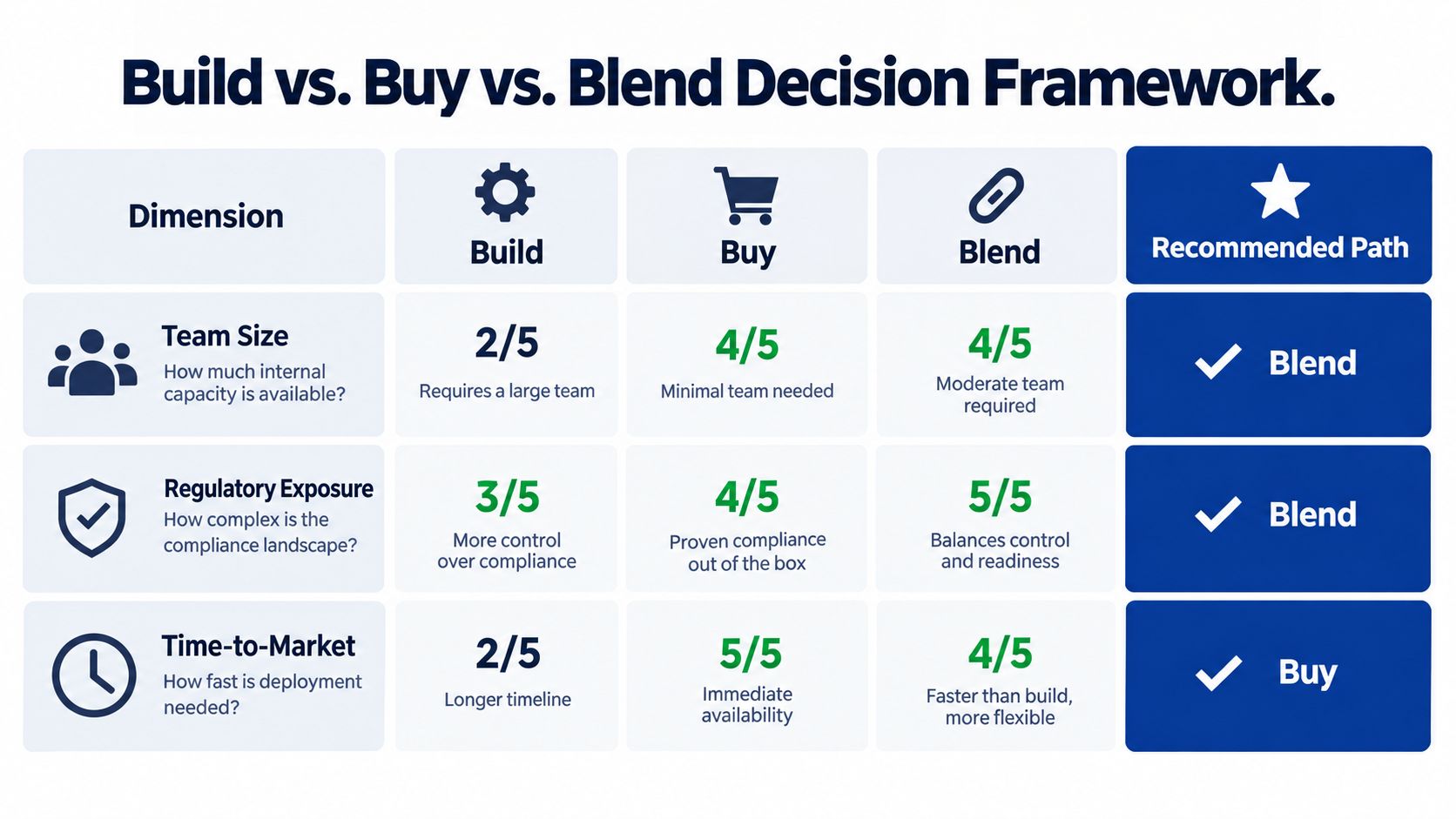
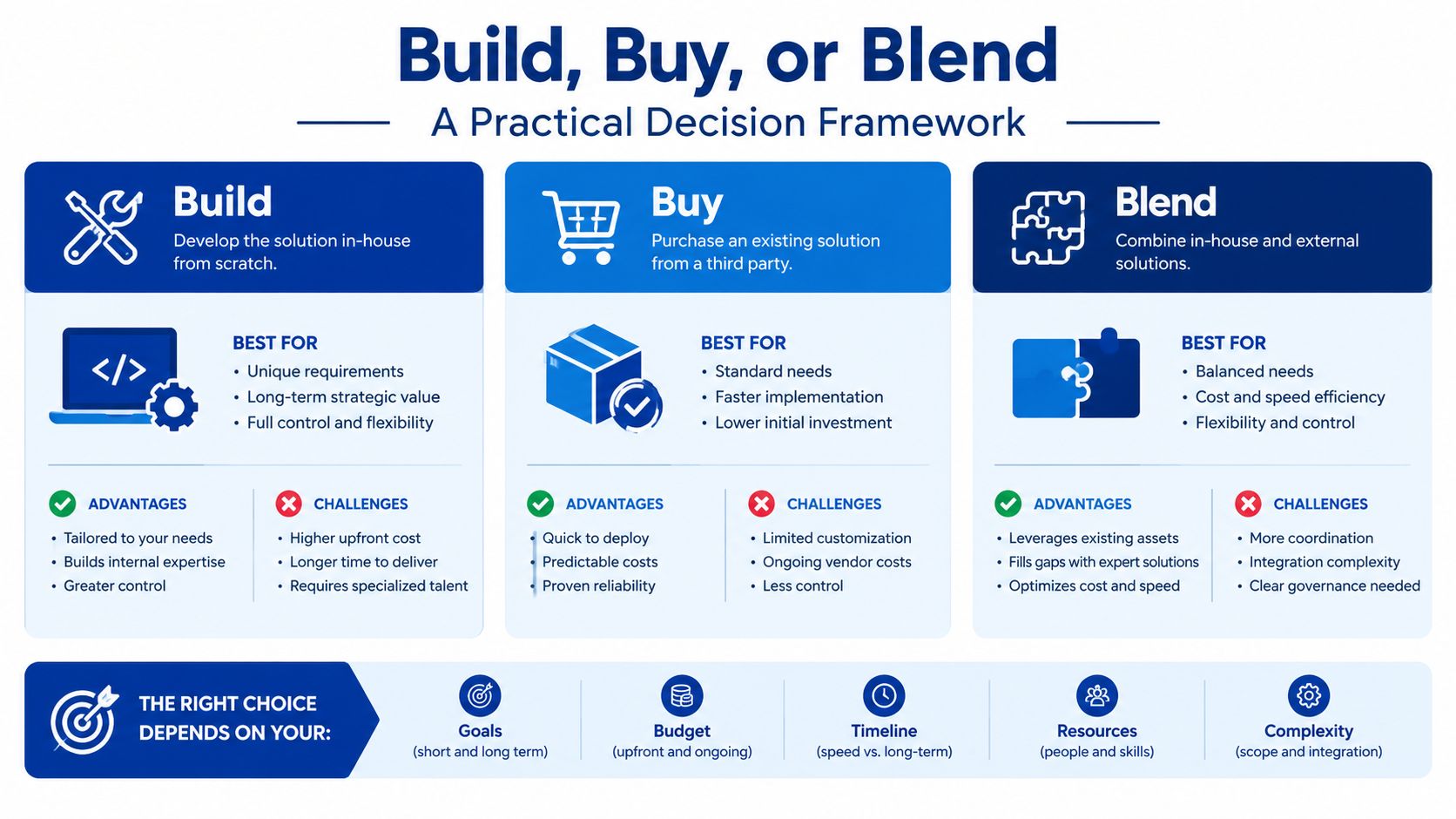
The build-versus-buy debate gets muddled when people turn it into a philosophy contest. It's more useful to treat it as an operating decision based on team size, regulatory exposure, and time-to-market. A small team with a non-core use case usually should not build the whole stack. A regulated lender with proprietary underwriting logic often should own the core data layer.
A simple way to score the decision
Start with four questions. Do you have enough in-house engineering capacity to maintain ingestion, governance, and monitoring? Does your regulatory burden demand tighter control than a generic SaaS tool can comfortably provide? Does the data layer create real differentiation, or is it just plumbing? How quickly do you need to launch?
If the answers point towards speed and low differentiation, buy or outsource the heavy lifting. If the data layer drives underwriting, claims decisions, or compliance evidence, own more of it. The blend model often wins in Canadian FinTech, where a managed ingestion and governance backbone can sit underneath a thin proprietary layer that reflects the business's actual edge.
Rule of thumb: If your team spends months on authentication before customers see value, you're probably over-building.
Red flags that you've gone too far
Bespoke ETL for standard feeds: If your team is rewriting common bank feed handling by hand, the platform is drifting into waste.
Missing SOC 2 evidence: If compliance can't show controls, the architecture is not operationally mature enough.
Auth before value: If permissions, roles, and edge cases consume the whole roadmap, the product is likely stalled.
Custom everything: If nothing is reusable, your next feature will cost almost as much as the first.
Cleffex Digital Ltd can sit in the blend category for teams that need financial data integrations, streaming pipelines, APIs, and regulated software development without turning the whole stack into a custom engineering exercise. That kind of engagement makes sense when the business wants a thin proprietary layer over a controlled backbone rather than a full build from zero.
Industry Use Cases and Real-World Examples
The clearest way to understand the platform is to watch it remove friction in different businesses. The pattern stays the same, but the source systems and outcomes change.
Claims, lending, and dealership finance
A Canadian insurer can use ingestion to pull policy records, telematics signals, and repair-shop updates into one stream. Normalisation aligns coverage codes, while analytics flags suspicious patterns quickly enough for claims teams to triage instead of guess. The value comes from the platform joining insurer core data with external events without creating a new manual review queue.
A small-business lender can use consent-scoped open banking APIs and aggregated transaction history to evaluate cash flow more confidently. Instead of waiting on paper statements and back-and-forth emails, the team can underwrite working-capital loans from fresher account data and a cleaner customer view. The platform's job is to make the consent and history rules usable in practice, not just compliant on paper.
A multi-rooftop dealership group can stream financing applications, credit-bureau pulls, and F&I product choices into one ledger. Finance managers then see approval activity in near real time, and they can compare branches without waiting for end-of-day exports. Here the useful capability is not just storage; it is a shared operational layer for sales, finance, and compliance.
The common pattern across all three
Each example depends on a different source mix, but the same building blocks repeat. Ingestion brings the data in. Normalisation makes it comparable. Analytics turns it into decisions. Secure APIs pass it to the teams that need it.
| Use Case | Main Capability Layer | Integration Points |
|---|---|---|
| Insurance claims triage | Normalisation and analytics | Policy systems, telematics, repair-shop data |
| SMB lending | Ingestion and consent management | Open banking rails, bank account data |
| Dealership finance | Streaming and shared ledger access | Financing applications, credit bureaus, F&I systems |
The point is not that every company needs the same product. The point is that every regulated business needs a data foundation that can survive growth without losing control.
Selection Checklist and a 90-Day Implementation Roadmap
A good vendor or delivery partner should answer practical questions, not just demo dashboards. If procurement can't compare options clearly, the platform decision will drift for months.
Vendor selection checklist
Ingestion coverage: Confirm support for bank feeds, APIs, batch files, and legacy fallbacks.
Schema governance: Ask how canonical models, versioning, and schema drift are handled.
API design: Check whether the platform supports secure, well-documented consumer APIs.
Observability: Look for data freshness, lineage, error tracking, and alerting.
Data residency: Verify regional controls, especially for Quebec-sensitive workloads.
Compliance alignment: Ask for evidence of PIPEDA and OSFI-aligned controls.
Pricing transparency: Demand clarity on storage, processing, API calls, and support.
Reference customers: Prefer regulated FinTech or insurance references over generic SaaS logos.
A 90-day rollout that avoids overreach
| Phase (Days) | Objective | Key Deliverables | Exit Criteria |
|---|---|---|---|
| 1 to 15 | Define scope and sources | Source map, requirements, control list | Stakeholders agree on priority use cases |
| 16 to 45 | Build the sandbox foundation | Ingestion, identity, consent store | Test data flows without manual fixes |
| 46 to 75 | Deliver usable data products | Normalisation models, APIs, dashboard MVP | Two pilot use cases run end to end |
| 76 to 90 | Validate production readiness | Parallel run, KPI monitoring, runbook | Data integrity and support process approved |
Track four KPIs during the rollout. Monitor ingestion freshness, normalisation accuracy, API latency, and consent coverage. If one of them drifts badly, fix the cause before expanding scope.
A few migration habits keep risk down. Use dual writes only where needed. Run shadow analytics before cutover. Keep replay windows long enough to recover from bad source events. Define a rollback trigger tied to data integrity, not just service uptime.
Cleffex Digital Ltd helps teams design and implement financial data integrations, streaming pipelines, APIs, and regulated software foundations that fit real product and compliance needs. If you're planning a financial data platform for lending, insurance, or open banking workflows, visit Cleffex Digital Ltd to explore how their delivery team approaches the build, blend, and compliance trade-offs with modern FinTech systems.