

Think about your own health history for a moment. It’s likely scattered across different places: your GP's surgery, a specialist you saw last year, the lab that ran your blood work, and the pharmacy where you get prescriptions. HealthTech integration is the crucial process of connecting all those digital dots to form one complete, coherent picture of your health.
This isn't just about convenience; it's about making modern healthcare work safely and efficiently. At its core, it’s about creating a connected ecosystem where patient data flows seamlessly between different systems, from Electronic Health Records (EHRs) and patient portals to medical devices and billing software. When done right, this integration leads to better patient outcomes, streamlined operations, and a more sustainable healthcare model.
Why Connected Healthcare Is No Longer Optional
For decades, healthcare has operated in isolated silos. Your general practitioner’s records, a hospital’s discharge summary, and your prescription history all lived in separate, walled-off systems. This fragmentation isn’t just a headache; it introduces serious risks and wastes an incredible amount of time and money.
When a clinician can't see a patient's full story, they're working with one hand tied behind their back. This can lead to ordering duplicate tests, missing crucial context for a diagnosis, or even prescribing medications that could cause a dangerous interaction.
It also creates a mountain of administrative busywork. Staff spend far too many hours manually re-entering data, phoning other offices to track down results, or trying to make an Electronic Health Record (EHR) talk to a separate billing platform. Every minute spent on that is a minute not spent with a patient. Moving from isolated tools to a truly connected system has become a matter of survival.

The Consequences of a Disconnected System
A lack of integration has real-world consequences for everyone involved. When data doesn't flow freely and securely, healthcare organisations run into a host of preventable problems.
What does this look like in practice?
Compromised Patient Safety: A doctor deciding without all the facts is a recipe for error. They might prescribe a drug that clashes with another one filled at a different pharmacy, simply because they couldn't see the patient's complete medication history.
Bloated Operational Costs: The time spent on manual data entry, chasing down faxes, and fixing errors from mismatched records adds up. These inefficiencies directly inflate the cost of delivering care.
A Frustrating Patient Experience: Being asked to repeat your entire medical history at every single appointment is exhausting. Patients get frustrated when they can't easily access their own results or share information between providers.
To truly grasp why connected healthcare is indispensable, it's vital to understand the foundational role of data integration. The principles behind connected care system architectures show how these digital bridges are constructed to enable seamless information flow.
Ultimately, HealthTech integration is the practical solution to this deep-seated fragmentation. By building bridges between different systems, we can create a single source of truth. This empowers clinicians to make better decisions, helps reduce operational waste, and firmly places the patient at the centre of their own care. For any modern practice looking to thrive, a connected ecosystem isn't a "nice-to-have"; it's a necessity.
To learn more about putting digital innovation into practice, you can find valuable resources on our homepage.
Speaking the Same Language: The Standards That Connect Healthcare
For any two healthcare systems to talk to each other, they need a common language. Without it, crucial patient data gets stuck in digital silos, making it impossible to get a full picture of a person's health. This is precisely the problem that interoperability standards solve; they act as the universal translators for health information.
Think of it like this: for a hospital in London and a clinic in Manchester to cooperate on a patient's care, they can't just shout data into the void. They need a shared protocol, a set of rules that ensures the information sent from one system is perfectly understood by the other.
The Bedrock of Health Data Exchange
Three main standards form the foundation of modern HealthTech integration. Each one has a specific job, and understanding their roles is the first step toward building a truly connected healthcare system.
Key Healthcare Interoperability Standards at a Glance
These standards are the backbone of data exchange, each designed for a particular type of information. Here’s a quick breakdown of the big three and where you'll encounter them.
| Standard | Primary Function | Common Use Cases |
|---|---|---|
| HL7 (Health Level Seven) | Exchanging clinical and administrative data | Patient admissions, lab results, billing information, discharge summaries. |
| DICOM (Digital Imaging and Communications in Medicine) | Transmitting and storing medical images | X-rays, MRIs, CT scans, ultrasounds, and other medical imaging files. |
| FHIR (Fast Healthcare Interoperability Resources) | Lightweight, real-time data exchange via modern APIs | Mobile health apps, patient portals, wearable device data, on-demand queries. |
Each standard plays a vital part in creating a seamless flow of information, but they are not interchangeable.
A Closer Look at the Core Three
HL7 (Health Level Seven): This is the old guard, the established workhorse of healthcare data. For decades, HL7 has been the go-to for moving core information between major hospital systems like Electronic Health Records (EHRs) and Hospital Information Systems (HIS). It's great for structured, predictable messages like patient admissions or discharge summaries.
DICOM (Digital Imaging and Communications in Medicine): When it comes to medical images, DICOM is the only language that matters. It’s the universal standard that ensures a radiologist can view an MRI from any machine on any compatible software, without losing a single pixel of diagnostic quality or critical patient data embedded in the file.
FHIR (Fast Healthcare Interoperability Resources): FHIR is the new kid on the block, built for the internet age. It uses the same modern API technology that powers the apps on your phone. Instead of sending a whole patient file, a system using FHIR can make a small, specific request, like asking only for a patient's latest blood pressure reading, and get an answer in real-time.
These aren't just obscure acronyms for the IT department. They are the rules that make modern medicine safer. They ensure the allergy flagged in a family doctor's office shows up for the emergency room physician, potentially preventing a life-threatening mistake.
So, which standard do you use? It really depends on the job. While HL7 is still essential for back-end system communication, FHIR's speed and flexibility make it perfect for patient-facing apps and real-time clinical decision support. If you want to dig deeper into its impact, you can learn more about how FHIR integration transforms healthcare.
Most often, a truly effective integration strategy doesn't pick just one. It skilfully combines all three to create a responsive and fully connected healthcare ecosystem.
The Blueprints for Connecting Healthcare Systems
Knowing the shared languages healthcare systems use is one thing, but how do we actually build the digital bridges between them? Any successful HealthTech integration project comes down to choosing the right architectural blueprint, the plan that dictates exactly how data will flow from one application to another.
Think of your healthcare organisation as a bustling city. Each piece of software, your EHR, the billing system, and the patient portal, is a different building. To make the city function, you need to build transport links between them so information can travel quickly and safely.
Choosing Your Integration Architecture
There's no single "best" way to connect these systems. The right choice really depends on your specific needs, like how fast you need data to move and just how many systems you're trying to connect. The most common architectures are like different types of transport networks in our digital city.
Three main blueprints are used time and again:
APIs (Application Programming Interfaces): These are like direct, high-speed roads connecting two specific buildings. APIs enable real-time, on-demand data exchange. A great example is a patient portal using an API to instantly pull the latest lab results from the EHR. They’re fast and flexible, but each connection needs to be carefully managed to keep it secure.
Middleware: This is your city's central transport hub. Instead of building a direct road between every single building, all traffic flows through this central point. Middleware is brilliant for simplifying complexity because it translates and routes data between multiple, often very different, systems. The main risk? If that central hub goes down, the entire network can grind to a halt.
ETL (Extract, Transform, Load): Imagine this as a scheduled freight service. ETL processes are designed to move large batches of data from point A to point B. The process extracts data from a source (like an old EHR), transforms it into the right format for the new destination, and then loads it in. It's the perfect solution for big, one-off data migrations, but it’s not built for real-time needs.
These blueprints are the "how," but they still need to speak the right "language", the interoperability standards we discussed earlier, to communicate data effectively.
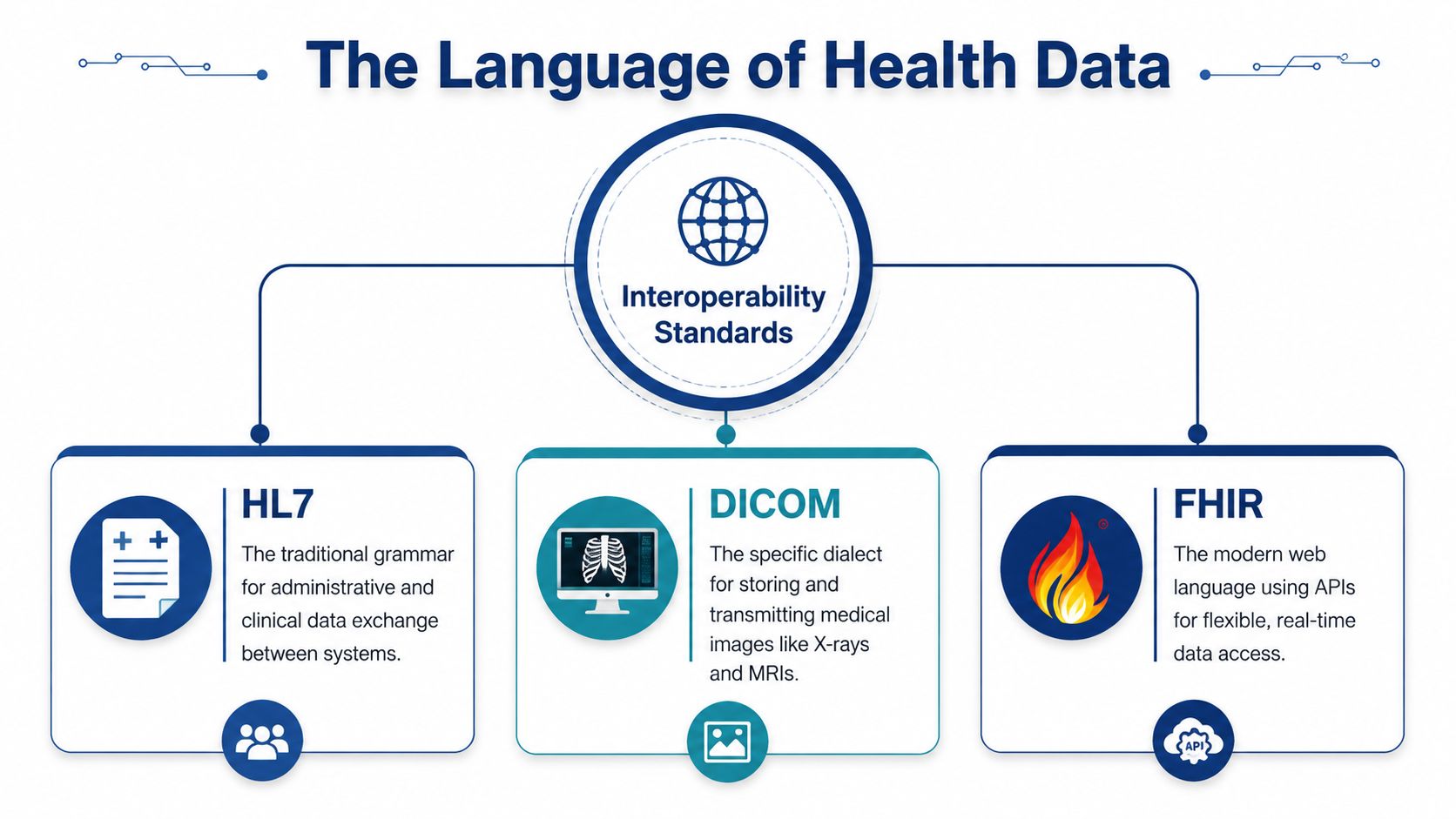
As you can see, different data types require different standards, from traditional administrative data (HL7) to modern, web-based requests (FHIR). Navigating these blueprints and standards is the key to building robust, reliable connections. You can see how these principles come together when you build fully connected healthcare platforms that create a seamless experience for both patients and providers.
Securing Patient Data During Integration
Connecting healthcare systems offers incredible benefits, but it also opens the door to significant risks. We're talking about the immense responsibility of protecting sensitive patient information as it moves between different platforms. In HealthTech integration, security isn't an add-on; it's the very bedrock of patient trust.
Without airtight security, a connected healthcare network isn't an asset; it's a massive liability. Imagine each integrated system is a new door into a vault holding priceless patient data. Every one of those doors must be completely secure.
The Framework for Building Trust
This is where regulations like the UK's Data Protection Act 2018 (which incorporates GDPR) and America’s HIPAA (Health Insurance Portability and Accountability Act) come into play. It's best to see these not as bureaucratic hurdles, but as the blueprints for building a secure digital environment. They provide the non-negotiable rules for how personal health information should be handled, giving us a clear and legally sound path to follow.
True HealthTech integration bakes security into the process from day one, rather than trying to bolt it on later. A data breach doesn't just expose information; it shatters the trust patients have in their providers and can result in severe penalties. This requires a proactive, "security-by-design" approach.
Core Security Practices in HealthTech Integration
To properly protect data, both when it's moving and when it's stored, several key practices need to work in concert.
End-to-End Encryption: Think of this as the digital equivalent of an armoured car. Encryption scrambles data as it travels between systems, rendering it completely unreadable to anyone who doesn't hold the specific decryption key. Even if the data is intercepted, it remains gibberish.
Strict Access Controls: Not everyone in a healthcare setting needs to see all patient information. Role-based access control is crucial. It ensures that clinicians, administrators, and other staff can only view the specific data they need to do their jobs. It’s about giving people the right keys for the right doors, and nothing more.
Clear Patient Consent: Patients must always have the final say. Before their information is shared between different applications or providers, they need to give clear, informed consent. This transparency is the cornerstone of any ethical and compliant HealthTech integration.
Continuous Auditing and Monitoring: Security is never a "set it and forget it" task. You need systems in place that constantly monitor for suspicious activity and regular security audits to find and fix vulnerabilities. This ongoing vigilance ensures the digital vault stays secure over the long haul.
Anyone involved in this space needs to have a firm grasp of the security risks. To dive deeper, take a look at our guide on the importance of cybersecurity in the healthcare industry. By embedding these principles into every project, we can build a connected health system that is worthy of the trust we ask patients to place in it.

The Business Case for HealthTech Integration
For too long, healthcare organisations have viewed their IT departments as a necessary expense. But that mindset is changing, and fast. HealthTech integration is no longer just an IT project filed away in a back office; it's a core business strategy that directly fuels growth, slashes operational costs, and carves out a real competitive advantage.
The market has certainly taken notice. The global healthcare data technology market was valued at USD 3.10 billion back in 2024 and is on track to hit a staggering USD 9.5 billion by 2033. What's even more telling is that health data integration and monetisation made up 66.55% of that market's revenue in 2024, showing exactly where the smart money is going. Add to that the rapid acceleration in healthcare AI, with spending projected to hit USD 1.4 billion in 2025 and sales cycles dropping from 18 months to less than six, and the message is clear: the demand for connected, intelligent systems is exploding. You can explore more on the state of AI in healthcare and its market dynamics here.
From Cost Centre To Value Generator
This shift in thinking recasts technology from a simple cost centre into a powerful value generator. A well-executed HealthTech integration strategy pays for itself by delivering tangible financial returns across the organisation. The business case really stands on two strong legs.
First, you have operational efficiency and cost reduction. When your systems talk to each other, you eliminate enormous amounts of administrative waste. Imagine a telehealth appointment where the data flows instantly into the EHR and then directly to the billing system without anyone lifting a finger. The hours saved on manual data entry translate directly to lower operational costs, allowing your highly skilled team to focus on what they do best: caring for patients.
Second, a connected ecosystem unlocks entirely new revenue streams. An integrated platform is the foundation for offering new, billable services like remote patient monitoring or comprehensive chronic care management programmes. Beyond direct care, you can also generate powerful, anonymised data sets that can be invaluable for research partnerships or public health studies, opening up entirely new avenues for monetisation.
Interoperability is no longer just a technical ideal; it is a commercial imperative. The organisations that successfully connect their data ecosystems are the ones that will lead the market, attract investment, and ultimately provide better, more sustainable care.
Gaining a Competitive Advantage
In a market as crowded as healthcare, the patient experience is one of the most powerful ways to stand out. And that's where seamless HealthTech integration truly shines.
When a patient can easily book an appointment online, see their complete health record in one place, and have their information follow them effortlessly from their family doctor to a specialist, you’ve removed the friction from their healthcare journey. That kind of positive experience builds satisfaction and deepens loyalty.
This creates a flywheel effect. A better patient experience leads to higher retention, glowing reviews, and more referrals, which strengthens your position in the market. You become the provider of choice not just for quality clinical care, but for an experience that is simple and stress-free. For expert help in building these integrated solutions, explore our healthcare software integration services.
Use Cases of HealthTech Integration in 2026
It’s one thing to talk about healthtech integration in theory, but where it really clicks is seeing it work in the real world. Let's step away from the abstract and look at what a truly connected healthcare system feels like day-to-day.
Imagine a General Practitioner (GP) caring for a patient with a complex chronic illness. In the past, this was a nightmare of fragmented information. The GP had their own notes, sure, but crucial details from specialists, hospitals, and pharmacies were siloed away, often showing up days or weeks late as a fax or a letter in the mail.
Now, picture the "after." That same GP logs into their Electronic Health Record (EHR) and sees a single, coherent timeline for their patient. With a glance, they can see the cardiologist’s latest report, confirm the patient picked up their new medication yesterday, and pull up the blood test results from the lab. It's all right there. This isn't just convenient; it allows for safer, more informed decisions on the spot.
Real-World Examples of Connected Care
On the ground, effective integration is solving countless practical problems for both patients and staff, making the entire care journey smoother.
Here are just a few examples we see all the time:
Automated Appointment Scheduling: A patient uses a mobile app to book an appointment. The system instantly cross-references the clinic’s master calendar, confirms an open slot, and sends a confirmation, all without a single person needing to pick up the phone.
Seamless Telehealth Workflows: A doctor finishes a virtual visit. The telehealth platform automatically generates the clinical notes and billing codes, then pushes that data directly to the practice's EHR and billing software. This simple step eliminates hours of tedious data entry and drastically cuts down on billing errors.
AI-Powered Clinical Support: The use of generative AI in healthcare has exploded. Adoption jumped from 72% in the first quarter of 2024 to 85% by the end of that year. By early 2025, 70% of healthcare providers were actively working to implement it for tasks like documentation and patient communication. You can discover more insights about AI in healthcare on ventionteams.com.
A fantastic example of this is an AI tool that listens to a patient-doctor conversation and drafts the clinical notes in real time. This is a game-changer for reducing the administrative load on physicians, helping to combat burnout and giving them more time to actually focus on their patients.
These aren't futuristic pipe dreams. They are the tangible results of well-planned HealthTech integration. Of course, getting these systems to work requires specialised knowledge; understanding industry-specific IT support for healthcare practices is a critical piece of the puzzle.
Ultimately, every successful integration project, big or small, helps build a healthcare system that is more efficient, safer, and much more centred around the patient.
Conclusion: Building the Future of Connected Care
The journey towards a fully connected healthcare ecosystem is no longer a distant vision; it is a present-day imperative. HealthTech integration is the engine driving this transformation, moving us away from fragmented, inefficient silos towards a unified system that prioritises patient safety, operational excellence, and a seamless user experience.
By embracing standardised languages like HL7 and FHIR, adopting smart architectural blueprints, and embedding security into every step, healthcare organisations can unlock immense value. The benefits are clear: reduced administrative burdens, lower costs, new revenue opportunities, and, most importantly, better-informed clinicians making safer decisions.
The path forward requires strategic planning and a deep understanding of the technological and regulatory landscape. But for those ready to invest in building these digital bridges, the reward is a more resilient, responsive, and patient-centric model of care. The future of healthcare is connected, and integration is the key that unlocks it.
Frequently Asked Questions
Jumping into a HealthTech integration project for the first time can feel a bit daunting. Let's walk through some of the most common questions we hear to help clear the path forward.
What Is the First Step in a HealthTech Integration Project?
It’s tempting to jump straight into the technology, but the real first step is taking stock of where you are right now. Before you can build any bridges between systems, you need a detailed map of your current setup.
Think of it as a thorough self-assessment. What software are you using? Where does all your critical data live? And most importantly, what are the specific pain points and bottlenecks you're trying to fix? Once you have a clear picture of the landscape, you can define what success actually looks like. Are you aiming to cut down administrative tasks by 20%, or maybe you want to slash patient check-in times? These specific goals will be your North Star for every decision that follows.
How Much Does HealthTech Integration Cost?
This is always the big question, and the honest answer is: it depends entirely on the project. There's no standard price tag because every healthcare organisation's needs are unique.
The final cost really boils down to a few key things:
Project Complexity: Simply connecting two modern applications with a clean API is going to be far less involved and less expensive than untangling a web of older, legacy platforms with a custom middleware solution.
Number of Systems: The more systems you need to link together, the more complex the development, testing, and maintenance will be.
Chosen Architecture: Different integration methods, like APIs, middleware, or ETL, come with their own costs for both the initial build and long-term upkeep.
Because of these moving parts, any experienced partner will need to dig into your specific requirements before they can give you a realistic quote.
How Is Patient Data Kept Secure?
In healthcare, security isn't just a feature; it's the foundation of everything. Protecting patient data is non-negotiable and has to be woven into the project from day one. It all starts with unwavering compliance with regulations like the UK's Data Protection Act and GDPR, which set the legal and ethical baseline for handling sensitive information.
Beyond compliance, a solid security strategy uses multiple layers of defence. We're talking about things like end-to-end encryption, which scrambles data so it's unreadable while it's moving between systems or sitting in a database. It also means using role-based access controls to ensure that a team member can only see the specific information they absolutely need to do their job. Ultimately, the best way to ensure security is to work with a partner who lives and breathes healthcare's unique privacy and security challenges.
Ready to build a connected healthcare system that is both efficient and secure? The team at Cleffex Digital Ltd has the expertise to guide you through every stage of your healthcare software integration journey.