

Clinical decision-making has never been simple, but the gap between what clinicians need to process and what a working day allows is widening. One useful reality check comes from Canadian practice: AI is used mainly for therapy material generation at 74.5%, clinical documentation at 32.67%, and administrative or scheduling tasks at 31.47%, which shows that clinicians are using it first as a cognitive support tool rather than as a replacement decision-maker (Canadian AI use patterns in practice).
That matters because the most productive conversation about AI in healthcare isn't about replacing doctors. It's about helping clinicians think more clearly, document more efficiently, and catch what busy human minds can miss. For clinic managers and doctors, the practical question is simpler than the headlines suggest: where does AI fit into real workflow, and where must human judgement stay firmly in charge?
Good implementation also depends on strong digital foundations. Practices that already invest in connected systems, secure platforms, and reliable integration tend to be in a better position to use AI safely. If you're reviewing your wider digital capability, it helps to start with a provider that understands healthcare-grade software and connected services, whether that's through the Cleffex homepage or a focused look at healthcare software integration services.
The New Era of AI-Enhanced Medical Decisions
Modern medicine asks clinicians to do several difficult things at once. They have to assess symptoms, review histories, interpret investigations, consider risks, document decisions, and explain options to patients, often in limited time. AI fits into this environment not as a futuristic extra, but as a working tool for handling information load.

Why pressure on decision-making has increased
A clinician rarely makes a decision from one data point. Real decisions come from a mix of lab values, medication lists, prior notes, imaging, referral letters, patient preferences, and evolving symptoms. Even straightforward cases can become messy when the record is fragmented, or the presentation isn't typical.
AI helps most when it reduces friction in that process. In practice, that often means:
Summarising records: Pulling key points from long notes into something usable during consultation
Supporting documentation: Helping draft structured notes, letters, or therapy materials
Flagging risks: Surfacing possible concerns that deserve a second look
Improving retrieval: Helping clinicians find relevant guidance or prior data faster
AI as support, not substitution
The most sensible frame is this: AI can widen attention, but it can't own responsibility. Canadian guidance on diagnostic reasoning already points to the value of a deliberate verification step, where clinicians test an initial hypothesis and look for inconsistent features before settling on a diagnosis (clinical verification and diagnostic reasoning in Canada). AI is useful in exactly that space. It can prompt the extra question, the missed differential, or the conflicting medication issue.
Practical rule: If an AI tool makes it easier to pause, verify, and document, it's probably helping clinical decision-making. If it pressures clinicians to accept outputs without scrutiny, it's introducing risk.
The clinics getting value from AI aren't handing over judgement. They're using AI to reduce clutter around judgement.
Foundations of Clinical Reasoning
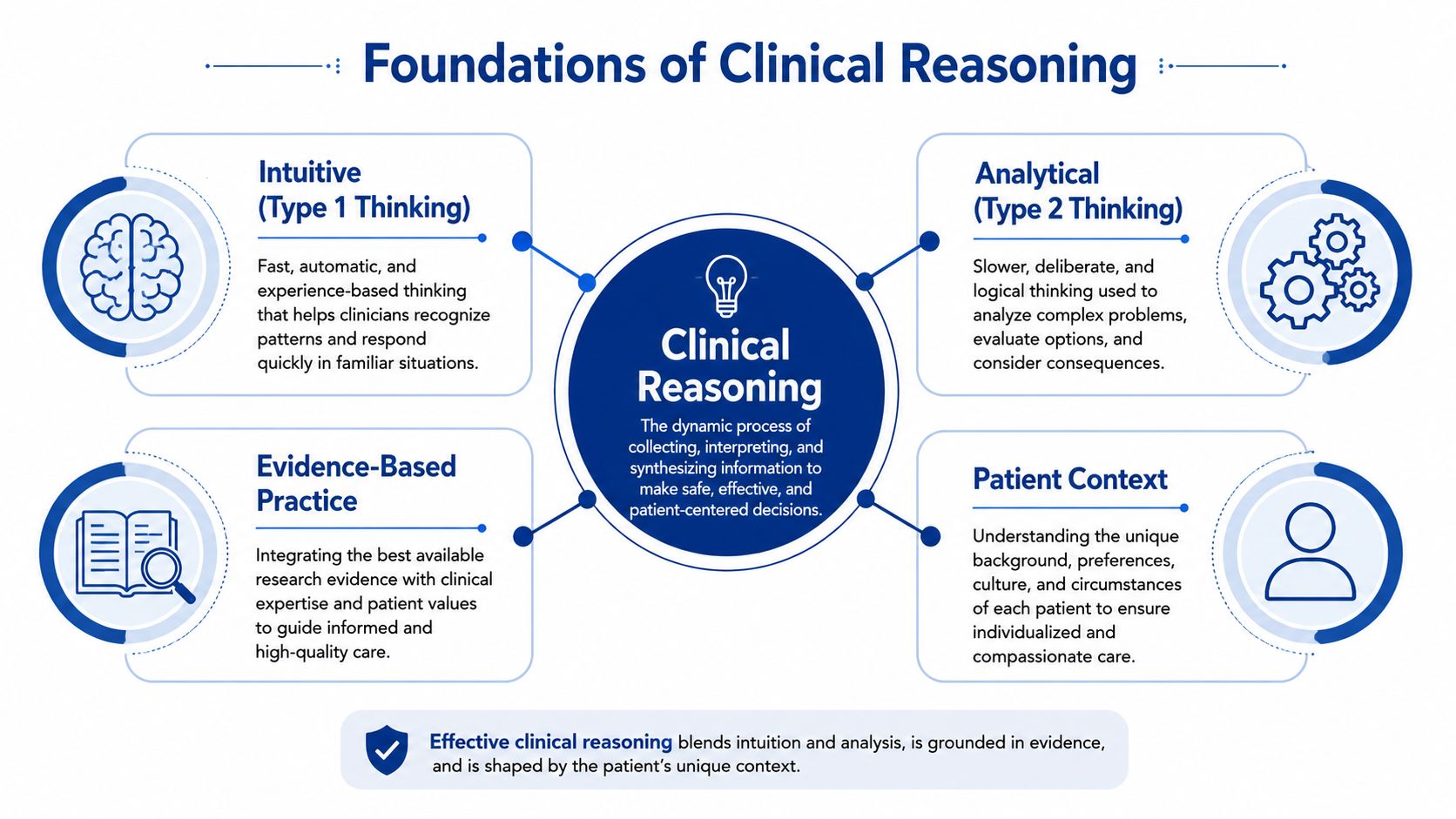
Before discussing AI, it helps to ground clinical decision-making in the way clinicians already think. Most clinical reasoning combines pattern recognition, deliberate analysis, evidence, and the circumstances of the person in front of you. That's why a good clinician often resembles a careful detective. Not because medicine is guesswork, but because clues have to be weighed in context.
The four working parts of reasoning
A useful way to think about clinical reasoning is to break it into four parts:
| Foundation | What it looks like in practice | Where it helps |
|---|---|---|
| Intuition | Rapid recognition of familiar patterns | Time-sensitive, common presentations |
| Analytical thinking | Slowing down to compare options and contradictions | Complex or atypical cases |
| Evidence-based practice | Using current guidance and validated knowledge | Treatment choices and risk reduction |
| Patient context | Considering goals, preferences, social situation, and capacity | Shared decisions and realistic care plans |
None of these stands alone. A doctor may recognise likely pneumonia quickly, then switch into analytical mode if the signs don't fit, then consult evidence on antibiotics, then adjust the plan based on the patient's preferences and home support.
Evidence matters, but so does participation
Clinicians often hear about evidence-based medicine and shared decision-making as if they are separate models. In reality, they work together. Evidence-based medicine asks, "What is the best supported option?" Shared decision-making asks, "Which option makes sense for this patient?"
That second question is where many systems still struggle. A 2017 Web-based survey of 1,591 Canadians found a low degree of shared clinical decision-making, with a mean score of 2.25 out of 5. Only 42.8% of respondents said their healthcare professional often mentioned they had a choice of treatment (Canadian shared decision-making survey findings).
For managers, that isn't just a communication issue. It affects workflow, trust, adherence, and patient experience. If the patient doesn't understand the options or doesn't feel involved, the clinical plan may be technically correct but practically weak.
Shared decision-making isn't a soft extra. It's part of sound clinical reasoning because treatment only works when the patient can accept, follow, and sustain it.
Where readers often get confused
Some people assume AI belongs only to the evidence part. It doesn't. AI can support all four foundations, but in different ways.
For intuition, it can surface patterns from records or images.
For analysis, it can help test alternative explanations.
For evidence, it can speed access to relevant knowledge.
For patient context, it can help structure information, though human conversation still does the heavy lifting.
That last point matters most. AI can organise facts about a patient. It can't replace the clinician's responsibility to understand what matters to that person.
The Human Factor: Cognitive Biases in Diagnosis
Clinical reasoning is powerful, but it isn't neutral. Human beings use mental shortcuts constantly. In a busy clinic, those shortcuts help with speed, but they can also distort clinical decision-making.
Biases that show up in ordinary practice
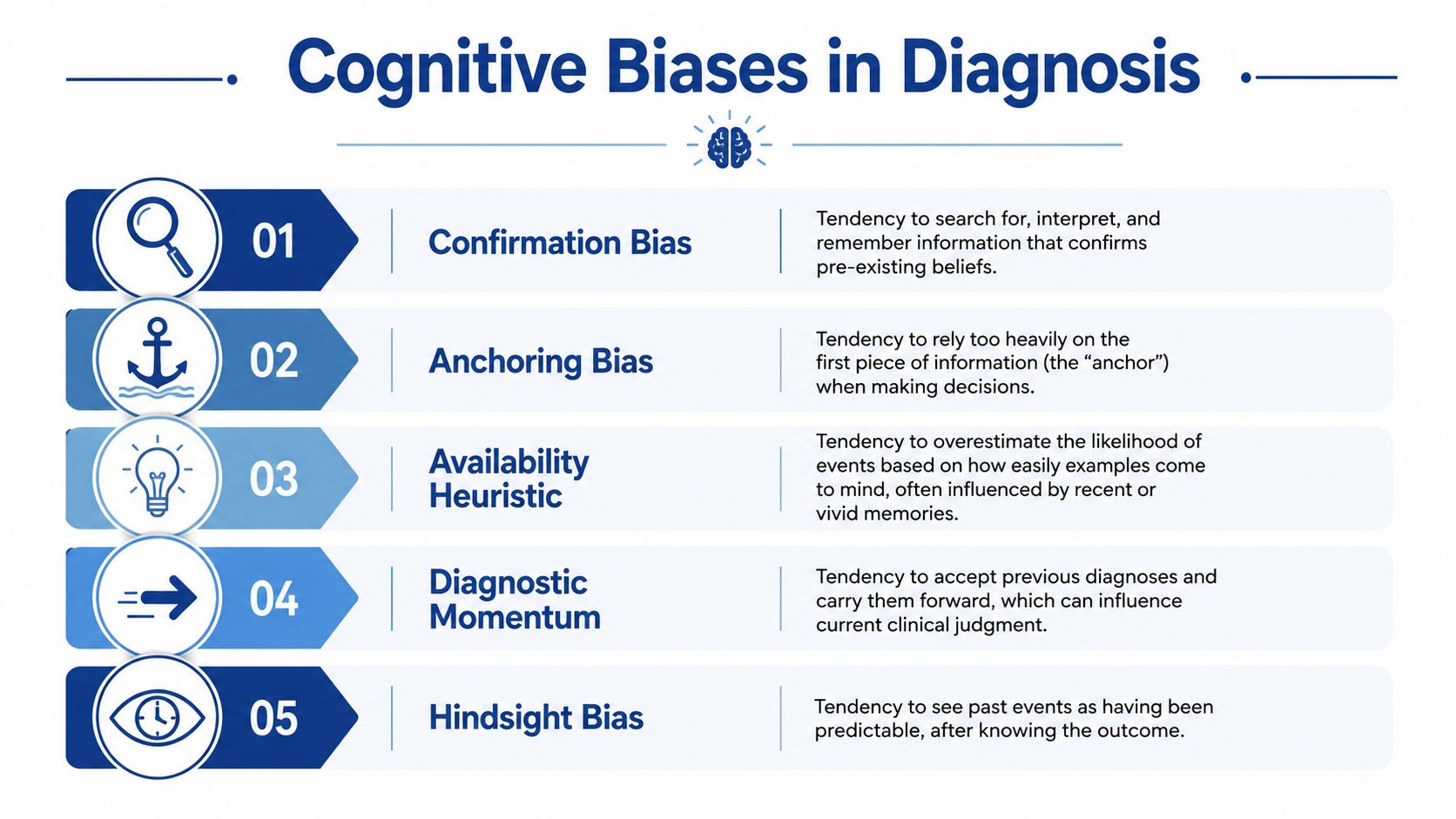
A few biases turn up repeatedly.
Anchoring bias: A clinician fixates on the first plausible explanation. A patient presents with reflux-like symptoms, so the later red flags are interpreted through that early impression.
Confirmation bias: The clinician gives more weight to findings that support the working diagnosis and discounts conflicting details.
Availability heuristic: A recent memorable case shapes the next one too strongly. After seeing several viral illnesses, bacterial causes may be under-considered.
Diagnostic momentum: Once a label appears in the chart, it gains force because it already exists.
These aren't signs of poor character or lack of training. They're features of human cognition under pressure.
Why uncertainty matters
Bias doesn't only affect diagnosis. It also affects how decisions are presented and understood by patients. Analysis of over 1,300 patients in Québec and Ontario primary care studies found that clinically significant decisional conflict affects between 10% and 31% of patients, depending on the medical decision, and is higher in males and those living alone (Canadian primary care decisional conflict findings).
That tells us something important. Clinical uncertainty isn't confined to the clinician's mind. Patients feel it too. If the consultation leaves key questions unresolved, treatment quality can suffer even when the diagnosis is reasonable.
What AI can do in this space
AI works best here as a cognitive safety net. It can prompt review of alternatives, identify data gaps, and surface inconsistencies that a rushed human may overlook. In imaging-heavy environments, this support becomes even more visible, especially in tools used to assist pattern recognition and review workflows. A deeper look at that role appears in this discussion of AI for medical imaging and diagnostics.
A useful AI tool doesn't say, "Trust me." It says, "Check this before you decide."
A simple test for teams
When evaluating AI in diagnosis, ask three practical questions:
Does it broaden the differential, or narrow it too early?
Does it show why a flag was raised, or only present an output?
Does it fit into the clinician's verification step, or interrupt it?
Those questions are more valuable than hype. Clinics need support that reduces blind spots, not systems that create new ones.
How AI Augments the Clinician's Workflow
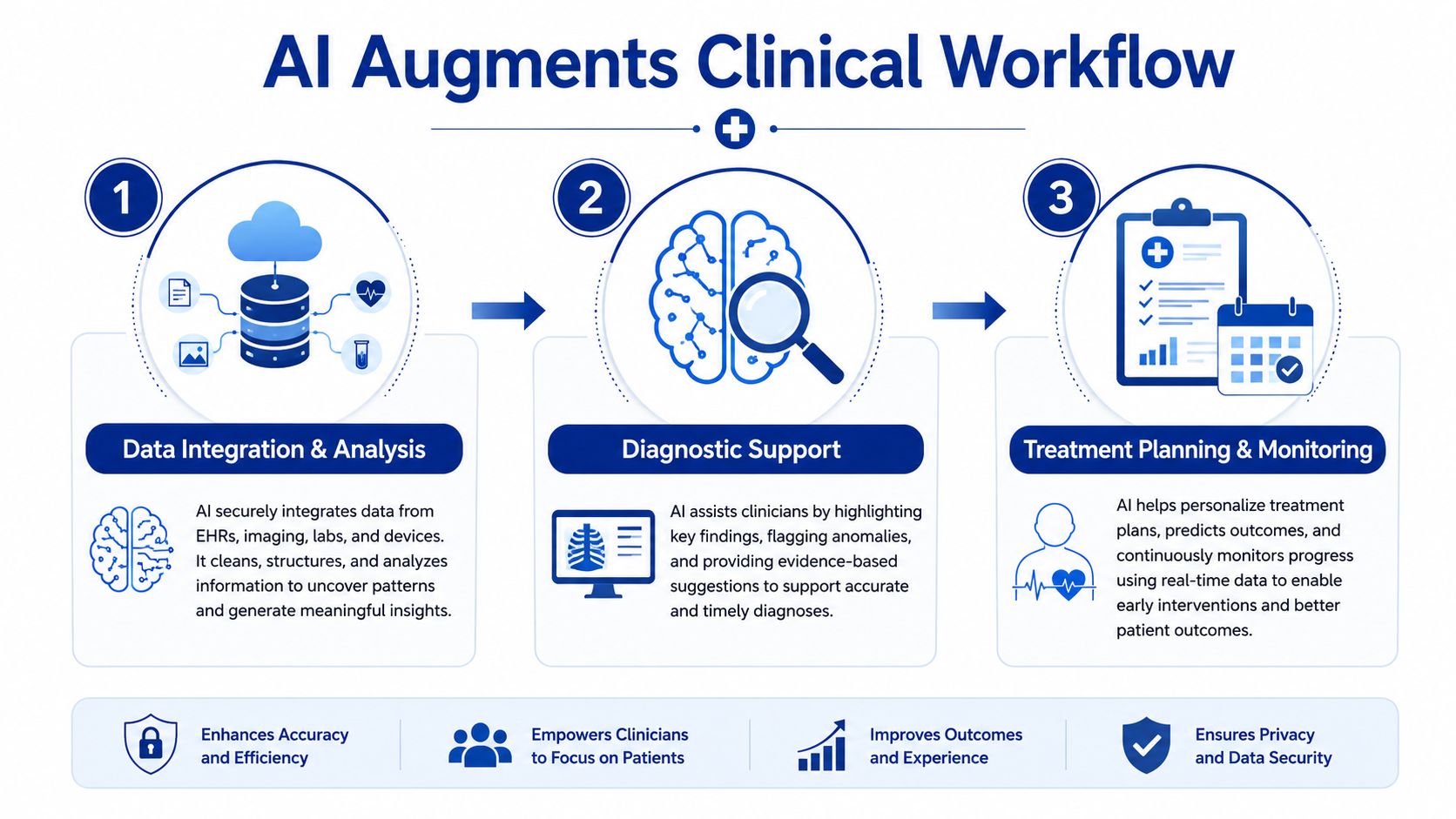
AI has the most practical value when it is built into the tasks clinicians already do every day. In a busy clinic, the question is rarely whether a model is impressive in isolation. The question is whether it helps a doctor, nurse practitioner, pharmacist, or receptionist complete the next step safely, quickly, and with less mental clutter.
Documentation and cognitive offloading
One of the clearest early uses of AI in clinical settings is documentation. That matters because documentation is not just an administrative burden. It competes with diagnostic reasoning for the same limited attention.
An AI scribe works like a junior assistant preparing a first draft. It captures the conversation, structures the note, and suggests wording for the assessment or plan. The clinician still checks the facts, corrects omissions, and signs off. Used well, the tool reduces clerical load while keeping responsibility where it belongs.
This is also where many clinic managers first see a return. If doctors finish notes sooner, they are less likely to carry unfinished charting into the evening. If notes are clearer and more consistent, coding, billing, referrals, and continuity of care improve as well. Teams comparing tools should pay close attention to the features of clinical documentation software, especially audit trails, edit controls, and how drafts are reviewed before they become part of the record.
Clinical support at the point of decision
AI can also support the parts of care that depend on sorting complex information under time pressure. The role here is not to hand over judgement. The role is to surface relevant signals at the right moment.
In practice, that often means four kinds of support:
Differential support that suggests possible diagnoses worth checking against the history, examination, and test results
Medication review that flags contraindications, interactions, or dosing concerns inside prescribing workflows
Risk stratification that identifies patients who may need earlier follow-up, closer monitoring, or escalation
Trend summarisation that brings together changes in symptoms, observations, or utilisation over time
Published research on knowledge-based clinical decision support systems shows that these tools can improve practitioner performance in diagnosis and recommendation tasks. The practical lesson for clinics is straightforward. AI adds the most value when it presents a relevant prompt inside the normal review process, not when it asks clinicians to leave their workflow and interpret a detached score.
Medication safety offers a useful example because the workflow is familiar. High-quality evidence summarised in this review of clinical decision support systems found improvements in suboptimal prescribing and reductions in potential medicines-related problems. The same review also highlights alert fatigue. That is the operational warning clinic leaders should remember. An alert that fires too often, fires too late, or cannot be actioned quickly becomes background noise.
Workflow fit determines adoption
A strong model can still fail in practice if the setup is poor. If staff must re-enter data, switch between multiple screens, or chase output that does not map to their usual process, the tool adds friction instead of removing it.
A useful way to assess this is to follow the patient journey through the day.
| Workflow point | What good integration looks like |
|---|---|
| Before consultation | Relevant history, previous results, and risk indicators appear in a form the clinician can scan quickly |
| During consultation | Documentation support stays in the background and does not disrupt rapport, eye contact, or shared decision-making |
| After decision | Notes, letters, coding, tasks, and follow-up actions flow into the existing record and admin process |
For a closer look at how this works in real settings, this guide to AI clinical decision support in practice is a useful companion read.
Canadian clinics need one more filter. A tool may look helpful in a demo and still be difficult to deploy if privacy, data residency, procurement, and Privacy Impact Assessment requirements have not been addressed early. That is why the sensible view of AI is not "Will it replace clinicians?" but "Where does it reduce cognitive load without weakening accountability?" Clinics that answer that question well usually choose systems that support the existing workflow, preserve human review, and can pass real regulatory scrutiny.
Practical AI Solutions for the Modern Clinic
The AI market in healthcare is crowded, so clinics need a way to separate categories. Most buyers will encounter two broad families of tools. One uses rules and expert knowledge. The other uses models trained to detect patterns in data.
Two common types of AI support
Knowledge-based clinical decision support systems usually work through logic, rules, and validated content. They can issue prescribing alerts, highlight contraindications, or prompt best-practice actions. These systems are often easier to explain because the reasoning path is clearer.
Machine learning tools look for patterns in images, records, or operational data. They may support imaging review, patient risk stratification, or early warning workflows. Their strength is scale and pattern recognition. Their weakness, if poorly implemented, is opacity.
A clinic manager doesn't need to become a data scientist. But they do need to ask which class of tool they're buying, what problem it solves, and how clinicians will validate output.
What this looks like in practice
Consider three common scenarios.
A radiologist reviews an image with an AI overlay that highlights suspicious regions. The radiologist doesn't hand over the case. They use the overlay as a second reader that may prompt a closer look.
A GP dashboard flags a patient whose pattern of results and history suggests rising clinical risk. The flag doesn't make a diagnosis. It helps the practice decide who may need earlier contact.
A specialist clinic uses AI to prepare draft education material and structured records after consultations. Staff then review, correct, and personalise those documents before they reach the patient.
Major trends in Canadian healthcare AI include its integration into diagnostic imaging such as radiology and pathology, and the use of predictive analytics for early warning systems and patient risk stratification, with peer-reviewed Canadian studies reporting gains in diagnostic accuracy for selected use cases (Canadian healthcare AI trends and developments).
What buyers should look for first
When teams compare products, the first screen shouldn't be marketing language. It should be operational fit.
Clinical fit: Does the tool solve a problem your clinicians face?
Output clarity: Can users see the basis of a recommendation or flag?
System fit: Will it work with current records, workflows, and review processes?
Documentation value: Does it save staff time without lowering note quality?
For practices reviewing documentation tools specifically, this overview of the features of clinical documentation software gives a practical checklist worth comparing against your current workflow.
A modern clinic doesn't need every AI product on the market. It needs a small number of tools that remove real friction and can be governed properly.
Implementing AI Safely and Ethically in Canada
Healthcare leaders often ask the wrong first question. They ask whether an AI tool is impressive. The better question is whether the clinic can introduce it safely, lawfully, and in a way staff can trust.
Governance starts before deployment
In Canada, regulators make one point very clear. A Privacy Impact Assessment (PIA) must be completed when an AI tool is first introduced to a practice for use in decision-making, and AI outputs must be assessed for accuracy, reliability, and limitations before being used in patient care (Canadian AI requirements for regulated health professionals).
Healthcare AI often touches sensitive patient information, workflow design, and clinical accountability simultaneously. A procurement process that skips governance is not efficient; it's incomplete.
Governance question: If a tool produces an incorrect output, who catches it, how is it documented, and what process improves the system afterwards?
The ethical risks are practical, not abstract
The biggest concerns usually fall into four areas:
Privacy: Patient data handling, storage, access, and third-party processing
Bias: Outputs may perform unevenly across populations if design or training is narrow
Overreliance: Staff may accept AI suggestions too quickly if the interface appears authoritative
Accountability: Final responsibility still sits with clinicians and organisations
These aren't theoretical worries. They shape whether a tool is safe in daily use. Practices working through privacy obligations and implementation planning may find this article on AI in healthcare data privacy in Canada useful for operational context.
A safer implementation checklist
A sensible clinic rollout usually includes:
PIA completion before live use
Local validation against real workflows and sample cases
Role clarity so staff know where AI assists and where human review is mandatory
Feedback loops for incorrect, weak, or unhelpful outputs
Ongoing review because tools, models, and risks change over time
Safe AI adoption isn't about saying yes or no to innovation. It's about creating a system where useful tools can operate under disciplined oversight.
The Future of AI-Assisted Healthcare
The future of clinical decision-making isn't doctor versus machine. It's a better division of labour.
AI is well suited to handling volume, repetition, retrieval, pattern support, and structured drafting. Clinicians remain essential for judgement, accountability, conversation, and the interpretation of context that doesn't fit neatly into data fields. That's especially true when patients are uncertain, when symptoms don't follow a script, or when treatment choices depend on values as much as evidence.
The most promising organisations will be the ones that use AI to create more room for human care. That means less time wrestling with notes, fewer missed prompts in complex cases, and more attention for explanation and shared decisions.
Clinical decision-making will still be hard. It should be. The point isn't to remove complexity from medicine. It's to give clinicians better tools for managing it.
Frequently Asked Questions
Can AI replace doctors in clinical decision-making?
No. AI works best as a clinical support tool, not as a substitute for professional judgement. It can help sort information, draft summaries, surface possible risks, and reduce clerical load, but the clinician still carries responsibility for diagnosis, treatment, consent, and follow-up.
A practical way to view it is this: AI can act like a second set of eyes on the record, but it is not the person in the room with the patient.
What's the best first AI use case for a clinic?
For many clinics, documentation support is the strongest starting point. It addresses a daily pain point, staff can assess it quickly, and the risk is usually easier to control than with tools making diagnostic suggestions.
Structured summarisation and risk flagging can also work well early on, especially if a clinician reviews every output before it affects care.
How should a clinic evaluate an AI tool?
Start with the workflow, not the sales demo. Ask where the tool fits in the consultation, who checks the output, how corrections are made, and whether it works with your current EMR and communication systems.
Then examine the practical safeguards. Look at privacy, audit trails, staff training, explainability, and what happens when the tool is wrong. A good product in the wrong workflow usually creates extra work rather than saving time.
Do clinicians still need to verify AI output?
Yes. Every output needs human review before it is relied on in care. That includes notes, summaries, alerts, coding suggestions, and any diagnostic prompt.
AI can sound confident even when it is incomplete, outdated, or misaligned with the patient's actual situation.
What makes AI adoption fail in healthcare?
Poor integration is one of the main reasons adoption stalls. If staff have to copy and paste between systems, repeat checks manually, or leave their usual workflow to use the tool, usage drops quickly.
Governance problems cause just as much damage. Clinics run into trouble when they buy software before agreeing who owns review, what level of oversight is required, and how privacy risks will be handled. In practice, trust and workflow fit matter as much as technical performance.
What should Canadian clinics do before implementation?
Canadian clinics should complete the privacy and governance work before rollout, especially if the system will influence decisions, document care, or process patient data across multiple systems. In many settings, that means carrying out a Privacy Impact Assessment and confirming how provincial requirements apply to the intended use.
After that, run a controlled pilot in your own environment. Test outputs with real workflows, define human oversight clearly, and document how errors, corrections, and exceptions will be handled. That is the difference between an AI tool that looks impressive in a demo and one that is safe and useful in day-to-day care.
Cleffex Digital Ltd helps healthcare organisations turn ideas like AI-assisted clinical decision-making into secure, usable software systems that work in real practice. If your clinic, hospital, or health startup needs connected platforms, compliant integration, or custom healthcare software, explore Cleffex Digital Ltd to start the conversation.