


Canada's AI healthcare market isn't inching forward. It's moving from USD 163.80 million in 2024 to a projected USD 3,321.44 million by 2033, with a 36.81% CAGR, according to IMARC's Canada artificial intelligence in healthcare market analysis. For hospital leaders, clinic owners, and health technology teams, that changes the conversation.
The question isn't whether AI will affect Canadian healthcare. It already is. The actual question is whether your organisation will adopt it in a controlled, useful, compliant way, or end up with scattered tools, unclear ownership, and workflow disruption.
That's where AI healthcare consulting matters. Not as a buzzword. As a discipline for deciding what to automate, what to validate, what to reject, and what to scale.
The AI Revolution in Canadian Healthcare
Canadian healthcare organisations are trying to absorb fast-growing AI investment at the same time they are dealing with staff shortages, wait-time pressure, and rising administrative load. For hospital executives and clinic owners, the near-term opportunity is not limited to clinical AI. It sits in the back office and at the front desk, where documentation, scheduling, intake, billing, prior authorisation, referral handling, and patient follow-up consume hours every day.
That is where many Canadian organisations can get an earlier return. Automating repetitive administrative work usually carries less clinical risk than decision-support tools, and it is often easier to measure. Teams can track call handling time, claims processing speed, no-show reduction, chart completion lag, and staff hours returned to patient-facing work.
Growth in the market has created urgency, but it has also created confusion. Leaders are being asked to approve pilots before anyone has confirmed whether the source data is structured, whether privacy obligations differ by province, or whether the workflow can support a new tool without adding friction for clinicians and staff.
In practice, AI adoption rarely fails because the model is weak. It fails because the organisation is not ready to support it. I see the same pattern repeatedly. Data sits across EMRs, scheduling systems, billing tools, scanned PDFs, and spreadsheets. Naming conventions are inconsistent. Consent rules and retention requirements are not handled early enough. A promising use case stalls before procurement is complete.
That is why the strongest AI programs in Canadian healthcare usually start with a business case and a data assessment, not a product demo. A good first project solves a visible operational problem, uses data the organisation can access, and can pass privacy and security review without months of rework. Readers assessing the broader operational upside can review these benefits of AI in Canadian healthcare alongside their own cost and workflow priorities.
Teams that are new to the advisory side of this work may also benefit from understanding AI consulting before they evaluate healthcare-specific engagements.
In Canada, that discipline matters. Provincial privacy expectations, public and private care delivery models, procurement constraints, and uneven data quality all shape what is realistic in the first 6 to 12 months. The organisations that get value from AI are usually the ones that treat it as an operational transformation effort with technical, legal, and clinical oversight built in from the start.
What AI Healthcare Consulting Really Is
AI healthcare consulting is most easily understood as architecting a smart hospital. An architect doesn't just choose materials. They design for use, safety, regulation, flow, and long-term performance. An AI consultant should do the same.
It's not software selection alone
A weak engagement starts with a demo. A strong one starts with questions such as:
What workflow is failing today
Which users will trust or resist the tool
What data is available and usable
Which approvals are required before deployment
How success will be measured in practice
That distinction matters because healthcare AI consulting services are growing as a specialised field. The global market is projected to grow from USD 8.75 billion in 2025 to USD 17.15 billion by 2031, at a 12.24% CAGR, according to Mordor Intelligence's healthcare AI consulting services market report. That demand exists because organisations need guidance on deployment, governance, and risks such as unsanctioned AI use.
The five jobs a consultant actually performs
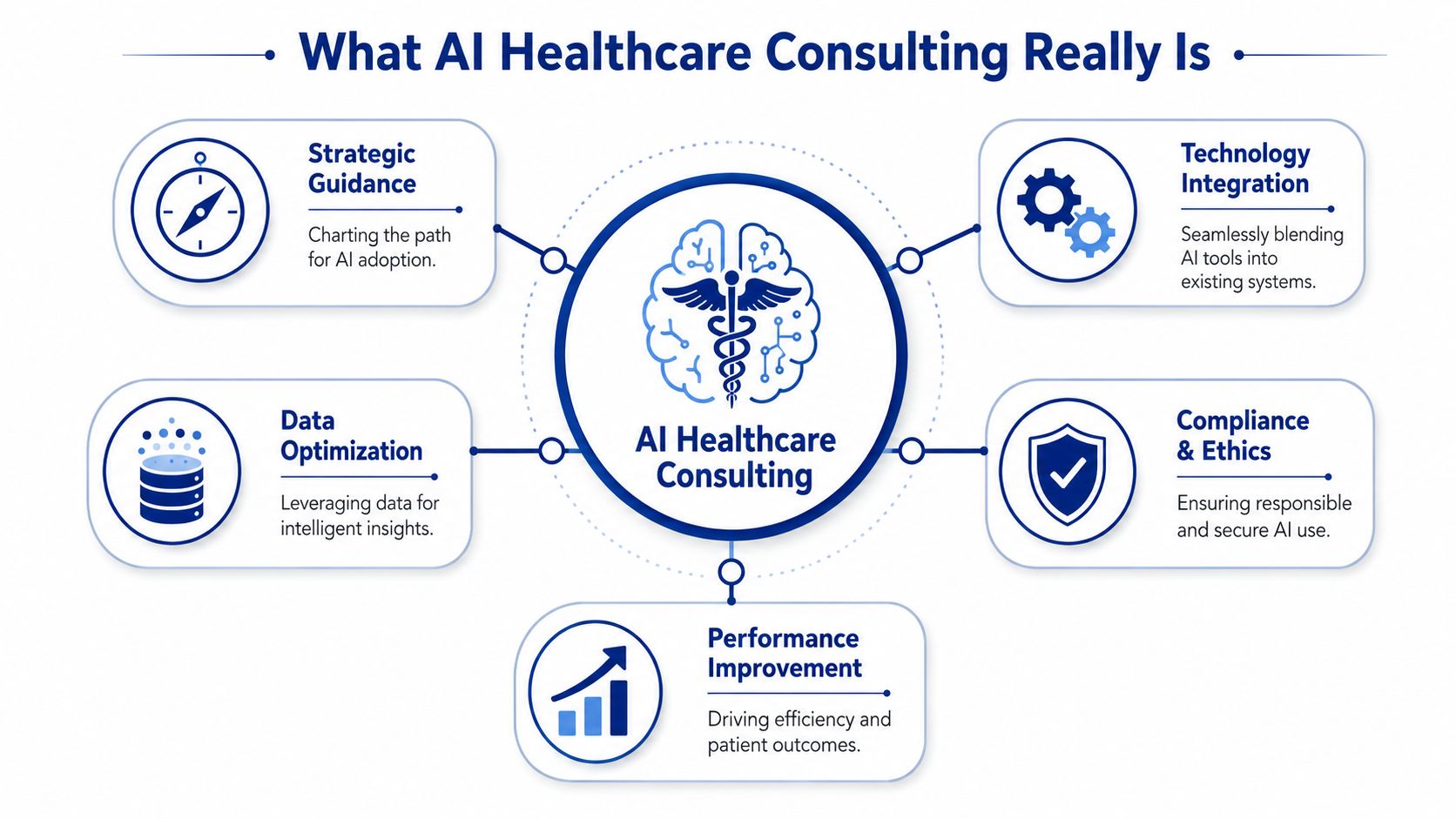
In practice, good AI healthcare consulting usually covers five connected responsibilities:
Strategy
The team defines where AI fits the organisation's priorities. That may be reducing documentation time, improving intake handling, or improving consistency in coding and referrals.Data assessment
Many projects live or die during this phase. Consultants check whether source data is structured, complete, permissioned, and fit for the intended use.Integration design
AI that sits outside the EMR, scheduling system, call flow, or document process often creates more work than it removes. Integration planning is operational planning.Compliance and governance
Healthcare leaders need rules for tool approval, human oversight, logging, vendor accountability, and patient data handling.Performance management
Once a tool is live, someone has to decide whether it's helping. That requires agreed metrics, review cadence, and an escalation path when outputs drift or workflow friction rises.
Practical rule: If a consultant can't explain how an AI tool changes the daily work of front-desk staff, clinicians, privacy officers, and managers, the engagement is still too abstract.
If you want a broader business lens before narrowing to healthcare, this piece on understanding AI consulting offers a useful primer on how consulting differs from buying AI software.
Transformative Use Cases Beyond the Hype
The loudest AI conversations in healthcare still revolve around diagnostics. Those use cases matter, but many Canadian organisations will get faster returns from administrative work that slows clinics and burns out staff.
Start where work is repetitive
A family practice doesn't need a moonshot to benefit from AI. It needs fewer bottlenecks. In real settings, that often means looking at the tasks that happen hundreds of times a week and add little strategic value when done manually.
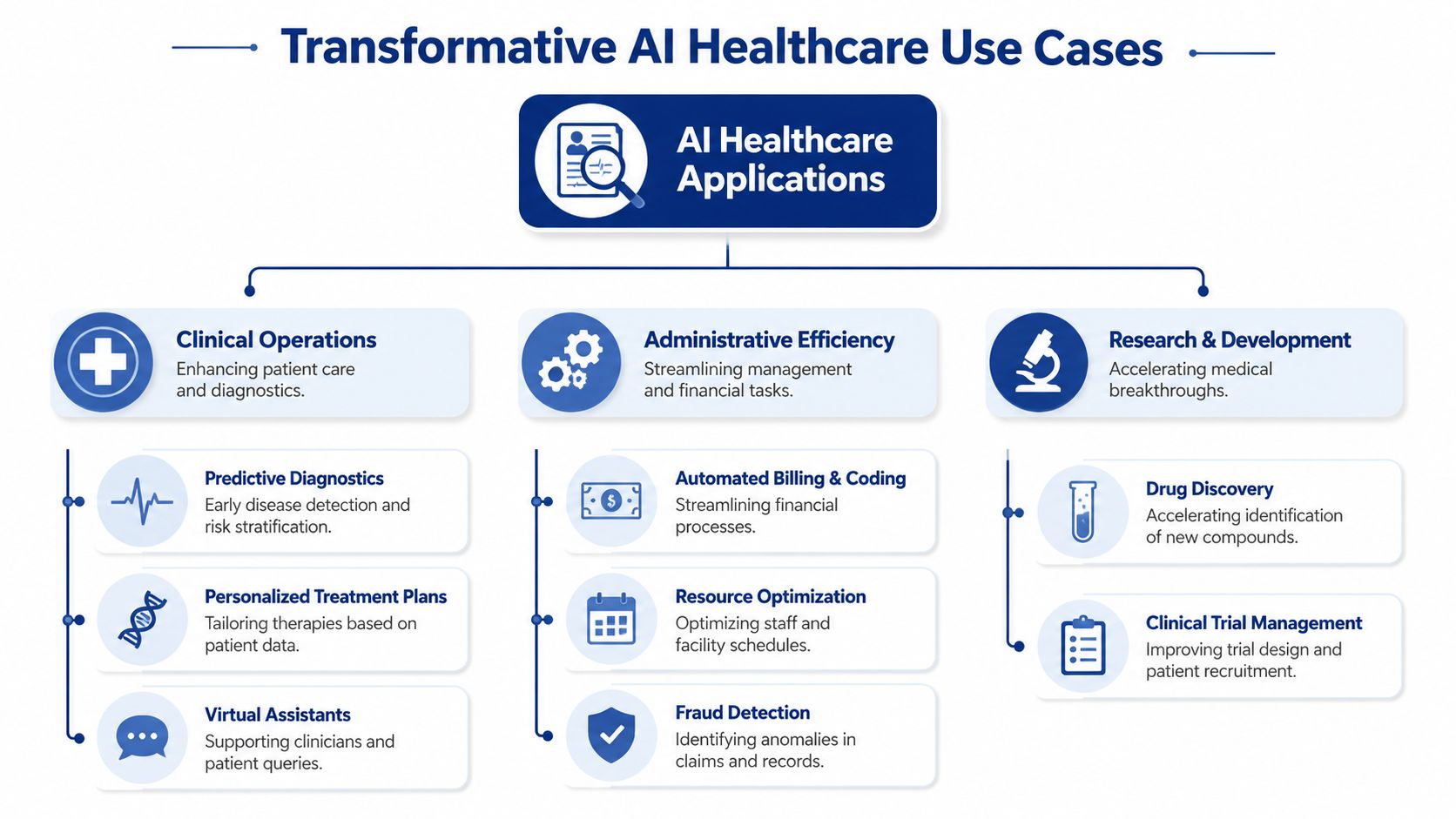
Three categories tend to stand out:
Clinical support tasks that organise information for clinicians, surface relevant context, or assist with routine patient communication
Patient service workflows such as triage intake, appointment routing, reminder handling, and follow-up coordination
Administrative operations including note generation, scheduling support, coding assistance, and document classification
The biggest overlooked opportunity is administrative burden reduction. In Canada, AI-driven automation of tasks such as notetaking and scheduling represents a CA $9B to $16B net savings opportunity, according to Cleffex's strategic guide to AI healthcare consulting. That same analysis notes that adoption is slowed by data readiness and regulation, which is exactly why organisations need disciplined implementation support.
What tends to work first
The strongest early use cases usually share three traits. They're high-volume, rules-based, and easy to audit.
The best first deployment often isn't the most advanced model. It's the one staff will actually use next Monday.
Examples that fit this pattern include:
Ambient documentation support for clinician note capture and summarisation
Scheduling assistance that reduces back-and-forth for bookings and rescheduling
Document intake and routing for referrals, forms, and incoming records
Administrative chat support for common non-clinical patient questions
These are also easier to govern because humans can review outputs before they affect care decisions.
Where teams overreach
Problems usually start when leadership tries to implement AI in the most sensitive workflow before proving operational discipline elsewhere. If the data is inconsistent, if front-line teams weren't involved, or if no one has defined acceptable error handling, adoption stalls.
That's why visual communication also matters during implementation. When training staff or explaining new workflows to patients, teams sometimes use tools such as Natomy's AI medical illustration tool to create clearer educational materials around procedures, anatomy, or care pathways.
One practical example from the solution side is Cleffex Digital Ltd, which offers AI-driven EHR capabilities that automate administrative work and support predictive insights. That kind of tooling can be useful when paired with workflow redesign, governance, and measurable rollout criteria. On its own, software won't fix process confusion.
Navigating the Canadian Compliance and Data Maze
In Canadian healthcare, AI projects rarely fail because the algorithm is too simple. They fail because nobody resolved the privacy, data ownership, accountability, and workflow questions early enough.

Compliance is a design input
Teams often talk about PHIPA, PIPEDA, provincial privacy obligations, and data residency as if they're late-stage legal checks. They aren't. They shape vendor choice, hosting decisions, access controls, audit logging, and how model outputs are reviewed.
That means an AI healthcare consulting engagement in Canada has to involve more than technical staff. Privacy officers, clinical leadership, operations, procurement, and legal review all need a practical role. If they only see the project after a vendor is chosen, delays are almost guaranteed.
For leaders building more formal internal controls around regulated workflows, a process-oriented resource like this guide for pharma on compliant documentation can help frame how structured documentation supports oversight, training, and auditability, even though healthcare provider environments have their own Canadian requirements.
Data readiness is more than data availability
A common executive assumption is that having an EMR means being AI-ready. It doesn't. Readiness depends on whether the right fields exist, whether records are consistent, whether permissions are clear, and whether the workflow can tolerate ambiguity.
A consultant should test questions such as:
Can the model access the required fields legally and operationally?
Are key records complete enough to support reliable output?
Who reviews low-confidence results?
Where is the human override?
What logs prove appropriate use?
If those answers are vague, the project isn't ready for production.
Indigenous data sovereignty cannot be treated as a footnote
Generic AI guidance often misses one of the most important Canadian realities. Effective AI consulting in Canada must address Indigenous-led data sovereignty, including frameworks that call for “non-biased AI-enhanced community profiles” and assessment of “digital readiness” while respecting Indigenous governance, as discussed in this SAGE-published framework for remote and Indigenous Canadian populations.
That has practical consequences. Consultants working with remote care programmes or community-based services can't just port in a standard urban deployment model. They need governance structures that reflect local authority, local context, and local consent expectations.
Governance starts before procurement. If your organisation can't say who owns the data, who approves the use case, and who is accountable for harm, it's too early to buy.
For a Canada-specific view of these privacy issues, this overview of AI in healthcare data privacy in Canada gives a useful operational lens.
Choosing Your Strategic AI Consulting Partner
The wrong consulting partner usually sounds impressive in the first meeting. The right one sounds specific.
A credible partner should ask about referral flow, charting burden, patient access problems, privacy approvals, and integration constraints. If the conversation stays at the level of “AI transformation” without touching scheduling logic, document handling, or clinician workflow, you're probably speaking to a vendor-led sales process rather than a consulting-led delivery model.
What to look for in practice
Use these criteria when evaluating firms:
Healthcare workflow fluency
They should understand how clinics, hospitals, and care teams operate. Technical skill matters, but healthcare delivery context matters just as much.Canadian compliance awareness
They don't need to be your legal counsel, but they should know how privacy, data residency, governance, and accountability affect implementation choices.Data and integration capability
A team that can't deal with messy source systems, workflow mapping, and system interoperability won't get a project into production.Change management discipline
AI projects succeed when users trust the process. Training plans, fallback procedures, and role clarity are part of delivery, not extras.Transparent engagement model
You should know what is included, what is excluded, how decisions are documented, and how success will be measured.
Questions worth asking before you sign
A good interview reveals how the partner thinks. Ask questions that force practical answers:
How do you assess whether a use case is ready for AI?
How do you handle workflow redesign alongside tool deployment?
What governance artefacts do you produce?
How do you manage vendor risk and unsanctioned AI use?
What happens if the pilot shows weak adoption or poor output quality?
Ask for an example of a project they decided not to scale. A serious consulting team knows when to stop.
Comparing AI consulting pricing models
| Model | Best For | Cost Structure | Key Consideration |
|---|---|---|---|
| Project-based | Defined use cases with clear scope | Fixed or scoped fee for a specific engagement | Scope control matters. Change requests can expand timelines and cost. |
| Retainer | Ongoing advisory, governance, and roadmap support | Monthly recurring fee | Best when you need steady decision support across multiple initiatives. |
| Success-based | Narrow engagements tied to agreed outcomes | Payment linked to predefined milestones or results | Works only when outcomes are measurable and attribution is clear. |
| Hybrid | Organisations combining implementation and ongoing oversight | Mix of project fee and recurring advisory cost | Useful when a pilot is likely to expand into broader operational rollout. |
If you're weighing build-versus-buy decisions at the same time, this guide to choosing a healthcare technology partner in Canada can help sharpen the evaluation.
A Phased Roadmap for Successful AI Implementation
Most healthcare AI failures don't come from ambition. They come from skipping sequence. Teams jump from idea to vendor, or from pilot to scale, without proving readiness in between.
Phase 1 and Phase 2
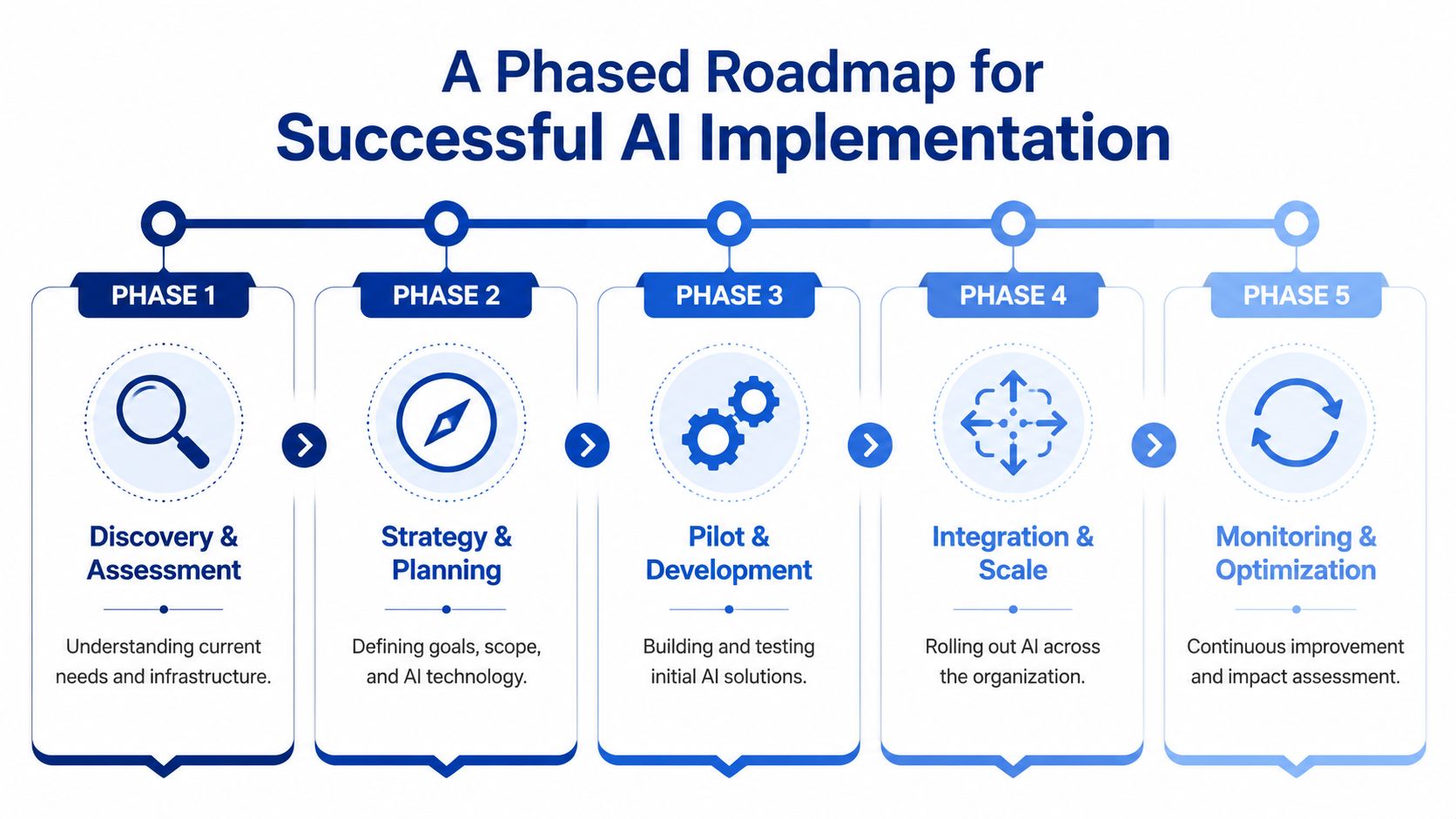
Discovery and assessment come first. The organisation identifies the operational problem, current workflow, user groups, system constraints, and risk profile. This stage should produce a shortlist of viable use cases, not a shopping list of tools.
Strategy and planning follow. Here, the team defines scope, governance, success criteria, review roles, and implementation boundaries. If there's no written decision on what the AI will not do, the plan is incomplete.
A practical output at this stage often includes:
Workflow maps that show current and future-state steps
Data inventories that identify source systems and access limits
Governance rules for approval, review, escalation, and documentation
Pilot metrics aligned with operational outcomes
Phase 3
Pilot and development is where many organisations either gain confidence or discover they were too early. The point of a pilot isn't to prove AI is exciting. It's to test whether the workflow, data, users, and controls hold up under real conditions.
Useful pilot measures are often operational, such as:
Reduction in documentation workload
Improvement in scheduling turnaround
Decrease in manual data entry
User adoption and override patterns
Escalation frequency for uncertain outputs
Notice that these are business and workflow measures, not just model measures.
Phase 4 and Phase 5
Integration and scale start only after the pilot shows consistent value and manageable risk, at which point teams embed the solution into daily operations, expand access, train users by role, and formalise support ownership.
Monitoring and optimisation never stops. Models, workflows, and user behaviour all drift. If no one reviews outputs, exception handling, and user feedback after launch, the deployment becomes fragile fast.
Operational advice: Treat go-live as the start of governance, not the end of the project.
A strong roadmap also includes stop conditions. If the data quality is poor, if user trust collapses, or if the workflow impact is negative, the right decision may be to redesign or pause. Mature teams don't confuse movement with progress.
Taking Your First Step with Confidence
AI in healthcare isn't a single purchase. It's a series of decisions about workflow, data, accountability, and change. That's why the organisations seeing traction aren't the ones chasing the flashiest demos. They're the ones choosing clear use cases, putting guardrails in place, and treating implementation as an operational programme.
In Canada, that discipline matters even more. Privacy expectations, provincial realities, data handling requirements, and Indigenous governance considerations all shape what responsible adoption looks like. The upside is real, especially in administrative automation. But value only shows up when the deployment fits the care environment it's meant to support.
If you're considering AI healthcare consulting, start small and start practically. Identify one workflow with visible friction. Check whether the data is usable. Decide who owns the risk. Then bring in a partner who can guide strategy, validation, compliance, and rollout without turning the project into theatre.
If your team is evaluating AI opportunities in clinics, hospitals, or healthcare operations, Cleffex Digital Ltd can help you start with a practical readiness conversation focused on workflow fit, compliance constraints, and implementation priorities. A good first step is a scoped assessment of one administrative use case, such as documentation, scheduling, or patient intake, before committing to a wider rollout.