

Canada's Lynx payment system processes more than $400 billion each day, according to the Bank of Canada's account of payment modernisation. At that scale, a payment isn't just a request followed by a confirmation. It's the beginning of several related activities, each with different responsibilities, timing requirements and failure risks.
For product teams considering event-driven architecture, FinTech presents a demanding test. Customers want immediate answers, finance teams need trustworthy balances, and investigators need evidence when something goes wrong. Good architecture must support all of them, not just move messages quickly.
Why FinTech Product Teams Are Rethinking Architecture
A customer submits an insurance payout request. The application contacts the payment provider, updates accounting, sends a notification and refreshes the claims dashboard. In a tightly coupled design, developers might put these tasks into a chain of synchronous API calls.
That works until a dependency stops answering. If the notification service fails after the payment succeeds, should the application show an error? Should the customer try again? Without explicit payment states, a minor communication problem can become a financial problem.
Canadian payments change the design context
Payments Canada began its modernisation programme in 2016, and Lynx went live in 2021. Beyond that high-value infrastructure, the instant payment system, or RTR, is designed for continuously available, data-rich payments. Payments Canada indicated that it should be ready for industry testing in 2026. That is a testing milestone, not confirmation of a public launch.
Canada also has an established instant-payment foundation. Interac e-Transfer launched in 2002, and more than 280 financial institutions participated in the Canadian real-time payments ecosystem by January 2024. Nevertheless, real-time payments represented just 5.9% of transaction volume in 2023, according to ACI Worldwide's Canadian payment overview.
The architectural implication is practical: teams need to support immediate payment activity without assuming every related service can finish at the same moment.
Separate immediate answers from downstream work
Synchronous APIs still have a place. A customer needs an immediate response when submitting an instruction, and Suby's payment API explainer is a useful companion for understanding that application-facing boundary.
The design question is what must happen before that response, and what can safely happen afterwards.
Before acceptance: Validate the instruction and apply any mandatory authorisation or risk controls.
After a durable state change: Let independent services perform appropriate follow-up work.
When status is uncertain: Show a pending state rather than encouraging another payment attempt.
Practical rule: Don't make successful money movement depend on successful delivery of a customer email.
Event-driven architecture offers a way to separate those responsibilities. Its value depends on clear event meanings, reliable financial records and deliberate handling of failure, not on replacing API calls with a broker.
How Event-Driven Architecture Works in FinTech
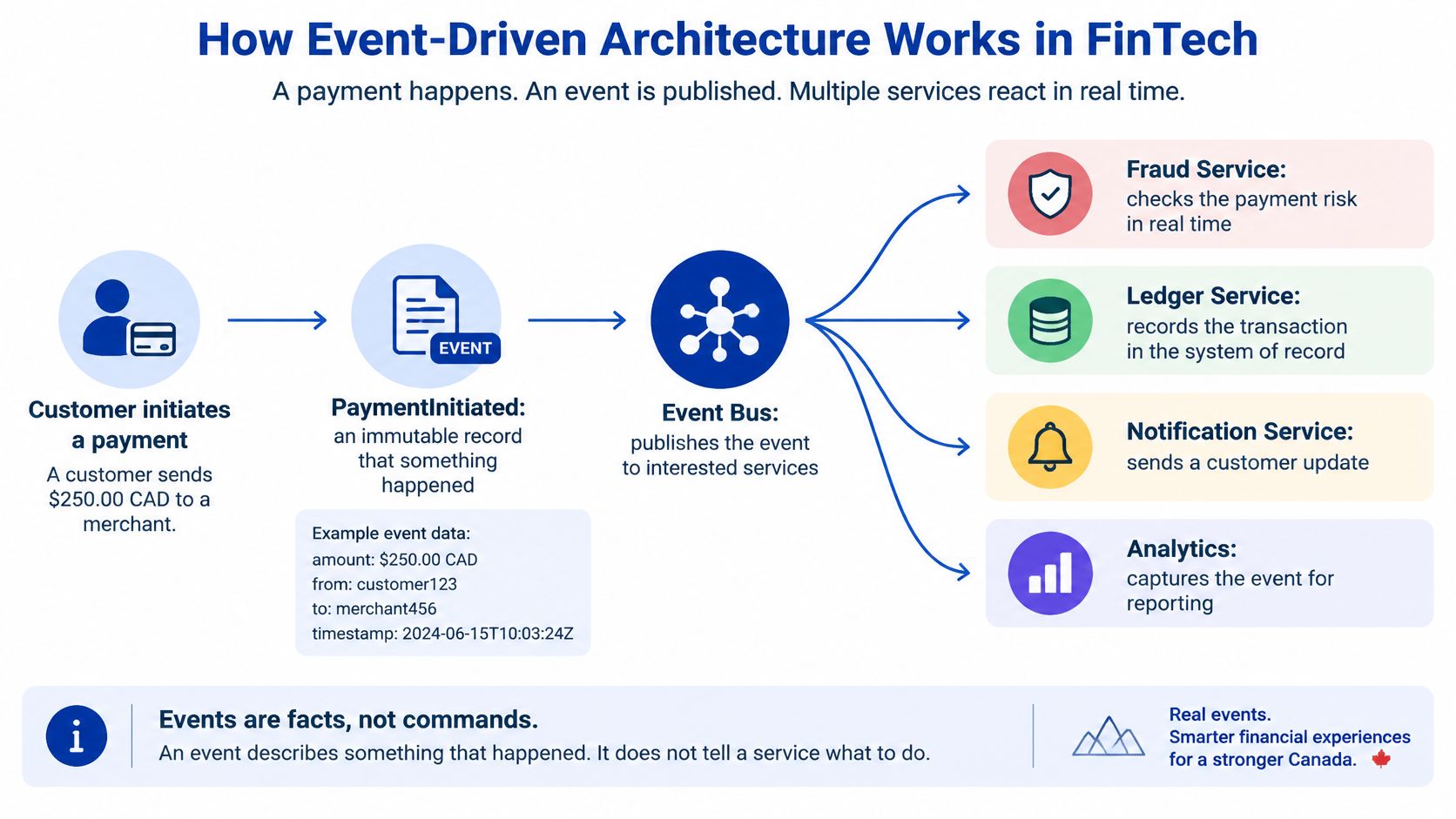
A customer initiates a payment. The payment service validates the instruction, saves its authoritative state and publishes PaymentInitiated.
That event records something that has happened. It doesn't mean the recipient has received the money, and it doesn't authorise every interested service to change the payment.
Follow the payment through the components
The payment service is the producer. It publishes the event with enough context for other services to understand it, such as a payment identifier, event identifier, creation time and schema version.
A broker, sometimes described as an event bus, receives the publication and makes it available to interested consumers. A fraud service might assess risk, a workflow service might advance processing, and an analytics consumer might update reporting data.
Think of a shared newsroom wire rather than a chain of phone calls. The producer publishes a fact; subscribers decide how to respond within their responsibilities. The producer doesn't need to know every subscriber's internal implementation.
An event store adds durable history and replay capability. It isn't automatically the same thing as the broker: teams must explicitly decide where events live, how long they remain available and who can replay them.
Events, commands and messages aren't interchangeable
These terms describe different things:
Event:
PaymentInitiatedstates that an instruction was recorded.Command:
AssessPaymentRiskasks a particular component to perform work.Message: The transport envelope carrying either an event or a command.
Naming matters. PaymentAccepted should have a documented business meaning, rather than meaning whatever an individual consumer assumes it means.
For a conceptual payment flow, fraud screening, ledger handling, notifications and analytics can react independently to relevant events. Independence doesn't remove business dependencies, though. A notification service mustn't announce settlement merely because it received an initiation event.
Keep financial authority explicit
The ledger remains the authority for balances and financial positions. An event stream supports integration, investigation and replay; it doesn't remove the need for transactional financial controls.
Preserve structured payment context rather than reducing rich messages to vague text references. Retaining message identifiers, versioned schemas and correlation identifiers is a practical approach for ISO 20022-based flows, alongside the distinction between event history and the system of record described in this Payments Canada integration reference.
The product manager's key question is therefore simple: What fact does this event prove, and which component is authorised to act on it? Answer that before discussing broker technology.
Event-Driven Patterns in Financial Software Architecture
A team can adopt events without adopting every event-driven pattern. Choosing selectively keeps financial software architecture understandable and avoids turning a straightforward integration problem into an unnecessary platform rebuild.
Start with the business problem. Does the product need independent subscribers, reconstructable history, a faster dashboard or coordination across a long-running payment process?
Comparing Event-Driven Patterns for FinTech
| Pattern | How It Works | Best Fit in FinTech |
|---|---|---|
| Publish-subscribe | A producer publishes an event for independent subscribers. | Customer updates, monitoring and downstream reporting. |
| Event sourcing | An append-only event history supports reconstruction of application state. | Workflows requiring carefully governed historical reconstruction. |
| CQRS | Commands update authoritative state, while separate read models serve queries. | Payment dashboards and transaction searches with distinct read workloads. |
| Saga or process manager | A coordinator tracks local steps and invokes appropriate compensating actions. | Refunds, payouts and settlement workflows spanning services. |
| Event-carried state transfer | Events include selected business context that consumers need locally. | Reducing repeated lookups for permitted transaction attributes. |
These patterns solve different problems. Publish-subscribe doesn't require event sourcing, and CQRS doesn't mean every application needs a separate database for every screen.
Event-carried state transfer also creates a trade-off: copying more context reduces lookups but distributes more information. Include only fields a consumer needs.
For the broader relationship between these choices and application structure, see enterprise application architecture patterns.
Model payment transitions precisely
A practical state model might include PaymentInitiated, PaymentAccepted, PaymentSettled, PaymentRejected and PaymentReversed. These names should correspond to valid transitions, with rules governing which transitions can follow others.
The RTR's multi-stage payment process makes explicit states particularly important. Routing, validation, confirmation, clearing and settlement aren't a single indistinguishable action, as illustrated by Payments Canada's real-world payment use cases.
Consumers must accommodate delivery problems:
Idempotency: Reprocessing an instruction mustn't repeat its financial effect.
Deduplication: Recognise an event that has already been handled.
Ordering: Don't let a late-arriving event overwrite a more authoritative state.
Retries with backoff: Retry recoverable failures without overwhelming an unavailable dependency.
Explicit uncertainty: Resolve unanswered calls through status enquiries or later authoritative events.
A timeout proves that a response wasn't received. It doesn't prove that the payment failed.
A saga also isn't a magical distributed rollback. Sending a compensating instruction requires its own authorisation, processing and evidence, particularly when money has already moved.
Real-Time FinTech Use Cases and Examples
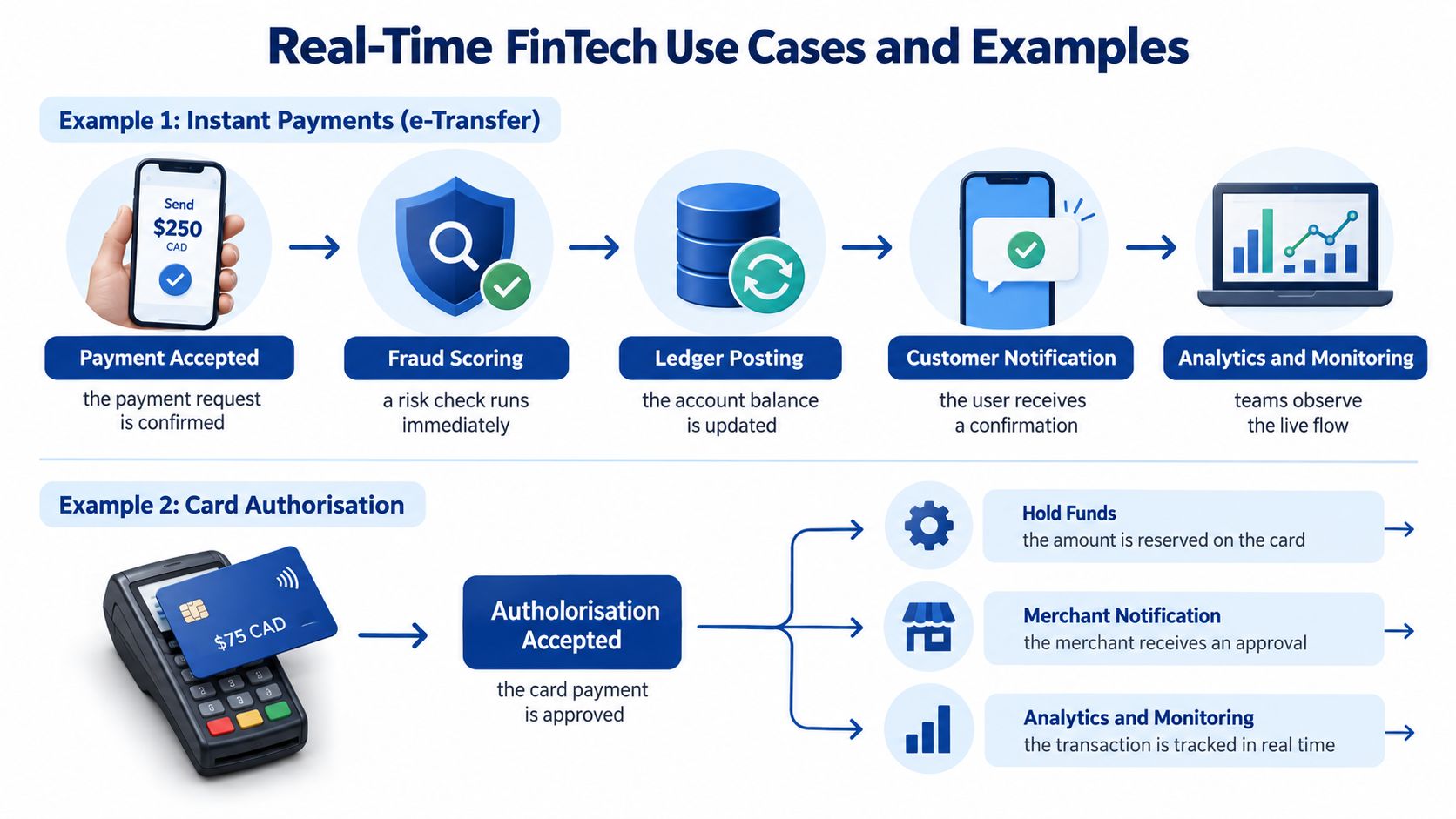
Consider the following as illustrative product designs, not claims about deployed customer systems. Each begins with a business event, identifies the services that react and makes the intended outcome explicit.
Instant payments with truthful customer updates
A payment service emits PaymentAccepted after completing the checks required for acceptance. Accounting, notification, reconciliation and monitoring consumers then perform their permitted downstream work.
Any fraud checks required to authorise movement must already have occurred at the relevant gate. Post-acceptance fraud monitoring can continue, but it mustn't be confused with pre-payment approval.
The business outcome is coordinated processing without making every follow-up task part of the customer's original request. The interface can show acceptance while waiting for authoritative settlement confirmation.
Fraud recovery rather than detection alone
A risk service emits PaymentFlagged, and a case-management consumer opens a review. An analyst examines the evidence and records a decision, including the relevant risk signals and decision context.
If the original decision was wrong, a FraudDecisionOverturned event preserves the correction without erasing what happened. Where financial remediation is authorised, a separate compensating workflow records that action.
This distinction matters because a faster pipeline can distribute a mistaken decision just as efficiently as a correct one. Recovery design should include:
Human review: Give authorised staff a controlled way to challenge automated outcomes.
Complaint evidence: Preserve the decision history and analyst actions.
Customer recovery: Track agreed recovery service levels and clearly communicate the next action.
Canadian fraud reporting makes recovery a material product concern, not an optional support feature. The Financial Consumer Agency of Canada's annual reporting provides relevant context for that focus.
Credit, claims and analytical workflows
For credit decisioning, ApplicationSubmitted can activate document validation and assessment services. A separate decision event records the outcome, while incomplete evidence routes the application to review rather than producing a final answer.
In insurance, ClaimApproved can start a payout workflow. Payment-status consumers then update the claim record, while customer-service staff can distinguish approval from actual disbursement.
For analytics, TransactionRecorded can update a reporting projection rather than requiring each dashboard to query the core ledger. Teams exploring that separation can use real-time financial data for FinTech decisions as a related resource.
Across these examples, the outcome isn't just speed. It's a clearer connection between a recorded fact, an authorised reaction and a visible business result.
Benefits and Trade-Offs for FinTech Teams
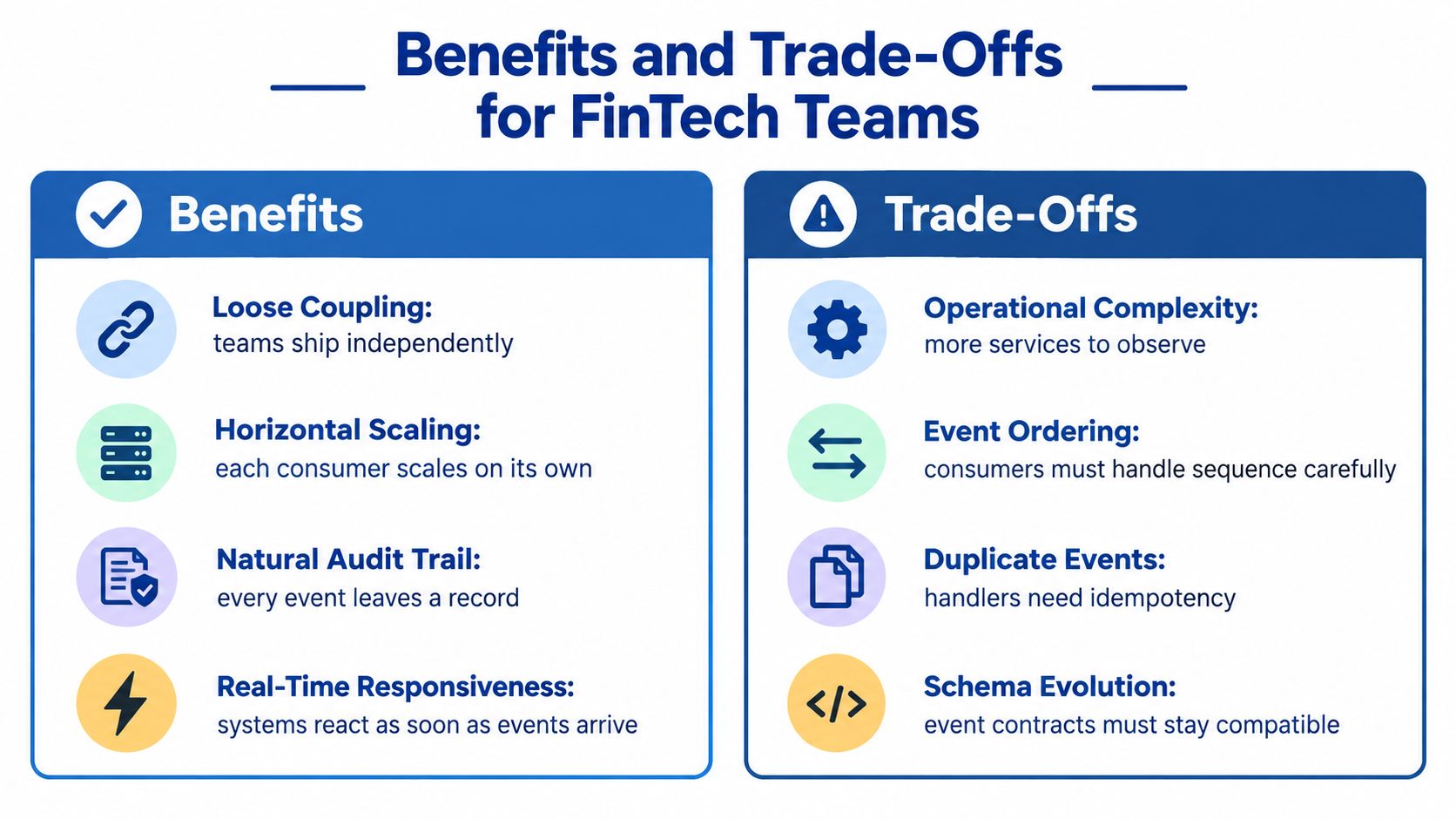
The strongest argument for event-driven design is selective independence. A reporting backlog shouldn't automatically prevent payment acceptance, and a busy notification consumer shouldn't force the entire application to scale.
The corresponding cost is distributed responsibility. Someone must own the event contracts, delivery failures, processing delays and customer-visible consequences.
Assess the benefits against operating costs
Loose coupling can let teams release consumer changes independently, provided they preserve compatible contracts. Horizontal scaling can target an overloaded consumer rather than adding capacity everywhere.
Durable event history can also support investigation and integration. However, an audit trail is only useful if the team records the right context, protects it and can explain its meaning.
The less visible costs deserve equal attention:
Eventual consistency: A read model may temporarily lag behind authoritative state, so the interface needs honest freshness and pending indicators.
Observability: Engineers need correlation identifiers, consumer-lag monitoring and a way to trace a payment across components.
Schema governance: A producer's field change can break consumers unless compatibility rules are enforced.
Broker operations: Capacity planning, access management, upgrades and recovery become ongoing responsibilities.
A simple product with limited integration needs may be better served by a modular application and a narrowly scoped queue. More components aren't evidence of a better design.
Plan for unavailable third parties
Resilience means deciding what the product should do when a broker, identity provider or payment rail is unavailable. Canadian supervisory discussion has highlighted third-party contingency planning, recovery frameworks and severe-but-plausible testing, as outlined in the Bank of Canada's financial-system survey highlights.
A deliberately degraded mode can be safer than forcing normal processing:
| Failure condition | Possible controlled response |
|---|---|
| Notification consumer unavailable | Retain updates for later delivery. |
| Reporting pipeline delayed | Display the last refresh time and bounded staleness. |
| Payment status uncertain | Suspend repeat initiation and reconcile authoritative status. |
| Mandatory identity checks unavailable | Pause affected activity or use an explicitly approved fallback. |
Resilience test: Can the team explain what customers will see while a dependency is unavailable, not just how engineers will restart it?
Define recovery time and recovery point objectives by event class. Then test backlog processing, reconciliation and financial side-effect suppression after restoration. A service restart alone doesn't demonstrate that the product recovered correctly.
Security, Privacy and Compliance for Canadian FinTech
An event-driven platform can distribute sensitive information across brokers, consumers, audit stores and analytical systems. Security design therefore starts with where information travels, not just where the main database sits.
Create a data-flow map showing which services receive each field, why they need it and what happens when an event is retained or replayed.
Turn breach duties into evidence requirements
Under PIPEDA, a FinTech organisation must report a breach of security safeguards to the Office of the Privacy Commissioner of Canada when it poses a real risk of significant harm, notify affected individuals and retain records of every breach, including incidents below the reporting threshold. The Commissioner's breach guidance explains these obligations.
A monitored security stream can help preserve events such as unauthorised access, credential compromise and data disclosure. Record enough context to connect the affected account, data category, involved systems, assessment and response actions without spreading unnecessary personal information.
Organisations must keep breach records for two years, including non-reportable breaches, under the Commissioner's organisational privacy guide. This requirement concerns breach records; it isn't a universal retention period for every payment event or monitoring log.
Minimise exposure before adding controls
The PIPEDA safeguards principle identifies financial information as generally sensitive and says safeguards should reflect the information and associated risks. It doesn't prescribe a particular broker or certify an architecture automatically.
Translate that principle into concrete design decisions:
Payload minimisation: Avoid publishing names, account details or documents when a protected reference will do.
Tokenisation: Use controlled identifiers instead of exposing raw account data.
Encryption: Protect information in transit and at rest.
Least privilege: Give service identities access only to required topics and operations.
Tamper-resistant evidence: Separate investigative records from ordinary application logs.
Staff need to understand these boundaries too. Vigil Security's resource on security awareness training for sensitive data is a useful companion to technical access controls.
Govern replay and third-party dependencies
For federally regulated institutions, address OSFI expectations concerning technology, cyber and third-party risk through documented controls. Include broker permissions, data residency, subcontractor dependencies, recovery procedures and evidence of testing.
Replay deserves a separate access decision. A service allowed to receive current events shouldn't automatically receive unrestricted historical personal information.
Use redaction, purpose-specific replay permissions and controlled environments before enabling historical reprocessing. For product teams connecting these decisions to wider governance, FinTech compliance solutions provide a related starting point.
Making Smart Implementation Decisions and Choosing a Partner
A first event-driven project should fail safely. Pick a workflow where a broken consumer inconveniences someone but never moves money incorrectly: notification delivery, downstream analytics or a status feed are typical candidates, because the team can evaluate delivery, monitoring and ownership without redesigning the core ledger.
Introduce the broker beside the existing application. Keep the original source of financial authority clear while the team proves the surrounding integration. For a Canadian product preparing for the Real-Time Rail, that might mean a service publishing ISO 20022-aligned payment status events while the authoritative record stays where it is.
Decide what to build and what to operate
Managed messaging reduces infrastructure work, yet it says nothing about event meanings or financial controls. Building internally gives the team more implementation control and makes it responsible for maintenance and operational expertise. Neither choice settles the harder questions.
| Decision | Product question |
|---|---|
| Broker technology | Do consumers need retained replay, simple work distribution or independent subscriptions? |
| Event contracts | Who owns each schema, and how are incompatible changes prevented? |
| Financial state | Which records remain transactional, and which histories support integration? |
| Failure ownership | Who investigates rejected events, backlog growth and reconciliation differences? |
| Delivery approach | Can the team test the new workflow alongside existing behaviour? |
A transactional outbox is one answer worth evaluating for the consistency problem: the application saves an outgoing event alongside its business change, then a publisher forwards that recorded event. The design still needs delivery tracking and consumer safeguards. Operational readiness matters just as much as implementation skill, since developers, testers and operations staff share responsibility for deployment, monitoring and recovery.
Compare internal delivery with specialist support
Internal delivery works when the team has sustained capacity for distributed systems and regulated delivery. A partner earns its fee when the difficult work spans architecture, integration, testing and organisational change, which is common for a team handling its first event-driven design.
We helped an Indonesian financial technology company shift its architecture to microservices for application scaling and integrated backend functionalities. We also build digital platforms for regulated insurance and financial services.
At Cleffex, we provide end-to-end microservice architecture services to realise business potential and quicken development. Our insurance and FinTech practice is the relevant starting point for discussing regulated platform needs.
Judge any partner, internal or external, on demonstrable work rather than vocabulary. Ask for payment-state models, audit examples, replay-test results and a walkthrough of dependency-failure scenarios. Familiarity with Kafka or another broker isn't a substitute for explaining what happens when an accepted payment's response disappears mid-flow.
A short pilot keeps the evaluation honest. Give the candidate team one contained workflow, set observable criteria such as delivery tracking, backlog behaviour and reconciliation evidence, and agree in advance what result would justify expanding the engagement.
Conclusion and Frequently Asked Questions
Event-driven architecture suits real-time FinTech when teams need independent reactions to trustworthy financial facts. Canada's payment transition provides a concrete reason to examine that approach, but it doesn't make every workflow asynchronous or every application a candidate for a rewrite.
Begin by identifying where customers encounter ambiguity today: an unclear payment status, a delayed payout update or a fraud decision that support staff can't explain. Choose a contained workflow, define its authoritative states and prove the failure behaviour before expanding.
How does event-driven architecture differ from microservices?
Microservices describe application boundaries; event-driven architecture describes how components communicate and react. They can work together, but neither requires the other.
A modular application can publish events without being split into separate services. Equally, microservices can communicate through synchronous APIs, although that choice creates different dependencies.
Does event-driven architecture require Kafka?
No. Kafka is a technology choice, not the definition of event-driven design.
A simpler queue or managed publish-subscribe service may suit a limited workflow. Choose according to delivery, retention, replay, ordering and operational needs rather than adopting the tool with the most recognisable name.
Can a legacy banking or insurance core adopt events gradually?
Yes. An integration layer can publish confirmed changes while the legacy core remains authoritative.
The important boundary is accuracy: publish committed business facts, not guesses based on partially completed processing. Avoid creating competing sources of financial truth during migration.
What does a minimum viable setup look like?
A small team needs more than a producer connected to a broker. A credible initial setup includes:
A defined contract: Document the event's meaning, ownership and permitted use.
Durable handling: Retain work appropriately and make failures visible.
Consumer controls: Prevent repeated delivery from repeating business effects.
Operational evidence: Monitor processing and test recovery.
A named owner: Assign responsibility for exceptions and reconciliation.
Keep the scope narrow enough that the team can operate it confidently. Expansion should follow demonstrated reliability, not successful message delivery in a development environment.
Cleffex Digital Ltd offers microservice architecture services and builds digital platforms for regulated insurance and financial services. Visit Cleffex Digital Ltd to discuss a contained event-driven workflow, the financial controls it needs and a practical route from your existing platform.