


Your emergency department is filling up, the ward team can't confirm the next available bed, and clinic staff are calling patients to rearrange appointments. A community provider may have capacity, but nobody has confirmed whether it matches the patient's needs. Everyone is working hard, yet the next step in care remains uncertain.
Healthcare resource optimisation means making those decisions together rather than managing disconnected queues. HealthcareOps technology can help staff coordinate appointments, clinical skills, rooms, equipment, and onward care. Its value depends on whether patients reach appropriate care, not whether the calendar looks full.
Why Healthcare Resource Optimisation Matters Now
A bed shown as available isn't necessarily ready for a patient. The ward may lack the right nursing skills, cleaning may still be underway, or the patient may need equipment that's elsewhere. Similarly, an open community appointment is useful only when eligibility, transport and clinical requirements align.
These are the decisions that turn nominal capacity into usable capacity. An operations team needs to know what can safely happen next, who must authorise it and which dependencies remain unresolved.

Workforce shortages change the operating problem
Health Canada's pan-Canadian Health Workforce Education, Training and Distribution Study identified a need for almost 23,000 additional family physicians, equivalent to a 49% increase over existing supply, alongside shortages of 28,000 registered nurses and 14,000 licensed practical nurses, among other clinical roles.
Recruitment remains necessary. But an operating plan shouldn't depend entirely on clinicians who haven't yet been recruited, trained or retained.
The immediate task is to protect scarce clinical time. That means examining what clinicians spend time doing, whether patients reach the appropriate professional and where administrative hand-offs interrupt care.
Protect clinical work: Review tasks that could safely be delegated, centralised or removed.
Match skills to need: Plan around competencies and patient dependency, not headcount alone.
Make constraints visible: Distinguish an available room from a fully staffed, equipped service.
Practical rule: Don't count capacity until the people, space and support required to use it are available together.
Technology should help teams make these distinctions. A dashboard that shows empty rooms without staffing constraints could encourage bookings the organisation can't safely deliver. A useful system makes the limitation explicit and gives staff a clear route to resolve it.
The Real Cost of Inefficient Resource Use
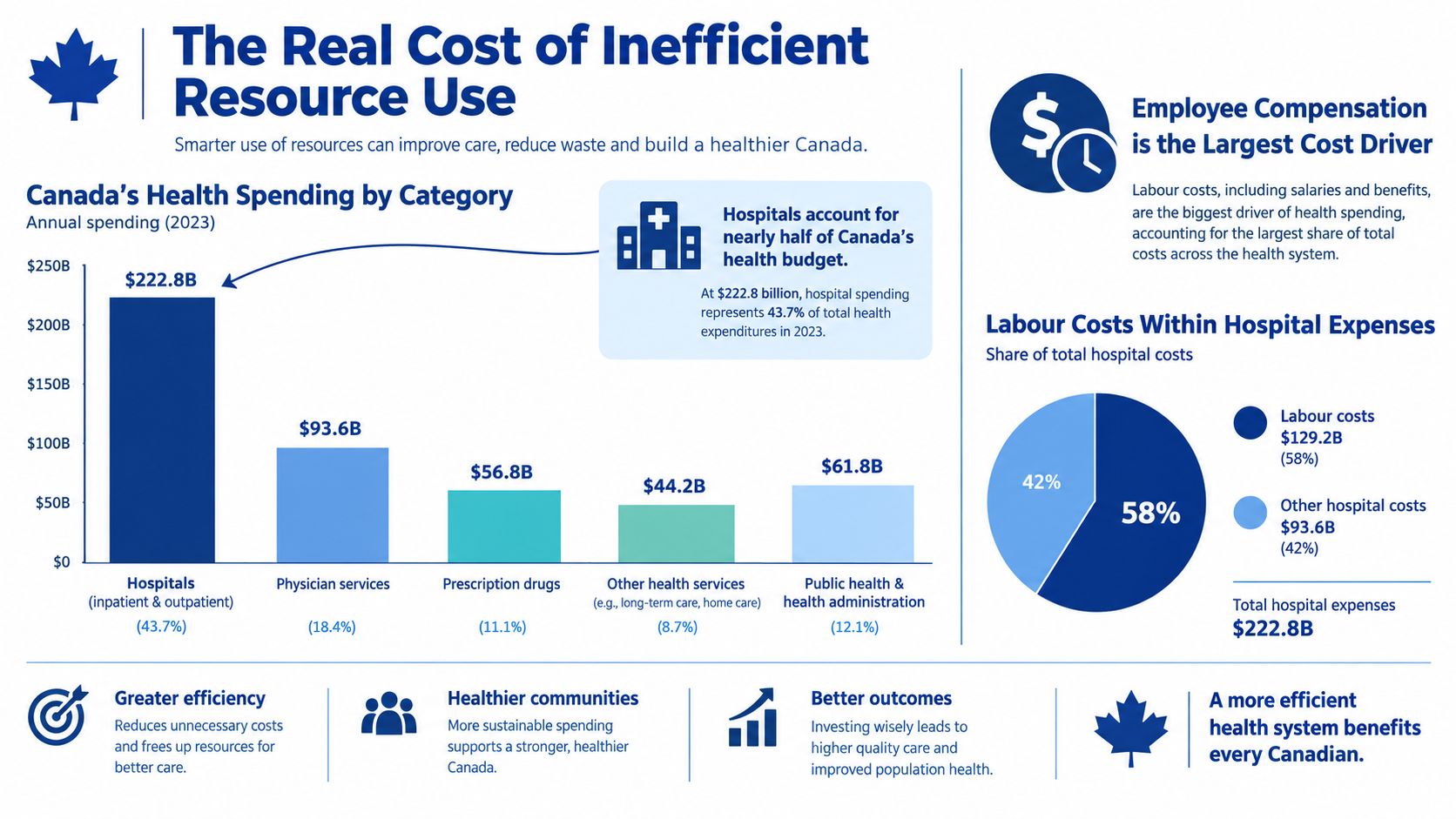
Canada's spending figures show why hospital resource decisions deserve close operational attention. The Canadian Institute for Health Information projected $372 billion in total health expenditure in 2024, or $9,054 per person, with hospitals representing the largest category at 26% and hospital spending projected to grow 6.1%; employee compensation was also identified as the largest single hospital expense in the 2022–2023 Canadian MIS Database.
Those figures establish scale, not the amount an individual hospital could save. Local financial decisions still require local activity, staffing and cost data.
Released capacity isn't automatically a cash saving
Suppose a team removes a recurring delay between assessment and treatment. Staff may use the released time to see waiting patients rather than reduce expenditure. That can be a worthwhile improvement, but it should be reported as additional care capacity, not a budget reduction.
The same distinction applies to appointment utilisation. Filling an otherwise unused appointment may improve access while adding consumables, diagnostic work or follow-up activity. Finance and clinical leaders should agree on the intended benefit before approving the change.
| Operational change | Potential benefit | Trade-off to examine |
|---|---|---|
| Fill cancelled appointments | More patients receive planned care | Preparation and notice requirements |
| Adjust staffing patterns | Better alignment with demand | Continuity, preferences and safe coverage |
| Extend equipment availability | More usable clinical sessions | Maintenance and support costs |
| Accelerate administrative hand-offs | Less time waiting for decisions | Verification and exception handling |
A narrow cost target can encourage the wrong behaviour. Removing administrative support, for example, deserves scrutiny if clinicians would then inherit the same work.
Measure total work across the pathway, including work transferred to another department or provider. Otherwise, a department can appear more efficient while the organisation pays elsewhere through coordination effort, delayed activity or additional workload. Financial discipline means understanding that trade-off, not assuming every reduction in departmental spending represents an improvement.
The Core Pillars of Healthcare Resource Optimisation
A hospital resembles a busy restaurant in one useful respect: tables, kitchen capacity and serving staff must be available together. Adding tables won't help if the kitchen can't prepare meals. In healthcare, the consequences are more serious, and clinical suitability must govern every allocation.
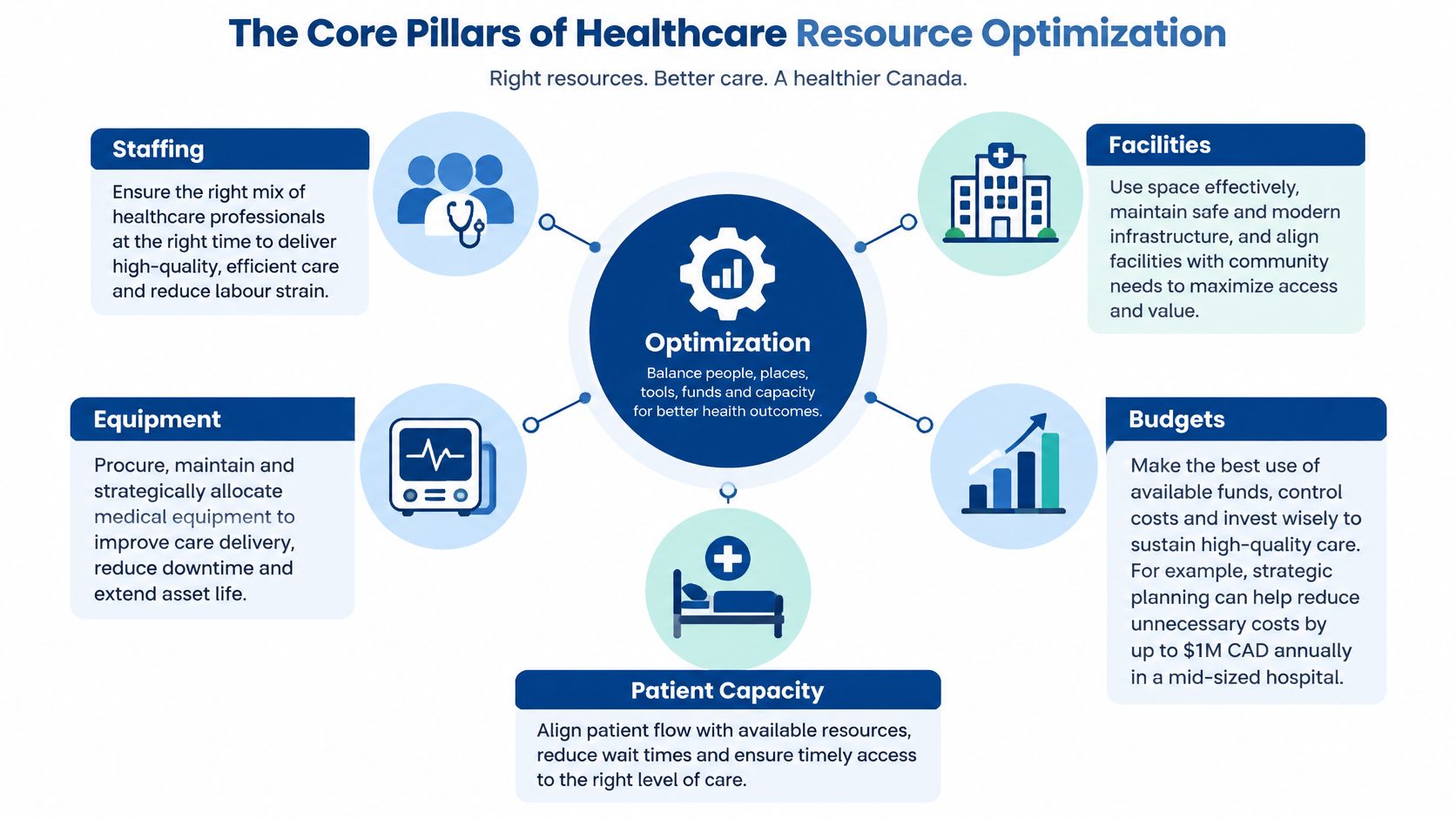
Use staffing, facilities, equipment, budgets and patient capacity as a practical framework for investigating constraints. Treat them as connected planning categories, not separate improvement programmes.
Start with the resource that limits delivery
Staffing requires more detail than a roster. Record the competencies needed for each service, supervision requirements, availability and protected breaks. A scheduled clinician isn't interchangeable with every other clinician.
For facilities, distinguish physical space from operational readiness. A treatment room may need cleaning, privacy arrangements or accessibility adjustments before a particular appointment can proceed.
Equipment planning should answer a different question: will the required device be ready where it's needed? Include maintenance, cleaning, movement and compatibility with the planned procedure.
Budgets: Assess the full cost of a proposed change, including implementation, training, support and ongoing coordination.
Patient capacity: Plan how many patients a service can safely accommodate given their clinical needs and the resources required.
Test the dependencies before changing the schedule
Consider a clinic proposing an additional procedure session. The room and clinician may be available, but the plan should also confirm equipment preparation, recovery support and arrangements for complications. Booking first and resolving those requirements later isn't sound capacity planning.
A useful evaluation question is: what must be true for this appointment to proceed safely? Turn the answers into booking rules, readiness checks and escalation responsibilities.
For teams comparing workflow categories, TOOLii provides a directory to find healthcare workflow software. Use it as a starting point for requirements gathering, then assess candidates against your actual workflow rather than a feature checklist alone.
An apparently idle resource may be reserved for a legitimate operational reason. Investigate before labelling it waste.
Leave room for uncertainty in the plan. Unexpected clinical needs and urgent work require a deliberate response; filling every visible gap shouldn't be the default objective.
How Digital Tools Transform Scheduling and Resource Allocation
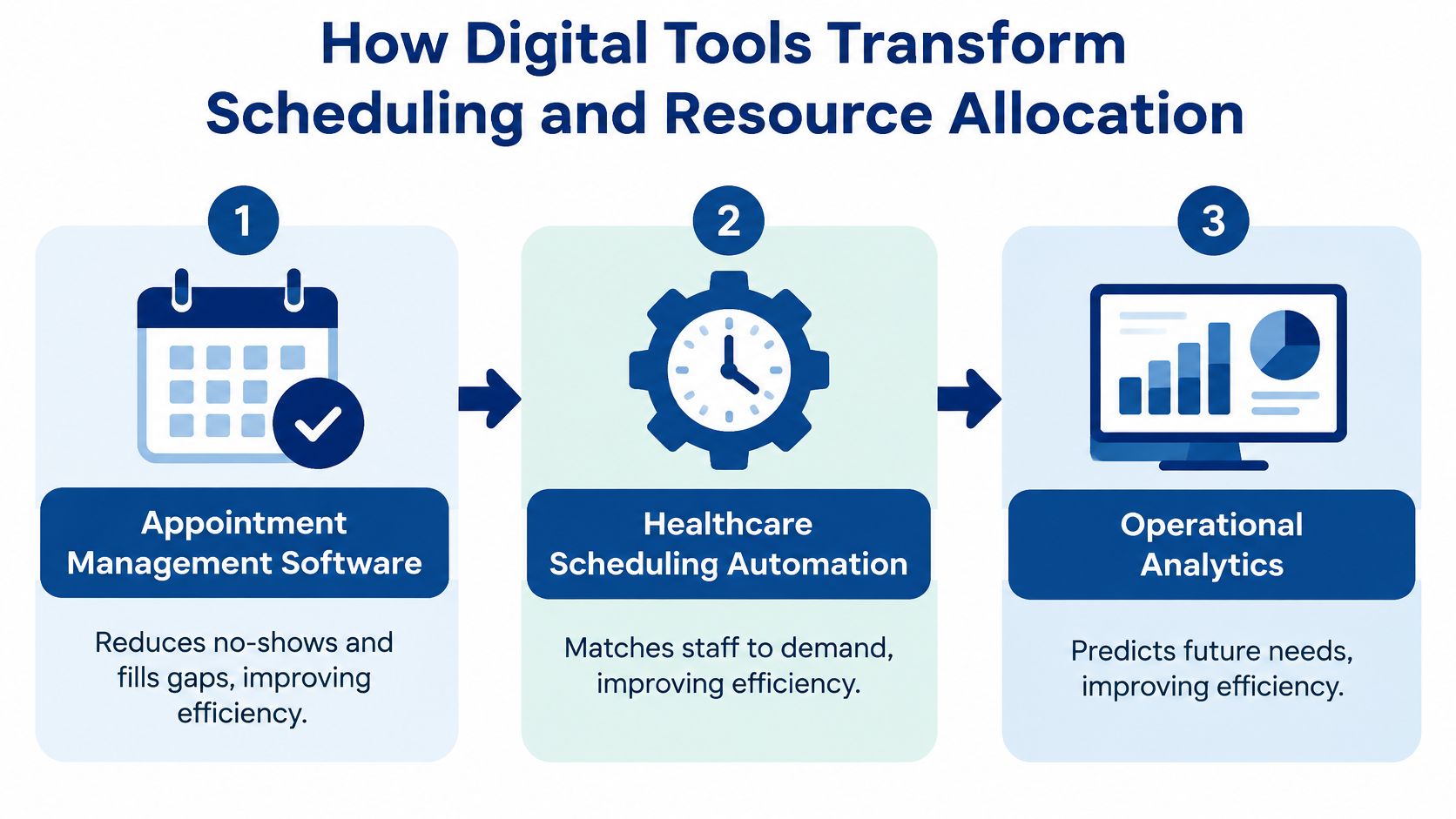
Appointment management software, healthcare scheduling automation and operational analytics serve different purposes. Their strongest use is as a connected decision workflow: capture the request, allocate appropriate resources and assess whether the plan worked.
Statistics Canada reported that healthcare users surveyed in July and August 2023 included 57.5% with only in-person appointments, 5.3% with only virtual appointments and 37.2% with both during the preceding year; virtual care represented 32% of physician services in 2020.
Give each tool a defined job
Appointment management software should capture visit purpose, communication preferences, preparation requirements and accessibility needs. Staff can then offer suitable appointment types within clinically approved rules, rather than treating every request as an identical calendar entry.
Scheduling automation can apply those rules to clinician availability, room requirements and equipment constraints. It should explain why an appointment can't be placed and allow authorised staff to handle exceptions.
Operational analytics supports review and planning. Teams can compare demand with available sessions, examine cancellation reasons and identify where the booking process breaks down.
For a clinic considering automated telephone intake, Chimehill's AI receptionist for clinics is an option to evaluate. Keep the assessment focused on administrative scope, privacy, human transfer and safe escalation rather than assuming automated conversation is suitable for clinical triage.
Connect booking decisions to operational evidence
Consider a clinic offering routine follow-up remotely when clinically appropriate. The booking workflow should first check suitability and patient preference, then reserve the required professional's time without unnecessarily reserving an examination room.
Before booking: Check prerequisites and explain preparation.
During allocation: Apply resource and modality rules.
After delivery: Compare planned duration, actual activity and unresolved needs.
The discussion of predictive analytics in healthcare operations provides a useful extension for teams exploring forecasting. Predictions should support a named decision, such as adjusting future session availability, rather than becoming another report nobody owns.
Real-World Examples of Optimisation in Action
Operating-room planning with a defined scheduling question
A Canadian clinical institution evaluated whether predictive and prescriptive analytics could support adding another hip- or knee-arthroplasty case to the daily schedule. A model-supported scheduling success rate of 77% was associated with approximately 35 additional cases annually, while 100% success produced a projected gain of 56 cases annually at no extra cost, rather than a guaranteed result for other institutions.
The useful lesson is the specificity of the question. The team wasn't asking an algorithm to optimise an entire hospital; it was examining whether a particular scheduling change could fit within available operating time.
An organisation adapting this approach should bring together historical procedure durations, turnover requirements, cancellation patterns and relevant procedure attributes. Surgeons, anaesthesia teams and theatre managers should review the recommendation before changing the list.
Validate locally: Test whether duration estimates fit the local surgical programme.
Check supporting services: Confirm recovery, sterilisation and ward readiness.
Monitor exceptions: Record overruns, cancellations and reasons staff reject recommendations.
Emergency access needs an outcome beyond bookings
Canadian emergency departments recorded 16.1 million visits across reporting facilities in 2024–2025, covering approximately 89% of national visits; 1.2 million patients, or 7.7%, left before being seen and assessed by a physician.
That early-departure measure is a meaningful outcome to watch when redesigning access. It doesn't prove that appointment technology would prevent those departures, and it shouldn't be used to justify redirecting patients without clinical assessment.
A practical use case is a clinician-approved follow-up pathway that gives suitable patients a confirmed appointment and clear instructions. The relevant operational question is whether the receiving service accepted the patient, not merely whether someone sent a referral.
Make onward care a closed-loop process
Referral workflows should show acceptance, missing information, the responsible team and the next action. The guide to healthcare referral automation is relevant when planning these hand-offs.
For multi-channel care, give patients a supported route to change format when their circumstances or clinical needs change. A virtual appointment that must later become an in-person examination should remain part of the same tracked pathway, rather than becoming an unresolved booking task.
Why a System-Wide Approach Beats Quick Fixes
Adding emergency department capacity may be necessary, but it shouldn't be treated as a complete answer to admission delays. The critical question is what happens after the emergency team decides that a patient needs inpatient care.
In 2024–2025, 1 in 10 admitted patients waited more than 36 hours for an inpatient bed, with that wait 45% longer than in 2018–2019; CIHI connects admission delays with constraints across inpatient care and downstream services, including long-term care, home care and rehabilitation.
Give someone authority across organisational boundaries
A shared display isn't enough if nobody can resolve the constraint. Establish who can escalate an unavailable placement, confirm community support or reconcile conflicting discharge information.
The operational view should connect expected emergency admissions with inpatient readiness and verified onward-care options. Staff also need timestamps so they can distinguish a confirmed service from an old availability record.
Faster movement isn't the same as better care. A transfer only represents progress when the receiving service can meet the patient's needs.
Keep equity and financial boundaries visible
A throughput target can favour patients with straightforward discharge arrangements. Review whether proposed scheduling priorities disadvantage older adults, people with complex conditions, rural patients or those needing language and transport support.
Use clinical priority: Don't rank patients solely by expected speed of completion.
Review unmet need: Include patients who remain waiting, not just completed activity.
Name accountability: Assign responsibility for unresolved cross-provider hand-offs.
Financial processes also deserve boundary checks. Clarity's resource on outsourced revenue cycle pitfalls can inform questions when evaluating external administrative services, but revenue-cycle outsourcing shouldn't be confused with solving Canadian patient-flow constraints.
The broader principle is straightforward: assess any local change against its effect on the receiving team, the patient and the remaining care pathway.
Building Your Healthcare Resource Optimisation Strategy
Start with a specific access problem and a named clinical owner. “Improve utilisation” is too broad; “understand why discharge-ready patients remain without confirmed onward support” gives the team a process to examine.
In 2024–2025, 8% of patients admitted to acute inpatient care through an emergency department were designated alternate level of care, with a median hospital stay of 24 days, compared with four days for admitted patients overall.
Establish a baseline before selecting technology
Map the current process with the people who perform it. Record where information originates, who verifies it and what happens when an expected service isn't available.
Audit data quality: Check appointment statuses, discharge dates and resource definitions.
Identify the constraint: Separate demand pressure from missing information or unavailable services.
Choose a bounded pilot: Test a workflow with clear ownership and manageable dependencies.
Connect relevant systems: Assess healthcare software integration requirements before creating another standalone application.
Agree decision rights: Specify which recommendations require clinical approval and how staff can override them.
Key Metrics for Monitoring Resource Optimisation
| Metric | What It Measures | Why It Matters |
|---|---|---|
| Appointment utilisation | Delivered activity against usable slots | Distinguishes booked capacity from completed care |
| Referral acceptance time | Time until the receiving service confirms acceptance | Exposes incomplete hand-offs |
| Discharge-ready waiting time | Delay after documented readiness | Identifies onward-care constraints |
| Clinical hours released | Time returned to direct patient work | Tests the practical value of automation |
| Overtime and cancellations | Schedule disruption | Checks whether added activity is sustainable |
| Access by patient group | Differences in waiting and completion | Supports equity review |
Use a healthcare operations dashboard to bring agreed measures together, with visible definitions and accountable owners.
Review prediction errors, overrides and unintended effects alongside performance. If demand patterns change, reassess the model rather than assuming its earlier performance still applies. Scale only when the team can explain the improvement and maintain the controls that made it safe.
Frequently Asked Questions About Resource Optimisation
Does healthcare technology replace staff?
It shouldn't be planned as a substitute for workforce capacity. Start by defining the administrative work the tool will handle and the decisions people retain. Measure whether staff recover usable time, including any new effort spent checking outputs or resolving errors.
How can a small clinic make the investment manageable?
Choose a narrow problem with a clear owner, such as cancelled-slot management or referral tracking. Compare configuration of existing software with buying or building something new. Include integration, training, support and staff review time in the assessment, not just the subscription price.
What privacy questions should teams ask?
Ask your privacy and security leads to assess the proposed data flows before implementation. Establish what information is necessary, where it will be processed, who can access it and how long it will be retained. Review vendor access, audit records, incident arrangements and applicable provincial requirements.
How quickly should results be expected?
There's no universal delivery timeline or guaranteed performance gain. Data preparation, integration complexity and workflow changes determine what's realistic. Agree on readiness checks and evaluation criteria before launch, then compare results with the baseline rather than relying on demonstrations or adoption figures.
How should teams evaluate vendors?
Ask vendors to demonstrate your difficult cases, not just routine bookings. Test missing information, urgent escalation, accessibility needs, downtime and staff overrides.
Check compatibility: Confirm how updates reach the clinical record and other connected systems.
Check accountability: Identify who maintains rules and investigates incorrect recommendations.
Check publishing resources: Before publishing supporting content, verify existing blog URLs and destinations rather than assuming they remain live.
Good optimisation supports better operational decisions. Technology earns its place when staff can use it safely, patients can follow the resulting pathway, and leaders can verify that access improved without shifting an unreasonable burden elsewhere.
Cleffex Digital Ltd offers healthcare software integration connecting clinical platforms, EHR/EMR systems and operational workflows. Visit the team to discuss how appointment, referral and capacity data could support a focused resource-utilisation pilot, with clear integration requirements and measurable patient-access outcomes.