

Two weeks after a payments feature goes live, the questions change. Nobody asks about throughput any more. Someone in operations wants to know why a customer's transfer sat in pending for forty minutes. Someone in compliance wants the exact sequence of decisions behind a transaction that was later disputed. An engineer wants to know why the fraud check never ran on a payment that settled anyway.
None of those questions is about speed. All of them are about control and evidence, and they're the reason event-driven architecture in fintech deserves to be learned properly rather than copied from a vendor diagram. The pattern is usually sold as a way to cut latency and decouple services. That's part of the value. The harder, more useful part is that events leave a durable record of what happened, in order, with a named owner for every step.
Get that right and real-time payment processing becomes something a team can operate, audit and defend. Get it wrong, and you've built a system that moves money quickly and can't explain itself afterwards.
Why Fintech Platforms Are Moving From Batch to Events
At a café counter, a customer taps a card or a phone. The terminal approves in about a second, and the customer walks out. The money, in plenty of Canadian setups, doesn't move until an overnight batch runs.
That gap is the problem in miniature. The customer experienced a real-time event. The bank experienced a scheduled job. Everything in between, from the fraud check to the ledger entry to the receipt in the customer's inbox, has to be reconciled later, often by people.
Event-driven architecture closes that gap by changing what systems say to each other. Instead of one system asking another whether something happened, the system that knows publishes the fact: payment initiated, payment authorised, payment settled. Anyone who cares subscribes. A fraud service, a ledger, a notification service and an accounting export all react to the same news at the same moment, with none of them ringing round to check.
The analogy that sticks is a newsroom. A reporter files one story, and it lands on the desks of the editor, the picture desk, the sub-editors and the social team at once. Each desk works from the same facts.

Canada's own plumbing has been moving this way for years. Lynx, the country's high-value payment system, went live in 2021 as the successor infrastructure for large Canadian-dollar electronic payments, and the Bank of Canada describes it as the backbone of Canada's payment system, with more than CAD 400 billion settling through it each day. The same source notes that the planned Real-Time Rail is designed to let businesses and consumers send and receive payments 24 hours a day, 365 days a year, with Payments Canada expecting it to be ready for industry testing in 2026.
Behaviour is shifting faster than the rails. The Bank of Canada's 2024 Methods-of-Payment Survey found that almost 5% of consumer payment transactions were made using mobile payments, against less than 3% in both 2023 and 2022. Every one of those taps has to trigger authorisation, fraud analysis, a ledger update, a customer alert and, sometimes, a reversal.
If you want the rail-level view of how a transfer clears in seconds rather than overnight, how real-time payments work locally pairs well with the architecture discussion here. What follows is the working detail: which parts do the work, how one payment travels, where the controls and audit trails sit, and the point at which adding more services stops helping.
The Core Components Behind Real-Time Payment Processing
Seven moving parts appear in almost every payment system built this way. Vendors use different names for them, which is where most confusion starts. Match the names first, then the design gets easier.
| Component | Job in the system | Example in a payment flow |
|---|---|---|
| Event producer | Publishes a fact when something happens | Payment app emits PaymentInitiated |
| Event broker | Stores and routes events to subscribers | Topic that delivers each payment event to every interested service |
| Schema registry | Keeps event formats versioned and compatible | Adds richer payment data fields without breaking older consumers |
| Consumer | Reacts to an event with its own logic | Fraud service scores a transfer before it settles |
| Transactional outbox | Writes a business change and its event together | Ledger update and PaymentSettled event commit as one unit |
| Dead-letter queue | Holds events that still fail after retries | Failed notification held for operator review |
| Event store or audit log | Keeps the full sequence for replay and evidence | Rebuilding the steps behind a disputed transfer |
The broker is a sorting office. It takes each parcel that arrives and routes it to every desk that needs a copy. The consumers are those desks, and each one has its own job: checking identity, scoring risk, moving the ledger, telling the customer.
Events are contracts between teams, so they deserve the same design attention as a public interface. The discipline behind good fintech APIs for developers applies to event schemas too: name the fields, version them, and document who consumes them.
Three parts teams skip and what breaks
The schema registry: Without versioning, a renamed field can stop a fraud score from running, and the payment settles with no risk check at all. A registry keeps each format versioned, so richer ISO 20022 payment data can be added without breaking an older fraud service.
The transactional outbox: If the ledger writes to the database and the event publish fails, you've settled a payment that fraud screening and notifications will never see. Committing the business change and its event as one unit closes that hole.
The dead-letter queue: Retries eventually give up. Without a queue to catch what failed, an event is lost, and nobody knows to look for it.
Practical rule: for a payments product, build the broker, the outbox and the dead-letter queue first. They prevent the failures that cost money and reputation, and the rest can follow as the service count grows.
How a Payment Event Moves Through the System
Here is one transfer, walked end to end, using the event names a team would publish.
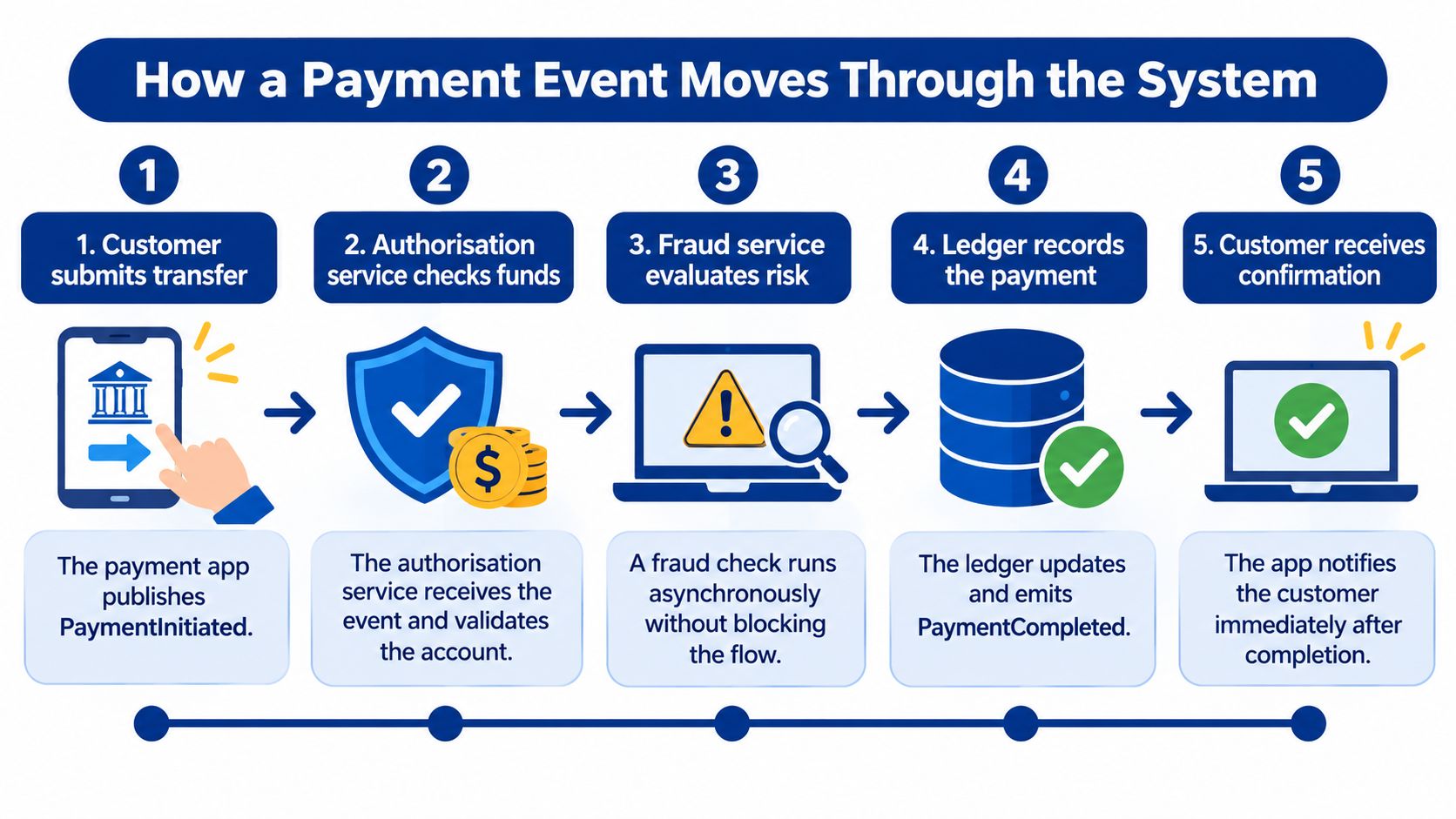
The customer submits the transfer: The payment app writes the request to its outbox and publishes PaymentInitiated with an ID, an amount, a currency and a timestamp. If the broker is down, the request waits, and the app shows pending, never a confirmation it can't honour.
Authorisation checks balance and limits: The service publishes PaymentAuthorised or PaymentDeclined. When this service is unavailable, the event waits in the broker, and the payment stays pending rather than travelling onward unapproved.
The fraud consumer scores the transfer: A high score publishes a hold that moves the payment to PendingReview instead of letting it continue. A slow model delays the hold decision, not the customer's confirmation, which is why those two things are separate.
The ledger consumer posts the entries: Debit and credit are written with an idempotency key, so a redelivered event can't post the same entry twice. If the ledger is down, the event returns later, and the key makes the replay safe.
The notification service tells the customer: The message goes out on the channel they chose. A failure here doesn't hold up the payment; the message is retried and then parked for an operator if it keeps failing.
Settlement sends the instruction over the rail: This is the step that depends on infrastructure outside the building. The Bank of Canada describes the Real-Time Rail as designed for continuous exchange, clearing and settlement of data-rich electronic payments, with immediate availability of funds. That always-on model is what lets validation, fraud screening, ledger updates, notifications and reconciliation run without waiting for a batch window, and the data-rich ISO 20022 messages give downstream services structured payment information to consume.
Reconciliation matches confirmation to ledger: The consumer compares the settlement confirmation against the ledger and raises an exception for any mismatch. If it's unavailable, exceptions accumulate, which is why processing age on this consumer is worth an alert.
Every step in your own flow should be visible as an event you could replay. If a step only exists inside a database transaction, you can't reconstruct it when someone disputes a payment six months later.
Where Financial Transaction Processing Uses Events
The same pattern repeats across the industry. One trigger fires, several independent consumers react, and the customer sees one coherent outcome.
| Use case | Triggering event | Consumers that react | Outcome |
|---|---|---|---|
| Real-time payments | Payment initiated | Fraud, ledger and notifications | Funds confirmed in seconds |
| Fraud detection | Login or transfer attempt | Risk scoring and step-up authentication | Suspicious activity held before settlement |
| Insurance claims | Claim submitted | Document check, underwriting and payout | Faster triage and fewer manual handoffs |
| Lending | Application or repayment received | Credit model, collections and ledger | Exposure updated in near real time |
| Reconciliation | Settlement confirmed | Matching engine and accounting | Exceptions surfaced the same day |
| Healthcare billing | Claim adjudicated | Patient statement and payment processor | Clear billing status for patients and clinics |
Insurance shows how the pieces combine. A policyholder submits a claim with photos attached, and the system publishes ClaimSubmitted. A document service reads the images and flags anything missing, underwriting checks the policy is active and the peril is covered, and a payout service schedules payment once both agree. Each step runs on its own timeline. The customer sees one claim moving forward, not four departments passing an email around.
Healthcare billing works the same way with a different vocabulary. A claim adjudicated event lets the patient statement and the payment processor update together, so the clinic's phone stops ringing with billing questions.
Selection rule: start with the flow where delay costs money or trust, such as fraud holds or payment confirmation. The easiest flow to split is rarely the one worth splitting first.
Security, Resilience and Audit Trails for Regulated Platforms
For a federally regulated financial institution in Canada, event-driven design belongs in the same category as backups and incident drills. It's operational resilience, not an integration preference. OSFI Guideline B-13 requires a technology environment that's stable, scalable and resilient, supported by sustainable operating and recovery processes, and expects a technology-architecture framework aligned with business, technology and security requirements.
Turn each expectation into a design control
Explicit schemas with versions: Every event carries a documented structure so a consumer can reject what it doesn't understand instead of misreading it.
Correlation IDs: Each event links back to the customer action that caused it, which is what makes a dispute investigation possible months later.
Idempotency keys: Retries are normal, so every handler must be able to see a duplicate and ignore it.
Replay and dead-letter handling: Operators need a way to reprocess a stream and a place to find what failed after retries ran out.
The architecture should also let noncritical consumers fail on their own. Fraud scoring or customer notification degrading independently is a feature, not an incident, as long as the core payment flow keeps running and the gap is visible.
Set recovery-time and recovery-point objectives for each critical event stream, replicate event logs across failure domains, and monitor consumer lag and processing age rather than just broker uptime. Map the broker, schema registry, identity layer and third-party payment APIs onto your critical dependency graph; those four are where an outage spreads fastest.
Prove the chain from event to ledger entry
Audit evidence doesn't fall out of an event log by itself. A team has to show which event caused which decision, who owns each event type, how long it's retained, who's allowed to read it, and that the chain from source event to ledger entry to customer message has been tested rather than assumed.
Build the reporting attributes into the event from day one: transfer value, customer geography, timestamp and reporting period. The Bank of Canada requires payment service providers covered by the Retail Payment Activities Act to report both the number and total value of electronic funds transfers for each month of the reporting year. Under the same framework, PSPs report transfers for which they perform at least one regulated function, such as initiating, authorising, transmitting or facilitating an instruction, or providing clearing or settlement, which means the event model has to record which service did which of those things, for which transfer, at what time.
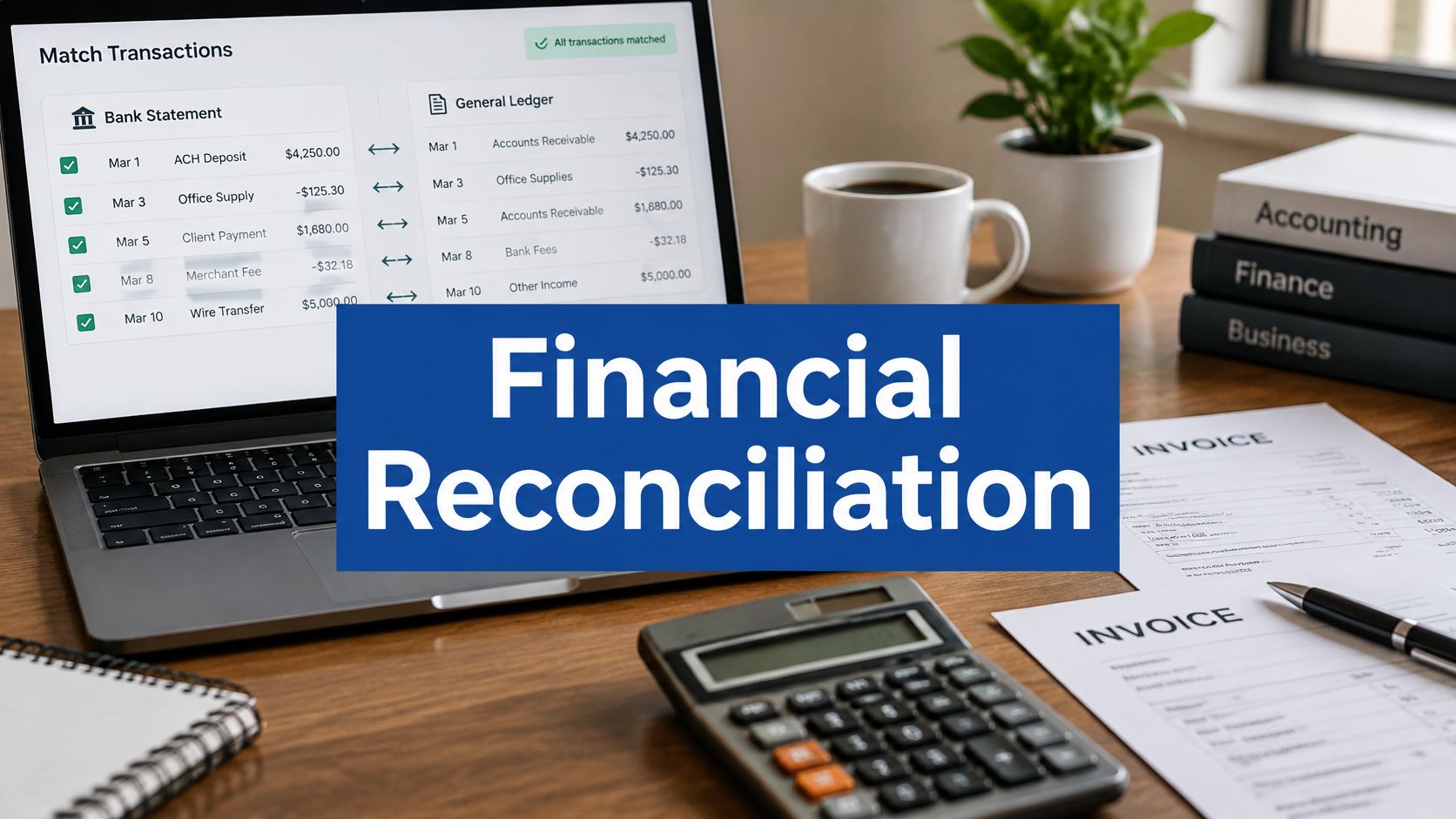
Reconciliation is where that evidence gets tested first, and automated financial reconciliation software covers the matching side in more depth.
Benefits and Trade-offs of Event-Driven Design
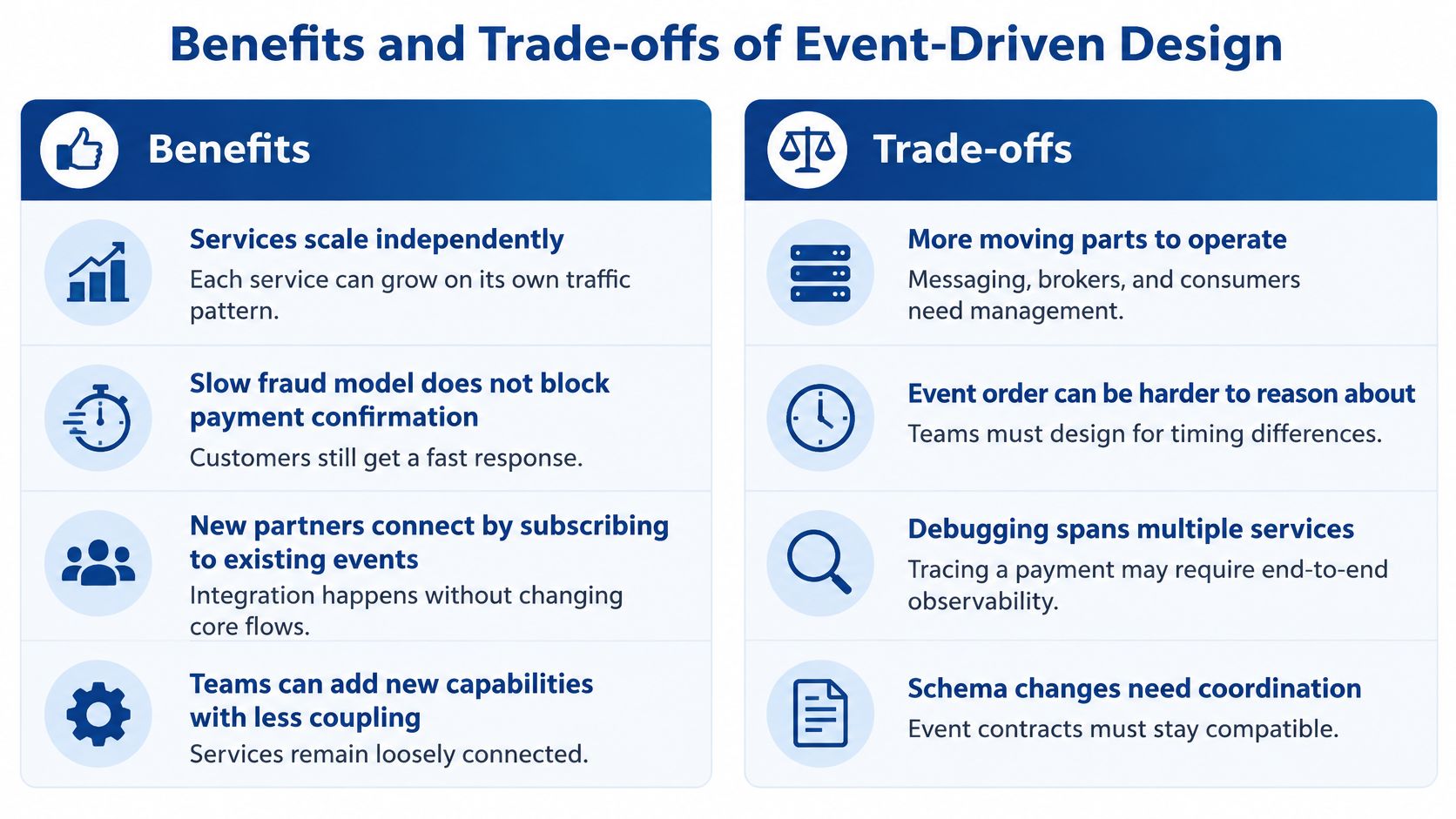
Split a payment flow into independent services, and you buy real benefits. You also take on costs that tend to surface six months later, usually at two in the morning.
| Benefit | Cost to manage |
|---|---|
| Services scale independently | Data is eventually consistent, so a customer may briefly see a pending balance |
| A slow fraud model does not block payment confirmation | Duplicates and out-of-order delivery must be handled by design |
| New partners connect by subscribing to existing events | Debugging means following a chain of events across services |
| Replay rebuilds a lost consumer's state | The team needs skills in brokers, schemas and monitoring |
Scale explains why the trade-off is worth taking seriously. Payments Canada reports that Canada's payment market reached 26.7 billion transactions worth $12.9 trillion in 2025, with transaction volume up 3% and value up 5% year over year, and describes the planned Real-Time Rail as instant, irrevocable, 24/7 payments with data-rich ISO 20022 messages and centralised fraud detection.
Irreversible plus always-on changes the design question. Once an event is published and money has moved, you can't quietly unsend it. You need pre-authorisation controls, compensating business actions, replay that can't double-settle, and explicit pending or exception states that a support agent can act on.
The part most explainers skip: for regulated payments, the most valuable architecture is often the least distributed one. A few strongly controlled boundaries around authorisation, settlement and reconciliation are frequently safer than a separate service for every step.
So apply a decision rule. Decompose where a failed step can be retried safely and where a duplicate costs nothing but a retry. Keep authorisation and settlement inside one controlled boundary, with pending and exception states written down before any code exists. Everything else can be distributed later.
Confirm Your Architecture Before Scaling Your Platform
Before you add consumers or partners, run this list against the flows you already have.
List every payment action and mark which ones must be real-time and which can wait a few minutes.
Mark the irreversible boundary, usually authorisation and settlement, and keep both inside one controlled boundary with explicit pending and exception states.
Choose a broker and a schema registry, and version your first event schemas now rather than after the first breaking change.
Add a transactional outbox to every service that writes money, and make every consumer idempotent.
Rehearse one broker failure and one replay of a settled payment, then trace that payment from source event to ledger entry to customer message.
Pilot one low-risk flow, such as notifications, before you move the ledger onto events at all.
Then agree which boundary you'll harden first and write that decision down. If the map shows your reporting layer is the weak link, financial data platform development is the adjacent piece of work.
Teams short on in-house capacity can hand that map to us at Cleffex Digital Ltd for a review alongside their architecture. We've done comparable work before, including helping an Indonesian financial technology company shift its architecture to microservices for application scaling and integrated backend functionalities, and our end-to-end microservice architecture services cover the build once the boundaries are agreed. Our insurance and fintech services page explains how we work with regulated teams.
Frequently Asked Questions
What is event-driven architecture in fintech, in plain terms?
It's a way of connecting systems so that each one announces what has happened instead of being asked. A payment service publishes that a transfer was authorised; the fraud engine, ledger, notifier and reporting layer each react to that announcement on their own. Nobody polls anybody, and every action leaves a record.
Do we need a heavyweight streaming platform to start?
No. A managed queue with a schema registry and a dead-letter queue will carry most payment products a long way. What matters is that events are versioned, handlers are idempotent, and failures are visible. Reach for a larger streaming platform when throughput or replay requirements demand it, not because a vendor diagram did.
How do we stop a retry from paying a customer twice?
Give every event a stable identifier and every money-writing handler an idempotency key derived from it. The handler checks whether it has already processed that key before it posts anything. Pair that with an inbox or processed-events table so the check survives a restart.
Can we adopt this one flow at a time?
Yes, and that's the safer path. Start where a failure is cheap to absorb, such as notifications or analytics, and prove the operational habits first: monitoring consumer lag, replaying a stream, handling a dead letter. Move the ledger only once those habits are routine.
What will a regulator want to see?
Evidence that you can reconstruct a business outcome. That means knowing which event caused which decision, who owns each event type, how long records are kept, who can read them, and having tested the path from source event to ledger entry to the message the customer received.
Cleffex Digital Ltd builds and modernises the systems behind regulated money flows, from event-driven payment services to audit-ready reporting layers, for insurers, fintechs, healthcare teams and growing enterprises. If your next release has to be fast, traceable and defensible under review, our team can map your flows, agree the boundaries and scope the build with you. Visit Cleffex Digital Ltd to start that conversation.