

You open the admin, and hundreds of product pages still show a title, a price, and almost nothing else. A supplier sent a spreadsheet last week. Launch day is Friday. Someone on the team has been pasting the same three sentences onto every colour of the same jacket.
That is when AI product content generation starts to look useful. It can draft the missing copy from facts you already store. It can't invent a size, a warranty, or a delivery promise you never approved. This guide sorts each field by the evidence it needs, then shows the checks that stop a busy shop from publishing the wrong line.
What AI Product Content Generation Means for Your Catalogue
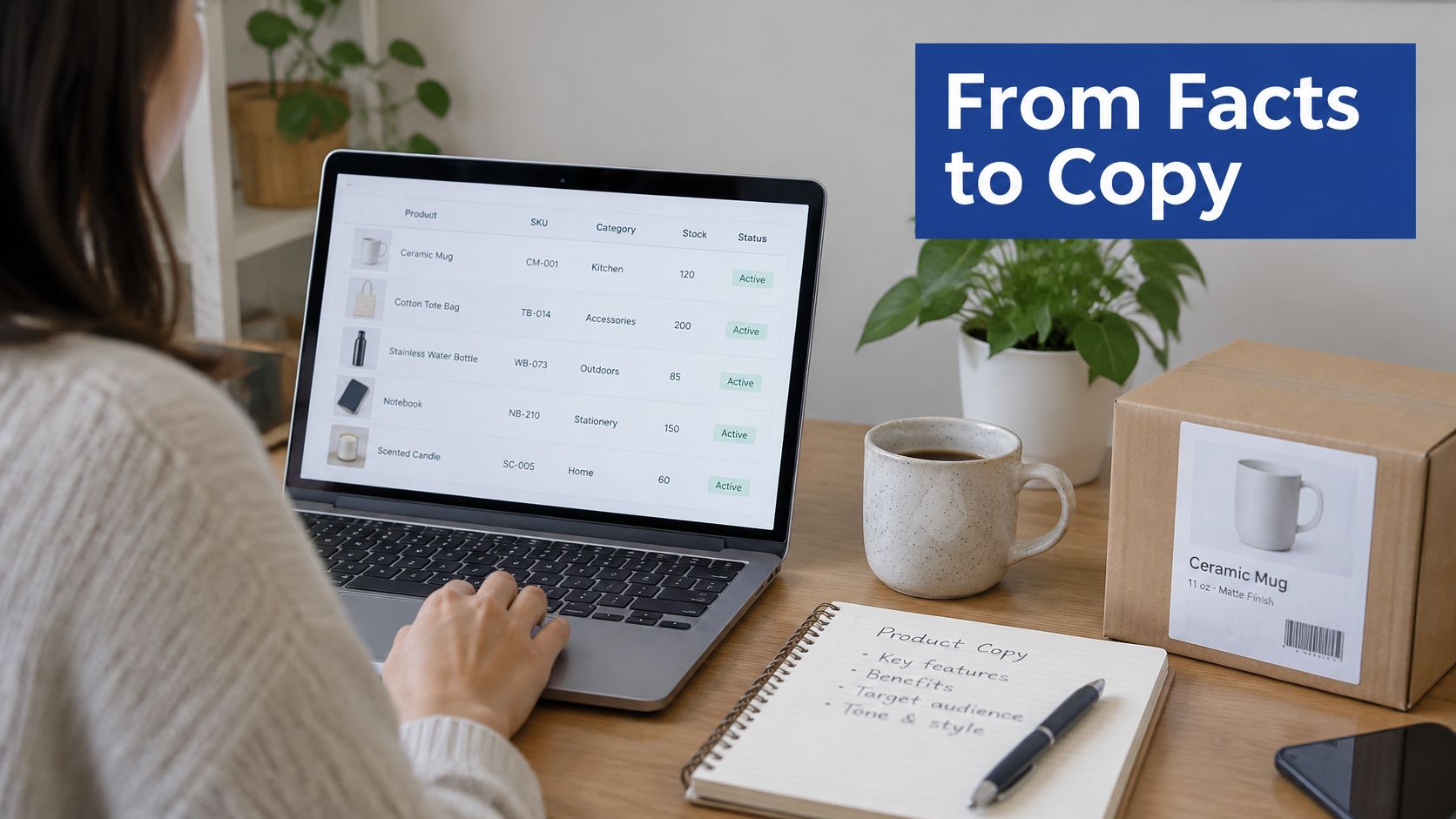
Say you sell outdoor gear and 4,000 SKUs still have blank descriptions. Sizes, colours, and materials sit in a spreadsheet. The pages don't.
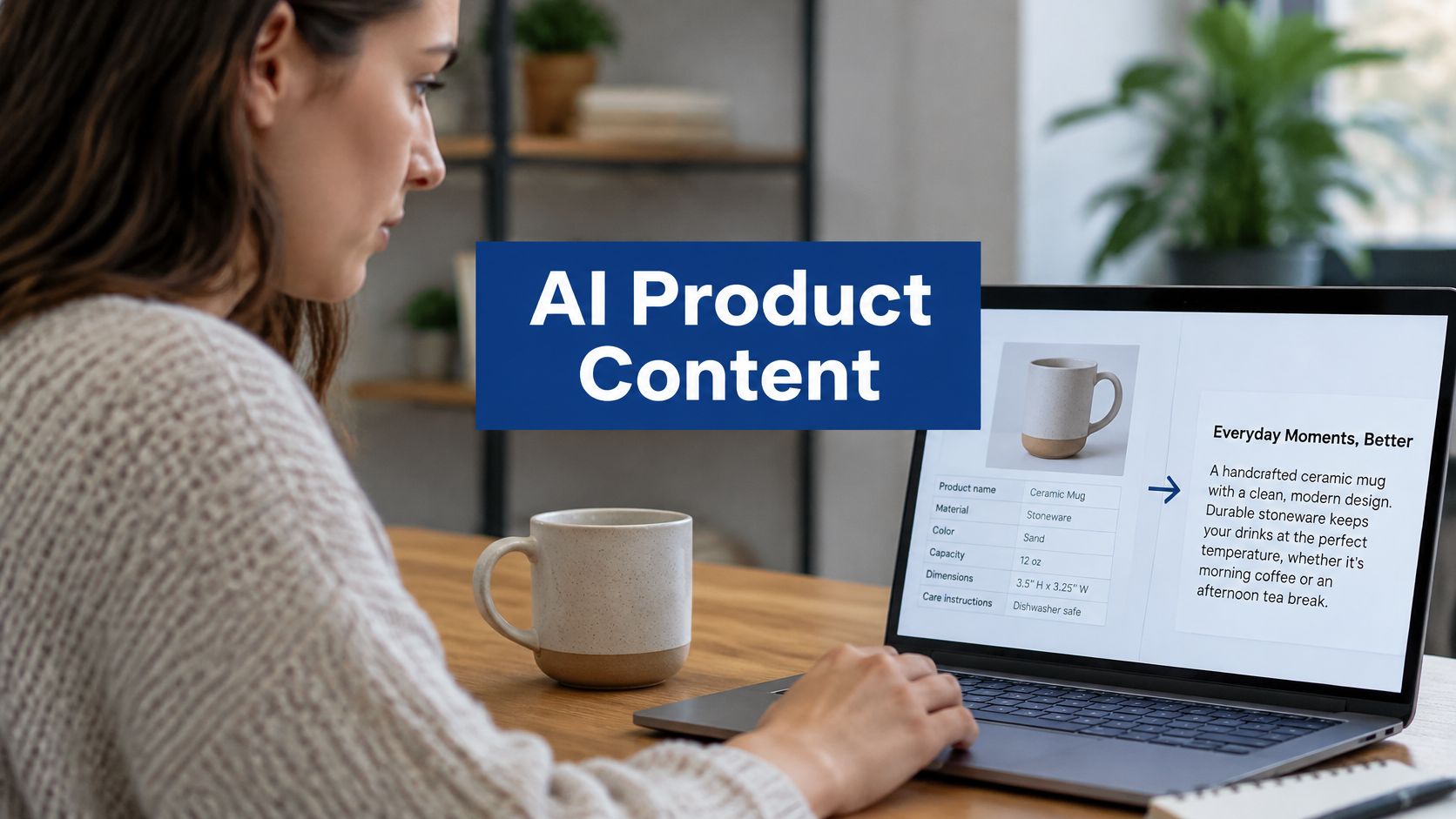
Think of the product record as a recipe card. It holds size, material, colour, compatibility, and price. The model is the assistant who writes the menu from that card. Your team still decides what reaches the table.
AI product content generation turns one governed record into drafts for titles, descriptions, bullet points, meta descriptions, email copy, and image briefs. Three gains show up for a retailer in that spot.
First drafts, not a month of typing: Those 4,000 blank pages can get a first pass in hours. Editors then keep only what the data supports.
One record, several channels: The same attributes can feed the website, a Shopify store, marketplaces, and email, so a material change isn't retyped four times.
English and French moving together: Bilingual drafts get a catalogue moving when a native speaker reviews the French before it goes live.
The output is only as accurate as the data it receives. Missing or contradictory attributes produce confident, wrong copy. A bottle listed as both 500 ml and 750 ml will get a description that picks one and sounds sure.
Check the product data before you compare tools. A clean record beats a clever prompt.
Teams that have finished that check can explore ecommerce AI software options with a clearer brief. For how this sits in day-to-day retail work, see our retail and ecommerce page.
Which Product Fields to Automate and Which to Keep Human
Sort every field before anyone writes a prompt. The more a sentence could affect a buyer's safety, money, health, or legal position, the more evidence it needs before it goes live.
| Product field | Automation level | Evidence needed before publishing |
|---|---|---|
| Product title and core attributes | Automate with a rules check | Source attribute record in the product information system |
| Specifications such as size, material and compatibility | Automate from structured data | Validated data field, with no free-text inference |
| Delivery, returns and duty wording | Automate only from approved logistics fields | Current policy and region-specific data |
| Health, safety, performance or coverage claims | Expert approval required | Citation, test evidence and a named approver |
| Customer-specific recommendations | Human review | Sample audit against customer data |
| French and bilingual adaptations | Draft automatically, bilingual reviewer approves | Approved terminology glossary |
A water bottle's capacity can publish after a data check. The number comes from a dimension field. If that field is empty, the draft stops.
A cable's "works with model X" line needs a tested compatibility list. Free-text guessing is how the wrong plug ends up on the page.
A supplement claim, or wording that implies insurance coverage, needs a citation and a named approver. Human review on its own isn't the control. You also need a provenance record, a source check, an approval threshold, and an escalation path when the claim is high impact.
Less automation is often the stronger product content automation choice. Routine colour and size copy can pass a rules check. Regulated attributes, advice written for one customer, and translations stay on a slower path.
Practical rule: If a sentence can't be traced to a field in the product record or an approved source, it doesn't publish.
Editors who still want a manual pass on voice, not only on facts, can use these five passes for better product descriptions after the tier check. Those attributes should live in one system, which is why a product information management setup comes before any model touches the catalogue.
How to Build an AI Content Workflow Step by Step
Ecommerce AI integration is a sequence, not a button. Each step exists because the one before it fails in a predictable way. These AI ecommerce solutions only help when the steps below are in place.
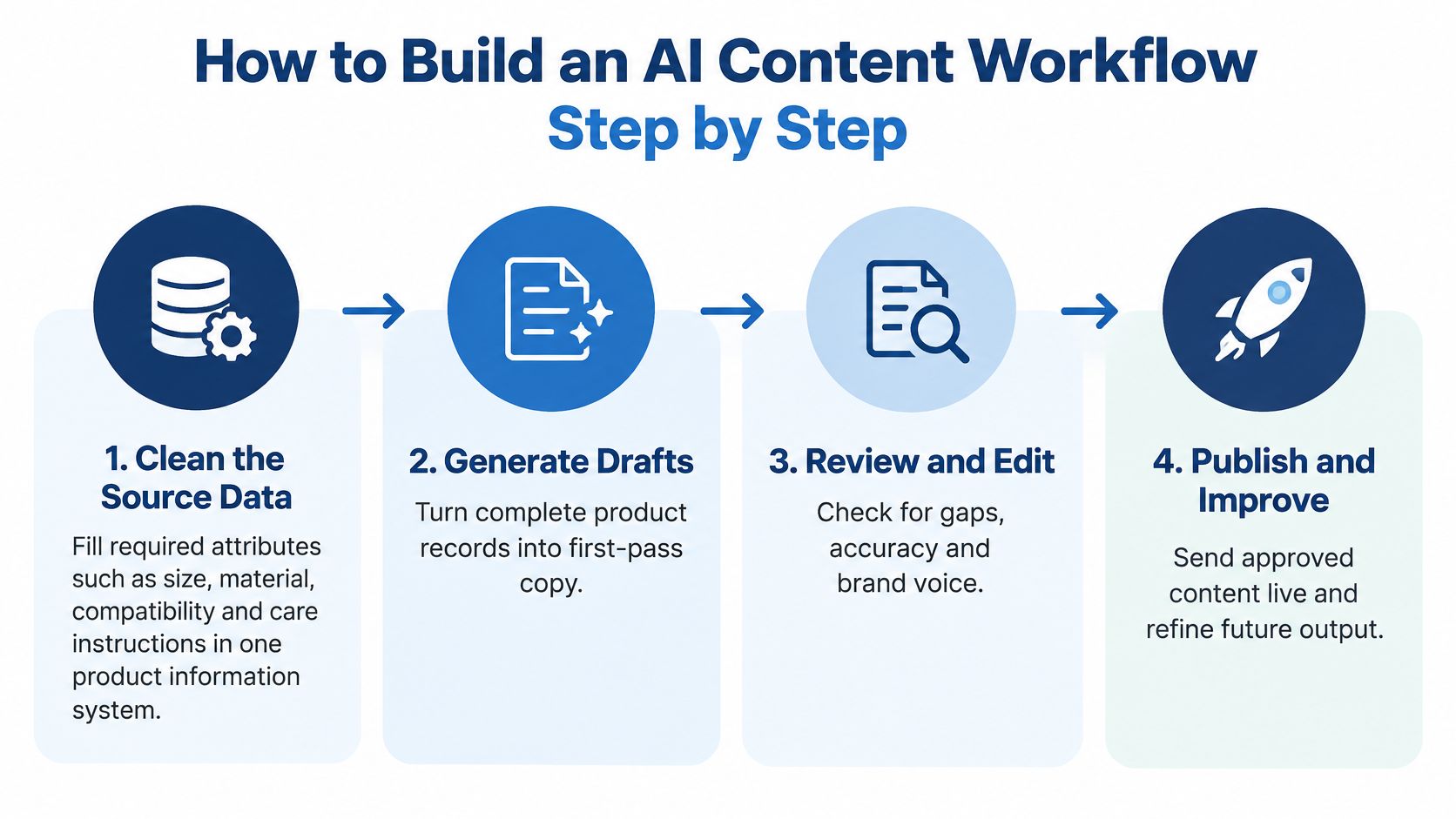
The picture compresses the path into four blocks. The working version has seven moves, because review and logging are where most shops slip.
Clean the source, then set the rules
1. Clean the source data: Fill size, material, compatibility, and care instructions in one product information system. Gaps push the model to invent a lining or a wash cycle. The usual slip is leaving "TBC" in a cell and treating it as a real value.
2. Build an approved claims library: List benefits, certifications, and policy lines, each with a source and an expiry date. A certification that lapsed last spring shouldn't still be in the prompt. The slip is a shared doc nobody dates.
3. Set the generation rules: Tell the model to use only supplied fields and to flag missing data instead of guessing. If care instructions are blank, the draft should say the field is missing. The slip is a friendly prompt that says, "fill any gaps so the page feels complete."
Check, route, publish, and refresh
4. Run automated checks: A rules engine tests required fields, banned words, length limits, and whether each claim matches the library. The slip is checking grammar and skipping the claim match.
5. Route by risk tier: Low-risk drafts go to a category editor. Regulated claims go to a named expert. The slip is one inbox for every SKU, so a coverage line waits behind a colour rename.
6. Publish and log: Store the prompt, the output, the approver, and the sources. The slip is overwriting the draft in the CMS and losing the trail.
7. Refresh on change: When price, stock, or policy data changes, regenerate the affected pages. The slip is a note that says you'll update the page later, with no date on it.
Connect the product information system to the storefront through an API. On Shopify, generation should read live attributes, not a CSV exported in March. A practical look at the store settings is configuring AI product descriptions for Shopify. The pipe between systems is covered in our note on ecommerce data integration. Teams that need that storefront connection built can use our ecommerce development service.
Before launch, open the rendered page. Check headings and the text sitting on images, not only the HTML field in the admin.
Accuracy, Trust and Accessibility Risks to Control
The failure that costs money is a model that invents a warranty length, a delivery window, or a certification. Persuasive copy doesn't fix a promise the warehouse can't keep.
Fulfilment lines are where shoppers decide to stay or leave. DHL's 2025 Canada report found that 82% of Canadian shoppers would abandon a basket if their preferred delivery options were unavailable, and 78% would abandon it if their preferred returns options were unavailable. The same report found that 47% had abandoned a basket because of unexpected customs charges.
Ground every promise in a field
Delivery regions, arrival windows, duties, shipping fees, and return eligibility come only from approved logistics fields. If the data has no date, the model doesn't get to offer one. When a field is missing, or two systems disagree, the draft waits for a person.
That control matters most when you ship across provinces or abroad. Tax and customs aren't one national sentence you can reuse everywhere.
Many shoppers already doubt whether product copy was written by a model. Where your policy calls for it, say that AI helped draft the page. A label doesn't replace the field check. It tells the reader how the page was made.
Accessibility and the missing sentence
Automated product descriptions still have to work for people using keyboards, screen readers, and small screens. The Canadian government treats WCAG as a key accessibility framework, and Accessibility Standards Canada's web requirements specify WCAG 2.1 Level AA for applicable web pages. Generated copy needs clear headings, meaningful link text, plain instructions, and text alternatives for images that carry product facts.
Don't stop at one product URL. Walk search, filters, variant selection, cart, and checkout. A tidy description on a page that can't be bought with a keyboard still fails the buyer.
A sentence can be true and still mislead when the caveat is missing.
A fitting described as suitable for "most machines" that never says it isn't dishwasher-safe will generate returns. Read each page for the warning you'd want if you were the buyer. Any safety or money claim goes to the expert route, with a citation and a name on the approval.
Frequently Asked Questions About AI Product Content
Will search engines penalise AI-written product pages?
Search guidance looks at whether the page is helpful and accurate, not at which software drafted it. The main risk is thin, duplicated pages, so give each product its own specifications, use cases, and reviews before the batch goes live.
Will the copy sound like every competitor?
It will, if the only instruction is "write a description." Build a brand voice guide with three example sentences, a list of banned phrases, and a target reading level. Editors score each draft against that guide and send back anything that could sit unchanged on a rival's site.
How should keywords be handled?
Give the model one primary keyword per product, plus a region-specific term. For a Canadian winter shopper, "snow boots" can match the search better than a generic "winter boots" label. Read the live page afterwards and cut any line that exists only to repeat the term.
How should bilingual pages be handled?
Run separate keyword research for English and French. A word-for-word translation rarely matches how French-speaking shoppers search. Keep a glossary of approved terms, and have a bilingual reviewer sign the French page. An English sign-off doesn't cover both.
How should variants be handled?
Don't paste one description across every colour and size. Generate the attributes that change, such as the dye, the fit, or the capacity, and keep shared facts on the parent record. A shopper comparing two sizes should see the difference without opening a spec sheet.
Which tool should I choose?
Audit your fields first. The tool matters less than clean attributes, a storefront API link, approval routing, and a log of prompts and sources. If a vendor can't show where a claim came from, keep looking.
Before each batch goes live, run this short check.
Voice: Three sample sentences still sound like your brand, and banned phrases are absent.
Search: One primary term per product, a regional term where it fits, and no stuffed repeats.
Uniqueness: Variant pages aren't copies of each other.
Language: French pages use researched terms, not only a translation of the English keyword.
Measure and Pilot Before You Scale
Start with about 50 SKUs in one category. Split them into a generated group and a control group with a similar sales history. Run the test for a full sales cycle so one holiday week doesn't decide the result.
Week one: Audit those products and fill gaps in the product information system.
Week two: Generate drafts, run the rules checks, and log how long editors spend changing each one.
Week three onward: Compare the groups. Read quality before you celebrate speed.
| Metric | What it shows | How to measure it |
|---|---|---|
| Factual-error rate | Accuracy of generated attributes | Errors found per 100 published descriptions in an audit |
| Unsupported-claim rate | Claims without source evidence | Share of claims that fail the citation check |
| Human-edit distance | Effort needed to approve a draft | Words changed between draft and published copy |
| Approval time | Speed of the review workflow | Hours from draft to approval, by risk tier |
| Search click-through rate | Visibility in search results | Search Console data for pilot and control pages |
| Conversion rate | Sales impact | Pilot and control pages over the same period |
| Return rate | Whether content sets accurate expectations | Returns per 100 orders, by SKU group |
| Content refresh latency | Speed of updating after data changes | Days between a data change and the live update |
How to read the numbers
Quality metrics come first. Factual-error rate and unsupported-claim rate tell you whether the pages are safe to trust. Human-edit distance and approval time tell you whether the draft saved work. Search click-through, conversion, and return rate tell you whether shoppers behaved differently.
One number on its own misleads. Faster edits mean little if returns rise. Duplicate pages, mismatched bilingual terms, and a second review queue can wipe out the hours you saved on drafting.
Put the pilot's cost next to the writer hours saved. Scale only when accuracy holds, and conversion or search click-through improves without a rise in returns.
What to list this week
Write down the three product fields your business must never generate without evidence. For many shops, that list is coverage or safety wording, delivery promises, and anything that names a certification.
We use our C.A.P.E. process, Collaborative AI-Powered Engineering, to move from a proof of concept through Discover and Prototype, Plan and Prioritise, Build and Test, and Deliver and Evolve. A proof of concept or MVP lets you test the workflow and see whether it pays off before a full build. On Shopify, later features such as product recommendations, dynamic search, and automated email only help once those catalogue fields are trustworthy. How to judge the pilot is set out in our guide to AI-driven ecommerce analytics.
Cleffex Digital Ltd builds ecommerce and AI workflows for retailers that need catalogue copy tied to real product data, not a blank prompt. We can connect a product information system to your storefront, route high-risk claims to the right approver, and prove the result on a small pilot before you scale. Visit Cleffex Digital Ltd to talk through a 50-SKU pilot on your own catalogue.