


Your loan application is ready to launch, but the balance on the customer's screen doesn't match the figure in the credit report. Finance has another answer. Your engineers are checking connectors while business teams argue about which number is right.
Financial data platform development starts with resolving that disagreement. For Canadian FinTech products, the challenge isn't just connecting more systems. It's building a shared, consent-aware foundation that can explain every figure, restrict its use and adapt as banking rules change.
What a Financial Data Platform Does for Your Business
A lender's underwriting, collections and finance teams check the same customer's balance. Underwriting sees the application snapshot, collections checks the servicing system, and finance reads the closing ledger. The figures may all be correct for different points in time, but without clear context, teams can't tell which one applies to the decision at hand.
That confusion can delay a decision, prompt unnecessary customer contact or lead to lending based on stale information.

A shared water utility
A financial data platform works like a water utility. Banks, payment providers, market feeds and internal systems are rivers. Validation is the treatment plant, governed storage is the reservoir, and APIs and dashboards are the pipes. Adding another source doesn't make its data fit for use. The records need checks before applications, reports, or models receive them.
A financial data platform collects and organises financial records, then makes them available for defined uses. Unlike a warehouse, which primarily stores data for queries, a platform also manages integration, consent, lineage and delivery. Those controls help explain where a figure came from and whether a particular user or application is permitted to receive it.
A shared view without a competing ledger
Canadian non-bank financial intermediation assets increased 5.7% in 2023 to $12.8 trillion, according to a Bank of Canada staff analytical note. As financial information moves between more types of organisations, teams need to distinguish a useful shared view from the official record.
External resources such as AI-assisted market research from HeliosNet may inform market research workflows. Keep that research separate from authoritative account and transaction records.
A unified platform shouldn't invent a better balance. It should explain which balance you're looking at.
Ask different teams for the same figure this week. If their answers differ, can they explain what each one represents? That gap is a practical starting point for scoping a platform.
Core Features Every Financial Data Platform Needs
Core platform capabilities and what they do
| Capability | What It Does | Example |
|---|---|---|
| Unified data model | Maps accounts, transactions and balances to one schema | Account IDs from different banks mapped to one customer view |
| Connector management | Runs and monitors feeds from banks, custodians and payment providers | Alert raised when a daily feed misses its delivery window |
| Data validation and quality checks | Flags missing, duplicate or late records | Transaction without a currency code is rejected and queued |
| Lineage and audit trail | Records where each figure came from and who changed it | Credit score input traced back to its source file |
| Time-series storage | Keeps historical and intraday records side by side | Multi-year balance history alongside live positions |
| Real-time streaming | Pushes updates promptly after a change | Card transaction alerts sent to a fraud team |
| Access control and consent | Limits who sees which data, and for what purpose | Analysts see masked account numbers only |
| Reporting and APIs | Serves verified data to dashboards, apps and partners | Lending app pulls verified income data through an API |
| Monitoring and alerting | Tracks latency, errors and reconciliation breaks | Break flagged when ledger totals exceed an agreed tolerance |
Rank features by the decisions they support
These capabilities perform distinct jobs: bring data in, model it, check it, preserve its history, and serve it safely. Don't give every feature equal priority just because it appears in a product demonstration.
The unified model, connector monitoring, validation and lineage are day-one foundations. Without them, engineers can move records successfully while the business receives inconsistent or untraceable answers.
Real-time streaming is optional for monthly reporting. It becomes essential when fraud teams or treasury staff must act on changes before the next scheduled delivery. Even then, choose a latency target that supports the decision rather than pursuing speed for its own sake.
Prioritise the failure that would hurt most
Consider an insurer onboarding a customer. Identity documents, policy history and claims records must reconcile before the quoting workflow can rely on them. A polished dashboard won't compensate for joining the wrong person's claims to an application.
List the business's most important decisions, then map each to its required capabilities:
Issuing a quote: Prioritise identity matching, validation and traceable inputs.
Reviewing liquidity: Prioritise freshness, account coverage and reconciliation.
Explaining a report: Prioritise historical versions and reproducible calculations.
Give higher priority to features whose failure would block a decision or create customer harm. Adding predictive features before fixing data quality merely spreads errors into more workflows.
The readiness question is practical: which capability would the business miss most if it failed tomorrow?
A Reference Architecture From Sources to Applications
Build the architecture from the sources upwards, with a clear boundary between received information and information approved for use. That boundary lets engineers repair a transformation without pretending the original record was different.
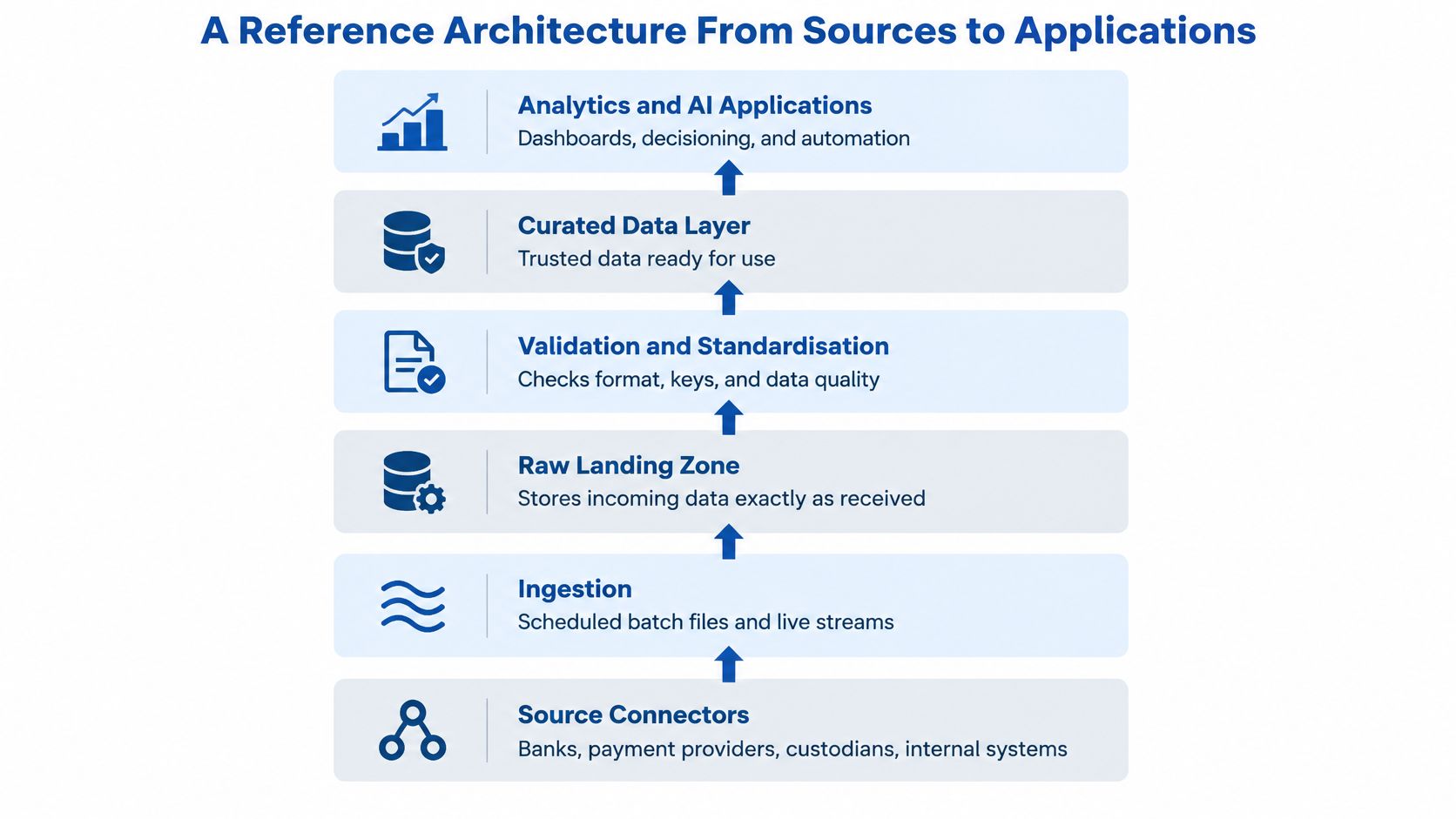
Follow the layers upwards
Source connectors communicate with banks, payment providers, custodians and internal systems. They handle authentication, pagination and provider-specific formats, but shouldn't contain scattered business definitions.
Ingestion accepts scheduled files and live events. Use separate paths where their delivery characteristics differ, with durable queues for events and file manifests for batches.
The raw landing zone retains incoming records as received, subject to retention and deletion policies. If a mapping is wrong, engineers can replay the authorised source record rather than overwrite history.
Validation and standardisation check required fields, identifiers, currencies and dates. Accepted records move into a curated canonical layer, where agreed definitions make them usable across products.
The serving layer exposes financial data APIs, reporting views and machine-learning features. Governance surrounds every layer through cataloguing, lineage, access controls and operational monitoring.
Choose hosting around operational responsibility
In 2023, 48% of Canadian businesses with five or more employees used cloud computing, according to Statistics Canada. A managed cloud warehouse or lakehouse is therefore a realistic option, not an automatic requirement.
Managed services reduce database maintenance work, but teams still need to manage permissions, spending and deployment choices. Self-hosting offers more direct infrastructure control while transferring patching, backups and recovery responsibility to your staff.
Compare total operating effort, contractual data-residency needs and existing skills. Check where backups, logs and support access reside, not just the primary database.
Trace a lender's income record
A bank transaction lands in raw storage. A transformation maps its account identifier, classifies the payment and applies the lender's approved income calculation. The loan application receives the verified result through an API, with its observation time and calculation version.
Keep consent management separate from ingestion so permission changes don't require rebuilding connectors. Version schemas independently from application releases so a new field doesn't unexpectedly break an existing consumer.
For asynchronous delivery, the event-driven architecture guide for FinTech provides useful implementation context.
Design checkpoint: Sketch the route from a source record to a customer-visible answer before choosing tools.
Financial Data Integration Methods Compared
Financial data integration methods compared
| Method | How It Works | Strengths | Limitations |
|---|---|---|---|
| Open banking API | Customer grants permission and data flows through a standard API | Consent-based, stable schema | Coverage depends on participating institutions |
| Direct bilateral API | Custom agreement with an institution | Deep, tailored data | Partner-specific cost and maintenance |
| Secure file transfer (SFTP or CSV) | Scheduled batch files | Simple and widely supported | Not real-time; exceptions may need manual handling |
| Webhook or event stream | Provider pushes change events | Near real-time updates | Needs retry and replay logic |
| Screen scraping | Platform logs in with customer credentials | Works where no API exists | Fragile, credential exposure, outside standardised consent frameworks |
| Market data vendor feed | Subscription to market prices | High-frequency delivery | Licensing cost and usage restrictions |
Use an approved, consent-based API where available. For slow-moving reporting information, a scheduled file transfer may be simpler and easier to reconcile.
Webhooks suit change notifications, but receiving a notification isn't proof that you've processed the underlying transaction. Implement retries, duplicate detection, replay and a way to retrieve missed records.
Design for Canadian framework changes
The federal consumer-driven banking framework describes standardised machine-readable sharing across deposit accounts, payments, investments and secured or unsecured lending, with protections addressing security, privacy and consent. Verify the applicable implementation status before treating any provider's interface as a regulated standard.
Canada's consumer-driven banking information describes an evolving framework, while proposed expansion towards payment initiation targets mid-2027, after broad Real-Time Rail adoption. Treat that as a proposal, not an available capability or guaranteed delivery date.
Until participation is confirmed, assess an API through its commercial agreement. Keep changing policy rules outside core transformation code, and plan migration away from credential-based scraping rather than making it a permanent dependency.
Normalisation is work every method needs
Suppose different banks report the same transfer on different dates because one uses booking date and another settlement date. Preserve both concepts, choose the appropriate reporting rule and record which field the calculation uses.
Account identifiers, transaction categories, time zones, pagination and currency codes need similarly explicit treatment. Applied's resource to compare data integration architectures can help frame the architectural choices, but your provider contracts determine the actual constraints.
Before implementing a connector, establish:
Delivery: How are gaps, duplicates and corrections communicated?
Permissions: Which uses and downstream disclosures are authorised?
Recovery: Can missing history be retrieved or replayed?
Change management: How are schema changes and service retirement announced?
Security, Privacy and Compliance Requirements
Compliance is a product feature, not a final review. A customer needs to grant and withdraw access, an operator needs to investigate suspicious activity, and a compliance team needs evidence that those functions work.
For federally regulated financial institutions, OSFI's technology and cyber risk guidance organises Guideline B-13 around governance and risk management, technology operations and resilience, and cyber security. Map those domains to accountable owners, recoverable services and enforceable technical controls.
Turn obligations into testable behaviour
Include these controls in the platform backlog:
Consent records: Capture purpose, scope, expiry and withdrawal, including downstream handling.
Restricted tokens: Limit access by resource and purpose rather than granting broad account access.
Encryption: Protect data in transit and at rest, with controlled key access.
Analytics protection: Apply pseudonymisation or anonymisation appropriate to the intended use.
Access oversight: Review roles and monitor privileged activity.
Audit evidence: Preserve tamper-evident events without copying unnecessary sensitive payloads into logs.
Incident readiness: Rehearse response, restoration and applicable regulator-notification procedures.
Identify the privacy regimes relevant to the actual relationship. Consider PIPEDA for Canadian private-sector personal information, GDPR where European processing falls within scope, and HIPAA for applicable US healthcare relationships. A healthcare customer alone doesn't make every dataset subject to HIPAA.
Our development process prioritises GDPR and HIPAA compliance and includes encryption, secure storage, anonymisation techniques and access controls.
Make investigations possible
Suppose an insurer detects an unusual API call. Centralised logs should let investigators trace the request through the gateway to the affected tenant, dataset and downstream disclosure without reconstructing events from disconnected systems.
Document each third party's access, ownership and recovery dependencies. Test restoration and failover against business needs, and include vendors in incident exercises where appropriate. The FinTech compliance solutions guide offers further context for connecting these responsibilities.
In a 2022 survey of 5,460 adults, more than 80% said they would stop using a financial service if they didn't trust protection against theft, fraud or accidental loss, according to the Financial Consumer Agency of Canada.
Acceptance rule: Don't approve a control because it appears in a diagram. Approve it when a test demonstrates the intended behaviour.
Visible consent controls support trust. Their underlying requirements and acceptance criteria belong in the project before development starts.
How to Build the Platform in Seven Steps
A reconciliation report shows two different balances for the same account. The finance team trusts one figure, operations trusts another, and the release stalls while they trace the mismatch. A focused first release should establish which figure is authorised, how it was calculated and who owns corrections.
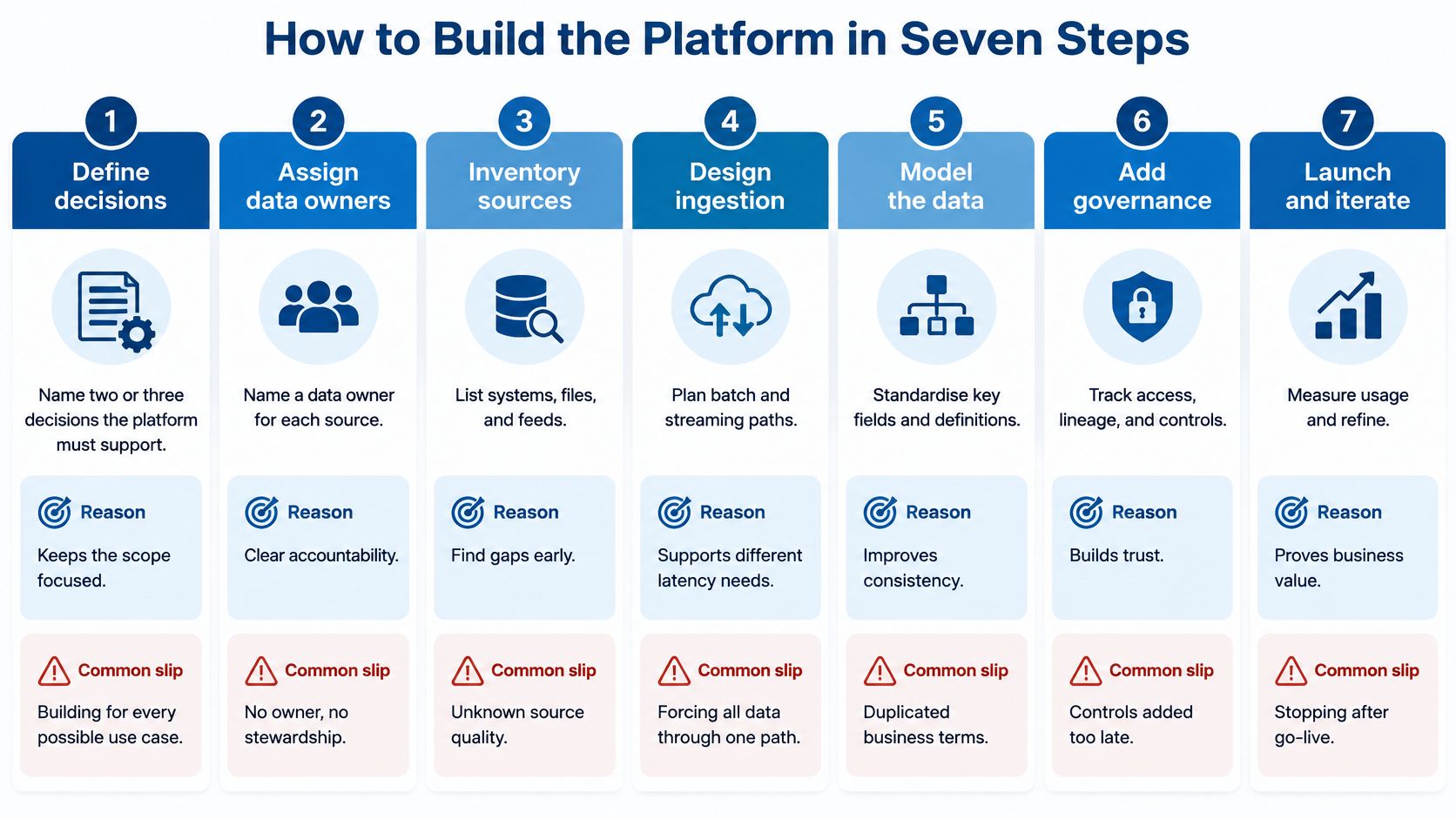
Sequence the work around expensive decisions
Define decisions and owners: Choose a small set of business decisions the platform will support, then assign an owner to each source and output. Without clear ownership, rejected records can sit unresolved while engineering and operations debate who should fix them.
Inventory sources and consent rules: Record systems, file formats, authorised purposes and contractual limits before building connectors. Technical access does not establish permission to use the data for every purpose.
Design the canonical schema and lineage: Agree on identifier mappings, date meanings, correction handling and who owns each calculation. A field name alone cannot settle whether a figure means a posted balance, an available balance or something else.
Build ingestion with validation and alerts: Detect missing feeds, incomplete batches and rejected records, then route exceptions to named owners. A successful connection can still deliver incomplete data.
Set up security before production data flows: Test permissions, logging, secret handling and access reviews with representative synthetic records. Establishing these controls before copying live information reduces avoidable exposure.
Reconcile and rehearse recovery: Compare platform results with authoritative sources, then test replay, backup restoration and failover. Matching row counts won't catch incorrect amounts or duplicate processing.
Pilot, measure and expand: Start with a bounded product workflow and a small user group. Resolve exceptions before expanding to another data domain; deployment alone does not prove that users can trust the output.
Use delivery phases without hiding feedback
Cleffex Digital Ltd's SaaS development process follows four phases: Discover, Design, Build and Deliver. Treat them as decision points, not a reason to postpone validation until handover.
Set measures early and review them during delivery. Cleffex defines clear KPIs for AI projects, provides progress visibility through dashboards and sprint reviews, and aligns development with business goals to track ROI. The same discipline can guide platform work: track reconciliation break rates, exception resolution time and report delivery time.
Keep delivery pitfalls visible:
Scope creep: Add domains only after the pilot meets its acceptance conditions.
Premature connectors: Confirm authorised uses before expanding access.
Skipped reconciliation: A functioning dashboard is not proof that its figures are correct.
Where AI and Real-Time Data Add Business Value
Adding AI isn't the objective. Improving a measurable decision is.
12.2% of Canadian businesses used AI to produce goods or deliver services in the second quarter of 2025, while finance and insurance had an adoption rate of 30.6%, according to Statistics Canada. Adoption doesn't establish readiness for autonomous financial decisions.

Match automation to the consequence of error
Useful starting points include suggesting reconciliation matches, prioritising exceptions and identifying records that need review. Measure whether these tools shorten month-end work or reduce unresolved breaks, rather than counting generated recommendations.
Automation risk tiers and the oversight each needs
| Use Case | Risk Tier | Recommended Oversight |
|---|---|---|
| Reconciliation matching | Low | Human review of exceptions only |
| Anomaly triage | Low to medium | Analyst sign-off on flagged items |
| Fraud scoring | Medium to high | Score thresholds with a documented override process |
| Credit or underwriting decisions | High | Human approval with explainable reasons |
| Payment actions | High | Dual authorisation before release |
These are starting recommendations, not universal classifications. A supposedly low-risk matching tool needs stronger controls if its output can post ledger entries.
Keep models accountable to evidence
Attach confidence and data-quality indicators to outputs, but don't treat a model's self-reported confidence as calibrated probability. Monitor drift, test explanations, and define approval thresholds around the consequences of a wrong answer.
Real-time financial data helps where delayed action matters, such as fraud review or cash-position monitoring. The guide to real-time financial data for FinTech decisions connects freshness with operational use cases.
A model isn't an accounting system. Preserve its recommendations and reviewer outcome separately from authoritative financial records, and prevent unapproved outputs from changing them.
Frequently Asked Questions About Financial Data Platforms
Should we build in-house or with a partner?
Compare your available FinTech data engineering skills with the integration and compliance workload. Retain business ownership of definitions and acceptance criteria even when a partner handles implementation. Investment teams can also use AI research platform questions from Artul.ai to frame a separate assessment of research tools.
How long does a first release usually take?
Source access, data quality and approval requirements determine the schedule. Start with a bounded decision and data domain rather than committing to a generic timeframe before discovery.
What if a source has no approved API?
Prefer provider-supported scheduled files where available. If scraping is unavoidable and permitted, document its risks, migration conditions and planned exit date instead of treating it as permanent infrastructure.
How do we keep data accurate after launch?
Assign exception owners, monitor feed delivery and review reconciliation tolerances and break rates during sprint reviews. Investigate recurring causes rather than repeatedly clearing the same alerts.
At Cleffex, a Canada-based software company, we build digital platforms for regulated insurance and financial services. Our custom API development supports reliable application integration, while our data and AI services cover data planning, automated processes and modern data fabric.
Cleffex Digital Ltd offers custom API development, data and AI services, and regulated financial platform development to help turn disconnected records into dependable product inputs. Visit Cleffex Digital Ltd with your source inventory, priority decision and current reconciliation problems to discuss a focused platform scope.