

You can feel the shift at checkout. A shopper reaches the payment page, sees Pay in 4, and chooses it instead of paying the full amount up front. That tiny button looks like a convenience layer, but in practice it sits on top of a growing consumer-credit machine, with underwriting, disclosures, repayment scheduling, and collections all happening in the background.
That is why BNPL platform development has moved far beyond building a nice-looking checkout widget. The product now sits at the intersection of credit infrastructure, payments orchestration, and regulatory design, which means the engineering choices you make early will decide whether the platform can survive merchant growth, compliance review, and later expansion into new provinces or countries.
Why BNPL Has Become Credit Infrastructure
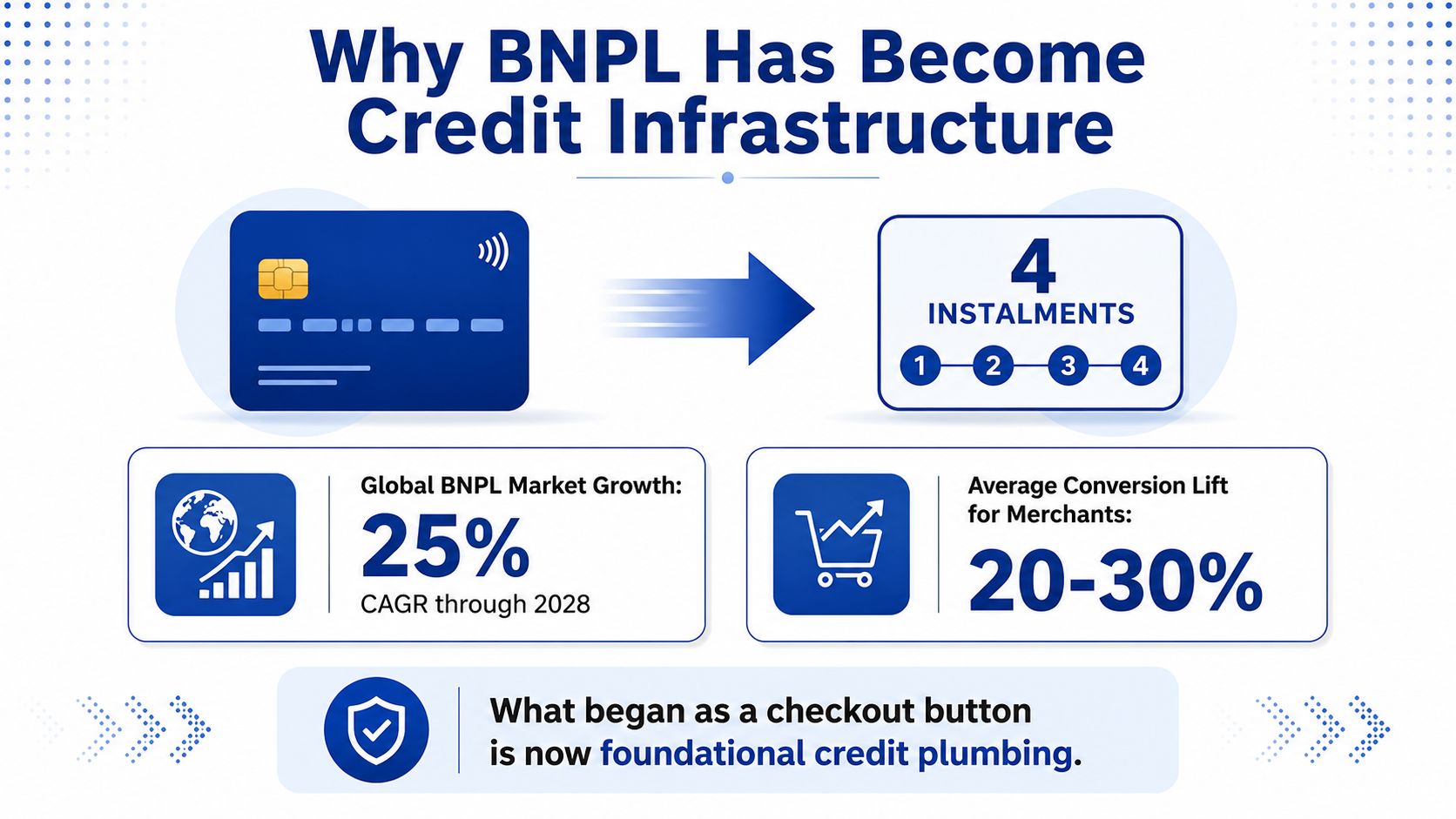
A checkout button only looks simple when the repayment logic is hidden. Once a customer splits a purchase into instalments, the platform is no longer just processing a card or routing a payment. It is originating consumer credit, tracking repayment timing, handling late fees, and managing a loan portfolio that needs operational discipline.
That change shows up clearly in the U.S. market data. The five largest surveyed lenders expanded BNPL loan originations from 16.8 million in 2019 to 180 million in 2021, while the dollar volume of those originations rose from $2 billion to $24.2 billion. The same source reports that the average BNPL order value moved from $121 in 2020 to $135 in 2021, which is a sign that merchants were doing more than just testing the model; they were using it for larger baskets at scale. By 2024, Morgan Stanley estimated BNPL financed 6% of U.S. e-commerce, up from 2% in 2020. Those are infrastructure signals, not novelty signals.
What the market mix now tells builders
By 2025, the Richmond Fed estimated BNPL providers originated close to $160 billion in consumer credit products, with pay in 4 accounting for about half of issuance and other instalment loans making up the rest. The same source said BNPL transaction value had been growing roughly 20% per year since 2021, reaching an estimated $70 billion in 2025, or about 1.1% of total credit card spending. That does not describe a speculative feature. It describes a product category that has entered the credit stack.
Practical rule: if repayment, delinquency, and disclosures are not first-class services in your design, you have not built a BNPL platform; you've built a fragile checkout experiment.
The regulatory angle matters just as much as the volume story. CFPB data showed that from 2022 to 2023, the number of BNPL loans surveyed increased 23%, total loan dollars rose 26% after inflation adjustment, late-fee incidence fell from 5.2% to 4.1%, and charge-offs declined from 2.63% to 1.83%. That pattern suggests the market is maturing into a more disciplined credit channel, where portfolio quality, servicing, and compliance controls matter more than raw merchant acquisition.
The engineering mistake is to treat BNPL like a promotional payment option. Teams that do that usually overbuild the merchant-facing front end and underbuild the credit spine. The safer view is simpler: the platform must behave like regulated credit infrastructure, with checkout acting as only one entry point.
For teams already thinking in terms of embedded finance solutions and FinTech software development, that framing changes priorities. Merchant onboarding still matters, but underwriting, servicing, compliance routing, and repayment integrity sit at the centre of the product, not at the edge. For a related primer on embedded finance patterns, see this guide on embedded finance solutions.
Defining the MVP for a BNPL Platform
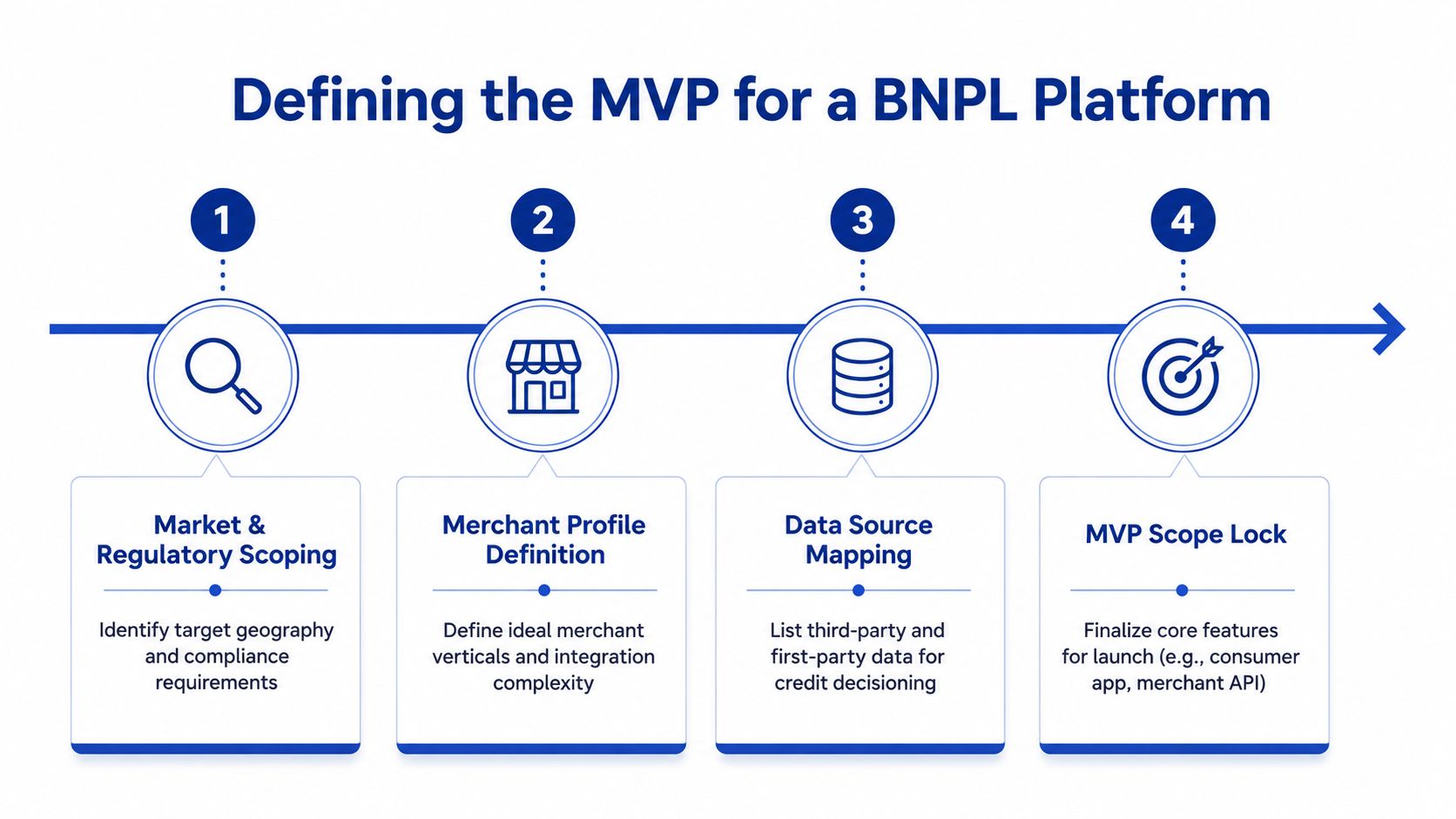
A BNPL MVP fails fast when the team starts with interface polish instead of the operating boundaries. The first pass has to define where the product is allowed to originate credit, which borrower attributes can be used in each market, and how merchant rules change by country or province. That discovery work also has to map the compliance set for the launch geography, including the credit, privacy, payments, and onboarding rules that apply during build, not after go-live. A merchant with a low-friction checkout integration and a merchant that needs a heavier back-office flow create very different implementation paths, so scope has to start there.
A practical roadmap usually breaks into a discovery and regulatory scoping phase, a UX and architecture phase, then the MVP build itself. For many teams that means a few weeks to align the legal boundary, a few more to settle service boundaries and user flows, then the build window once the data model and partner integrations are fixed. The point is not speed for its own sake; it is avoiding a launch plan that ignores PCI DSS, local lending rules, KYC/KYB checks, and the specific settlement obligations in each launch market.
What belongs in version one
The MVP should prove the full credit and repayment loop before it tries to cover every merchant segment or repayment pattern.
Core checkout flow: The customer can choose BNPL, review repayment terms, and complete the purchase without breaking merchant checkout.
Simple credit scoring: The platform can make a quick eligibility decision using the minimum viable set of data.
Payment scheduling: Instalments are calculated, shown clearly, and triggered automatically.
Merchant settlement: Funds move to the merchant on a controlled schedule with reconciliation built in.
The launch risk usually sits in the integrations, not the screen design. Payment gateway, credit bureau, and KYC connections often take longer than the core UI build because each one brings its own schema, error handling, and retry logic. Security review also needs time for PCI DSS, encryption, key management, and the controls that compliance teams will want to test before they sign off. For a useful reference on how those pieces fit into a scalable fintech architecture, the service boundaries have to be clear before development starts.
Keep the MVP narrow enough that every step can be audited. A broad launch with weak controls is slower than a focused launch that survives review.
That is why v1 should avoid trying to support every merchant type, every repayment cadence, or every risk model on day one. It should prove that the transaction chain works, that money settles correctly, and that compliance staff can inspect the flow without asking engineering to rebuild the core. Anything beyond that belongs in the next release, not in the launch gate.
Architecting an Event-Driven BNPL Platform
A shopper clicks “pay later,” the credit check returns, the merchant expects an approval, and the settlement ledger has to stay in sync with both. That flow breaks fast if underwriting, repayment, and settlement are packed into one monolith. A better BNPL platform treats each step as part of a credit system, not a checkout widget, with event-driven microservices isolated around the functions that need to scale and fail on their own.
That architecture matters because BNPL lives or dies on timing. Eligibility checks, loan origination, and fraud detection have to complete in milliseconds, not after the customer has already dropped out. The practical pattern is API-driven ingestion of behavioural data and alternative credit inputs, with the platform reacting while the shopper is still in the session.
A workable service split
The service boundaries hold up when each domain owns its own state and its own failure mode.
Credit decisioning service: It evaluates eligibility, affordability, and fraud signals in real time.
User profile service: It stores identity, repayment history, wallet state, and communication preferences.
Collections service: It manages instalment schedules, retries, delinquency flows, and notices.
Settlement service: It orchestrates merchant payout timing and reconciliation.
This separation is operational, not cosmetic. If payment retries spike, collections should absorb the load without pulling down approval logic. If underwriting rules change for one market, settlement should not need a rewrite just to keep merchant payout timing intact.
Engineering rule: any service that must answer during checkout should fail fast, log clearly, and hand off cleanly. Slow failure usually creates worse merchant support than an explicit rejection.
The failures are usually ordinary and expensive. Callback mismatches break order status. Payment-reconciliation errors turn into support tickets and manual fixes. Missing compliance coverage across checkout and repayment flows creates rework after launch, which is exactly what teams try to avoid when they are shipping under pressure.
For a closer look at how these boundaries fit into scalable fintech architecture, the key point is clear. BNPL architecture is a resilience decision first and a software pattern second. If the event model is weak, expansion only exposes the same defects in more provinces, more payment rails, and more regulatory regimes.
Integrating Payments, Underwriting, and Settlement
BNPL platforms fail most often when teams treat payments, underwriting, and settlement as separate projects. They're one flow. The shopper initiates a purchase, the risk engine makes a decision, the payment rail authorises the money, and the merchant gets settled later according to the agreed schedule. If those layers are loosely coupled, reconciliation becomes a daily fire drill.
The practical approach is to choose a PSP and acquirer stack that supports pay in 4 schedules, split settlements, and clean reconciliation from day one. Credit bureau calls, identity checks, and bank account verification should sit inside the decision path, but they need to be timed carefully so they don't add visible checkout latency. That means asynchronous enrichment where possible, with only the minimum blocking checks running in the critical path.
What a clean integration test plan looks like
A good test plan starts with the money movement, not the user interface.
| Integration | Purpose | Typical Effort Added |
|---|---|---|
| Payment gateway | Authorisation, capture, and transaction routing | 2 to 4 weeks |
| Credit bureau | Credit checks and risk enrichment | 2 to 4 weeks |
| KYC / identity verification | Customer verification and compliance checks | 2 to 4 weeks |
These time bands come directly from implementation planning guidance for BNPL builds.
Teams should load-test with realistic merchant volumes and realistic retry behaviour, not just happy-path transactions. The worst production issues usually appear in failure handling, not in first-time approvals. That includes duplicate payment attempts, delayed webhook delivery, and broken ledger updates when a gateway times out but the acquirer eventually succeeds.
A useful pattern is to test the whole transaction as an event sequence. Checkout creates the credit event, underwriting emits a decision, payment services emit authorisation and capture events, and settlement closes the loop with a merchant payout event. If each transition is logged and replayable, reconciliation becomes much easier.
The main trade-off is speed versus certainty. Faster integration gets merchants live sooner, but shallow integration pushes complexity into support and finance later. In BNPL, that debt arrives as failed collections, settlement disputes, and customer confusion, which is much more costly than spending the time to wire the core flow properly.
Compliance, Risk, and Fraud by Design
Compliance should be a platform layer, not a launch checklist. BNPL products now sit in a regulatory zone where the credit treatment, disclosure model, and consumer protections can vary by market, so the architecture has to support jurisdiction-specific logic from the start. If you bolt that on later, every new market becomes a rework project.
The U.S. is already treating BNPL as a credit product in practice, and Europe is moving closer to consumer-credit treatment as well. Canada adds another layer because disclosures and repayment logic may need province-sensitive handling. The product answer is modular regulation, not a single global ruleset. A platform that cannot vary disclosures, repayment timing, and notices by jurisdiction will hit a wall the first time it tries to expand.
For teams working through the security side of this, the Intelligent Contacts PCI DSS platform is a useful reference point for thinking about payment security as an operating discipline, not just a certificate.
Controls that belong in the platform
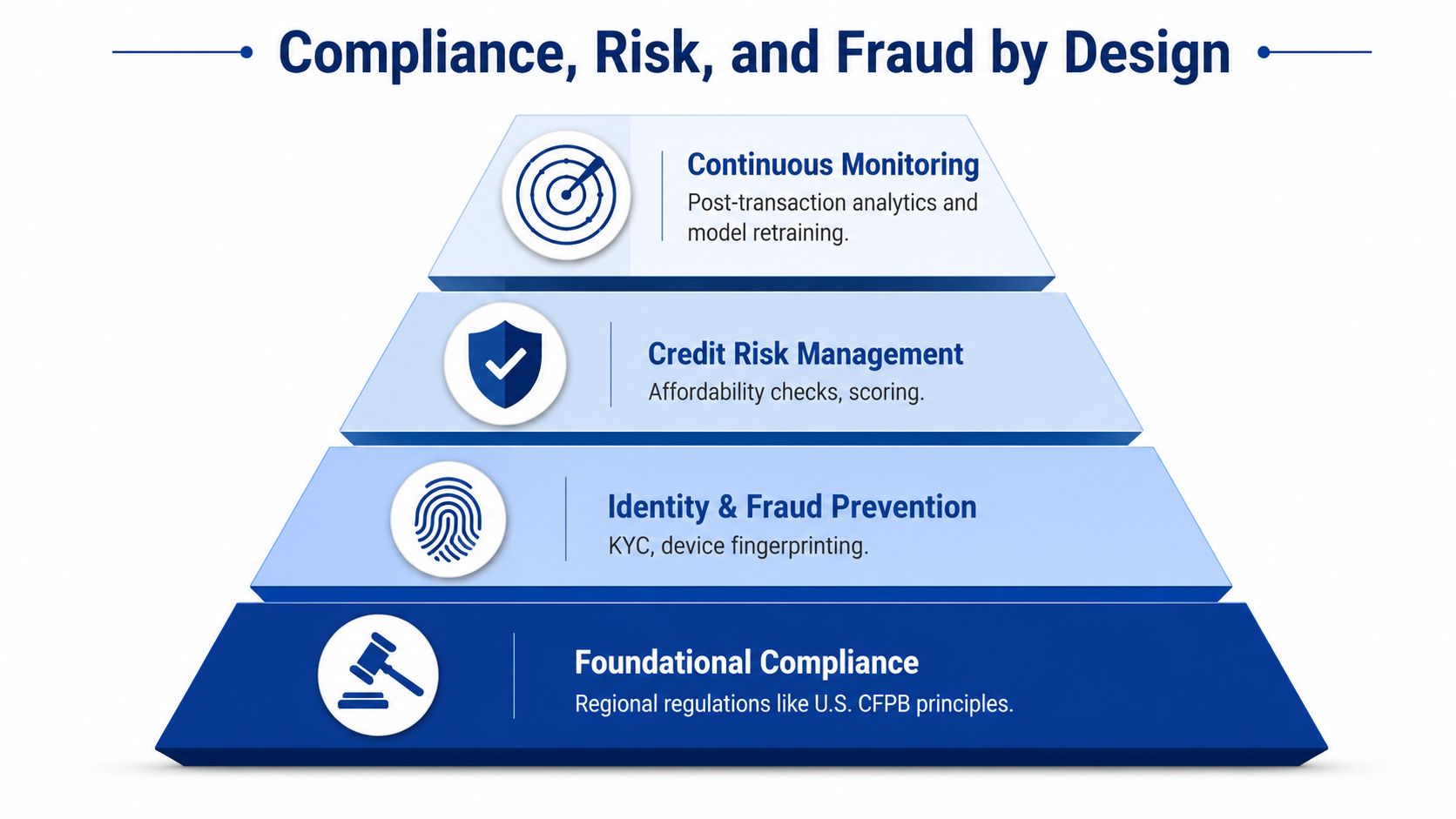
The strongest BNPL teams tend to build four control layers together.
Foundational compliance: Local regulation, disclosures, consent, retention, and auditability.
Identity and fraud prevention: KYC checks, device fingerprinting, and velocity rules.
Credit risk management: Affordability checks, scorecards, and exposure limits.
Continuous monitoring: Post-transaction analytics and model retraining.
Risk controls work best when they are event-aware. If collections, disputes, and charge-off handling live in the same service family that originated the loan, the platform can react to delinquency patterns before they become portfolio problems. Batch-only fraud logic is usually too slow for checkout fraud and too blunt for good customers who just need a cleaner verification flow.
A BNPL platform without jurisdiction-aware compliance logic is not ready for expansion, even if the checkout looks polished.
The useful mindset is to design every decision as traceable: why was the user approved, what disclosure did they see, which repayment schedule applied, and how was the merchant settled? If those questions can't be answered from the platform itself, the compliance model is incomplete.
Team, Timeline, Cost, and KPIs for a BNPL Build
A BNPL build works best when the team is small but properly cross-functional. You need a product lead who understands merchant flows, a compliance owner who can read the regulatory implications, an engineering lead who can keep the architecture coherent, and an integrations specialist who lives in the payment, bureau, and KYC details. That last role is often the difference between a launch on time and a launch that slips every week.
The delivery window usually follows the 18 to 24 week MVP range already noted. For cost benchmarking, it's sensible to compare against 2026 MVP team cost ranges rather than assuming a generic app budget will fit a regulated credit product. BNPL is heavier than standard checkout work because it includes credit logic, settlement controls, compliance review, and security gating.
KPIs that actually matter after go-live
Approval rate: If it is too low, the product won't convert. If it is too high without controls, the portfolio can drift.
Basket lift: Merchants care whether BNPL changes order size and conversion behaviour.
Late-fee incidence: This tracks repayment friction and customer health.
Charge-offs: This is the clearest sign that underwriting and collections need work.
Merchant settlement accuracy: If finance can't trust the payouts, the partnership model weakens fast.
What separates a platform that can scale from one that merely survived launch is visible in five signals. The underwriting engine is stable, the reconciliation process is boring, compliance can audit decisions without hand-holding, support tickets around repayment are falling, and merchant finance teams trust the payout reports. If those five things aren't true, the platform isn't ready for faster merchant onboarding.
That's the point where engineering and governance finally line up. The build stops being a launch project and becomes a financial operating system.
Designing for Cross-Border Expansion From Day One
Most BNPL guides stop at checkout and generic underwriting. The harder question is how to make the platform change its behaviour by province or country without rebuilding the core system. That question matters in Canada-first builds because the same product may later need to run under different disclosures, repayment rules, and consumer protections in the U.S. or Europe.
The BIS analysis is the right lens for that problem. It finds that BNPL uptake is stronger in countries with higher e-commerce penetration, higher inflation, and looser consumer-protection rules. That means adoption is shaped by market structure as much as by product design. A copy-paste platform built from a single-market U.S. template can miss the regulatory and banking differences that define how BNPL performs in Canada and beyond.
The architecture that scales across jurisdictions
The practical answer is to separate policy from product flow.
Jurisdiction-aware decisioning: Approval rules should change by geography without changing the core checkout engine.
Modular disclosure templates: Consumer wording should be stored as governed content, not hard-coded text.
Country-specific repayment rules: Instalment timing, reminder cadence, and default handling need local logic.
Configurable merchant treatment: The settlement model may differ by market or merchant type.
That approach gives you one platform with many rule sets. It also makes audits much less painful. When a province changes its requirements, the team updates policy configuration rather than rewiring underwriting or repayment code. That's the difference between a platform that expands cleanly and one that accumulates hidden forks.
A question that comes up in scoping calls is whether a no-code or low-code route is realistic. For a regulated credit product, the answer is usually no, at least not for the core decisioning and compliance path. Low-code can help with internal admin tools or merchant onboarding forms, but the credit spine needs controlled services, clear logging, and testable decision logic. If you cut corners there, expansion becomes fragile very quickly.
Another common question is what makes BNPL harder than a normal checkout build. The answer is the combination of real-time credit, repayment orchestration, and jurisdiction-sensitive compliance. A standard checkout can fail and be retried. A BNPL platform has to decide, disclose, settle, and service correctly the first time.
Teams also ask about realistic timing for security and compliance review. The earlier implementation guidance is still the right benchmark; 2 to 3 weeks is the minimum realistic window for PCI DSS, encryption, and regulatory checks, and integration-heavy work can push the schedule further. That's why scoping needs to happen before the code starts, not after the first test environment is live.
If you're comparing platform ownership models, the merchant of record guide is a useful way to think about who carries which obligations in the transaction chain. That decision affects settlement, tax handling, and support responsibilities, so it belongs in architecture planning, not just legal review.
The practical takeaway is plain. Build the core once, make policy modular, and keep jurisdiction logic outside the checkout path. That is the architecture that lets a Canadian BNPL platform grow into new markets without turning every expansion into a replatforming project.
Cleffex Digital Ltd builds BNPL and broader fintech products with the kind of architecture that can handle real compliance, real settlements, and real expansion pressure. If you're planning BNPL platform development or need help shaping a regulated FinTech software development roadmap, visit Cleffex Digital Ltd and start the conversation with a team that understands how credit platforms scale.