


Your team is preparing to connect another clinic, but the booking system can't show its availability, the laboratory sends results into a separate inbox, and clinicians still ask patients to repeat their medication history. Everyone has digital tools. The difficulty is getting independent organisations to work together.
Designing multi-provider healthcare software means solving that coordination problem, not expanding a clinic's existing application. The architecture must support shared care while respecting different organisations, clinical responsibilities and access rules.
Why Multi-Provider Operations Change Platform Design
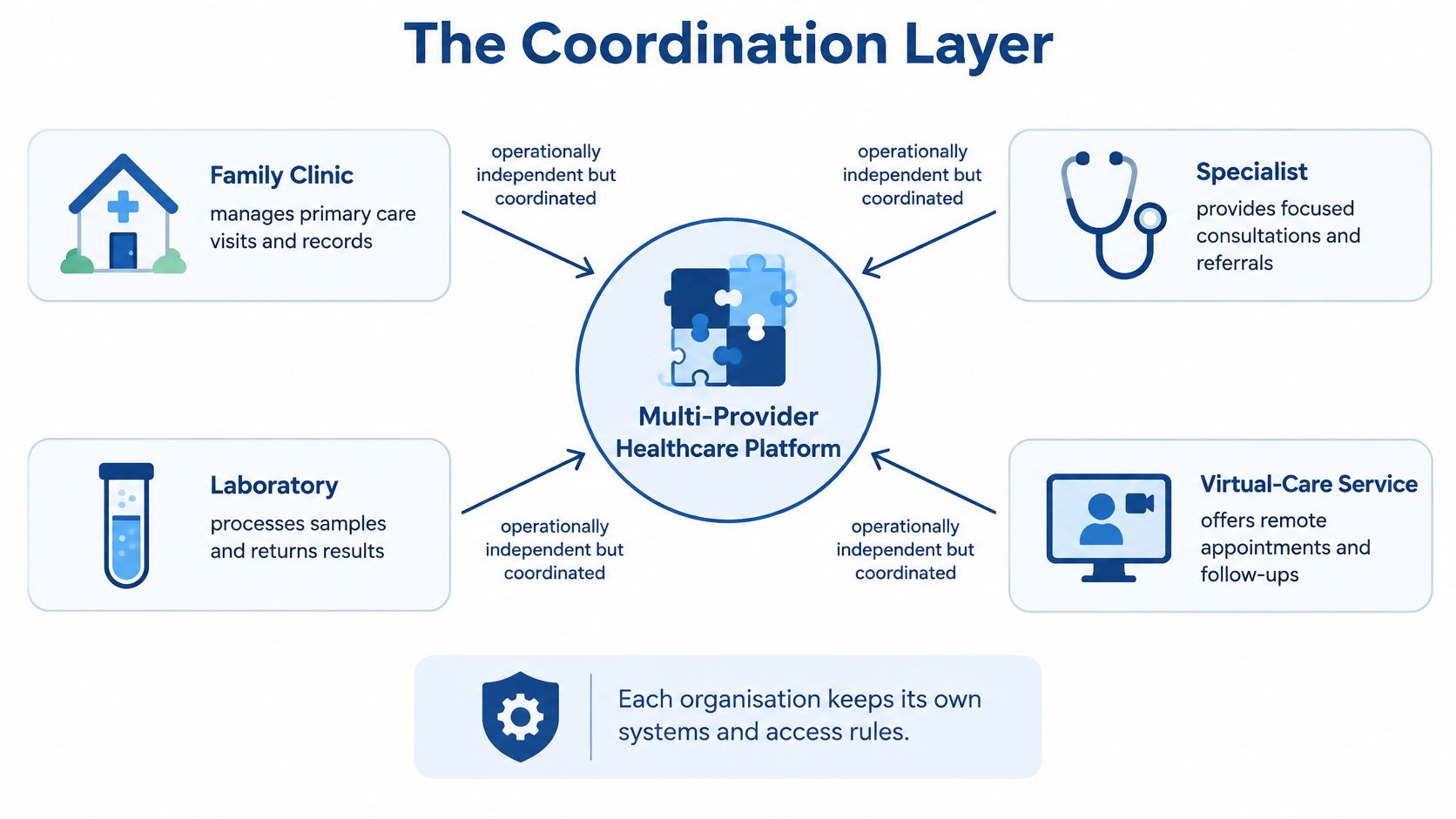
Consider a representative patient journey. A family clinician requests laboratory tests, refers the patient to a specialist and arranges a virtual follow-up. Each organisation records a different part of the journey, and each controls its own system.
The patient experiences one episode of care. The participating teams see separate appointments, documents and responsibilities.

Shared care without shared ownership
A larger single-practice application might assume that an administrator can configure every user, change every workflow and resolve every disputed record. That assumption doesn't suit independent providers.
The specialist may accept a referral but reject an appointment request. The laboratory may correct a result after another clinician has reviewed it. A virtual-care practitioner may need relevant history without permission to browse unrelated encounters.
Design principle: Coordinate the patient journey without assuming that every participant belongs to the same organisation.
The practical requirements follow from these boundaries:
Explicit responsibility: Identify who accepts, completes and follows up each task.
Local decision-making: Let organisations retain appropriate control over services and working practices.
Visible hand-offs: Show whether information was delivered, accepted or returned for clarification.
Portable participation: Plan how an organisation joins, changes systems or leaves.
Healthcare SaaS can provide a common delivery model, but a cloud subscription doesn't settle these questions. Teams still need defined tenant boundaries, understandable sharing agreements and a way to retrieve usable information.
The architectural shift is from managing a digital filing cabinet to coordinating commitments between organisations. A successful hand-off includes information, permission and an accountable recipient.
Understanding the Core Platform Concept
Think of the platform as a railway interchange. It connects routes and helps passengers make their next connection, but it doesn't need to own every train.
Similarly, a multi-provider platform can connect organisations that retain their existing clinical systems. Its job is to make their relationships and shared work understandable.
Separate the people from the organisations
A useful starting model distinguishes:
Organisation: The participating clinic, laboratory or care business.
Practitioner: The individual professional, potentially working with different organisations.
Location: The physical or virtual setting where a service is available.
Patient: The person whose information and care are being coordinated.
Encounter: A particular care interaction, with its own participants and context.
These distinctions matter when a practitioner works across locations. Their professional identity may remain unchanged, while their authority to access a record depends on the organisation and encounter involved.
Provider management software focuses on people, credentials, affiliations, schedules and availability. A broader healthcare SaaS platform also coordinates clinical information, care pathways, integrations and governance.
Digital access isn't connected care
In 2024, 92% of Canadian healthcare providers had access to a digital health system, but only 52% used one to send or share clinical information with providers outside their main practice.
For platform buyers, that distinction is fundamental. Having records on a screen doesn't mean another organisation can use them.
Nor does a shared database automatically provide suitable organisational separation. Database structure, workflow flexibility and permission boundaries are different decisions. Evaluate them separately rather than accepting a single claim that the product supports multiple providers.
Core Capabilities for Shared Clinical Workflows
Start with the work a patient and care team need to complete. Feature names are useful only when they describe a reliable path from registration to follow-up.
Establish identity and find the right service
At registration, the platform should help staff determine whether an incoming record belongs to an existing patient. Ambiguous matches should enter a review process rather than trigger an irreversible automatic merge.
Next, a provider directory should identify participating organisations, practitioner affiliations, service scope and availability. A directory entry needs an owner who can correct it when a clinician changes location or stops accepting referrals.
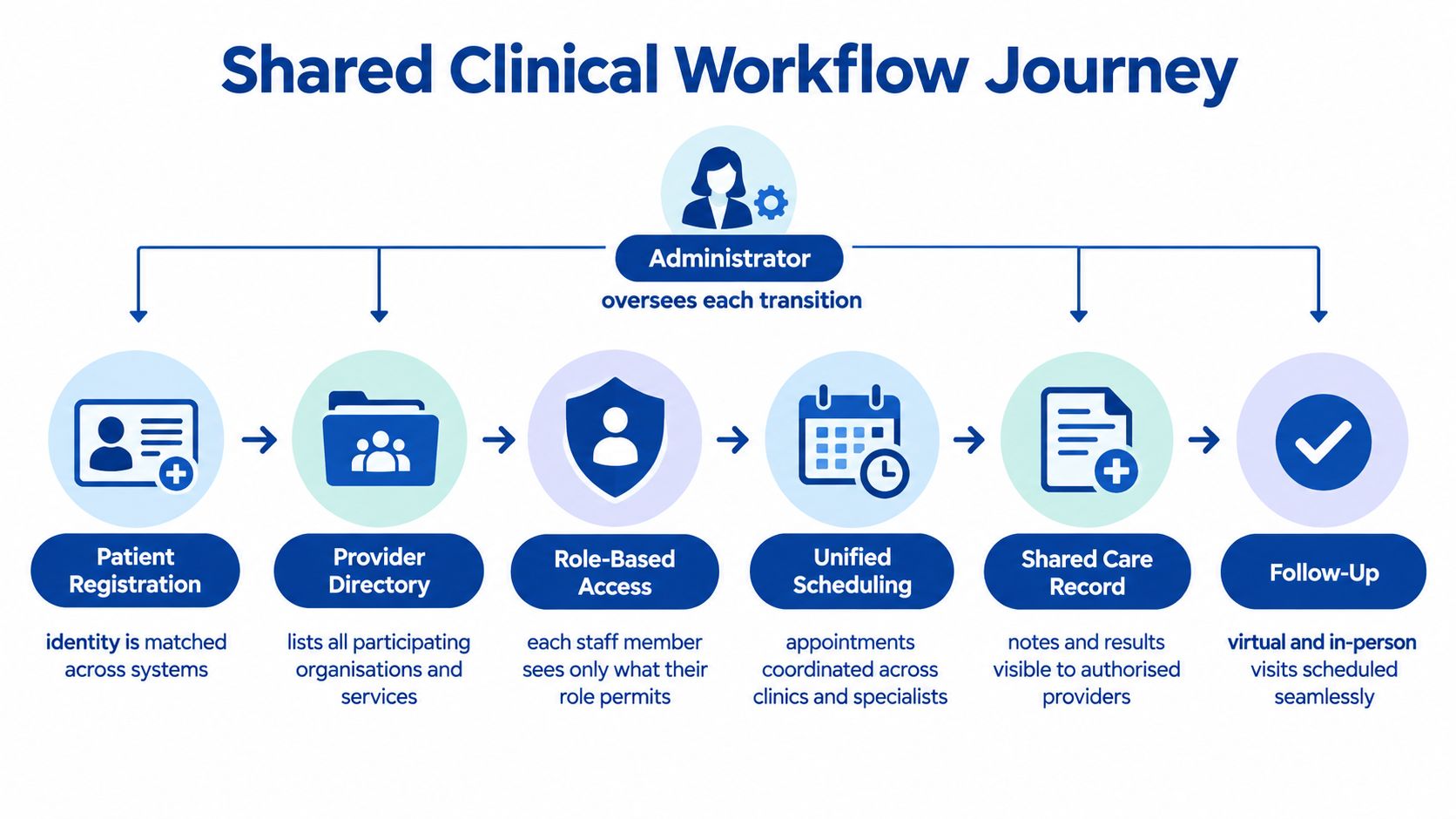
Booking then becomes more than choosing an empty calendar slot. A patient requesting a routine appointment at their usual clinic has different routing needs from someone seeking an available specialist across a regional network.
In 2024, 38% of primary-care physicians' practices offered online scheduling, 21% of Canadians used a secure website, patient portal or mobile app to request an appointment, and 33% reported virtual care with their primary-care provider.
Make each transition actionable
A practical capability checklist should connect features to responsibilities:
Scheduling: Check location, appointment type, practitioner availability and service eligibility together.
Referral routing: Identify the receiving team, required information and acceptance status.
Messaging: Attach conversations to the relevant patient and task, with an escalation route for unanswered requests.
Clinical record views: Present authorised notes and results with their origin and review status.
Follow-up coordination: Assign responsibility for the next action rather than assuming someone will notice.
Operational reporting: Surface incomplete referrals, unresolved identity reviews and overdue tasks.
Keep the shared workflow small enough to explain. An administrator should be able to see that a referral needs attention without automatically receiving access to the full clinical narrative.
Separate baseline capabilities from speciality-specific extensions. Identity review and accountable task ownership belong in the foundation; specialised assessment forms or supervision arrangements should be configurable. Otherwise, accommodating a new provider type can force unnecessary changes on every existing participant.
Interoperability Across Providers and Locations
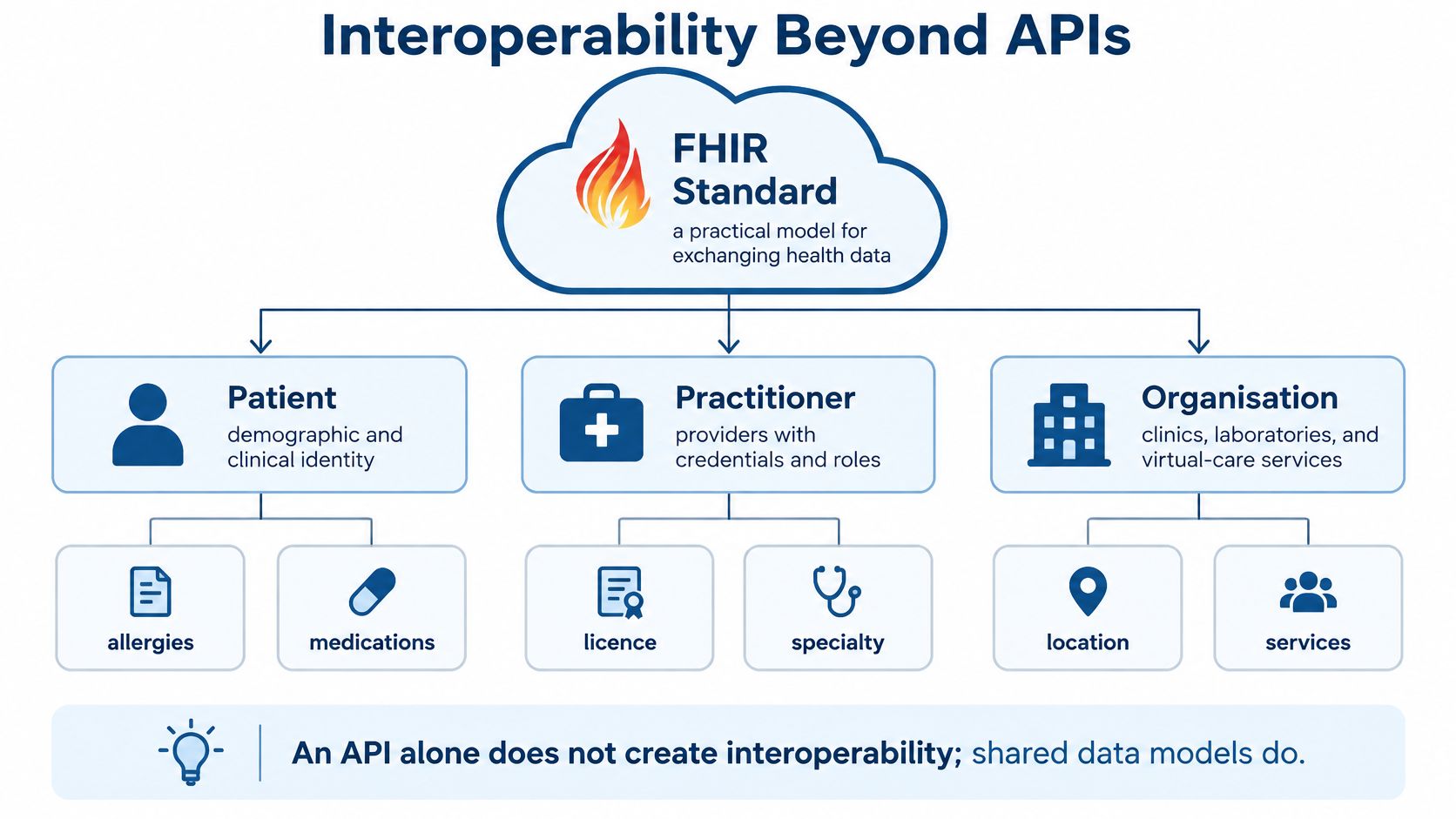
An API provides a route for software to communicate. It doesn't guarantee that the receiving system understands what a message means.
A laboratory result can arrive successfully yet remain unsuitable for clinical use if its units, patient association or correction status are unclear. Interoperability therefore requires shared meaning as well as successful transmission.
Agree on language and grammar
FHIR offers resource models for exchanging healthcare information, including Patient, Practitioner, Organisation, Encounter, Observation, Medication and DocumentReference. Think of these models as a shared language, with implementation profiles supplying more precise grammar.
Canada Health Infoway's CA Core+ standardises Canadian healthcare data exchange, while CA:FeX defines minimum requirements for single- and multi-resource FHIR exchanges and supports SMART on FHIR and International Patient Access, as described in Infoway's interoperability market guidance.
For implementation, define a canonical model, meaning the platform's agreed representation of shared information. Validate incoming payloads against applicable profiles and terminology requirements, and preserve resource versions and provenance, the record of where information originated and how it changed.
Reconcile meaning rather than overwrite differences
Use explicit handling rules for difficult exchanges:
Patient duplicates: Retain source identifiers and route uncertain matches for review.
Medication histories: Distinguish a reported medication from a prescription or a discontinued treatment.
Referrals: Preserve the request, acceptance decision and resulting encounter as related events.
Laboratory results: Retain units, reference ranges and corrected-result relationships.
An API gateway can provide a consistent boundary for authorisation, consent checks and exchange logging. Don't bury every organisation's rules inside individual connectors.
For technical evaluation, Cleffex's guide to healthcare interoperability with HL7 FHIR APIs provides a relevant starting point. To connect those design questions with the patient journey, Orange Neurosciences' resource on the benefits of care continuity offers useful context.
Ask vendors to demonstrate meaningful exchanges, including a correction and a failed validation. Measure completeness and interpretation accuracy, not just successful API responses, and test whether those exchanges remain usable after an EMR vendor changes.
Security and Compliance by Design
A valid login shouldn't grant unrestricted access across participating organisations. Authentication establishes identity; the platform still needs to decide whether a particular action is appropriate.
Access decisions should answer who, which patient, which purpose, which organisation and when.
Translate privacy expectations into controls
Design tenant isolation so that an organisation's data isn't exposed merely because another participant uses the same infrastructure. Combine role-based permissions with contextual attributes, such as organisational affiliation, care-team membership and the purpose of access.
Build the following controls into the implementation:
Purpose limitation: Record why information is collected, accessed and shared.
Consent records: Preserve applicable permissions, restrictions and changes.
Protected storage and transmission: Encrypt information in transit and at rest.
Traceable activity: Maintain tamper-resistant audit trails with restricted administrative access.
Controlled disclosure: Return only the API fields needed for the approved task.
Retention management: Apply documented retention and disposal rules.
Keep clinical exchange separate from analytics and other secondary uses. A Canadian analysis identified privacy concerns around virtual-care platforms' handling of registration information, de-identified health data and user data, reinforcing the need to examine those purposes independently in research on virtual-care privacy risks.
Assign responsibility beyond the software
Ontario's PHIPA framework places breach-notification and risk and privacy assessment duties on health information network providers serving multiple health information custodians, as set out in Ontario IPC guidance on network-provider obligations.
For an electronic service provider that isn't a custodian's agent, separate IPC guidance on electronic service providers describes restrictions on using personal health information beyond providing the contracted service.
The platform's legal classification needs appropriate review. Technical safeguards alone don't settle contractual or statutory responsibilities.
Document who handles patient-access requests, investigates suspicious activity, approves subcontractor access and notifies participating organisations. Give smaller clinics workable review screens and incident procedures, not just policy documents. Cleffex's overview of data security in healthcare information systems can support those design discussions without replacing jurisdiction-specific advice.
Multi-Provider Workflows in Practice
The following scenarios are illustrative design patterns, not claims about a particular vendor's product. Their value lies in the questions they expose during testing.
Regional booking and specialist follow-up
A regional clinic network could offer cross-location appointments while letting each clinic control which services it makes available. The booking process should distinguish a practitioner's open time from a clinic's ability to deliver the requested service.
A specialist referral introduces another dependency. The receiving team may need supporting laboratory results before accepting the request, so the platform should show the missing requirement and identify who must supply it.
For implementation considerations around these transitions, healthcare referral automation is a useful related topic.
Representative journey: A virtual-care clinician records a triage assessment, requests an appropriate in-person appointment and transfers the relevant context. The receiving team confirms responsibility, while the patient can see the next step.
Route by clinical need before convenience
Between April 2023 and March 2024, 15% of emergency-department visits involved conditions potentially manageable in primary care, while 9% involved conditions potentially manageable virtually. These categories shouldn't be added together or treated as guaranteed opportunities for diversion.
Use this context to test routing cautiously:
Clinical suitability: Allow professional judgement to override automated suggestions.
Capacity: Confirm that the destination can accept the patient.
Completion: Track whether the intended appointment or referral occurred.
Changing participation: Test what happens when a provider temporarily withdraws a service.
These operational checks make healthcare platform scalability tangible. More connected locations are useful only when staff can reliably direct work to an appropriate, accountable destination.
Implementation Factors for Scalable Growth
Buying software and redesigning shared operations are different projects. Start by understanding how participating organisations work, then choose architecture that can support the agreed relationships.
Discover responsibilities before connecting systems
Map providers, locations, clinical journeys, existing applications and information ownership. Include frontline staff, privacy leads, integration teams and representatives from smaller organisations.
Resolve foundational questions before development:
Authority: Who can approve changes to shared workflows and data contracts?
Identity: Who reviews uncertain patient matches and practitioner affiliations?
Service ownership: Who maintains directory entries and resolves failed hand-offs?
Success measures: What constitutes a completed referral, usable exchange or successful patient-access request?
Exit arrangements: What information must remain accessible when a participant leaves?
Patient access deserves explicit acceptance criteria. Between 2021 and 2023, Canadians reporting that they checked health information online increased from 32% to 39%, but in 2025 only 13% reported access to all the identified core components: laboratory and imaging results, immunisation records excluding COVID-19, and medication history and renewals.
A portal login therefore isn't enough. Define which information patients should find and how missing or disputed records are handled.
Choose an architecture that matches organisational independence
Architecture options for multi-provider operations
| Architecture | Best fit | Main strength | Main trade-off |
|---|---|---|---|
| Shared multi-tenant platform | Networks willing to adopt common operating processes | Consistent workflows and central operational support | Requires strong isolation, configurable permissions and agreement on shared governance |
| Modular integration layer | Independent providers retaining existing systems | Preserves local configuration and clinical applications | Requires ongoing mapping, interface monitoring and reconciliation support |
| Custom platform | Organisations with distinctive care models and implementation capacity | Tailored relationships, workflows and administrative controls | Creates long-term maintenance, standards and portability obligations |
There's no universal winner. A shared platform may simplify support but constrain local variation; a modular approach preserves independence while increasing interface work.
Custom development can accommodate unusual operating models, but the organisation must fund maintenance and keep interoperability commitments current. In every option, test exportability and audit-history access rather than assuming portability follows from ownership of the database.
Pilot the exceptions as well as routine work
Select representative organisations and include difficult cases: a corrected result, an ambiguous identity match, a rejected referral and a practitioner moving between locations. Use synthetic or appropriately authorised test data.
Before migration, agree on rollback conditions, reconciliation responsibilities and clinical sign-off. Train by role, and rehearse downtime procedures so staff know how to continue care when an exchange fails.
Make expansion an operational capability
Create repeatable onboarding for provider management software, including affiliation checks, directory approval and access review. Compare configurations regularly so undocumented local changes don't undermine shared workflows.
Assign executive ownership to unresolved cross-organisation decisions. Define support escalation, integration monitoring and vendor-change procedures before expanding the network.
For organisations evaluating external implementation support, Cleffex's healthcare software integration service is an option alongside internal delivery or platform-vendor services. Match that choice to available expertise, clinical risk and the ongoing support burden, not just initial development capacity.
Build a Platform That Can Grow Without Fragmenting Care
The strongest investment test isn't whether a vendor can display many participating organisations. It's whether your team can add a participant without making clinical work, privacy decisions, or support responsibilities harder to understand.
Among Canadian providers with digital-system access in 2024, 50% identified insufficient integration as a principal obstacle to external information sharing.
A practical decision checklist
Ask for evidence against these questions:
Relationships: Can the platform represent practitioners, organisations and locations explicitly?
Meaningful exchange: Can receiving teams interpret information and identify its provenance?
Accountable access: Are tenant-specific permissions, consent ownership and incident responsibilities clear?
Clinical exceptions: Can staff resolve duplicates, corrections and rejected referrals safely?
Operational visibility: Are failed integrations and incomplete hand-offs visible to named owners?
Patient access and portability: Can patients obtain relevant information, and can organisations leave without losing usable records?
Document unresolved assumptions and give each an owner. A successful demonstration shouldn't conceal work that clinics will have to perform manually after launch.
Frequently Asked Questions
Does multi-provider healthcare software require a shared database?
No. A shared platform and an integration layer connecting existing systems are different options. Choose according to organisational independence, workflow needs and support capacity.
Can small clinics participate without a dedicated compliance team?
Design for that constraint. Provide understandable permissions, manageable access reviews and clear escalation arrangements rather than transferring complex administrative work to clinic staff.
What should we test before adding another location?
Run a complete cross-provider journey, including a failure and its recovery. Confirm that staff can identify the responsible team at every transition.
Scalability means preserving trust, continuity and accountability as participation changes. Make those outcomes acceptance criteria, not aspirations attached to a feature list.
Cleffex Digital Ltd offers custom healthcare software development and integration for organisations connecting clinical systems and shared workflows. Visit Cleffex Digital Ltd to discuss your provider network, existing applications and the interoperability and implementation requirements for your next stage of growth.