

In a crowded online marketplace, the secret to getting ahead isn't just about working harder; it's about working smarter. Think of Shopify AI solutions as your secret weapon, a digital team of experts working around the clock to fine-tune every part of your business. These tools help with everything from creating personalised shopping experiences to making your back-end operations run like a well-oiled machine.
The New Era of Ecommerce With Shopify AI
Artificial intelligence in ecommerce isn't some far-off idea anymore; it's here, and it’s a must-have. For business owners, this means you now have access to powerful systems that can predict what your customers will do next, automate the tedious tasks you hate, and uncover insights that were previously out of reach.
It's best to think of AI not as a substitute for human instinct, but as a powerful amplifier. It sifts through the mountains of data your Shopify store collects every day, purchase histories, browsing habits, abandoned carts, and turns it all into a clear, actionable game plan.
This guide will demystify what "Shopify AI solutions" really means for your store's bottom line. As a leading software development company, we’ll show you how to unlock these capabilities and turn impressive technology into real, tangible results.
What AI Means for Your Business
At its heart, artificial intelligence is all about making smarter, faster decisions on a massive scale. For a Shopify store owner, that means a few key advantages that directly boost your profits. You can get a good sense of the possibilities by seeing how others are leveraging AI apps for Shopify stores.
When you bring AI into the mix, you can:
Truly Understand Your Customers: AI algorithms can analyse thousands of data points to build rich customer profiles, revealing what your shoppers actually want.
Make Your Operations More Efficient: Imagine automating repetitive tasks like writing product descriptions, tracking inventory, and answering the same customer questions over and over. That frees you up for more important work.
Drive More Sales and Conversions: AI can serve up spot-on product recommendations and personalised marketing messages that nudge customers to click "buy now."
The core idea here is that AI gives merchants the power to build the kind of highly individualised and efficient AI-powered ecommerce experiences that, until recently, only the biggest retail giants could afford.
From Manual Effort to Automated Growth
Adopting an AI-assisted approach is about shifting your focus. You move away from time-consuming, manual chores and toward high-impact, strategic thinking. For example, instead of manually tagging hundreds of products for your recommendation engine, an AI system can handle it instantly by analysing visual cues and customer behaviour.
This simple shift lets you concentrate on what really matters: building your brand, crafting creative marketing campaigns, and nurturing customer relationships. As we'll get into, making this change can be surprisingly straightforward, whether you start with off-the-shelf apps or opt for custom AI-driven Shopify development services. The goal is the same: to make your business smarter, more responsive, and ultimately, more profitable.
Key Categories of AI-Powered Tools on Shopify
Diving into Shopify AI feels a lot more manageable once you know how the tools are grouped. Instead of thinking of AI as one big, complicated thing, it’s better to see it as a toolkit. Each tool is built to solve a specific business problem.
These tools fit neatly into a few main categories, covering everything from how you talk to customers to how you manage your stock behind the scenes. By understanding these groups, you can quickly pinpoint which solutions will actually make a difference for your business and its unique goals. It’s all about focusing on practical results.
AI for Personalised Shopping Experiences
The most visible category is personalisation. Think of these AI tools as an expert personal shopper for every single person who visits your website. They create a unique journey for each customer, which dramatically increases the chances of making a sale. The main goal here is to make every shopper feel seen and understood.
How does it work? Through a few clever mechanisms:
Smart Product Recommendations: The AI looks at what a visitor has browsed, what they’ve bought before, and even what’s sitting in their cart. It then suggests other products they’re very likely to want. This is miles ahead of the old "customers also bought" widgets.
Dynamic Content: AI can change what people see on your homepage or landing pages. A returning customer might be greeted with items related to their last purchase, while a brand-new visitor is shown your best-sellers.
Personalised Search Results: When someone searches for a "dress," the AI can push styles, colours, or brands it knows they prefer to the top of the results. It makes finding the perfect item quick and painless.
AI for Operational Efficiency
Behind the curtain, AI is also a powerhouse for your back-end operations. This category is all about automation and optimisation. These tools take on the repetitive, data-heavy tasks, freeing up your team to focus on what really matters. They are the quiet workhorses that keep your business running smoothly.
The big win here is that operational AI cuts down on human error and lets your team think about strategy, not spreadsheets. That shift is absolutely crucial for scaling your business.
Key functions include automated inventory management, which predicts demand to stop you from running out of stock or ordering too much. There are also sophisticated fraud detection systems that spot suspicious transaction patterns in real-time. For a deeper dive into how these tools are changing the game, as we explored in our AI solutions for ecommerce and retail guide, you can see the wide range of applications.
AI for Smarter Marketing and Content Creation
Finally, AI is completely changing how we approach marketing and content. These tools help you write better copy, create stunning visuals, and make data-driven decisions instead of just guessing what will resonate with your audience.
Shopify's Winter '26 Edition brought over 150 AI updates to the platform, including the Sidekick AI assistant and Agentic Storefronts. These new features enable deep integrations with tools like ChatGPT, which is a major step forward for Canadian businesses that need secure, personalised customer chats.
This is where you'll find tools for writing persuasive ad copy, segmenting customer lists for targeted email campaigns, or even generating entire blog posts. Shopify Magic, for example, can write detailed product descriptions in seconds. It’s an incredible time-saver. To see what's out there, guides like the 12 best AI tools for fashion brands offer a great overview. By automating these creative tasks, you can run more sophisticated marketing campaigns with less heavy lifting.
To help you connect the dots, here's a quick summary of how these AI capabilities translate into real business benefits.
Core Shopify AI Capabilities and Their Business Impact
| AI Capability Category | Example Tools and Features | Primary Business Benefit |
|---|---|---|
| Personalisation | Smart product recommendations, dynamic web content, personalised search | Increases conversion rates and average order value by showing customers what they want to see. |
| Operational Efficiency | AI-powered inventory forecasting, automated order processing, and fraud detection | Reduces manual workload, minimises stockouts/overstocking, and protects revenue from fraud. |
| Marketing & Content | Automated ad copy generation, AI-driven customer segmentation, product description writing | Saves significant time on content creation, improves marketing ROI with better targeting. |
This table should give you a clear starting point for identifying which area of your business could benefit most from an AI-powered boost.
Real-World Applications for Your Industry
Technology is great in theory, but its real worth is measured by what it can do for your business on the ground. When it comes to things like machine learning or predictive analytics, the important question isn't "what is it?" but "what can it do for me?" The great thing about Shopify AI solutions is their flexibility; the answer really depends on what industry you're in and what you’re trying to achieve.
Whether you're selling insurance or automotive parts, AI tools can be moulded to fit your specific challenges. The goal is always to create a smarter, more personal experience for your customers, no matter how simple or complex your business is. Let’s dive into how different sectors are already putting these tools to work.
Applications in the Insurance Sector
If you're an insurance firm using Shopify for lead generation, your top priority is building trust. That trust starts the moment a potential client lands on your site, looking for quick, clear answers about policies, coverage, or the claims process.
This is where an AI-powered chatbot becomes an invaluable team member. It can handle all those initial questions 24/7, guiding visitors to the right information or policy pages. This frees up your human agents to handle the more nuanced, high-stakes conversations, like finalising a complex policy or managing a sensitive claim. It’s a win-win: customers get instant help, and your team can focus where they’re needed most.
Automotive Industry and Lead Qualification
The automotive world is fiercely competitive, whether you're selling parts online or generating leads for vehicle sales. A huge challenge is separating the serious buyers from the window shoppers. AI-driven forms and lead scoring systems are perfect for this.
Instead of a static contact form, these smart forms adapt in real-time. They ask different questions based on a user's previous answers, gathering better info without being a drag to fill out. The AI then instantly analyses the responses to "score" that lead based on their apparent budget and intent.
The result? A much cleaner sales pipeline. Hot leads get flagged and routed straight to your sales team, while cooler leads can be put into an automated email sequence to warm them up.
This kind of smart pre-qualification means your sales pros aren't wasting time on dead ends. They're only talking to the most promising prospects, which can have a huge impact on conversion rates. This is just one of many AI-powered ecommerce experiences that deliver real, measurable results.
Healthcare, Wellness, and Startups
For startups in the healthcare and wellness space, especially those selling non-prescription products on Shopify, getting personalisation right while staying compliant is everything. AI can recommend products based on a customer's quiz answers, browsing habits, or stated goals, all while operating within strict industry guidelines. For example, it can make helpful, personalised suggestions without crossing the line into making unverified medical claims.
Startups and small businesses, in particular, can punch well above their weight with these tools. Shopify, the Canadian ecommerce titan headquartered in Ottawa and Montreal, has been a major player in this space. Its own AI tools, like Shopify Magic, are built to give a leg up to small businesses, including insurance brokers, auto dealerships, and new online stores, that are up against big competition. You can read more about how Shopify's AI tools are boosting merchant growth in Canada.
Levelling the Playing Field for Small Businesses
Looking beyond specific industries, Shopify AI gives any small business a serious advantage. Tools like Shopify Magic can generate professional-grade marketing copy, product descriptions, and even blog posts, saving a massive amount of time and money.
Marketing Copy: Create snappy headlines and ad copy for your social media campaigns in an instant.
Product Listings: Write detailed, persuasive, and SEO-friendly product descriptions in a few clicks.
Customer Service: Get help drafting professional and consistent replies to common customer emails.
These capabilities let entrepreneurs step back from the daily grind and focus on the bigger picture of growing their business. A huge part of that is anticipating what customers will do next. As we explored in our AI's role in demand forecasting for retail guide, you can learn more about anticipating future trends. By automating these crucial tasks, a small team can suddenly have the output and polish of a much larger company.
Choosing Your Path: AI Apps vs. Custom Development
So, you've decided to bring artificial intelligence into your Shopify store. Excellent. Now you’ve hit your first major fork in the road: do you go with a ready-made app or build something from scratch?
Think of it like getting a suit for a big event. You can walk into a store and buy one off the rack, or you can hire a tailor for a custom-fit piece. Both are valid choices, but they serve very different needs and budgets.
The off-the-shelf Shopify apps are the ready-to-wear suits of the ecommerce world. They're quick, usually affordable, and you can have one up and running in an afternoon. But, just like a suit off the rack, it might not be a perfect fit for your unique brand or the specific way you run your business.
Then you have custom development, the bespoke, tailor-made suit. This route requires a much bigger investment in time and money upfront. The result, however, is a system built precisely for you, aligning perfectly with your business logic and giving you a competitive edge no one else can copy.
This decision tree helps visualise how different industries can approach AI adoption, highlighting how a tailored strategy can solve very specific problems.
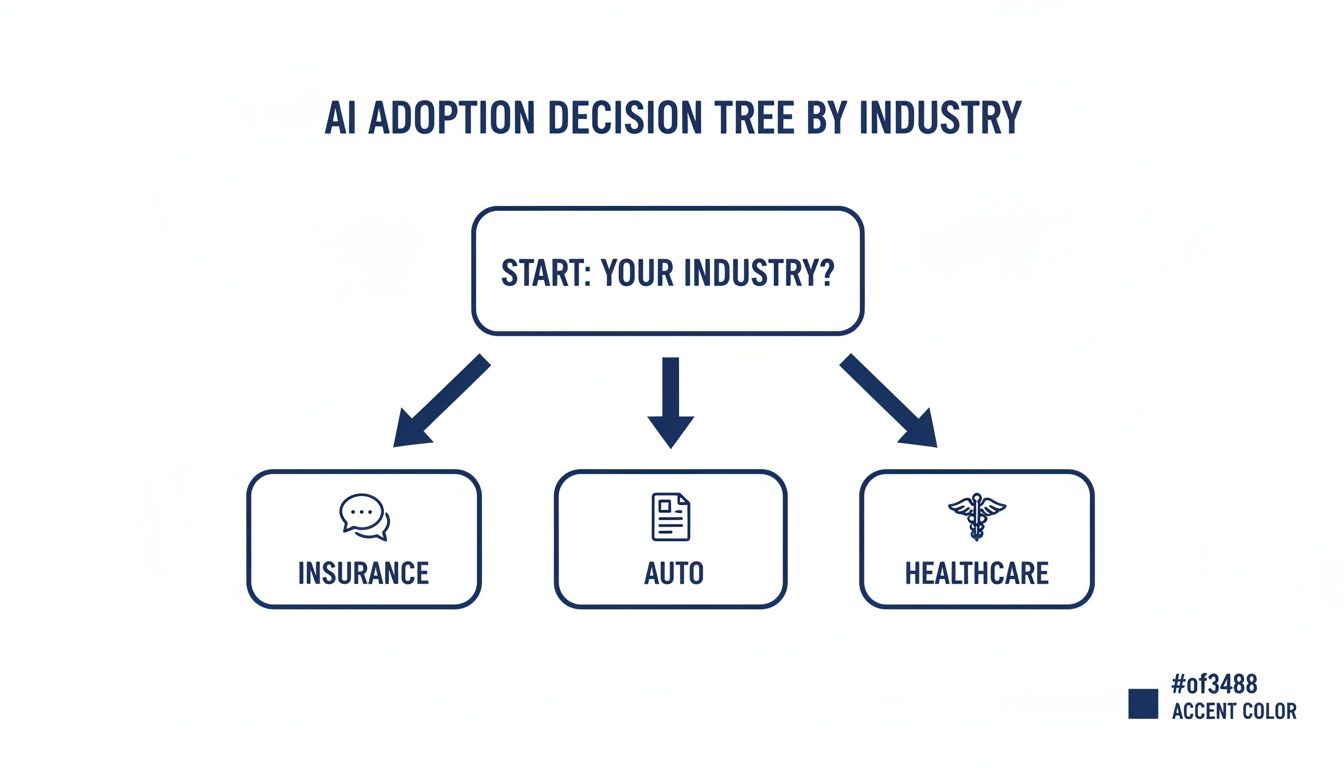
As you can see, even if the core technology is similar, how it's applied, whether through a simple app or a custom build, changes dramatically based on industry goals like qualifying leads or handling client support.
Comparing Off-the-Shelf AI Apps and Custom AI Integrations
To make the decision clearer, it helps to put the two options side-by-side. This table breaks down the key differences to help you figure out which path makes the most sense for your business right now.
| Consideration | Shopify AI Apps | Custom AI Development |
|---|---|---|
| Time to Implement | Minutes to hours. Install and configure directly from the App Store. | Weeks to months. Requires a full development cycle from discovery to deployment. |
| Initial Cost | Low. Typically, a monthly subscription fee often includes a free trial. | High. A significant upfront capital investment is required. |
| Customisation | Limited. You are restricted to the features and settings provided by the developer. | Unlimited. Built from the ground up to match your exact business processes and data. |
| Competitive Edge | Minimal. Your competitors can install and use the same app. | Significant. Creates a unique, proprietary asset that no one else has. |
| Technical Skill | None required. Designed for easy installation by non-technical store owners. | Expert team needed. Requires specialists in AI, data science, and Shopify development. |
| Scalability | Depends on the App. May have limitations as your business grows or needs change. | Highly scalable. Designed to grow and adapt with your business over the long term. |
| Data Ownership | Varies. Your data is processed by a third-party service, so review the privacy policies. | Full ownership. You own the code, the model, and all the data it processes. |
Ultimately, there's no single "best" choice. An app might be the perfect entry point, while a custom build could be your long-term goal. It all comes down to your current resources, needs, and vision for the future.
The Case for Shopify AI Apps
For most small businesses and startups, dipping a toe into the AI waters with an app from the Shopify app store is a no-brainer. These tools are built for speed and accessibility, usually running on a subscription model that’s easy on the cash flow.
Here’s why they’re so popular:
Speed to Market: You can add powerful AI features to your store in minutes, not months.
Lower Initial Cost: A monthly fee is much easier to swallow than the five- or six-figure price tag for custom work.
Proven Technology: These apps are often used by thousands of merchants, so the kinks have been worked out.
Of course, this convenience has its limits. You’re stuck with the features the developer gives you, and customisation can be minimal. If you have a very specific workflow, a generic app might cause more headaches than it solves.
When to Go for Custom AI Development
When off-the-shelf solutions just don’t cut it, custom development becomes the clear winner. This is the path for businesses that want to build a real competitive advantage, something baked right into their operational DNA. As a leading software development company, we see this as the way to create genuine, lasting value.
A custom solution means you own your technology. Instead of just renting a feature, you're building an asset that grows with your business and can be adapted as the market shifts.
This approach is the right call if you need to:
Connect AI with your own internal, proprietary systems.
Develop a one-of-a-kind recommendation algorithm based on your unique customer data.
Create deeply personalised AI-powered ecommerce experiences that no app can replicate.
This is where having an expert partner is critical. Working with a team that specialises in AI-driven Shopify development services ensures the final system is not only technically solid but also perfectly aligned with your business goals.
The choice isn't about which is better overall, but which is right for you, right now. Many businesses start with apps to test ideas and then invest in custom solutions to scale what works. If you'd like to explore how our expertise can guide you on this journey, feel free to learn more about our team on our about us page.
The Technical Nuts and Bolts of AI Integration
Plugging an AI solution into your Shopify store isn't quite as simple as installing a new app. To really get the value out of these tools, you have to look under the bonnet a bit. Think of it like dropping a powerful new engine into a car; you also need to make sure the brakes, the fuel system, and the frame can handle the extra horsepower.
Getting these technical details right from the start is the difference between an AI tool that boosts your business and one that just causes headaches. Let's walk through the three main areas you need to get straight for a smooth and effective integration.
Data: The Fuel for Your AI Engine
AI runs on data. It’s a learning machine, and the quality of what it learns from dictates the quality of its output. The old computer science saying, "garbage in, garbage out," is truer than ever here. If you feed an AI system messy, incomplete, or just plain wrong customer data, you're going to get back shaky predictions and unhelpful recommendations. Your first job is to get your data house in order.
Beyond that, we have to talk about privacy. Here in Canada, compliance with regulations like the Personal Information Protection and Electronic Documents Act (PIPEDA) isn't optional. You need to be crystal clear with your customers about what data you're collecting and how your AI is using it. This is more than just a legal box to tick; it's about earning and keeping customer trust.
When a customer trusts you with their data, they're far more likely to stick around and buy again. Breaking that trust is one of the fastest ways to torpedo your brand's reputation.
Performance and Keeping Things Speedy
Every online retailer shares the same nightmare: a slow website. It's a legitimate fear. A sluggish store can sink your search rankings and, even worse, send frustrated shoppers clicking away. In fact, a study from Portent showed that every extra second of load time can slash conversion rates by an average of 4.42%.
So, when you're looking at any AI solution, you have to ask how it will affect your store's speed.
Is the code lean? You want a tool that runs efficiently without adding a bunch of digital dead weight to your pages.
Does it load smartly? The tool's scripts should load in the background (asynchronously) so they don’t stop the rest of your page from appearing.
Can it handle the rush? Imagine your biggest Black Friday sale. You need a solution that can scale up to meet a huge spike in traffic without falling over.
Your AI should work like an invisible assistant, not an anchor dragging down the customer experience. This is a crucial piece of the puzzle when we build out AI-powered ecommerce experiences.
Making It All Work Together
Finally, remember that your AI tools don't live on an island. They need to play nice with the rest of your technology, your CRM, your email marketing platform, and any other systems you depend on. A setup where different tools can't talk to each other creates isolated pools of data and operational chaos, which is the exact opposite of what you want from automation.
And don't forget about upkeep. The digital world moves fast. Your AI tools will need regular updates to stay secure and effective. Whether you're using an off-the-shelf app or a custom-built solution, you need a solid plan for ongoing support. As any good software development company knows, planning for future maintenance is just as important as the initial build.
Partnering with Cleffex for Your AI Transformation
We've covered the incredible potential of Shopify AI solutions, but knowing what’s possible is one thing. Turning that potential into profit? That takes the right strategy and a team with serious technical chops. Honestly, choosing the right partner is the most critical step you'll take. It's what separates a successful AI integration from a costly experiment.
At Cleffex, we live at the intersection of powerful AI and real-world business problems. We don't just plug in technology for the sake of it; we build solutions that solve your specific challenges and actually drive growth. As a dedicated software development company, we’re all about delivering real, tangible outcomes.
From Theory to Tangible Results
Let's make this real. Imagine an automotive parts retailer wrestling with a massive, complicated catalogue. They come to us, and we build a custom AI recommendation engine. The result isn't just a shiny new feature on their site. It’s a measurable lift in their average order value and a noticeable uptick in customer loyalty because shoppers are no longer frustrated; they're finding what they need, fast.
That's our entire philosophy in action. We blend our deep expertise in the Shopify platform with sophisticated AI integration to create systems built for a purpose.
Our process is straightforward and collaborative:
Deep Discovery: First, we dig in. We need to understand your unique business goals, your operational headaches, and how your customers think and act.
Strategic Alignment: From there, we map out an AI strategy that lines up directly with your growth plans. Every feature we propose has a clear "why" behind it.
Agile Development: We build, test, and refine in short cycles. This agile approach means you see value quickly, and we can adapt based on your real-time feedback.
This method guarantees the final product isn't just a technical marvel but a powerful strategic asset for your business.
Your Expert Partner in Growth
Getting AI right is a journey, not a quick, one-and-done project. You need a partner who gets both the technology and the commercial realities of running an ecommerce business. Whether you're looking to build out unique AI-powered ecommerce experiences or need custom functions that no app can provide, our team has the skills to make it happen.
Our goal is to demystify AI and make it an accessible, powerful tool for your business. We handle all the technical complexity so you can focus on what you do best, running your company and serving your customers.
For businesses ready to move beyond generic apps and build a genuine competitive edge, our AI-driven Shopify development services offer a clear path forward. We help you build proprietary systems that are perfectly tuned to your brand and your operations.
Ready to talk about what AI can really do for you? To get to know our team, our values, and our track record, we invite you to visit our about us page. Let's explore how we can turn your business challenges into your next big growth opportunity.
Got Questions About Shopify AI? We’ve Got Answers.
Jumping into the world of AI for your Shopify store can bring up a lot of questions. We get it. Here are some of the most common ones we hear from business owners, along with straightforward, no-nonsense answers.
What’s the Real Cost of Shopify AI Solutions?
The price tag for Shopify AI can swing from a simple monthly fee for an app to a more significant, one-time investment for a custom-built system. But honestly, the initial cost isn't the most important number to look at.
The real focus should be on your return on investment (ROI). Think about it: if an AI tool bumps up your conversion rate by even a small fraction, it can pay for itself in no time. For some businesses, a ready-made app from the Shopify store does the trick. But if you’re aiming to create a truly unique edge over your competition, investing in custom AI-driven Shopify development services is where the real long-term value lies.
Is AI Going to Replace My Ecommerce Team?
Absolutely not. This is a common worry, but it’s a misconception. AI is a tool to support your team, not make them redundant. It’s brilliant at handling the repetitive, time-consuming tasks that bog people down.
This frees up your team’s brainpower for what they do best: thinking creatively, building your brand, and forming genuine connections with your customers.
Think of AI as a power-up for your team. It takes care of the grunt work so your people can focus on the strategic, human-centric parts of the business, the stuff that builds a loyal customer base and drives real growth. That’s how you build memorable AI-powered ecommerce experiences that last.
How Fast Will I See a Return on This?
That really depends on the tool you’re using. Some AI applications deliver results almost instantly. An AI-powered product description writer, for example, starts saving you hours of tedious work from day one.
Others, like a sophisticated personalisation engine, need a bit of time to get up to speed. These systems have a "learning period" where they gather data on your customers' behaviour. Once they have enough information, their recommendations become incredibly accurate and effective.
The key is to see it as a cumulative gain. The benefits compound as the AI gets smarter about your business and your audience. As a specialised software development company, we help businesses build for long-term success. A patient, data-first approach, as we explored in our software development solutions guide, always wins in the end.
If you’re curious about the team behind this thinking, you can get to know us and our mission over on our about us page.