

Using AI to boost online sales isn’t some far-off concept anymore. It's happening right now, giving businesses the tools to understand what customers actually want and deliver experiences that feel personal, not just automated. This is a move away from casting a wide net and hoping for the best; it's about using data to create real connections that drive revenue.
How AI Is Redefining Ecommerce Success
Welcome to the new era of online retail, where artificial intelligence is a core part of any serious growth strategy. For years, we relied on broad analytics to get a sense of our audience, but AI lets us zoom in on the individual customer journey with incredible detail. It’s the difference between reacting to what a customer just did and anticipating what they'll do next.
This shift is everything if you want to stay competitive. Instead of just stockpiling data, AI systems actively analyse browsing history, past purchases, and what shoppers are doing on your site in real-time. The result is a living, breathing profile for every single person, which is the foundation for how modern ecommerce businesses connect with their customers.
The Power of Predictive Personalisation
Think of smart product recommendations or pricing that adjusts on the fly – these AI-powered tools are perfect examples. They aren't just flashy add-ons; they are central to a modern sales engine.
Here’s how they do it:
They crunch massive amounts of data to find patterns and connections that a human team could never spot.
They use past behaviour to predict future actions, letting you get ahead with your marketing.
They automate these one-on-one interactions at a scale that would be impossible to manage manually.
This creates a shopping experience that feels like it was built just for the individual, which is key to building loyalty and getting people to come back again and again.
The image above gives you a sense of the technologies at play: machine learning, deep learning, and natural language processing. These are the engines that run everything from your support chatbot to the "you might also like" section.
Measurable Impact on the Bottom Line
The return on this investment is very real. Online retailers who've jumped into AI are seeing huge wins. For example, personalised product recommendations alone can bump up the average order value by 10–30% and conversion rates by 5–15%. That's the difference between a window shopper and a paying customer.
By using AI to understand and anticipate customer needs, businesses can not only make shopping better but also see real growth in the numbers that matter most: conversion rates and customer lifetime value.
Getting these advanced systems up and running requires a solid technical setup. To dive deeper into how artificial intelligence is changing the advertising game, you can find great resources on AI Ads. Throughout this guide, we'll walk through practical, actionable ways to put this power to work for your business.
Delivering True Hyper-Personalisation with AI
Let's be honest, true personalisation is a lot more than just dropping a customer's first name into an email. It’s about crafting a completely unique, one-to-one shopping experience. When you use AI to boost online sales this way, you're making every single customer feel like your online store was built just for them.
This magic happens by feeding machine learning algorithms a ton of customer data. We're talking about everything from their browsing history and past purchases to real-time behaviour, like where their mouse is hovering or how long they're looking at a product. This rich data allows AI to build a living, breathing profile for every visitor.
From there, the AI can serve up experiences that aren't just relevant, but genuinely helpful. It's not about reminding them of products they've already seen; it’s about predicting what they'll want next, sometimes even before they realise it themselves.

Deploying Intelligent Recommendation Engines
One of the most powerful tools in your hyper-personalisation toolkit is an AI-powered recommendation engine. These are the smarts behind the "Customers Also Bought" and "Recommended for You" sections that have become absolutely essential for top retail sites.
Unlike older, clunkier systems that just pushed popular items, AI algorithms spot subtle patterns between products and user actions. This lets them offer suggestions that feel incredibly intuitive, leading to natural cross-selling and up-selling opportunities without being pushy.
For example, an AI might notice that customers who buy a specific camera often come back two weeks later for a particular lens and tripod. It can then proactively suggest that lens and tripod to the next person who buys that camera, seamlessly increasing the average order value.
By analysing massive datasets in real time, AI recommendation engines can uncover hidden product affinities and customer intent, leading to suggestions that are not just personalised, but also genuinely useful and timely.
This completely changes the game. Product recommendations stop being a sales gimmick and become a valuable customer service feature, helping shoppers discover products they’ll actually love.
Crafting Dynamic and Personalised Content
Hyper-personalisation goes way beyond just product suggestions. With AI, you can customise the entire digital storefront for each visitor, creating a truly dynamic journey.
Here’s how it can play out:
Personalised Banners: A shopper who loves running shoes sees a homepage banner for the latest trainers. Meanwhile, another visitor who's been looking at hiking gear gets a promotion for outdoor equipment. No more one-size-fits-all promotions.
Tailored Marketing Messages: Your emails and social media campaigns can be automatically filled with content and offers based on what a person has browsed or bought before. The message actually resonates because it's for them.
Segment-Specific Content: AI can group users into tiny micro-segments. High-value customers might see exclusive offers, while first-time visitors could be shown content that introduces them to your brand story. To see how these strategies work in the wild, check out the ultimate guide to ecommerce personalisation.
Think about a fashion retailer. It could use AI to show its new winter coat collection to a visitor from a colder climate, while at the same time showing its swimwear line to someone browsing from a sunny beach town. It's this level of smart, context-aware customisation that builds a real connection with your customers.
Using AI Chatbots to Elevate Customer Engagement
Great customer service can be your single biggest competitive advantage, turning first-time buyers into lifelong fans. When we talk about using AI to boost online sales, it's not just about suggesting the right products. It’s about being there with instant, intelligent support the moment a customer needs help. AI-powered chatbots and virtual assistants are now the front line for this new kind of customer care.
Forget those clunky, frustrating bots from a few years ago. Today’s chatbots deliver immediate, 24/7 assistance, handling everything from common questions to order tracking. They can even guide a hesitant shopper through the final steps of a purchase, which frees up your human support team to tackle the more complex, high-touch issues.

The Shift to Conversational AI
The real game-changer is the technology underneath. Old-school, rule-based bots could only follow a strict script, which often led to frustrating dead ends for customers. Modern conversational AI, on the other hand, actually understands natural language and figures out what the user really wants.
This means a customer can just ask, "Where's my stuff?" instead of needing to find and type "Track order #12345," and the AI gets it. It's this kind of sophisticated, intuitive experience that we build into our AI ecommerce development services.
A truly smart bot can:
Answer complex questions by tapping directly into your knowledge base.
Escalate to a human agent without missing a beat, handing over the full chat history so the customer doesn't have to repeat themselves.
Capture valuable data on common customer frustrations and sticking points.
These tools are designed to make the customer journey smoother, not more difficult. By providing this kind of proactive support, you’re not just answering questions – you’re actively preventing abandoned carts and building trust.
To see just how far the technology has come, it helps to compare the old way with the new.
Comparing AI Customer Support Tools
| Feature | Traditional Support (Email/Phone) | Rule-Based Chatbot | AI-Powered Conversational Assistant |
|---|---|---|---|
| Availability | Business hours only | 24/7, instant | 24/7, instant |
| Response Time | Hours to days | Immediate | Immediate |
| Query Handling | Manual, one-to-one | Pre-defined scripts only | Natural language, complex queries |
| Scalability | Limited by staff size | Highly scalable | Infinitely scalable |
| Personalisation | Agent-dependent | None | High, based on user data |
| Data Insights | Manual analysis of tickets | Basic usage stats | Deep insights into user intent |
This table really highlights the jump from simple scripts to true conversational intelligence. An AI assistant doesn't just respond; it understands and learns.
From Reactive Support to Proactive Insights
Beyond just putting out fires, AI can analyse all your support tickets and chat logs to spot recurring problems. Are people constantly asking about the sizing on a certain jacket? Is a new discount code causing confusion at checkout?
AI doesn't just solve individual problems; it identifies systemic issues. This allows you to proactively improve your products, descriptions, and overall service based on real customer feedback, turning your support function into a powerful source of business intelligence.
This is where AI really proves its worth, transforming customer service from a cost centre into a genuine growth engine. Businesses that have fully embraced AI in their sales process are seeing incredible results. Some have reported up to a 65% lower cost per lead, and among companies that adopt AI in their sales workflow, a staggering 83% report revenue growth within the first year.
A well-designed chatbot does more than just talk; it listens, learns, and helps your business get better. It’s about creating an experience that feels human, helpful, and perfectly in sync with your brand.
Optimising Prices and Promotions with AI
In today's ecommerce world, setting a price and forgetting it is a surefire way to fall behind. Static pricing is a relic. If you're serious about using AI to boost online sales, you need to think about dynamic, intelligent pricing that flexes with the market in real time. We're talking about finding the perfect price for every single customer interaction, not just a daily update.
AI algorithms make this a reality by crunching an incredible amount of data all at once. They go way beyond a simple cost-plus model, factoring in everything from current market demand and competitor pricing to your own inventory levels. Imagine a sudden surge in interest for a particular product; an AI system can instantly adjust the price to capitalise on that demand.
This kind of real-time analysis keeps your business nimble. Forget about manually stalking competitor websites and fiddling with spreadsheets. AI handles the heavy lifting, ensuring your prices are constantly optimised for both profitability and your position in the market.
Implementing Personalised Promotions That Convert
Beyond just tweaking the base price, AI truly shines when it comes to personalised promotions that feel special and urgent. This isn't about generic, margin-killing sales. It's about smart, targeted offers that are triggered by what your customers are actually doing.
Let's say a visitor has looked at the same pair of trainers three times this week but still hasn't bought them. An AI system picks up on this high-intent behaviour. It can then automatically fire off a unique, one-time discount code for that specific item, right to that user. It’s that little nudge that often turns a hesitant browser into a happy customer.
This kind of personalised touch is only possible with a solid technical foundation. As we have covered in our ecommerce development solutions guides, you need a robust backend to handle these complex AI models and create a store that can react intelligently. It's all about making sure data flows seamlessly from a user's click to a perfectly timed promotional offer.
The Mechanics of AI-Powered Pricing
So, how does an AI pricing engine actually work its magic? It's really a combination of a few key functions working together to land on that perfect price point.
Competitor Monitoring: AI tools are always watching. They continuously scan competitor sites to see what they’re charging, what promotions they’re running, and even what their stock levels look like. This gives you a complete, up-to-the-minute picture of the competitive landscape.
Demand Forecasting: By digging into historical sales data and spotting current trends, these algorithms can make surprisingly accurate predictions about future demand. This allows you to get ahead of the curve with your pricing.
Behavioural Analysis: The system is constantly learning how different customer groups react to price changes. This helps you find that sweet spot that drives the most conversions without giving away too much profit.
Inventory Optimisation: Got too much of one item? AI can automatically lower the price to help clear it out. Have a hot-selling product that’s low in stock? It might nudge the price up to maximise revenue.
This holistic approach means your pricing strategy is never just sitting there. It’s a living system that constantly learns and adapts to market shifts, which is fundamental to building a truly modern online business. To truly leverage AI for sales, businesses can transition from manual processes to more efficient automated PPC funnels with AI.
The whole point of AI-driven pricing isn't just to keep up with competitors, it's to outsmart them. It shifts you from a reactive, price-matching game to a proactive, profit-focused strategy that’s fine-tuned for both the market and the individual shopper.
By adopting these tools, you can be confident that every price tag and every promotion is a calculated move designed to drive conversions and build sustainable growth. For a deeper dive into this topic, check out our strategic guide on AI in ecommerce pricing.
Your Practical AI Implementation Roadmap
Turning theory into action is where you’ll see the real payoff from using AI to boost online sales. It’s one thing to understand the concepts, but quite another to launch a successful AI-driven strategy. The key is a clear, methodical approach. Let's break down the process into manageable stages, cutting through the technical jargon to focus on what really matters: measurable results.
The journey doesn't start with tech, it starts with strategy. Before you even look at a single tool or platform, you have to define what success actually looks like for your business. A vague goal like "improving sales" just won't cut it.
You need to get specific. Are you aiming to:
Push your average order value (AOV) up by 15% with smarter product recommendations?
Slash cart abandonment rates by 20% using timely, personalised promotions?
Cut customer support response times by 50% by bringing in an AI chatbot?
These are the kinds of clear, quantifiable objectives that will guide every decision you make, from picking the right technology to measuring its true impact.
Choosing Your AI Toolkit
Once your goals are crystal clear, it’s time to select the right tools for the job. You essentially have two main paths: grabbing an off-the-shelf solution or building a custom system from the ground up.
For many businesses, especially those running on platforms like Shopify, ready-made apps are the perfect entry point. These plugins pack powerful AI features for personalisation, chatbots, and pricing, all with minimal technical fuss. This approach is often a core part of effective Shopify development services, where pre-built intelligence is integrated seamlessly into your store.
On the other hand, a custom solution, often created through AI-driven ecommerce website development services, gives you complete control. It can be tailored precisely to your unique business logic and data. This route is usually best for larger companies with specific needs or those trying to build a serious competitive advantage.
The choice between off-the-shelf and custom isn't just about budget; it's about control, speed, and scalability. Your decision should be based on where your business is today and where you want it to be tomorrow.
Technical Foundations for AI Success
No matter which tools you choose, a solid technical foundation is non-negotiable for AI to work its magic. The most critical piece of the puzzle? Your data. AI algorithms are only as smart as the information you feed them, so getting your data clean, organised, and accessible is your top priority.
This really boils down to three key tasks:
Data Collection: Pulling all your customer data, from your website, CRM, email platform, and sales history, into one unified place.
Data Hygiene: Cleaning up that data by removing duplicates, fixing errors, and standardising the formats. Messy data leads to bad AI decisions.
API Integrations: Making sure your new AI tools can talk to your existing ecommerce platform and other software through solid APIs.
This whole process, from feeding data into the system to getting an optimised price out, is a continuous loop of learning and refinement.
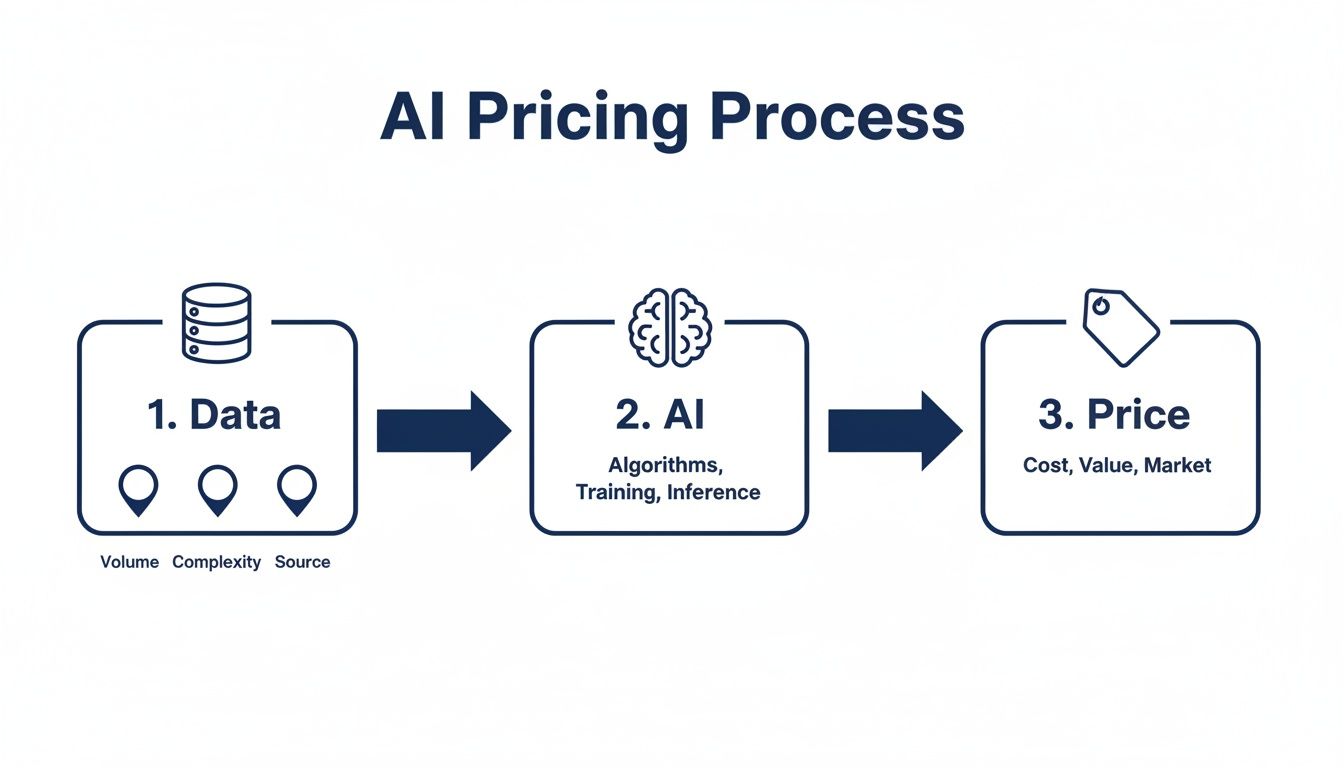
The infographic above makes a crucial point about ecommerce AI: the quality of your strategic output is completely dependent on the quality of your initial data input.
This is especially true in hyper-competitive markets. For instance, California's role as a hotbed for AI talent and funding directly impacts online sales growth. In 2024–2025, the state nabbed the majority of U.S. AI startup funding and was home to 15.7% of all U.S. AI job postings. This dense ecosystem means that innovations in AI-powered commerce, like new recommendation engines and dynamic pricing models, are often developed and tested there first. This gives local merchants a head start on game-changing technology. You can dig into more details by checking out the state's official report.
Measuring Your Return on Investment
Finally, to make sure your efforts are paying off and to fine-tune your strategy, you have to measure the ROI of your AI initiatives. It’s time to circle back to those key performance indicators (KPIs) you set at the very beginning.
Keep a close eye on these core metrics:
Conversion Rate: Are more visitors actually buying something?
Average Order Value (AOV): Is the AI successfully nudging customers to add more to their carts?
Customer Lifetime Value (CLV): Are customers coming back more often and spending more over their lifetime?
Customer Acquisition Cost (CAC): Is AI helping you attract new customers more affordably?
By consistently tracking these numbers, you can prove the tangible business value of your AI investment and make smart, data-driven decisions about what to do next. This practical, results-focused mindset is central to how we operate, which you can learn more about on our about us page.
Common Questions About Using AI for Sales
Diving into AI can feel like a massive leap, and it's natural to have questions. How much is this going to cost? Is my shop big enough for this? Will it make my brand feel cold and robotic? Let's cut through the noise and tackle these common concerns head-on, giving you clear, straightforward answers to light the path forward.
Using AI to boost online sales isn't about replacing what already works; it's about making it smarter and more efficient.
Do I Need a Huge Budget to Use AI for My Online Store?
Not at all. This is a common myth. While a fully custom-built AI system can be a major investment, the market is now full of accessible, off-the-shelf solutions. Many business owners are surprised to find out just how affordable it can be to get started.
Take a look at most ecommerce platforms. Shopify, for example, has a massive app marketplace brimming with AI-powered tools for product recommendations, smart chatbots, and marketing automation. Many of these run on a simple, manageable monthly subscription. Our Shopify development services often focus on integrating these powerful yet cost-effective tools for our clients.
The trick is to start small. Pinpoint a single, specific problem; maybe it's abandoned carts or an inbox flooded with the same customer questions, and find a tool designed to fix it. This approach lets you see a clear return on your investment and gives you the confidence to scale up your AI efforts as you see real results.
How Much Data Do I Need for AI Personalisation?
This is a great question, and the answer really depends on what you’re trying to do. The good news? You probably have more than enough data to get started right now.
For basic features like product recommendations ("people who bought this also bought…"), your existing sales history and product catalogue are often all you need. An algorithm can chew on that data, spot patterns, and start making helpful suggestions almost immediately.
Now, for more sophisticated hyper-personalisation, you’ll want to pull in richer datasets. This could include:
User Browsing Behaviour: What pages are visitors lingering on? What products are they comparing?
On-Site Search Queries: What exact words are customers typing into your search bar?
Interaction Data: Which emails get opened? Which promo banners get clicked?
Most ecommerce platforms are already quietly collecting this information for you. So, your first step isn't about gathering more data; it's about making sure what you have is clean, organised, and ready for an AI to analyse. Even a modest amount of history can reveal valuable patterns, and the system will only get smarter as it learns from every new customer interaction.
Will AI Make My Brand Feel Robotic and Impersonal?
This is easily the biggest worry we hear, but the whole point of modern ecommerce AI is to do the exact opposite. When it’s done right, AI should make the customer experience feel more human and personal, not less.
Think about it this way: AI helps you understand what individual customers want at a scale no human team could ever dream of. It’s what allows you to show someone the right product at the perfect moment, answer their question instantly at 3 AM, or send a promotion that actually aligns with their interests. That level of attention doesn't feel robotic; it feels personal and valuable.
The secret is to treat AI as a tool that enhances the customer journey, not something that replaces the human touch that makes your brand unique. Your brand's voice and personality should always lead the way; AI is just the engine that delivers that experience flawlessly.
Our AI-powered ecommerce services are built around this very idea – using technology to build stronger, more individual relationships with customers.
What Is the Biggest Mistake to Avoid When Implementing AI?
Jumping on the AI bandwagon without a clear business goal. Hands down, this is the single biggest mistake we see. Too many businesses get swept up in the hype and install a new tool just to seem "innovative," which almost always ends in wasted time and money.
Before you even look at a single tool, you need to define exactly what you want to achieve. As we explored in our ecommerce development solutions guide, a sharp focus is non-negotiable. Are you trying to bump up your average order value? Cut down on customer support tickets? Or maybe improve conversions for a specific product line?
By starting with a clear, measurable goal, you can pick the right AI solution and know for sure if it's working. Without that focus, you’re just buying powerful tech that isn't solving a real problem for your business or your customers. The journey starts with a problem, and AI is the solution. To learn more about how we tackle these challenges, you can see how we operate by visiting the page about our company.
Ready to transform your online store with intelligent, results-driven technology? At Cleffex, we specialise in creating bespoke AI and ecommerce solutions that drive real growth.