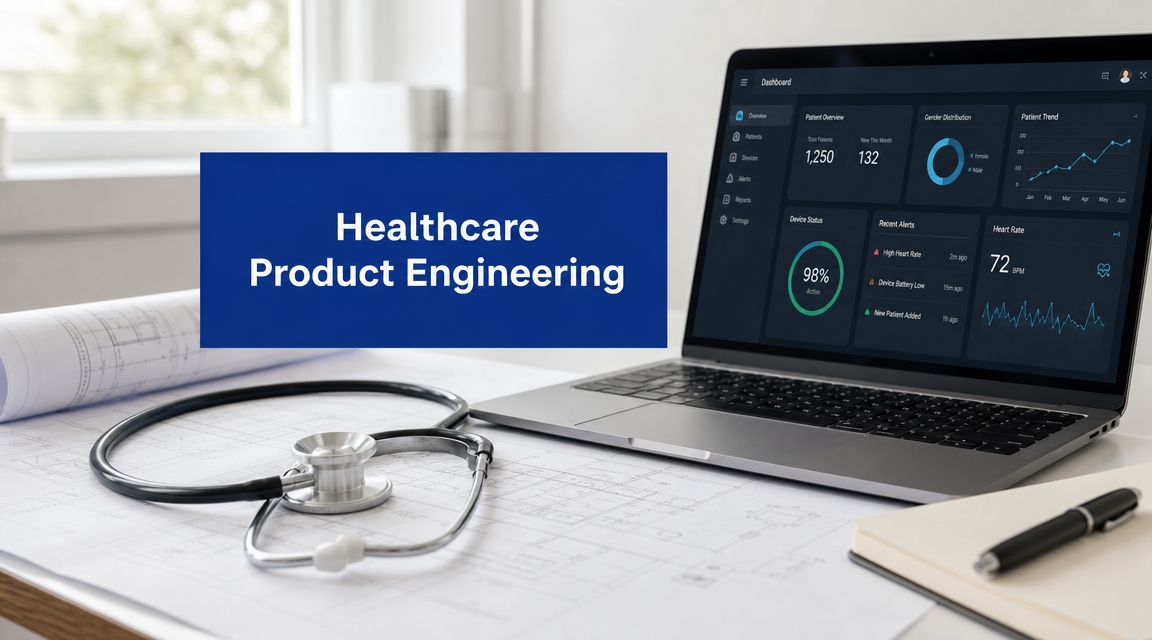


You're probably dealing with one of two situations right now. Either your organisation already knows what it needs to build, a patient portal, virtual care workflow, connected device platform, claims automation tool, clinician app, and can't get it shipped without creating new compliance risk. Or you've got a product in market, but every upgrade gets trapped between security reviews, integration headaches, and vendor promises that sound polished but don't survive contact with a real healthcare environment.
That's where healthcare product engineering services stop being a procurement line item and become a risk decision. In healthcare, bad engineering doesn't just create technical debt. It creates privacy exposure, slows operations, frustrates clinicians, and can force expensive rework when regulators or enterprise buyers start asking harder questions.
Why Healthcare Product Engineering Matters Now
Canada is a large healthcare market, not a side market for software vendors. Statistics Canada reports that healthcare and social assistance employed about 2.3 million people in 2024, representing roughly 11% of total employment, and that scale matters because the sector is continuing to digitalise around interoperability, patient portals, telehealth, and workflow automation, all of which increase demand for engineering teams that can handle software, data, security, and compliance together, not separately (Canadian healthcare sector scale and digitalisation context).
If you run a clinic, insurer, hospital programme, or healthtech startup, you already feel the pressure. Patients expect digital access. Clinicians expect tools that don't slow them down. Procurement teams expect auditability. Privacy officers expect answers before launch, not after incident response. A generic app shop won't solve that mix.
The Real Issue Is Orchestration
Most executives make the same early mistake. They treat product development as a feature-delivery problem.
It isn't.
It's an orchestration problem across five moving parts:
Clinical workflow fit: The software has to match how care is delivered.
Security architecture: Access control, encryption, logging, and incident readiness have to be built in.
Integration reality: New tools must work with existing scheduling, billing, portal, and records systems.
Regulatory fit: Privacy, consent, and device-risk obligations shape architecture choices.
Operational sustainability: Your team has to maintain and improve the product without freezing every release.
Practical rule: In healthcare, the cheapest vendor at kickoff often becomes the most expensive vendor by deployment.
Why Outsourcing Can Be the Smarter Move
I'm opinionated on this. Most healthcare organisations shouldn't try to build everything with a fully in-house team unless they already have mature product, security, compliance, and integration leadership under one roof.
Outsourcing makes sense when you need to compress time, reduce hiring friction, and gain domain-specific execution. But only if the partner understands that they're not building a consumer app. They're building software that sits inside a regulated care environment.
That distinction changes everything. It affects discovery, architecture, test planning, release governance, and support. If your vendor doesn't understand that on day one, you'll pay for it on day one hundred.
What Are Healthcare Product Engineering Services
Healthcare product engineering services are the end-to-end work required to design, build, validate, deploy, and improve digital health products. That can include software platforms, patient-facing apps, clinician tools, device-connected applications, internal workflow systems, and software that supports regulated medical products.
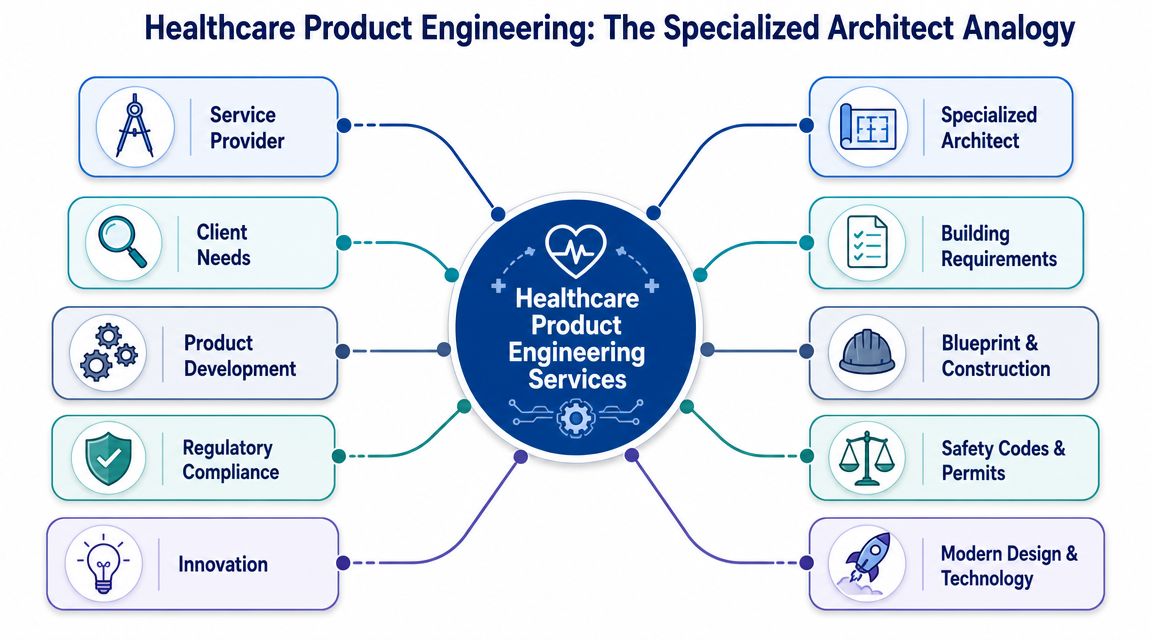
The easiest way to think about it is this. Hiring a healthcare product engineering partner is like hiring a specialised architect to design a new surgical wing, not a general contractor to fit out a standard office. Both can build structures. Only one understands sterility rules, patient flow, equipment placement, safety checks, and inspection requirements.
What the Service Actually Covers
A serious provider doesn't just write code. They usually work across a lifecycle like this:
Discovery and Product Strategy
They help define the user, workflow, risk profile, integration scope, and regulatory implications before the backlog gets bloated.UX and Service Design
They design for multiple users, patients, clinicians, administrators, and compliance teams, each with different needs and permissions.Architecture and Development
They choose the stack, data model, APIs, cloud pattern, and security controls based on what the product must withstand in real operations.Verification and Validation
They test not only whether the product works, but whether it behaves reliably, safely, and traceably.Deployment and Lifecycle Management
They support release planning, monitoring, incident handling, change control, and ongoing optimisation.
Canadian Buyers Are More Mature Than Many Vendors Assume
That maturity matters. By 2024, millions of Canadians were using digital tools such as online appointment booking, e-prescribing, and access to test results through connected systems across provinces and territories, and virtual care use has grown strongly since the pandemic period (digital health adoption in Canada). Buyers no longer want standalone apps that look modern in a demo and fail in production. They expect integration, resilience, and compliance.
That's also why product teams should think beyond MVP theatre. In medtech and regulated software, the journey from idea to launch is shaped by evidence, risk controls, and market readiness. If you want a useful reference on that broader path, this piece on the concept to market for medtech is worth reading.
A healthcare product isn't finished when the UI looks clean. It's finished when users can trust it, buyers can approve it, and your team can support it without panic.
Navigating Compliance, Privacy, and Security
Project derailment often begins here. Teams discuss features, user stories, and launch dates first. Then someone asks where the data will live, who can access it, whether the product could be classed as a medical device, and how audit logs will work. Suddenly, the architecture has to change. That's avoidable.

In Canada, Compliance Shapes the Build
For Canadian organisations, privacy and regulatory design can't be bolted on late. Healthcare product engineering for regulated software and connected devices must be designed around both privacy and device-risk controls from the start. Health Canada classifies medical devices I to IV, with higher classes requiring progressively stronger evidence. Digital health platforms handling patient data must also satisfy provincial privacy rules such as Ontario PHIPA and Alberta HIA, which directly affect data residency, access logging, and encryption design (Canadian healthcare compliance engineering context).
That means your vendor needs to understand three layers at once:
Federal privacy expectations: PIPEDA can matter, especially in commercial contexts and cross-organisational data handling.
Provincial health privacy laws: PHIPA, HIA, and similar provincial rules often drive practical data decisions.
Device and quality obligations: If the product crosses into regulated software or connected device territory, evidence and traceability become central.
Translate Legal Language Into Engineering Tasks
Executives don't need legal theory. They need to know what those rules do to a build plan.
Here's the plain-English version:
| Regulatory concern | Engineering consequence |
|---|---|
| Patient data privacy | Encrypt data at rest and in transit, design role-based access, control sharing paths |
| Data residency expectations | Choose hosting and backup patterns carefully, document where data and logs are stored |
| Auditability | Record user actions, admin changes, consent events, and access history in tamper-resistant logs |
| Device-risk classification | Maintain requirements traceability, verification evidence, and risk-control documentation |
| Incident response obligations | Build alerting, event review, breach workflows, and access revocation processes |
A good partner will discuss these items before sprint planning, not after procurement asks for a security package.
Don’t Ignore Cross-Border Exposure
If your product touches US patients, providers, or partners, HIPAA may become part of your operating reality even if you're headquartered in Canada. If AI is involved, governance gets even more sensitive. For a concise, practical reference, review these HIPAA-compliant AI guidelines alongside your internal risk review.
You should also pressure-test the vendor's development practices against a healthcare-specific compliance lens. A useful benchmark is this guide to healthcare compliance software development, which outlines the kind of engineering discipline regulated projects require.
If a vendor says, “We can make it compliant later,” they're telling you they plan to rebuild later.
Key Technologies Shaping Digital Health Products
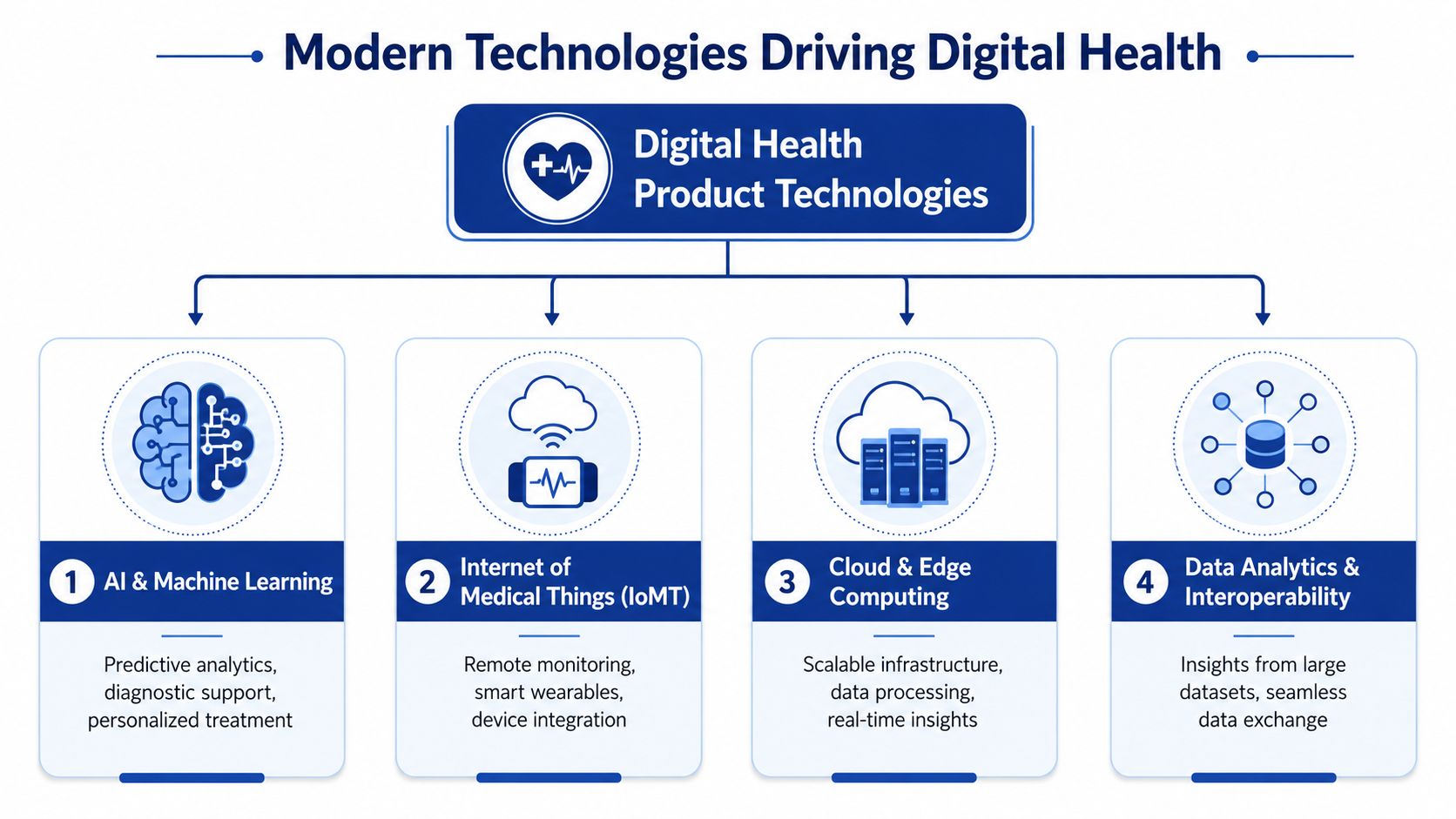
Technology choices matter, but not for the reasons vendors usually pitch. The issue isn't whether a team can say “AI”, “cloud”, or “FHIR” in a sales call. The issue is whether they know when each technology reduces risk, when it creates complexity, and how it supports a usable product.
Interoperability Is the Price of Entry
If your product can't exchange data cleanly, it becomes another silo. That's unacceptable in healthcare.
Think of FHIR and HL7 as the shared grammar that lets different systems exchange meaning, not just files. A scheduling platform, patient app, lab system, and hospital record can all store data differently. Interoperability standards help them communicate without forcing every organisation to replace core systems.
What to ask a vendor:
Integration depth: Can they work with APIs, middleware, and legacy constraints?
Data mapping discipline: Can they model clinical and operational data without creating ambiguity?
Failure handling: Do they design for retries, reconciliation, and exception monitoring?
Cloud and DevOps Decide Whether You Can Scale Calmly
Healthcare teams often underestimate release management. They focus on launch. The primary challenge comes after launch, when updates, patches, and integrations keep arriving.
A credible engineering partner should know how to structure cloud environments for isolation, observability, and repeatable deployment. They should also separate development convenience from production discipline. Fast releases are useful only if they're controlled.
AI Should Solve a Workflow Problem
AI isn't a product strategy. It's a component.
Use it where it improves triage, summarisation, decision support, personalisation, anomaly detection, document handling, or operational routing. Don't use it just to make the product sound current. In healthcare, every AI feature creates new questions about explainability, oversight, testing, and user trust.
If you're evaluating AI-heavy health products, this guide to AI integration in healthtech platforms gives a practical view of how ingestion, model serving, and clinical-system integration fit together. Cleffex Digital Ltd is one example of a Canada-based firm that offers this type of architecture and integration work for healthtech platforms.
Security Testing Has To Mimic Real Risk
Generic QA won't catch healthcare-specific failures. You need threat modelling, permission testing, audit validation, and scenario-based verification tied to sensitive workflows.
For user experience, I also recommend going beyond standard interviews and happy-path testing. Teams exploring design validation at scale may find value in these insights on synthetic users for UX validation, especially when they need faster iteration before live pilot feedback.
The right stack doesn't just ship features. It reduces failure modes.
How To Select the Right Product Engineering Vendor
Treat vendor selection like clinical risk triage, not like shopping for design capacity. You're not buying velocity alone. You're buying judgment under regulatory, security, and budget pressure.
That matters even more in Canada because the Canadian Centre for Cyber Security's 2024 reporting shows healthcare remains a high-value target for cybercrime, and for startups and clinics, the essential decision is whether a partner can embed threat modelling, auditability, and privacy-by-design without blowing the budget (cyber risk and compliance economics in healthcare).
The Wrong Vendor Creates Hidden Costs
A polished demo can hide dangerous gaps. I've seen vendors with strong frontend talent and weak compliance instincts. I've seen infrastructure teams that knew cloud security but had no feel for clinical workflows. I've seen offshore teams that delivered features quickly but couldn't answer a basic question about provincial privacy handling.
Those gaps don't stay hidden for long. They show up in security reviews, enterprise procurement delays, failed pilots, and rewrites.
Use a Hard-Edged Checklist
Here's the shortlist I'd use in your position.
| Evaluation Criterion | What to Look For | Potential Red Flags |
|---|---|---|
| Domain expertise | Experience with provider, payer, clinic, medtech, or health platform workflows | Portfolio is mostly retail, fintech, or generic SaaS |
| Canadian regulatory fluency | Clear understanding of PIPEDA, provincial privacy realities, and documentation expectations | Vendor speaks only in generic “HIPAA-ready” language |
| Security capability | Threat modelling, access control design, audit logging, incident support | Security is framed as a later add-on or separate phase |
| Integration depth | Experience with EHR, scheduling, billing, lab, portal, or device connectivity | “We build APIs” with no explanation of interoperability challenges |
| Quality process | Traceability, validation planning, release discipline, controlled change management | Testing means only manual QA before launch |
| Delivery model | Team structure that fits your stage, product squad, augmentation, or phased delivery | Rigid model that doesn't adapt to startup or enterprise reality |
| Commercial realism | Ability to prioritise a minimum viable compliance stack within budget | Pushes full enterprise complexity on day one |
Ask Questions That Expose Maturity
Don't ask “Can you build this?” Every vendor will say yes.
Ask these instead:
What changes in your architecture approach if this product handles provincial patient data?
How do you document access logging and auditability in your delivery process?
Where do projects like this usually get delayed, and how do you reduce that risk?
What would you build in phase one, and what would you deliberately postpone?
Who on your team owns security, compliance interpretation, and release governance?
For a broader buying framework, this comparison of in-house vs healthcare software development partner is useful because it frames the decision around operating model, not just cost.
A vendor that can't explain trade-offs clearly probably can't manage them well.
Mapping Your Product Journey and Measuring Success
Once you've picked a partner, the next mistake is rushing straight into build mode. Healthcare products need a disciplined path. Not because process is fashionable, but because rework is expensive and trust is hard to rebuild.
A Practical Rollout Path
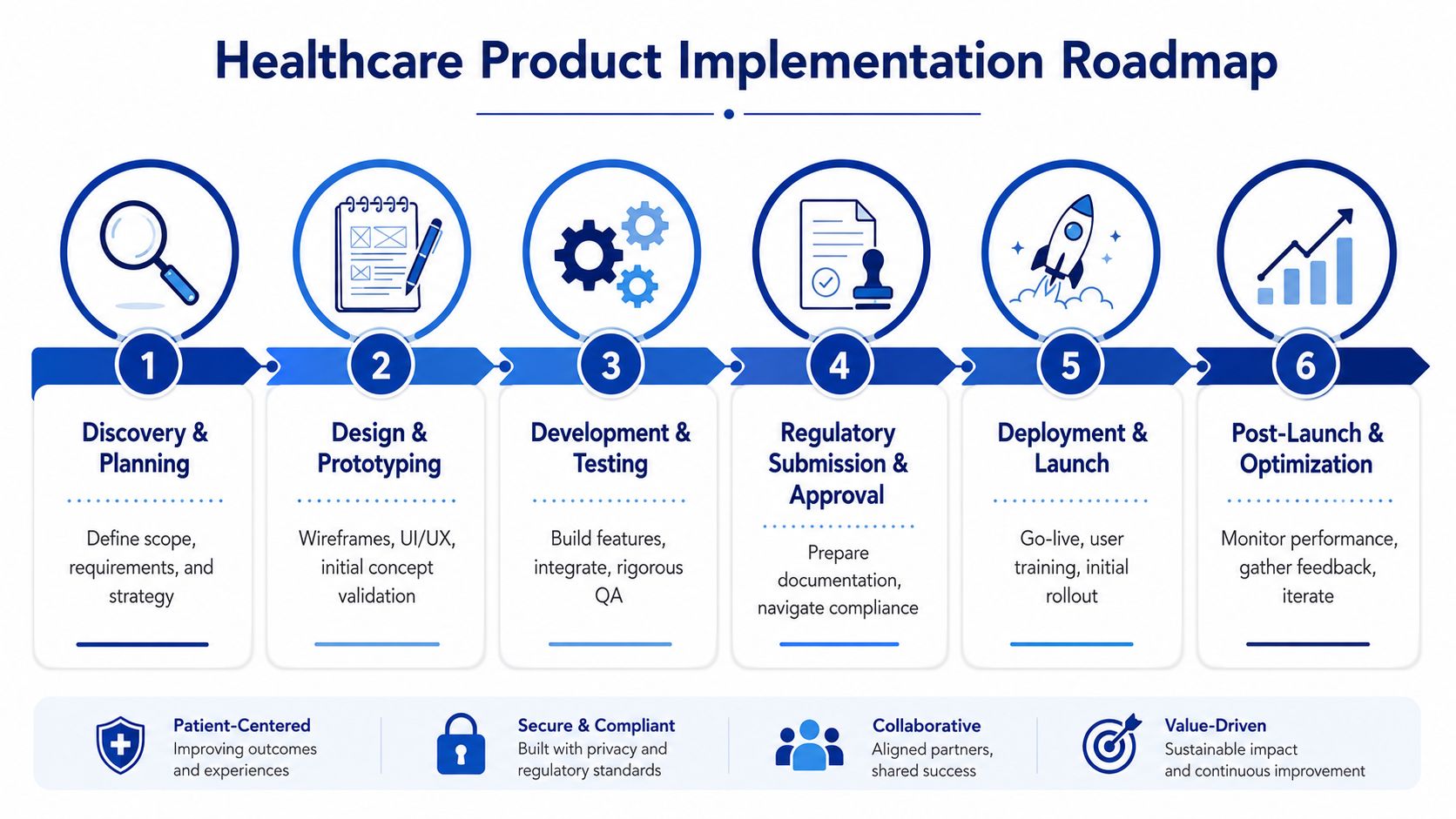
A sound product journey usually follows this pattern:
Discovery and Planning
Confirm the problem, user groups, data flows, dependencies, and risk posture. If this phase is weak, every later phase gets noisier.Design and Prototyping
Test workflows early. In healthcare, screen layout isn't enough. You need to validate handoffs, exceptions, and permission logic.Development and Testing
Build in increments, but don't confuse agile with improvisation. Requirements, validation criteria, and release standards should stay explicit.Regulatory and Compliance Preparation
Prepare the evidence, documentation, and internal review needed for your operating context.Deployment and Launch
Roll out with training, support ownership, monitoring, and rollback discipline.Post-Launch Optimisation
Use live feedback, operational data, and support patterns to improve the product systematically.
Measure More Than Revenue
Healthcare executives often ask for ROI and then look only at commercial return. That's too narrow.
A successful product can create value in several ways:
Operational value: Less admin burden, fewer manual handoffs, cleaner workflows
Clinical value: Better adherence, better information access, stronger continuity of care
Risk value: Lower compliance exposure, better audit readiness, stronger incident response posture
Market value: Faster procurement progress, stronger enterprise buyer confidence, easier expansion into adjacent offerings
Build a Scorecard Early
Don't wait until launch to decide what success means. Define it during discovery.
Use a simple scorecard with categories such as:
Adoption signals: Active use by clinicians, staff, patients, or partners
Workflow performance: Turnaround time, task completion reliability, exception rates
Quality indicators: Defect severity, release stability, support burden
Governance indicators: Audit trail completeness, access review discipline, issue response readiness
If you don't define those measures early, the project will drift toward feature accumulation instead of outcome delivery.
The Future of Digitally-Enabled Healthcare
Healthcare is moving toward products that are more connected, more continuous, and more embedded in day-to-day care delivery. That future won't be built by generic development teams chasing feature velocity alone. It will be built by organisations that treat engineering as part product strategy, part compliance system, and part operational design.
That's why healthcare product engineering services matter. They help providers, payers, startups, and digital health vendors turn a difficult brief into something deployable. The brief is always the same. Build something useful. Make it secure. Keep it compliant. Integrate it with reality. Maintain it without chaos.
In Canada, that challenge is sharper because privacy expectations, provincial rules, and regulated product pathways shape technical decisions early. Vendor choice becomes a governance decision. Architecture becomes a legal and operational decision. Testing becomes a trust decision.
My advice is simple. Don't hire a partner because they can code. Hire them because they can reduce risk while still moving the product forward.
The organisations that get this right won't just launch more software. They'll deliver better digital access, cleaner workflows, and stronger foundations for the next wave of personalised, predictive, and digitally-enabled care.
If you're weighing vendors for a healthcare build, Cleffex Digital Ltd is one option to review, especially if you need a Canada-based software partner for compliant health platforms, AI integration, or outsourced product development with agile delivery. The right next step isn't a long RFP. It's a focused conversation about your product risk, data flows, compliance scope, and what should be built first.