

A customer taps a phone at a coffee shop counter. The app shows a tick, the receipt lands in an inbox, and the balance drops, all before the milk is steamed. Behind that tick, four separate jobs ran in sequence: a fraud model scored the transaction, a ledger recorded the debit, a notification service produced the receipt, and a settlement instruction queued up for later in the day.
Now imagine all four jobs living inside one request. The tap waits for the fraud score. The receipt waits for the ledger. A slow report at month-end holds up the checkout queue. A crash in the loyalty service means nobody can buy coffee. Teams often encounter this problem at the worst possible moment, when a new feature has to be bolted onto a payment flow that already works.
Event-driven design fixes it by inverting who waits for whom. Instead of one service calling five others and blocking on each reply, the payment service states a fact – that a payment was initiated – and moves on. Any service that cares about the fact picks it up on its own schedule. The checkout stops being a chain of dependencies and becomes a stream of records that each system reads at its own pace.
What Event-Driven Architecture Means for Payments
A payment can be authorised in milliseconds while the work it triggers keeps going for hours: fraud review, ledger posting, receipts, risk limits, settlement files. Event-driven architecture is the discipline of separating the fact that must be recorded now from the reactions that can follow safely.
An event works like a signed receipt pinned inside the system: short, fixed, and already true. "PaymentAuthorised" states that authorisation happened; any action belongs to readers. The producer writes that receipt once. A consumer is any service that reads it and decides what to do next, such as scoring risk, updating the balance view, or queuing settlement. Because the producer never calls those readers directly, a new consumer can be added without reopening the payment path.
That separation is also the audit model. If every meaningful change is emitted as an ordered fact, investigators can replay what the system believed and when, instead of reconstructing intent from logs scattered across services. It is also the containment model: when a reporting consumer stalls, the payment service still accepts the tap; when the payment service slows, consumers keep working from what was already published. The design test is whether failure stays in one lane and whether the record still explains itself later.
Demand makes the choice less academic. Mobile and app-based payments are growing quickly among Canadians, so the same tap increasingly has to reach fraud, ledger, notifications, and reporting without turning one slow dependency into a queue at checkout.
A quick test: if a step cannot finish until five other steps finish, make it an event. If a customer is watching a spinner for that answer, keep it synchronous.
The goal is a deliberate split: synchronous where a person needs an answer now, asynchronous where the business needs durable proof, ordered recovery, and room for one part to fail politely.
The Core Components and What Each One Does
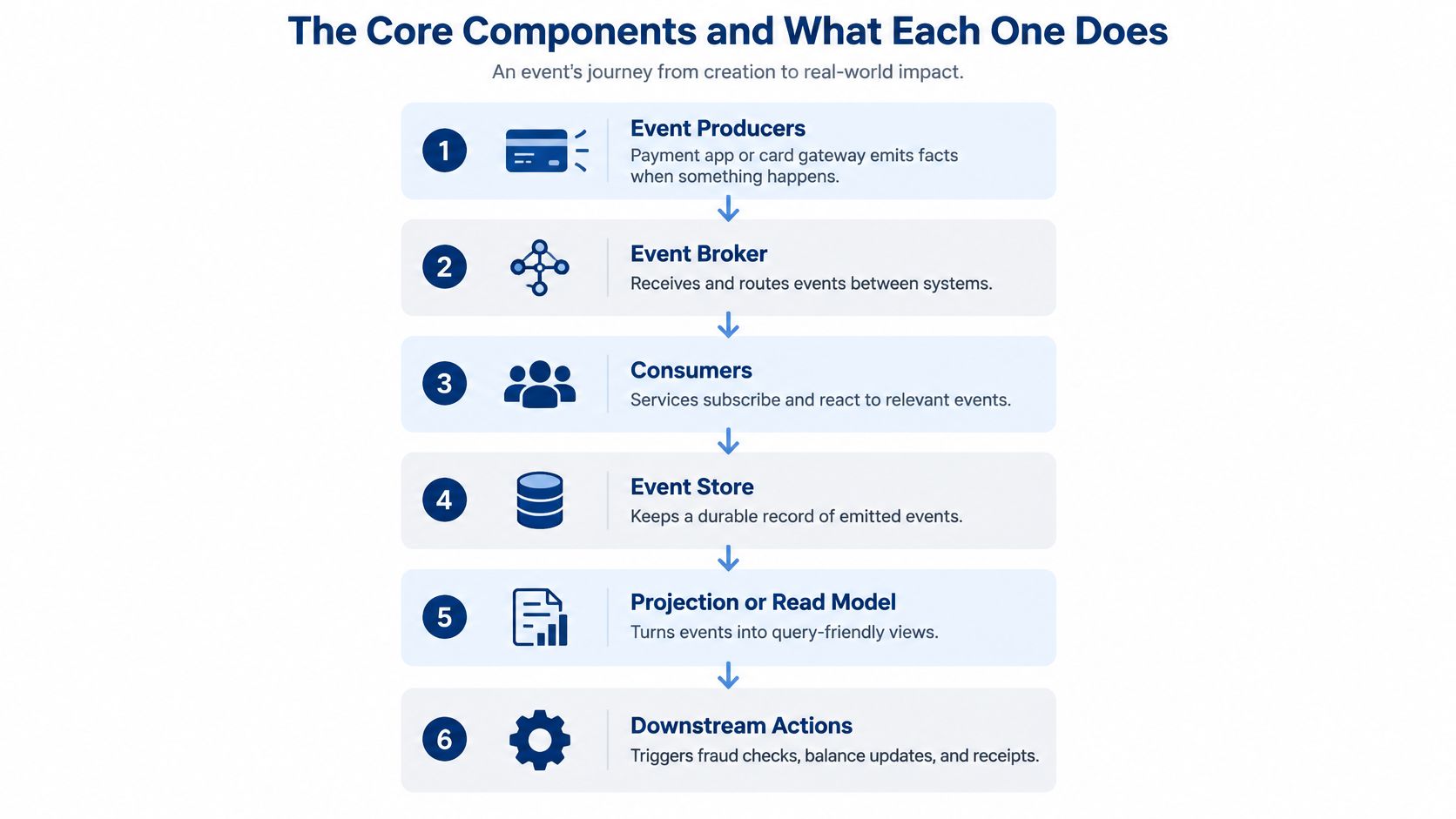
A FinTech system architecture built on events has six parts, and each one has a single job. Confusing those jobs is where most first implementations go wrong, usually by asking a broker to behave like a database or a database to behave like a broker.
| Component | Role | Fintech example |
|---|---|---|
| Event producer | Emits a fact when something happens | Payment app sends PaymentInitiated |
| Event broker | Stores and delivers events durably | Kafka or a managed cloud messaging service |
| Consumer | Reacts to an event independently | Fraud scoring service updates a risk score |
| Event store | Keeps an append-only history for audit and replay | Record of every ledger change for a given account |
| Schema registry | Holds versioned event formats | ISO 20022 message versions shared by all services |
| Dead-letter queue | Holds events that fail repeatedly | Payment that cannot be matched to an account |
Those six layers appear in the diagram below, ordered by the path a single event travels from the moment a producer emits it to the moment a downstream action fires.
Producers and the broker
An event producer is any service that knows something worth telling. In a payment platform, that's the checkout service, the card gateway, the standing-order scheduler, or the statement importer. A producer should do one thing well: stamp a unique event ID, capture the facts, and hand the record to the broker without waiting for a reply from anyone.
The event broker is the durable pipe. Apache Kafka is the common open-source choice, and managed cloud messaging services do the same work with less operational load. Its promise is narrow but valuable. A published event survives restarts, reaches every interested subscriber, and can be re-read weeks later. If your broker drops events when a consumer is offline, it's a queue, not an event log.
Consumers, the store and the safety net
Consumers subscribe to the topics they care about. A fraud service builds a risk profile, a ledger service writes the accounting entry, a notification service sends the receipt. Because each runs independently, a slow fraud model delays risk scores rather than payments. When you're tuning that side of the system, this stream processing guide for DevOps teams covers consumer configuration, partitioning and throughput trade-offs in useful detail.
The event store is the append-only history: every fact, in order, never overwritten. It's what lets you replay a day's activity when a consumer's logic turns out to be wrong, and it's what an auditor asks to see when they want to know how a balance reached its current figure. The schema registry is the companion piece, holding versioned definitions so producers and consumers agree on fields before either ships. ISO 20022 makes this concrete, since Payments Canada names enhanced remittance data, improved transparency and global interoperability as benefits of the standard in a report on the national payment system that settles in seconds. Structured remittance and party fields get reused by many services, so a breaking change ripples much further than adding a column would.
The dead-letter queue completes the set. It holds events that fail repeatedly, so one payment that can't be matched to an account doesn't block the stream behind it.
A unique ID on every event: A UUID or a key derived from the payment instruction, so duplicates are detectable at the door.
Handlers that can run twice: Any consumer that debits on a re-delivered event will eventually debit twice.
A monitored dead-letter queue: An unmonitored one is a storage cost, not a control.
How a Payment Moves Through Events, Step by Step
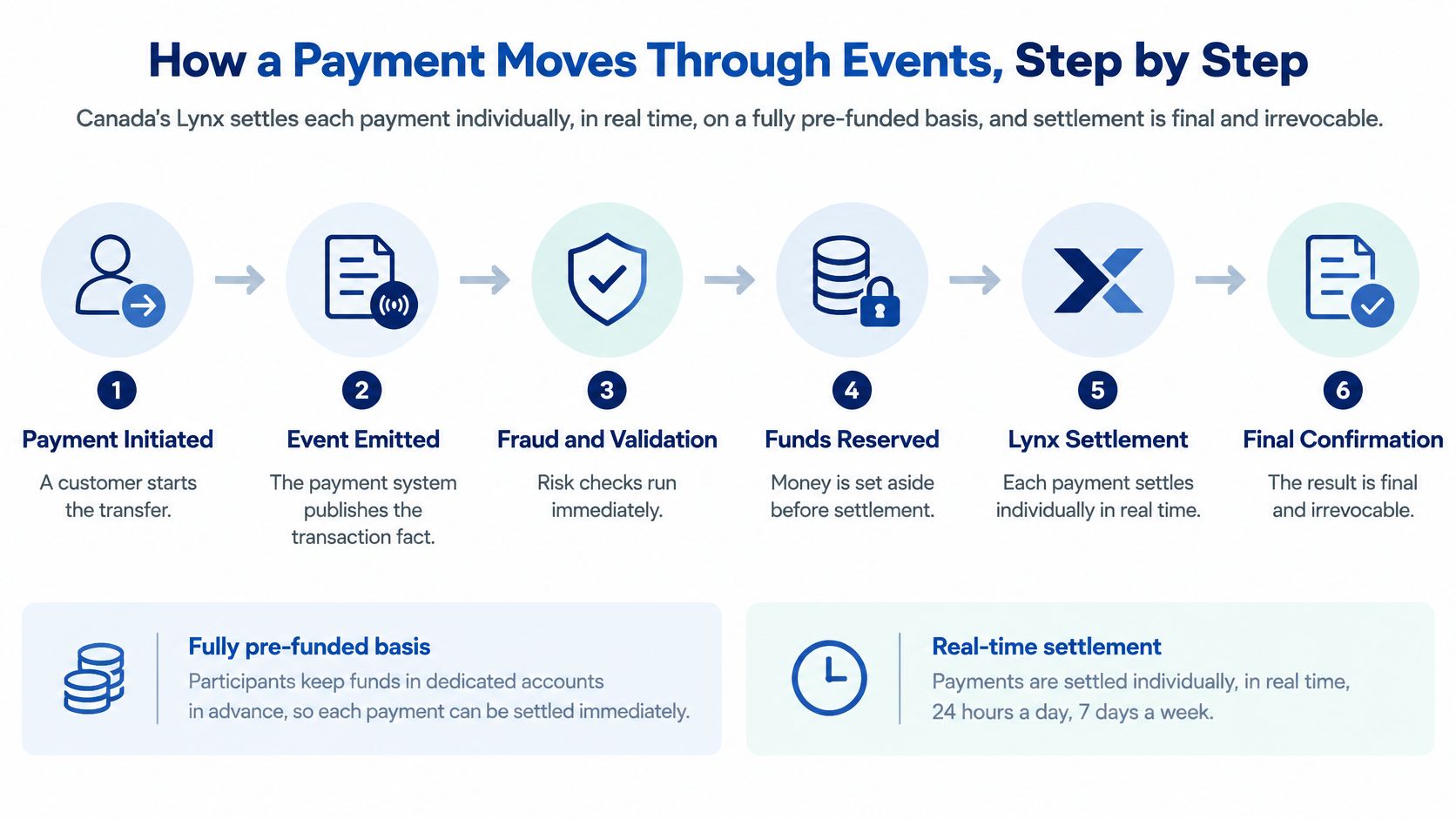
Canada's Lynx high-value payment system is the clearest teaching example available, because it's unforgiving about finality. Payments Canada's 2025 Lynx disclosure reports that the system processed 13.6 million payment items worth $93.3 trillion in 2025, a daily average of 54,229 items valued at $371.9 billion. Lynx settles each payment individually, in real time, on a fully pre-funded basis, and settlement is final and irrevocable.
That finality is what forces a clean event model. In financial transaction processing, timing, finality and auditability matter as much as speed, so the lifecycle has to be explicit.
The payment is initiated: The instruction becomes a PaymentInitiated event with a unique idempotency key. The key is what makes a retry safe, because resubmitting the same instruction with the same key is recognised as a duplicate rather than a second payment.
Fraud and limit checks run as consumers: They subscribe to the event instead of sitting inside the submit call, so a risk score that takes 800 milliseconds no longer sits between the customer and their confirmation.
The receiving institution accepts or rejects: That produces PaymentAccepted or PaymentRejected. Both are statements about the instruction, not about the money.
Liquidity is confirmed before settlement: Lynx requires the sending participant to hold sufficient intraday liquidity for the full payment value, so the check has to happen before a PaymentSettled event is emitted. Publish settlement first, and you will eventually publish a fact that turns out to be false.
The ledger and customer notifications follow settlement: They read the settlement event, not the original request, because only settlement is final.
| Event | What it signals | Typical consumers |
|---|---|---|
| PaymentInitiated | Customer or system instructs a payment | Fraud scoring, limit checks |
| PaymentAccepted | Receiving side has accepted the instruction | Pending status for the customer |
| PaymentSettled | Funds are final and irrevocable | Ledger update, recipient notification |
| PaymentRejected | Validation or liquidity check failed | Reversal workflow, customer alert |
The flow looks like this from a customer's point of view, with the pre-funded and real-time mechanics noted underneath.
The most common mistake is collapsing acceptance and settlement into one state. They mean different things, they arrive at different moments, and a notification built on acceptance will occasionally announce money that never moved. Keep one rule: every state change is recorded once, in order, and never overwritten.
Integration Patterns and When Each One Fits
Decision rule: use an asynchronous pattern for anything that can finish later, and keep a synchronous call only for the decision the customer is waiting on right now.
| Pattern | How it works | Best fit | Main trade-off |
|---|---|---|---|
| Publish-subscribe | Producer publishes; many consumers subscribe | Notifications and analytics | Eventual consistency between consumers |
| Choreography | Services react to each other's events with no coordinator | Loosely coupled payment steps | Harder to trace the full flow |
| Orchestration | Coordinator sends commands and tracks replies | Multi-step payouts needing clear status | Coordinator becomes a critical dependency |
| Event sourcing | Account state rebuilt from an event log | Audit-heavy ledgers | Replay and erasure need careful design |
| Synchronous request-reply | Caller waits for an immediate answer | Balance check before acceptance | Adds latency to the customer journey |
Publish-subscribe is the default. A producer announces a fact and any number of consumers receive it, so receipts, analytics and audit feeds can all want the same settled event without the payment service knowing any of them exist.
Choreography goes further and removes the controller entirely. Each service reacts to the events it cares about, which keeps payment steps loosely coupled and lets a new consumer slot in without touching the producer. The cost is visibility. When six services react to each other, nobody owns the end-to-end picture, so correlation IDs and a trace that follows one instruction from tap to settlement become mandatory rather than nice to have.
Orchestration puts a coordinator in charge, sending commands and tracking replies. It suits multi-step payouts where a customer needs a clear status. That coordinator becomes a critical dependency, though, and if it stops, everything it coordinates stops with it.
Event sourcing rebuilds account state from the log instead of storing only the latest balance. Audit-heavy ledgers benefit because the history is the record. It also complicates replay and erasure, since nothing is meant to change and some personal data eventually must.
Synchronous request-reply still earns its place. A balance or limit check before acceptance is a decision the customer is waiting on, and a stale answer is worse than a slow one.
Real-time rails sharpen the rule. Canada's forthcoming Real-Time Rail is designed so each payment is exchanged, cleared and settled between financial institutions within 10 seconds, with funds generally available to the recipient within 60 seconds after settlement, according to Payments Canada's RTR consultation document. The Bank of Canada's payment oversight paper notes that Payments Canada expected the RTR to be ready for industry testing in 2026. For real-time payment processing, that window fits one synchronous call at most: the check the payer is staring at, while fraud analytics, notifications and reconciliation move to asynchronous consumers. If you're mapping these patterns onto an existing API surface, our guide to fintech APIs for developers covers contract design and versioning.
Where Fintech Teams Use Event-Driven Systems
A card refund arrives four hours after the original purchase. On a batch-based platform, that refund waits in a file for the nightly run and the customer stares at a pending line for a day. With events, the refund arrives as a fact: the ledger takes it, the dispute case opened at the time of the return closes itself, and the customer gets a confirmation in seconds. No job runs, and nobody reconciles a file.
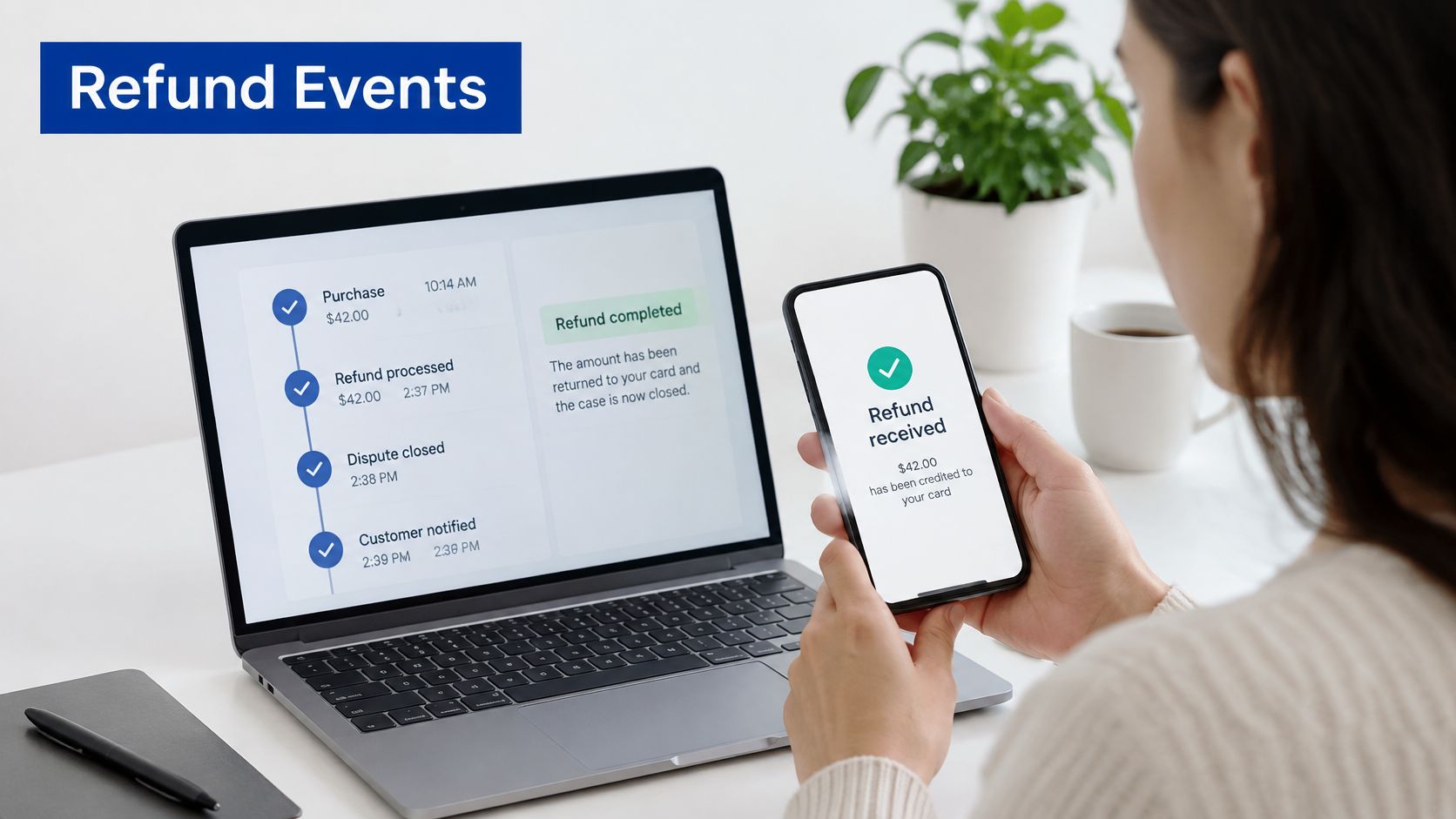
That refund is one instance of a pattern that shows up in four places.
Payment processing: One confirmed payment publishes a fact that the ledger, the receipt service and fraud analytics all consume in parallel. None of them asks the payment service for permission or waits for the others to finish.
Automated reconciliation: Settlement events are matched against internal records as they arrive. Exceptions surface in the morning instead of at month end, and the matching logic deals with a single event rather than a file of thousands.
Lending and insurance disbursements: A claim approval or a loan decision publishes an event that starts three things at once: the payout instruction, the customer notice, and the compliance log. A stalled email service doesn't stop the payout, and the customer isn't told the claim was approved before the money moves.
Real-time fraud response: A risk event places a hold while a decision is reviewed. The hold is itself an event, so the customer's app can show exactly why the payment is sitting in pending rather than leaving support staff to guess.
This is the kind of fan-out that scalable FinTech platforms are built around, and the demand is there. Payments Canada research found that 52 per cent of Canadians considered the prospect of real-time payments appealing, and that only 39 per cent of businesses experienced no payment challenges during the six-month period examined, with processing delays cited by 9 per cent, as reported in its 2025 transaction research. We've done this kind of migration at Cleffex, helping an Indonesian financial technology company shift its architecture to microservices for application scaling and integrate backend functionalities. If you're scoping the customer-facing side, our breakdown of real-time payment software key features covers what users expect to see.
The pattern repeats across all four cases: start with one high-volume flow, then extend the event model to the next. Retiring a monolith one flow at a time beats rewriting the platform in a single step.
Benefits, Failure Risks and Trade-Offs to Weigh
Independent scaling is the benefit teams notice first. A surge in receipt generation never touches the payment path, a failed fraud model degrades risk scoring without stopping payments, and events can be replayed to rebuild a projection that drifted. Those gains are real, and they are also the easy part. Speed is what event-driven design gets praised for, yet the true design test in a regulated system is quieter: does a failure stay contained inside one consumer, and can you prove afterwards, event by event, what the system did while it was failing?
The first failure to design for is the same event arriving twice.
Idempotency is the discipline that stops a re-delivered settlement event from debiting a customer twice. The contract is simple: every handler records the event ID it processed and refuses to act on a repeat. Teams that skip it meet the problem in production, usually during a broker rebalance or a consumer restart that triggers redelivery of a whole batch.
Ordering is the second trap. A notification consumer that reads a settled event before it has seen the accepted event will tell a customer their payment cleared while the app still shows pending, the same way a tracking page can mark a parcel delivered before it records the parcel shipped. A global lock would only serialise the traffic the broker was built to parallelise. Design each consumer to tolerate a missing predecessor, or to buffer briefly and reconcile before it speaks.
The stakes are not abstract. Consumer fraud is a growing concern, and regulators now treat recovery as a supervised discipline rather than an internal one. A Canada Gazette notice on operational resilience records that OSFI expects institutions to undergo cyber-resilience testing and monitoring of significant cyber incidents, with operational-resilience expectations effective September 1, 2026. That turns your incident log and your replay evidence into a supervisory question rather than an engineering nicety.
The controls that work are unglamorous:
Idempotency keys on every handler, so a duplicate delivery becomes a no-op instead of a second debit.
Event quarantine, so a suspicious message is set aside for review rather than retried forever.
Replay testing before release, run against a copy of a real day's stream rather than a synthetic one.
Manual override paths, because a stuck payment needs a human route out at 2 AM.
Customer-visible status labels such as pending, accepted and settled, so support staff and customers read the same state from the same vocabulary.
Incident logs that prove recovery, including when each service resumed and which events were replayed.
The uncomfortable trade-off: the fastest design is not automatically the safest. Asynchronous processing widens the window in which fraud, balance and notification states disagree, and someone has to decide how wide that window is allowed to get.
So put the question to your product owner before the architecture review: how long can your product safely show a payment as pending? Ten seconds and two hours lead to very different designs, and only one of them will match what your support team promises on the phone.
Security, Compliance and Audit Trails for Event Streams
Immutability and erasure pull in opposite directions, and every fintech event stream lands in the middle of that argument. An append-only log is exactly what an auditor wants and exactly what a privacy officer worries about, because an event that can never change can never be corrected or deleted. Resolve that tension on paper before you write a single producer.
Keep personal data out of the stream
Publish a tokenised reference with tamper-evident metadata, and keep the sensitive fields in a separately governed system with purpose-based access. If a name, an account number or an address sits in the event payload, every consumer inherits the obligation that came with it, including the ones built by teams you haven't met.
Decide how erasure will work before you write
Redaction and crypto-shredding both work, and both need to be designed in from the start. Encrypt the payload per data subject and destroy the key on request, and the event survives as a record while the personal data becomes unreadable. Bolt that on after a year of production traffic, and you'll be rebuilding the log instead of extending it.
Version the contract and record consent
ISO 20022 messages carry structured remittance and party data that many services reuse, so a schema change is a cross-team event rather than a routine deploy. Treat the registry as a contract registry, with backwards-compatibility rules and a dead-letter path for messages that fail validation.
Consent deserves the same treatment as money. Consent granted, data accessed, payment initiated, and consent revoked should each be an event, attributable to a person, timestamped, and linked to the purpose and retention rule that governed it. Canada's proposed consumer-driven banking framework is expected to require standardised, machine-readable sharing of account, transaction, investment, lending and payment data through APIs, per the Department of Finance framework for consumer-driven banking, while questions about liability, dispute resolution, consumer recourse, fraud controls and accreditation remain open. Implementation is expected in phases, beginning with read access.
Keep four things where a regulator can find them: event IDs with the schema version in force at the time, access logs tied to a stated purpose, the retention rule applied to each record, and an incident timeline showing when each consumer resumed. Our guide to automated financial reconciliation software explains how matching logic consumes those events without duplicating the ledger.
Confirm Your Design Before You Build
A design review costs days. Rebuilding a live payment pipeline costs quarters, plus the customer trust you spent when duplicates or missed events reached production. Four checks decide more about the outcome than the choice of broker.
Map your money-moving flows: Take the top three and list every state change in each, separating instruction, acceptance and settlement. Duplicates and premature notifications usually trace back to a state that was never named.
Choose a pattern per flow: Use the comparison above, then mark which steps must stay synchronous because a customer is waiting on a response. Everything else can queue.
Write the event contract: Unique ID, schema version, source system, causation ID, settlement status and idempotency key, agreed by every team that publishes or consumes it. This contract is the skeleton of your audit trail, so a vague field here becomes a gap a regulator can ask about later.
Pilot one high-volume flow: Run replay tests, wire up a manual override, and put an alert on the dead-letter queue before the pilot goes live. The pilot should prove you can contain a failure, not just process a success.
Two versions of this decision play out in practice. A team on a modest managed messaging service with strict idempotency and a governed event store will sleep better than a team running Kafka with neither. Cleffex Digital Ltd offers end-to-end microservice architecture services for regulated insurance and financial services platforms, and an outside review before you commit to a build can start on the insurance and fintech services page.
Frequently Asked Questions
Is event-driven architecture the same as microservices?
No. Microservices describe how a system is split into services, while events describe how those services communicate. Plenty of fintechs combine the two, but you can run microservices on plain REST calls, or pass events between two large services that were never split at all.
Do I need Apache Kafka?
No. Kafka is one broker option among several, and a managed cloud messaging service often suits a smaller team with fewer operations staff. What matters is durable storage, replay and a versioned contract, not the vendor on the invoice. Replay is what lets you reconstruct state during an audit or after a failure, so treat it as a requirement rather than a bonus feature.
How is an event different from a message queue?
A queue usually holds a task until one worker takes it and then removes it. An event is a durable record of a fact that many consumers can read, at different times. That durability is also what makes an event stream auditable, since the record survives after processing instead of disappearing. Some brokers offer both models, so check which one you are configuring.
Can a small fintech adopt this safely?
Yes, if you start with one flow, add idempotency keys and an event store from day one, and resist building every pattern at once. Teams that begin with four patterns and no dead-letter queue usually rebuild within a year.
Cleffex Digital Ltd builds digital platforms for regulated insurance and financial services, and offers proof-of-concept and MVP development to validate ideas before full-scale implementation. Visit Cleffex Digital Ltd to start the conversation.