


Canadian retail ecommerce revenue reached CAD 73.7 billion in 2024, growing 9.0% year over year, according to Statistics Canada's annual retail trade release. For groups operating several brands, the architectural question isn't whether to invest in online selling. It's how to grow without paying to rebuild the same capabilities for every storefront.
Multi-brand ecommerce platform development works when teams share reliable commerce infrastructure while protecting each brand's data, identity and customer promises. The hardest decisions concern consent boundaries, delivery commitments and configuration ownership, not just putting several catalogues in one database.
Why One Shared Commerce Core Beats Separate Stores
Canadian retail ecommerce generated $67.7 billion in 2023, up 7.0% year over year, representing approximately 8.1% of total retail spending, according to Statistics Canada's annual retail trade figures. That makes dependable online operations a business requirement, rather than a separate experiment for each brand.
Think of a shared shopping centre. Each shop keeps its own window display, product range and opening hours, while using common parking, security and cleaning services. A multi-brand platform applies the same principle to digital commerce, with a common payment desk behind distinct storefronts.
Say a retail group runs five brands in separate stores. Each store has its own checkout extensions, tax configuration, customer accounts, catalogue synchronisation and reporting setup. When the operations team changes a warehouse process, developers must update and test each connection separately.

Remove duplication without removing identity
Separate installations allow settings to drift. A developer fixes a discount calculation in one store, but another keeps the old behaviour. Finance then receives different interpretations of the same promotion.
A shared core gives the group a common implementation for order calculation, inventory reservations and operational reporting. Brand teams control the settings that distinguish their businesses, rather than maintaining separate copies of the underlying code.
Practical rule: Share the calculation and control mechanisms. Configure the commercial decisions.
Centralisation still creates risk. A discount change that works for a clothing brand could break a homeware basket if developers assume every product uses the same eligibility rules. Shared code needs explicit brand scope, automated regression tests and controlled releases.
The useful distinction is therefore shared capability versus shared policy. A common promotions engine is sensible; a compulsory promotion calendar usually isn't. A common shipping connector is useful; an identical delivery promise across warehouses may be impossible.
Before committing to a platform, decide which operations need consistency. Architecture, integrations, rollout effort and maintenance costs follow from that decision, not from the number of logos on the homepage.
What Multi-Brand Platforms Share and Keep Separate
| Component | Shared across brands | Configured per brand |
|---|---|---|
| Product catalogue | Master product records and attributes | Brand assortments, descriptions and imagery |
| Customer accounts | Single identity and login service | Brand profiles, loyalty rules and consent scope |
| Pricing and promotions | Rules engine and price calculation | Brand price lists and discount calendars |
| Checkout and payments | Payment orchestration and fraud checks | Enabled payment methods, receipts and refund rules |
| Tax and shipping | Tax calculation and carrier connectors | Ship-from locations, delivery promises and return policies |
| Inventory | Stock ledger and reservation logic | Allocation rules by fulfilment location |
| Storefront and theme | Design system and component library | Domain, theme, language and page layout |
| Reporting | Shared warehouse and common metrics | Brand dashboards and cohort benchmarks |
Share anything customers or finance must see consistently, and configure anything a brand needs to set differently. Shared infrastructure shouldn't force brands to adopt identical commercial policies.
For example, a home-goods group could operate sleep, kitchen and furniture brands through one stock ledger and checkout service. In this hypothetical setup, the sleep brand offers a 90-day return window while the kitchen brand offers 30 days. The order must retain the applicable policy for each item, so support staff don't apply today's configuration to an earlier purchase.
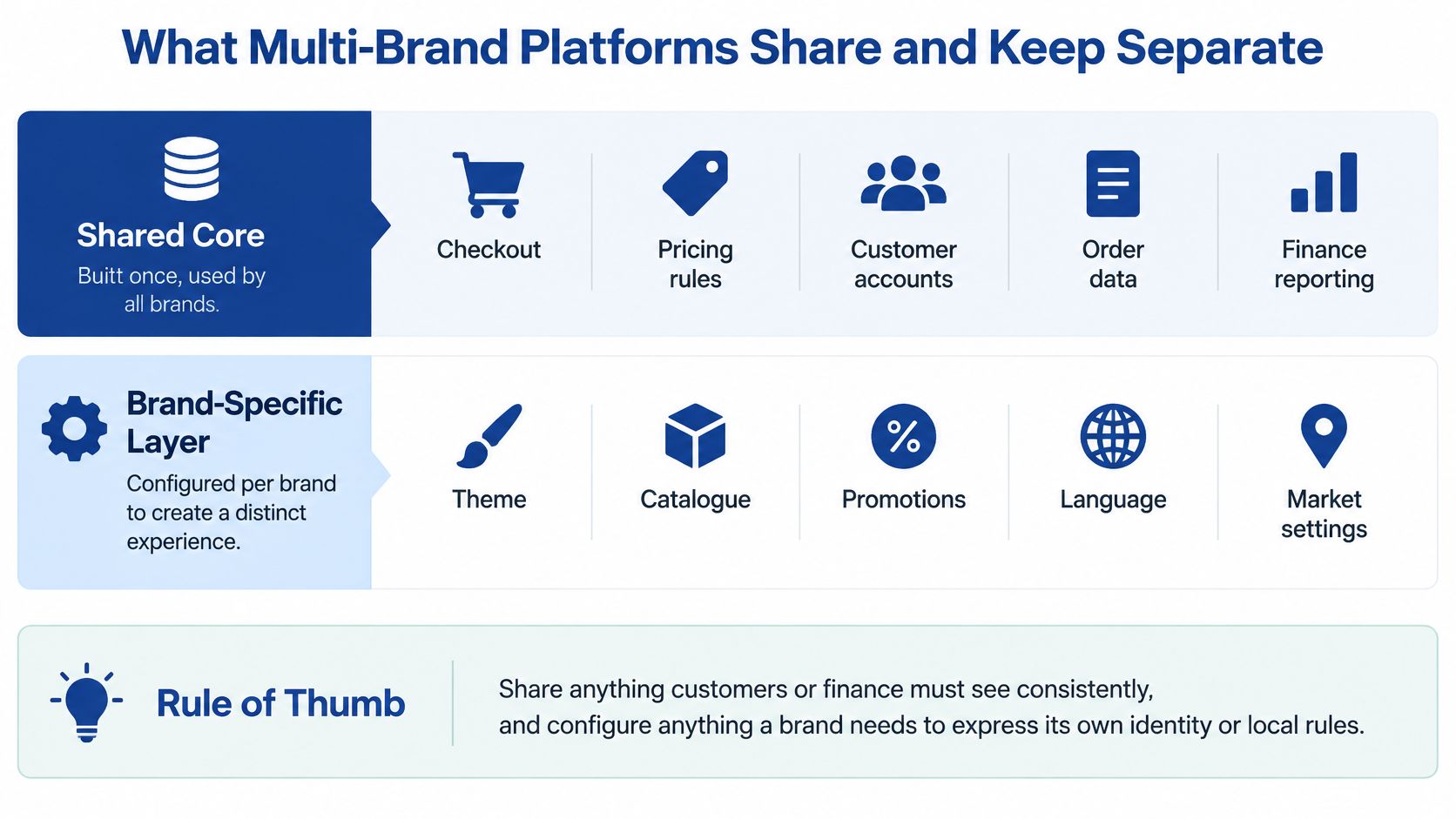
Customer identity isn't blanket permission
A shared login doesn't automatically justify combining purchase histories for marketing. Canada's privacy framework includes PIPEDA and substantially similar provincial laws in Quebec, British Columbia and Alberta, as explained by the Office of the Privacy Commissioner of Canada.
Model consent by brand, purpose and channel. Keep access, deletion and retention workflows connected to those boundaries, and obtain legal review for the proposed use of customer information. A central customer identifier can coexist with restricted purchase records and separate marketing preferences.
Product data needs ownership rules too. Establish which attributes come from the master catalogue and which brand editors may override; the practical issues are explored in product data integration for PIM. For storefront naming and domain planning, RedirHub on brand domain architecture provides a useful companion resource.
Preserve the promises customers buy
The International Trade Administration's Canada ecommerce guide reports that 82% of Canadian shoppers may abandon a basket without preferred delivery options, while 78% may abandon without preferred returns options. Checkout configuration therefore needs delivery windows, return periods, and English and French content, not just colours and logos.
For a mixed-brand basket, display shipment-level promises instead of inventing a common delivery date. Give customers a clear support route even when fulfilment is split.
Use these questions to assess new features:
Consistency: Does every brand need the same answer?
Data impact: Does the feature change access to customer information?
Control: Would a brand reasonably need a different setting?
Architecture Patterns for Multiple Brands Compared
| Pattern | How brands are separated | Best fit | Main trade-off |
|---|---|---|---|
| Single-tenant store per brand | Separate installation for each brand | Two or three brands with very different systems | Duplicated code and repeated upgrades |
| Multi-store on one installation | Shared codebase with separate store records | Similar brands sharing a catalogue and team | Shared release timing affects every store |
| Multi-tenant platform | Tenant-scoped data and permissions in shared services | Groups or agencies running many brands | Strict isolation design needed in every query |
| Headless commerce | Shared commerce APIs with separate front ends per brand | Brands needing distinct experiences across web and apps | More integration work for each front end |
Single-tenant stores suit a small portfolio whose brands operate differently enough to justify independent installations. The advantage is release autonomy. The penalty is maintaining repeated upgrades, monitoring and integration deployments.
Multi-store ecommerce architecture keeps stores in one installation. This works well when a central team manages similar brands, provided everyone accepts shared release coordination. A brand-specific exception should become configuration where practical, not a permanent code fork.
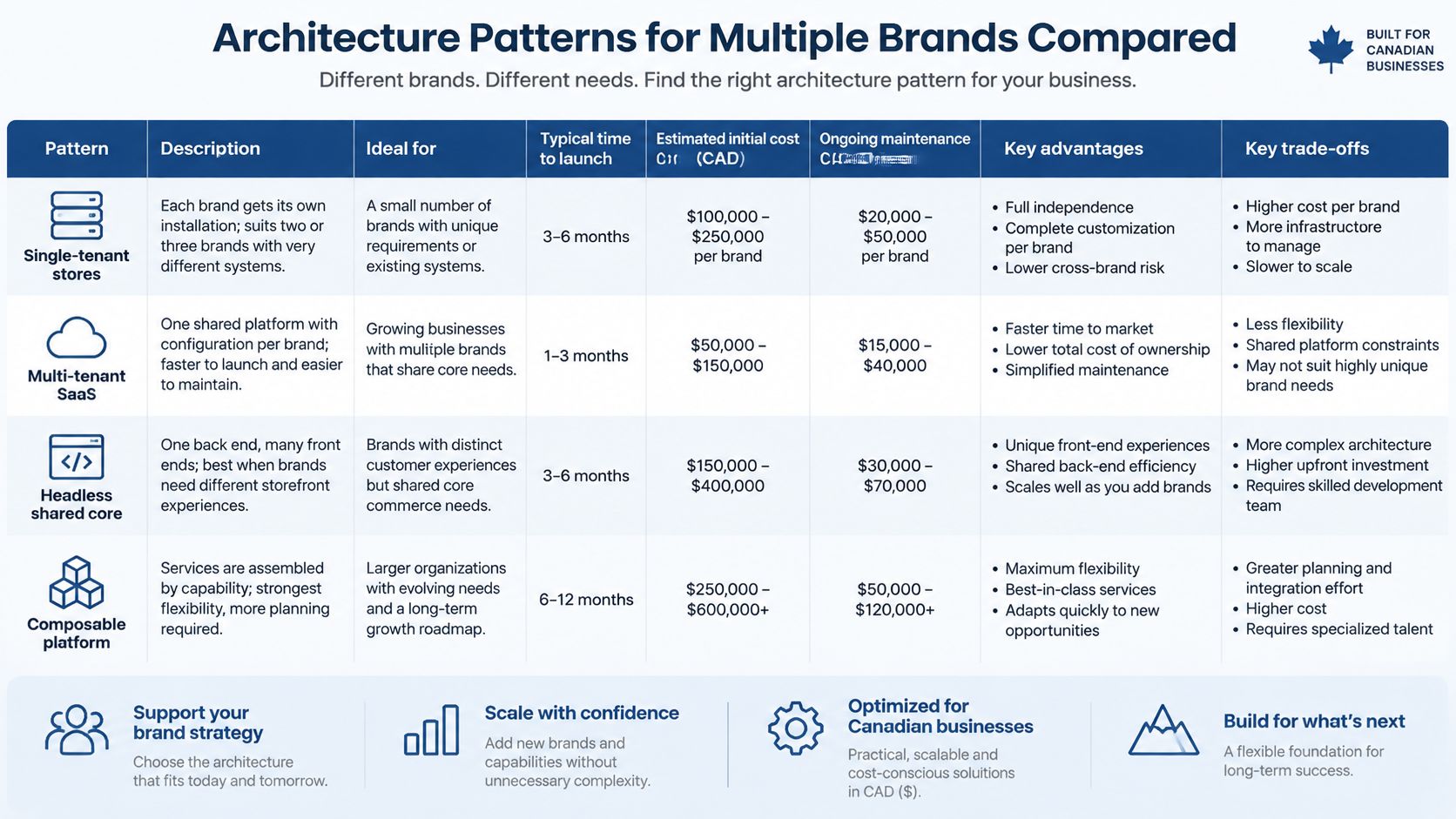
Choose isolation and presentation separately
A multi-tenant ecommerce platform serves brands through shared services while separating their operational records and permissions. A tenant is an administrative boundary, not necessarily a storefront: an independently operated business might control several storefronts within its tenant.
Headless commerce separates presentation from commerce APIs. Brand websites and apps consume common product, pricing, basket, checkout and order capabilities, but front-end teams remain responsible for accessibility, content rendering, analytics and release testing.
These patterns aren't mutually exclusive. A practical combination is a tenant-aware commerce core with headless storefronts where brand experiences differ. Themes, domains, assortments and fulfilment policies remain configuration, while tenant identifiers belong in product relationships, customer access, orders and tax records.
For teams evaluating service boundaries and deployment options, enterprise application architecture patterns provide additional architectural context.
Don't distribute services before you need to
A modular application can provide clear capability boundaries without making every module independently deployed. Composable services offer flexibility, but teams must also manage network failures, API compatibility and distributed diagnostics. Choose separate deployments where independent scaling or ownership justifies that overhead.
Headless describes how customers reach commerce capabilities. Multi-tenancy describes whose records and settings those capabilities may use.
Channel attribution also needs a common model. Statistics Canada's ecommerce definition covers qualifying orders committed through websites, mobile experiences, apps and electronic data interchange, even when payment occurs elsewhere; telephone, fax and email orders are excluded.
Record a canonical order identifier, brand and originating channel. Subsequent payment, warehouse and accounting messages should update that order's lifecycle, not create additional revenue records.
Scalability and Integration Checks Before Launch
| System | Typical load pattern | Failure to design for |
|---|---|---|
| Product information management | Bulk updates when a new season loads | One brand's import overwrites another brand's variants |
| ERP and accounting | Nightly batches and month-end postings | Brand sales posted to the wrong legal entity |
| Warehouse and stock feeds | Frequent small updates with spikes at promotions | Overselling when stock sync lags |
| Payment providers | Authorisation spikes during sales | One provider outage halts checkout for every brand |
| Search and recommendations | Full reindex after catalogue changes | Slow search for all brands during reindexing |
| CRM and email | Bursts after campaigns | Emails sent to customers who opted out of that brand |
Say simultaneous flash sales at two brands generate stock changes several times faster than normal. If catalogue imports, reservations and search indexing compete for the same worker pool, unrelated stores can become slow even though their own traffic hasn't changed.
Separate workloads by urgency. Checkout reservations need a controlled, timely result; search indexing can usually wait behind a queue. Set an explicit inventory authority and reservation protocol rather than treating every stock message as equally current.
Make retries safe
Use event-driven processing for downstream order status, indexing and integration updates. An event consumer should be idempotent, meaning that receiving the same message again doesn't post another accounting entry or create another shipment.
Keep immutable order events containing the tenant, order identifier, event type and relevant transaction snapshot. Corrections should produce new events rather than rewriting the audit trail. Put failed messages into a recoverable queue with a named operational owner.
For mapping identifiers and reconciling feeds, ELECTE multi-source data integration tips offers useful supporting reading. A commerce-specific integration inventory should also document ownership and direction of travel, as discussed in connecting ecommerce systems through data integration.
Test containment, not just capacity
Load-test individual brands and the combined portfolio. Rehearse a promotion launch while a warehouse connection fails, then verify that unaffected brands can still complete purchases.
Track measures that expose the affected tenant:
Checkout response time by brand: Separate customer-facing latency from background processing.
Stock synchronisation lag: Measure how far storefront availability trails the authoritative inventory system.
Failed event counts by tenant: Identify which integration needs recovery without hiding failures inside a portfolio total.
Queue age and recovery: Confirm workers can clear accumulated messages after a dependency returns.
Operational warning: A shared platform needs limits on how much work any brand can consume, not just enough capacity for an average day.
Set per-tenant rate limits, worker allocations and alerts before launch. Document what customer service should say when payment authorisation succeeds, but order confirmation is delayed, because technical recovery alone won't answer the customer's question.
How to Build a Multi-Brand Platform Step by Step
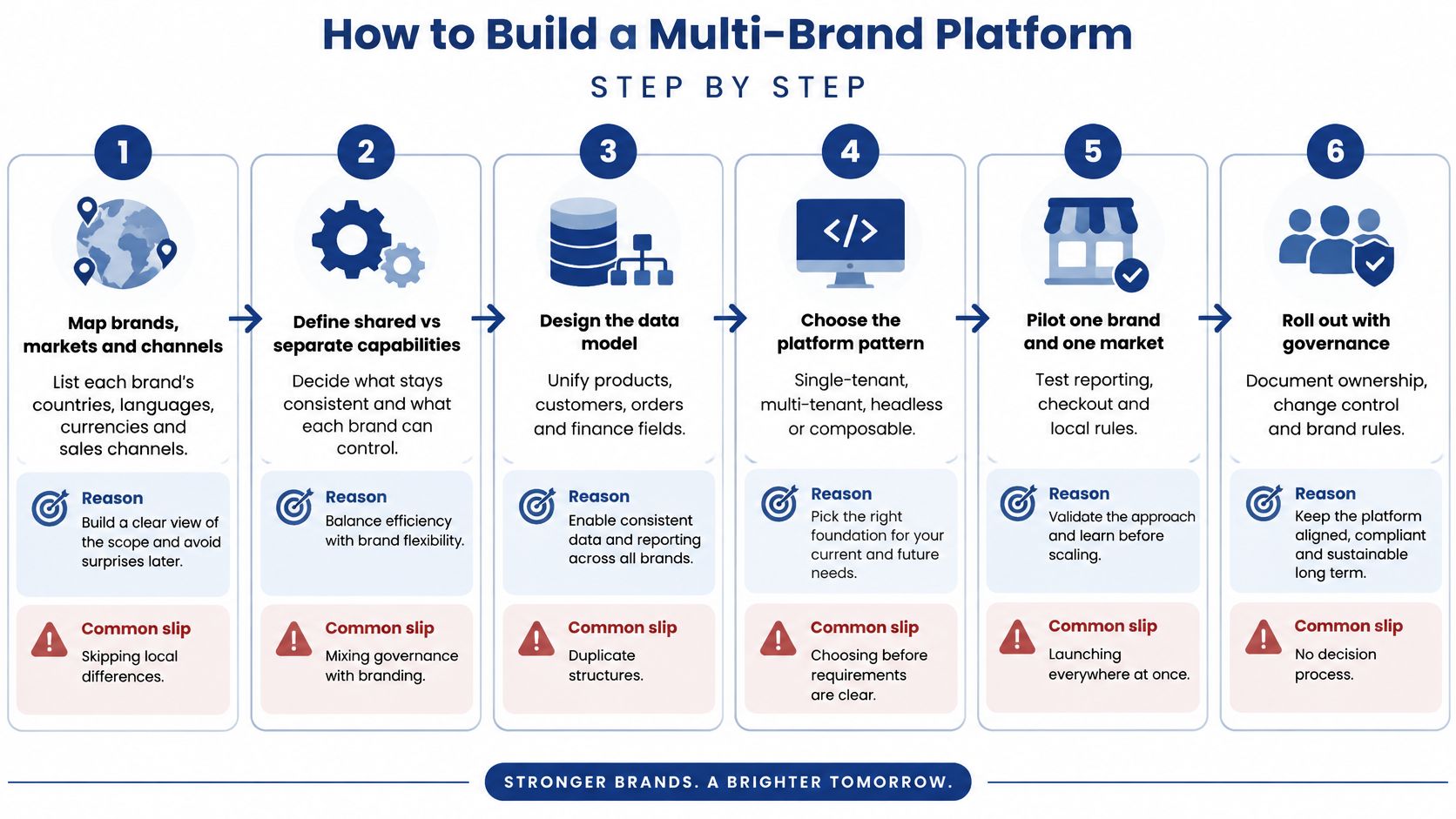
The difficult decisions in this build come early: who owns which data, what the checkout may promise on each brand's behalf, and how much configuration a brand is allowed before it becomes its own codebase. The sequence below puts those decisions first.
Map brands, markets and channels: List each brand's countries, languages, currencies, sales channels and legal entities, then name the person who approves local differences. Skipping this work hard-codes assumptions into screens and integrations that are expensive to unwind later.
Define shared and per-brand data: Agree product ownership, customer access, order structure and reporting fields before anyone designs an interface. Record the source of truth for each field and the overrides each brand is permitted, because conflicting ownership produces repeated migration and integration work.
Choose the architecture pattern: Base the decision on the operational independence each brand needs and the experiences it must deliver, rather than a preference for fashionable technology. A standard storefront with configurable components often covers the requirement without separate headless applications.
Model tenants and permissions: Give brand-owned records an explicit tenant or brand scope, and put server-side access checks into every relevant query and background job. Deliberately shared records need their own access relationships; a brand filter on the administration screen alone leaves data exposed.
Build the shared commerce core and a pilot brand: Connect payments, tax and inventory to one canonical order lifecycle, then exercise purchases, cancellations, partial refunds and failed payments. Define which promises the core makes, such as delivery estimates and stock messages, and which each brand controls. Pick a representative pilot rather than the easiest brand, or later onboarding will surface requirements the core never addressed.
Connect operational systems and rehearse failures: Finish the integration inventory, mapping contracts and recovery procedures before the pilot accepts live orders. Assign someone to reconcile transactions during launch, since a successful API response does not prove finance and warehouse records agree.
Onboard the next brand through configuration: Time the work and keep content preparation separate from platform engineering. The second brand is the honest test of your boundaries: if a routine difference requires new code, or developers rebuild a checkout or connector, the reusable boundary needs attention before the wider rollout.
Keep discovery separate from implementation
During early merchandising discovery, teams often collect competitor storefronts as reference material, and some build store research workspaces to keep those references organised. Use them as inputs for discussion rather than a brief to reproduce every competitor feature.
Maintain a decision log alongside the backlog. For each exception, record whether it belongs to the platform, the brand configuration or an external system, and who can approve a change. This log stops a one-off concession for one brand from becoming platform behaviour.
Before publishing migrated content, check existing blog URLs and prepare redirects for changed paths. Validate canonical tags, translated pages and internal links so a functioning checkout does not conceal a damaged content migration.
A healthy launch means checkout, stock movements and financial reporting reconcile from the first live trading day. Teams should be able to trace a customer purchase through payment, fulfilment and accounting without reconstructing its history from disconnected spreadsheets.
Choose the Architecture and Budget Before You Build
| Cost driver | Raises cost when | Keeps cost lower when |
|---|---|---|
| Number of brands at launch | Each brand needs its own storefront design and content setup | Brands start on shared templates and one theme system |
| Integrations | Each ERP, warehouse or CRM needs custom mapping and testing | Standard connectors are used for the first release |
| Front-end design | Each brand has a fully bespoke headless storefront | Brands share a component library with brand-level themes |
| Data migration | Legacy catalogues need manual cleaning and mapping | Source data is cleaned before the move begins |
| Compliance and consent | Per-brand consent models and audit logs are built from scratch | One consent framework is defined once and configured per brand |
| Team model | A separate team is assigned to each brand | One platform team serves all brands |
Integration complexity and custom front ends are more useful budgeting measures than brand count alone. A portfolio using common components and operational systems can require less engineering than a smaller group with incompatible ERPs and bespoke customer journeys.
Standard connectors help only when they support the required business flow. Check partial fulfilment, refunds, bundles, legal-entity mapping and retry behaviour before treating a connector as finished integration work.
Budget for operations as well as launch
The pilot absorbs foundational work: environment setup, access controls, deployment pipelines, data contracts and monitoring. Later brands should require less platform engineering, although content preparation and catalogue cleaning remain real work.
There's no defensible universal price for multi-brand ecommerce platform development. Build the estimate around scope, integrations and design effort, then cost hosting, security updates, connector maintenance, regression testing and support separately.
At Cleffex, we build retail and ecommerce software supporting omnichannel operations and growth, including intuitive interfaces and secure payment methods. Our delivery process covers strategy and consulting, UI/UX design, development, testing, deployment and post-launch support.
For business context, explore our retail and ecommerce focus. Teams comparing delivery approaches can review our ecommerce development service.
Commit to a workable starting scope
Use this checklist to turn architectural discussion into an actionable budget:
Choose the pattern: Record the isolation and storefront approach, with the reasons for each.
Select the initial brands: Pick a pilot and a follow-on brand that tests whether configuration is reusable.
Fix launch integrations: Choose the three operational connections that must work before accepting orders.
Approve data boundaries: Name who can access customer records and authorise cross-brand use.
Assign platform ownership: Give a named owner authority over shared changes and exceptions.
Fund maintenance: Reserve capacity for dependency updates, reconciliation and incident response.
The best starting architecture is the least complicated one that preserves these commitments. Cutting an optional visual feature is reversible; launching with ambiguous data ownership or unreliable order posting is much harder to repair.
Frequently Asked Questions About Multi-Brand Platforms
Can a business start with one brand and add others later?
Yes, provided the initial build includes brand-aware data, permissions and configuration. Starting small doesn't require designing an elaborate platform, but it does require avoiding assumptions that only one brand will ever exist.
For example, store brand settings in a configuration record rather than embedding a brand name, sender address or warehouse identifier in code. Before wider rollout, test whether another brand can be provisioned without changing core order logic.
Is headless commerce needed from day one?
No, headless commerce is useful when distinct experiences justify separate front ends. A standard storefront is a sensible starting point when brands mainly differ in styling, content and product selection.
Consider a group whose brands all use the same browsing and checkout journey. A shared theme system can serve them without separate application releases; a brand requiring an interactive product configurator may justify a different presentation layer.
How can existing stores move without downtime?
Aim for a staged cutover rather than promising that every migration can be interruption-free. Move brands individually, keep the old and new environments available during validation, and switch domains only after stock, customer records and orders reconcile.
During parallel operation, designate which system may accept and write live transactions. Avoid uncontrolled dual writes, preserve old order references for support, and define a rollback procedure before changing traffic routing.
Is a multi-tenant platform safe for competing brands?
It can be, provided the isolation model matches the commercial risk and passes deliberate cross-tenant access tests. A shared database isn't automatically unsafe, but shared infrastructure must never imply shared permission.
Test direct record requests, exports, search results, cached responses, file downloads and background jobs using accounts from another tenant. Where contracts or risk assessments demand stronger separation, use dedicated databases or environments rather than relying solely on application filters.
Decision checkpoint: Choose the required level of separation before selecting how much infrastructure to share.
Confirm the architecture, launch scope, ownership and operating budget before approving the build.
Cleffex Digital Ltd offers full-cycle software development, from architecture and UI/UX design to integrations, testing and post-launch support. Visit Cleffex Digital Ltd to discuss your initial brands, essential system connections and customer-data boundaries, and turn them into a practical multi-brand platform scope.