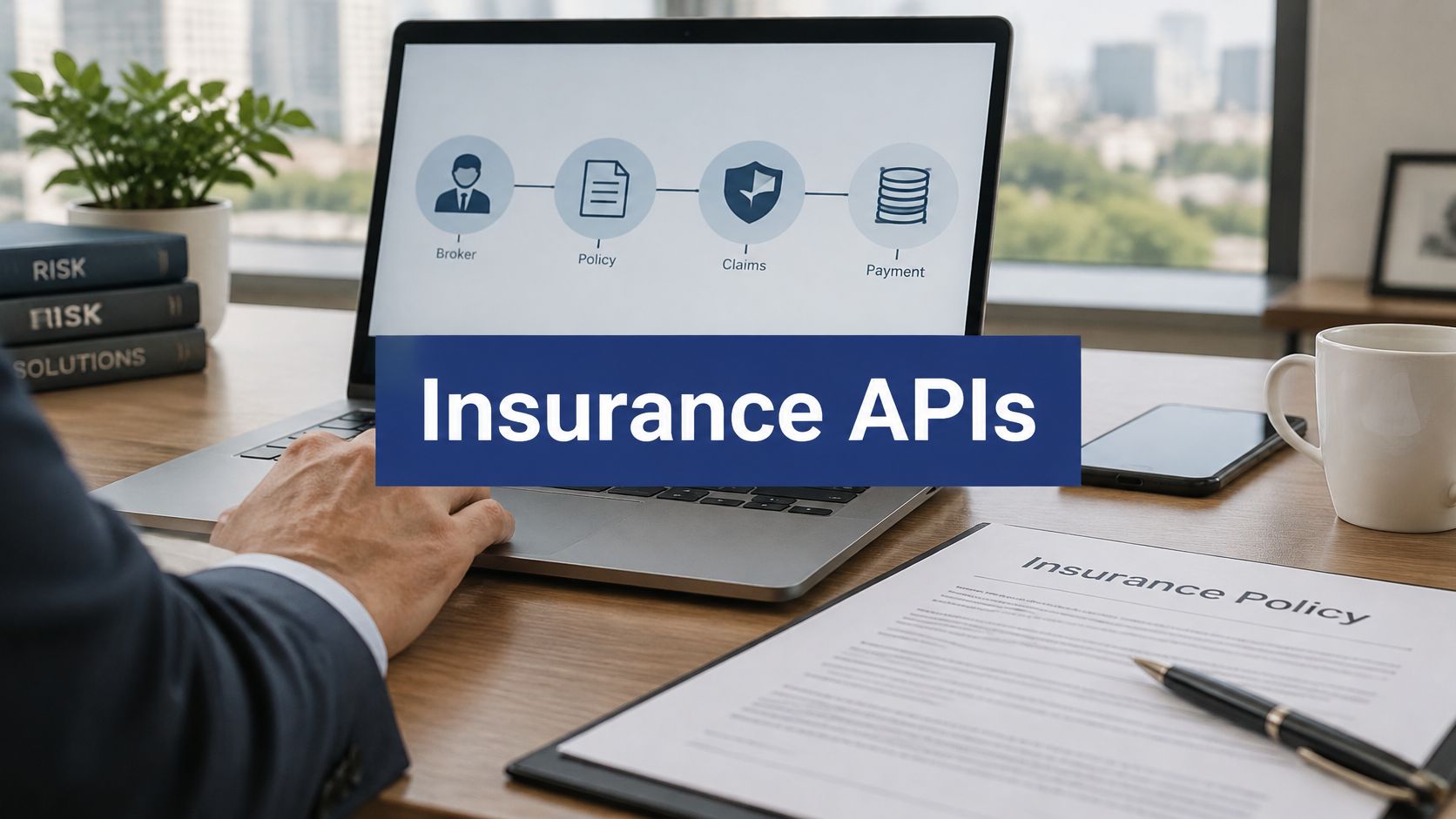


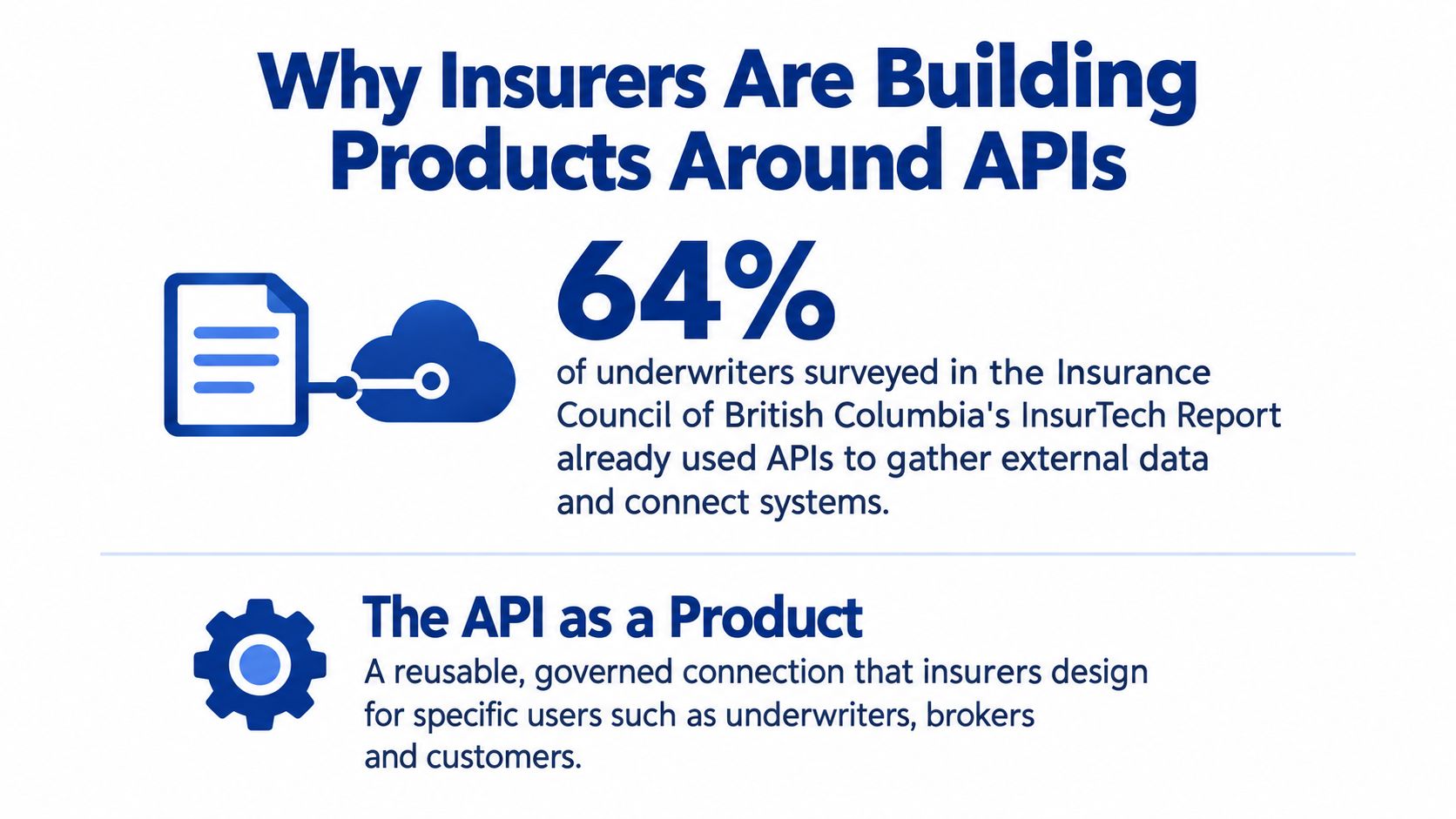
Underwriting teams across insurance already use APIs to pull in external data and connect systems that once exchanged files by email or overnight batch. That makes insurance API development an underwriting concern as much as an IT one. The question that decides whether a build succeeds is whether customers and staff can complete a journey when information is missing, consent changes or a partner goes offline. Treat those moments as core design requirements, including the point where a person steps in to finish what the system started.
Why Insurers Are Building Products Around APIs
An API is a controlled door between software systems. Think of a teller window: a broker's platform submits an approved request, such as an application for a quote, and receives a defined answer without gaining access to everything behind the counter.
Consider a hypothetical commercial application. A broker enters business details into a broker management system, then copies them into an insurer's portal. Someone later reconciles the returned quote with the original submission. Connecting the systems can remove those hand-offs, but only if both sides agree on what each field and response means.
Treat the connection as a product
A useful API needs identifiable users, an owner and a support process. Underwriters need reliable evidence, brokers need clear submission status, and customers need understandable next steps. Returning technically valid data isn't enough if nobody knows what to do with it.
Rather than planning a wholesale replacement, an insurer can connect existing platforms and introduce new digital channels around them. The development challenge becomes deciding which information should move, which system makes the decision and who handles exceptions.
Practical rule: Judge an API project by the manual work it removes across the entire journey, not by the number of endpoints delivered.
That judgement requires more than a connectivity diagram. Architecture, security, consent and human escalation must work together. Otherwise, a polished online application can leave staff doing the same reconciliation work behind a different screen.
What an Insurance API Connects To Every Day
An insurance API is closer to a staffed interchange than a pipe. Each connection moves specific information for an agreed purpose, with a named owner on each side and someone accountable when an exchange stalls. That staffing is where integrations usually succeed or fail: the technical connection is the easy part.
The table below maps the exchanges a typical insurance platform handles each day. Treat it as a menu, not a checklist, since few insurers need every row.
| System | What the API Exchanges | Typical Example |
|---|---|---|
| Policy administration | Quote, bind and endorsement data | A renewal updates vehicle details and returns a new premium |
| Broker management system | New business submissions, commission and status | A broker submits a commercial quote without re-keying |
| Claims system | First notice of loss, claim status and payments | A customer reports a loss in the app and sees the claim number |
| Customer portal and mobile app | Policy documents, coverage summaries and payment history | A customer views proof of insurance on a phone |
| Underwriting and third-party data | Vehicle, business or property data used in pricing | The underwriter receives external data before a decision |
| Payment services | Premium collection, refunds and payment status | A monthly premium is collected and confirmed |
| Identity verification | Know-your-customer checks and identity confirmation | A new applicant is verified during onboarding |
| Document and e-signature services | Signed forms, policy wording and audit copies | A signed application is stored with a timestamp |
Follow a submission through the systems
Take a commercial quote as a worked example. A broker enters business details in their own platform and sends them through the integration. The API validates the submission, checks that consent covers the data being requested, passes permitted fields to underwriting and pulls supporting data from external sources.
Underwriting returns a price or a referral. The API writes that result back into the broker's system, including any outstanding requirements, so nobody copies an answer from one screen into another.
A referral counts as a valid business response. The system can work exactly as designed while a human underwriter still needs a fire safety report or a claims history. Design for that outcome: the response should carry the referral reason and identify who owns the next step. For how these records relate across the wider data flow, see insurance data integration for policyholder services.
Map ownership alongside connectivity
Every dependency adds a team responsible for availability, data quality or both. Your inventory should identify three roles:
Data holders: which system maintains the authoritative policy, customer or payment record.
Decision makers: which service can price, approve, decline or refer.
Escalation owners: who investigates an incomplete exchange, and who decides what happens when a field arrives empty.
Start with a customer journey and list every system it touches. Mark the ones that store information separately from the ones that decide. Sparse fields and unanswered requests are design inputs here, not edge cases to patch later.
Architecture Patterns for Insurance API Development
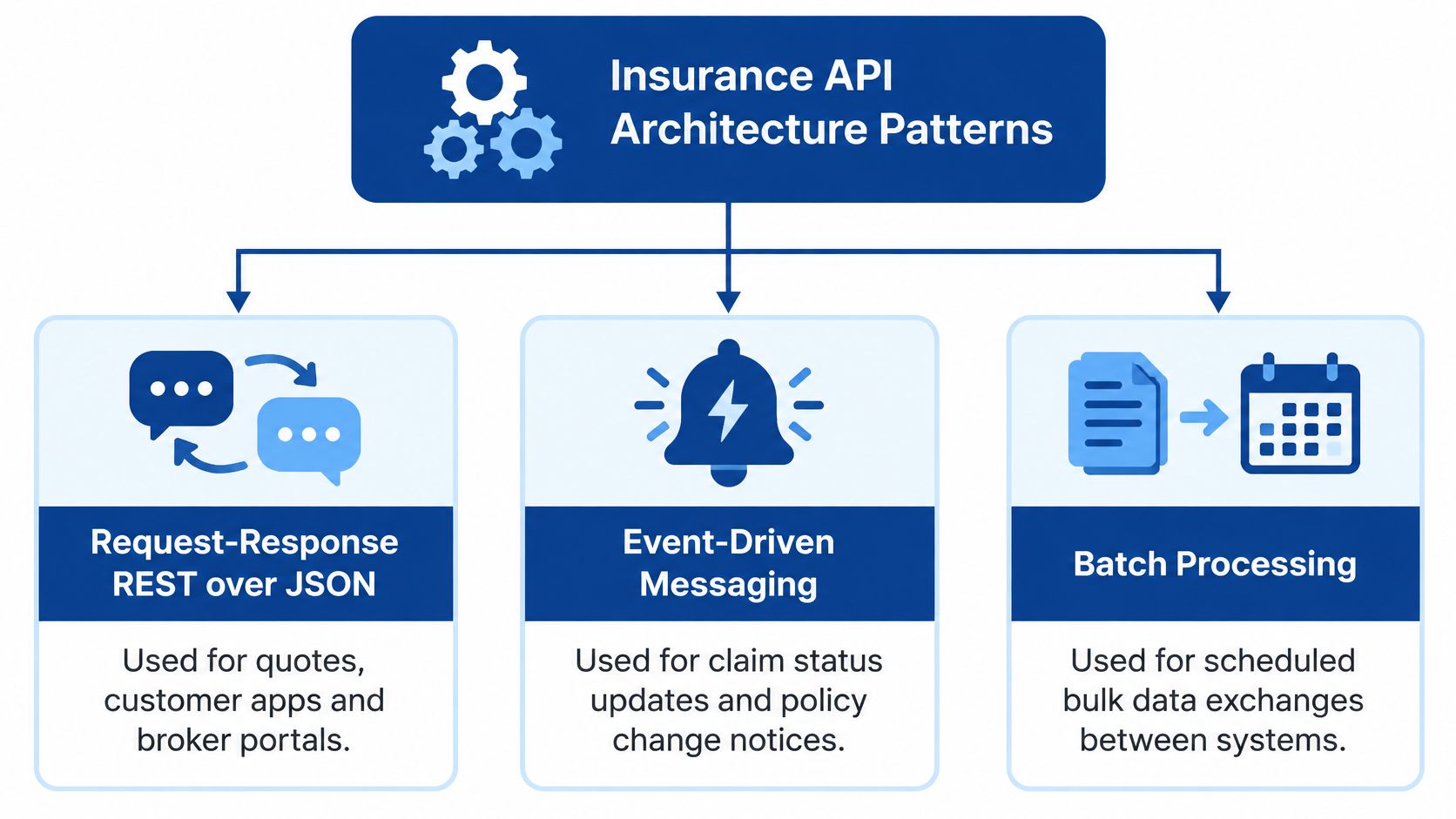
Request-response, events and batch exchange solve different problems. Use a direct request when someone needs an immediate answer, an event when other systems need notification, and a scheduled exchange when immediate feedback isn't necessary.
| Pattern | Best For | Main Trade-Off |
|---|---|---|
| REST over JSON on HTTPS | Quoting, customer apps and broker portals | Needs careful versioning and rate limits as partners grow |
| Event-driven messaging | Claim status updates and policy change notices | Harder to debug; tests must allow for delayed delivery |
| Batch and XML exchange (EDI or XML) | High-volume legacy exchanges and nightly reconciliation | Slow feedback and brittle when formats change |
| Hybrid API layer over legacy systems | Insurers that cannot replace core platforms quickly | Adds a translation layer that must be maintained |
| Microservices behind a gateway | Products that change often, such as usage-based or embedded cover | More services to monitor and secure |
Agree the contract before writing the connection
Canada's Centre for Study of Insurance Operations provides an important starting point. CSIO's INNOTECH programme supports bidirectional XML and JSON API data standards, insurer and vendor certification, and an API security standard.
Build around these design rules:
Shared business objects: Define quote, risk, policy, document and endorsement consistently, with explicit mappings to applicable CSIO fields and codes.
Contract-first definitions: Use OpenAPI to describe accepted requests and responses before implementation. Version schemas so partners can plan upgrades.
Idempotent operations: Give quote and bind requests a unique operation key. A retry should retrieve or complete the original operation, not create another policy.
Traceable journeys: Carry a correlation ID through connected calls so support staff can investigate a submission across systems.
Modernise without a forced replacement
A hybrid layer can translate between a new channel's contract and an older platform's format. Keep that translation separate from product rules wherever possible, so a legacy field name doesn't become a permanent constraint on the customer experience.
Retire an older exchange only after reconciliation, exception handling, and rollback have been proven. A successful demonstration isn't the same as a dependable production integration.
Security Controls to Design In From Day One
Security is a lifecycle, not a gateway setting. Authenticating a request at the entrance doesn't establish whether that caller should see a particular claim or perform a particular action.
OSFI Guideline B-13 applies to federally regulated financial institutions, including federally regulated insurers. It expects technology and cyber-risk controls within development and operations, including data classification, discovery and protection at rest, in transit and in use.
Give every caller a limited job
Translate that expectation into controls with a clear purpose:
Short-lived OAuth access tokens: Limit how long a stolen credential remains useful.
Narrowly scoped permissions: Permission to create a quote must not imply permission to cancel a policy or access claims.
Separate machine identities: Identify each partner and service independently so access can be revoked selectively.
Mutual TLS where required: Verify both ends of a connection when partner assurance calls for it.
Schema and payload validation: Reject unexpected structures and invalid business inputs.
Immutable audit logs: Preserve evidence of access and material actions without allowing silent alteration.
Rate limits and replay protection: Control request volume and reject inappropriate reuse of requests.
Automated secret rotation: Replace credentials through a managed process rather than relying on reminders.
Test misuse as well as success
Include authorisation-bypass checks, token replay, excessive-data-exposure checks, fuzzing and dependency scanning. Fuzzing means testing unexpected or malformed inputs, rather than assuming every caller follows the documentation.
Failure-mode tests should also simulate unavailable downstream insurer services. A compromised partner integration or outage can interrupt quoting, binding and document delivery while also disrupting the evidence needed to investigate events.
A successful login proves identity. It doesn't prove permission to perform the next action.
B-13 also supports enterprise-level risk governance. Establish a risk appetite, then translate it into endpoint criticality, availability requirements, dependency inventories and escalation ownership. Circuit breakers, tested backups, and recovery exercises are practical implementation choices, not substitutes for that governance.
Build these checks into continuous integration and delivery, alongside monitoring and alerting. Retrofitting controls after partners depend on an interface creates avoidable rework. The operational context is explored further in cybersecurity in the insurance industry.
Consent and Privacy Rules That Shape Data Flows
Consent must be meaningful, specific and withdrawable. An authenticated partner shouldn't receive personal information just because the integration can provide it.
Canadian privacy guidance treats driver-behaviour information as personal information and warns about unreasonable uses or inadequately explained risks, including higher premiums. Québec exposure can include penalties up to $25 million or 4% of worldwide turnover, fines up to $10 million or 2%, and a private right of action, as discussed in the Insurance Institute's analysis of telematics privacy laws.

Make consent an operational record
Design a consent record containing:
Identity and purpose: Who consented, to which use and for which data fields.
Evidence: Timestamp, notice version and the channel used.
Withdrawal history: What changed, when retrieval stopped and which partners acknowledged the change.
Ontario's electronic insurance card offers a concrete model. FSRA's electronic-card guidance requires policyholder consent, makes digital issuance optional and references the Electronic Commerce Act, 2000 and privacy legislation, including PIPEDA. Cards must not track location or collect, use or disclose personal information without the customer's knowledge and informed consent.
Separate proof from account access
FSRA's automobile insurance information also specifies lock-screen capability, either by design or through consumer activation. That helps prevent someone viewing proof of insurance from accessing other information on the phone.
Return the minimum information needed to verify cover, not an entire policy record. Keep proof-of-insurance functionality separate from telematics collection, and document accountability if a partner misuses data.
These decisions belong alongside the wider issues discussed in AI and data privacy in insurance, rather than being left to an application's consent screen.
Use Cases and Fallback Design for Sparse Data
The following scenarios illustrate proposed designs, not measured customer outcomes. Their shared principle is simple: an incomplete decision should still produce a useful next step.
The Insurance Institute of Canada's fall review describes embedded-insurance decisions made using information supplied in the moment, such as age, gender and driving-licence details, rather than years of driving history. It also identifies comparatively limited publicly available Canadian business data, including revenue and employee counts.
Embedded cover at a dealership
Before integration, a dealership customer might leave checkout to complete a separate insurance application. In the proposed API journey, permitted application details go directly to underwriting.
The API should return a quote only when the available evidence supports it. Otherwise, it returns a partial-quote state, a confidence flag and the outstanding requirements. Any use of supplied fields must remain subject to applicable underwriting and privacy rules.
The failure point is assuming missing history means an applicant is eligible or ineligible. Monitor referral reasons and whether referred applications reach an underwriter, not just whether requests finish successfully.
A loss reported through a mobile app
Without a connected workflow, a customer may submit details online and then telephone to confirm receipt. With integration, the app sends the first notice of loss to the claims system and receives an acknowledgement and claim reference.
Status changes can arrive as events, while a chatbot answers follow-up questions from authorised records. If the claims service is unavailable, return a pending acknowledgement without pretending that a claim number exists.
Monitor submission-to-acknowledgement failures, duplicate reports and event-delivery problems first. Offer an agent hand-off when the available status doesn't answer the customer's question.
A commercial quote awaiting evidence
Before integration, a broker might discover missing revenue information only after chasing an application. A better response identifies the missing evidence immediately and provides a document-submission route.
The API returns a held quote with a reason code. Monitor unresolved document requests and review-queue ownership, so a technical hold doesn't become an unattended application.
| Data Situation | API Behaviour | Human Step |
|---|---|---|
| No driving history available at point of sale | Return a partial quote with a low-confidence flag | Underwriter reviews from a queue |
| Business revenue or employee count not publicly available | Hold the quote and request supporting documents | Broker follows up with the client |
| Customer withdraws consent mid-journey | Stop data retrieval and propagate withdrawal to partners | Retain existing policy documents subject to applicable retention rules and notify the customer |
| Partner data service times out | Show a pending state and retry with an idempotency key | Agent calls back within an agreed window |
| Customer asks for a person | Route to the contact channel with full session context | Agent sees the journey without re-asking |
| Confidence score below agreed threshold | Refer with a reason code | Specialist decides and records the rationale |
Design the human hand-off
Provide an accessible phone or in-branch route, carrying relevant session context within authorised access boundaries. A confidence flag should describe evidence quality, not imply a scientifically calibrated probability unless you've validated it.
Our work with a Canadian cyber insurance provider began with hiring senior talent, then expanded to senior developers and project managers building advanced tools and applications. The relevant lesson is organisational: give people explicit responsibility for operating the workflow.
Release check: Run your five most common data gaps through staging. Each should end with a visible next step and a named owner.
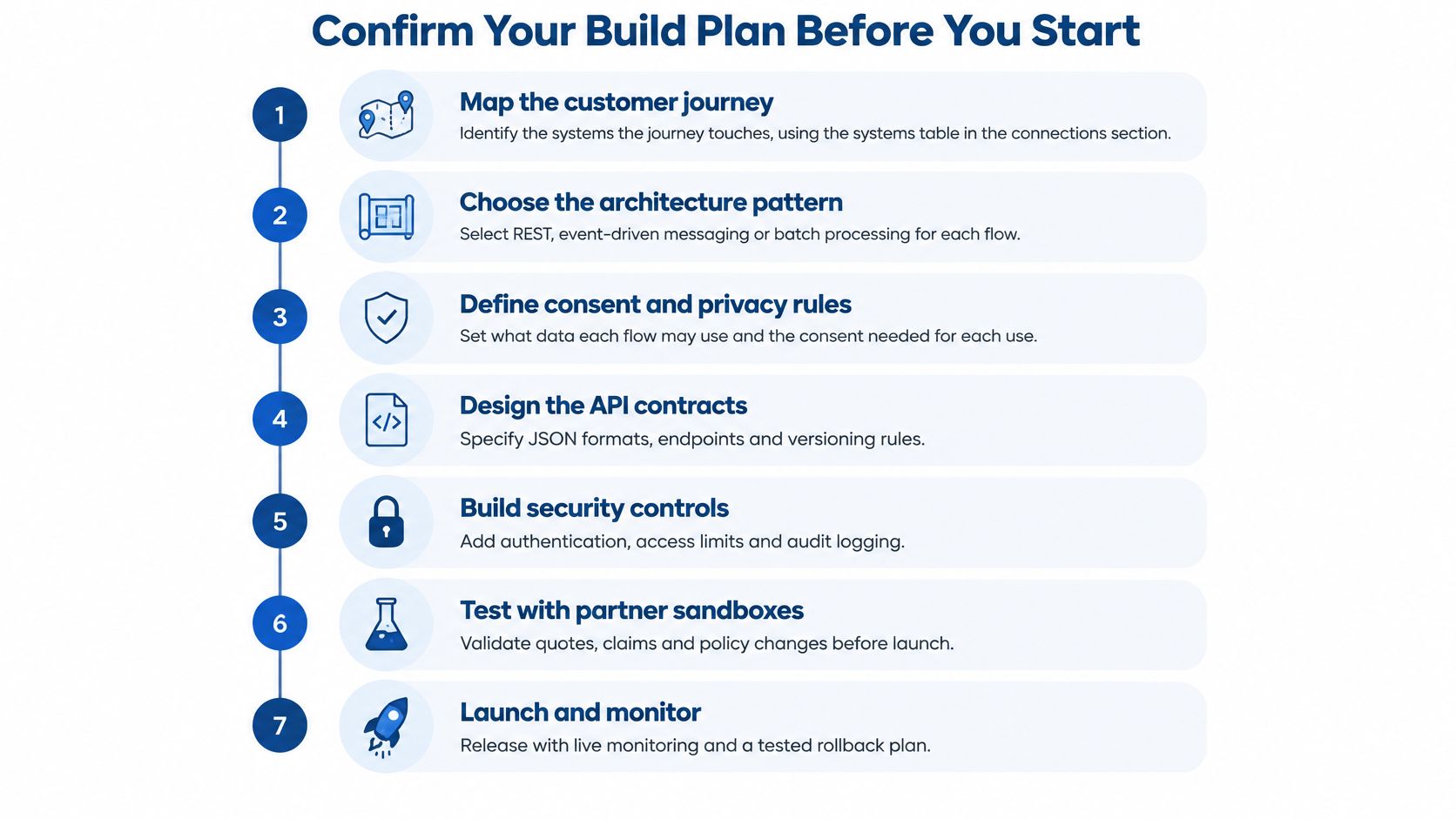
Confirm Your Build Plan Before You Start
A build plan works like a handover note in a relay race: every runner should know who has the baton, what happens if it drops, and when a coach steps in. Start with one bounded journey, then turn requirements into a testable delivery plan.
Map the journey: Name each system, manual hand-off and authoritative record the journey touches.
Choose the architecture: Match each exchange to its timing needs and align applicable data contracts with CSIO standards.
Classify impact: For institutions within B-13's scope, use business impact to set availability targets and recovery priorities.
Define privacy boundaries: Resolve consent, minimisation and any lock-screen requirements before enabling data flows.
Specify fallbacks: Give incomplete data, failed dependencies and requests for human help an owner and a visible response.
Complete vendor due diligence: OSFI's third-party-risk guidance expects agreements to address confidentiality, availability, integrity, breach notification, liability and timely access to data. Include export arrangements and control ownership.
Prove a journey: Test a proof of concept with realistic exceptions before committing to the wider build.
Estimate after discovery
Cleffex reviews business objectives and requirements before giving an accurate API-development timeframe. Systems involved, partner readiness, and exception paths should inform that assessment, including work that integrates AI capabilities into CRMs, ERPs and custom software without disrupting current workflows.
Its custom API development connects applications so they can share data through stable, dependable interfaces. See the integration context on the insurance and fintech page and company background on the Cleffex homepage.
Before you request that estimate, list the three integration points that would remove the most manual re-keying for your team.
Frequently Asked Questions
Understanding the terminology
What is an insurance API?
It's a controlled connection through which systems exchange agreed information or request actions. For example, a broker platform can submit an application to underwriting and receive a quote, referral or request for evidence without a separate phone call or manual re-entry.
Is an InsurTech API the same as insurance API integration?
No. InsurTech APIs are interfaces offered by insurance technology systems or services. Insurance API integration is the implementation work that connects those interfaces to existing platforms, maps information between them and handles errors, permissions and operational support.
Do we have to replace our core system first?
Not necessarily. The hybrid approach described earlier can preserve a working core while supporting new channels. Whether that's suitable depends on the core's available interfaces, operating constraints and ability to support the required business actions safely.
Applying the design in Canada
Which standards apply in Canada?
CSIO's INNOTECH standards are a practical starting point for applicable XML and JSON exchanges, certification and API security. Confirm the standards and code sets relevant to your insurance line and partners rather than assuming a single payload fits every connection.
Does OSFI B-13 apply to every insurer?
No. OSFI's technology and cyber-risk guidance applies to federally regulated financial institutions, including federally regulated insurers and foreign insurance branches where consistent with applicable obligations. Provincially regulated firms should establish their own regulatory obligations rather than assume identical scope.
Must every customer journey be digital?
No. A dependable digital insurance platform should preserve suitable human-assisted routes. Customers shouldn't have to restart an application because information is unavailable, a service fails, or they need someone to explain a decision.
Cleffex Digital Ltd offers custom API development and integration to connect applications, share data and improve connectivity. Visit Cleffex Digital Ltd to discuss a defined insurance journey, the systems it touches and the consent, security and human hand-offs your build needs.