

CAA MyPace policies placed from January through September 2021 were 418% higher than during the equivalent period in 2019. That jump shows how quickly real-time insurance data can change risk assessment when traditional assumptions stop matching real-world behaviour.
In Canada, insurers are moving from occasional snapshots towards continuously refreshed information about driving, claims, vehicles, weather and exposure. The opportunity is substantial, but the technology itself isn't the hard part. Reliable identifiers, clear consent, provincial rules, explainable models and useful data determine whether real-time risk assessment improves decisions or just creates faster confusion.
Why Real-Time Insurance Data Matters Now
Usage-based auto insurance has been available in Canada since 2013, and that matters because it marked a practical shift from pricing built mainly on broad historical proxies to pricing informed by observed behaviour. Instead of inferring risk mostly from age, gender, or past records, insurers could start using signals such as braking, acceleration, cornering, speed, distance travelled, and time of day. In some programmes, location also entered the picture. Canadian insurance coverage of the MyPace milestone captures that turning point.
The change became easier to see during COVID-19. Lockdowns disrupted normal mileage patterns, so products tied to actual usage suddenly fit the moment better than policies built around routine driving assumptions. CAA MyPace policies placed from January through September 2021 were 418% higher than in the equivalent period in 2019. New MyPace policies from April through December 2020 also increased by nearly 300% year over year, according to the same Insurance Business Canada report cited above.
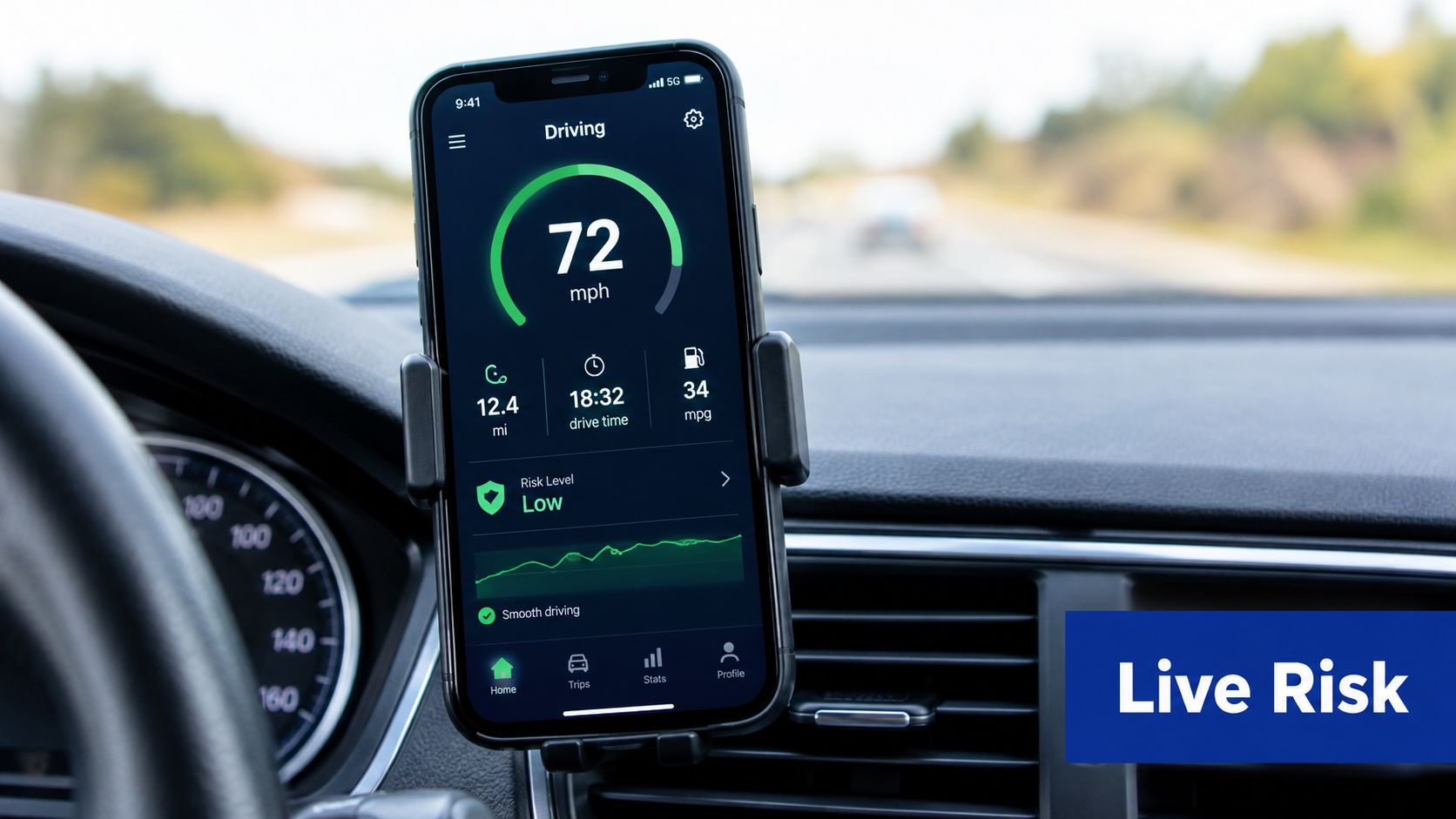
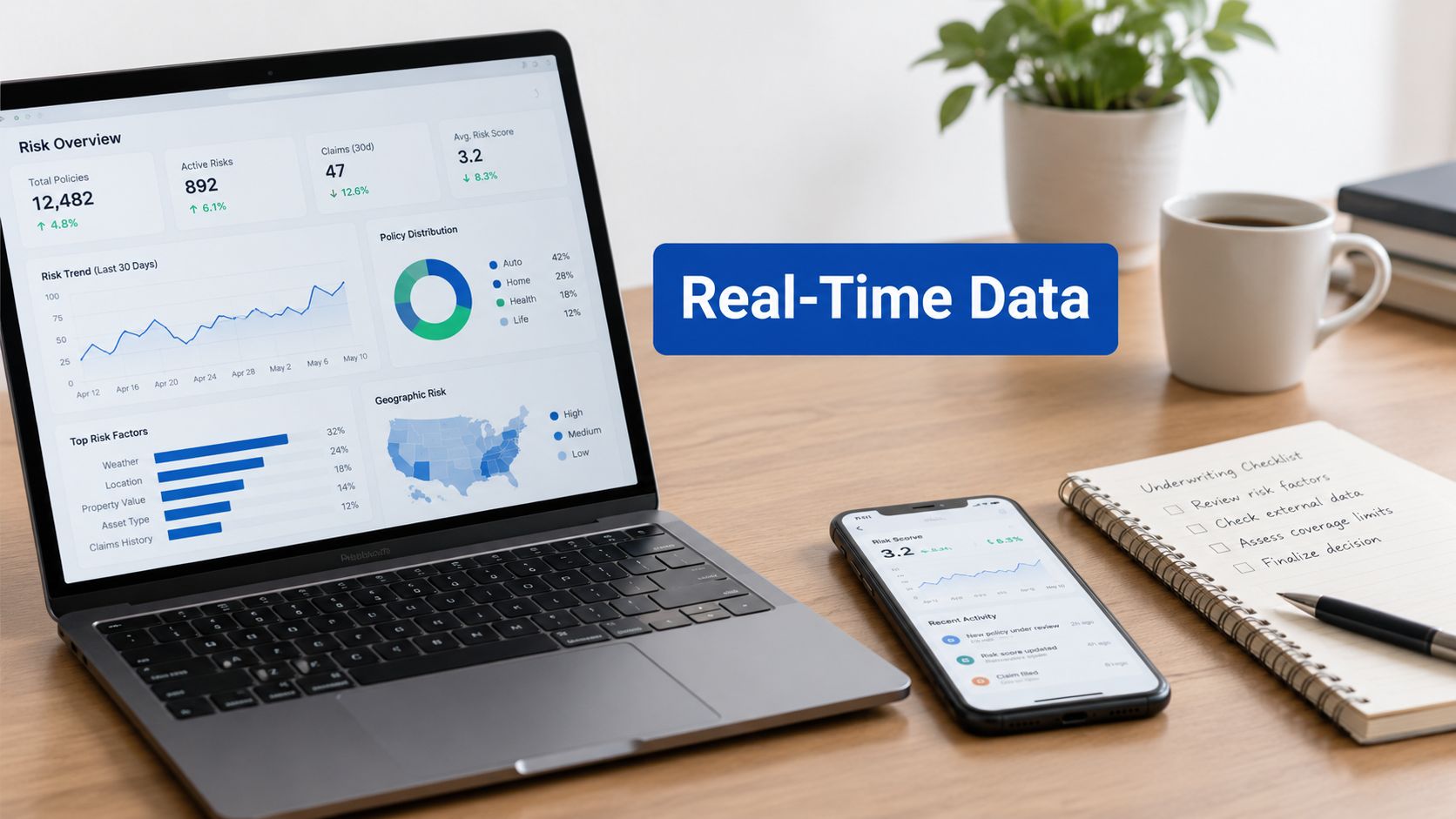
For industry leaders, the lesson is not just that connected data exists. It is that demand can move quickly when real-world behaviour stops matching old rating assumptions. Real-time data works like a live instrument panel. It can support dynamic pricing, sharper risk segmentation, usage-based products, and earlier intervention when a pattern suggests rising exposure.
That promise comes with a constraint that many technology discussions skip. Better insurance decisions depend less on collecting more signals than on being ready to use them properly. Weather alerts are a good example. A storm warning may help with prevention or claims triage, but it does not automatically justify a pricing action in every province. The same tension applies to telematics and mobile data. An insurer needs accurate identifiers, clear customer consent, a model that can explain its outcome, and operating rules that fit provincial privacy and consumer-protection requirements.
Practical rule: Treat live data as a decision input with a defined purpose, not as permission to collect everything a device can observe.
What Real-Time Insurance Data Actually Means
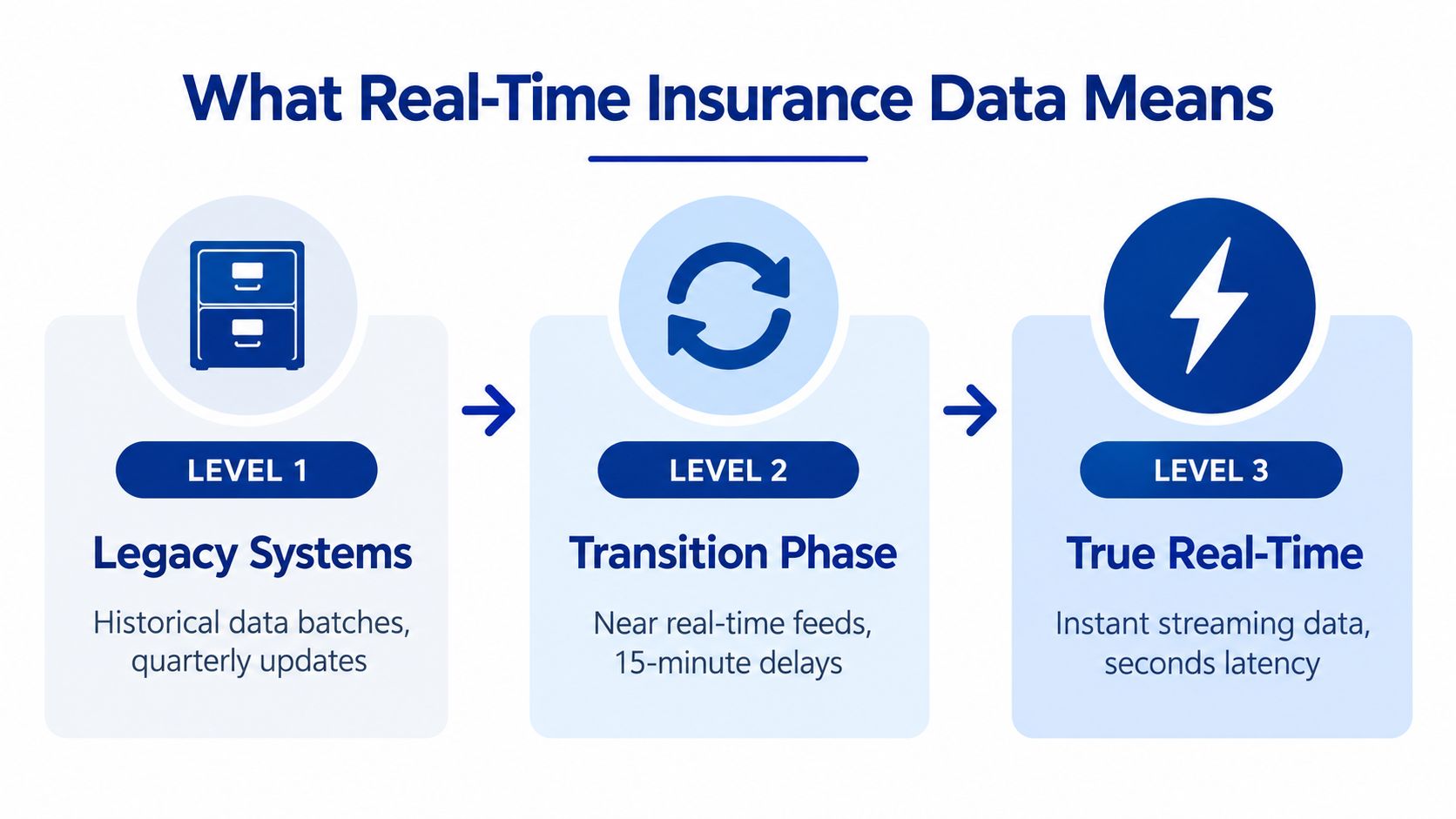
Real-time insurance data is information that reaches a decision system frequently enough to influence an action while the underlying risk is still relevant. It doesn't always mean an instantaneous decision made within seconds. A near-real-time claims update, a telematics event processed shortly after a journey or a refreshed vehicle-risk record may be more useful than a theoretically instant feed that hasn't been validated.
Traditional underwriting often works from periodic files and historical proxies. Real-time risk assessment adds a stream of events, such as:
Driving behaviour, including hard braking, rapid acceleration, speed and cornering.
Exposure, including kilometres travelled, time of travel and location where permitted.
Claims activity, with event dates and changing status.
Weather and geographic conditions, provided the source and uncertainty are visible.
Vehicle information, connected to the correct policy and insured party.
Telematics makes the concept tangible. The Insurance Council of British Columbia describes a stream in which vehicle location, speed and driver behaviour can support underwriting, pricing, loss prevention and claims investigation. Its Canadian regional report found telematics use among 19% of the insurance industry and 30% of surveyed adjusting firms, indicating meaningful adoption that remains far from universal. The Insurance Council of British Columbia InsurTech report also supports treating each observation as a timestamped event, checking device integrity, converting raw telemetry into explainable features and separating immediate safety alerts from slower actuarial recalibration.
The data is more than a feed
A usable event needs context. The system should record when it arrived, when it occurred, which device supplied it, what policy it relates to and whether the value has been changed or corrected. That combination of timestamp, provenance, identity and consent lets a reviewer distinguish new information from an old record that merely arrived late.
Real-time financial data for fintech decisions provides a useful comparison. In both financial services and insurance, speed only helps when the organisation can trust the data and connect it to the correct customer, account, policy or claim.
A mature design also exposes uncertainty. A weather alert should show its geographic scope and confidence, while a telematics score should explain which observations affected it. Without that context, faster insurance risk analytics can make decisions harder to challenge.
How Real-Time Insurance Data Is Integrated
A production implementation usually combines several layers rather than replacing every legacy system. Start with the sources, then establish a controlled route into underwriting, claims and customer-facing applications.
Build the identity layer first
The first requirement is a stable way to identify policyholders, vehicles, claims and service providers. Canonical identifiers prevent one vehicle from appearing as several records or one claim from being attached to the wrong policy. They also allow a model to compare newly received information with historical records without treating duplicates as fresh evidence.
The Insurance Bureau of Canada operates data infrastructure that supports near-real-time access to policy, claims and vehicle-risk information through systems including DASH and the Health Claims Database. Its insurance data tools illustrate the value of standardised, queryable industry services instead of isolated insurer files.
Route events through controlled interfaces
An API gateway can receive approved data and expose read-only services for quotation or underwriting workflows. A versioned data model ensures that a field's meaning doesn't change without notice while a model is still using it. Streaming or event-driven updates suit high-value events, such as a new claim, a material policy change or a collision notification. Batch reconciliation remains appropriate for regulatory and financial reporting.
A simple telematics flow might look like this:
A connected device records an observation.
The platform authenticates the device and checks the event's integrity.
The system links the event to a policy and vehicle.
Raw observations become explainable features.
A safety service decides whether an immediate alert is needed.
A slower actuarial process evaluates whether the broader risk profile should change.
This separation matters. A severe braking alert can help a driver immediately, while pricing recalibration may require a wider set of observations and human oversight.
Architecture principle: Stream events when they change an action now. Reconcile in batches when completeness and reporting matter more than immediacy.
For teams comparing continuous monitoring approaches, a GoSafe white-label risk platform offers a relevant reference point for packaging risk signals into an operational service. The same design question applies to insurance: can the platform show where a signal came from, who may use it and what happens when the signal is wrong?
Insurers assessing their integration plan can also review insurance data integration for better risk management. The central lesson is practical. An API without identity resolution, validation, access controls and provenance is only a faster way to distribute unreliable information.
Business Benefits and Real-World Use Cases
The business case for real-time insurance data becomes clearer when each signal connects to a specific decision. A driving event may support a safety message, a claims referral or a pricing review, but those are different actions with different governance requirements.
A documented Desjardins usage-based programme collected kilometres travelled, hard braking, rapid acceleration and driving time. Driving between midnight and 5 a.m. was treated as higher risk. Participation was voluntary, customers received an immediate 5% premium discount, and the discount was recalculated monthly before being applied at renewal. The programme advertised a maximum saving of 25%, as reported by Canadian Underwriter's coverage of usage-based insurance.
Where the value appears
Underwriting can use current behavioural observations to supplement historical information. This doesn't mean removing professional judgement. It means giving the underwriter a more current view of exposure and driving patterns.
Pricing can become more closely connected to usage and observed behaviour, provided the insurer explains the scoring logic and follows the applicable provincial framework.
Claims teams can use event timing, vehicle information and connected signals to route a suspected collision into an accelerated intake process. The data should support investigation, not become an unquestionable substitute for evidence.
Loss prevention is often the safest starting point. Repeated severe braking can trigger a coaching message, while a severe-weather signal can prompt preparation advice before the event becomes a claim.
The fraud function can also benefit from linked claims, policy and behavioural signals. For background on how automated pattern analysis is applied in this area, insurers can consult an AI for Insurance fraud database. Any fraud signal still needs a review path, because an unusual pattern isn't proof of misconduct.
Match the signal to the consequence
A useful operating distinction is:
| Decision type | Example | Appropriate control |
|---|---|---|
| Preventive | Send a severe-weather warning | Show source, timing and uncertainty |
| Operational | Prioritise a suspected collision for intake | Permit human review and correction |
| Consequential | Change a premium or coverage outcome | Explain the model, record consent and apply provincial rules |
That distinction prevents an insurer from turning every live signal into an adverse decision. The AI risk assessment in fintech and insurance discussion is relevant here because automated scoring creates value only when decision-makers can understand and govern its inputs.
Consumer Behaviour and Market Demand
Consumer interest is measurable, but demand alone does not make real-time insurance data workable. RATESDOTCA's analysis of UBI demand found that interest in usage-based insurance rose by nearly 20% during the period covered by its 2023 review. In January, UBI quotes were up 18.22% year over year. Month over month, the number of drivers choosing a UBI discount increased 54.64%, and February UBI-discount quotes were 39.68% higher than the comparable earlier period.
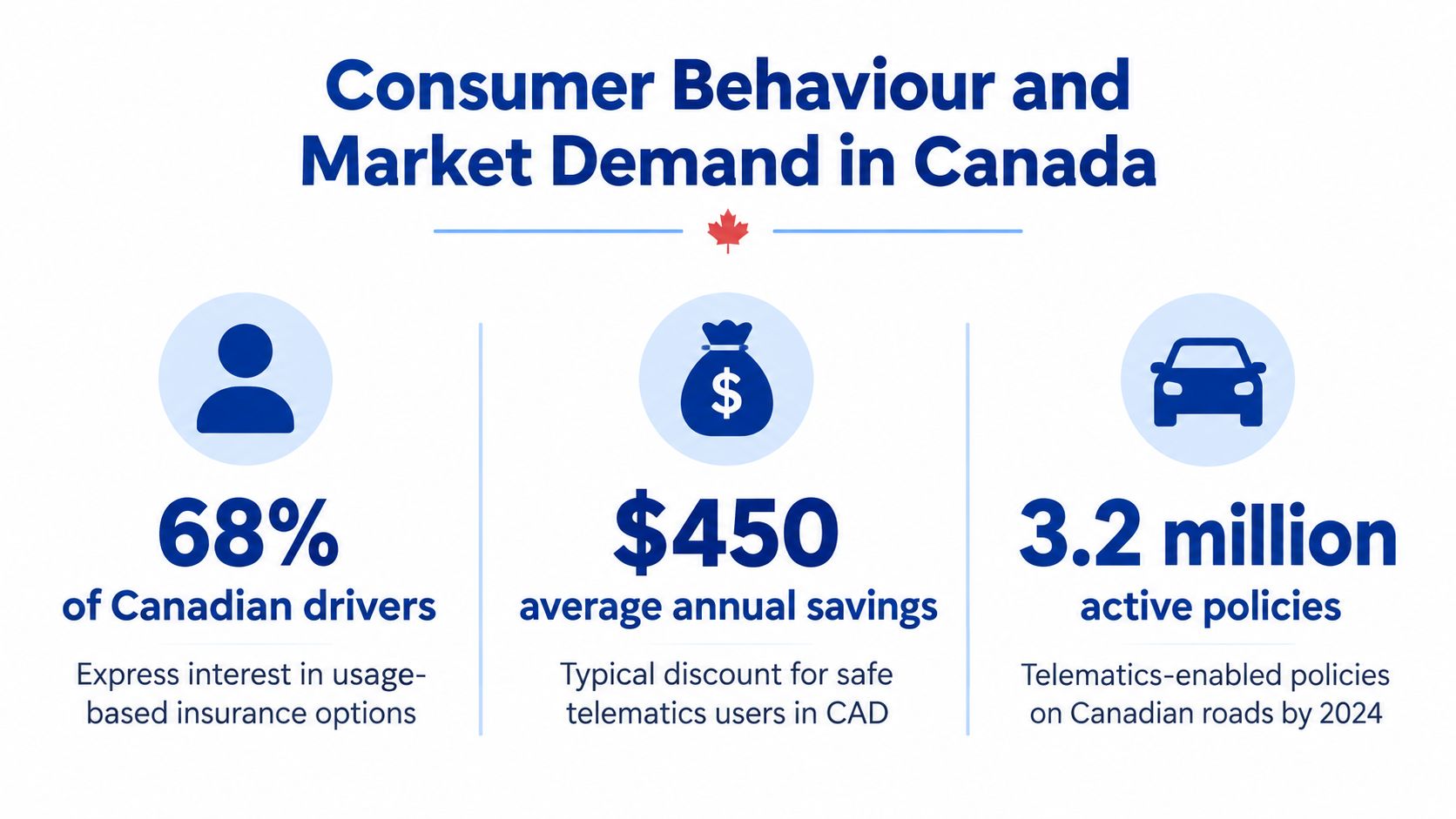
The age split points in the same direction. Nearly 55% of drivers aged 20 to 29 opted for a UBI discount, compared with 40% of those aged 30 to 39, according to the same RATESDOTCA analysis. That pattern matters because it shows adoption is not only a technology issue. It is also a product-design issue, where convenience, price sensitivity and comfort with data sharing all shape response.
Still, a quote request is not the same as durable trust. A driver may accept app-based monitoring for a discount, then object when the programme seems to expand from mileage and braking into location history, behavioural profiling or decisions they did not expect. Real-time data works like a home sensor system. People often like the alert, but they want clear rules about what is being monitored, who sees it and what happens after the signal appears.
That is why the value exchange has to be concrete and plain-language:
What gets collected, such as kilometres, braking or driving time.
When it gets processed, whether immediately, daily or at renewal.
What changes, a discount, a warning, a review or no customer-facing action.
Who can access it, including internal teams and service providers.
How corrections work, if a device records an inaccurate journey.
Regional differences add another practical constraint. A proposition that converts well in one province may need different consent language, customer education or pricing treatment in another, especially where privacy expectations and acceptable uses of weather or behavioural signals differ. Demand supports investment. It does not remove the data-readiness gap or the consumer-protection limits that decide whether a real-time programme can scale.
Privacy, Fairness, and Regulatory Constraints
Real-time insurance data becomes personal information when it can be connected to an identifiable customer, vehicle or household. The Office of the Privacy Commissioner of Canada requires organisations to identify collection purposes before or at the time of collection, obtain meaningful consent where required, limit collection to what is necessary and restrict use or disclosure to the purposes identified. The Office of the Privacy Commissioner guidance on privacy obligations provides the foundation for applying those principles to telematics and automated insurance decisions.

An insurer should state whether location, driving behaviour or connected-device information can affect underwriting, claims handling or renewal pricing. If data was originally collected to service a policy, repurposing it for predictive analytics or automated decisions may require a separate governance review and, in some situations, additional consent.
Weather data needs a higher threshold
Weather monitoring exposes the tension between useful prevention and harmful automation. A January 2025 Canadian consumer survey found that 45% of respondents were comfortable with insurers using AI to monitor severe-weather risks and send real-time alerts, while 42% worried that prediction accuracy could influence their premiums or coverage. The figures are reported in Insurance Canada's coverage of the severe-weather AI survey.
A forecast can be wrong, geographically imprecise or updated after a customer has already acted. That makes an alert different from a pricing decision. A sound governance approach should ask:
What confidence threshold is required before an alert is sent?
What source, timestamp, geographic resolution and uncertainty range are shown?
Can the customer challenge an incorrect signal?
Is the event being used for prevention or for an adverse underwriting outcome?
Does the model produce different outcomes across regions or driving contexts?
Consumer protection rule: Use uncertain signals first to help people reduce harm. Require stronger evidence and a review path before using them to worsen a customer's insurance outcome.
Introduce controls in phases
Begin with purpose limitation, minimum collection and consent records. Then add field-level access logs, retention rules, correction workflows and model testing. Only after those controls work should an insurer expand automated pricing or coverage decisions.
Implementation Roadmap and Quick Wins
Insurers don't need to build a fully autonomous pricing engine before they can use real-time insurance data responsibly. A smaller, controlled pilot can reveal whether the organisation's identity, consent, integration and support processes are ready.
Start with a minimum viable data framework
Define the essential fields before selecting a platform. For a telematics pilot, that might include an approved policy identifier, vehicle identifier, event type, event timestamp, source, consent status and processing outcome. Validate freshness, record provenance, expose uncertainty and create an auditable correction process.
A practical first release could include:
Voluntary participation: Offer a clear usage-based programme rather than enrolling customers without notice.
Transparent mechanics: Explain which observations affect a discount, how often the score changes and when the result appears.
Prevention-first alerts: Use driving or weather signals to support safer action before using them for adverse pricing.
Existing data services: Connect approved policy and claims information rather than rebuilding every industry record.
Human review: Route disputed or consequential outcomes to trained staff.
Compare platforms on operating discipline
A vendor that promises instant scoring isn't necessarily ready for insurance. Evaluate how each platform handles:
| Evaluation area | Questions to ask |
|---|---|
| Data quality | Can the system reject duplicates, stale records and invalid events? |
| Explainability | Can an underwriter show which features affected an outcome? |
| Privacy | Can consent be recorded, changed and revoked by purpose? |
| Resilience | What happens when a device, API or weather feed is unavailable? |
| Integration | Does the platform support versioned models and read-only workflows? |
| Governance | Are access, retention, correction and provincial rules configurable? |
Provincial variation makes deployment especially important. A Canadian summary reported that UBI was available in Quebec, Ontario, New Brunswick, Nova Scotia, Alberta and Prince Edward Island, while other provinces and territories were still considering such programmes. The same Canadian UBI market summary reported discounts of up to 30% for safe drivers, possible surcharges for higher-risk drivers in Quebec and Ontario rules allowing surcharges linked to high kilometres and other risky driving behaviour.
That means a national model shouldn't use identical pricing logic everywhere. Map each province's data collection, consent, discount and surcharge requirements before expanding. Keep streaming updates for events that need prompt action, and retain batch reconciliation for financial and regulatory completeness.
Frequently Asked Questions
Does real-time mean an instant pricing decision?
No. It means information arrives frequently enough to influence a relevant decision. A safety alert may be immediate, while actuarial recalibration may happen more slowly after validation.
Can insurers use every signal a connected device collects?
No. Collection should be necessary for an identified purpose, supported by meaningful consent where required and restricted from unrelated reuse. Customers should know whether data affects underwriting, claims or renewal pricing.
Should weather predictions change premiums?
A warning and a premium change carry different consequences. Start with prevention, disclose the source and uncertainty, and require stronger evidence and review before an imperfect forecast affects coverage or pricing.
Do small insurers need complex AI first?
No. Statistics Canada reported that in Q2 2025, 8.3% of Canadian businesses considered AI investment very important to operations and 20.1% considered it somewhat important, as reported in Statistics Canada's business adoption analysis. A governed minimum viable data framework may create more value than an advanced model built on unreliable inputs.
The Competition Bureau describes insurance data portability as a customer's ability to securely transfer insurer-held information to another insurer or third-party application. That makes consent revocation, correction, lineage and reciprocal access important design questions, not future enhancements.
Cleffex Digital Ltd offers insurance data integration services that connect policy administration, claims, billing, compliance and third-party workflows into a governed data layer, alongside AI solutions that analyse historical and real-time data for unusual patterns, fraudulent claims and risk profiles. Visit Cleffex Digital Ltd to discuss a practical, privacy-aware foundation for real-time insurance risk assessment.