

You can have a modern EHR, a strong AI pilot, and a busy clinical team, and still end up with a tool nobody trusts. The usual reason is simple. The data feeding the model is scattered across systems, delayed by workflow gaps, or stripped of context before the algorithm ever sees it.
That's why healthcare data integration is no longer a back-office concern. It's the foundation that decides whether AI healthcare integration improves care or stays trapped in demonstrations, procurement decks, and short-lived pilots. When information can move cleanly across lab systems, imaging, medication records, billing platforms, and patient-facing apps, AI gets the complete picture it needs to make safer, more useful predictions. When it can't, the model may be clever, but the workflow around it is blind.
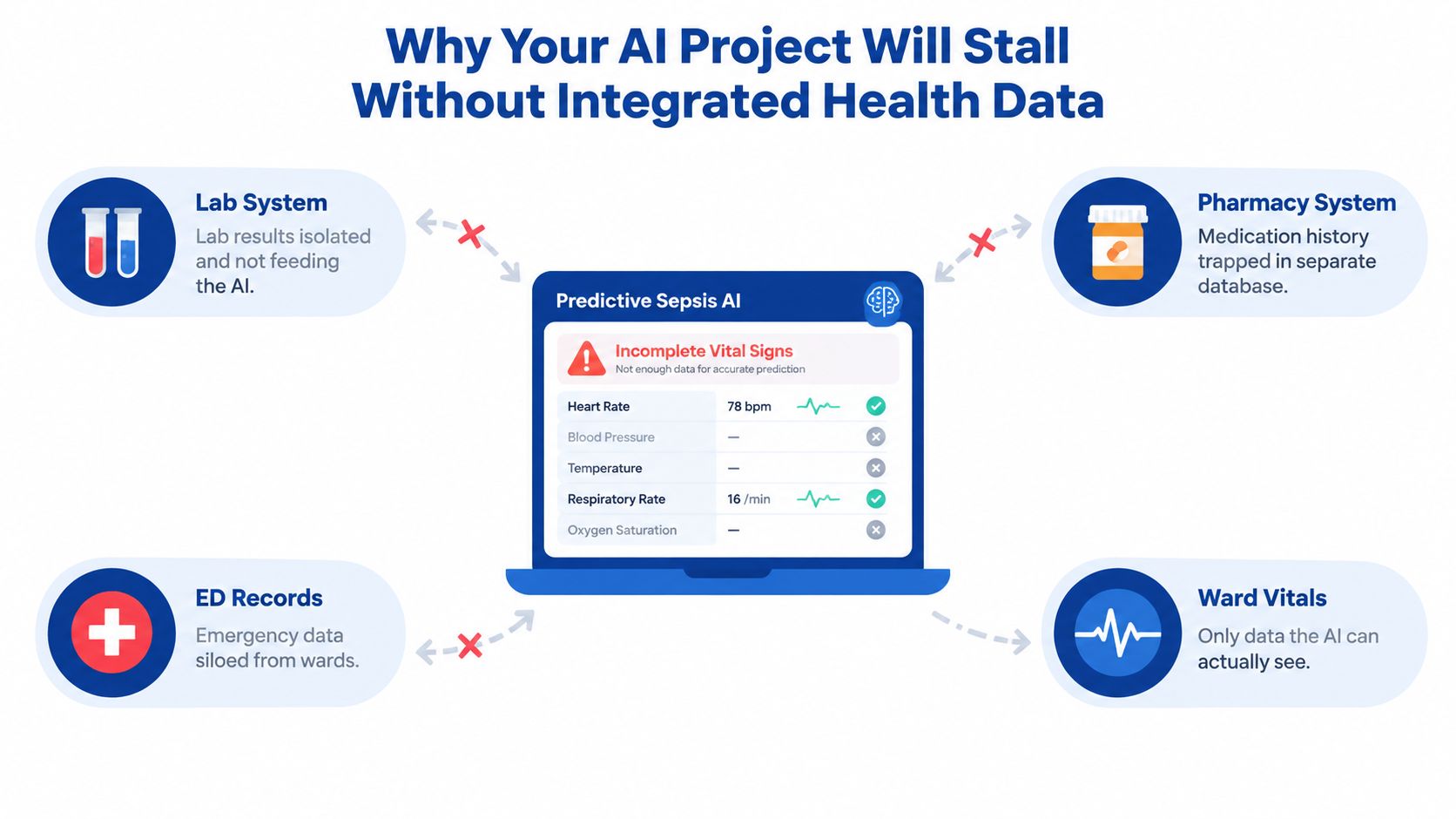
Why Your AI Project Will Stall Without Integrated Health Data
A hospital can spend months preparing a predictive sepsis model, then discover it only sees vital signs from one ward. The lab results sit in one system, pharmacy data sits in another, emergency department notes live elsewhere, and the model keeps making decisions with half the story. That's not an AI problem first; it's a healthcare data management problem.
The clearest way to think about healthcare data integration is as the connective layer that lets information move between systems without losing meaning. It's not just about “connecting software”. It's about making sure a clinician, an application, and an AI model can all work from the same patient context, whether the data started in an EHR, a lab platform, an imaging archive, or a partner network.
Why fragmented data makes AI fragile
AI models depend on patterns, but patterns only hold up when the inputs are complete enough to reflect reality. If medication history is missing, or a lab value arrives late, the model may produce an output that looks confident while being clinically weak. That's why fragmented data isn't just inconvenient; it can become a safety issue.
Practical rule: if a model cannot see the same context a senior clinician would ask for before acting, it isn't ready for routine care.
A useful internal reference for teams trying to clean up the source systems is Cleffex's guide to healthcare data management. It helps frame the operational side of the problem, which matters because AI projects usually fail at the handoff between systems, not inside the model itself.
For clinic leaders and IT buyers, the questions are practical. Which standards will the vendor support? Which architecture will survive future growth? Which security controls protect patient data while still letting the model learn? And which governance model keeps the pilot from becoming another isolated tool that nobody can safely scale?
What Healthcare Data Integration Actually Means
Think of patient information in three stages. First, it lives in paper folders, separate and easy to misplace. Then it becomes digital, but still scattered across apps that don't talk to one another. Only later does it become a unified record that can be searched, shared, and acted on across the care journey.
That distinction matters because digitisation alone is not integration. A clinic can scan forms, move to electronic charts, and still leave lab results, referrals, and billing records trapped in separate systems. Healthcare data integration means those systems exchange information in a way that preserves context and supports action inside the workflow, not just after the fact.
The three pillars buyers should check
The first pillar is connectivity. Systems need to exchange data reliably, whether they use direct feeds, APIs, or an interface engine. If data can't move, nothing else matters.
The second is semantic consistency. The receiving system must understand what the data means. A blood pressure reading, a medication code, or a diagnostic term has to mean the same thing in every place it appears. Without that, you don't get a longitudinal view; you get a pile of mismatched fragments.
The third is workflow embedding. Data must arrive where care happens. If a result is available only in a separate dashboard that no one opens during rounds, the integration is technically live but operationally weak.
A good external primer on exchange patterns is the Bridge Global data exchange guide, which is useful because it keeps the focus on movement, not just storage. For a more practical internal walkthrough, Cleffex's guide to breaking down healthcare data silos is worth keeping nearby when teams are mapping where the blockers sit.
Useful shorthand: if the system can store data but not move it cleanly, it's a repository. If it can move data but not preserve meaning, it's a transport layer. True integration does both.
That's why buyers should treat integration as a clinical safety and AI-readiness requirement. A unified record is not a luxury feature. It's the difference between an AI tool that supports care and one that adds another screen.
The Standards Behind Every Integrated Health System
Healthcare systems often speak different “languages”. One hospital sends short messages, another sends documents, and a modern app expects web-based requests. The standards are what let those different styles of communication line up without every vendor inventing a private translation scheme.
How the main standards fit together
HL7 v2 is the long-established workhorse for hospital messaging. It's still widely used for moving admissions, lab results, and similar operational messages between systems. CDA is better suited to clinical documents, where structured narrative and record-style exchange matter. FHIR is the newer, web-friendly approach built for modular data exchange through APIs, which makes it much easier to use in cloud platforms and AI workflows.
That's why many healthcare technology teams now ask vendors about FHIR first. Canada is moving in that direction too, with CA Core+ defining a national core set of essential FHIR profiles for exchange across jurisdictions and use cases, which means integration work needs to think about profile conformance and terminology consistency rather than only one-off mappings.
| Standard | Format | Typical Use Case | AI Readiness |
|---|---|---|---|
| HL7 v2 | Message-based | Routine hospital messaging | Moderate, useful for legacy feeds |
| HL7 v3 | Message and document models | Structured exchange in specific environments | Limited in day-to-day modern workflows |
| CDA | Clinical documents | Summaries and document-centric exchange | Moderate, better for records than real-time apps |
| FHIR | Resources and APIs | App integration, cloud exchange, AI pipelines | High, because it fits granular, machine-readable data exchange |
A practical buyer question is simple. Ask vendors which FHIR resources they support, how they handle terminology mapping, and whether they can show a conformance statement rather than a vague “FHIR-ready” claim. That question matters because AI systems usually need clean, granular inputs, not just exported PDFs.
For teams evaluating implementation effort, Cleffex's FHIR integration services guide to compliance is a useful internal reference point. It helps connect the technical standard to the compliance reality that healthcare buyers live with every day.
Choosing an Integration Pattern That Fits Your Organisation
No clinic or hospital should start with the fanciest architecture on day one. The right pattern depends on how many systems need to connect, how quickly data must move, and how much in-house technical support the organisation can sustain.
Start with the smallest structure that can hold the workload
A point-to-point setup is the simplest option. One system sends data straight to another, which works well for a small ambulatory clinic with only a few systems and straightforward flows. The downside is obvious: every new connection adds another custom link, and the whole setup becomes fragile fast.
An interface engine sits in the middle and routes, translates, and monitors messages. Multi-site hospitals often reach this point because the number of connections grows quickly, and centralised control becomes more valuable than ad hoc scripting. An engine can still add latency, but it usually beats maintaining dozens of bespoke links.
An API platform is a better fit when AI vendors need real-time access to many endpoints. It gives developers a cleaner way to request specific data without building separate connections for each source. The trade-off is governance, because once APIs become the front door, access rules, versioning, and monitoring need to be disciplined.
A data lake or warehouse fits population health, historical analytics, and model training on large datasets. It's powerful when the goal is to analyse trends across claims, labs, and long-term records. The risk is obvious too: a lake without curation becomes a data swamp.
A practical resource on automation-heavy integration work is AI coding agents for data integration, which is helpful for teams exploring how development assistance can speed up repetitive build tasks. For organisations choosing a vendor, that efficiency only matters if the underlying pattern fits the clinical use case.
| Pattern | Best Fit | Limitations |
|---|---|---|
| Point-to-point | Small environments with a few systems | Scales poorly and becomes hard to maintain |
| Interface engine | Multi-site hospitals with growing message volume | Can introduce latency and platform dependency |
| API platform | AI vendors needing real-time access to multiple endpoints | Requires careful governance and version control |
| Data lake or warehouse | Analytics, population health, model training | Can turn messy without strong data curation |
Decision rule: if you're solving one connection, keep it simple. If you're solving many, centralise. If AI needs live access, design for APIs. If the goal is analysis over time, curate into a warehouse.
Security, Privacy and Consent by Design
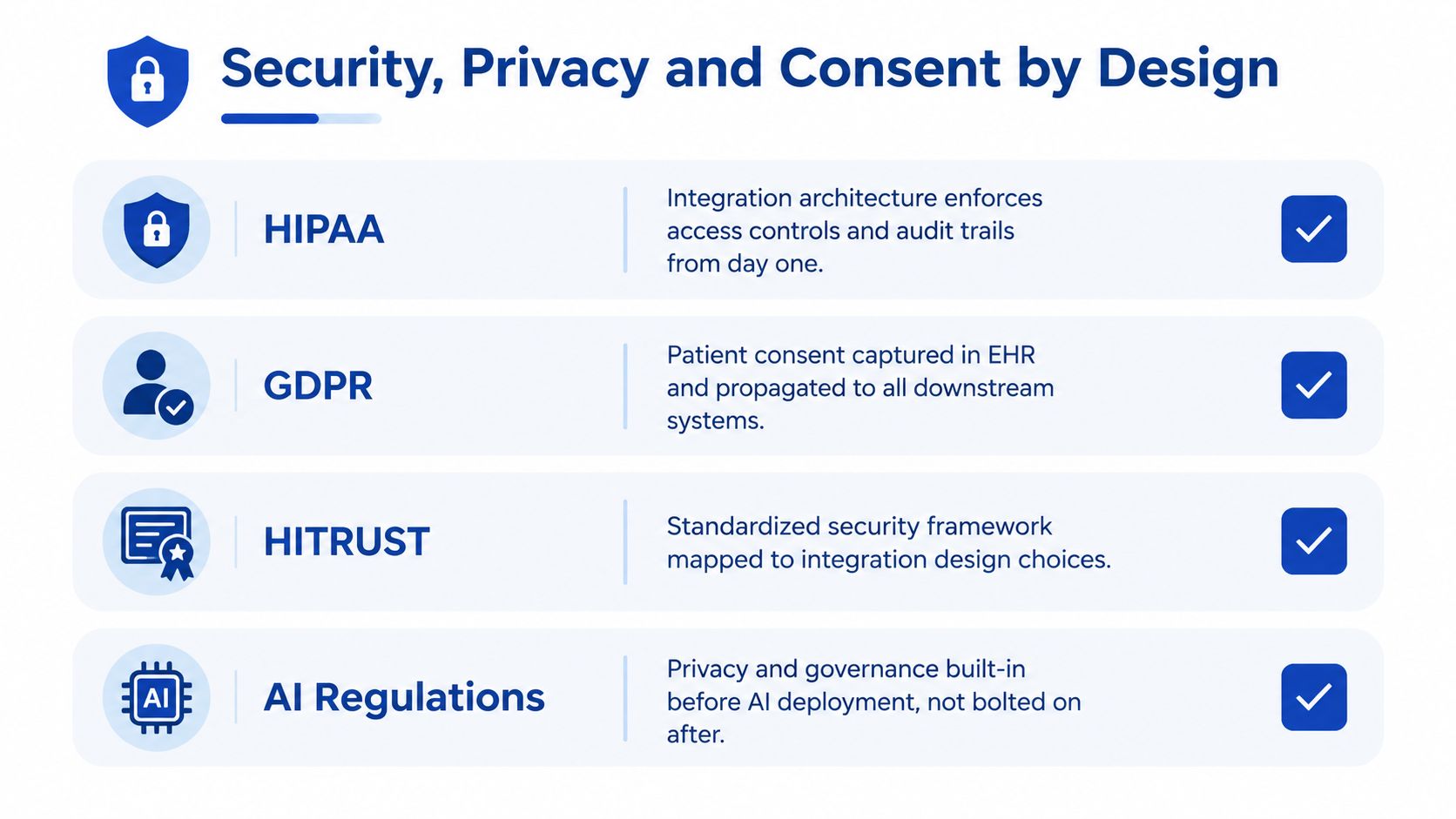
Privacy can't be patched on after the integration layer is live. Once data starts moving between systems, every endpoint becomes part of the security perimeter, and every workflow that touches the data must be able to prove who accessed what, when, and why. That's why HIPAA, GDPR, HITRUST, and emerging AI regulations need to shape architecture choices from the start.
Consent has to travel with the data
If a patient opts out of a certain use, that decision has to follow the record downstream. It isn't enough for the EHR to store the consent flag if the AI tool, analytics layer, or partner platform never receives it. In practical terms, consent management is part of healthcare data integration, not a separate policy file in another folder.
Role-based access, audit logging, tokenisation, and de-identification all belong in the blueprint. They're not extras for later. A well-designed pipeline encrypts data in transit, authenticates every caller, logs every access, honours consent flags, and redacts identifiers before training or analytics use.
A short internal checklist helps teams stay honest:
Encrypt every transfer: Protect data while it moves between systems, not just when it rests in storage.
Authenticate every caller: Make sure each system, user, or service account proves identity before data exchange.
Log every access: Keep an auditable record that shows who touched the data and when.
Respect consent flags: Carry opt-outs and usage restrictions through the workflow.
Remove identifiers early: De-identify or tokenise before data reaches model training or wider analytics where appropriate.
The point is simple. Security and consent are not barriers to AI adoption; they're the controls that make adoption defensible to patients, regulators, and internal risk teams. When trust is built into the pipeline, the organisation can move faster without reopening every compliance argument for each new use case.
Real-World Examples of Integration Powering AI in Care
A regional hospital network doesn't need a perfect architecture to get a useful AI result. It needs the right data in the right format at the right moment. One network connected HL7 v2 feeds from three EHRs into a FHIR API layer, then launched an AI triage tool in the emergency department. The team reported that door-to-clinician time fell by more than twenty per cent after the workflow was stabilised, because the model could finally see the relevant context when patients arrived.
An outpatient group took a different route. It piped visit transcripts through a secure integration broker into a large language model that drafted ambient clinical notes. The win wasn't just speed; it was cleaner documentation and less after-hours charting for clinicians. Teams looking at similar workflow automation can also review Beam's AI document processing use cases, which help illustrate how structured intake and document handling can support clinical and administrative work.
A public health authority used a data lake built from integrated claims, lab data, and social determinants to run a predictive model for readmission risk. Community nurses used the output to intervene earlier with patients who were likely to come back to hospital. In that setting, the integration decision mattered more than the model brand, because the predictive value depended on being able to combine different classes of data into one governed dataset.
The pattern across all three examples is the same. AI didn't create the value on its own. Integration made the use case possible, and then the workflow made it useful.
A Practical Roadmap for Healthcare Data Integration
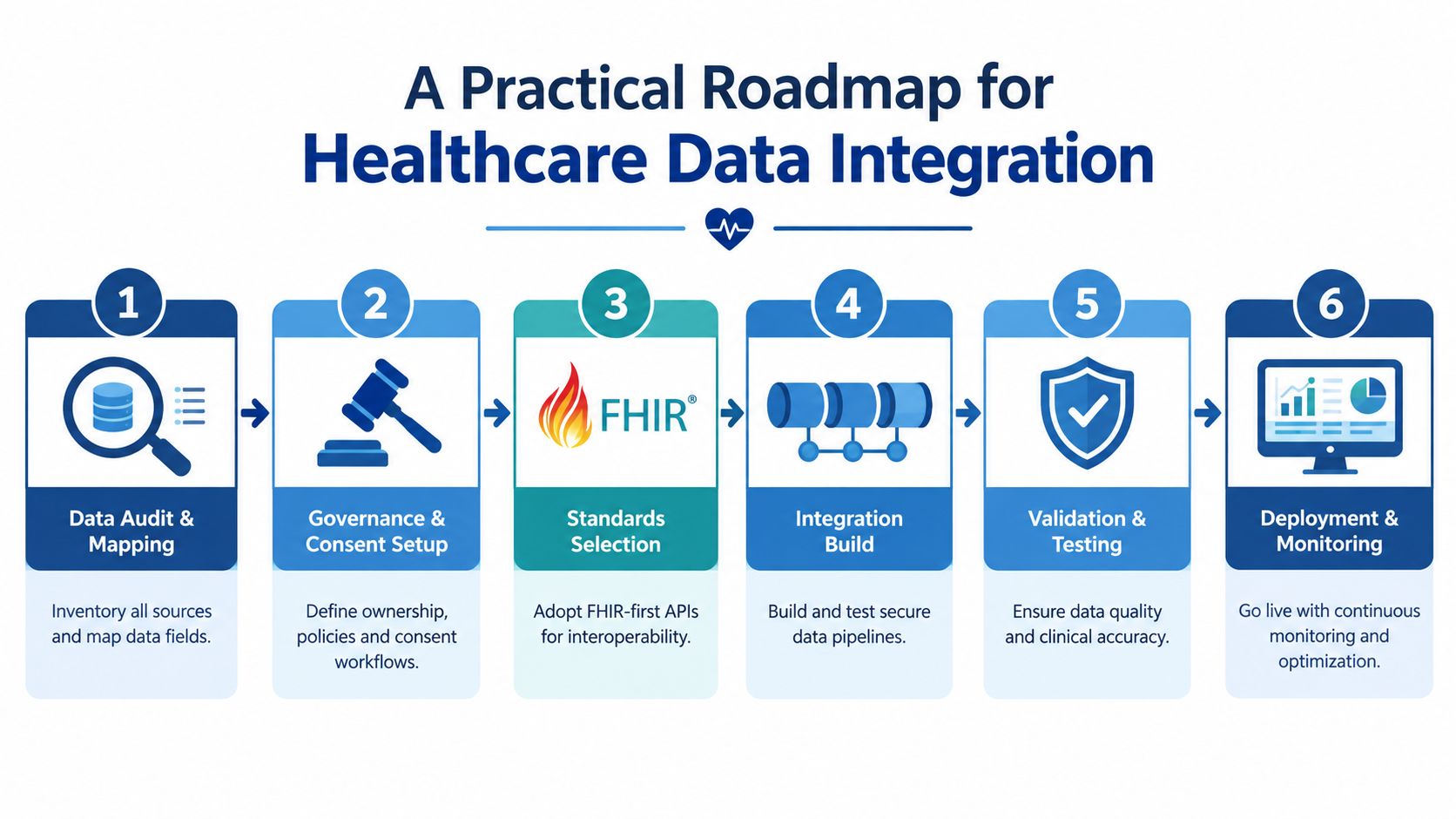
The fastest way to waste time is to start with a vendor demo before you know what data you own, who controls it, and how it moves today. A disciplined rollout usually starts with the basics and builds outward.
Six phases that keep the project grounded
Data audit and mapping: The deliverable is a source inventory and a field map. The owners are IT, informatics, and operational leads. Readiness shows up when everyone agrees where each patient data element lives.
Governance and consent setup: The deliverable is a policy set with access rules, consent handling, and escalation paths. Compliance, legal, and clinical governance teams should own it. The milestone is a workflow that treats consent as a living rule set, not a one-time checkbox.
Standards selection: The deliverable is a standards decision, ideally FHIR-first where possible. Architecture and integration leads should drive it. You're ready to move on when vendors can show how their data maps to the chosen profile and terminology set.
Pilot interface build: The deliverable is a working connection between two or three priority systems. Integration engineers and vendor teams usually own it. The key milestone is a tested path that preserves meaning, not just transport.
Validation and testing: The deliverable is a signed-off test plan covering data quality, clinical accuracy, and workflow fit. Clinical champions should be heavily involved. If users can't trust the output in a live shift, the build isn't ready.
Deployment and monitoring: The deliverable is a live pipeline with alerts, logging, and review cadence. Operations and platform owners keep it healthy. Success means the connection stays reliable after real users start depending on it.
Three common stalls deserve attention. Teams underestimate workflow validation, treat consent as static, and skip data quality scoring before exposing feeds to models. Procurement can also trip the project if the organisation buys a point-to-point tool that makes later platform consolidation harder than it should be.
Measuring ROI and Success Beyond the Hype
Boards don't fund integration because it sounds modern. They fund it when it supports safer care, better throughput, and cleaner finances. The challenge is separating the value of the integration layer from the value of the AI application sitting on top of it.
Measure the infrastructure, not just the app
The most credible ROI questions are operational. Did clinicians save time because notes, results, or alerts arrived in the workflow instead of another inbox? Did duplicate imaging or lab ordering fall because teams could finally see existing records? Did the organisation catch adverse drug issues earlier because medication history was available where decisions were made?
Finance leaders will also look at coding quality and denials, because cleaner data movement can reduce downstream rework. Those are board-level outcomes. Vanity metrics like “number of APIs connected” don't help anyone decide whether the programme deserves more investment.
| KPI Category | Example Metric | Baseline to Target | Owner |
|---|---|---|---|
| Data freshness | Time from source update to availability | Measured before go-live to steady-state target | Integration team |
| Data completeness | Required fields present for a given workflow | Baseline current gaps to acceptable coverage | Informatics |
| Consent compliance | Availability aligned with patient permissions | Current manual checks to automated enforcement | Compliance |
| Clinical throughput | Time from arrival to usable decision support | Baseline flow to post-integration performance | Clinical ops |
| Financial integrity | Denials or rework linked to missing data | Baseline error rate to reduced exceptions | Revenue cycle |
A quarterly review with clinical, IT, and finance leaders keeps the project honest. If the integration layer is working, the team should see fewer workarounds, faster use-case deployment, and less friction when the next AI pilot appears. That's the test, because a durable data foundation should make each new initiative easier than the last one.
Direct answers for vendor conversations
How long does a typical integration project take?
It depends on the number of systems, the amount of workflow validation, and the governance work that surrounds the build. A small point-to-point connection can move faster, while a multi-site architecture with consent and audit controls takes longer because it has more stakeholders and more testing.
What lock-in risks should buyers watch for?
Watch for proprietary connectors, hidden data models, and platforms that only work cleanly inside one vendor's ecosystem. If a supplier won't explain how data can be exported, remapped, or moved to a different stack later, that's a warning sign.
Where should AI governance live?
It should live in the integration layer as well as the model layer. Access control, audit trails, consent rules, and data lineage need to be visible before data ever reaches the application that scores, summarises, or recommends.
What happens to legacy HL7 v2 traffic during a move to FHIR APIs?
It doesn't disappear overnight. Most organisations keep existing feeds running while they translate priority workflows into the newer API layer, then gradually reduce reliance on older paths where that makes sense.
How can smaller clinics phase the work?
Start with one high-value workflow, one source inventory, and one governance decision. Smaller teams don't need to bet the budget on a full enterprise platform before they prove the first use case.
What should vendors show before procurement?
Ask for a FHIR conformance statement, a view of their security controls, and a concrete explanation of how their integration pattern supports your current systems without blocking future consolidation.
The main message holds across every question. Healthcare data integration is not a one-off deliverable. It's a capability that compounds over time, and it determines whether AI in healthcare becomes clinical infrastructure or remains a collection of impressive pilots.
If your organisation is trying to connect EHRs, labs, patient portals, and AI tools without creating new silos, Cleffex Digital Ltd can help design and build the integration layer around your actual workflows. Visit Cleffex Digital Ltd to explore healthcare software integration services that support standards-based exchange, secure interfaces, and AI-ready data pipelines.