

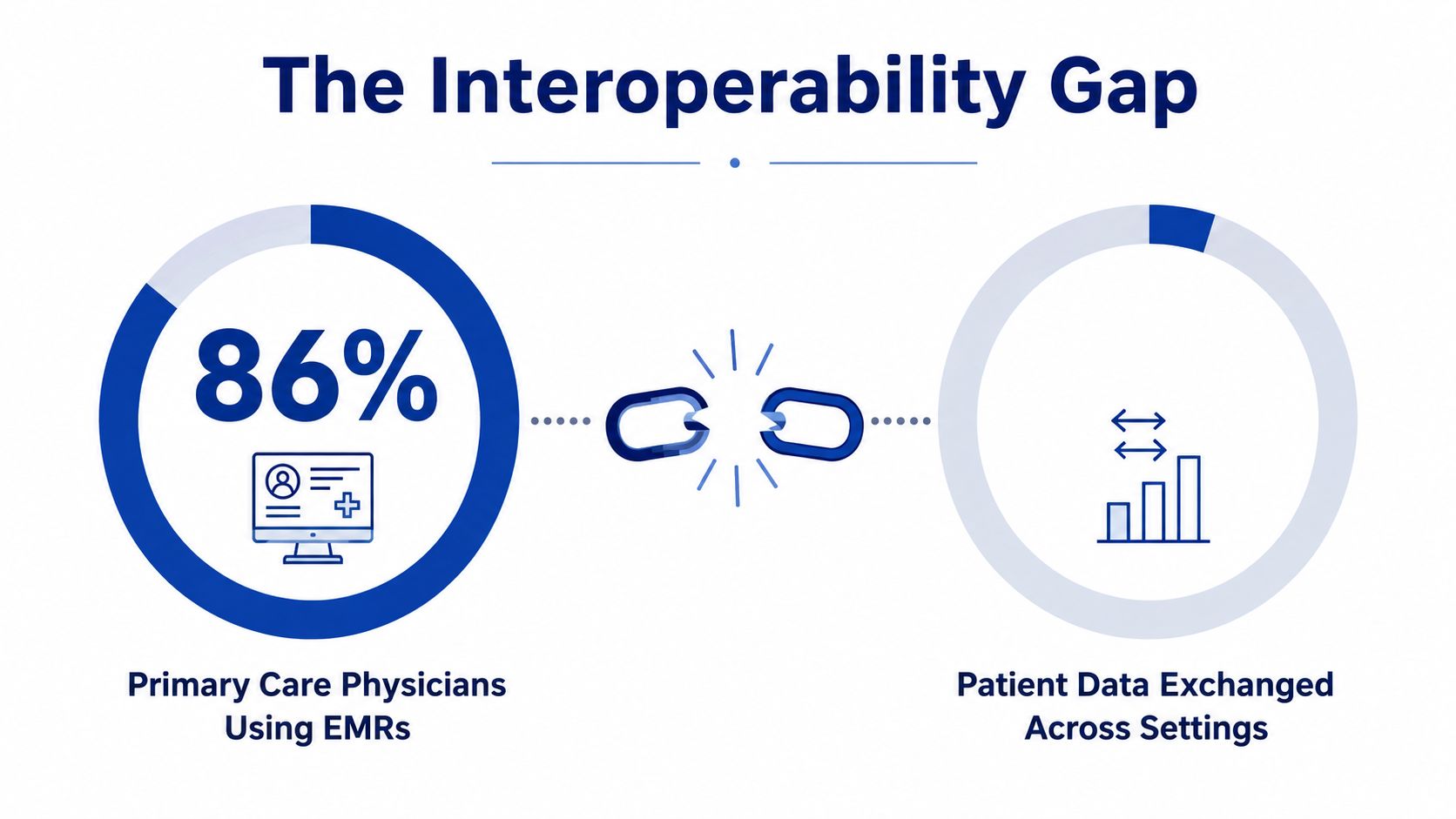
Only 13% of Canadian adults had online access to all core components of their health records in 2025, even though 69% could access at least one type of health information electronically and 32% used digital tools to manage their health CIHI. That gap is the key business case for healthcare platform modernization. The issue is not whether organisations have bought software; it’s whether the data moves when a patient moves.
In Canadian delivery work, the pattern is consistent. Teams spend years replacing systems, but the clinical benefit appears only when records, identity, consent, and workflow line up across settings. Modernisation succeeds when leaders stop treating it as a technology refresh and start treating it as a measurable interoperability programme.
Why Most Healthcare Modernization Programmes Stall
The biggest mistake is assuming digital access means connected care. In Canada, 92% of healthcare providers reported access to a digital health system in 2024, but only 52% used one to send or share patient clinical information outside their main practice setting, and 78% reported at least one barrier to sharing across settings. That gap is the modernisation problem. The software exists, yet the workflow still breaks when a patient moves between settings.
Workflow continuity is the binding constraint
Legacy replacement gets too much attention because it is visible. Leaders can point to an old EHR and say it must go. In practice, the binding constraint is usually the handoff between systems, including referrals, discharge summaries, lab results, and medication updates.
Cloud migration alone rarely fixes that. It can improve hosting, but it does not repair broken data liquidity or build trust in the exchange path. A programme that modernises storage without redesigning how data travels still leaves staff re-keying information, exporting PDFs, or phoning another site for confirmation.
Integration debt is the silent budget killer
Point-to-point interfaces accumulate over time. HL7 v2 feeds keep the lights on, but each custom connection adds maintenance risk, testing effort, and change control overhead. The cost is technical, and it also shows up in slower releases and more fragile clinical workflows.
The better question is not, “What should we replace?” It is, “What exchange path do we need to make reliable first?” For a broader view of healthtech service integration, see Ekipa AI healthtech services. For platform framing, Integrated Healthcare Platforms is useful, and the roadmap should align with the Shared Pan-Canadian Interoperability Roadmap, not just a vendor feature list.
Practical rule: if clinicians still copy data between systems, the programme has not modernised the platform; it has only modernised the display layer.
The business case is strongest when leadership treats healthcare software modernisation as a clinical-operations change. That means measuring exchange success, not installation progress. It also means involving clinical governance early enough to decide which workflows must not break.
Assessing Your Legacy Healthcare Platform
Start with a full system inventory, not an architecture debate. List every application in the clinical, administrative, and billing stack, then assign an owner, contract end date, hosting model, and data residency location. If no one can say who maintains a component, that component is already a risk.
Next, map how data moves. Count HL7 v2 feeds, custom interfaces, reporting warehouses, CSV exports, fax steps, and any re-entry between systems. Teams often discover they do not have one platform, but a patchwork of hidden dependencies.
Build a risk heat map before you choose your target state
The most useful deliverable is a one-page heat diagram. Rank each system by clinical impact, integration debt, and compliance exposure, then use that ranking to decide what gets modernised first. A lab interface that feeds several clinics deserves more attention than a low-use departmental tool, even if the departmental tool looks older.
Operational insight: a clean inventory shortens every later decision, from vendor selection to cutover sequencing.
Add the compliance baseline early. For a Canadian programme, that means checking access review cadence, logging maturity, breach history, and how well the current stack fits HIPAA, PIPEDA, and PHIPA. If the platform cannot show who touched what, when, and why, modernisation has to include auditability, not just new features.
A common clinic-to-hospital pattern makes the gap obvious. A 40-physician group may hold structured data in its EMR, while the regional hospital can only read PDFs from the portal. The identity model may not federate with hospital SSO, and clinicians may ignore uploaded documents because they are hard to trust and harder to use. That is a digital access problem, but it is also a cross-setting exchange problem, and it is where measurable interoperability outcomes matter.
For a practical baseline exercise, the Healthcare Technology Upgrade Playbook is a useful internal reference point when teams need a structured assessment sequence.
| Legacy Healthcare Platform Assessment Matrix | ||||
|---|---|---|---|---|
| System Component | Clinical Impact (1-5) | Integration Debt (1-5) | Compliance Risk (1-5) | Modernisation Priority |
| EMR and charting | High | High | High | Immediate |
| Lab integration layer | High | High | Medium | Immediate |
| Patient portal | Medium | Medium | Medium | Near term |
| Billing and claims | Medium | High | Medium | Near term |
| Reporting warehouse | Low to High, depending on use | High | Medium | Case by case |
Designing the Target Architecture for Healthcare Platforms
A good target architecture is boring in the right way. It uses the simplest structure that can still deliver the interoperability outcome you've committed to. In healthcare, that usually means a hybrid model, not because hybrid sounds fashionable, but because not every workload belongs in the same place.
Cloud-native and hybrid both have a place
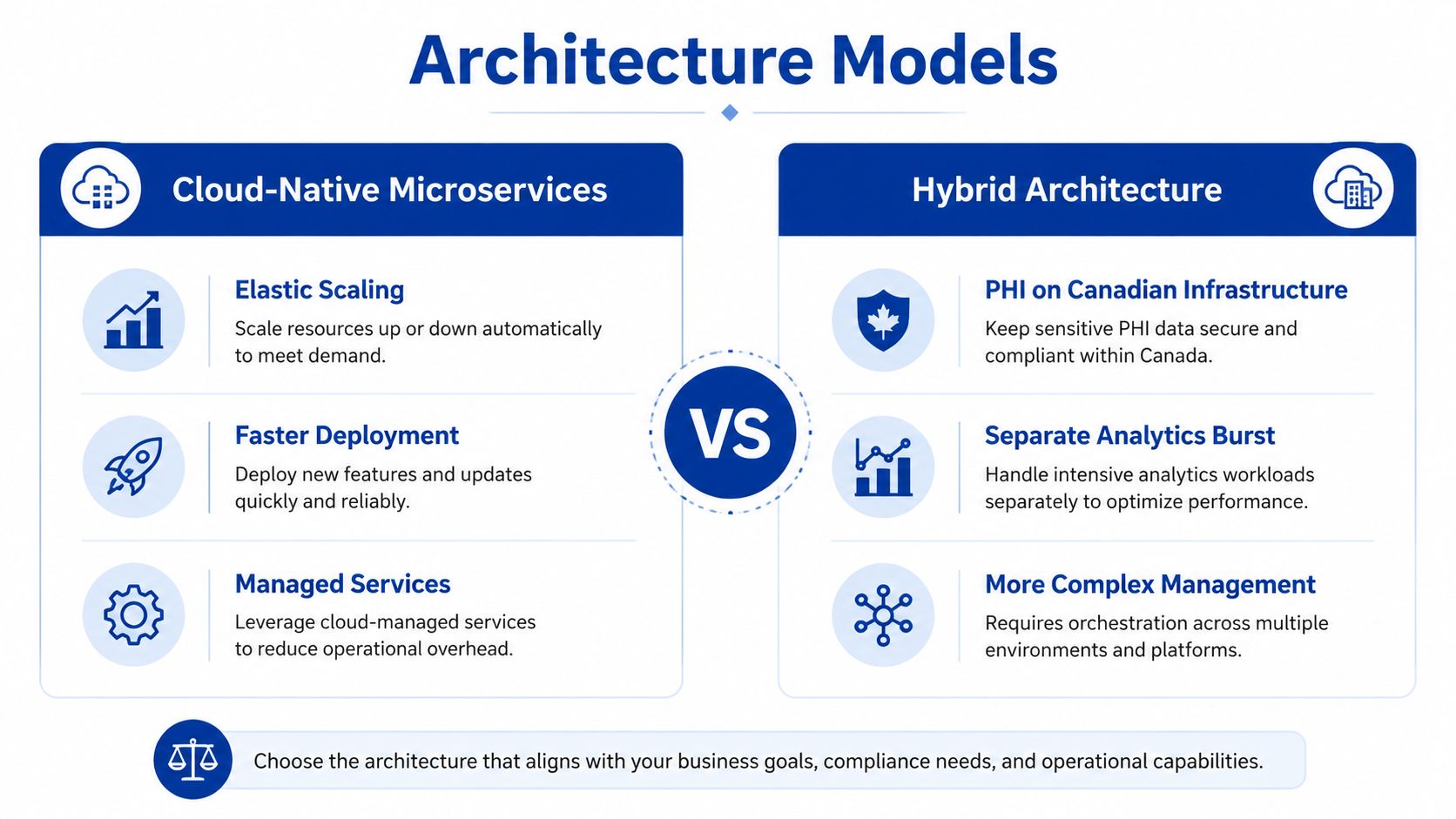
Cloud-native microservices help when you need elastic scaling, faster feature delivery, and managed observability. They work well for patient-facing portals, scheduling, and services that change often. The trade-off is that cloud introduces egress costs, cross-border data concerns, and shared-responsibility ambiguity, so the operating model has to be explicit.
Hybrid architecture keeps PHI on Canadian-hosted infrastructure where that matters, while allowing analytics workloads to burst elsewhere if policy permits. It also preserves investments in imaging, lab systems, and PACS that are stable but expensive to replace. The drawback is management complexity, especially when teams have to coordinate identity, logging, and disaster recovery across environments.
Use the right exchange layer for each job
Not every interface should be rewritten. HL7 v2 still makes sense for high-throughput ADT and lab feeds where replacing proven interfaces would create more risk than value. FHIR R4 belongs at the public API edge for clinical apps, patient access, and partner integrations. Internal service-to-service traffic often works best with gRPC or message queues, because they keep dependencies tighter and contracts clearer.
The important decision rule is simple. Don't choose architecture by trend; choose it by the exchange path that needs to work reliably. If your biggest pain is poor external sharing, then FHIR and API governance matter more than another round of infrastructure abstraction.
A careful architecture review also keeps vendor conversations honest. Teams often talk about cloud or on-prem as if one is always superior, but the core question is where the clinical data must live, who needs to access it, and how fast the system has to respond. In Canada, that is a governance question as much as a technical one.
Data Migration and Interoperability With FHIR and HL7
A migration plan fails fast if the source data is messy. Start with the feeds, charts, and side systems that already carry clinical work, including legacy HL7 v2 interfaces, DICOM stores, shadow spreadsheets, and any unofficial databases teams depend on day to day. Build a data dictionary, capture consent flags, and clear out duplicate or conflicting fields before you move records.
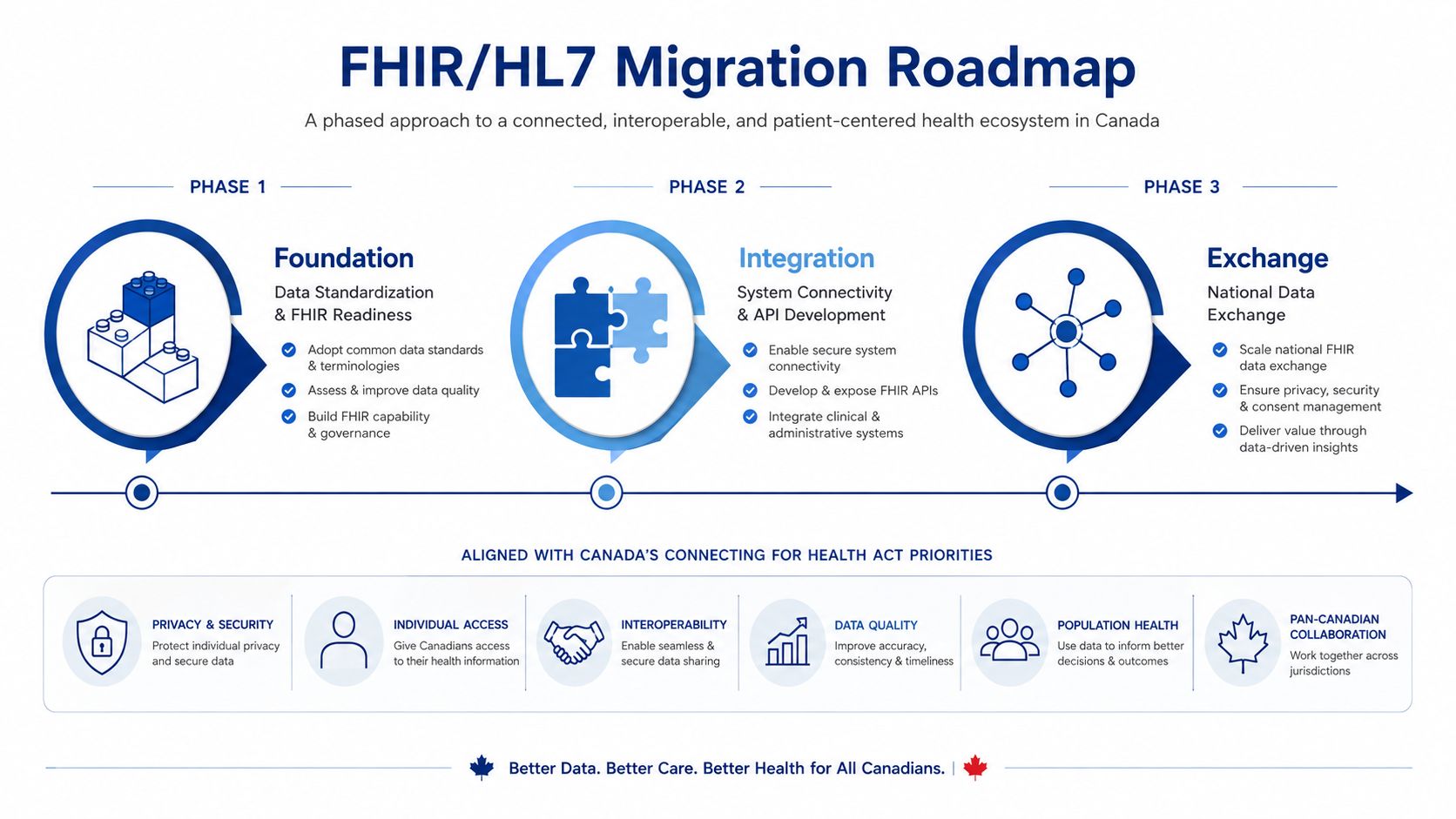
Phase one is standardisation
The first pass is about making the data readable and consistent. If one site records the same concept three ways, every later integration step just spreads the inconsistency further. Teams that support FHIR integration with EHR systems usually treat mapping and governance as the core work, not the code.
Phase two is the FHIR facade
Stand up a FHIR R4 facade or repository, then map each source field to canonical FHIR resources. Validate those mappings against a public test server with $validate operations, and keep traceability back to the source record. That gives you a controlled bridge while legacy systems keep running.
Phase three is actual exchange
Once the model holds up, enable patient-mediated access, provider directories, and consent registries. That part matters because interoperability only counts when the right clinician or patient can get the right data in the right context.
The gap in Canadian programmes is often not access; it is exchange. The FPT Action Plan on Health Data and Digital Health pushed governments toward comparable depersonalised data, better public health information, and common interoperability standards. CIHI's Connected Care framework takes the same direction with standardised health data elements and value sets so jurisdictions and vendors can record information in the same way.
Validation should happen at every gate. Schema conformance, referential integrity, and identity match quality all matter, but so does clinician acceptance on real journeys from community clinic to hospital discharge. If the handoff still feels clumsy, the migration is not done.
A useful repository pattern is to make the authoritative path obvious. The Pi firm CMS data repository is a good reminder that governed repositories work better when they are built around traceability, not convenience.
For teams planning the transition, the same logic applies to the interface layer. A practical guide to FHIR and EHR integration planning helps keep the mapping work tied to real clinical flows instead of abstract standards.
Security and Compliance Across HIPAA and PIPEDA
The strongest compliance programmes do not build separate control sets for each law. They use one control map and show how it satisfies overlapping obligations under HIPAA, PIPEDA, and provincial rules such as PHIPA. That keeps audits easier to run and lowers the risk that a new workflow falls between teams.
The overlap is wider than commonly assumed
HIPAA's Security Rule sets safeguards for electronic protected health information. PIPEDA focuses on fair information principles, while PHIPA adds custodian and circle-of-care expectations that matter in Ontario. Those differences matter, but they do not call for separate control universes.
One control map should cover governance, access, encryption, logging, vendor risk, breach response, subject rights, and audit. A solid contingency plan, for instance, supports HIPAA's availability expectations, PIPEDA's safeguarding principle, and the operational need to keep patient services running. Divergence usually appears in consent handling, notification timing, and where data is hosted.
Make cloud decisions with residency in mind
US-hosted cloud can work for some workloads, but it needs a clear privacy and residency review. If the architecture relies on cross-border processing, legal, procurement, and security teams need to agree on the model before production. That conversation belongs early, not during go-live week.
| HIPAA, PIPEDA, and PHIPA Control Overlap | HIPAA | PIPEDA | PHIPA |
|---|---|---|---|
| Governance | Required | Required | Required |
| Access controls | Required | Required | Required |
| Encryption | Required safeguard | Safeguarding principle | Strongly aligned |
| Logging and audit | Required | Strongly supportive | Strongly aligned |
| Vendor management | Required | Required | Required |
| Breach response | Required | Required | Required |
| Subject rights | Limited and defined | Required | Required |
| Availability and continuity | Required | Strongly aligned | Strongly aligned |
A vendor can pass a security questionnaire and still fail a healthcare implementation if its operating model does not fit the care context. The compliance discussion has to cover who can access what during care, how exceptions are logged, and how incidents are escalated when one province or organisation depends on another. That is where digital access often diverges from real cross-setting data exchange, and why FHIR, cloud design, and privacy controls need to be planned together rather than reviewed as separate workstreams.
CI CD and Testing for Regulated Healthcare Software
Healthcare delivery teams can't afford release chaos. A bad deployment may not just create downtime; it can interrupt medication workflows, hide a critical result, or block a discharge task. That's why CI/CD in regulated healthcare has to be designed around control, not just speed.
Build the release train around care risk
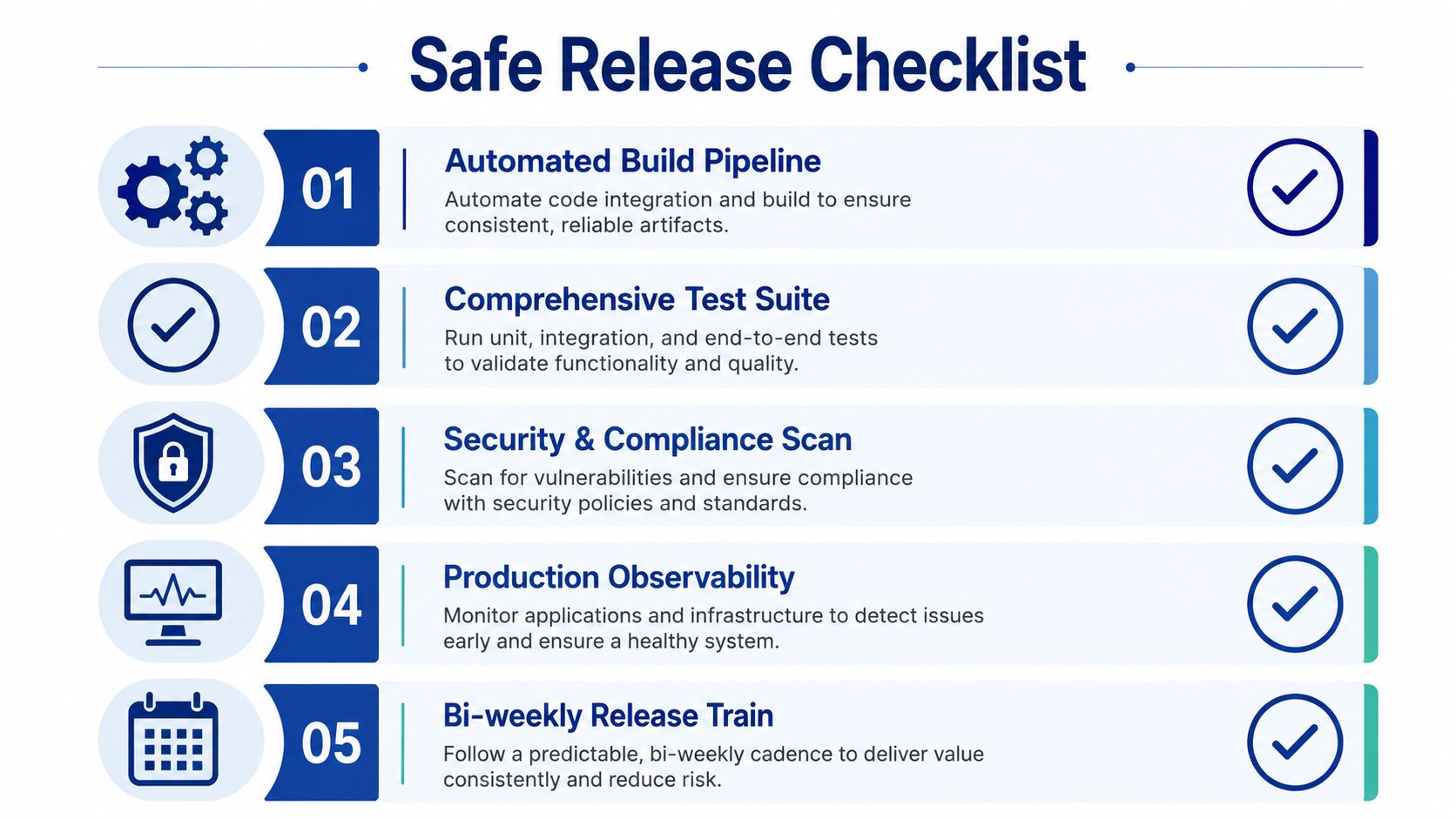
A fixed release train, every two weeks, gives operations and clinical governance a predictable cadence. Feature flags should gate any workflow that touches patient care, and a change-control board should review production promotion before anything goes live. That doesn't slow delivery as much as people fear, because it removes surprise.
The test pyramid has to match the risk profile. Unit tests cover clinical logic, contract tests cover every FHIR and HL7 interface, integration tests run against a disposable sandbox seeded with de-identified data, and chaos drills prove failover paths. If one layer is missing, the team is only testing the easy part.
What works in practice: release governance is easier when every test maps to a patient journey, not a code module.
Observability matters just as much as testing. Structured audit logs, synthetic patient-journey probes, and release-to-incident dashboards tied to service-level objectives catch the issues that automated tests miss. Teams need to know not only that a build passed, but that the discharge flow still works under load.
Vendor selection should be outcome-led
Stop buying feature checklists. Tie every evaluation to the Shared Pan-Canadian Interoperability Roadmap and measurable clinical outcomes. Score vendors on FHIR R4 conformance depth, live cross-jurisdiction exchange references, proven PIPEDA plus provincial health information act controls, and their willingness to contract on interoperability KPIs rather than seat counts.
The best procurement conversations include sandbox access before signature. Your team should be able to run real Patient, Observation, and Encounter queries against vendor endpoints, then see how the system handles errors, latency, and partial data. If a vendor can't support that, it's not ready for regulated healthcare delivery.
A short market note is useful here. Cleffex Digital Ltd is one option among firms that can support phased healthcare software modernization; including integration, workflow-safe releases, and controlled data exchange. The right choice is still the one that fits your governance, not the one with the loudest pitch.
Measuring Modernisation Outcomes That Matter
Boards don't fund modernisation because the diagrams look neat. They fund it when the numbers show better care delivery, lower risk, and cost that can be defended in a review. That means the dashboard has to go beyond uptime and sprint velocity.
Track the right outcomes
Start with interoperability rate. Measure the share of patient encounters where structured data moves across settings through FHIR within the target latency. Portal logins do not count. If the patient can view the chart but the receiving clinician still cannot use the data, the case for change is still weak.
Then measure clinician time saved per shift from automated chart retrieval and reconciled medication lists. Track mean time to detect for security incidents, and patch cycles against documented SLAs. Also quantify avoided cost from retiring legacy interfaces and duplicate charting, because those savings help justify the next wave of work.
Governance rule: every metric needs a named owner, a baseline before cutover, and a quarterly review.
Compress the roadmap into 90 days
Days 1 to 30 should focus on inventory, integration mapping, and compliance baseline capture. Days 31 to 60 should lock the target architecture, run vendor sandboxes against FHIR R4 test data, and choose the first use case, usually cross-setting medication reconciliation. Days 61 to 90 should bring in CI/CD, automated compliance scans, one migration wave, and live outcome instrumentation.
Cloud and on-prem choices belong in the same review. In Canadian programmes, residency, latency, and operational control often push teams toward hybrid models, while cloud helps when the workflow can tolerate it and the governance is clear. HIPAA and PIPEDA controls also need to sit inside the same measurement plan, not in a separate compliance folder.
Metrics for patient-facing work should be treated with the same seriousness as technical ones. The discussion of metrics for UX outcomes is useful here because platform work fails fast when clinicians cannot move through the workflow cleanly. In healthcare, experience is operational.
Frequently Asked Questions
How does AI fit into healthcare platform modernisation?
AI fits best after the data model is clean enough to support reliable exchange. It can help surface patterns, automate triage, or support documentation, but it doesn't replace integration, consent, or interoperability governance.
Should a mid-sized Canadian provider choose cloud or hybrid?
Start with the care workflow and data residency requirements, then choose the lightest architecture that satisfies them. Many organisations end up hybrid because imaging, lab, and legacy EHR functions are easier to keep stable while portals and analytics move sooner.
How do HIPAA and PIPEDA overlap in practice?
They overlap most on governance, safeguards, logging, breach response, and vendor management. A single control map can satisfy both if the team handles consent, hosting location, and notification rules with care.
What usually blocks FHIR adoption?
The usual blockers are poor source data quality, inconsistent identifiers, and teams trying to expose FHIR before the underlying workflows are understood. FHIR is a transport and resource model, not a substitute for data discipline.
What's the safest first use case?
Medication reconciliation across settings is often a strong starting point because it has clear value, obvious handoffs, and visible patient-safety impact. It also forces the programme to solve identity, consent, and structured exchange early.
If you're planning healthcare platform modernisation and need a delivery partner that understands integration, regulated release management, and interoperability in Canadian care settings, talk to Cleffex Digital Ltd. They work on secure software delivery, platform integration, and healthcare workflows that have to stay live while change is happening.