

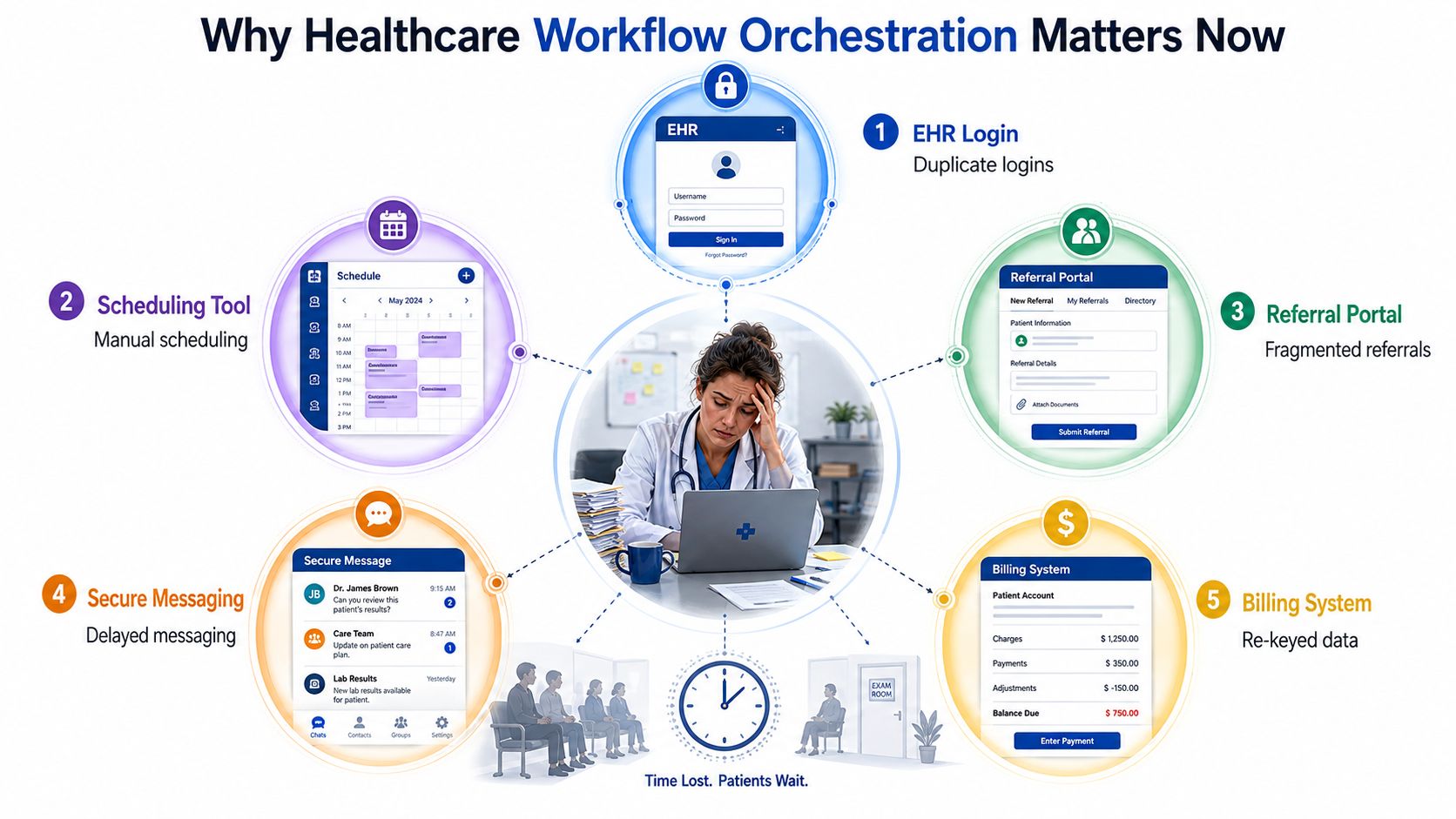
A clinician starts Monday by signing into the electronic health record, then opening a scheduling tool, a referral portal, a secure messaging app, and a billing system. A patient is waiting, a referral is missing an attachment, and nobody can see whether the authorisation request has moved forward. The clinician becomes the unofficial connection between systems, copying information, checking status, and chasing the next person.
Healthcare workflow orchestration addresses that coordination problem. It sits above EHRs, standards, and automation tools, directing information and tasks between them without requiring a clinic to replace every system already in use. The aim is simple: send the right information to the right person or application at the right moment, with a clear record of what happened.
Why Healthcare Workflow Orchestration Matters Now
Disconnected software creates more than inconvenience. Each handoff can introduce duplicate data entry, delayed communication, missed tasks, and compliance blind spots. A referral might be accepted in one portal but remain invisible in the clinic's work queue. A discharge notification might arrive after a follow-up appointment should already have been arranged. A billing team might re-key details that clinical staff entered earlier.
The coordination layer above existing systems
Think of an orchestration layer as a capable operations coordinator. It watches for events, checks the relevant rules, assigns work, passes information between applications, and records the outcome. The EHR remains the clinical system of record, while scheduling, referrals, pharmacy, finance, and messaging tools continue to perform their specialised jobs.
That distinction matters. Healthcare integration connects systems so they can exchange data. Healthcare workflow orchestration uses those connections to coordinate a complete process. An interface can deliver a lab result. An orchestration flow can receive that result, identify the responsible clinician, create a review task, send an appropriate notification, wait for the decision, and escalate an overdue action.
Why fragmented workflows create operational pressure
Clinicians and operations teams feel the impact in several places:
Handoffs: Staff spend time checking whether another team has received or acted on a request.
Context switching: Users move between applications instead of working from a prioritised queue.
Patient communication: Patients call for updates because internal status information is scattered.
Data quality: Re-keyed information creates opportunities for mismatched patient, provider, or appointment details.
Accountability: Leaders can't easily identify where a process stopped or who owns the next action.
California's progress illustrates why coordination has become a formal healthcare workflow milestone. The California Health and Human Services Agency's Data Sharing Framework required signatories to meet a state-mandated deadline of January 31, 2023. By that date, 19 hospitals, more than 200 physician practices and medical groups, 18 health plans and disability insurers, and 23 community-based organisations had signed on, according to the California data-sharing overview.
The broader California health information exchange programme also emphasises workflow integration. It requires providers to access CURES within the EHR and supports daily admission, discharge, and transfer feeds within 24 hours for hospitals following milestone-based implementation. The lesson for clinic managers is practical: interoperability creates value when it appears inside the work people already do, not only in a technical interface catalogue.
For a broader explanation of how connected platforms support coordinated care, see connected healthcare systems. Orchestration builds on that connected foundation by adding sequence, responsibility, decision logic, and visibility.
The Core Components of an Orchestration Platform
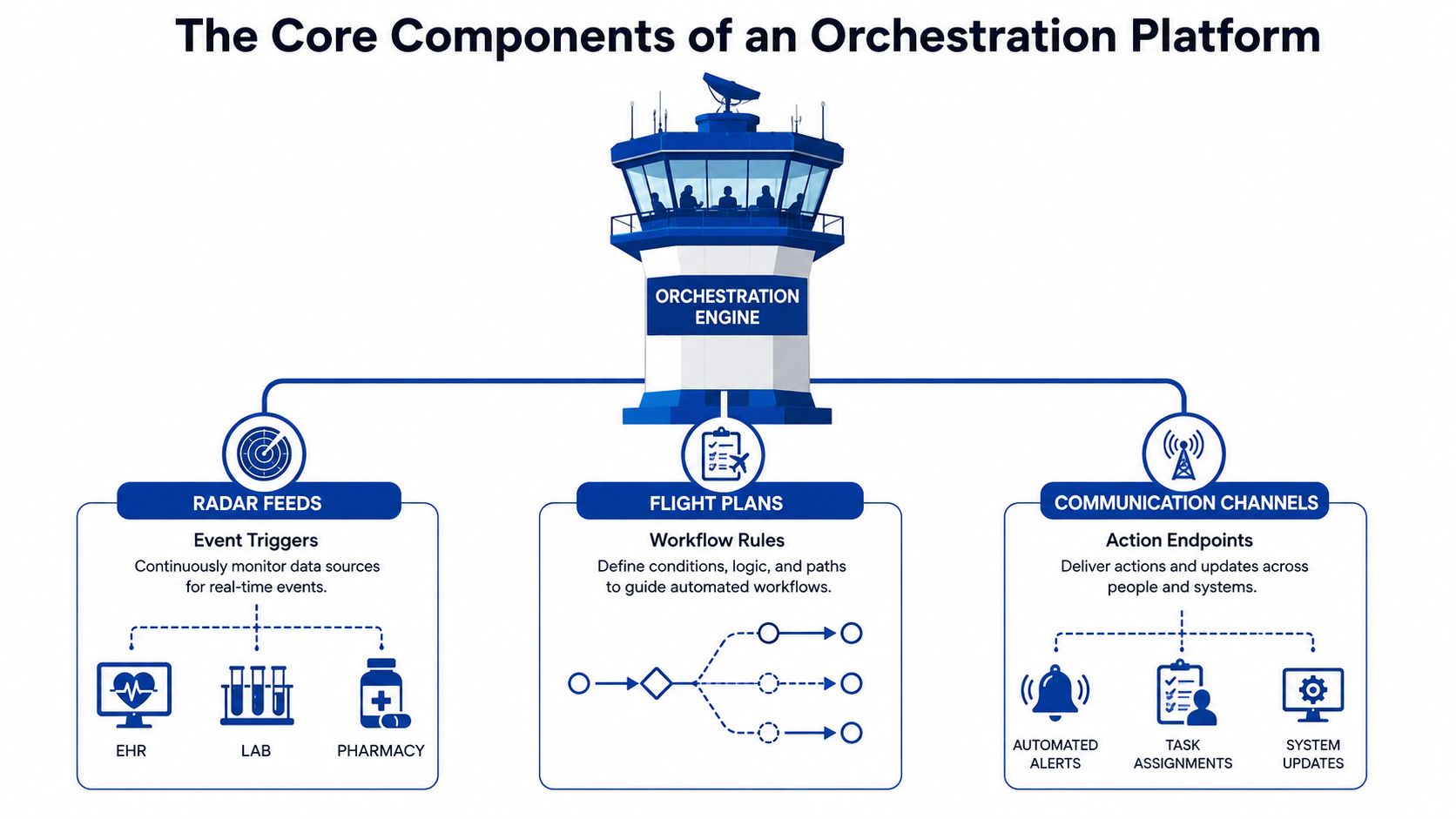
An air traffic control tower offers a useful analogy. Radar feeds tell controllers what's happening in the airspace. Flight plans define intended routes. Controllers apply rules and make decisions. Communication channels direct pilots and ground crews. A healthcare orchestration platform performs similar work across clinical and administrative systems.
Events provide the radar feed
An event is something the platform can detect. It might be a new referral, a lab result, a patient admission, a medication update, a missed appointment, or a change in authorisation status. Events can arrive through APIs, FHIR resources, HL7 messages, database notifications, secure files, or carefully controlled portal interfaces.
The event should contain enough context for the platform to identify the patient, the organisation, the relevant care team, and the process that applies. Reliable identity matching is critical. If the orchestration layer can't confidently match the event to the correct patient record, it should pause for review rather than automatically route the information.
Rules define the flight plan
Rules determine what should happen next. A rule might say that a new referral requires completeness checks before triage, or that an abnormal result needs review by a designated clinician. Rules can include conditions, deadlines, priority levels, escalation paths, and exceptions.
Good rules reflect operational policy, not hidden assumptions. The clinic should be able to explain why a task was sent to a particular queue and what happens if nobody completes it. That clarity supports safer configuration, easier testing, and more useful audits.
Middleware translates and coordinates
Different systems often use different formats, field names, identifiers, and terminology. Middleware connectors translate those differences and move the required data between applications. They may also handle authentication, consent checks, retries, acknowledgements, transformation, and error handling.
The process layer then coordinates people and applications across multiple steps. It can create a human task, wait for a clinician's response, call a scheduling service, update the EHR, and notify another team. Observability tools show the full journey, including successful actions, rejected messages, failed mappings, retries, and tasks waiting for human input.
Practical rule: An interface moves information. An orchestrator manages what the organisation does with that information.
An orchestration platform, therefore, isn't one isolated automation script. It's a control layer that combines event triggers, workflow rules, connectors, process state, human tasks, and operational monitoring.
How FHIR, HL7, and Shared Standards Fit In
Standards are the shared language that lets healthcare systems exchange information. HL7 v2 remains common in established hospital infrastructure, especially for event messages such as admissions, discharges, transfers, and laboratory updates. FHIR uses modular resources and web-friendly patterns, making it well suited to API-based exchange and application integration.
Neither standard is the orchestration layer. They help systems describe and transport information. Orchestration adds the operational logic around that exchange, including consent, routing, retries, prioritisation, human review, and escalation.
FHIR and HL7 in practical terms
Suppose a laboratory system sends a result. An HL7 v2 message might deliver the event through an established interface. A FHIR-based API might expose the result as a structured resource that another application can query or subscribe to. The orchestration engine still needs to determine who should review it, whether the result is complete, how urgent it is, and what follow-up process applies.
Canada's pan-Canadian Patient Summary Specification, known as PS-CA, provides a concrete example of standardised information for point-of-care sharing. Canada Health Infoway says PS-CA standardises the terminology and structure used by health information systems across Canada, drawing on frameworks including HL7, IHE, ISO, and the International Patient Summary. Consistent structure helps an orchestration flow interpret patient information without relying on manual re-entry or local guesswork, as described in the Canada Health Infoway digital health standards resource.
| Aspect | FHIR | HL7 v2 |
|---|---|---|
| Typical role | API-based exchange using modular, structured resources | Event messaging across established healthcare interfaces |
| Orchestration value | Supports query, retrieval, subscriptions, and reusable resource patterns | Delivers operational events from systems already using message interfaces |
| Implementation challenge | Requires agreement on profiles, terminology, and access rules | Requires careful interpretation of local message variations |
| Best use | Connecting modern applications and registries | Receiving real-time or batch events from existing hospital systems |
Semantic interoperability remains the difficult part. Two systems may exchange a field successfully but interpret its code, status, or meaning differently. Canada's national scan identified 152 clinical AI initiatives and found that semantic, workflow, organisational, and evaluative interoperability gaps remain major blockers, while workflow-embedded applications showed the strongest adoption. The national clinical AI scan supports a clear design principle: orchestration must align data meaning and operational rules, not just connect endpoints.
Teams planning a FHIR project can also consult this guide to FHIR integration services and compliance.
Orchestration vs Automation and Process Management
A thermostat automates one action. It detects a temperature condition and turns the heating on. Orchestration is closer to a building manager coordinating heating, lighting, security, room access, and maintenance in response to shared conditions.
That distinction helps clinic teams separate three related ideas:
Automation completes a repeatable task, often inside one application. Examples include sending a standard appointment reminder or creating a task when a lab result arrives.
Orchestration coordinates several tasks across people and systems. It carries context from the triggering event through the entire process.
Business process management, or BPM, models, analyses, governs, and improves end-to-end processes. Modern orchestration engines often include BPM capabilities, especially process modelling, task management, rules, and reporting.
Consider a clinically significant result. A single-system automation might send an alert. An orchestration flow can update the EHR, create a specialist referral task, notify the primary care provider, request an appointment, record the patient communication, and arrange follow-up imaging. Each step can have its own owner, deadline, exception path, and audit record.
| Dimension | Automation | Orchestration | BPM |
|---|---|---|---|
| Main purpose | Perform a repeatable action | Coordinate connected actions | Model and improve an end-to-end process |
| Typical scope | One task or application | Multiple systems, teams, and tasks | Organisation-wide or department-wide process |
| Trigger | A defined condition | A shared event and its context | A process design, policy, or operational objective |
| Human involvement | Often limited | Built into review and exception steps | Defined through roles, approvals, and governance |
| Best question | “Can this task run automatically?” | “What should happen across the journey?” | “How should this process work and improve?” |
A useful rule is to automate what's repetitive, orchestrate what's cross-system, and combine both when a patient journey spans departments. The healthcare operations automation guide provides a related perspective on where repeatable operational work can be structured.
Real World Examples of Workflow Orchestration
A medication workflow shows why orchestration is more than a data connection. In Ontario, a point-of-care application can use the Digital Health Drug Repository, an EHR, and pharmacy-related services as parts of a coordinated process. Ontario Health's implementation guide describes FHIR-based actors and interactions for creating, updating, and sharing drug and pharmacy information, using profiles such as Medication, MedicationDispense, MedicationRequest, MedicationAdministration, Patient, Practitioner, PractitionerRole, Location, Encounter, and Composition.
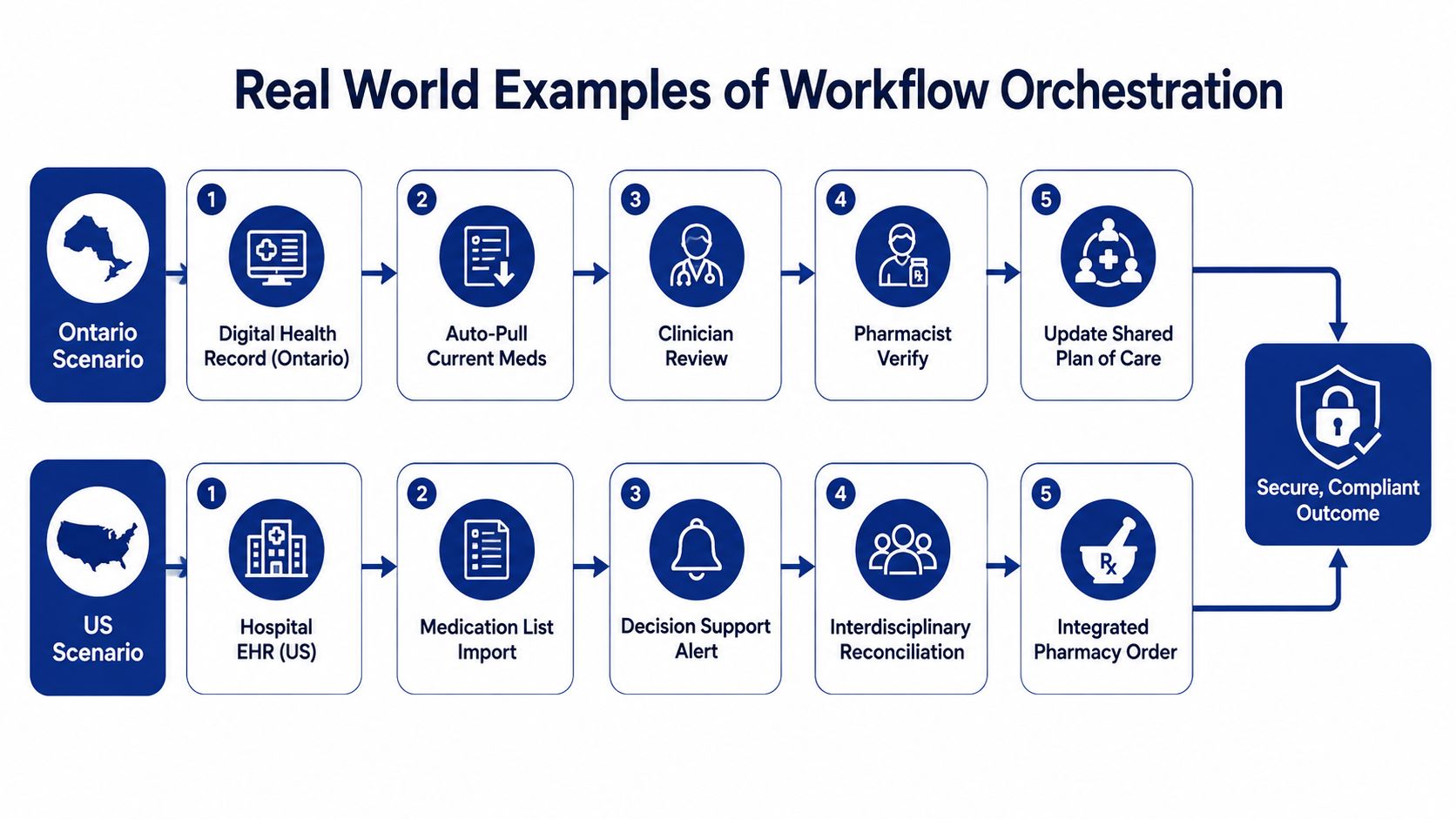
An Ontario medication pathway
A practical flow could work like this:
Identify the patient: The system uses an authoritative patient registry to resolve the correct record.
Retrieve medication information: The orchestration layer requests current medication and pharmacy information.
Compare records: It places the retrieved information beside the EHR medication list for clinician review.
Create an exception: A possible duplication, missing medication, or interaction becomes a review task rather than an invisible data conflict.
Update the record: After the prescriber confirms the changes, the relevant systems receive the authorised update.
Record the outcome: The platform stores the decision, time, responsible user, and any failed or pending action.
Ontario Health's Provincial Client Registry FHIR guide provides a related example of registry-backed workflow integration. A patient registry supports patient lookup, while a provider registry can support provider information exchange. Together, these registries help route work to the correct patient, practitioner, organisation, or location instead of relying on fragmented local lists.
A cross-network care coordination pathway
A US-style pathway can apply the same logic across a participant network. A primary care referral can trigger a query for relevant documents, retrieve the available information, place it into the specialist's EHR workflow, and send a status update back to the referring clinician. The value isn't the query alone. It's the closed loop, with clear ownership for review, appointment preparation, communication, and follow-up.
A rural multi-physician clinic could use a similar pattern with an AI scribe. The scribe produces a structured note, the EHR stores it, and an orchestration flow creates follow-up tasks, updates the patient portal, and sends the required billing information for reconciliation. The AI tool supports documentation. The orchestration layer ensures the resulting information enters the wider operational process rather than remaining in a parallel silo.
Security, Compliance, and the Business Case
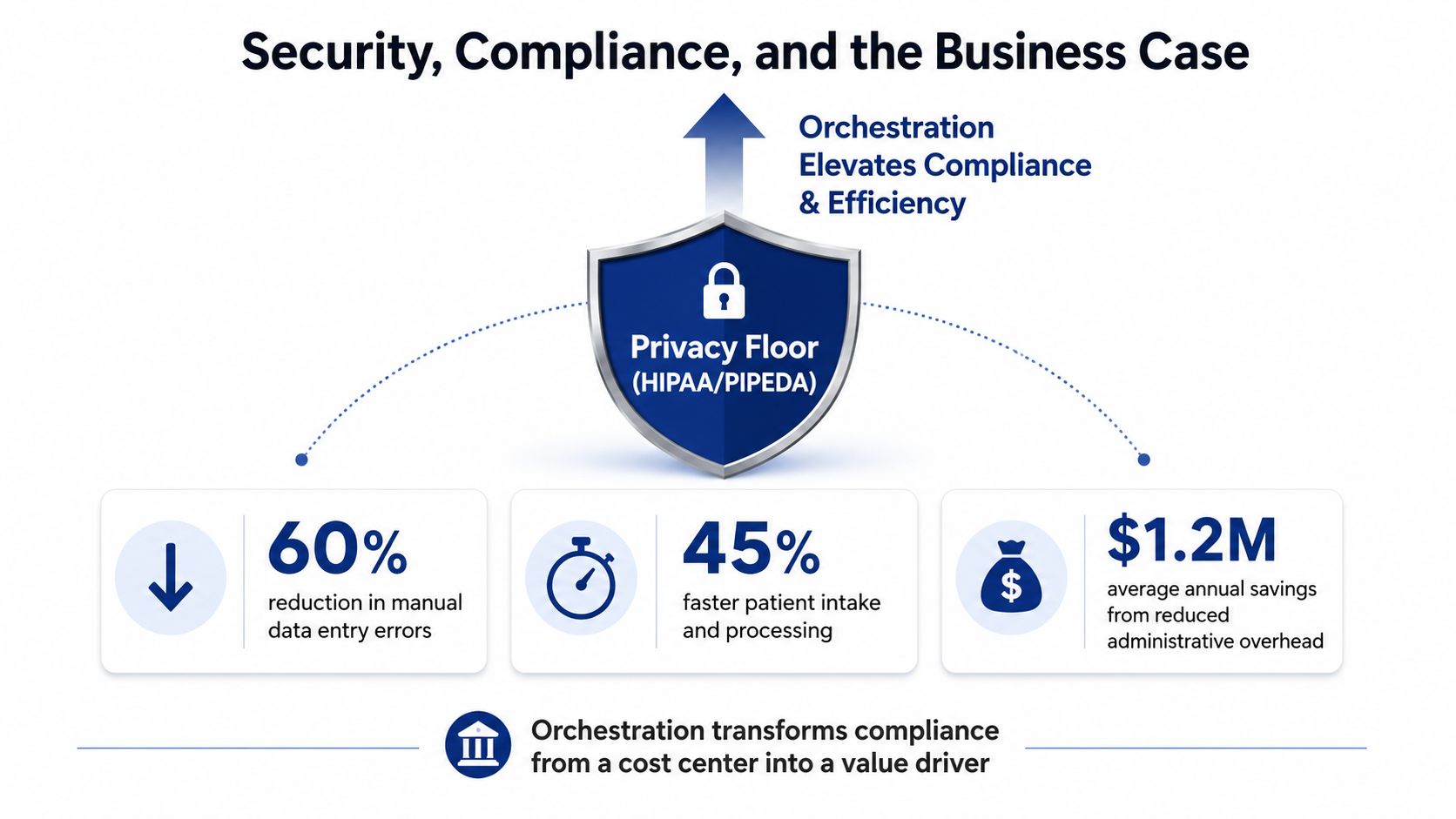
Security and value should be designed together. HIPAA and PIPEDA establish important privacy expectations, but a workflow that merely moves data between systems isn't automatically safe. The orchestration layer should apply consent, purpose of use, minimum-necessary access, role-based permissions, and auditable logging at every handoff.
Canadian provincial health information legislation may add requirements depending on the organisation, location, and data custodian. The platform should show which identity accessed information, what information moved, why the action was permitted, which rule initiated it, and whether a person approved an exception. Failed deliveries and rejected consent checks need the same operational attention as successful transactions.
Measure the friction the clinic already feels
A business case becomes credible when it starts with observable problems rather than abstract efficiency. Choose measures connected to current work:
Referral status calls and manual follow-up
Duplicate diagnostic requests
Time spent on after-hours charting
Missed or delayed follow-up appointments
Prior authorisation turnaround
Denied claims caused by incomplete or inconsistent information
Staff time spent reconciling queues across applications
California's Medicaid HIT plan shows how structured event routing can mature over time. In 2012, fewer than 10% of hospitals were engaged in all four interoperability domains, compared with nearly half by 2019. The same plan reports that 349 qualified provider organisations, or 89.5%, reached milestone 2a for admission, discharge, and transfer alerts, while 348, or 89.2%, reached the related event-notification milestone.
Those results don't provide a universal return-on-investment forecast for every clinic. They do show why structured digital routing is a foundation for reducing manual communication and improving operational visibility.
Build the case in phases
Start with one process where staff can describe the current pain clearly. Define the baseline, measure the time and exceptions, then pilot the flow with a limited group. Expand only after the team can explain how the system handles incorrect patient matches, missing data, denied permissions, unavailable endpoints, and human review.
Security evidence supports procurement. Operational evidence supports budgeting. An orchestration project that can't prove both will struggle to move beyond a pilot.
A Practical Roadmap and Evaluation Checklist
A sensible rollout starts with a narrow, visible problem. Referral triage and discharge notifications are useful candidates because they involve defined events, multiple participants, and clear handoffs. Medication reconciliation can also work when the clinic has authoritative data sources and a willing clinical owner.
A phased implementation path
Discovery comes first: Map every step, system, queue, role, exception, and patient communication. Ask staff where they re-enter data, where they wait for information, and where they maintain private workarounds. Don't automate a process that nobody can explain.
The pilot should prove the control layer: Connect the required systems, define event triggers, configure rules, and include human approval points. Test normal flow and failure flow. A successful pilot must show not only that data moves, but also that the clinic can see why a task is pending or blocked.
Scale by pattern, not by copying scripts: Once one process works, reuse identity resolution, consent checks, audit functions, notification patterns, and monitoring. Keep clinical rules configurable so authorised operational teams can update them without rebuilding the entire integration.
Optimisation needs evidence: Review queue time, exception types, manual interventions, and user feedback. Remove unnecessary alerts, refine routing, and investigate repeated failures. The workflow should become easier to supervise, not harder to understand.
Questions for procurement meetings
Use questions that test interoperability depth:
FHIR capability: Can the platform expose and consume the FHIR APIs and profiles the clinic depends on?
Event handling: Can it receive events, prevent duplicates, retry temporary failures, and preserve ordering where required?
Semantic mismatches: What happens when two systems use different code sets, statuses, or value meanings?
Identity resolution: How does it handle uncertain patient or provider matches, including cross-organisation identity differences?
Governance: Can administrators define consent, purpose, role access, retention, and escalation rules?
Auditability: Can the platform reconstruct each handoff, decision, retry, and human intervention?
Configuration: Can authorised teams adjust routing and rules without custom code for every change?
Jurisdictional variation: How will the implementation adapt to provincial governance and operational requirements?
Operational proof: Can the vendor provide deployments with comparable workflows and integration constraints?
In Ontario primary care, the vendor-neutral HALO middleware evaluation found support for single sign-on, task automation, and middleware integration across disparate EHRs, while also identifying vendor alignment, governance, and organisational readiness as adoption conditions. The HALO evaluation record reinforces a central procurement lesson: technical capability matters, but system-level alignment determines whether staff can use it consistently.
Frequently Asked Questions and the Road Ahead
How can a clinic address semantic interoperability gaps?
Start by identifying the data elements that drive decisions, not every field available in an EHR. Agree on shared definitions, permitted values, ownership, and mapping rules for those elements. Canada's Baseline FHIR specification describes common data elements, code systems, and value sets intended to create basic interoperability expectations across jurisdictions and use cases, as explained in the HL7 Canada Canadian Baseline.
Where do AI scribes fit?
An AI scribe is a documentation capability. It can produce a structured note, but it shouldn't become a second record of care. Orchestration can validate the output, route it into the EHR, request clinician approval, create follow-up work, and prevent unreviewed content from triggering downstream actions.
Is cross-provincial orchestration feasible?
It's feasible when organisations design for variation instead of assuming one national workflow. Different custodians, standards, consent models, and operating rules require a shared semantic layer, authoritative registries, adaptable policies, and transparent exception handling. A stand-alone point integration may work locally but become difficult to govern as soon as the workflow crosses organisational or provincial boundaries.
Does orchestration replace clinical judgement?
No. It coordinates systems and people, while clinicians remain responsible for clinical decisions. The strongest early value often appears in fewer manual handoffs, clearer queues, and better visibility of unfinished work before teams attempt to attribute broader clinical outcomes to the platform.
The road ahead points towards AI-assisted routing, ambient documentation, and shared patient summaries becoming triggers within coordinated workflows, rather than isolated products. Leaders should choose platforms that can absorb new capabilities without forcing a redesign of every existing process.
Cleffex Digital Ltd helps healthcare organisations connect EHRs, medical devices, digital applications, and workflow tools through secure healthcare software integration and automation. Visit Cleffex Digital Ltd to discuss a practical orchestration roadmap for your clinic, hospital, or healthcare platform.