

Most healthcare teams don't struggle because they lack data. They struggle because the right person sees it too late. A care manager is still chasing yesterday's fax, a claims analyst is still reconciling a batch file, and a clinic lead is still making decisions from a dashboard that already feels stale by the time it loads. Real-time healthcare data changes that timing, and in healthcare, timing is often the difference between prevention, delay, and avoidable rework.
For executives, the shift is simple to describe and hard to execute. Instead of waiting for records, events, and operational signals to arrive in batches, teams can act on them while patients are still in a clinic queue, while a discharge is still being planned, or while a claim is still moving through review. That's why healthcare data analytics, healthcare operational analytics, and real-time healthcare insights matter together. They only create value when the underlying information is current enough to support the next decision.
The result is not just faster reporting. It's better coordination across clinicians, insurers, and digital-health teams, with fewer blind spots and fewer handoffs that depend on someone manually chasing a status update. In California, Ontario, and Canada's interoperability work, the direction is clear: live exchange is becoming an operational expectation, not a nice-to-have.
What Real-Time Healthcare Data Really Means
A clinic coordinator sends three messages about the same patient, one to a specialist office, one to a payer, and one to a discharge team. By the time each team replies, the patient has already moved to a different care setting, and the plan has to be rewritten. That gap between the event and the response is where real-time healthcare data earns its keep.
Timing is the feature that changes the decision
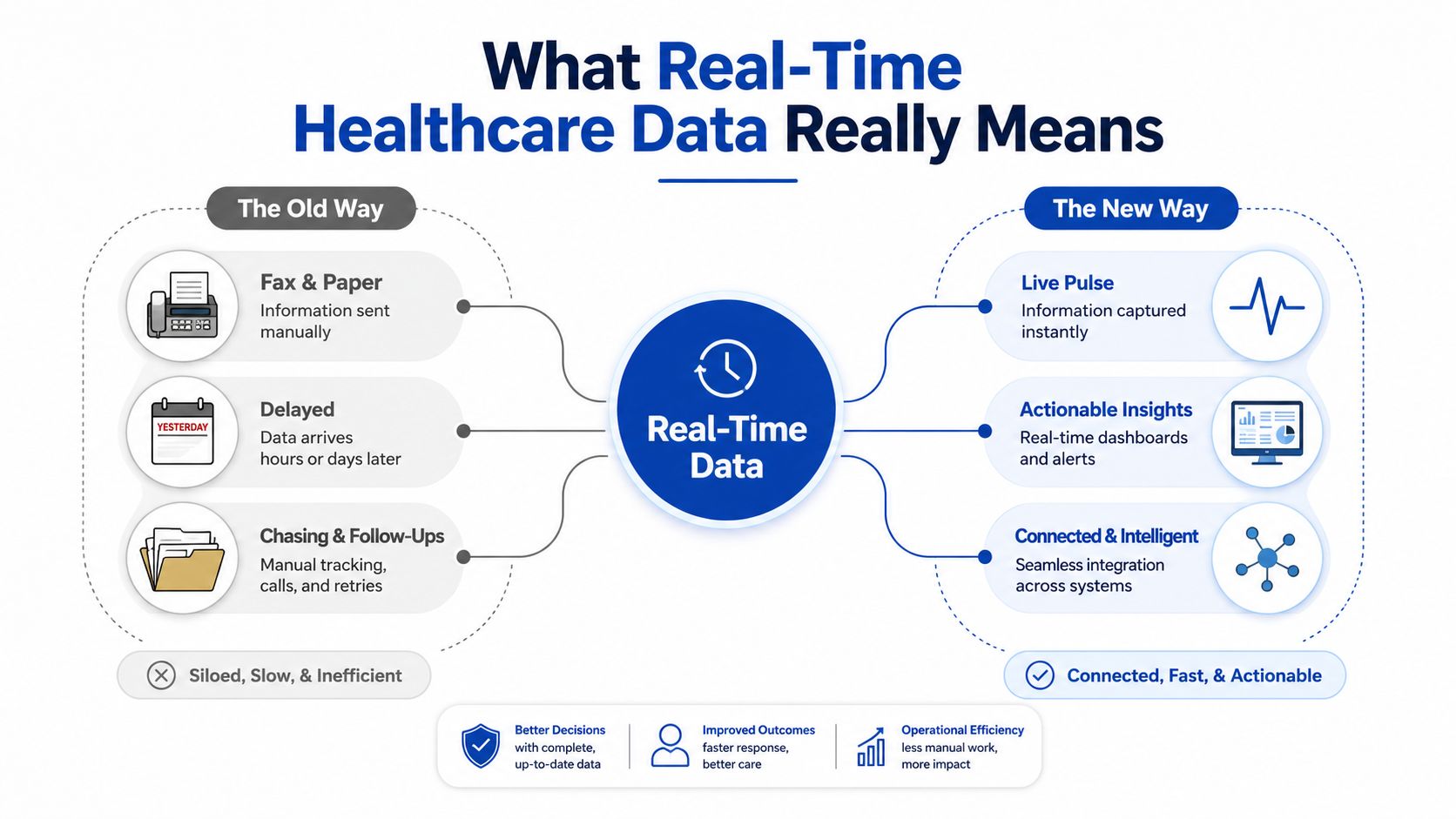
In healthcare, “real-time” doesn't always mean millisecond-by-millisecond streaming. It can mean near-real-time, where data moves fast enough to support an action before the opportunity passes. Batch data is the old rhythm: records are collected, packaged, and reviewed later. Real-time data is closer to a live feed, where a queue, claim, discharge, or alert can trigger a response while the situation is still active.
That difference matters operationally. A care team working from batch updates may duplicate tests, miss a discharge notification, or chase a patient who has already left the building. A payer relying on delayed data may adjudicate a claim after avoidable manual handling has already piled up. Fast data doesn't remove judgement; it gives people a better chance to use it at the right moment.
What leaders should look for
The practical question isn't whether a system says it's digital. It's whether it can keep pace with the operational clock. If a queue, claim, or admission alert only arrives after a manual handoff, the organisation still behaves like a batch shop, even if the front end looks modern.
Practical rule: if the data arrives after the decision point, it's reporting. If it arrives before the decision point closes, it's operational intelligence.
That's why implementation details matter. The people building the pipeline need to think about audit trails, access controls, event definitions, and handoff logic. A useful resource for compliance needs for data engineers can help clarify why the pipeline design and the governance design can't be separated. For a broader systems view, the same logic appears in connected healthcare systems, where the value comes from joining workflow, exchange, and decision-making instead of treating them as separate projects.
The Standards and Architecture Behind Live Healthcare Data
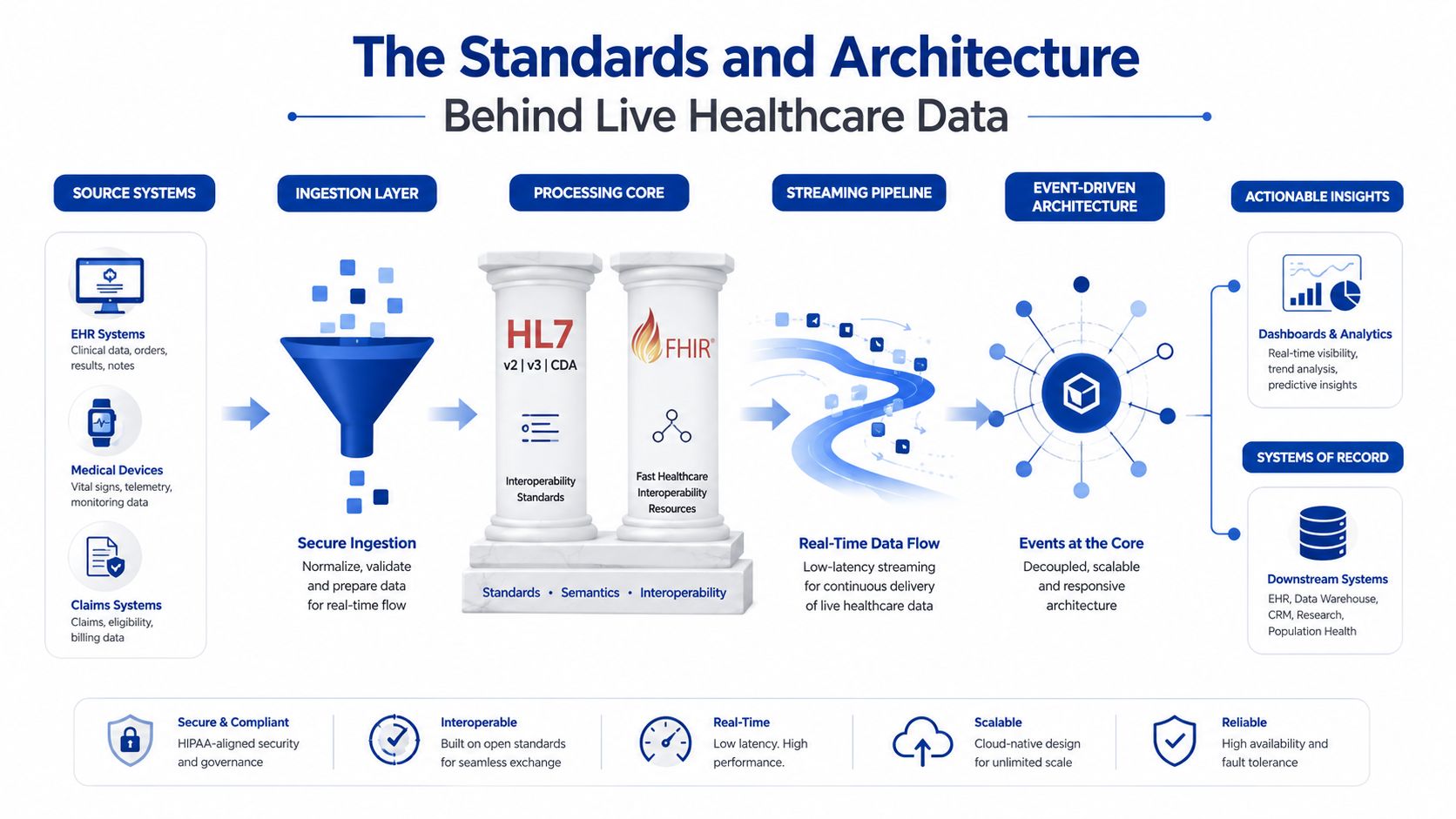
Live healthcare data only works when the plumbing is predictable. Most executive teams don't need the syntax of every standard, but they do need a simple model of how records move from one system to another without breaking along the way. That model usually starts with HL7, FHIR, APIs, and event-driven architecture.
The standards are the language; the architecture is the route
Think of HL7 and FHIR as the shared language that lets systems describe a patient, an observation, or an encounter in a consistent way. FHIR has become the practical bridge for many modern interoperability efforts because it is built for structured exchange and easier integration than older, heavier approaches. The point is not that every platform must be “FHIR-first” in a slogan sense, but that FHIR gives teams a common vocabulary for moving clinical information across systems.
The architecture sits beneath that language. A traditional request-response model is like asking a receptionist for a file, waiting, then asking again later if anything changed. An event-driven system is more like being notified when the file changes. That matters in healthcare, because the workflow often depends on change detection, admission, discharge, a lab result, a queue shift, or a claim status update.
Where the moving parts fit
An integration engine often helps translate between older systems and newer ones. APIs expose controlled entry points so systems can request or send specific data. Streaming platforms keep information moving continuously instead of waiting for overnight batches. Together, they make real-time healthcare data usable without forcing every organisation to replace its core systems at once.
The operational lesson is straightforward. Standards decide whether systems can understand each other. Architecture decides whether they can keep up with each other. If the architecture is still batch-heavy, even a modern analytics layer will feel delayed. That's why many organisations pair exchange standards with governance rules, interface monitoring, and event design from the start.
A useful implementation lens is covered in FHIR integration services and compliance, because compliance and data movement can't be handled as separate tracks. When the architecture is built properly, the organisation gets a foundation that can support clinical records, operational events, and partner exchange without rebuilding every time a new payer, clinic, or regulator enters the picture.
High-Impact Use Cases for Real-Time Healthcare Insights
Live data creates value when it shortens a decision cycle. That's the common thread across bedside care, claims work, population oversight, and monitoring between visits. The data sources differ, but the pattern stays the same: the right information reaches the right person while there's still time to act.
Four decisions that become faster and cleaner
Clinical decision support improves when clinicians can see a current medication list, a recent event, or a live risk signal at the point of care. The decision being accelerated is not “do we have data”; it's “what should happen before the patient leaves this encounter?”. If the record is delayed, the clinician may work from an incomplete picture and order something the patient already received elsewhere.
Remote patient monitoring works best when device or symptom data arrives between visits, not after a quarterly review. The point is to catch drift early, before a manageable issue becomes a larger one. A smart device feed can help a care team notice patterns that are hard to spot in scheduled follow-ups, especially when the patient's behaviour changes outside clinic hours.
Claims processing and adjudication depend on speed and consistency. The faster the claim hits the right checks, the less time staff spend sorting avoidable exceptions. Real-time feeds can help teams spot mismatches, incomplete information, or signals that require human review before a file sits in a queue for too long.
Population health management needs a near-live picture of what is happening across a region. That means knowing where demand is building, where follow-up is slipping, and where a service line needs support. The decision being accelerated is resource allocation, and latency is costly because it hides patterns until they've already shaped outcomes.
| Use Case | Decision Accelerated | Primary Data Source |
|---|---|---|
| Clinical decision support | Point-of-care treatment or routing | EHR events, observations, alerts |
| Remote patient monitoring | Early outreach or escalation | Device feeds, symptom reports |
| Claims processing | Review, routing, or adjudication | Claims data, eligibility, encounters |
| Population health management | Staffing, outreach, and planning | Cross-site operational data |
Operational insight: the best use case is usually the one where delay is already creating rework, not the one with the flashiest dashboard.
The challenge is matching latency to need. A safety alert needs faster handling than a monthly performance review. A payer workflow may only need near-real-time validation, while a clinical queue may need live status changes. The right design starts with the decision, then works backwards to the data feed that can support it.
How Insurers, Clinics, and Digital-Health Startups Use It Differently
The same stream of live information lands in three very different operating models. Insurers care about precision, clinics care about flow, and startups care about proof. If leaders treat them as the same problem, they usually end up with a platform that serves nobody well.
Insurers look for control and clean routing
Payers use live data to triage claims, surface irregularities, and direct member outreach. Their operational question is simple: which files need attention now, and which ones can move automatically? That's why data freshness matters as much as the rules themselves, because a slow signal can turn a clean exception into a backlog. In insurance settings, real-time healthcare data is useful when it reduces manual sorting, not when it just produces another dashboard.
Clinics need a shared view of the queue
Clinics use live data differently. They want to see risk in the waiting room, support discharge coordination, and reduce duplicate testing. Ontario Health's i4C Dashboard gives clinicians a real-time view of practice population performance and supports immediate action, while Ontario's Digital Health Playbook says real-time reporting from Ontario Health Teams helps provide a clearer understanding of attributed populations, utilisation, and programme delivery, and that the i4C Dashboard enables immediate action for clinicians, as described in the Digital Health Playbook. That is a clinic-friendly use of live information, because it connects operational visibility to what staff do next.
Startups need proof, fast
Digital-health startups usually want faster validation cycles. They need to know whether a product is changing behaviour, improving follow-through, or surfacing actionable risk. That means their analytics stack has to show whether the product is helping real users now, not just whether it looks good in a pilot. California's Manifest MedEx gives a useful example of scale, with more than 16 million health records in its statewide nonprofit exchange, reported by California's DxF ecosystem. That kind of shared infrastructure shows startups what becomes possible when live exchange already exists.
Ontario Health's Health System Insights platform is also described as a business intelligence tool that visualises live patient queues and supports data-driven decisions such as funding allocation and resource allocation, according to Ontario Health. For startups, that's a reminder that the market wants outcomes, not just connectivity.
If a team is choosing where to begin, start with the operating pain point that already costs time every week. That gives the work a clear owner, a measurable outcome, and a reason to survive after the pilot ends.
A Practical Roadmap to Operational Real-Time Data
A clinic manager sees a discharge waiting for approval, while the insurer still has no updated claim status. The roadmap begins with that operational delay, not with an architecture diagram. Identify the decision that is slow today, then build the smallest reliable data path that can improve it. This turns healthcare operational analytics into a working business capability.
Start with one pain point that people already feel
Begin with a data audit. Map what information exists, where it is stored, who uses it, and where delays occur. Leaders often find that the barrier is agreement about priorities rather than a total lack of data. A discharge notification, queue update, or claim-status change that still travels between teams by email can provide a clear pilot.
The pilot should prove that one live decision improves when the data arrives sooner.
Build the smallest useful pipeline
Connect one source to one decision first. Keep the architecture narrow enough for the team to trace failures quickly and assign ownership. Governance, security, and operational responsibility belong in the initial design, because a pilot without those controls creates rework when other teams need to adopt it.
Teams that need a practical implementation reference can review this guide to FHIR integration services and compliance. A useful reference point is Cleffex Digital Ltd, which builds healthcare integration pipelines for live operational decisions.
Practical rule: begin with a defined workflow and a measurable decision. Prove the improvement before connecting additional systems.
Scale only after the workflow changes
Expansion works when staff change their daily process. Nurses, analysts, and claims teams need to use the live signal in the place where they already make decisions. Otherwise, the feed remains a side channel alongside the manual path. Track whether the intended action happens sooner, whether exceptions are handled clearly, and whether teams trust the information enough to rely on it.
Scale should extend a workflow that has demonstrated value, while monitoring data quality, ownership, and adoption across participating teams.
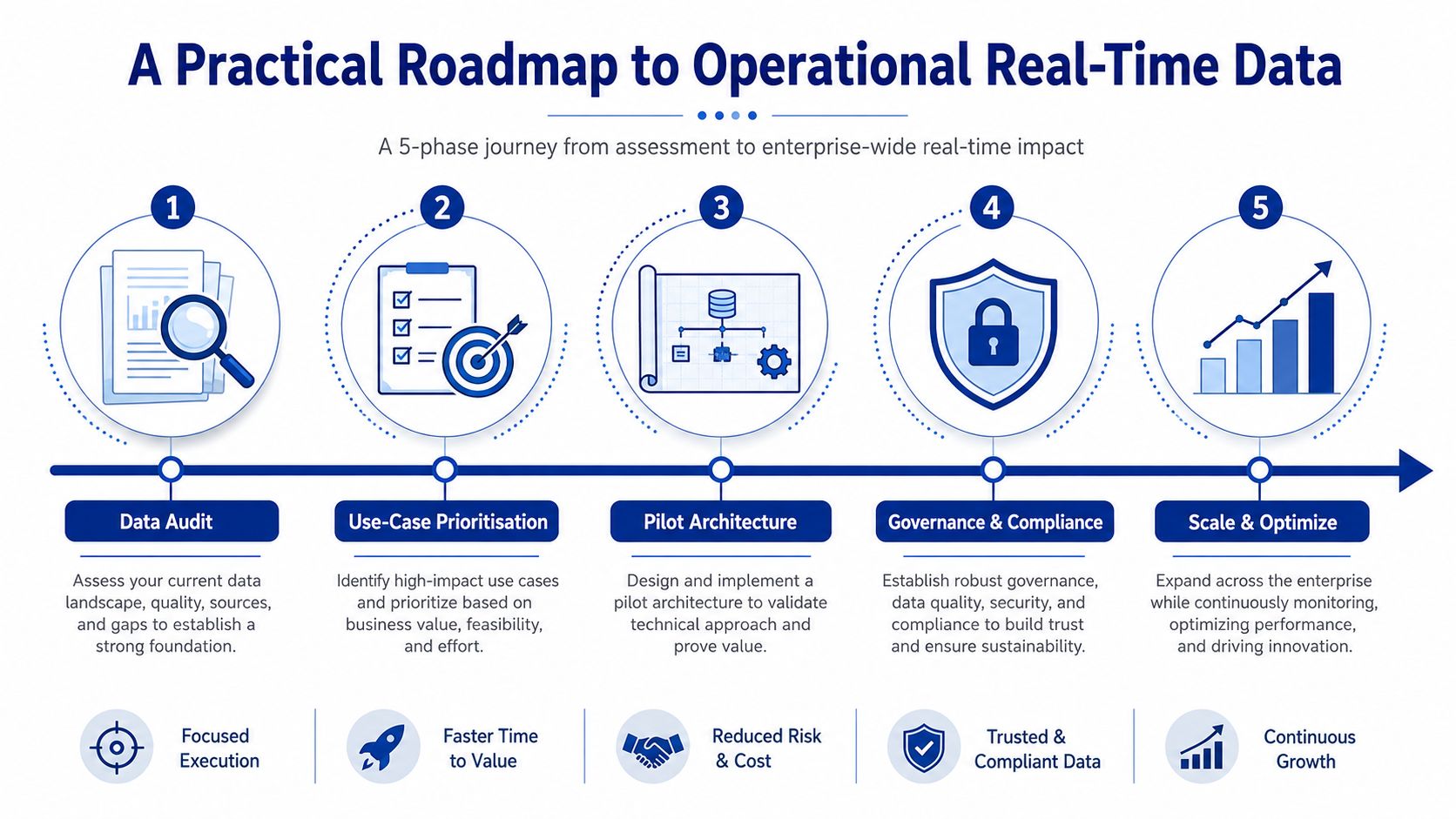
The strongest roadmap is one a clinic operations director or insurer VP can explain in one meeting. It names the pain point, the live feed, the governance model, and the decision that improves. Later integrations can wait until the first use case has earned wider adoption.
Security, Compliance, and PHI Handling as a Design Choice
Security should be designed into the pipeline from the first sketch, not treated as a final gate before launch. That choice determines which data can move, which staff can view it, and whether the workflow remains usable after deployment. If PHI handling is postponed, the live pipeline may slow down, face approval barriers, or become too risky for routine decisions.
Access should follow purpose, not just role
Healthcare teams need an access model that answers three practical questions: who can see which fields, at what point, and for what purpose. Provincial access rules in Canada, along with HIPAA and GDPR-style requirements in broader healthcare environments, make de-identification, role-based access, audit logging, and purpose limitation part of the exchange design. Canada's interoperability discussion shows the same tension: organisations want near-real-time information, while governance determines who may access it and under which conditions, as noted in Canadian interoperability research.
The safest architecture limits exposure at the source. De-identify data when the workflow allows it. Separate operational dashboards from identity-heavy records. Record access that could affect care, claims, or reporting. These controls give clinic and insurance teams a defensible way to use live signals without creating unnecessary legal or reputational risk.
Purpose-based access also makes reviews easier. A claims analyst may need eligibility and billing details, while a care coordinator may need an event that prompts outreach. Giving both users the same full record increases exposure without improving either decision.
Secure movement is part of the product, not a patch
A secure pipeline combines encrypted transit, controlled access, retention rules, and clear ownership. The data should also carry a defined purpose, so staff know which actions are permitted and which are outside scope. Teams designing these controls can review healthcare information systems data security guidance alongside operational requirements. For messaging workflows, secure messaging options by Call Loop reinforce the same principle: transport, permissions, and auditability must be designed together.
Ontario Health's data governance direction connects these controls to operational value. The Ontario Health Data Council says the ecosystem should support real-time and intelligent data for patient care, public health, informed decision-making, system planning, analytics, and performance evaluation, with role-based access to integrated sources, as set out in the council report. For a clinic, insurer, or digital-health startup, that means security design should preserve useful decisions while limiting unnecessary visibility.
The better question is whether the system can stay safe, auditable, and lawful once real staff use it daily.
Common Obstacles and How to Work Around Them
The hardest part of live healthcare data is rarely the software. It's the organisational friction around it. Teams run into fragmented sources, slow approvals, mismatched definitions, and a mismatch between what can be streamed technically and what can be shared legally.
Fragmentation is the default, not the exception
Ontario, California, and Canada's wider ecosystem all show the same basic problem: data sits across systems, provinces, providers, and policy boundaries. CIHI's public materials still reflect a world where some products require login, and some are only available as aggregate tables, which is a reminder that public access and operational access are not the same thing. That fragmentation doesn't mean live data is impossible. It means leaders need to choose a narrow use case that crosses the fewest boundaries first.
Latency has a cost, but freshness isn't free
Fresh data usually takes more engineering, more monitoring, and more governance. Teams sometimes ask for the fastest possible feed when a slightly slower one would still support the decision and cost less to run. The right answer is to match speed to purpose. If the decision can wait a few minutes, don't overbuild for a second-by-second stream. If the decision affects safety or immediate routing, don't settle for overnight processing.
Vendor lock-in is a governance problem
A platform can make integration look easy while hiding the dependency, which is the workflow and the data model. The workaround is to define interfaces, event structures, and exit criteria before you scale. That way, the organisation can replace a vendor, a connector, or a visual layer without rebuilding every business rule from scratch.
Change resistance needs local ownership
Clinical and operations staff won't adopt live data just because it exists. They adopt it when it helps them finish work faster or avoid errors they already hate. The mitigation is simple: involve the people who run the queue, the discharge desk, or the claims desk in the pilot. When they help shape the alert, they're far more likely to trust it.
Real-time programmes stall when teams buy a platform before they settle the governance and workflow questions.
The practical workaround is disciplined sequencing. Fix the decision path first, clarify access second, and then scale the feed. That is slower than a software demo, but it's much faster than a failed rollout.
Measuring ROI and Turning Data Into Operational Wins
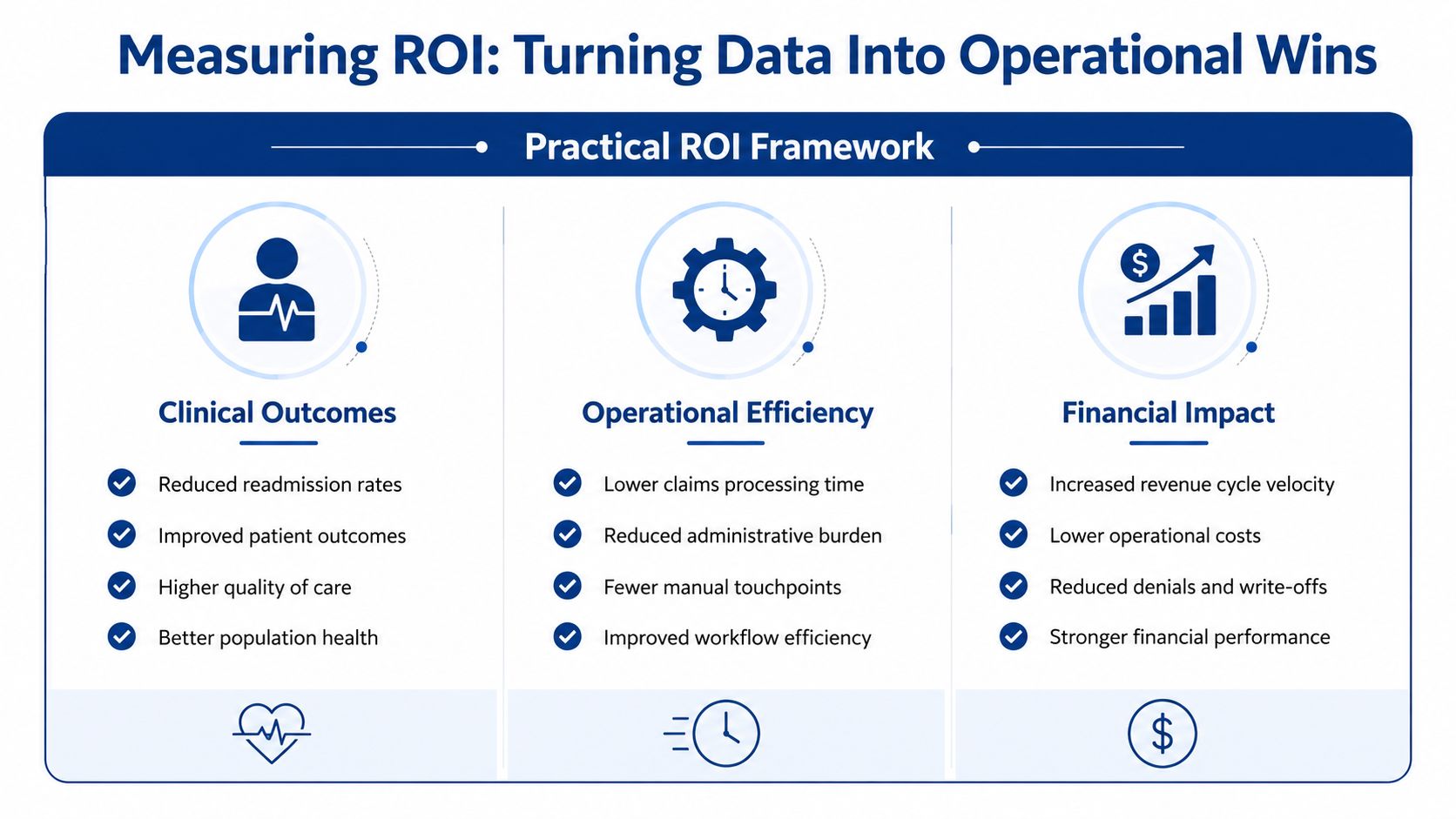
Leaders don't need another promise about transformation. They need to know what gets better, who notices first, and how to prove it. The cleanest ROI model for real-time healthcare data sits across three buckets: clinical, operational, and financial.
What to measure first
In the first 30 days, track whether teams are using the live feed at all, and whether it changes a decision. In the first 60 days, look for signs that the organisation is handling fewer avoidable handoffs or fewer stale cases. By 90 days, you should be able to see whether the new workflow is shortening delays, improving queue visibility, or reducing the number of times staff have to reconcile the same information twice.
What ROI looks like in practice
Clinical ROI often shows up as better routing, earlier follow-up, or less duplicate work at the point of care. Operational ROI shows up as faster queue movement, clearer escalation, and better staff allocation. Financial ROI shows up when claims, utilisation, and service coordination stop waiting on outdated data. The biggest wins often come from decisions no longer delayed, not from a single flashy dashboard.
The most useful question is still the simplest one. Did the right person get the right information early enough to act? If the answer is yes, the organisation is not just producing data faster. It's making better decisions faster.
Cleffex Digital Ltd helps healthcare organisations connect systems, move information safely, and design operational workflows that use live data where it matters most. If your team is working through interoperability, secure exchange, or healthcare software integration, visit Cleffex Digital Ltd to see how their services can support a more responsive data strategy.