

The worst mornings in a hospital rarely begin with one dramatic failure. They start with small, familiar delays, a missing result, a scheduler patching gaps by hand, a billing team waiting on discharge notes, a nurse calling twice for the same answer. By the time those delays stack up across a shift, healthcare operations technology stops looking like a back-office upgrade and starts looking like the only way to keep care moving.
That pressure is not abstract. The American Hospital Association says about 25% of total U.S. health care expenditures, roughly $1 trillion, goes to administrative tasks. At the same time, healthcare organisations are projected to spend $279.5 billion globally on IT in 2025, with the United States accounting for about 63% of that market. In a setting where every delay becomes a throughput problem, a digital-first operations strategy is no longer a nice-to-have.
Why Digital-First Operations Are Now a Survival Question
A regional hospital morning often looks efficient from the outside and chaotic once you step inside. Clinicians are hunting for results across disconnected systems, the bed board is out of date, schedulers are rebuilding rosters by hand, and finance is trying to reconcile claims after discharge. None of that is rare, and none of it is sustainable when patient demand, staffing gaps, and reimbursement pressure all hit at once.
The pressure is sharper because the labour problem is already showing up in operations. California's nursing shortage has been documented by the California Board of Registered Nursing, and the operational effect is familiar to anyone running a service line with too many manual steps. When staff time is tight, every handoff that depends on re-entry, callbacks, or spreadsheet triage consumes capacity that should be going to patients.
That is why digital healthcare operations have become a margin, access, and continuity issue. It is no longer enough to digitise paperwork after the fact. The operating question is whether the organisation can move patients, information, and staff decisions fast enough to avoid bottlenecks before they turn into delays. A discharge that waits for one missing signature, or a referral that sits because three teams are checking different systems, can clog the next several hours of flow.
Practical rule: if a process depends on three different teams re-entering the same information, it's already costing you capacity.
A nurse manager I worked with kept a whiteboard beside the workstation because the schedule system could not reflect late call-outs in time. By midday, the unit had already lost hours to phone calls, manual reshuffling, and double-checking, while patients waited for bed assignment.
The strategic shift is simple to state and hard to execute. Health systems need technology that reduces administrative waste, protects scarce clinical time, and supports throughput without creating another layer of work. In practice, that means building a HealthcareOps strategy around flow, not around software count, and choosing tools that fit the organisation's ability to implement them. For more health tech insights, see health tech insights.
What Healthcare Operations Technology Means
Healthcare operations technology is the connected layer of software that helps a health system run as one measurable workflow instead of a collection of separate tasks. It sits between the patient journey and the internal machinery of the organisation, linking intake, scheduling, documentation, billing, staffing, referrals, and analysis. If EHRs are the record of what happened, operations technology is the system that helps decide what happens next.
A useful analogy is air-traffic control. The EHR is the radar screen, because it shows the aircraft and the flight path. Operations technology acts like the controller, sequencing movement, spotting conflicts, and rerouting activity when demand changes. That distinction matters because a digital-first hospital does not just need more data; it needs a way to act on the data without adding more admin work.
The scale of electronic record adoption shows why the discussion has moved past basic digitisation. JMIR reports a 10-fold increase in EHR use among hospitals and a 5-fold increase among physicians since 2009. That history matters because it shows the foundation is already in place. The current problem is coordination across systems, not adoption in the abstract.
For readers comparing approaches, the health tech insights collection offers a useful way to track how digital systems are being applied in practice. The main point, though, is not trend-watching. It is that healthcare digital transformation now depends on orchestration, not just recordkeeping.
The core stack underneath the label
A practical operations stack usually has four moving parts. Data integration brings patient, claims, and staffing data into one view. Automation moves repetitive tasks out of human inboxes. Patient flow management keeps the journey visible across departments. Resource optimisation helps leaders assign people, rooms, and equipment where they'll be used.
EHRs create the digital foundation. Operations technology uses that foundation to make the next action visible and defensible. In practice, that means a discharge queue, a referral backlog, or a staffing gap can be seen in time to change the decision, instead of being discovered after patients have already waited.
The value shows up in how the organisation handles throughput and access under pressure. A clinic with solid data integration and workflow automation can reduce the manual re-entry that slows intake, prior authorisation, and scheduling handoffs. A hospital with better patient flow tools can spot where beds, rooms, or transport are creating delay before the bottleneck spreads.
Implementation capacity is the differentiator. Two organisations can buy the same platform and end up with very different results if one has clean governance, clear ownership, and interoperability discipline, while the other layers new software on top of old silos. That is why the question is never only whether the tool works, but whether the organisation can fit it into daily operations without creating more friction.
One practical way to assess fit is to start with the data layer. A useful healthcare data integration guide should show whether systems can exchange information cleanly enough to support scheduling, referrals, documentation, and reporting without manual patching. If that backbone is weak, every other layer inherits the same delays.
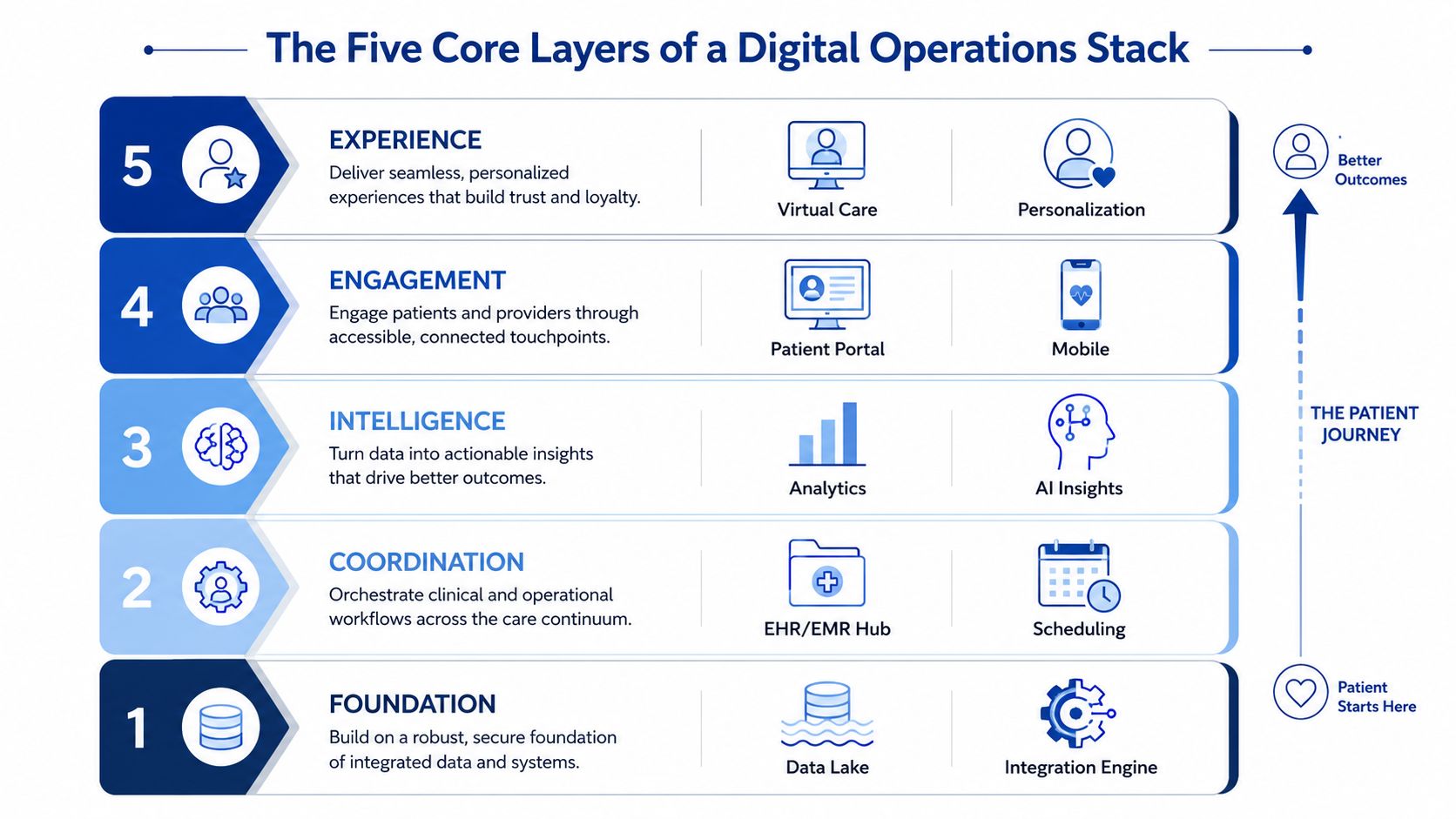
The Five Core Layers of a Digital Operations Stack
When a hospital maps the patient journey from intake to discharge, five layers of technology determine whether flow stays controlled or breaks into delays. The stack begins with the data backbone and ends with the patient experience, and each layer removes a different kind of friction. If one layer is weak, the others usually absorb the gap, which is where staff start compensating manually.
Foundation and coordination
The foundation layer is EHR and EMR integration. It makes clinical and operational data usable across departments instead of trapped in separate records. Without that backbone, scheduling, claims, discharge planning, and referral tracking all begin with partial information, and each team has to correct the same gaps in a different way.
The coordination layer is workflow automation. Prior-authorisation forms, intake tasks, routing rules, and recurring notifications can move automatically instead of being chased manually. The gain is not only speed. It is fewer handoffs, fewer missed steps, and fewer situations where a person has to remember the next move while also handling the current one.
Intelligence and engagement
The intelligence layer is analytics and business intelligence. Leaders use it to see patterns in no-shows, resource use, denial trends, and turnaround times. It also depends on strong data plumbing, because analytics only helps when systems can share information cleanly enough to support decision-making. A practical healthcare data integration approach keeps that layer from becoming another isolated reporting island.
The engagement layer covers patient portals, mobile access, and virtual care. Digital healthcare operations start to shape access directly here. A telehealth visit is not a standalone convenience if it is tied into scheduling, triage, and follow-up, because then the patient moves through one connected flow instead of a series of disconnected contacts.
Experience and real-time signals
The final layer is often overlooked, but it is where operational resilience shows up in daily work. Connected devices, IoT signals, and equipment telemetry let teams see utilisation and bottlenecks in real time. That helps a hospital understand whether a room, device, or pathway is available before a staff member spends ten minutes searching for it.
Operational insight: isolated point solutions usually create a new queue somewhere else. A digital-first strategy only works when the stack is designed to pass information cleanly from one layer to the next.
A practical reading of the stack also means checking integration quality. If analytics cannot see scheduling, or the portal cannot talk to the EHR, the organisation has software, but not an operating model. Internal architecture matters as much as the brand on the purchase order.
Measuring ROI and Operational Benefits That Leadership Cares About
Leadership signs off on digital change when the operational case is plain. It has to show up as shorter turnaround, more usable capacity, fewer avoidable delays, and less clerical rework. Extra dashboards do not earn budget approval on their own.
A practical benchmark comes from reported process gains in the research base. One study summarised in the available literature reports that EHR adoption reduced documentation time by 22% and improved information retrieval speed by 35%, while hospital information systems cut patient wait times by 28% and improved bed turnover by 15%. Those gains matter because they show up as staff time returned to the schedule, quicker handoffs, and fewer interruptions during a shift.
The workforce pressure in California makes that point harder to ignore. The projected 40,000 RN shortage by 2030 means operational technology has to remove friction from daily work, not add another layer of admin for nurses and coordinators to absorb. A useful reference point is the discussion of modern healthcare operations, which treats workflow design as a capacity problem, not just a software purchase. If automation reduces repetitive tasks, clinical staff can spend more time on direct care and less time recovering from manual gaps.
Operational benefits by technology layer
| Technology Layer | Primary Operational Benefit | Metric to Track |
|---|---|---|
| EHR and EMR integration | Less duplicate entry and faster information access | Documentation time |
| Workflow automation | Fewer manual handoffs and fewer missed tasks | Claim denial rate |
| Analytics and business intelligence | Better decisions on demand and capacity | Referral cycle time |
| Telehealth and virtual care | Easier access and fewer unnecessary visits | No-show rate |
| IoT and connected devices | Better visibility of assets and utilisation | Bed turnover |
The table gives leadership a common language for review. Finance can see where time returns to the system, while operations can trace whether the change improved throughput. It also keeps the conversation tied to visible movement instead of vague transformation language.
For hospitals and clinics that are already stretched, a second benefit matters just as much as speed. Better queue control lowers the amount of staff time spent chasing missing information, finding open rooms, or correcting preventable errors. That is the value of throughput-oriented technology, especially in regions under workforce pressure.
Security and governance still belong in the ROI discussion. If leaders do not ask how the platform handles access controls, audit trails, and security controls for Shadow AI, they risk buying speed at the expense of control. A system that moves work faster but expands risk is not a clean operational win.
Leadership test: if the team cannot name the metric the software changes, the business case is still incomplete.
The strongest ROI cases usually begin with a narrow process. A scheduling workflow that saves staff time is easier to defend than a broad transformation promise. Once that gain is visible, the organisation can extend the model into referrals, discharge coordination, and financial workflows.
An Implementation Roadmap Built Around Governance and Interoperability
A digital-first strategy fails most often at the point where teams assume technology alone will carry the change. It won't. Readiness, governance, and change management have to be built into the rollout from the first week, or the organisation ends up with new tools and the same bottlenecks.
Start with the operating reality
The first phase is a readiness assessment. Map the highest-friction workflows, the systems that feed them, and the points where staff are compensating manually. The healthcare data governance guide at Cleffex's practical overview is a useful reference here because governance is not a separate chapter at the end. It belongs inside the workflow design.
Build for interoperability, not novelty
The technical backbone needs FHIR-enabled integration, event-driven data pipelines, and real-time dashboards. Those are not buzzwords in this context. They are what lets patient intake, scheduling, billing, referrals, and discharge planning share current information rather than stale exports.
Security has to be designed in from the start. If teams are testing new automation or AI-adjacent tools, it helps to look at practical security controls for Shadow AI early, before unapproved tools slip into day-to-day work. That is especially important in healthcare, where unmanaged shortcuts can create both compliance and data quality issues.
The California Office of Health Care Affordability adds another layer of pressure, because state-level spending and performance expectations push organisations towards systemwide efficiency. In plain terms, the internal workflow has to stand up to external scrutiny.
Don't separate “integration work” from “governance work”. In healthcare, they fail together.
A useful rollout pattern is pilot, scale, then refine. Start with one constrained workflow, prove that the data moves correctly, and only then extend it to adjacent teams. If the pilot works but the broader adoption stalls, the problem is usually training, ownership, or workflow design, not the technology itself.
Where the Strategy Works and Where It Breaks
The same digital-first playbook can produce two very different outcomes depending on context. In a well-resourced regional system, integrated scheduling, telehealth, and analytics can help absorb rising demand without a matching increase in beds. The reason is simple. The organisation sees bottlenecks early, routes patients more intelligently, and keeps the flow moving across sites and channels.
In an under-resourced rural site, the story changes. Broadband gaps slow virtual care, thin IT staffing limits support, and training time competes with already stretched clinical schedules. Research on hospitals in disadvantaged areas found lower adoption of telehealth and health information exchange, with infrastructure limits, insufficient funding, and lack of training repeatedly cited as barriers.
The difference is implementation capacity
The lesson is not that technology works in one place and fails in another. The lesson is that implementation capacity decides whether the tool becomes an advantage or another burden. A site with strong executive sponsorship, cleaner data flows, and enough staff training can turn digital healthcare operations into a throughput advantage. A site without those conditions can end up shifting work to patients and front-line staff instead.
That is why operations technology should be evaluated as an access and equity intervention, not only as a productivity tool. If the rollout does not improve referrals, reduce no-shows, or make it easier for rural and low-income patients to connect, the organisation may have digitised a workflow without improving care access.
A blunt truth helps here. More software doesn't automatically mean more equity. Sometimes it moves the friction to the patient side, where language access, broadband, transport, and trust determine whether the system is usable at all.
The organisations that do this well plan for support, not just deployment. They budget for training, name workflow owners, and measure whether the technology is lowering friction for staff and patients. That is the difference between a rollout and a functioning operating model.
A Vendor Evaluation Framework for Healthcare Operations Technology
Procurement decisions are easier when the questions are concrete. The first filter is interoperability, because a tool that cannot work cleanly with existing EHR and revenue-cycle systems will create more manual work than it removes. The second is security and compliance posture, because healthcare systems cannot afford to retrofit protection after go-live.
One practical way to evaluate vendors is to ask how they handle real integration work, not just sales demos. Ask for FHIR, HL7, and API examples. Ask what happens when a source system changes. Ask who owns the workflow after implementation. If a vendor cannot explain the handover clearly, that is a warning sign.
Vendor evaluation criteria for healthcare operations technology
| Evaluation Criterion | Question to Ask in Demo | Red Flag |
|---|---|---|
| Interoperability track record | How do you connect with our EHR, claims, and scheduling tools? | Vague claims about “easy integration” without examples |
| Security and compliance | How do you manage access, audit trails, and role control? | Security discussed only after contract signing |
| Change management support | What does training and go-live support actually include? | “Self-service” as the whole support model |
| ROI evidence | Which operational metrics have you improved for similar clients? | No measurable outcomes, only feature lists |
| Roadmap transparency | What is on your product roadmap and how do you communicate changes? | Unclear ownership or frequent surprise changes |
If you want the integration layer handled by a partner that can connect chosen components into one operating system, Cleffex Digital Ltd is one option to review alongside other providers. It focuses on healthcare software integration work that helps systems tie workflow, data, and operational tools together.
The best vendor is not the one with the longest feature list. It is the one that fits the organisation's workflow reality, governance model, and support capacity. That is what makes the system coherent after launch.
From Strategy to Operating System
A digital-first hospital does not win by buying more applications. It wins by turning healthcare operations technology into an operating system that moves data, staff, and patients with less friction. The binding constraint is almost always implementation capacity, not tool selection.
That is why success should be measured in operational terms, not slogans. Look for fewer no-shows, faster referrals, lower administrative load, and better access for rural and low-income patients. If those outcomes do not move, the strategy is still incomplete.
The organisations that get this right treat digital transformation as a practical redesign of how work gets done. They connect governance, interoperability, and training to the workflow itself, and they keep the focus on throughput and access. That is where the core value sits.
Cleffex Digital Ltd helps healthcare teams connect systems, workflows, and data so operations run as one coherent model instead of a set of disconnected tools. If you're mapping a digital-first operations strategy, visit Cleffex Digital Ltd to review healthcare software integration support that can help close the gaps between your current systems and the workflow you want to run.