

Your clinic's morning probably looks a lot like this. A care coordinator opens one screen for the EHR, another for labs, a third for billing, then jumps into a telehealth app and a community referral inbox because a patient still hasn't heard back about follow-up care. Nothing is broken in the dramatic sense, but everything takes longer than it should, and every extra handoff creates another place where information can slip.
That friction is why integrated healthcare platforms matter. They're not just a nicer way to move data around; they're the operational layer that helps a clinic, hospital, or network coordinate work across teams, systems, and partners. For executives, the question isn't whether data can move. It's whether the organisation can run care safely and predictably when the EHR alone no longer tells the full story.
The Daily Reality of Disconnected Healthcare Systems
A mid-sized clinic often starts the day with good intentions and a stack of invisible gaps. One patient's medication update sits in the pharmacy system, the referral note lives in a separate inbox, and the billing team is waiting for a code change that never made it across from the chart. By lunch, the care coordinator has chased the same information three times and still can't tell whether the patient was booked, seen, or handed off to community support.
What fragmentation looks like in practice
This is the everyday cost of disconnected care. Staff retype details, check status manually, and reconcile records that should have matched from the start. Duplicate tests happen because the right result wasn't visible at the right moment, referrals stall because no one owns the next step, and patients end up calling back to repeat information they already gave once.
The deeper problem is that these tasks don't fail loudly. They fail unnoticed, one missed update at a time. A clinic can look busy on paper while the essential work is spread across systems that don't agree with each other.
Practical rule: if a team has to ask, “Where is the latest version?” more than once a day, the workflow isn't integrated yet.
Why this has become an executive issue
The old model treated the EHR as the centre of gravity. That still matters, but it's no longer enough when care touches telehealth, billing, lab feeds, remote monitoring, payer workflows, and community referrals. That's where a HealthcareOps platform becomes relevant, because it sits above the EHR and coordinates the work around the record.
For leaders, this is the difference between storing information and running operations. The same issue appears in broader market adoption, where integrated healthcare platforms are now part of a multi-billion-dollar North American healthcare IT layer, not a niche experiment. Mordor Intelligence's estimate places the global Healthcare IT Integration market at USD 5.81 billion in 2025, with North America holding 42.95% of that market, and projecting USD 11.23 billion by 2031 at a 11.62% CAGR. A separate market estimate for healthcare data integration platforms places the global market at USD 1.15 billion in 2025, with North America at 42.19%, growing to USD 2.80 billion by 2034 at 10.39% CAGR. These figures point to one conclusion: integrated operations are becoming infrastructure, not an optional upgrade. See the broader market context.
What Integrated Healthcare Platforms Mean
A clinic can have a working EHR and still struggle to keep referrals, consent, billing, and follow-up aligned. That gap is where an integrated healthcare platform earns its value. It coordinates the operational work around the record, so staff is not stitching together tasks by hand every time a patient moves from one team to another.
EHR versus coordination layer
An EHR is the system of record for clinical data. It shows what was documented, when it was documented, and by whom. A HealthcareOps platform sits above that record and helps route tasks, connect systems, manage consent, surface analytics, and keep the patient journey moving across departments and external partners.
That distinction matters because healthcare work does not stay inside one application. A discharge note may need to trigger a pharmacy action, a home care follow-up, a payer update, and a community referral. Without a coordination layer, each of those handoffs becomes another manual task for staff. With one, the work can follow a repeatable path instead of depending on whoever happens to notice the next step.
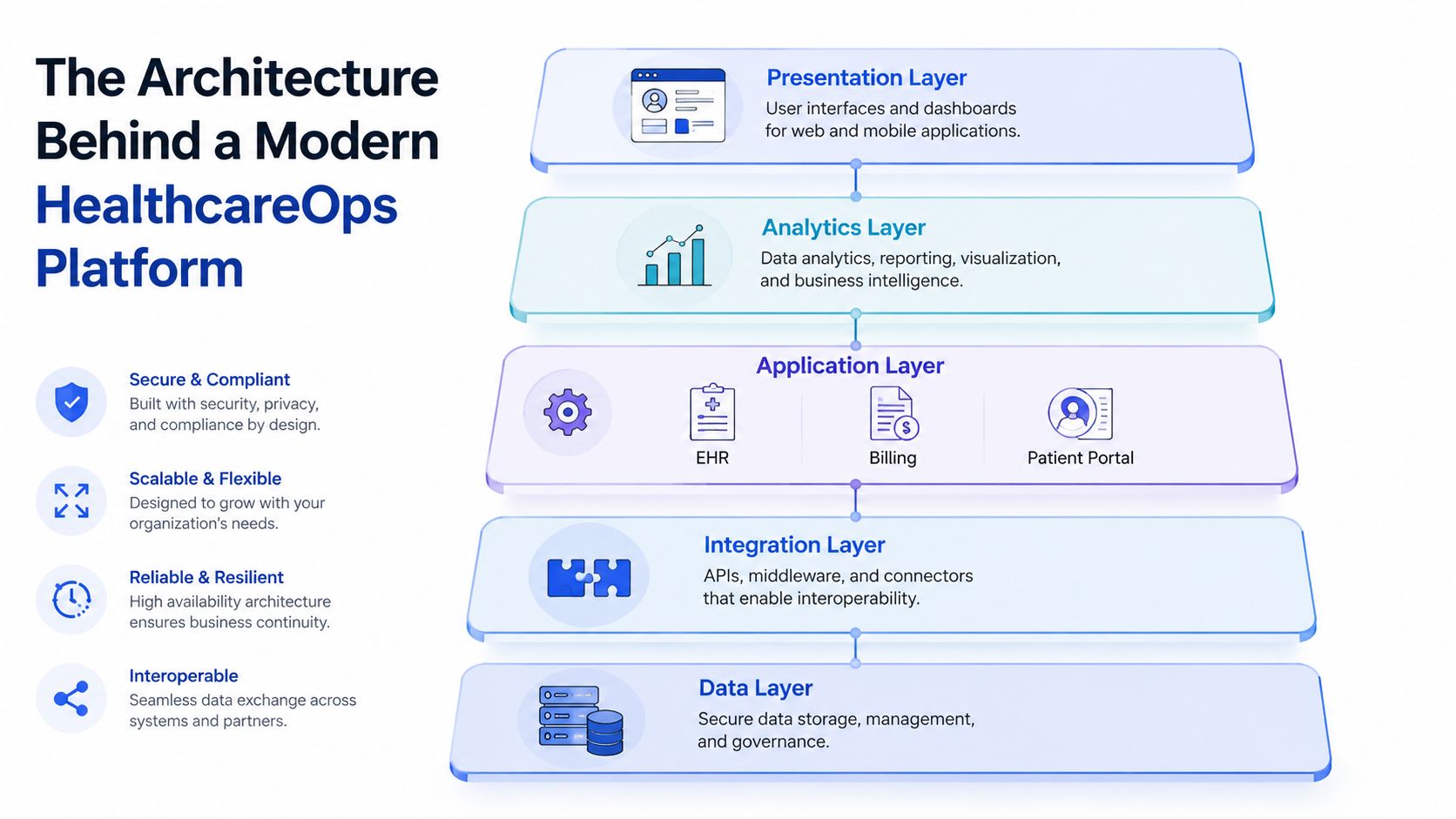
A practical way to picture the platform is by layers:
Presentation layer: What staff or patients see in portals and dashboards.
Analytics layer: What leaders use to spot bottlenecks and risk.
Application layer: The EHR, billing, patient portal, and operational apps.
Integration layer: The rules and connections that move data between systems.
Data layer: The underlying patient, encounter, and operational data.
That layered view appears in public digital health architecture thinking, including the WHO's reusable digital health infrastructure concept and Johns Hopkins' discussion of interoperability layers, health information exchange, and governance structures for safe sharing. Both point to the same lesson: integration is a system design problem, not a single software purchase. For a practical overview, see Cleffex's healthcare software integration service page.
Why the platform view changes decisions
Once leaders see the coordination layer, vendor pitches become easier to judge. A tool that only moves data from one chart to another still leaves questions about workflow ownership, consent handling, and cross-team follow-up. A real platform makes the same information usable across settings, so the work does not fragment as it moves.
That is also why the conversation is shifting beyond clinical data exchange. The operational layer now matters just as much, because care teams need coordination across payer touchpoints, community partners, and internal departments. In insurance operations, similar integration patterns are already being used to streamline claims with integrated AI, which shows how much value sits in the workflow around the core record.
The Architecture Behind a Modern HealthcareOps Platform
A clinic may have one system for registration, another for the EHR, a separate pharmacy feed, a remote monitoring tool, and a scheduling engine. The question is whether those systems merely sit side by side, or whether they are coordinated through a HealthcareOps layer that keeps work moving across them. That operational layer sits above the EHR and handles workflow, consent, analytics, and the payer and community touchpoints that often decide whether care is completed or stalls.
A modern platform is usually built as a set of reusable services, which makes it easier to add or change one function without rebuilding everything around it. That is a different model from the older monolithic approach, where every new connection became a custom project and any failure could spread across the full stack. Care teams need near-real-time updates across portals, EHRs, pharmacy, remote monitoring, and scheduling, so modular design has become the practical choice.
The core building blocks
A useful way to read the architecture is to start with the jobs each layer has to do.
HL7 v2 still handles many legacy feeds, especially high-volume hospital and lab messages.
FHIR APIs provide modern access for apps, portals, and newer workflows.
MPI, or Master Person Index, resolves identity so the platform knows which records belong to the same person.
A terminology server maps codes so one system's language can be understood by another.
A consent service enforces who can see what, and under which policy.
These pieces are the plumbing that lets the platform do more than store data. They let clinical, administrative, and payer workflows stay coordinated without forcing a new point-to-point connection every time a team launches a service. For a broader build view that sits above these components, see Cleffex's enterprise healthcare platform development guide.
A good integration layer should make systems less dependent on one another, not more.
Why microservices and event-driven design keep showing up
A 2024 review of 89 studies found that microservice-based architectures dominate current health information system implementations, with 159 microservice-related and 197 distributed-ledger-related studies identified in the literature (IJRCAIT review). The specific counts matter less than the pattern. Healthcare teams increasingly need parts of the platform to scale on their own, especially messaging, device ingestion, and background workflows.
Event-driven design supports that operating model. If a lab result arrives, the platform can trigger the next task without waiting for someone to notice it in a queue. If a remote monitoring device flags a reading, that event can move into triage, documentation, and follow-up without being copied by hand into three different tools.
For integration teams, this architecture changes vendor conversations too. Instead of asking whether a system can connect, ask which services handle identity, terminology, consent, logging, and retries. Practical implementation guidance often shows up in how endpoints are designed and governed, which is why Recepta.ai API best practices can help when evaluating integration design choices.
Interoperability Standards and Compliance in Practice
Healthcare leaders hear a lot of acronyms in vendor meetings, and most of them are used too loosely. FHIR is the newer standard most organisations want for API access. HL7 v2 is still widely used for legacy message feeds, especially for labs and admission-discharge-transfer traffic. In a live environment, you usually need both.
How the standards work together
FHIR gives modern systems a cleaner way to request and exchange clinical or administrative data through APIs. HL7 v2 keeps the older, high-volume feeds moving, which matters when your organisation still relies on legacy lab systems or hospital interfaces. The integration layer has to translate between those worlds without making every upstream system redesign itself.
That's also why interoperability can't be separated from policy. Johns Hopkins' interoperability guidance and the WHO's platform model both point to governance as part of the infrastructure, not an afterthought. If the system can move data but can't prove who authorised access, it's not ready for real operations.
For a plain implementation guide focused on conformance and compliance handling, see Cleffex's FHIR integration services guide to compliance.
What Canadian and North American organisations should ask
Canadian leaders also need to think about cross-border and privacy obligations. In the CA context, the Pan-Canadian Interoperability Roadmap is a useful anchor because it is built around common standards and use cases so jurisdictions can exchange health data more consistently. For U.S. partnerships, HIPAA obligations shape data handling. For Canadian patient data, PIPEDA and related provincial rules shape how consent, audit logging, and residency are designed.
The practical vendor questions are straightforward:
FHIR conformance: Can the platform publish and consume the resources you use?
HL7 bridging: Can it still handle legacy feeds without brittle custom work?
Consent enforcement: Can access be restricted by purpose, role, or jurisdiction?
Audit logging: Can you prove who accessed what and when?
Cross-border flows: Can patient data move safely across partner organisations without weakening compliance?
A clean answer to those questions says far more than a slide full of standards logos.
Measuring the Real ROI of Integration
Executives usually ask for one thing first: the business case. The mistake is reducing integration to software savings alone. The larger return shows up in coordination quality, staff time, risk reduction, and the organisation's ability to run more reliably across settings.
The KPIs that matter
A board-level dashboard for integrated healthcare platforms should include a short list of indicators that speak to clinical and operational performance:
Wait times and referral completion, because patients feel delays directly.
Duplicate tests and manual reconciliation, because these consume staff time and create avoidable cost.
Scheduling utilisation, because disconnected calendars leave capacity stranded.
Denial rates and cost-to-collect, because fragmented documentation can turn into financial leakage.
Audit findings and breach exposure, because weak governance creates downside risk.
You don't need a dozen vanity metrics. You need a few measures that show whether the platform is changing how work gets done.
Fragmented Systems vs Integrated Healthcare Platforms
| Dimension | Fragmented Systems | Integrated Healthcare Platforms |
|---|---|---|
| Care coordination | Teams chase updates across multiple tools | Shared workflows move tasks between teams |
| Patient handoffs | Referrals can stall or go missing | Closed-loop follow-up is easier to track |
| Staff workload | Manual reconciliation eats time | Repeated admin work is reduced |
| Data visibility | Information is scattered | Leaders see a clearer operational picture |
| Compliance | Audit trails are harder to assemble | Consent and logging are built into the flow |
| Financial performance | Rework and denials are harder to contain | Fewer preventable leaks in the process |
A useful way to frame the ROI discussion is this. Fragmented systems make people work harder. Integrated platforms make the same people work on the right tasks sooner.
For a broader operational lens on how modern healthcare operations teams organise this work, see Cleffex's article on modern healthcare operations.
Real-World Use Cases and Where Integration Breaks Down
A coordinated network can make the value of integration obvious. In one multi-setting model, the hospital EHR, primary care clinic, home health agency, and community paramedicine programme all work from shared care plans. A discharge can trigger a home visit, a community referral, and a follow-up task in the same operational flow, so the patient isn't left repeating the same story to four different teams.
Where good integration works
The best deployments keep the operational chain intact. Shared care plans make it easier for each provider to see what happened before, what needs attention now, and who owns the next step. Closed-loop referrals are especially important because they turn “we sent the message” into “we know the message was received and acted on.”
The last-mile problem shows up here. A platform can connect hospitals and clinics and still miss the community resources supporting recovery at home. That gap is why a HealthcareOps platform has to include post-visit follow-up, not just clinical data exchange.
Where integration breaks down
A different outcome is common in rural or underserved settings. The platform exists, but infrastructure is weak, training is limited, and staff don't trust the privacy model. A 2025 review of community-based digital health platforms found the top reported barriers were lack of infrastructure (77.3%), limited training (74.3%), and data privacy concerns (73.8%). That's a strong sign that adoption fails for operational reasons as much as technical ones.
For home care workflows, the connection between platform design and field execution becomes even more obvious. Documents, visits, and approvals have to move quickly, or the care plan falls apart between the office and the patient's home. A practical example of that operational layer can be seen in Closer Innovation Labs Corp's home care, where the focus is on making remote care processes easier to manage.
The biggest mistake leaders make is treating integration as an IT project. It's really a redesign of clinical operations, partner relationships, and staff habits. Scope creep, weak change management, and ignoring community partners usually cause more damage than the original technical stack ever does.
Vendor Selection, Implementation Roadmap, and What Comes Next
Vendor selection should start with operations, not features. Ask whether the platform supports the standards you need, whether it handles security and compliance cleanly, and whether it can fit into your broader integration ecosystem without locking you into one path. You also need observability, because if you can't see failures quickly, you can't run the platform well.
A practical shortlist for decision-makers
Look for these capabilities:
Standards support: HL7 v2, FHIR, and the connectors you still rely on.
Security and compliance posture: Consent, logging, and access controls built into the platform.
Integration ecosystem: Ability to work with EHR, billing, telehealth, and community systems.
Observability: Monitoring, alerting, and traceability for failed messages or delayed tasks.
Total cost of ownership: Implementation, support, maintenance, and change costs, not just licensing.
The implementation roadmap should be phased. Start with assessment, then pilot one high-value workflow, scale to adjacent teams, and optimise after the platform has real operational use. That sequence reduces the risk of launching a broad programme before the organisation knows which workflows matter.
What comes next in the platform shift
The next wave is already visible. AI-driven triage, ambient documentation, population-level predictive analytics, and tighter payer-provider integration through value-based care contracts are all pushing platforms further up the stack. That doesn't make the EHR less important. It makes the coordination layer more valuable, because the system has to turn data into action faster.
| Question | Short Answer |
|---|---|
| How long does implementation take? | It depends on scope, but phased rollout is safer than a big-bang launch. |
| Who should own the programme? | Usually a clinical operations leader with IT, compliance, and finance support. |
| How do we justify the investment? | Tie it to coordination quality, staff time, financial leakage, and risk. |
| What's the biggest pitfall? | Treating integration as software replacement instead of workflow redesign. |
If you're reviewing options now, Cleffex Digital Ltd builds secure integration frameworks that connect healthcare software systems, including EHRs, billing tools, patient portals, and connected health platforms. If you want a partner to help map that operational layer into a workable programme, visit Cleffex Digital Ltd and start the conversation with your team.